A good kitchen soap dispenser set keeps dish soap, a sponge and a brush neat beside the sink. The best sets use a pump that does not clog, a base that drains and a design that is easy to refill, and many include a caddy so the clutter stays in one place.
The six options below cover glass and plastic pumps, caddy sets and a touch-free dispenser. We have not used these products ourselves, so please confirm sizes, finishes and details on the current listing before you buy. Capacity, refill details and material claims are the makers’ own, so check the listing for sizes.
As an Amazon Associate we earn from qualifying purchases. Links below are affiliate links, and they do not change the product information we give.
What to Look For
| Feature | Why it matters |
|---|---|
| Pump quality | A smooth pump stops drips and leaks |
| Material | Glass, stainless steel and plastic wear differently near water |
| Caddy and drainage | Drain slots keep sponges from sitting in puddles |
| Refill ease | A wide opening speeds up refilling |
| Footprint | Check the width against your sink ledge |
In this guide
Specs at a Glance
| Set | Material | Parts | Notes |
|---|---|---|---|
| mDesign soap dispenser set | Glass and metal | Pump and holder | Check the version |
| iDesign Gia pump | Plastic | Pump | Check the version |
| simplehuman sensor pump | Stainless steel | Touch-free pump | Battery operated |
| OXO Soap Dispensing Dish Brush Storage Set | Plastic and steel | Brush and base | Brush holds soap; check the version |
| iDesign Forma caddy | Plastic | Caddy | Check the size |
| Creative Scents soap dispenser set | Ceramic or glass | Pump with a tray | Check the listing |
The 6 Best Kitchen Soap Dispenser Sets
Top pickBest for neat counters
1. mDesign Glass Soap Dispenser Pump Set
A glass pump bottle set with a metal pump and matching accessories. The clear glass makes the soap level easy to see, and the set suits a simple, modern look beside the sink. Check the listing for what is in the set.
Suits: neat counters. Strengths: a stylish look and a see-through glass bottle. Weaknesses: glass needs careful handling. Skip it if you have a wet, slippery sink area.
View mDesign Glass Dispenser Set on Amazon
Best for simple setups
2. iDesign Gia Soap Dispenser Pump
A simple pump dispenser with a plain look. It is easy to refill and fits easily on a sink ledge. It is a sensible refill-friendly bottle for those who buy soap in large containers. Check the listing for capacity.
Suits: simple setups. Strengths: a plain, easy refill. Weaknesses: a basic look. Skip it if you want a set with accessories.
View iDesign Gia Pump on Amazon
Best for hands-free use
3. simplehuman Rectangular Sensor Soap Pump
A touch-free soap pump that dispenses at the wave of a hand, from a brand known for polished kitchen accessories. The sensor reduces contact with the pump after handling raw food. Check the listing for the capacity and battery details.
Suits: hands-free use. Strengths: touch-free dispensing and a smooth finish. Weaknesses: needs batteries. Skip it if you prefer a manual pump.
View simplehuman Sensor Pump on Amazon
Best for cooks who want a combined tool
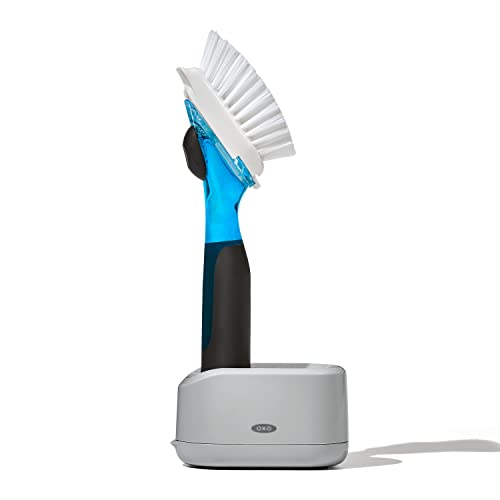
4. OXO Good Grips Soap Dispensing Dish Brush Storage Set
A dish brush that holds soap in its handle, with a base that stores it upright and drains water. A practical all-in-one for dish washing that reduces the clutter beside the sink. Check the listing for replacement brush heads.
Suits: cooks who want a combined tool. Strengths: a soap-holding brush and a draining base. Weaknesses: brush heads need replacing. Skip it if you want a pump bottle.

Best for sponge and brush storage
5. iDesign Forma Sink Caddy
A plastic sink caddy for sponges and brushes. It keeps small items tidy and helps water drain away from the sponge. It is easy to rinse and sits neatly on a counter or inside a sink. Check the listing for its size.
Suits: sponge and brush storage. Strengths: a simple, tidy caddy. Weaknesses: plastic can stain over time. Skip it if you want a soap pump included.
View iDesign Forma Sink Caddy on Amazon
Best for decorative kitchens
6. Creative Scents Soap Dispenser Set
A decorative soap dispenser set with a matching tray. Styles vary, so check the exact version and its materials. A tray beneath the pump catches drips and protects the counter.
Suits: decorative kitchens. Strengths: a matching look. Weaknesses: style varies. Skip it if you want a utilitarian look.
View Creative Scents Dispenser Set on Amazon
Care and Setup
- Rinse the pump with warm water now and then.
- Empty and wash the base every week.
- Dry the caddy so mildew does not build up.
- Use soap thin enough to flow through the pump.
Mistakes to Avoid
- Filling to the brim so the pump overflows.
- Using thick gel that clogs the pump.
- Leaving sponges in standing water.
- Ignoring the footprint of a caddy on a small sink.
Choosing the Dispenser Material for a Wet Sink Area
The space next to a sink is damp, greasy and occasionally knocked by elbows, so the material of the bottle matters. Glass looks clean, lets you see the soap level and does not stain, but it is heavy, slippery when wet and can break on tile or stone. Ceramic offers a similar upscale look and hides the level, which means you have to lift it to check. Plastic is light, forgiving of drops and often the simplest to refill, although it can scratch, cloud or pick up odors over time.
Stainless steel pumps and collars resist rust better than bare metal, but some cheaper finishes can spot or corrode where soap and water sit. Check the listing for what the pump itself is made of, as the bottle and the pump are often different materials. A metal pump on a plastic bottle can still clog or stick if soap dries inside.
Think about the household. In a home with children or a crowded sink, a lightweight shatter-resistant bottle is the safer option. If appearance is the priority and the counter is dry and roomy, glass or ceramic can suit better. Wipe the outside of any bottle after use, since soap residue builds up on the pump head and the base, and keeps the surface looking dirty even when the dispenser is new.
Pump Mechanisms and Which Soaps They Handle
Pumps are not all the same. A basic manual pump pushes soap up a tube, and the amount depends on how far you press. Some give a fixed dose per push, which controls waste. Foaming pumps mix soap with air to make suds, and they require a thin foaming formula or a diluted soap, because thick liquid will jam the mixing chamber. Sensor pumps use a small motor and need batteries or a charge, as the listing explains.
Soap thickness is the main compatibility issue. Dish soap is often thick, and a pump designed for hand soap may struggle with it. If the pump labors or leaves air gaps, try diluting a little soap with water, shaking gently and letting it settle. Do not dilute so much that the soap loses its cleaning power. Check whether the maker recommends certain soap types, and note whether the pump tube can be trimmed to suit a shorter bottle.
- Manual pump: simple, repairable and good for most liquid dish soaps.
- Foaming pump: uses less soap, but only works with thin or diluted formulas.
- Sensor pump: reduces contact after handling raw food, at the cost of batteries.
When shopping, look for a pump with a locking head, which helps when you carry the bottle or store it.
Caddy Layout and Drainage Details
A caddy turns scattered sponges and brushes into a tidy corner, but only if it drains. Look for slots or a sloped base that carry water back into the sink, rather than a closed tray that holds a puddle. A raised rest lets air reach the underside of the sponge, which helps it dry between uses and slows odors. A removable tray makes cleaning easy, because the area below a sponge collects grime.
Measure the sink ledge before you buy. A caddy that overhangs the edge can tip, while one that is too narrow will not hold a full-size brush. Check whether it has suction cups, a flat base or a hook for hanging. Suction cups hold smooth surfaces but can lose grip on textured or wet stone. A flat base is more stable on a counter, but it takes space.
Think about what you keep in it. Dish brushes, scrubbers and a small bottle brush fit most caddies. Larger scouring pads and long-handled brushes may need a deeper compartment. Some sets combine a soap pump and a caddy in one unit to reduce clutter, but a combined unit means that if one part fails, you may have to replace the whole thing. Pick a layout that matches your habits, such as a deep slot for a brush if you wash by hand every day.
Keeping the Set Clean, Hygienic and Clog-Free
Dispensers look clean but get dirty. The pump head traps soap and food splashes, the base collects water, and sponges kept wet breed odors. A routine keeps things fresh without much effort. Once a week, wipe the pump head and the base with a damp cloth. Once a month, empty the bottle, wash it with warm soapy water, rinse the tube, and let everything dry before refilling.
If the pump clogs, flush it by placing the tube in a cup of warm water and pumping until the water runs clear. A pump that sticks can sometimes be freed by soaking the head in warm water. If thick soap keeps jamming the pump, dilute it or switch to a thinner formula. Never mix different soaps in the same bottle, because some combinations separate or thicken.
For caddies, empty the tray, rinse the slots and dry the surface. Replace sponges regularly, since an old sponge is harder to keep clean than a new one. Wring it out after each use and set it upright so it can dry. Scrub brushes should stand with the head up. If you have wash-up routines for raw meat, wash hands and wipe the pump, or consider a sensor dispenser, as the listing describes it, to cut cross-contamination.
Refilling, Economy and Signs to Replace Parts
Refilling from a large container is cheaper and creates less waste than buying small pump bottles, so a wide opening is a real advantage. Use a funnel for narrow necks, and fill only to the line the maker suggests, leaving space for the pump tube. Overfilling pushes soap into the head and makes a mess when you press.
Choose the right capacity for your routine. A large bottle suits a busy kitchen that washes up several times a day, while a smaller one looks neater on a narrow ledge and is easier to keep clean. Check the listing for capacity and compare it with the soap you buy. If you keep both dish soap and hand soap, avoid mixing them up by choosing different shapes or colors.
Know when parts need replacing. A pump that no longer draws soap, drips after use or has a cracked collar should be swapped, since many makers sell spare pumps that fit the same bottle. Replace a caddy that has stained deeply, cracked or lost its grip. Sensor models need new batteries when the response slows. If the bottle itself clouds, scratches or smells even after a thorough wash, retire it. A small, inexpensive replacement is better than continuing with a dispenser that spreads grime around your sink.
A Ten-Second Counter Check Before You Order
Most disappointment with a sink set comes from small things that a quick look at your counter would have caught. Walk to the sink with a tape measure and a pen, and run through this list before you pick anything from the roundup above.
- Measure the open space between the faucet base and the backsplash, because a caddy that overhangs the sink edge will tip or trap water.
- Note which side your dominant hand favors, since a pump placed on the wrong side gets awkward during a long stack of dishes.
- Check how tall your faucet neck is, so a tall dispenser does not collide with the spout when you swing it.
- Decide whether you want one bottle for dish soap only, or a second for hand soap, and match the number of pumps in the set.
- Look at the opening on any refill bottle, because a narrow neck makes pouring thick soap slow and messy.
- Confirm the material suits your cleaning habits, whether that means wiping down plastic or lifting out glass.
Write the numbers down and compare them with the dimensions printed on each listing. If a listing leaves out a measurement, treat that as a reason to look at another option rather than guess. A few minutes of checking now saves a return later.
Small Words on a Listing, Decoded
Product pages for dispensers lean on short terms that sound technical but mean something simple. Knowing them helps you compare the mDesign, iDesign, simplehuman, OXO and Creative Scents options on equal footing.
Pump head is the pressing part on top, and its tube length decides how much soap reaches the bottom of the bottle. Dip tube is the thin stem that reaches down inside, and a tube that is too long for a short bottle curls and blocks flow. Neck size describes the opening, which matters when you refill from a large jug. Weeping is the slow drip that sometimes appears at the nozzle after use. Tray or drip catcher is the base that holds spills so they do not reach the counter.
When a listing mentions capacity in milliliters or ounces, think about how fast your household uses dish soap. A larger bottle means fewer refills but takes up more room beside the faucet. Where a listing is vague about the pump mechanism or material, read the product questions and the maker description closely, and follow the maker instructions once the set arrives.
Which Set Suits Which Sink Situation
Instead of asking which set is best in general, ask which one fits the sink in front of you. The table below pairs common situations with the kind of set that tends to suit them.
| Your situation | What to lean toward | Why it helps |
|---|---|---|
| Narrow counter beside the sink | Slim single pump or compact caddy | Takes little width and leaves room to work |
| Busy household with messy hands | A sensor pump such as the simplehuman model | No touching a sticky handle mid-task |
| Wet sponge that never dries | A caddy with drainage like the iDesign Forma | Lets water run back to the basin |
| Brush and sponge clutter | The OXO dish brush storage set | Keeps tools upright and together |
| Matching bathroom and kitchen look | Glass pump sets from mDesign or Creative Scents | Gives a consistent, tidy appearance |
Use the table as a rough guide only. Your faucet type, counter material and how often you wash by hand will tip the choice one way or the other.
Habits That Help Any Set Last Longer
Even a well made dispenser behaves poorly when it is neglected. A few easy habits make the difference between a set that looks fresh for years and one that turns sticky within weeks.
Begin with the base. Lift the bottle and wipe the spot underneath once in a while, because dried soap rings are where grime collects and where mildew loves to settle. If your set has a tray, empty it when you notice water pooling instead of waiting for a visible mess.
Next, think about what goes in the bottle. Thin liquid soap flows well through most pumps, while very thick gels may need a little water to move smoothly. Check the maker guidance for any limits on the kind of soap the pump handles. Avoid mixing different soaps in one bottle, since they can thicken or separate and clog the stem.
Finally, rinse the pump head under warm water now and then and let it dry before refilling. Follow the care notes that come with your set for anything related to dishwashers or cleaning agents, and replace the pump when it feels weak rather than forcing it.
How a Dispenser Set Changes the Daily Dish Routine
It is easy to underestimate how much of kitchen tidiness comes down to the two square feet beside the sink. That small ledge is where the dish soap lives, where the sponge dries, where a brush waits between jobs, and where water, suds and food residue collect all day. A loose collection of bottles and soggy sponges makes the area look unfinished even in a clean kitchen, and it slows you down: the soap bottle tips, the sponge slides into the sink, and the brush ends up wherever it was last dropped. A dispenser set solves the problem less by being decorative than by giving every item a fixed home.
The first benefit is reach. When the soap is in a pump that always sits in the same spot, you stop hunting for a bottle that has migrated to the back of the counter or fallen behind the faucet. One press with the back of a wrist or a knuckle delivers soap while your other hand holds the pan, which matters more than it sounds during a busy cleanup. Sets that pair the pump with a caddy extend that logic to the sponge and brush, so the whole washing-up kit is gathered in one footprint instead of spread along the ledge.
The second benefit is dryness. A sponge left in a puddle stays wet, smells sooner and breaks down faster. A caddy or tray with drainage moves water away from the sponge and off the counter, and a raised base keeps the bottom of the bottle out of standing water too. Over weeks, that small difference is what separates a sink area that wipes clean in seconds from one with a ring of residue under every item.
The third benefit is refill discipline. A dedicated dispenser encourages buying soap in larger refill containers and topping up on a schedule, rather than accumulating a new plastic pump bottle with every purchase. You also control what goes in it: the same dish soap you already like, diluted or straight as the maker of the pump advises, rather than whatever came in a disposable bottle.
None of this requires a large or expensive set. It requires the right combination for how you wash up. A household that mostly loads a dishwasher may need only a hand soap pump and a small caddy for a brush. A household that hand-washes pots daily benefits from a soap-dispensing brush and a draining base. Reading the picks above with your own routine in mind is the fastest way to choose well.
Matching the Set to Your Sink Layout
Sink ledges come in a few common shapes, and the best set for each is different. A wide, deep ledge behind a farmhouse or apron sink can carry a full set: pump, caddy and tray side by side, with room to spare. A standard double-bowl sink in a modest kitchen usually has a narrow strip behind the faucet, where a tall bottle can crowd the faucet handles and a wide caddy may overhang the bowl. A corner sink or a sink under a low window sill limits height, which rules out tall pumps and stacked caddies.
Start by measuring the ledge depth from the back of the sink to the wall or backsplash, and the clear width between the faucet base and anything fixed, like a water filter tap or a soap hole cover. Then compare those numbers with the footprint in the listing. Leave a little slack: you will reach past the set with wet hands, and a set that only just fits will be knocked regularly.
Think about which side you work from. Most people keep the sponge on their dominant-hand side and the soap within the same reach. If the dishwasher is to the right of the sink, a caddy on that side keeps drips off the floor path between sink and machine. In a two-person kitchen, a centered pump with the caddy to one side keeps both users from reaching across each other.
Undermount sinks with no ledge at all need a different answer: a caddy that sits inside the sink, a suction or over-the-divider holder, or a set that lives on the counter beside the sink rather than behind the faucet. Freestanding sets with a tray suit that arrangement, because the tray defines the zone and catches the drips that would otherwise spread across the worktop.
Finally, consider the faucet itself. A high-arc faucet throws water further and splashes more of the ledge, which argues for materials that shrug off constant wetting. A pull-down sprayer used at the counter edge for filling pots will splash the set from another angle. None of this is complicated, but five minutes with a tape measure prevents the most common disappointment with these sets, which is a good product in the wrong footprint.
The Picks Above, Compared in Plain Terms
The six picks divide into three families. The mDesign glass set, the iDesign Gia pump and the Creative Scents set are bottle-first options: a pump is the centerpiece, and storage for tools is secondary or comes from a matching tray or holder. The simplehuman sensor pump is also bottle-first but replaces the press with a wave, which changes who it suits. The OXO set and the iDesign Forma caddy are tool-first options: they organize the brush and sponge, and soap delivery is built into the brush or left to a separate bottle you already own.
Within the bottle-first group, the differences are about material and ceremony. The mDesign set leans on clear glass, so the soap level is visible at a glance and the look is tidy and modern; the trade-off, as the review notes, is careful handling on hard surfaces. The Gia pump is the plainest of the three, a straightforward refillable bottle for someone who wants the function without a styled set. The Creative Scents set goes the other way: the matching tray and decorative finish are the point, and the tray earns its place by catching drips before they reach the counter.
The simplehuman pump stands apart because it removes touch. After handling raw chicken or greasy pans, dispensing without pressing a pump head keeps the dispenser itself cleaner, and the soap goes on the sponge or hand rather than on the pump. The cost of that convenience is batteries and one more device to maintain, which is why the review suggests skipping it if you prefer a manual pump.
The OXO set answers a different question: what if the brush is the dispenser? Soap stored in the handle is released as you scrub, and the storage base drains the brush upright. It replaces a bottle rather than complementing one, so it suits cooks who wash as they go and want one tool at the sink. The Forma caddy is the organizer of the group, with no pump at all; it makes sense when your soap arrangement already works but your sponge and brushes have no home.
A practical way to decide is to name your current annoyance. Bottle tipping over: choose a set with a tray or a heavier bottle. Sponge always soggy: choose drainage, in the OXO base or the Forma caddy. Pump head always grimy: consider the sensor pump. Counter looks mismatched: the coordinated sets, mDesign or Creative Scents, fix the visual problem directly.
Setting Up the Sink Zone in a Sensible Order
When a new set arrives, resist the urge to place it and move on. Ten minutes of setup pays off for the life of the set. Start by clearing the ledge completely and wiping it dry, including the area behind the faucet where residue hides. Old soap scum under a new caddy will keep wicking moisture and smell, whatever sits on top of it.
Prime the pump before filling the bottle completely. A few presses with water or a small amount of soap confirm the tube reaches the bottom and the head moves freely. Then fill to below the neck rather than to the brim; the pump assembly displaces liquid when you screw it down, and an overfilled bottle weeps soap down its sides for days.
Position the set with the pump closest to your working hand and the caddy where the sponge naturally lands after use. Put the tray, if your set has one, under the items that drip most. Live with the arrangement for a day of real cooking before deciding it is final; the right layout is the one you stop noticing.
Label nothing, but do standardize: the same soap in the pump every refill keeps the pump’s seals and tube working as expected, because switching between thick gels and thin liquids can change how a pump primes. If two people refill, agree on where the bulk soap lives so the dispenser is topped up rather than left empty and bypassed with a squeeze bottle.
Finish with a weekly rhythm: empty and rinse the caddy, wipe the tray, and run warm water through the pump if the flow weakens. The care section above covers the details; the point here is that a set stays a set only if the small routine around it holds.
One Sink, Two Jobs: Hand Soap Versus Dish Soap
A kitchen sink does two different kinds of work. It is where hands are washed before and during cooking, and it is where dishes, boards and knives are cleaned. Those jobs call for different soaps, and a dispenser set is most useful when it keeps the two apart without clutter. Dish soap is formulated to cut grease on surfaces and is used in the water or on a sponge. Hand soap is gentler for skin that will be washed many times a day. Using dish soap on hands all day leaves them dry; using hand soap on a greasy pan leaves the pan greasy.
A two-bottle set, or a pump paired with the soap-dispensing brush from the OXO option, lets you run both systems side by side. Keep the positions fixed, because in the middle of cooking you will reach without looking. If your set has only one pump, dedicate it to the soap you reach for most often and keep the other in its original bottle behind it, rather than swapping the pump between soaps and mixing residues in the tube.
Foaming hand soap deserves a mention because it needs a foaming pump, which is a different mechanism from a standard pump. A standard pump filled with foaming soap gives a thin, disappointing result, and a foaming pump filled with regular soap barely foams at all. If foaming hand soap is part of your plan, confirm that the set includes a foaming pump or buy that piece separately, and keep it for hand soap only.
Whatever the arrangement, the dispenser should make the right soap the easy soap. The cook who has to open a cupboard for hand soap will skip it; the one who has to wrestle a clogged pump will squeeze dish soap straight from a bottle and leave the set unused. Convenience is the whole point of the purchase, so judge every arrangement by whether it survives a busy weeknight.
What Wears Out First, and What You Can Replace
Dispenser sets rarely fail all at once. The pump head is the usual first casualty: the spring tires, the seal swells from constant contact with soap, or dried soap locks the mechanism. The good news is that pump heads are the most replaceable part of any set, and many bottles use common thread sizes, so a fresh pump can revive a bottle you like. Before ordering a whole new set, try the warm-water flush described in the care notes, and check whether the dip tube has cracked or slipped off the pump.
Sponges and brush heads are consumables by design. A sponge that smells after rinsing, or that has started to crumble, should go, and the OXO brush in the picks above is built around replaceable heads for exactly this reason. Caddy parts last longer but suffer cosmetically: plastic clouds and stains, metal coatings can chip where they are knocked daily, and ceramic can craze if it meets sudden temperature changes from hot pans or boiling water splashes.
Trays and bases mostly fail by neglect. Standing water under a set will mark stone and wood counters and can rust a metal tray from underneath where you cannot see it. Lift the set during the weekly wipe-down and dry the counter beneath it. That single habit extends the life of both the set and the worktop it sits on.
When a set does reach the end, replace the failed part rather than the set where you can. It keeps a coordinated look intact, costs less than a full replacement, and avoids the trial and error of fitting a new footprint into a ledge you have already arranged around the old one.
A Quick Word on Guests, Kids and Busy Households
The sink area works hardest when the kitchen is busiest, and a dispenser set earns its keep in those moments. With guests helping to clear up, nobody knows where things live in your kitchen, but a visible pump and caddy explain themselves: soap here, sponge there, brush in its base. That self-explanatory quality is worth more than style when four people are tidying after a meal.
In households with children, height and weight matter. A tall, top-heavy bottle on a narrow ledge will be knocked into the sink sooner or later, which is another argument for the lower, lighter plastic options or a set anchored by a tray. Sensor pumps fascinate children and can waste soap for a week before the novelty fades; a manual pump with a measured stroke is easier to supervise. Whatever you choose, keep the arrangement identical day to day, because children, like guests, work best with a sink zone that never moves.
For anyone with limited grip strength, the pump itself is the decision. A wide pump head that presses with the palm or the heel of the hand is far easier than a small head that needs fingertip force, and a dispensing brush removes the squeeze-bottle problem entirely. Test this thinking against the picks: the OXO brush set and the sensor pump both reduce the force needed at the sink, in different ways.
None of these households need a different philosophy, just a different emphasis. The set is a small system for a repeated daily task. Choose the version of the system that fits the hands, heights and habits in your home, keep it clean and drained, and it will quietly do its job for years.
Soap Dispenser Set FAQ
Pump or tilt dispenser?
Pumps are easy to control. Tilt dispensers suit thick soap.
Is a touch-free pump worth it?
It keeps hands cleaner when cooking, though it needs batteries.
How do I stop the pump clogging?
Rinse it with warm water and dilute thick soap slightly.
Does a caddy need drainage?
Yes, to keep sponges from sitting wet.
Can I use dish soap in a hand soap pump?
Often you can, but dish soap is thicker and may strain a pump made for thinner hand soap. Dilute it slightly or check whether the maker recommends it. A pump rated for thicker liquids works more smoothly.
Why does my pump keep dripping?
Drips usually come from soap that is too thin, a loose collar or dried residue in the nozzle. Tighten the collar, clean the nozzle and avoid overfilling. If dripping continues, replace the pump.
How do I get a sticky pump unstuck?
Soak the pump head in warm water to dissolve dried soap, then pump clean water through the tube. Dry before refilling. Repeat if it still sticks.
Is a refillable dispenser better than buying pump bottles?
Refilling is generally cheaper and creates less plastic waste, provided the dispenser has an opening that is easy to fill. Make sure the bottle is washed and dried now and then so it stays hygienic.
Do glass dispensers break easily?
Glass can crack if dropped on hard surfaces, and it is slippery with wet hands. It suits a calm, dry counter better than a crowded sink. Choose plastic if you worry about breakage.
How often should I replace the sponge in a caddy?
Replace it when it smells, falls apart or stays greasy after washing. Many households swap sponges every week or two. Let it dry between uses to slow smells.
What size caddy fits a small sink?
Measure the ledge or corner where it will sit, then compare it with the dimensions on the listing. A narrow caddy that stands upright takes less space than a wide tray.
How much soap should a kitchen dispenser hold?
Enough that refilling is occasional rather than constant, but not so much that the soap sits for months. For most households a mid-sized bottle refilled every few weeks is the sweet spot. If you wash up by hand several times a day, a larger capacity or a second bottle for hand soap keeps both jobs covered without daily top-ups. Check the listing for the capacity of any set you are considering, and compare it with how quickly you currently get through a bottle of dish soap.
Can I put hand soap and dish soap in a two-bottle set?
Yes, and many people do exactly that: dish soap in one pump for washing up, hand soap in the other for the cook. Keep the arrangement consistent so nobody scrubs a pan with hand soap, and if the bottles look identical, choose soaps of different colors or place them in a fixed left-to-right order. The fixed order matters more than labels, because you will reach for the pump without looking.
Why does my dispenser pump out less soap than it used to?
Usually the tube or the pump head is partly blocked with dried soap, or the soap itself has thickened. Run warm water through the pump, clear the nozzle opening gently, and check that the tube reaches the bottom of the bottle. If the soap is a thick gel, thinning it slightly or switching to a standard dish soap often restores the flow. A pump that still struggles after cleaning may simply be worn, and many sets use standard pump heads that can be replaced.
Where should the set sit if my sink has no ledge?
On the counter beside the sink, ideally on a tray that catches drips, or in an in-sink caddy for the sponge with the pump on the counter. Keep the set within one step of the sink so wet hands are not carried across the floor. Sets with a matching tray, like the Creative Scents option above, work well in this arrangement because the tray defines the zone on an open counter.
Is a sensor pump hygienic enough for a kitchen?
A sensor pump reduces one specific contact: pressing a pump head with contaminated hands. It does not sterilize anything, and the sponge and caddy still need the regular cleaning described in the care section. Treat touch-free dispensing as a convenience that keeps the dispenser cleaner between wipes, not as a substitute for washing hands and tools properly.
Should the dispenser match my faucet finish?
It helps the sink area look deliberate, but function should come first: a well-draining caddy in a near-enough finish beats a perfectly matched set that puddles. If matching matters to you, the coordinated sets in the picks above are the easier route, since the pump, tray and accessories are designed together. Mixed metals are common in real kitchens, so do not discard a good pump over a small difference in tone.
How do I keep the outside of the bottle from getting sticky?
Wipe the pump head and bottle neck during the weekly clean, and avoid overfilling, which is the usual cause of soap creeping down the outside. A tray under the bottle catches what does escape. Sticky residue attracts dust and makes a clean set look grubby, so the quick wipe matters more than any deep clean done rarely.
Can I use a dispenser set at a bathroom-style kitchen sink or a utility sink?
Yes. A laundry or utility sink benefits from the same arrangement, often more, because those sinks collect garden tools, paint brushes and pet bowls as well as dishes. Choose the sturdier, plainer end of the range for a utility space, keep a caddy with real drainage, and expect to rinse the whole set more often. The pump and caddy do not care which room they are in; the routine around them is what changes.
What is the simplest upgrade if I am not ready for a full set?
Add drainage first. A draining caddy or a simple tray under the items you already own fixes the soggiest problem at the sink for the least effort. Then replace the soap bottle with a refillable pump once your current bottle runs out. Building the set in that order means each step solves a problem you actually have, and the finished arrangement will match your habits rather than a photograph.
The Short Version
For glass, the mDesign. For a simple pump, the iDesign Gia. For hands-free use, the simplehuman. For a brush with soap, the OXO. For a caddy, the iDesign Forma. For a decorative set, the Creative Scents.