Knife length should fit the tasks, grip and working area. A larger blade is not automatically a more versatile choice. The right length is the one you can control confidently on the board you actually have.
What to do
Compare the actual cutting edge, handle clearance and board size. Use safe supervised handling or an appropriate demonstration to assess control before choosing.
Blade length in listings may include the part buried in the handle or the heel, so check how the length is measured and how much of it is usable edge.
In this guide
Matching length to tasks
- Shorter blades: feel nimble and suit smaller hands, small boards and detailed work.
- Mid-length blades: a common all-round choice for vegetables, herbs and meat.
- Longer blades: slice large items such as melons and roasts in fewer strokes, but need more board and counter space.
Hand size, grip style and experience all affect what feels comfortable, so weight and balance matter alongside length.
A mistake to avoid
Do not practice a new grip on unstable food or a slippery board. A purchase comparison should not create a cutting risk.
Place a damp cloth or non-slip mat under the board, and cut food that has a flat side to rest on. Keep your fingers curled away from the blade.
A detail worth checking
Consider the knife and board as a pair. A blade length that feels manageable in open space may be awkward on a small work surface crowded by ingredients and other tools.
A rule of thumb is to have the board noticeably longer than the blade, so the tip has somewhere to go as you slice.
Try this practical check
List the foods you prepare most and the motions required. Ask a qualified retailer to demonstrate suitable blade sizes for those tasks.
If you can, hold a few knives, because balance and handle shape are difficult to judge from photographs. Keep it to holding, with the point down and the edge away from people.
Measuring the Edge You Will Actually Use
Two listings can quote the same blade length and still give you different amounts of working edge. Some makers measure from the tip to the end of the bolster or heel, others to the start of the handle, and some include a section that is buried inside the handle. The part that matters for cutting is the straight and curved edge that can meet the board, so ask or check how the number is defined before you compare.
Look at the photographs for clues. A pronounced bolster or a handle that begins well after the edge ends reduces usable length. A blade that is tall from edge to spine gives your knuckles more room but can also feel more substantial in the hand. If the listing offers a diagram, treat it as the better guide than the headline figure.
- Check whether the length quoted is the blade only or the whole knife.
- Look for how much of the edge is flat and how much curves upward at the tip.
- Compare handle length too, since a long handle changes where your hand sits.
- Read the maker’s size notes in the product listing or manual rather than guessing.
When two knives are close in length, the one with more usable edge and a comfortable handle position often feels longer in practice. Judging the real working edge is a better basis for comparison than the printed size alone.
What Your Cooking Style Says About Length
Think about what you actually do at the board most evenings. Someone who dices onions, slices peppers and chops herbs for one or two people has different needs from someone who carves roasts, halves large squash or prepares food for a crowd. The first cook is often well served by a moderate blade that turns easily. The second may find a longer blade saves strokes on large items.
It helps to sort your prep into groups and see which dominates.
- Small, detailed work: shallots, garlic, trimming and herbs. A shorter or lighter knife gives more control near the tip.
- Everyday vegetables and proteins: a mid-length blade handles most of it without crowding the board.
- Large, long items: melons, cabbages, joints and loaves. A longer blade can pass through in one sweep, if you have the space and confidence.
Many households also keep a second small knife for fine tasks, which lets the main knife be chosen for the bulk of the work. If you plan to own only one chef knife, favor the length you can manage comfortably on your worst day, such as a crowded counter or a tired hand, rather than the length that looks best in an ideal setup.
How Experience Changes the Right Length
People new to knife work often feel safer and more accurate with a shorter blade because the tip is closer to the hand and easier to steer. As skill and confidence grow, some cooks move to a longer knife for speed and reach, while others stay with what they know. Neither path is a mistake. Comfort and control should guide you more than any rule about what experienced cooks use.
If you are learning, spend time on the basics before worrying about length. Practice a claw grip with the fingertips tucked back, keep the board steady, and cut slowly. Fluent technique matters more than another inch of blade, and a knife you can place accurately will serve you better than one that feels like too much for your hand.
If you cook with children or less experienced family members, think about who will pick up the knife and whether a lighter, shorter option is more suitable. Ask a qualified retailer or instructor for supervised guidance on safe handling when you are unsure. When you outgrow your first knife, you can note which parts of it felt limiting, perhaps reach, weight or handle shape, and use that to decide on the next one.
Questions to Ask Before You Buy
A short list of questions can help you compare knives fairly, whether you are in a shop or reading a listing.
- How does the maker measure the length, and how much of it is cutting edge?
- How tall is the blade at the heel, and does that leave room for my knuckles over the board?
- Does the handle shape suit my grip, and does it stay secure when my hands are wet?
- Is the knife balanced near the handle junction, toward the blade, or toward the handle?
- What do the care instructions say about washing, honing and sharpening?
- Will it fit my block, drawer or magnetic strip?
- Is there a return policy or warranty that I can read before purchase?
Also think about budget in plain terms. Lower-cost knives can be perfectly workable for learning, although they may need more frequent attention to the edge. Mid-range options often balance steel quality and comfort, and premium knives may offer finer finishes or specialized steels that matter most to people who cook a lot. Choose the tier that fits how often you cook rather than chasing the highest one. Whatever you choose, read the product listing carefully, and check how many people rated it and what they actually say about comfort and edge retention rather than relying on a single score.
Signs Your Knife Length Is Wrong
Sometimes a knife that looked right on paper does not work in your kitchen. Your body and your board will usually tell you.
- You find yourself choking up on the blade or cutting with only part of the edge because the full length feels unwieldy.
- The tip frequently hits the back of the board, a wall or items stacked behind it.
- Your wrist or forearm tires quickly during routine prep.
- You reach for a small knife for most jobs and leave the big one in the block.
- You feel unsure about control when slicing through firm vegetables.
- The knife will not fit the storage you have, so it ends up loose in a drawer.
If several of these apply, step back and look at the whole setup before replacing the knife. A larger or steadier board, a non-slip mat, better lighting or a sharper edge can change how a length feels. If the knife is still a poor match after those fixes, it is reasonable to try a different length. Consider handing the old knife to someone it suits better, and apply what you learned about your own grip, hand size and workspace to the next choice.
Matching Blade Length to Your Hands
Chef knives come in a spread of lengths, and the right one depends on the person holding it more than on any rule. A shorter blade feels nimble and stays close to the work, which helps with small items such as shallots and herbs. A longer blade covers more ground in a single stroke, which suits large squash, cabbages and roasts. Hand size, comfort and confidence matter more than the number on the box.
- Smaller hands or newer cooks often find a mid-length blade easier to control.
- Larger hands may feel cramped on a short handle and blade, so check the handle too.
- Cooks who prep big batches may enjoy the reach of a longer edge.
- Anyone who works on a small board should lean toward the shorter side.
A Quick Board Space Test
Before buying, do a simple test at home. Lay a ruler or a long wooden spoon on your board at the length you are considering. Then mimic a rocking motion with it, pressing the tip down and lifting the heel. If the tip hits the edge of the board or the wall, the blade is too long for your setup. You also want room for the food, the cut pieces and a spot to push them aside without crowding the knife.
Counter depth matters too. A deep counter lets you stand slightly back, which keeps your elbow free. A shallow counter pushes you forward and shortens your swing, so a smaller blade often feels safer and more relaxed.
Handle Fit, Balance and Care Notes
Length is only one part of the story. Balance point, handle shape and weight all shape how a knife feels after twenty minutes of chopping. A blade that seems perfect in a quick grip can tire the wrist over a long prep session. Pick the knife up and pinch the blade near the handle to find where it balances.
For care, wash by hand where the maker advises, dry promptly and store in a block, sleeve or on a magnetic strip. Sharpening methods differ by steel and edge angle, so follow the maker’s guidance or ask a professional sharpener. Keep the edge away from hard surfaces such as glass or stone boards.
Common Mistakes When Picking a Length
Many buyers assume that longer always means better. In practice, a blade that is too long for the board forces you to cut at an angle, and that makes every stroke less precise. Others choose a short blade to feel safe, then struggle with big vegetables that need extra reach. A third error is ignoring the knuckle gap, which is the space between your fingers and the board when the handle is low.
The cure is simple: try before you buy, or buy from a seller that allows returns, and cut something real. A potato, an onion and a herb bunch will tell you more than a product photo ever could.
Quick Answers
Is a longer knife better?
Not always. It slices more in one stroke but demands more space and control. A shorter blade can be easier for everyday tasks.
What length is best for a beginner?
Many people find a mid-length blade comfortable, but it depends on hand size and the space you work in.
Does handle shape matter?
Yes. A handle that fits your grip reduces fatigue and slipping, and leaves room for your knuckles above the board.
Does a longer chef knife cut faster?
It can slice long items in fewer strokes, but speed depends mostly on control and a sharp edge. A knife that feels too big slows you down. Choose the length you can steer confidently.
How do I find out how a maker measures blade length?
Check the product listing, size chart or manual for a definition and a diagram. If it is not stated, ask the seller. Compare knives using the same method where you can.
Can I use one chef knife for everything?
Many home cooks do for most tasks, but a small knife helps with detailed work and a serrated knife helps with bread. One well-chosen chef knife covers a lot, and you can add others as needs appear.
What if I have a very small counter?
Pick a blade that fits your board with room to spare and a board that fits the counter without hanging over. A mid-length or shorter knife is often easier in tight spaces. Keep the board steady with a damp cloth or mat underneath.
Should left-handed cooks think about length differently?
Length matters in the same way, but handle shape and edge grind can matter more. Check whether the knife is made for either hand or favors one side, using the maker's description. Handle it safely in person if you can.
How do I check balance without a shop to visit?
Read the description for notes on weight and balance, and look at photographs of the handle and bolster. Return policies can make trying at home practical. Handle any new knife with the point down and edge away from you.
Is a wider blade better for protecting my knuckles?
A taller blade gives more clearance between your knuckles and the board, which many people find helpful. It can also feel heavier or less nimble. Compare blade height alongside length.
When should I move up or down a size?
Consider a change if you often feel cramped, fatigued or unsure of control. Try improving your board and technique first. If the problem remains, a different length may suit you better.
Blade Shape and Profile
Length is only one part of how a knife behaves. The curve of the edge, called the belly, affects how it rocks on the board. A pronounced curve suits a rocking motion, while a flatter edge suits push cuts and chopping straight down. The height of the blade from edge to spine changes how much knuckle clearance you have, and the shape of the tip affects precision work.
Two knives of the same length can feel very different because of these details. Look at photographs from the side and compare the listed blade height where available. Consider the kind of cutting you do most. If you rock the knife for herbs, you may like more curve, and if you slice vegetables with a push, a flatter profile may feel more natural.
Weight, Balance and Fatigue
A heavier knife can feel stable and do some of the work, while a lighter one feels agile and tires the hand less over a long prep session. Balance point also matters. A knife that balances near the handle junction feels neutral, one that is blade-heavy feels forward, and one that is handle-heavy feels tipped back. Neither is wrong, but one may suit your grip better.
- Try gripping the blade between thumb and forefinger just in front of the handle to feel the balance, if you have a chance to handle the knife safely.
- Consider wrist strain if you cut a lot at once.
- Think about whether others in your home will use the knife.
Listings may state weight, but feel in the hand is hard to capture in numbers, so try to handle the knife in person if possible.
Grip Styles and Hand Size
How you hold the knife shapes which length feels comfortable. Many cooks use a pinch grip, with thumb and forefinger on the blade just in front of the handle, which gives control. Others hold the handle only. Smaller hands may feel more at ease with a shorter blade and a slimmer handle, while larger hands may like more handle room.
Consider the handle shape, too. Round, oval and angular handles feel different, and a handle that is too small can cramp the hand. A well-fitting handle helps you hold the knife securely when wet. Always keep fingers curled away from the edge, and use a stable cutting surface.
Board Size and Counter Space
A longer knife needs a bigger board. If the board is small, ingredients pile up and the blade has less room to travel, which can make cutting less safe. Measure your board and counter before choosing a length, and make sure the board is stable. A heavy board or a mat underneath prevents slipping.
Storage is another constraint. Check the drawer, block or magnetic strip for blade length, since a long knife may not fit slots designed for shorter ones. A blade guard allows safe storage in a drawer. In a small kitchen, a mid-length knife often balances capability and space.
Care, Sharpening and Safe Handling
A sharp knife is safer than a dull one because it needs less force and is less likely to slip. Hone the edge regularly and sharpen when honing no longer restores it, following the maker’s guidance. Wash by hand and dry promptly, as many makers advise against dishwashers. Store the knife so the edge is protected and out of reach of children.
Never catch a falling knife, and carry it with the point down and the edge away from you. Cut on a board rather than hard surfaces like stone or glass, which can damage the edge. If the handle loosens, the blade chips badly or the edge will not hold, consider replacement or professional servicing.
Length in Practice: A Week of Meals With Each Size
Abstract comparisons sharpen when you follow each length through an ordinary week. The shorter chef knife, around six to eight inches of blade, spends the week in its element: dicing onions, slicing peppers, trimming chicken and cutting sandwiches all suit its quick, controlled strokes. It comes out of the drawer for jobs that take two minutes, and because it is never intimidating, it gets used constantly. Its limits appear at the weekend, when a whole cabbage, a large squash or a watermelon asks for a longer stroke than the blade can give, and the cook works in sections instead of single passes.
The longer knife, nine to ten inches, reverses that pattern. Through the week it handles the same everyday jobs perfectly well in experienced hands, though it can feel like more knife than a single onion requires. Its moment comes with volume and size: a pile of herbs rock-chopped in a fraction of the time, a whole chicken broken down with room to spare, a dense squash halved in one committed stroke rather than three anxious ones. Cooks who batch-prep at weekends often find the longer blade pays for itself in those sessions alone.
Neither week is better; they belong to different cooks. The useful exercise is to picture your own last seven days of cooking and ask which pattern matches. If your cooking is mostly small, quick and varied, the shorter knife will feel like an extension of your hand. If you regularly face large produce, whole birds or big prep sessions, the longer blade’s extra reach stops being a luxury and becomes the point. Many settled kitchens eventually hold one of each, but the first purchase should match the week you actually live.
How Length Interacts With Blade Height and Weight
Length is only one dimension, and it rarely changes alone. Longer chef knives are usually taller at the heel and heavier overall, and those companion changes matter as much as the extra reach. A taller blade gives your guiding knuckles more clearance above the board and provides a broader flat for scooping and transferring chopped food, which is a large part of why bigger knives feel efficient during long prep. The same height can feel clumsy for in-close work like trimming, where a tall blade puts the edge further from your fingertips’ judgement.
Weight follows a similar pattern. A longer, heavier knife lets gravity share the work on dense vegetables, so the cook guides rather than pushes. That is a genuine advantage over a long session, and it is why cooks with strong hands often drift toward larger knives as their technique settles. The cost appears in fine work and in fatigue of a different kind: a heavy knife asks more of the wrist during quick, precise cuts, and a cook with smaller hands may feel that cost within minutes. When you compare lengths, compare the whole knife, lifting each candidate and miming both a rock-chop and a careful trim.
Balance shifts with length too. On a well-made knife the balance point sits near where blade meets handle, whatever the length, but makers achieve that differently, and two knives of identical length can feel entirely different in the hand. If you cannot handle a knife before buying, read its description for overall weight and treat length as the beginning of the comparison rather than the whole of it. The right length in a badly balanced knife will disappoint you more than a slightly different length in a knife that feels natural.
Length and the Way You Were Taught to Cut
Technique and length are partners. The rocking chop, where the tip stays near the board and the heel rises and falls, uses the blade’s curve and rewards a medium to long knife with a generous belly. Push-cutting, where the blade moves forward and down in a single stroke, works across lengths but asks for enough edge to finish the cut without sawing, which is where longer blades quietly excel on wide ingredients. Draw-cutting, pulling the blade toward you through delicate items, favours control and often a shorter blade, especially for cooks still building confidence.
If you learned to cook with a particular knife, your hands have opinions your head may not have consulted. Cooks raised on a short knife often find a long one vague at the tip, while cooks raised on a long knife feel a short one runs out of edge mid-task. Neither reaction means the new length is wrong; it means technique adapts over a few weeks of daily use. When you change length, give the change a fair trial with ordinary meals before judging it, and be a little more deliberate with the guiding hand during the first week.
Knife skills classes and shared kitchens add one more consideration: a mid-length knife is the most transferable. If you cook in other people’s kitchens, or teach others in yours, the common eight-inch pattern is the one most hands already understand. That is not a reason to avoid the length that suits you at home, but it explains why the middle of the range remains the default recommendation for a first serious chef knife, and why deviations from it should be made for a reason you can name.
When Your Board and Counter Cast the Deciding Vote
Earlier sections covered board space in principle; here is the practical version. Lay your largest board on the counter where you actually work, place the knife diagonally across it, and check that the whole blade, tip to heel, sits on the board with margin to spare. That diagonal test is the classic fitter’s trick, because the diagonal is the longest line the board offers, and a knife that fits the diagonal will fit every stroke you make. A knife that overhangs the diagonal will overhang in use, and overhang means the tip or heel works off the board’s edge, which is both inefficient and hard on the edge.
Counter depth matters as much as board size. A long knife used on a shallow counter pushes the board toward the edge and the cook’s body backward, changing posture in ways that tire the shoulders. If your kitchen forces a small board, accept the verdict gracefully and choose the shorter knife; technique adapts to a short blade far more happily than a body adapts to a cramped stance. Conversely, a generous island with a large board is wasted on a timid little knife, and cooks in that position often find a longer blade transforms prep from a chore into something almost pleasurable.
Storage casts a vote too. A ten-inch blade needs a block slot, magnetic strip or drawer insert that can take its full length plus handle, and it needs a route from drawer to board that does not swing past other people in a small kitchen. Measure the storage you have before the knife arrives, not after. Length decisions made with board, counter and storage all in view are the ones that still feel right a year later.
Length Across Cuisines: What Different Traditions Ask of a Chef Knife
Cooking traditions quietly encode opinions about length. The classic French pattern, from which the modern chef knife descends, settled at a moderate length suited to a cuisine of varied, precise work: trimming, turning, slicing and chopping in roughly equal measure. German practice favoured a similar length with a deeper belly for rocking through herbs and vegetables in quantity. Neither tradition treated length as a virtue in itself; both treated it as fitted to the work, which is the principle this guide has pressed from the start.
Other traditions widen the picture usefully. The Chinese cleaver achieves its efficiency through height rather than length, reminding us that edge geometry has more than one solution to the problem of processing a pile of vegetables. Japanese gyuto patterns often run long and light, trusting a fine edge and a push-cutting technique rather than weight. A cook whose repertoire leans heavily toward one cuisine will find that cuisine’s knife shapes informative, not as fashion but as evidence: generations of cooks have already run the experiment of matching blade to task, and their settled choices are data.
For the home cook with a mixed repertoire, the lesson is to weight the evidence toward the food you cook most. A household that stir-fries nightly, breaks down whole fish and lives on leafy greens has different length needs from one built around roasts, gratins and salads, even if both households own exactly one chef knife. Let the menu vote. It is a more honest guide than any general recommendation, including the sensible defaults offered elsewhere in this article, and it explains why two equally experienced neighbours can swear by different lengths and both be right.
Age, Strength and Changing Hands
The right length is not fixed for life, because hands change. A cook who happily managed a long, heavy knife at thirty may find at sixty that grip strength and wrist comfort argue for a shorter, lighter blade, and that change should be read as information, not decline. Shorter knives ask less of the wrist in the rocking motion and are easier to control precisely when strength is variable, which is why many older cooks describe the move down in size as regaining confidence rather than losing capability. The food does not care which length cut it; the cook’s comfort decides the quality of the work.
At the other end of life, younger cooks building strength and technique often grow into length gradually. Starting moderate and moving longer as control improves is a sound progression, and it mirrors how most people actually learn: the knife that felt large in the first month feels ordinary by the sixth, because the hand has learned where the tip is without looking. Buying slightly ahead of your current skill is reasonable; buying far ahead of it invites the clumsiness and caution that make a knife feel wrong.
Injuries and conditions make the point sharply. A cook returning to the kitchen after a wrist injury, or managing arthritis, should treat length and weight as medical-adjacent decisions: shorter, lighter, with a handle that fills the hand without demanding a tight grip. Testing a knife in the hand for several minutes, miming real work, tells you more than any specification. The goal is a knife you can use for a full prep session without paying for it afterwards, and length is one of the main levers you have to reach that goal.
One Knife, Two Cooks: Sharing a Length in a Shared Kitchen
Many households share a single chef knife between two cooks of different heights, hand sizes and habits, and the length question becomes a negotiation. The workable compromise is usually the middle of the range, not because it is anyone’s favourite but because it is nobody’s obstacle: the smaller-handed cook can manage it without strain, and the larger-handed cook loses only a little of the reach they would choose. Where the cooks’ preferences diverge sharply, the honest solution is two knives, since a chef knife is a long-lived tool and daily compromise compounds over years.
Technique differences matter as much as hand size in a shared kitchen. A rock-chopper and a push-cutter sharing one knife will each find the other’s ideal length slightly foreign, because the two techniques use the blade’s length differently. If a shared knife must be chosen, favour the preference of the cook who does the bulk of the prep, and let the other cook’s favourite tasks guide any second purchase. Kitchens run on such small diplomacies, and the knife drawer is no exception.
Whatever the household arrangement, keep the shared knife’s storage and maintenance agreed and simple. A knife whose length suits the household but whose edge is neglected serves nobody, and the tests and care routines elsewhere in this guide apply with double force to a knife doing double duty. Shared tools wear faster; shared habits of honing, washing and storing are what keep a compromise knife feeling like a good knife for both of its cooks, year after year.
Renting, Travelling and Cooking in Other People’s Kitchens
Your length preference gets tested whenever you cook away from home. Rental cottages and shared kitchens tend to stock short, tired knives, and a cook accustomed to a long blade feels the loss immediately in every cabbage and loaf. Travelling with your own knife, properly guarded and legally carried, is the committed cook’s answer, and it is one more reason to know your preferred length precisely: the knife you pack should be the length your hands trust, because an unfamiliar kitchen adds enough variables without an unfamiliar blade joining them.
Cooking at friends’ houses makes the opposite case. There, adaptability is the skill, and a cook who understands length can pick up whatever knife the drawer offers and adjust: shortening strokes on a short blade, sectioning large ingredients, choosing the board that suits the knife rather than the recipe. That adaptability is worth cultivating deliberately, because it reveals which of your home difficulties are really about length and which were about habit all along. Many cooks return from a week of other people’s knives with a clearer, sometimes surprising, view of what their own kitchen needs.
The settled conclusion most experienced cooks reach is unglamorous and reliable: one well-chosen length for home, honestly matched to hands, board and menu, plus the technique to cope with anything elsewhere. Chasing the perfect length is a distraction; recognising the right range and working well within it is the skill. If this guide has moved you from a vague sense that size matters to a clear picture of which size, and why, it has done its work.
A Note on Sets and Matched Lengths
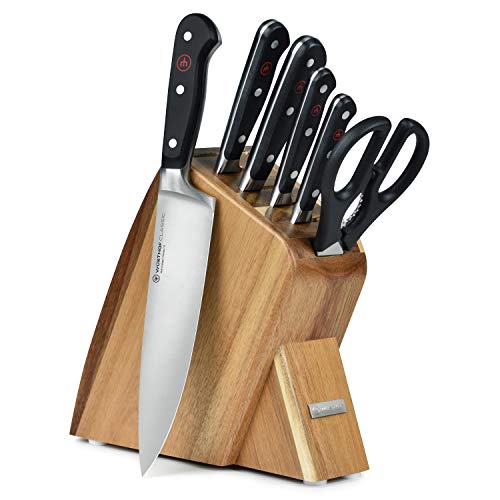
Knife sets present the length question pre-answered, usually with a chef knife in the middle of the range and a supporting cast around it. That default is sensible for most households, which is why sets persist, but it is worth checking the chef knife’s actual blade length before buying a set for its other pieces. Sets vary, and a set whose chef knife runs short will disappoint a cook who batch-preps, whatever the quality of its paring and bread knives. Read the set’s specification for the one knife you will use daily, and let the rest of the set be a bonus rather than the reason.
Building a collection piece by piece inverts the logic in your favour: the chef knife is bought first, at your length, and every later knife is chosen against it. The two approaches can even be combined, since a cook who starts with a set can later replace its chef knife alone with a better-fitting length while the rest of the set serves on. Length, once understood, stops being a property of a purchase and becomes a property of your kitchen, carried from one knife to the next as your cooking and your hands evolve.
One Last Check: The Knife You Reach For
After all the measuring, comparing and testing, there is a final piece of evidence that arrives only with time: the length your hand reaches for, week after week, without thinking. That unthinking reach is the sum of every factor in this guide, hands, board, counter, menu and habit combined, and it is worth noticing after a month with a new knife. If the length you chose disappears into your cooking, noticed only in the ease of the work, the choice was right. If you keep adjusting, compensating or wishing mid-task, the knife is telling you something the specifications could not. Trust the accumulated evidence of your own hands; over a season of ordinary meals, it is the most honest review your kitchen will ever give you.
Common Questions
Should I choose a knife based on blade length alone?
No. Balance, handle shape, blade profile and your board size all matter. Use length as a starting point and then compare the other details.
Is a heavier knife better?
Not necessarily. Heavy knives can feel stable, but they may tire your hand. Choose weight that suits your grip and the amount of cutting you do.
How do I know if a knife is too big for my board?
If the tip hangs over or ingredients crowd the blade, the board is too small. A board noticeably longer than the blade gives more room to work.
How often should I sharpen my chef knife?
It depends on use and the steel. Honing helps keep the edge aligned between sharpenings, and you sharpen when honing no longer restores performance.
Can I put a chef knife in the dishwasher?
Many makers advise against it, since heat, detergent and knocking can damage the edge and handle. Check the care guide and wash by hand when in doubt.
What is the safest way to store a chef knife?
Use a block, magnetic strip, sheath or drawer guard that protects the edge and keeps the blade out of reach of children.
Does blade length include the handle when a listing gives a size?
When a chef knife is described as eight or ten inches, that figure refers to the blade, measured from tip to heel, not the whole knife. The overall length, handle included, is considerably more, and listings usually give both numbers if you look beyond the headline. For storage and board fit, the overall length is the one that matters; for cutting comparisons, use the blade figure.
Is a longer knife harder to sharpen?
Not harder in principle, but it does ask for a steadier stroke, because you must hold a consistent angle along more edge in a single pass. A larger stone gives a longer blade room to travel, which many people find easier than working a long edge on a small stone. If you use a guided system or a professional service, length makes little practical difference at all.
Can a long chef knife replace a slicing knife?
For most home purposes, largely yes. A long chef knife draws through roasts and large fruit in satisfying single strokes, though its taller blade creates more drag than a dedicated slicer’s narrow profile. If you carve large roasts often, a slicer still earns its place; for occasional carving, the long chef knife is a perfectly reasonable stand-in and one less knife to store.
What length suits someone who cooks mainly for one?
Usually the shorter end of the range. Cooking for one involves small quantities, small boards and quick jobs, all of which flatter a nimble six-to-eight-inch blade. The exceptions are batch cooks who prepare several days of food in one session; their prep volume resembles a family cook’s, and a longer blade may serve them better despite the single diner at the table.
Should my second chef knife be longer or shorter than my first?
The opposite, in most kitchens. A second knife earns its storage space by covering the jobs the first handles least well, so a household whose main knife is a compact everyday blade gains most from a longer one for big produce and prep days, and vice versa. Two knives of the same length mostly duplicate each other, which is only useful if two cooks regularly work side by side.
Related reading
6 Best Chef Knives: German, Japanese and Value Picks (2026)
Reference and further practice
WUSTHOF knife maintenance and compatibility FAQs


Ready to Buy? Start Here
If this guide helped you decide what to look for, these products are a place to start.


As an Amazon Associate we earn from qualifying purchases. Prices and availability are shown on Amazon.