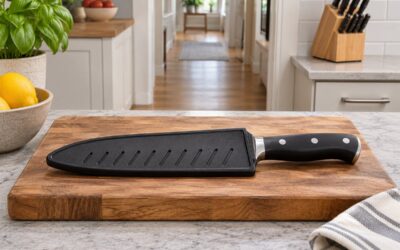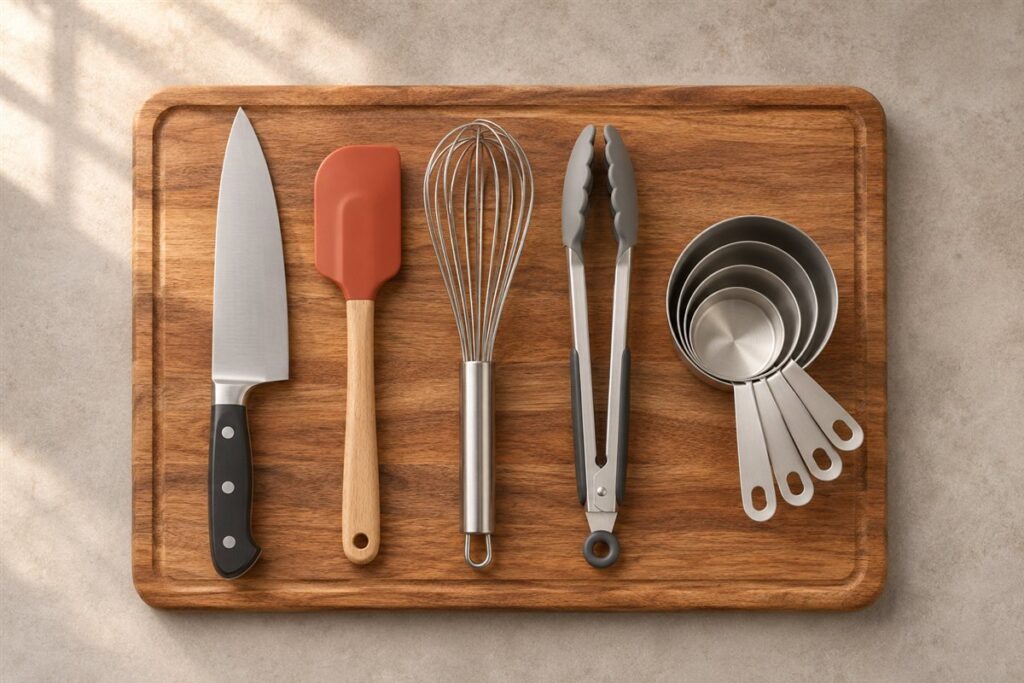
A chef knife has a curved belly that suits a rocking motion, while a santoku has a flatter edge that suits straight up and down chopping. Both handle most kitchen jobs, so the choice comes down to cutting style and hand feel.
What Each Knife Is For
The chef knife comes from the European tradition. It is long, with a pointed tip and a gently curved edge, and it works for meat, vegetables, herbs and more. The santoku, whose name suggests three virtues, comes from Japan and is a shorter all-purpose knife with a straighter spine and a rounded tip, often called a sheep’s foot shape.
Key Differences
| Feature | Chef Knife | Santoku |
|---|---|---|
| Blade length | Often 8 inches or longer | Often 6 to 7 inches |
| Edge shape | Curved belly | Flatter edge |
| Tip | Pointed | Rounded, lowered |
| Cutting motion | Rocking or push cut | Chopping or push cut |
| Weight | Often heavier | Often lighter |
| Scalloped edge | Rare | Some have dimples to help food release |
Details vary by maker, so check the maker’s guide.
Who Should Choose Which
- Choose a chef knife if you like to rock the blade for mincing herbs, want a longer reach for large vegetables or cut up whole chickens.
- Choose a santoku if you prefer a lighter knife, chop in straight motions, have a small board or find a long blade intimidating.
- Consider hand size: A comfortable handle matters as much as the blade shape.
Care and Handling
Both knives need regular honing, occasional sharpening and hand washing. Dry them right away and store them in a block, sheath or magnetic strip that protects the edge. Cut on wood or plastic boards rather than glass or stone.
Always keep your fingers curled and the blade moving away from your body. These are general tips only, so follow the maker’s manual and safety instructions.
Think about your cutting board and kitchen space. A long chef knife needs room to rock, so a small board may feel cramped, while a santoku fits comfortably on a smaller surface. Think about the foods you cut most: large squash, melons and roasts favor the longer knife, while sliced vegetables, boneless fish and herbs are easy with a santoku. Some cooks use both for a few weeks and keep the one they reach for most often. If you visit a shop, hold each knife with a firm, relaxed grip and notice how the weight sits in your hand.
Blade Profile and Cutting Motion
The biggest practical difference lies in how the blade moves through food. A chef knife usually has a belly that curves up toward the tip, which encourages a rocking motion: the tip stays near the board while the heel rises and falls. That motion is efficient for mincing herbs, garlic and onions. A santoku generally has a flatter edge and a lower, rounded tip, which suits an up-and-down chop or a push-and-pull slice with less rocking.
Neither style is wrong, and many people use both motions with either knife. The question is which feels natural. If you like to rock and keep the tip planted, the curved belly will feel at home. If you prefer a straight chopping action and want food to release from the blade, a flatter profile may suit you better.
Blade length and height also play a part. A taller blade gives your knuckles clearance and helps you scoop and transfer food, while a shorter one can feel nimble in smaller kitchens. Many santoku models are shorter than many chef knives, but sizes vary, so check the listing rather than assuming. Think of profile as a matter of habit and preference, not quality.
Blade Surface and Food Release
Some santoku knives have shallow scallops, sometimes called hollow edges or Granton indentations, along the side of the blade. The idea is that small air pockets help thin slices fall away instead of sticking. Some people notice the difference with potatoes, cucumbers or cheese. Others find it makes little difference, particularly when cutting at home with a sharp knife and a dry board. Chef knives are more often smooth, though this is not a rule.
If sticking is a frustration, you can also check blade finish and thickness. A thinner blade with a smooth, polished face can release food well without any scallops. A thicker, heavier blade may take more force in dense items but feels stable for tough jobs.
- Scalloped edges: may help release slices, but the effect varies.
- Smooth sides: easier to clean and sharpen along the full face.
- Thickness: check the listing for spine width if you want a sturdy or a nimble feel.
Whatever you choose, look for a blade finish that resists staining and a spine that does not dig into your finger when you use a pinch grip.
Compare the heel of the blade too, since that is where you do heavy chopping, and check that the profile gives you good knuckle clearance when pressing down through firm vegetables.
Weight, Balance and Handle Feel
Weight and balance shape comfort more than blade shape. A heavier knife lets gravity help on dense foods but can tire your wrist. A lighter knife feels agile but may need more effort. Balance describes where the knife rests when you hold it at the bolster or handle junction. A forward-heavy knife feels powerful in chopping, while a handle-heavy one feels controlled for fine work.
Handles come in many shapes, and a good one fits your hand without cramping. Check whether the handle is smooth or textured, how it feels when wet or greasy, and whether there is room for your knuckles when the blade is flat on the board. Smaller hands may prefer a more compact grip, and larger hands may prefer extra room.
If you can handle the knives in a store, pick each up and mime chopping. If you cannot, read the product description for weight, length and handle material. Do not choose on appearance alone. A knife that feels clumsy leads to fatigue and mistakes, no matter how good the steel.
Many reviews and descriptions mention feel, so read several, but remember that weight, length and handle shape are the facts to compare. Personal comfort should settle the decision.
Tasks Each Knife Handles Well
A chef knife is often described as a general workhorse. Its length and curve suit mincing, slicing larger vegetables, cutting up meat and handling bigger items such as melons or cabbages. A longer blade also gives you a longer slicing stroke, which can be helpful for roasts.
A santoku tends to excel at vegetables, boneless proteins and fish where precise, even slices matter. Its compact size can feel easier for people who cook small meals or work on small counters. The flatter edge supports the straight chopping style often used for stir-fry vegetables.
- Large squash or cabbages: a longer chef knife may be more comfortable.
- Thin slices of vegetables: a santoku can feel precise and tidy.
- Mincing herbs: a curved belly helps rocking.
- Bones or frozen food: neither is the right tool unless the maker says so.
If you are choosing only one, think about your most frequent task and your preferred motion, then pick the knife that supports it.
If you plan to use a sharpening stone, practice on an old knife first so you learn to hold a steady angle. Keep the stone wet as directed, and wipe the blade clean afterward before storing it, ideally in a sheath or on a strip.
Sharpening and Long-Term Ownership
Both styles need regular maintenance, and the style you choose can affect how comfortable sharpening is. A chef knife with a pronounced curve requires you to follow the belly as you sharpen, while a flatter santoku edge can feel more straightforward on a stone. Edge angles also differ by maker and by design, so follow the instructions for your knife or use a sharpening service that can match the original angle.
Hone regularly with a steel or ceramic rod to keep the edge aligned between sharpenings, and sharpen when slicing a tomato requires pressure. Hand wash and dry after each use, keep the blade away from hard surfaces such as glass, and store it in a block, sheath or on a magnetic strip.
When thinking about value, consider replacement parts and the maker’s warranty, along with whether the handle can be repaired. Signs it is time to replace include a persistent loose handle, deep chips that sharpening cannot remove, or a blade that has become bent. A well cared for knife of either style can serve for many years of home cooking.
Whatever you choose, remember that a dull knife of either style is harder and riskier to use than a sharp one, so build a simple sharpening habit into your routine.
FAQ
Can a santoku replace a chef knife?
For many home tasks, yes. It may be less handy for large roasts or heavy chopping.
Which is easier for a beginner?
Many beginners find a shorter santoku easier to control, while a chef knife offers more range as skills grow.
Is a santoku shorter than a chef knife?
Often, though lengths vary by model. Check the listing for the actual blade length before buying.
Why do some santoku blades have dimples?
The shallow scallops are meant to help thin slices release from the blade. The effect varies by food and by knife.
Can I rock a santoku like a chef knife?
You can, but its flatter edge makes rocking less natural. Many people prefer a straight chop or a push cut with it.
Which is better for small hands?
Either can work if the handle and weight suit you. A shorter, lighter knife is often easier to control, so compare dimensions.
Do I need to sharpen them differently?
The principles are the same, but the shape of the edge differs. Follow the maker's guidance on angle and method.
Should I buy both?
Not necessarily. One well chosen knife covers most tasks, and you can add the other later if you find a specific need.
The Short Version
Choose a chef knife for versatility and rocking cuts. Choose a santoku for a lighter feel and straight chopping. Hold both if you can, and go with the one that feels natural.