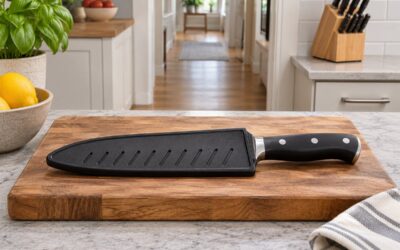
A santoku is a Japanese-style all-purpose knife with a flat edge, a rounded tip and a shorter blade than a typical chef knife. To choose one, focus on length, weight, edge type, handle comfort and how you plan to cut.
What Makes a Santoku Different
The name roughly means three virtues, often read as slicing, dicing and mincing. The blade is usually between 5 and 7 inches, with a fairly straight cutting edge and a sheepsfoot-style spine that drops toward the tip. This shape suits chopping with an up-and-down motion and makes it popular with cooks who prefer a lighter, shorter knife.
Decision Criteria
| Factor | Why it matters | What to check |
|---|---|---|
| Blade length | Control and board space | Around 6 to 7 inches suits many cooks |
| Edge type | Affects feel and upkeep | Plain edge or hollow-ground divots to reduce sticking |
| Steel | Edge hold and care | Stainless is easier to maintain |
| Weight and balance | Fatigue and control | Hold it, if you can |
| Handle | Grip comfort | Size, shape and material |
| Edge angle | Sharpening method | Check the maker’s guide |
Santoku or Chef Knife
- Choose a santoku if you have a smaller board, smaller hands or prefer a light feel.
- Choose a chef knife if you like a rocking motion, handle large produce or want a pointed tip for fine work.
- The flat edge of a santoku works best with a push or chop motion rather than rocking.
Fitting It to Your Hand
- Hold the handle in a pinch grip, with your thumb and forefinger on the blade just ahead of the handle.
- Check that your knuckles clear a flat board.
- Look for a smooth transition between the blade and the handle, with no gaps.
- Consider the blade height; a tall blade gives knuckle room but can feel heavy.
Care Basics
Wash by hand and dry promptly. Hone often, and sharpen with a method that suits the edge angle in the maker’s guide. Japanese-style edges can be harder and thinner, so avoid bones, frozen foods and twisting in hard items. Always cut on a suitable board and store the knife with edge protection.
Maintenance deserves a note. Santoku edges are often sharpened at a slightly narrower angle than many Western chef knives, so use a method that suits the maker advice. Honing on a fine rod or ceramic hone helps, but avoid heavy-handed steel rods on harder blades unless the guide recommends them. Treat the knife gently and it should hold its edge well.
Blade Profile and Cutting Technique
A santoku’s shape guides how you cut with it. The edge is fairly flat from heel to tip, with only a slight curve near the front, and the spine slopes down to a rounded tip. Because of that flat profile, the knife meets the board along most of its length, which makes it well suited to straight up-and-down chopping and push cuts. You press the blade forward and down through the food, lift, and repeat, rather than rocking the tip against the board as many cooks do with a curved chef knife.
This suits a number of everyday tasks. Slicing onions into even rings, cutting peppers into strips, dicing carrots and cutting through cabbage are all straightforward with a flat edge and a tall blade. The wide blade doubles as a scoop: after you chop, you can slide the flat of the blade under the pile and move it to the pan. The rounded tip is less suited to fine detail work such as scoring or peeling small items, so a paring knife still has a place in your kit.
If you are used to rocking cuts, expect a short adjustment period. Slow, deliberate strokes help you learn the push-cut rhythm, and keeping the fingers of your guiding hand curled keeps them clear of the edge. A flat board is important, because a warped or uneven board leaves gaps under the flat edge and makes cuts uneven. Choose a blade profile that matches the way you naturally move: if you chop in straight lines and like a light knife, a santoku is a good fit; if you prefer to rock, look at the curve of the profile in the listing photos before you decide.
Construction: Forged, Stamped and Tang
How a santoku is made affects weight, balance and durability. Forged knives are shaped from a heated piece of steel and often have a thicker spine and a bolster, the band between blade and handle. Stamped knives are cut from a sheet of steel and tend to be lighter and thinner. Neither method is automatically better; forged knives often feel more substantial and stamped knives often feel nimble. The product listing should state which method is used, and you can compare how each style suits your hand and your tasks.
Tang describes how far the blade metal extends into the handle. A full tang runs the length of the handle and is usually visible along the edges, which is often associated with strength and balance. A partial tang stops short, and some lighter knives use this design for a different feel. Check how the handle is attached: rivets should sit flush, and there should be no gaps where food and moisture can collect. Gaps at the joint are a common place for grime to build up over time.
Look at the finish of the spine and heel. A softly rounded spine is more comfortable for a pinch grip, while a sharp spine can dig into your finger. A bolster can add weight at the front of the handle, which some cooks like for balance, but it can get in the way when sharpening, so consider whether you prefer a bolster-free design. The details are described in listings, so read the material, tang and construction notes rather than relying on looks alone.
- Forged: often heavier and more substantial.
- Stamped: often lighter and more nimble.
- Full tang: usually runs the length of the handle; check the listing.
Steel, Hardness and What It Means for You
Steel choice sets the trade-off between edge sharpness, edge retention and toughness. Harder steels can take a keener edge and hold it longer, but they may chip if twisted or used on bones, which is why many Japanese-style knives are used gently on soft ingredients. Softer steels are tougher and easier to sharpen, but they may need more frequent attention. Stainless steel resists rust and is easier for most home cooks to manage, while carbon steel can take a very sharp edge but reacts to moisture and acidic food.
Listings often mention hardness using a number on a scale, or a steel name. Treat these as clues rather than guarantees, and check that the figures come from the maker. A single number rarely tells the whole story, because the heat treatment, edge geometry and thickness also change how the knife performs. If you are unsure, look for descriptions that cover the intended use and the recommended care.
Some santoku knives use layered or clad construction, with a hard core steel surrounded by softer outer layers. The idea is to combine edge performance with toughness and corrosion resistance, but the exact benefit depends on the design. If you cook mostly vegetables, boneless meat and fish, a harder, thinner blade can work well. If you tend to use your knife for tougher tasks, such as cutting squash, a sturdier blade with a slightly more robust edge may be more comfortable. Be honest about how you cook and choose steel that fits, rather than the highest-sounding figures.
Edge Patterns, Bevel and Handedness
Many santokus have a row of shallow dimples or scallops along the side of the blade, sometimes called a granton or hollow edge. The idea is that small air pockets reduce suction between the blade and moist food such as potatoes or cucumbers, so slices fall away more readily. The effect varies with design and technique, so treat it as a convenience rather than a necessity. Plain-sided blades cut perfectly well, and you may find a plain side easier to clean and sharpen.
Bevel is another point to check. Most knives sold for home use have a double bevel, ground on both sides of the edge, which suits left- and right-handed cooks equally. Some Japanese-style knives use a single bevel, ground on one side only, which can give extremely fine slicing but is handed and requires different technique. If a listing says single bevel, check whether it is made for left or right hand and whether it matches yours. Most beginners will find a double bevel easier to use and maintain.
Handle shape also matters for handedness. Rounded or oval handles suit both hands, while contoured handles with a thumb indent may favor one side. Handle materials differ: wood, composite and synthetic types vary in grip when wet and in how they feel. A handle that is too small can cramp your hand, while one that is too bulky can feel clumsy, so consider your hand size. If you can, hold the knife before you buy and imitate a pinch grip and a chopping motion to check comfort.
Questions to Ask Before Buying and Budget Tiers
A few questions can narrow your choice quickly. What do I cut most often: vegetables, boneless meat, fish or bread-like items? How much board space do I have? Do I want a very light knife, or something with more heft? Am I comfortable maintaining a thinner, harder edge, or do I prefer a forgiving blade? Is the knife left- or right-hand specific, and does the maker describe the intended care?
Budget tiers differ in steel, construction, fit and finish rather than in simple quality. Entry-level santokus are usually stamped, with simpler handles and softer steel. They are sufficient for casual cooking and easy to maintain. Mid-range options often add better steel, improved handle materials and more careful finishing. Higher-priced knives may use specialized steel, hand finishing or decorative features. Read the listing for the details, and weigh them against how you cook rather than assuming that more expensive always means better for you.
It is also worth thinking about the rest of your set. A santoku can replace a chef knife for many cooks, but if you already own one that works, a santoku may overlap. Consider adding a paring knife for detail work and a serrated knife for bread, which a santoku does not handle well. Check the return policy and warranty details in the listing, and look at the finish on arrival: the edge should be even, the spine smooth, and the handle joint tight.
FAQ
Are the dimples on the blade important?
They are meant to reduce food sticking when slicing, though results vary by food. They are a preference, not a requirement.
Can a santoku replace a chef knife?
For many home tasks, yes. Cooks who rock the knife or handle big items may prefer a chef knife.
Is a santoku good for beginners?
Many beginners like it because it is light, easy to control and suits straight chopping. Choose a double-bevel blade of moderate length, and take time to learn the push-cut motion.
What length should I choose?
Blades around 6 to 7 inches suit many cooks, while shorter ones feel nimble on small boards. Check the listing for the exact length, and think about your counter and board space.
Can I cut bread with a santoku?
A plain edge is not ideal for crusty bread, which is better with a serrated knife. A santoku can handle soft rolls, but it may crush the crumb.
Is a forged santoku better than a stamped one?
Not necessarily. Forged knives tend to feel heavier and more substantial, and stamped ones lighter and more nimble. Choose according to the feel you prefer.
Are left-handed santokus available?
Double-bevel knives with a symmetrical handle suit both hands. Single-bevel knives are handed, so check the listing for left- or right-hand versions before you buy.
Can I use a santoku on frozen food or bones?
It is best to avoid this. Thin, hard blades can chip or bend, so use a heavier knife or follow the maker's advice for tough ingredients.
How do I know the handle fits my hand?
Hold it in a pinch grip and mimic a chopping motion. Your fingers should clear the board without cramping, and the handle should not twist or feel slippery.
The Short Version
Choose a santoku for a light, short, flat-edged all-rounder. Check the length, balance, handle and care needs before you settle.