The right chef knife is one that suits your hand, your cutting habits and the care you are willing to give. Think about blade length, weight, handle shape and steel type, and hold a knife in person if you can before you decide.
Decision Criteria
| Factor | Why It Matters | What to Check |
|---|---|---|
| Blade length | Affects reach and control | Many home cooks like about 8 inches; smaller hands may prefer 6 to 7 |
| Weight | Changes how tiring long prep feels | Hold it and make a few cutting motions |
| Balance | Influences control | See where it rests on your finger near the handle |
| Handle | Comfort and grip | Look for smooth edges and a shape that fits your hand |
| Steel type | Affects edge holding and upkeep | Read the maker’s guide on care and rust resistance |
| Construction | Strength and feel | Forged or stamped, full tang or partial |
Understanding the Steel
Stainless steel resists rust and is easy to maintain. Higher carbon steel can take a very sharp edge but may stain or rust if left wet. Harder steels often hold an edge longer but may chip if used on bones or hard foods, while softer steels are tougher but need honing more often. The maker’s guide usually describes the intended use.
Try Before You Decide
- Hold the knife with a pinch grip, with your thumb and forefinger on the blade just ahead of the handle.
- Check that your knuckles clear the board with the knife flat.
- Mimic a rocking motion in the air and see whether the weight feels natural.
- Think about the board you own. A long blade needs a long board.
Plan for Care
- Hand wash and dry the knife right away.
- Hone often and sharpen when needed.
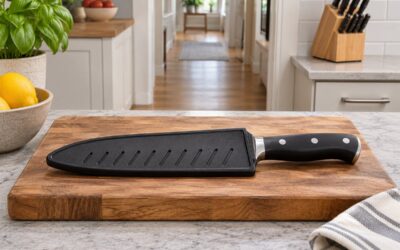
- Store the edge protected, in a block, sheath or magnetic strip.
- Use wood or plastic boards.
Sharp knives demand attention. Keep fingers curled, cut away from your body and follow the maker’s manual and safety instructions.
Consider how much time you want to spend on upkeep. A knife that needs frequent sharpening or careful drying may sit unused in a busy household, while an easy-care stainless knife may suit a cook who wants low fuss. Also think about whether you are left or right handed, since most knives have a symmetrical grind but a few are shaped for one hand. Read the maker’s guide about the grind and whether the knife can be sharpened at home.
Blade Shapes and Profiles
Not all chef knives are shaped alike. A French or Western profile has a curved belly that suits a rocking motion, with the tip staying near the board. A German-style profile tends to be fuller and curved, while a Japanese-style gyuto is often flatter and thinner. The flatter the edge, the more it suits a push-and-slice or chopping motion.
Think about how you cut. If you rock the knife across herbs, a curved belly helps. If you chop straight down, a flatter edge makes full contact with the board. Blade height matters too: a taller blade gives knuckle clearance and a place to rest your pinch grip, while a shorter blade feels nimble.
Pay attention to the tip. A pointed tip is useful for detail work, while a rounder one is more forgiving. Check the product listing for the profile description, and if you can, hold a few shapes to see which feels natural.
Handle Materials and Grips
The handle affects comfort and control as much as the blade. Common materials include wood, composite, plastic and metal. Wood feels warm and can be shaped nicely, but it needs more care and should not be soaked. Composite handles resist moisture and are easy to maintain. Plastic is light and affordable. Metal is durable but can be slippery when wet.
Check the shape. Some handles are round, some are oval and some are angular. An oval or contoured handle helps keep the knife from rolling in your hand. Look for smooth joins between the handle and blade, since gaps can collect dirt.
- Pick the knife up with a dry and a wet hand if you can, to test grip.
- Check that the handle is large enough for your hand size.
- Look for rivets that sit flush with the surface.
Comfort over a long prep session matters more than looks.
Western Versus Japanese Style
Knife makers often describe two broad styles. Western knives tend to be heavier, with thicker blades that tolerate rougher use. Japanese-style knives are often lighter, with thinner blades and a harder steel that takes a keen edge but may chip if misused. These are generalizations, so check the specific knife.
A heavier knife can feel more stable for hard vegetables, while a lighter one can reduce fatigue and feel precise. Thinner blades slice more easily but can be less forgiving with twisting or prying. Some cooks prefer a thicker spine to resist bending.
Sharpening also differs. Harder steels can take a fine angle but may need careful handling, while softer ones are easier to hone. Think about your habits and maintenance preferences. A beginner who wants durability might lean toward a sturdier build, while a precise cook may prefer a lighter one. Always follow the maker’s instructions for care.
Budget Tiers and What to Expect
Chef knives span a wide range. Lower-cost knives are often stamped from a sheet of steel and can be perfectly usable, though they may be lighter, with less refined edges and handles. Mid-range knives often use better steel, improved balance and more comfortable handles. Higher-end knives may feature forged construction, specialty steels and finer finishing.
Price alone does not guarantee a good fit. A knife that is comfortable in your hand and easy to maintain will serve you better than a costly one that is awkward. Consider the cost of upkeep too, such as honing tools or sharpening.
Spend more on the knife you use most, and skip extras you do not need. If you are unsure, begin with a reliable, comfortable knife and learn what you like before upgrading. Check the warranty or return policy, since a knife you can try is easier to choose.
Common Buying Mistakes
A few errors come up often. Buying by brand or looks without holding the knife can lead to a poor fit. Choosing a blade too long for your board or your hand makes control harder. Ignoring care needs can mean a knife that rusts or dulls quickly.
- Buying a large set when you only use one or two knives.
- Choosing a very hard steel without knowing how to care for it.
- Skipping a sheath, block or strip, then storing the knife loose.
- Assuming that heavier means better.
- Not checking whether the knife is left or right oriented.
Ask yourself a few questions before buying. How often do I cook? What do I cut most? How much maintenance will I do? Where will it be stored? Answering these narrows the choices quickly. If a store allows, handle several knives before deciding.
FAQ
Is an expensive knife necessary?
No. Comfort, sharpness and care matter most. Choose what suits your hand and habits.
Should I buy a knife set?
A single good chef knife often does more than a large block of rarely used blades.
What length chef knife is best for beginners?
Many home cooks find about 8 inches comfortable, while those with smaller hands may prefer a shorter blade. Hold one if you can and check how it fits your board.
Is a forged knife better than a stamped one?
Not always. Forged knives are often heavier with more mass near the handle, while stamped knives can be lighter and still cut well. Choose by feel and care needs.
Do I need a full tang?
A full tang can add strength and balance, but it is not the only measure of quality. Check the maker's description and how the knife feels.
How often should I replace a chef knife?
With care, a good knife can last many years. Replace it if the blade is bent, badly chipped, loose in the handle or cannot hold an edge after sharpening.
Can I use a chef knife for bones?
Most chef knives are not meant for bones or frozen food, which can chip the edge. Check the maker's guidance.
Is stainless or carbon steel easier to care for?
Stainless steel generally needs less upkeep and resists rust. Carbon steel can take a sharp edge but needs drying and care to avoid rust and staining.
The Short Version
Choose by fit first: length, weight, balance and handle. Then consider steel and care. A comfortable knife is one you will use and keep sharp.