Disclosure: topratedkitchenware.com is reader-supported. When you buy through links on our site, we may earn an affiliate commission from Amazon and other retailers, at no extra cost to you.
Where to buy
If you are shopping for the best food processors for nut flour, the six models below are the shortlist this guide is built around. Prices and availability change often on Amazon, so use the links to check the current listing before you buy. Orders are placed on Amazon, and the listing there carries the full manufacturer detail for each model.
- Best Overall: BLACK+DECKER 8-Cup Food Processor — Check on Amazon
- Cuisinart Core Custom 4-Cup Mini Chopper — Check on Amazon
- Cuisinart Elemental 4-Cup Chopper/Grinder — Check on Amazon
- KitchenAid 3.5 Cup Food Chopper — Empire Red — Check on Amazon
- BLACK+DECKER 1.5-Cup Electric Food Chopper — Check on Amazon
- KitchenAid 3.5 Cup Food Chopper — Contour Silver — Check on Amazon
Read the full guide ↓
The best food processors for nut flour succeed at a job defined by a stopping point. Nut flour — almonds ground for baking, hazelnuts for cakes, cashews for sauces and coatings — is what nuts become just before they become butter, and the entire craft lies in stopping there: fine, dry, and powdery, with the oils still locked inside the particles instead of released into a paste. That makes this a guide about control more than power. The machine must grind evenly and quickly, the maker must work in the right load sizes and rhythms, and the difference between flour and the first stage of butter is measured in seconds of extra running.
Why make your own at all? Freshness and fit. Nut flours stale faster than almost any baking ingredient once ground, because grinding exposes the oils to air; a flour milled minutes before it meets the batter tastes like the nut itself, and you choose the nut, the roast level, and the fineness — coarse for crumb toppings and rustic bakes, fine for delicate cakes and macaron-style work. Store-bought flour is one grind, one age, one nut. A processor on your counter is all of them, on demand, in exactly the quantity the recipe needs.
This list is honestly shaped for that work: one mid-size eight-cup machine for proper baking quantities, and a set of compact choppers and grinders whose small bowls are a genuine advantage here, because nut flour is best ground in small loads that stay in the blade’s path and never get the chance to warm and clump. If your interest runs the other way — pushing past flour all the way to butter — our guide to the Best Food Processors For Nut Flour Grinding covers the grinding technique in depth, and the butter guides in this series cover the destination.
Key Takeaways
- Nut flour is a stopping point: fine and dry, ground just short of the moment the nuts release their oils and turn to butter.
- Small loads grind finer and more evenly than full bowls — compact choppers are a genuine advantage for this job, not a compromise.
- Short pulses with shake-and-scrape pauses beat one long run, which warms the nuts and invites clumping and paste.
- Cold, dry nuts grind best; a brief chill firms the oils and buys you working time before the flour turns.
- Sift and return the coarse pieces for a second pass when a recipe needs a truly fine, even flour.
- Check the latest price on Amazon through the links here before choosing your mill of choice.
In this guide
Quick Picks
The eight-cup BLACK+DECKER leads for baking-day quantities, and the five compacts divide the small-batch work between them: two Cuisinart minis with different blade talents, two finishes of KitchenAid’s pulse-friendly chopper, and a tiny one-touch chopper for the smallest amounts of all.
| Pick | Badge | Why it earns its place |
|---|---|---|
| BLACK+DECKER 8-Cup Food Processor | Best Overall | An eight-cup bowl and four-hundred-fifty-watt motor for recipe-scale batches, with grind named among its jobs. |
| Cuisinart Core Custom 4-Cup Mini Chopper | Best for Small Flour Batches | A four-cup auto-reversing mini that keeps a small load moving evenly through the blade. |
| Cuisinart Elemental 4-Cup Chopper/Grinder | Best Grinder-Style Pick | A four-cup chopper-grinder whose BladeLock makes decanting fine, dusty flour cleaner and safer. |
| KitchenAid 3.5 Cup Food Chopper — Empire Red | Best Pulse Control | Two speeds plus pulse — the control that stopping exactly at flour demands — in Empire Red. |
| BLACK+DECKER 1.5-Cup Electric Food Chopper | Best for Tiny Amounts | A one-touch, one-and-a-half-cup chopper for spice-scale amounts of nut flour, fresh per recipe. |
| KitchenAid 3.5 Cup Food Chopper — Contour Silver | Best as a Dedicated Second Unit | The same KitchenAid chopper in Contour Silver, ideal as a dedicated dry-goods unit that never meets oily work. |
How These Picks Were Chosen
Picks were compared on the qualities flour-grinding actually tests: bowl size relative to sensible load size, control granularity — pulse and speed options matter enormously when the target is a stopping point — blade behaviour on dry ingredients, and how cleanly a fine, dusty product can be decanted and the machine cleaned afterwards. That comparison explains this list’s compact-heavy shape. Large bowls encourage large loads, and large loads of nuts grind unevenly, warm quickly, and tip into paste at the centre while staying coarse at the edges. Small bowls enforce the discipline the job wants.
We also looked for honest specification. The BLACK+DECKER listings state their wattages plainly — four hundred fifty for the eight-cup, one hundred fifty for the one-and-a-half-cup — and we cite them as listed. The KitchenAid choppers appear twice in this assignment’s pool in two finishes, Empire Red and Contour Silver, on the same KFC3516 platform; rather than pretend they are different machines, this guide treats the second as what it sensibly is — a dedicated second unit, so a dry-goods chopper never has to share duty with oily or wet work, a real workflow advantage for flour makers.
This is research-led guidance: listings and manufacturer descriptions weighed against the known behaviour of ground nuts, with no invented testing claims. The physics is not in dispute — small loads, cold nuts, short pulses, sift and repeat — and the reviews below rank these six machines by how well each design supports that method. For the savoury side of small-batch processing, our guide to the Best Food Processors For Nutbutter covers the same compact class taken to the opposite, glossy extreme.
The 6 Best Food Processors for Nut Flour
Each review names the batch scale the machine suits, the control it gives you at the critical stopping point, and its honest limit. With flour, the limit is usually load size — respect it and every machine here produces clean, dry, usable flour.

BLACK+DECKER 8-Cup Food Processor
Badge: Best Overall
Strengths
- Eight-cup bowl handles recipe-scale quantities in a few small-load passes
- Four-hundred-fifty-watt motor with grind named among its jobs
- Attachments to shred, slice, mince, and puree make it the kitchen’s general processor too
Trade-offs
- Eight cups tempts overloading — flour still grinds best in modest loads within it
- Four hundred fifty watts asks for the pulse rhythm rather than one long run
- No dedicated pulse program is named, so the stopping point is judged by eye and hand
Key specs from the listing: Capacity: 8 cups. Power: 450W. Blade: stainless steel. Jobs named: shred, slice, mince, grind, puree.
The BLACK+DECKER 8-Cup leads this guide as the baking-day machine: the bowl and motor for recipe-scale quantities, with grind explicitly among its named jobs alongside shred, slice, mince, and puree. The right way to use its size for flour is as a reservoir, not a load — work through a recipe’s worth of almonds in several modest passes, each small enough to circulate and stay cool, tipping each finished pass into a bowl and starting the next. Run that way, its four hundred fifty watts and stainless blade produce consistent flour at a pace a compact cannot match across a full baking session.
Its general attachments matter to the flour maker more than they first appear: the same machine that mills the almonds slices the apples and shreds the cheese for the rest of the bake, which is how a processor earns permanent counter space. The disciplines are the usual ones — pulse rather than run, watch for the moment the texture turns from sandy to silky, and stop before warmth and clumping begin. There is no program to judge that moment for you; flour rewards attention, and this machine gives you a capable, uncomplicated platform for paying it.
Best for: baking-day quantities ground in disciplined small-load passes / Not suited for: single huge loads — its size is a reservoir, not a load

Cuisinart Core Custom 4-Cup Mini Chopper
Badge: Best for Small Flour Batches
Strengths
- Four-cup bowl is the right scale for a baking session’s worth of flour
- Auto-reversing stainless steel SmartPower blade keeps the load circulating evenly
- Dishwasher-safe parts make flour-dust cleanup simple
Trade-offs
- Four cups caps each load; a big baking day means several passes
- Mini format prefers short runs with rests on harder nuts
- No full-size attachments — a specialist, not a station
Key specs from the listing: Capacity: 4 cups. Blade: auto-reversing stainless steel SmartPower. Care: dishwasher-safe parts. Finish: white/stainless steel. Model: MCH-4.
The Core Custom 4-Cup is the single-recipe specialist. Four cups is a comfortable load scale for the flour one bake needs, and its auto-reversing SmartPower blade — which changes direction between chop and grind behaviour — keeps a small load of nuts circulating through the cutting zone instead of settling into a static ring, which is the compact class’s core advantage for even grinding. Flour from a well-managed four-cup load comes out noticeably uniform, because every particle keeps meeting the blade.
Dishwasher-safe parts close the deal for frequent use: flour dust gets everywhere, and a bowl that goes straight in the dishwasher gets ground in far more often than one demanding a careful hand wash. The limits are scale and stamina, as with every compact here — a wedding-cake quantity of flour means many passes, and hard nuts deserve rests between runs. For the home baker whose flour needs run to a cake, a batch of biscuits, or a week’s breakfasts, this size and this blade behaviour are very well judged indeed.
Best for: one recipe’s flour at a time, ground evenly and fresh / Not suited for: large-quantity production for big baking projects

Cuisinart Elemental 4-Cup Chopper/Grinder
Badge: Best Grinder-Style Pick
Strengths
- Four-cup chopper-grinder brief is precisely this job
- BladeLock secures the SmartPower blade, so fine flour pours out without a loose blade following
- Compact size keeps small loads in the blade’s path for even grinding
Trade-offs
- Four-cup ceiling, with the compact family’s rested-run discipline
- The grinder brief means no slicing or full-size jobs around it
- Silver finish shows flour dust until wiped
Key specs from the listing: Capacity: 4 cups. Blade: SmartPower with BladeLock safety system. Finish: silver. Model: ECH-4SV.
The Elemental 4-Cup Chopper/Grinder is the pick whose details were clearly designed by someone who has actually decanted ground nuts. Its BladeLock system secures the SmartPower blade in place when you pour, so the flour leaves the bowl and the blade does not — no fishing a sharp blade out of a bowl of fine, dusty flour, no flour spilled across the counter at the final step. In a job where the product is a light, mobile powder, that single detail improves every single batch.
The chopper-grinder brief fits the work exactly: four cups, a compact footprint that keeps loads in the blade’s path, and no pretensions toward slicing or station duties it does not have. Spiced flour blends — nuts ground with a little cinnamon or cacao for a specific bake — are a natural speciality, ground and seasoned in the same small bowl. Its ceiling is the family’s usual one: small loads, rested runs, and a silver finish that will show every batch’s dust until wiped. For makers whose flour work is precise, small-scale, and frequent, this is the most thoughtfully detailed tool in the list.
Best for: precise small batches and spiced flour blends, poured cleanly / Not suited for: any full-size or high-volume work

KitchenAid 3.5 Cup Food Chopper — Empire Red
Badge: Best Pulse Control
Strengths
- Two speeds plus pulse give the fine control the flour stopping point demands
- Three-and-a-half-cup bowl suits a single recipe’s quantity in one or two loads
- Dishwasher-safe bowl and easy cord wrap suit frequent, small grinding sessions
Trade-offs
- Small loads only; recipe-scale flour means repeated batches
- Colour is a long-term commitment for a daily counter tool
- No grinder-specific locking blade for pouring, unlike the Elemental
Key specs from the listing: Capacity: 3.5 cups. Blade: stainless steel multi-purpose. Controls: 2 speeds plus pulse. Care: dishwasher-safe work bowl. Feature: easy cord wrap. Finish: Empire Red. Model: KFC3516ER.
The KitchenAid 3.5 Cup in Empire Red brings the control this job prizes most: two speeds plus pulse. Flour is a stopping point, and stopping points are hit with pulses — short bursts, a shake of the bowl, a look and a pinch between your fingers, another burst — rather than with a single committed run. The two speeds let you break whole nuts down on the higher setting and finish delicately on the lower, and the three-and-a-half-cup bowl is sized for one recipe’s quantity, ground in one or two fresh loads.
The supporting details suit a machine that will be reached for constantly: a dishwasher-safe work bowl, a stainless steel multi-purpose blade, and an easy cord wrap for tidy storage. Empire Red itself is a genuine consideration, not a joke — a chopper that lives on the counter for years should be a colour you enjoy, and this finish has devoted followers for a reason. Its limits are the compact standards: small loads, repeated batches for big bakes, and no locking blade for pouring. Judge it as the control pick, and it earns the badge comfortably.
Best for: makers who want speed-and-pulse control at the stopping point / Not suited for: bulk flour for large bakes
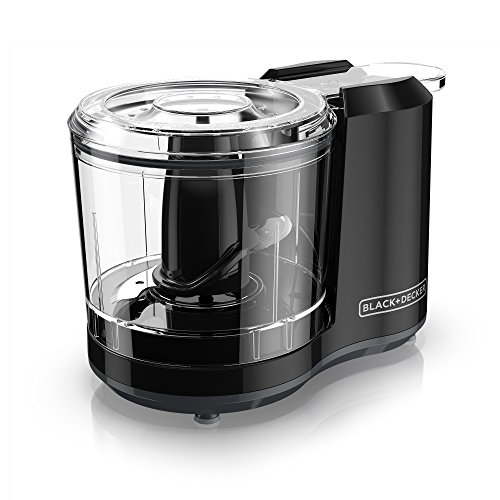
BLACK+DECKER 1.5-Cup Electric Food Chopper
Badge: Best for Tiny Amounts
Strengths
- One-and-a-half-cup size is perfect for the few spoonfuls many recipes actually need
- One-touch pulse operation is exactly the short-burst rhythm flour wants
- One-hundred-fifty-watt motor, stay-sharp blade, and dishwasher-safe parts in a tiny footprint
Trade-offs
- Strictly tiny quantities — a garnish or small recipe, not a baking day
- One hundred fifty watts is for short pulses, not sustained grinding
- One-touch only: no speed range to finesse different nuts
Key specs from the listing: Capacity: 1.5 cups. Power: 150W. Operation: one-touch pulse. Blade: stay-sharp. Care: dishwasher safe.
The BLACK+DECKER 1.5-Cup is the smallest machine in this guide and, for a surprising number of real recipes, the most correctly sized. Many bakes call for a few spoonfuls of nut flour — a dusting for a tin, a thickener for a sauce, a coating for fried food, a small crumble topping — and grinding that amount in a big bowl is hopeless, because the nuts never gather in the blade. In a one-and-a-half-cup bowl with one-touch pulse operation, a handful of nuts becomes flour in a few short bursts, fresh at the moment of use.
One-touch pulse is, almost by accident, the ideal interface for flour: the machine can only run in the short bursts the job wants, and its one-hundred-fifty-watt motor is asked for nothing more. The stay-sharp blade and dishwasher-safe parts keep it effortless. The boundary is absolute, though — this is a spoonfuls tool, and a baking day’s flour would take it an unreasonable number of loads. Keep it for what it is: the freshest possible small quantities, ground at the stove, in seconds, with a rinse for cleanup. Kitchens that cook in small, frequent touches will use it constantly.
Best for: spoonful quantities ground fresh at the moment of use / Not suited for: recipe-scale quantities or sustained grinding

KitchenAid 3.5 Cup Food Chopper — Contour Silver
Badge: Best as a Dedicated Second Unit
Strengths
- The same proven two-speed-plus-pulse control as its red sibling
- A dedicated dry-only unit avoids oily residue ever reaching your flour
- Contour Silver finish suits kitchens that prefer a quieter counter presence
Trade-offs
- Mechanically the same machine as the Empire Red pick — you are choosing a finish and a second unit, not an upgrade
- Same small-load ceiling and rested-run discipline as its sibling
- Two finishes in one guide reflects the pool; one unit is enough for most kitchens
Key specs from the listing: Capacity: 3.5 cups. Blade: stainless steel multi-purpose. Controls: 2 speeds plus pulse. Care: dishwasher-safe work bowl. Feature: easy cord wrap. Finish: Contour Silver. Model: KFC3516CU.
The Contour Silver KitchenAid is, mechanically, the same KFC3516 chopper as the Empire Red pick above it — same three-and-a-half-cup bowl, same two speeds plus pulse, same stainless multi-purpose blade — and this guide will not pretend a finish is a feature set. Its honest role in a flour kitchen is different in kind, though: it is the dedicated second unit. Flour work is dry work, and dry work suffers when it shares a bowl with oily, wet processing; a chopper reserved for nuts, spices, and crumbs always starts clean, dry, and uncontaminated, and its flour never picks up yesterday’s garlic or last week’s nut butter residue.
That dedication is worth more than it sounds. Cross-contamination of flavours is the quiet enemy of delicate baking, and a dry-only unit removes it entirely, while also meaning one machine is always free when the other is mid-recipe or in the dishwasher. Contour Silver’s quieter finish suits the second-unit role — present, useful, not demanding attention. Most kitchens need only one of these two KitchenAids; a serious baker who grinds flour weekly will understand exactly why owning the pair, one for dry and one for everything else, is a system rather than an indulgence.
Best for: a dedicated dry-goods unit alongside a general chopper / Not suited for: anyone expecting a different machine from the red version
Comparison Table
For flour, compare control and load scale before anything else: the machine whose bowl matches your typical quantity, and whose controls let you stop precisely, makes the finest flour.
| Pick | Bowl and format | Blade and controls | Stands out for | Listing |
|---|---|---|---|---|
| BLACK+DECKER 8-Cup Food Processor | 8-cup bowl | 450W motor; grind among named jobs; stainless blade | Recipe-scale batches in passes | Check on Amazon |
| Cuisinart Core Custom 4-Cup Mini Chopper | 4-cup mini bowl | Auto-reversing SmartPower blade; dishwasher-safe parts | Even small-recipe flour | Check on Amazon |
| Cuisinart Elemental 4-Cup Chopper/Grinder | 4-cup chopper-grinder bowl | SmartPower blade with BladeLock; silver finish | Clean pouring of fine flour | Check on Amazon |
| KitchenAid 3.5 Cup Food Chopper — Empire Red | 3.5-cup bowl | Stainless blade; 2 speeds plus pulse; cord wrap | Pulse control, Empire Red | Check on Amazon |
| BLACK+DECKER 1.5-Cup Electric Food Chopper | 1.5-cup mini bowl | 150W motor; one-touch pulse; stay-sharp blade | Spoonful quantities, fresh | Check on Amazon |
| KitchenAid 3.5 Cup Food Chopper — Contour Silver | 3.5-cup bowl | Stainless blade; 2 speeds plus pulse; cord wrap | Dedicated dry unit, Contour Silver | Check on Amazon |
How to Choose a Food Processor for Nut Flour
Start with your typical quantity, because it decides your bowl. Nut flour must be ground in loads small enough to circulate freely in the blade’s path; too large a load grinds unevenly and warms toward paste, too small a load in too large a bowl never gathers at all. A household grinding a cake’s worth at a time belongs in the three-and-a-half to four-cup class. A baker producing a full session’s flour belongs with the eight-cup machine used in passes. A cook who needs spoonfuls belongs with the tiny one-touch chopper. There is no virtue in owning capacity your loads never fill.
Control is the second criterion, and for flour it outranks power. The target is a moment — the moment the grind is fine, dry, and even, just before oil release — and moments are hit with pulses, speed changes, and pauses to shake and inspect. Two speeds plus pulse, as on the KitchenAid choppers, or a disciplined pulse rhythm on any machine here, will make finer flour than raw wattage run continuously. When you read listings, look for the controls that let you stop precisely, and treat headline power as background information.
Blade and bowl details decide how the finished flour leaves the machine. Fine flour is dusty, mobile, and eager to escape; a locking blade, like the Elemental’s BladeLock, keeps the pour clean and safe, and dishwasher-safe bowls make the inevitable dust a non-event. If you grind often, these unglamorous details will shape your experience of the job far more than any specification headline, because you will pour and wash after every single batch while you will consult the wattage never.
Consider dedicating the machine to dry work. Flour absorbs flavours and moisture from a bowl’s history; a unit that also purees soups and grinds oily butters will eventually season a delicate almond flour with something it should not taste of. Serious flour makers often keep a compact chopper for dry goods only — which is precisely the role the second KitchenAid in this guide is framed for — and let other machines carry the wet work. The same dry-discipline thinking appears in our guide to the Best Food Processors For Pureeing, where the opposite, wettest work gets its own dedicated logic.
Finally, match the machine to your nuts. Almonds are the standard and grind willingly; hazelnuts carry more oil and tip toward paste sooner, rewarding colder nuts and shorter pulses; cashews are soft and grind fast, asking restraint; walnuts and pecans are oily and delicate. A varied flour practice wants control and small loads above all — which is why this guide’s centre of gravity sits exactly where it does.
How to Grind Nut Flour Without Turning It Into Butter
The method is a rhythm of bursts and pauses, and it is the same on every machine in this guide. The two enemies are heat and time: both release the nuts’ oils, and released oil is the road to butter. Everything below — cold nuts, small loads, short pulses, sifting — exists to keep the grind fine and dry before those enemies gather. Master the rhythm once and every nut you meet afterwards is a variation, not a new problem.
Begin with dry, cool nuts. A brief chill in the fridge firms the oils and buys working time, especially with oily nuts like hazelnuts, walnuts, and pecans. If a recipe calls for blanched or skinned nuts, prepare them before grinding; skins left on make a speckled, slightly coarser flour, which is a legitimate style choice for rustic bakes and an error for delicate ones.
- Chill the nuts briefly if they are oily varieties, and make sure they are completely dry.
- Load the bowl modestly — the nuts should move freely, never pack the bowl.
- Pulse in short bursts, stopping to shake or scrape the bowl between bursts so the grind stays even.
- Watch the texture: crumbs first, then a sandy meal, then fine flour — stop while it is still dry and powdery.
- Tip the flour into a sieve over a bowl; return any coarse pieces to the machine for a second short pass.
- For the finest baking flour, repeat the sift-and-return once more rather than running one long grind.
- Use the flour promptly, or store it airtight in the fridge, away from heat and light.
- Wipe or wash the bowl straight away; nut oils left on parts will stale and flavour the next batch.
Sifting is not fussiness — it is how a processor’s flour becomes a baker’s flour. A processor grinds unevenly by nature, with fine particles and stubborn coarse pieces sharing every load; the sieve separates them, the coarse pieces get their second pass alone, and the combined result is a uniform flour that behaves predictably in batter. Skipping the sift is how a cake ends up with gritty pockets and a delicate sponge turns dense in patches.
Know the rescue moves too. If a batch starts to clump and gloss — the first whisper of butter — stop immediately, spread the flour on a tray, and let it cool and dry before a final gentle pulse; a spoonful of the recipe’s own dry flour or a little cornflour ground with a borderline batch can absorb surface oil and keep things powdery. And accept the boundary gracefully: the moment you actually want butter, switch guides — our Best Food Processors For Paleo coverage treats nut flours and butters as everyday staples of that kitchen.
Troubleshooting
Problem: The flour clumped and started to look glossy → the grind ran too long or the load was too warm → stop, spread it to cool, then finish with the shortest possible pulses; chill the nuts before the next batch.
Problem: The flour is uneven — fine at the bottom, coarse at the top → the load was too big to circulate → grind smaller loads, shake the bowl between bursts, and sift, returning the coarse pieces for their own pass.
Problem: The flour tastes stale or carries another flavour → the bowl carried residue, or the flour was stored warm → wash and dry parts thoroughly, dedicate a unit to dry work if you grind often, and store flour airtight in the fridge.
Fineness Guide: Matching the Grind to the Bake
Not every recipe wants the same flour, and a processor’s gift is that you choose the grind per bake. Coarse meal — stopped early, barely sifted — is right for crumb toppings, rustic coatings, and hearty biscuits where texture is welcome. A medium, even grind suits most cakes, muffins, and everyday gluten-free baking. A fine, twice-sifted flour is for delicate work: sponges, macaron-style shells, and fine patisserie where a coarse particle would tear the structure. Grinding to order, in the quantity the recipe needs, is something no bag on a shelf can offer.
The practical method is to grind slightly past the target in small test pinches rather than by the clock: take a little between your fingers at each pause. Flour that feels sandy is coarse; flour that feels silky and leaves a faint dust on the skin is fine. Your fingers learn the scale in two or three sessions, and after that the sift-and-return routine becomes instinct. Note the burst counts that produced each grade for each nut, and your future batches become repeatable rather than hopeful.
Nut Flour in the Gluten-Free and Paleo Kitchen
For gluten-free and paleo bakers, nut flour is not an occasional substitute — it is the flour, and the processor that makes it becomes core equipment rather than a gadget. Almond flour carries the cakes and breads, coconut and seed flours join for variety, and the whole pattern rewards exactly the habits this guide teaches: small fresh batches, ground to the fineness each recipe wants, stored cold, and made in a clean, dedicated, dry machine whose output never tastes of anything else.
That is also why the compact-heavy shape of this list suits those kitchens so well. A staple flour ground fresh several times a week, in recipe quantities, is a compact chopper’s natural workload, and the eight-cup machine covers baking days when the whole week’s breads and cakes are produced at once. Our dedicated guide to the Best Food Processors For Potatoes shows the same principle from the savoury side: the everyday staple, processed fresh, in the bowl size that fits the household.
Flour Freshness, Storage, and the Two-Week Rule
Ground nuts begin ageing immediately, because grinding multiplies the surface where their oils meet air. That does not make homemade flour fragile — it makes it honest, and it rewards a simple household rule: grind what the next two weeks of baking will use, store it cold and airtight, and let the processor, not the shelf, hold the rest of your supply in the form of whole nuts, which keep their quality far longer. Whole nuts in a cool cupboard are a pantry; their flour is a fresh ingredient, and treating it as one is the difference between flour that tastes of the nut and flour that tastes of the jar.
Within those two weeks, the fridge is the flour’s home, in a sealed container that is opened briefly and never left standing open on a warm counter while a long bake proceeds. Bring the quantity a recipe needs out, let it lose the fridge’s chill while you prepare everything else, and return the container promptly. Label with the nut and the grinding date — a habit borrowed from every professional kitchen that mills its own — and use the oldest flour first. Follow that much, and the freshness advantage that justified buying the machine survives all the way into the crumb of the cake.
One more storage detail separates careful mills from careless ones: never return unused flour from the mixing bowl to the storage jar. Flour that has been out, measured over a worktop, and exposed to the room’s moisture and the day’s other ingredients belongs in the bake or in the bin, not back with the pristine supply. Scoop what you need into a small dish, work from the dish, and let the jar itself be opened once, briefly, and sealed again. It is a tiny discipline, borrowed from how spice merchants treat their stock, and over a two-week jar it preserves exactly the freshness the grinding worked to create.
The two-week rule has one exception worth stating: flour ground for a specific bake within the next day or two needs no rule at all. It is at its peak, it will be used before age can touch it, and it represents the entire philosophy of this guide in a single batch — milled to order, for a purpose, at the fineness that purpose requires.
Pairing Nut Flours: Blends for Better Baking
Single-nut flours each bring a character — almond’s neutral sweetness, hazelnut’s richness, cashew’s softness — and blending them is where home milling quietly outperforms anything bought. A proportion of cashew softens almond flour’s structure in cakes; hazelnut blended into almond deepens flavour without the cost or the oiliness of a pure hazelnut bake; a little walnut flour adds darkness and depth to chocolate work. Because you grind to order, blends are mixed at the bowl stage, nut by nut, each ground to the fineness the blend needs — something no pre-mixed bag can arrange.
The method is to grind each nut separately, since they behave differently under the blade, then combine and sift the blend together so the particles marry evenly. Note the proportions on the container with the date. Start from equal parts, adjust by one variable at a time, and keep the notes with your recipes. Within a few bakes you will have house blends tuned to your own cakes — which is, in the end, the whole point of milling at home: flour that fits your baking, instead of baking that fits the flour.
Common Buying Mistakes
The defining mistake is one long, hopeful run. Continuous running warms the nuts, releases their oils, and delivers nut butter wearing flour’s clothes. The job is pulses and pauses — bursts, a shake, a pinch to test, another burst. If you take one idea from this guide, take that rhythm.
Second, overloading the bowl in the name of efficiency. A packed load grinds unevenly and heats fastest exactly where it matters, at the blade. Several small loads take barely longer than one big one and produce flour of a different class entirely. Efficiency in this job is measured in texture, not in seconds.
Third, grinding warm or freshly roasted nuts. Heat is the enemy at every stage, and warm nuts begin the grind halfway to butter. Let roasted nuts cool fully — or chill them — before they meet the blade, and give oily varieties the fridge treatment as a matter of routine.
Finally, storing flour like a shelf staple. Ground nuts expose enormous surface area to the air, and their oils stale quickly at room temperature. Grind close to use where you can, and store the rest airtight in the fridge. Fresh grinding is the entire point of owning the machine; a jar of flour ageing on the counter throws the advantage away.
Final Recommendation
Choose by quantity and control: the bowl that matches your typical load, and the controls that let you stop exactly at flour. Everything else in this guide — locking blades, dedicated dry units, the tiny spoonful chopper — is refinement on that single decision, and the method matters as much as the machine: cold nuts, small loads, short pulses, sift and return.
Start with the BLACK+DECKER 8-Cup Food Processor if you want the safest all-round choice from this list. Its eight-cup bowl and stated four-hundred-fifty-watt motor handle a baking session’s flour in disciplined passes, and its general attachments make it the one machine in this list that can anchor a whole kitchen rather than a single job. Grind in passes, not in one heroic load, and it will serve a serious baker well.
If that first choice does not fit your kitchen, the Cuisinart Elemental 4-Cup Chopper/Grinder is the alternative we would look at next. The compacts divide the honours for smaller scales: the Core Custom for even everyday flour, the Elemental for the cleanest pouring, the red KitchenAid for pulse control, its silver sibling as the dedicated dry unit, and the tiny BLACK+DECKER for spoonfuls ground at the stove. Match one to your real quantity, learn the pulse rhythm, and your flour will be fresher than any bag you have ever bought.
Frequently Asked Questions
How fine can a food processor grind nut flour?
Fine enough for the great majority of baking, especially with the sift-and-return method: grind, sieve, and give the coarse pieces a second short pass on their own. Delicate patisserie may still prefer commercially milled flour for absolute uniformity, but for cakes, biscuits, muffins, and most gluten-free baking, a well-managed processor flour is fully up to the job.
How do I stop nut flour from turning into nut butter?
Work cold, small, and in pulses. Chill oily nuts, load the bowl modestly, run short bursts with shakes between them, and stop while the texture is dry and powdery. The moment flour starts to clump and gloss, the oils are releasing — stop, cool the batch, and finish with the gentlest pulses if it needs more.
Which nuts make the best flour?
Almonds are the all-purpose standard and the most forgiving. Hazelnuts make a rich flour but carry more oil, so they need colder nuts and shorter pulses. Cashews grind quickly and softly; walnuts and pecans are oily and delicate and reward small, cold loads. Each nut is a variation on one method, not a new technique.
Should I grind with the skins on or off?
It depends on the bake. Skins left on give a speckled, slightly coarser flour with a rustic character, welcome in hearty bakes. Skinned or blanched nuts give the pale, fine flour delicate cakes and patisserie expect. Decide per recipe, and prepare the nuts before grinding rather than trying to correct the flour afterwards.
How should I store homemade nut flour?
Airtight, cold, and dark — the fridge is the right home, because ground nuts expose their oils to air and stale quickly at room temperature. Better still, grind close to the moment of use in the quantity the recipe needs; freshness is the whole reason to mill your own, and the compact machines in this guide make small, fresh batches effortless.
Can I use a mini chopper for nut flour, or do I need a full-size processor?
A mini chopper is often the better tool: flour loads should be small, and a compact bowl keeps a small load in the blade’s path so it grinds evenly instead of bouncing in a big bowl. Full-size capacity only helps when you are producing a baking session’s worth in passes, which is the eight-cup pick’s role here.