Disclosure: topratedkitchenware.com is reader-supported. When you buy through links on our site, we may earn an affiliate commission from Amazon and other retailers, at no extra cost to you.
Where to buy
The six machines below are the verified picks in this guide to the best combo coffee and espresso makers, for readers who want coffee and espresso-style drinks from one counter. Each name links to its Amazon listing, where you can check the latest price on Amazon, confirm the current configuration, and read the newest owner feedback before you decide. The introduction is honest about what espresso really requires.
- Elite Gourmet EHC111A
- Keurig K-Mini Mate
- Tastyle Mini Hot and Iced Coffee Maker
- Keurig K-Express (Evergreen)
- Keurig K-Express (Mint)
- Hamilton Beach FlexBrew Advanced 4-in-1
Read the full guide ↓ for the reasoning behind the order, the honest limitations of every pick, and the checks that matter more than any headline claim.
The dream behind the best combo coffee and espresso makers is a home café: a proper coffee for the morning, a concentrated espresso-style drink for the afternoon, milk drinks at the weekend, all from one machine that does not demand a second appliance or a second mortgage. True combo machines exist, pairing a drip or pod brewer with a pump espresso side. This guide must start with the honest version of its own pool: none of the six verified machines here is a pump espresso maker, and no review below will pretend otherwise.
What the pool offers instead is the practical middle that most households actually live in. These are single-serve coffee machines — pod, grounds and dual-format models — whose strong, small brews make convincing espresso-style bases for lattes, cappuccino-style drinks and iced milk coffees. The Hamilton Beach FlexBrew and the Tastyle lead on versatility, the Elite Gourmet gives grounds drinkers real dose control, and the Keurig models bring reservoir convenience. Ranked for the combo brief, they answer the question most buyers are really asking: how close can one simple machine get me to café drinks at home?
If your heart is set on true espresso — the pressurised extraction, the crema, the nine-bar ritual — this guide will help you recognise that you need a different product, and the how-to sections explain exactly what to look for. If your heart is set on good coffee drinks without the espresso hobby attached, read on: the machines here are the honest shortcut, and the Best Commercial Coffee Makers For Home Use guide explores the neighbouring question of café-grade expectations at home.
Key Takeaways
- No pick in this verified pool is a true pump espresso machine; the guide ranks them as espresso-style coffee makers and says so openly.
- The Hamilton Beach FlexBrew is the most versatile base for café-style drinks: pods, grounds, hot and iced, with a 45 oz reservoir.
- The Tastyle brews small, strong cups down to 6 oz, the closest format here to an espresso-style shot for milk drinks.
- The Elite Gourmet’s grounds dosing gives the manual control that concentrated brews reward.
- True espresso requires pressure equipment; these machines trade that ritual for speed, simplicity and variety.
In this guide
Quick Picks
The six verified picks below are ordered for a household that wants coffee plus espresso-style drinks from one simple machine. Badges name each machine’s café role, consistently across the Quick Picks, the detailed reviews and the comparison table.
| Pick | Badge | Best for | Link |
|---|---|---|---|
| Elite Gourmet EHC111A | Best for Grounds Drinkers | Drinkers who want to dose their own concentrated brews for milk drinks | Check on Amazon |
| Keurig K-Mini Mate | Best for Small Spaces | Solo drinkers who want a quick coffee and the occasional milk drink | Check on Amazon |
| Tastyle Mini Hot and Iced Coffee Maker | Best Espresso-Style Shots | Drinkers who build milk drinks and iced coffees on small strong brews | Check on Amazon |
| Keurig K-Express (Evergreen) | Best Pod All-Rounder | Pod households wanting strong small cups for milk drinks plus reservoir ease | Check on Amazon |
| Keurig K-Express (Mint) | Best Light Finish | Pod households in bright kitchens making occasional milk drinks | Check on Amazon |
| Hamilton Beach FlexBrew Advanced 4-in-1 | Best Overall | Households wanting the fullest café-style menu from one simple machine | Check on Amazon |
How These Picks Were Chosen
Selection for a combo brief begins with a definition test: does the machine extract under pump pressure? None of the verified pool does, so the ranking criterion became the honest substitute — how well does each machine produce the concentrated coffee that café-style drinks are built on? That was judged on brew size range at the small end, strong-brew options, format control and the versatility to serve the drink hot or iced, all from the verified listings. Machines that could only brew large and mild scored lowest for this brief, whatever their other virtues.
This is research-led guidance with its limits stated. Espresso quality is discussed in terms of method — pressure, dose, ratio — rather than invented tasting notes, and no machine is credited with a feature its listing does not confirm. The K-Express models, for example, are credited with a strong-brew button because their listings confirm one, and with nothing beyond it. Readers who finish this guide and decide they need genuine espresso will at least know precisely which specification to go and buy.
The 6 Best Combo Coffee and Espresso Makers, Honestly Assessed

Elite Gourmet EHC111A
Badge: Best for Grounds Drinkers
The Elite Gourmet EHC111A takes the opposite route to the pod machines around it: instead of a capsule, it brews through a reusable filter filled with your own ground coffee, and it will handle loose-leaf tea as well. That single design choice changes the running relationship completely, because your coffee choice becomes whatever bag is open in the cupboard rather than whatever pods you remembered to order. At 600W with one-touch operation it is intentionally simple, aimed at a 14 oz travel mug brewed directly and taken away. Auto shut-off removes the worry of leaving a small appliance on in a dorm, office or spare room, and the dishwasher-safe parts make the reusable filter routine realistic rather than a chore that quietly gets abandoned after the first week. Its compact shape fits the corners of a kitchen that larger machines cannot use: beside a student desk, on an office credenza, in a spare room when guests stay over.
For café-style drinks, the Elite Gourmet’s virtue is dose. Espresso-style coffee is a ratio before it is anything else — a lot of coffee meeting a little water — and a grounds basket is the only tool in this pool that lets the drinker set that ratio directly. Dose generously, brew into a small cup, and the result is a concentrated base that stands up in milk the way a café drink should. It is manual, it is one cup at a time, and it asks the drinker to learn a recipe. For the household that enjoys that learning, this modest machine is the most espresso-honest tool here, because it never pretends the concentration happened by magic.
Strengths
- Reusable filter brews your own grounds, with no pods to stock
- Also handles loose-leaf tea, which pod machines cannot do natively
- Auto shut-off and dishwasher-safe parts suit dorms and offices
Trade-offs
- No reservoir, so every cup starts with a fresh fill
- 600W output means a gentler pace than larger machines
- One mug at a time, with no batch option
Key specifications
- Format: Single-serve coffee maker for grounds
- Capacity: 14 oz brew
- Power: 600W
- Filter: Reusable filter for grounds and loose-leaf tea
- Feature: Auto shut-off
- Care: Dishwasher-safe parts
Best for: Drinkers who want to dose their own concentrated brews for milk drinks / Not suited for: Anyone wanting one-touch espresso-style drinks from a pod
Keurig K-Mini Mate
Badge: Best for Small Spaces
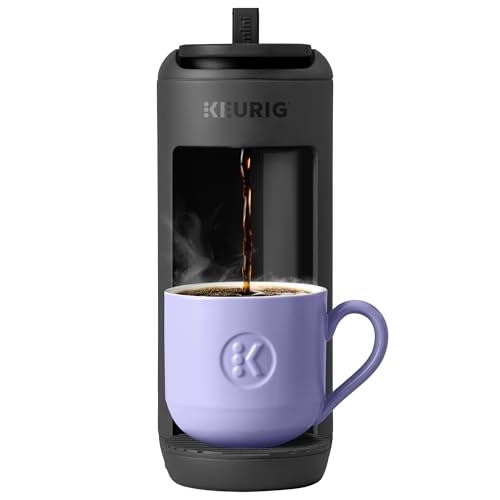
The Keurig K-Mini Mate is the K-Cup idea reduced to its smallest sensible form: a compact, portable single-serve machine that brews up to a 12 oz cup and is aimed squarely at small spaces, dorms and offices. There is no reservoir to manage; you add water for the cup you are about to brew, which keeps the machine tiny and makes it easy to move between a desk, a dorm shelf and a kitchen counter. That fill-per-cup routine is the trade at the heart of the design. For one person making one or two cups a day it is barely a thought, and the machine disappears into spaces where a full-size brewer simply cannot live. For a household queueing for coffee it would be a bottleneck. Judged on its own brief — personal coffee in a small footprint, with the whole K-Cup pod range available — the K-Mini Mate is coherent, honest and easy to recommend to the right owner.
The K-Mini Mate’s café contribution is modest and should be described modestly: a small pod cup, chosen from a strong pod and brewed at the modest end of its range, can anchor a simple latte-style drink for one person in a small space. It offers no concentration tools beyond pod choice, no reservoir for a round of drinks, and no pretence of being a café station. What it offers is a dorm or desk where a decent coffee and an occasional milky treat are possible at all. In a guide about combination machines, it marks the floor of the category — and for the single drinker in a small room, the floor is exactly where life happens.
Strengths
- Compact footprint fits dorms, desks and tiny counters
- Brews up to a 12 oz cup, enough for most mugs
- Simple one-cup-at-a-time routine with familiar K-Cup pods
Trade-offs
- Fill-per-cup design means no reservoir rhythm for groups
- Maximum 12 oz rules out the largest travel mugs in one pass
- Pods only, so grounds drinkers need a different machine
Key specifications
- Format: Single-serve K-Cup pod coffee maker
- Brew size: Up to 12 oz per cup
- Design: Compact and portable
- Intended spaces: Small spaces, dorms and offices
- Finish: Black
Best for: Solo drinkers who want a quick coffee and the occasional milk drink / Not suited for: Households building a full home-café routine
Tastyle Mini Hot and Iced Coffee Maker
Badge: Best Espresso-Style Shots
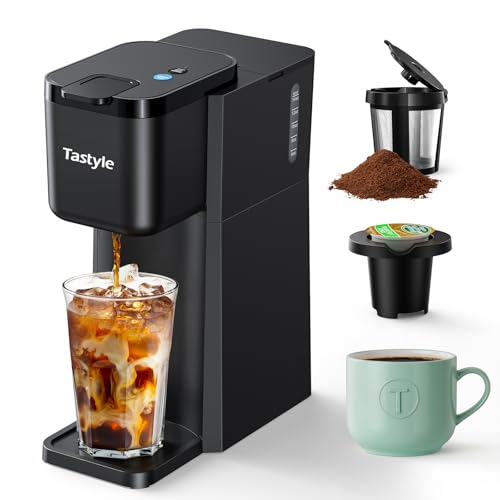
The Tastyle Mini is the most flexible small machine in this pool, because it accepts both K-Cup pods and ground coffee and brews both hot and iced drinks across a 6 to 14 oz range. That combination covers an unusual amount of ground for a mini machine: a pod on a rushed morning, your own grounds when you want a particular bag, a small strong cup or a full travel mug, and an iced coffee in the afternoon without a second appliance. The included recipe book nudges experimentation, and the 120V design is pitched at homes, travel, RVs, offices and dorms — anywhere a full-size brewer is too much machine. The honest limits are size and throughput: this is a one-cup-at-a-time mini, with filling and brewing per cup rather than a reservoir rhythm. For a single drinker or a couple with varied tastes, that trade buys remarkable versatility in a very small footprint.
The Tastyle is the most café-minded mini in the pool because of its floor: a 6 oz brew size. Small is where espresso-style drinks live, and a machine that can brew genuinely small — with grounds dosed by you or a pod when speed matters — produces the concentrated base that milk drinks and iced lattes are built from. The iced mode extends the café menu to the summer half of the year, which is where milk drinks multiply. It remains a coffee maker, not an espresso machine, and its drinks are espresso-style in the honest sense: concentrated, small and made for milk. For one or two drinkers, that is the café most homes actually use.
Strengths
- Genuinely dual-format: K-Cup pods and ground coffee
- Hot and iced modes in one compact machine
- Wide 6 to 14 oz brew range covers espresso-style small cups to travel mugs
Trade-offs
- Mini format means filling and brewing one cup at a time
- No large reservoir for back-to-back group service
- Iced results still depend on using enough ice and strong settings
Key specifications
- Format: Single-serve for K-Cup pods and ground coffee
- Modes: Hot and iced coffee
- Brew sizes: 6 to 14 oz
- Included: Recipe book
- Power: 120V
- Model: K310IC, version 2.0, Classic Black
Best for: Drinkers who build milk drinks and iced coffees on small strong brews / Not suited for: True espresso seekers and large households

Keurig K-Express (Evergreen)
Badge: Best Pod All-Rounder
Evergreen is the boldest colourway of the K-Express, and mechanically it is the same dependable package: a 42 oz removable reservoir, three brew sizes, a Strong Brew button, travel mug clearance and compatibility with all K-Cup pods. A deep green machine makes a deliberate statement on the counter, pairing well with brass fittings, cream cabinetry and the plant-filled kitchens that are currently fashionable, and it hides coffee splashes better than pale finishes do. The brewing story is unchanged and that is a virtue: pods are the fastest route from sleepy to caffeinated, the reservoir stretches across a morning of cups, and the Strong Brew setting answers the most common pod-coffee complaint, a cup that tastes thin, by slowing the extraction for a bolder result. Choose Evergreen when you want the K-Express routine and a machine that looks like a chosen object rather than an appliance that merely happened to you.
Evergreen’s café route runs through the Strong Brew button: a pod brewed strong at a smaller size becomes a workable base for a latte-style drink, and the 42 oz reservoir means the round of weekend milk drinks does not stall on refills. The pod library helps the café idea in its own way — flavoured pods, decaf pods for the evening drink, cocoa pods for the non-coffee drinker — so the machine serves a menu even if every item on it is coffee-machine coffee. Evergreen’s finish suits the kitchen that hosts this ritual in view. It is the convenience-first answer to the combo question, and for households that value the ritual of gathering over the ritual of extraction, it may be the right one.
Strengths
- Full K-Express feature set in a distinctive green finish
- 42 oz reservoir supports back-to-back cups for a household
- Strong Brew button adds intensity without changing pods
Trade-offs
- Evergreen is a commitment if your kitchen colours change
- Pods only in normal use, so running costs follow pod prices
- No dedicated iced or cold-brew programme
Key specifications
- Format: Single-serve K-Cup pod coffee maker
- Brew sizes: 3 brew sizes
- Reservoir: 42 oz, removable
- Feature: Strong Brew button
- Mug fit: Travel mug friendly
- Finish: Evergreen
Best for: Pod households wanting strong small cups for milk drinks plus reservoir ease / Not suited for: Anyone who needs grounds control or true espresso

Keurig K-Express (Mint)
Badge: Best Light Finish
The Mint K-Express brings the standard K-Express formula — 42 oz removable reservoir, three brew sizes, Strong Brew button, travel mug friendly, works with all K-Cup pods — in a pale mint finish that suits retro-leaning and pastel kitchens. Functionally nothing separates it from its black, Warm Stone and Evergreen siblings, so the honest advice is to choose it for the colour and enjoy the same routine: several cups per reservoir fill, a bolder option when a pod tastes weak, and clearance for the travel mug on workday mornings. The pale finish does ask for a little more wiping, because coffee drips and grounds dust show against mint more readily than against black or green. In exchange, the machine brightens a counter corner instead of darkening it. For a renter, a student house or anyone furnishing a small kitchen with some personality, Mint is the K-Express that does not take itself too seriously.
Mint repeats Evergreen’s café mechanics — strong button, smaller sizes, reservoir — in the finish for pale kitchens, and its honest role in this guide is to represent the large group of buyers for whom the combo question is really about variety at low effort. A mint machine on a bright counter, a pod chosen strong, milk frothed in a jug or warmed in a pan: the resulting drink will not fool a barista and will satisfy almost everyone else. The pale finish shows the splashes that milk drinks generate, so the wipe-after habit matters. Choose it for the kitchen it flatters and the routine it simplifies.
Strengths
- Full K-Express feature set in a light, retro-leaning mint finish
- 42 oz removable reservoir is easy to carry to the tap
- Three brew sizes plus Strong Brew cover most single-cup needs
Trade-offs
- Pale finish shows coffee splashes and needs wiping more often
- Pods only in normal use, with pod cost per cup to budget for
- No dedicated iced or cold-brew programme
Key specifications
- Format: Single-serve K-Cup pod coffee maker
- Brew sizes: 3 brew sizes
- Reservoir: 42 oz, removable
- Feature: Strong Brew button
- Mug fit: Travel mug friendly
- Finish: Mint
Best for: Pod households in bright kitchens making occasional milk drinks / Not suited for: Espresso enthusiasts

Hamilton Beach FlexBrew Advanced 4-in-1
Badge: Best Overall
The Hamilton Beach FlexBrew Advanced 4-in-1 is the pool member that tries to end arguments. It brews hot and iced coffee, it accepts both pod packs and ground coffee, and it carries a removable 45 oz reservoir — the largest water capacity in this guide alongside genuinely fast brewing. That combination means a household split between pod loyalists and grounds drinkers can share one machine, and a drinker who wants iced coffee in summer and hot coffee in winter is not maintaining two appliances. The reservoir changes the morning maths: several cups can be brewed back to back before anyone visits the tap, which is exactly when single-serve machines usually show their limits. It remains a single-serve design, so there is no carafe for a brunch table, and its broader brief takes more counter space than the minis. As a one-machine answer to mixed household tastes, though, it is the most complete package here.
The FlexBrew tops this guide because it assembles the most café variables in one body: grounds for dosed, concentrated brews; pods for speed and variety; an iced mode for the summer menu; fast brewing and a 45 oz reservoir for the round of drinks a weekend brunch actually orders. No single element is espresso, and the guide will not call the sum espresso either — but the sum is a home café in the practical sense, a station where coffee, strong coffee, iced coffee and milk drinks all happen without a second appliance or a hobbyist’s learning curve. Households that want café breadth with appliance simplicity should start here, and households that want the genuine pressurised article should read the espresso section below and shop accordingly.
Strengths
- Largest reservoir here paired with hot and iced modes
- Takes both pod packs and grounds, so no format lock-in
- Fast brewing suits back-to-back morning cups
Trade-offs
- Bigger brief than the minis, so it needs real counter space
- Still a single-serve machine: no carafe for a table of guests
- More modes means more settings for a household to learn
Key specifications
- Format: 4-in-1 single-serve coffee maker
- Modes: Hot and iced coffee
- Reservoir: 45 oz, removable
- Inputs: Pod packs and ground coffee
- Brewing: Fast brewing
- Finish: Black
Best for: Households wanting the fullest café-style menu from one simple machine / Not suited for: True espresso seekers and minimalists
The order above ranks by café usefulness rather than coffee quality alone, which is why a grounds mini with full dose control sits respectably among reservoir machines, and why the most expensive-looking pick is not at the top. Café drinks are systems — base, milk, temperature, glass — and the ranking follows the systems each machine can support. The table that follows reduces the six to the variables those systems depend on, so a reader building a particular drink can find its machine directly.
Comparison Table
Compare the café variables: what goes in, how the water is held, and each machine’s route to a concentrated cup. The honest headline is in every row — these are coffee machines with espresso-style range, not espresso machines.
| Pick | Format | Water capacity | Standout trait | Link |
|---|---|---|---|---|
| Elite Gourmet EHC111A | Grounds with reusable filter | Fill per cup, 14 oz brew | Manual dose control for concentrated brews | Check on Amazon |
| Keurig K-Mini Mate | K-Cup pods | Fill per cup, up to 12 oz | Compact and portable design | Check on Amazon |
| Tastyle Mini Hot and Iced Coffee Maker | K-Cup pods and grounds | Fill per cup, 6 to 14 oz | Small strong brews plus hot and iced modes | Check on Amazon |
| Keurig K-Express (Evergreen) | K-Cup pods | 42 oz reservoir | Strong Brew button for concentrated cups | Check on Amazon |
| Keurig K-Express (Mint) | K-Cup pods | 42 oz reservoir | Mint finish, full K-Express feature set | Check on Amazon |
| Hamilton Beach FlexBrew Advanced 4-in-1 | Pod packs and grounds | 45 oz reservoir | Hot and iced modes with fast brewing | Check on Amazon |
How to Choose Between Espresso-Style Convenience and True Espresso
Begin with the drink you actually order. If your café drink is a latte, a flavoured milk coffee or an iced coffee, the coffee inside it is a base, and a concentrated brew from a good coffee machine serves that base honestly — milk, syrup and ice do most of the talking. If your drink is a straight espresso, judged on its own in a small cup, nothing in this guide will satisfy you, because the drink is the extraction itself and the extraction requires pressure. Name your drink before you name your machine and the category sorts itself.
Then price the ritual honestly, in time rather than money. True espresso is a practice: grinding, dosing, tamping, timing, cleaning, and a learning curve measured in weeks. Some households fall in love with that practice and would not trade it. Others discover that the practice is why their espresso machine gathers dust while the pod machine works daily. The machines in this guide are for the second household, and there is no failure in being it — the best café machine is the one that makes drinks every day.
Finally, consider the household’s breadth. A combo brief usually hides a variety brief: different drinkers, different drinks, different seasons. Dual-format and dual-temperature machines — the FlexBrew above all here — serve breadth best. Readers whose variety problem is mainly about volume for a home office or a big family should also weigh the Best Commercial Coffee Makers For Office perspective, and readers who want café language without café complexity will find kindred honesty in the Best Commerical Coffee Makers overview.
How to Build Café-Style Drinks on a Coffee Machine
Start with the base. Brew small and strong: the smallest practical size, the strong setting if the machine has one, a generous dose if you are using grounds. The base should taste almost too intense on its own, because milk and ice are about to lengthen it. For a latte-style drink, warm the milk separately — a pan, a microwave jug, or a small frother if you own one — and pour the base into the milk rather than the other way round, which keeps the drink integrated. For a cappuccino style, froth the milk harder and dust the top; the theatre is part of the drink.
For iced café drinks, brew the same concentrated base directly onto ice or pour it over a full glass, then add cold milk. Sweeten the base while it is hot if the drink is sweetened at all. The Tastyle’s iced mode and the FlexBrew’s iced capability automate the calibration; on the other machines, the small-and-strong rule is the calibration. A drink built this way will not be mistaken for a café’s in a side-by-side test, and will be preferred to the café’s by the household that made it, which is the only test that repeats daily.
Problem: the milk drink tastes like milky water → the base was brewed at normal strength; halve the water or raise the dose before changing anything else. Problem: the drink is bitter → the base was over-extracted in pursuit of strength; use a milder coffee at the same concentration rather than a harsher one brewed longer. Problem: the household’s café drinks are inconsistent → the recipe lives in one person’s head; write the house recipe — pod or dose, size, milk volume — on a card by the machine, and consistency follows.
Keep the station café-clean. Milk residue is the fastest route to a drink that tastes wrong, so rinse whatever touched milk immediately, wipe the splash zone after the round, and descale the machine on schedule. A home café is a routine with standards, and the standards are mostly cleaning ones.
What True Espresso Actually Requires
Espresso is a method with a specification: finely ground coffee, a compacted puck, and hot water forced through it under high pressure in a short extraction, producing a small, concentrated drink with a layer of crema. Every element matters, and the pressure is the element no drip, pod or percolating machine reproduces, because their water arrives by gravity or gentle pumping rather than force. That is why this guide uses the phrase espresso-style with care: the drinks here share espresso’s concentration and its role in milk drinks, without sharing its extraction.
A reader who wants the genuine article should shop for a pump espresso machine or a manual lever device, budget for a grinder capable of espresso fineness, and expect the learning curve as part of the purchase. That is a good and rewarding road — it is simply a different road from the one this pool travels. Guides that blur the distinction sell machines to the wrong households; this one would rather lose the sale honestly, and the Best Commercial Coffee Makers Bunn guide applies the same discipline to commercial claims.
The Milk Drink Majority: Why Espresso-Style Is Enough for Most Homes
Count the drinks in a typical café and the majority are milk drinks, where espresso is an ingredient rather than the whole performance. In a latte, the coffee’s job is to be present, concentrated and clean-tasting through a large volume of milk — a job a strong coffee-machine brew performs creditably. The gap between espresso and espresso-style narrows with every ounce of milk, syrup and ice added, until in a flavoured iced latte it is undetectable to most palates most of the time.
That arithmetic is the real foundation of the combination category. Households are not settling when they choose a versatile coffee machine for their café drinks; they are matching the tool to the drinks they actually make. The FlexBrew and Tastyle lead this guide because they maximise the variables those drinks depend on — concentration, format choice, temperature of service — while keeping the routine simple enough to survive a weekday.
Building the Home Café Station Around One Machine
A café station is a machine plus its supporting cast, arranged so the drinks are easy to make well. The cast is small: the machine, a milk jug, a frothing method if the household uses one, glasses for iced drinks, a syrup or two, and the coffees themselves stored where the machine is. Arrangement matters more than equipment — everything within one step of the machine, nothing stored across the room — because café drinks are assembled in a sequence and a station that breaks the sequence breaks the habit.
Households that entertain should borrow the café’s final trick: a short house menu. Two or three named drinks the station makes brilliantly, offered to guests by name, beat an open-ended promise of anything. The machines in this guide each support such a menu — the pod machines through their libraries, the dual-format machines through their range — and a household that writes its menu down discovers, usually with surprise, that it has become the house whose coffee people mention.
Three House Drinks, Built Three Ways
Make the abstract concrete with the three drinks a home café actually serves. The morning latte: a strong base from the FlexBrew’s grounds side or a Tastyle small brew, milk warmed and poured, the drink assembled in the time a kettle would take to boil. The afternoon iced coffee: the same base built stronger, poured over a full glass of ice, milk cold this time — the drink the iced modes on those two machines exist to calibrate. The evening decaf: a pod from the K-Express library, brewed small, taken black or with a little milk, at an hour when a full espresso ritual would be absurd. Three drinks, three different machines’ strengths, one household.
Notice what the exercise reveals: the home café is not a machine but a repertoire, and combination machines earn their name by widening the repertoire without widening the counter. A household that drinks only the first of those three needs concentration and milk handling; a household that drinks all three needs formats, modes and a reservoir as well. The repertoire, written down honestly, is the true specification sheet for this purchase — and it is the one document no manufacturer can print for you, because it lives in your kitchen and nowhere else.
One more population deserves naming in a combo guide: the household where only one person drinks café drinks and everyone else drinks ordinary coffee. That household should not buy for the enthusiast alone. It should buy the machine that serves the ordinary majority beautifully — a reservoir pod model, most likely — and let the enthusiast keep a small grounds machine or the dual-format option as their personal station. Combination, in that house, is a property of the kitchen rather than of any single appliance, and it is often the happiest arrangement of all.
Learning Your Machine’s Dialects: A Fortnight of Experiments
A combination machine rewards a short, deliberate apprenticeship, and a fortnight is enough. Week one belongs to the base: brew your usual coffee at every size the machine offers, taste each one black, and note where your preferred strength actually lives. Most owners discover their daily cup was a size too large and a notch too weak, because default settings are chosen for the average drinker and nobody is the average drinker. The note you make — this pod, this size, this setting — is the foundation every café drink in this guide is built on, because a milk drink amplifies the base it is given, in both directions.
Week two belongs to the drinks. Build the house latte, the house iced coffee and the house evening drink, adjusting one variable at a time: base strength first, then milk volume, then sweetness. Write the three recipes down where the machine lives. This sounds like homework and behaves like a gift, because from the third week onward the household stops experimenting and starts enjoying — guests get the named drinks, the drinks taste the same every time, and the machine’s combination nature stops being a feature list and becomes a repertoire. Cafés are not better equipped than your kitchen; they are better rehearsed, and a fortnight is the rehearsal.
The apprenticeship has one more graduate benefit: it teaches the household what its machine is not. The drink that never quite lands — for this pool, the straight espresso-style shot taken black — identifies itself honestly in week two, tasted against the drinks that sing. Owners who learn that boundary early stop asking the machine for it and enjoy everything inside the boundary more. That is the practical endpoint of all the honesty in this guide: not lowered expectations, but correctly located ones, with a repertoire of drinks that are genuinely good inside them.
Common Buying Mistakes
The costliest mistake in this category is buying a coffee machine while believing it is an espresso machine, then blaming the drinks. Read for the word pressure, a pump specification and a portafilter; their absence is not a detail. This guide has labelled its pool honestly so the mistake is avoidable here.
The second mistake is the mirror image: buying true espresso equipment for a household that wanted milk drinks and convenience, then watching it gather dust. The learning curve is real, the cleaning is real, and a machine that is used daily beats a superior machine used monthly.
Third, do not build café drinks on a normal-strength base. Almost every disappointing home latte traces back to a base brewed for drinking black. Concentrate first; the milk will do the softening.
Finally, avoid neglecting the milk side of the station. The machine is half the café; warm, fresh, properly handled milk is the other half, and no brewer, however combined, can rescue a drink built on tired milk and a dirty jug.
Final Recommendation
The fullest home-café answer in this pool is the Hamilton Beach FlexBrew Advanced 4-in-1: both formats, both temperatures, family capacity and fast brewing behind every drink on the menu. Solo café drinkers should choose the Tastyle Mini Hot and Iced Coffee Maker for its small strong brews and iced mode at mini scale.
Grounds drinkers who want to craft their base by hand will get the most from the Elite Gourmet EHC111A, while pod households can step into café-style drinks through any K-Express and its Strong Brew button. And if the espresso section convinced you that only the pressurised original will do, take that clarity as the guide’s gift and shop for it deliberately — the households that thrive with espresso are the ones that chose it with open eyes.
Related guides
Frequently Asked Questions
Can any of these machines make real espresso?
No. Real espresso requires water forced through fine, compacted grounds under high pressure, and none of the verified machines in this pool is a pump espresso machine. They make concentrated coffee that serves as an espresso-style base for milk drinks, and the guide uses that term deliberately.
What is the best base for a homemade latte from these picks?
A small, strong brew: the Tastyle at its lower sizes, a K-Express cup on Strong Brew, or a generously dosed grounds brew from the Elite Gourmet or FlexBrew. The base should taste too intense alone; the milk restores the balance.
Do I need a milk frother as well?
Not strictly. Milk warmed in a pan or microwave and whisked or shaken in a sealed jar gives a serviceable texture for home lattes. A small frother improves the texture and the theatre, and is the first accessory most home-café households add.
Which pick handles iced café drinks best?
The FlexBrew and the Tastyle, because both have a dedicated iced capability confirmed in their listings. The other machines make iced drinks by the strong-brew-over-ice method described in the how-to section.
Is a pod or grounds better for café-style drinks?
Grounds give dose control, which concentrated drinks reward; pods give speed and a library of flavours, including decaf for evening drinks. Dual-format machines postpone the choice, which is why they lead this guide.
Should I buy a true espresso machine instead?
If you drink straight espresso and would enjoy the craft of making it, yes — buy a pump machine and a capable grinder, and expect a learning curve. If your drinks are mostly milky, iced or flavoured, the machines here will serve you daily with far less effort.
Can I make a flat white at home with these machines?
A flat-white style drink, yes: a small strong base with a thin layer of smoothly warmed milk. The texture will be gentler than a café’s steamed version, and the drink will satisfy most home drinkers. What these machines cannot reproduce is the pressurised extraction itself, which is why the guide keeps the word style attached.


