Disclosure: topratedkitchenware.com is reader-supported. When you buy through links on our site, we may earn an affiliate commission from Amazon and other retailers, at no extra cost to you.
Where to buy
The six machines below are the verified picks in this guide to the best commercial coffee makers for office, for office coffee at small and medium scale. Each name links to its Amazon listing, where you can check the latest price on Amazon, confirm the current configuration, and read the newest owner feedback before you decide.
- Ninja Single Serve Coffee Maker PB051
- Keurig K-Elite
- Keurig K-Express (Black)
- Keurig K-Express (Warm Stone)
- Elite Gourmet EHC111A
- Keurig K-Mini Mate
Read the full guide ↓ for the reasoning behind the order, the honest limitations of every pick, and the checks that matter more than any headline claim.
Office coffee is infrastructure, and the search for the best commercial coffee makers for office is really a search for the machine a workplace can forget about: always ready, usable by everyone, stocked without drama, and equal to the two daily rushes when the whole floor wants a cup inside the same fifteen minutes. This guide ranks six verified machines for that job at the scale most offices actually are — teams, small floors and shared kitchens — with the honesty the category needs: these are high-capacity home and light-duty machines, not plumbed commercial brewers, and their ceilings are stated as plainly as their virtues.
At office scale, the ranking logic changes from home logic in three ways. Variety stops being a preference and becomes a requirement, because thirty palates include decaf drinkers, tea drinkers and at least one person with strong opinions. Operability becomes absolute, because the machine’s users cannot be trained beyond a sentence. And the reservoir becomes the difference between a station and a queue. On those criteria the Ninja PB051 leads this pool — the biggest reservoir, both formats, the largest cups — with the Keurig K-Express models as the simplicity standard and two small machines, the K-Mini Mate and Elite Gourmet, cast honestly as desk satellites rather than break-room answers.
Large floors and venues with continuous demand should treat this guide as the small-office chapter and step up to genuinely commercial equipment, a boundary the commercial benchmark sections draw clearly. Workplaces recognising themselves here — a team, a kitchen, two rushes a day — will find the Best Commercial High Performance Coffee Makers discussion a useful companion on what performance claims in this category do and do not mean.
Key Takeaways
- The Ninja PB051 is the strongest break-room pick here: 56 oz reservoir, pods and grounds, cups up to 24 oz.
- Keurig K-Express models are the simplicity standard: a pod, a button, no training, in three office-friendly finishes.
- The K-Elite suits executive areas and client meetings, where presentation outranks volume.
- The K-Mini Mate and Elite Gourmet are desk satellites for individuals, not break-room machines.
- Every pick is light-duty; continuous-demand floors need true commercial equipment and service support.
In this guide
Quick Picks
The six verified picks below are ordered for office duty: break-room capability first, satellites last. Badges name each machine’s office role, consistently across the Quick Picks, the detailed reviews and the comparison table.
| Pick | Badge | Best for | Link |
|---|---|---|---|
| Ninja Single Serve Coffee Maker PB051 | Best Overall | Small office break rooms serving a team through two daily rushes | Check on Amazon |
| Keurig K-Elite | Best Premium Pod Pick | Executive offices, client meeting rooms and reception areas | Check on Amazon |
| Keurig K-Express (Black) | Best Break-Room Workhorse | Team kitchens wanting the simplest reliable pod station | Check on Amazon |
| Keurig K-Express (Warm Stone) | Best for Style-Led Offices | Design-conscious workplaces wanting K-Express service in a softer finish | Check on Amazon |
| Elite Gourmet EHC111A | Best Desk Satellite for Grounds | Individuals who want their own grounds coffee at their own desk | Check on Amazon |
| Keurig K-Mini Mate | Best Desk Machine | Personal desks, small satellite offices and hot-desking corners | Check on Amazon |
How These Picks Were Chosen
Office selection used workplace criteria rather than kitchen ones. The verified data was scored on reservoir capacity against a two-rush day, format operability for untrained users, variety coverage including the decaf and non-coffee drinkers every office contains, and the footprint and presentation appropriate to shared professional space. Satellites were scored on a different rubric — personal footprint and simplicity — and are labelled as satellites in their reviews so no reader mistakes a desk machine for a floor solution.
The guide is research-led and duty-honest. No machine is described as commercial-grade; each is placed at the office scale its design supports, from personal desk to small-floor break room. The K-Elite’s placement rests on format and finish because its verified listing confirms no more, and the guide says so in its review. An office purchase made on inflated claims fails publicly, in front of the whole team, on the first busy Monday — this guide would rather be accused of caution than be the cause of that Monday.
The 6 Best Commercial Coffee Makers for Office Teams

Ninja Single Serve Coffee Maker PB051
Badge: Best Overall
The Ninja PB051 is the heavyweight of this pool: a single-serve combo machine that takes both K-Cup pods and ground coffee, offers four styles of brewing, brews cup sizes up to 24 oz and carries a 56 oz removable reservoir — the largest water capacity and the largest single cup in this guide. Those numbers translate into a specific kind of freedom. The reservoir covers a full morning of household cups, the 24 oz ceiling means the biggest travel mug is filled in one brew rather than two, and the pod-plus-grounds format means a new bag of beans and a box of pods can coexist without a second machine. Four brew styles let the same coffee land differently in the cup, from an everyday mug to a more concentrated style for milk drinks or iced coffee. The costs are counter space and a modest learning curve. For households that brew often and in quantity, the PB051 is built exactly for that life.
The Ninja earns the break room on capacity and diplomacy. The 56 oz reservoir carries a rush without the mid-queue refill that turns a coffee break into a grievance, and 24 oz cups mean the travel-mug crowd is served in one pass instead of two brews each. Diplomacy is the format: pods keep the majority fast and happy, while the grounds option gives the office coffee enthusiast a corner of the station to call their own — a small concession that prevents the second, unauthorised machine from appearing on someone’s desk. Four styles let the office standardise a house menu. It is a home machine by rating and an office machine by behaviour, and for teams up to a few dozen it is the strongest honest pick here.
Strengths
- Biggest reservoir in the pool at 56 oz, removable
- Pods and grounds in one machine, with four brew styles
- Brews up to 24 oz, covering large travel mugs in one pass
Trade-offs
- The largest brief here, so small counters should measure first
- Four styles add a learning curve for guests and family
- Still single-serve: big cups, but no carafe
Key specifications
- Format: Single-serve combo machine for K-Cup pods and grounds
- Brew styles: 4 styles of brewing
- Cup sizes: Up to 24 oz
- Reservoir: 56 oz, removable
- Model: PB051
- Finish: Black
Best for: Small office break rooms serving a team through two daily rushes / Not suited for: Large floors with continuous demand

Keurig K-Elite
Badge: Best Premium Pod Pick
The Keurig K-Elite in brushed silver is the premium-leaning pod machine in this pool: a single-serve K-Cup brewer whose metal-toned finish is designed to be seen rather than hidden. Where the K-Express models compete on reservoir size and brew-size lists, the K-Elite competes on presence — it is the machine for a counter that is part of the room, in an open-plan kitchen or a smart office kitchenette where a plastic-looking appliance would jar. The coffee routine is the familiar Keurig one: a pod, a button, a cup, with the entire K-Cup range available to choose from. Buyers should note honestly that the verified listing for this model confirms fewer headline specifications than its K-Express siblings, so the decision here rests on finish, format and brand tier rather than on a longer feature list. If those are your criteria, the K-Elite is the pool member aimed at you.
The K-Elite is the office machine as furniture: brushed silver, recognisably premium, and instantly operable by any client or visitor who has ever used a Keurig. In meeting rooms and reception areas, that combination — presentation plus zero instruction — is the entire brief, because the coffee there is hospitality, and hospitality that requires explanation has already failed. Its volume ceiling is low and the guide states it without apology: this is a machine for rooms where four people meet, not floors where forty people queue. Placed in its niche, it does the most reputational work per cup of any pick in this guide.
Strengths
- Brushed silver finish suits visible, design-led counters
- Single-serve K-Cup format gives access to the full pod range
- A step-up Keurig nameplate for buyers who want the premium tier of pod machines
Trade-offs
- Listing confirms fewer headline specs than the K-Express models
- Pods only, so grounds drinkers are not served
- Premium positioning without a carafe or second format
Key specifications
- Format: Single-serve K-Cup pod coffee maker
- Finish: Brushed Silver
Best for: Executive offices, client meeting rooms and reception areas / Not suited for: Break rooms serving a whole floor

Keurig K-Express (Black)
Badge: Best Break-Room Workhorse
The Keurig K-Express in black is the straightforward centre of the K-Cup world: a single-serve pod machine with a 42 oz removable reservoir, three brew sizes and a Strong Brew button for a bolder extraction from the same pod. The reservoir is the detail that shapes daily life with it, because it turns brewing into a rhythm of several cups between refills instead of a fill for every single mug. It is travel mug friendly, so a commuter cup slides under the spout without decanting from a smaller mug first. Because it works with all K-Cup pods, the coffee choice is as wide as the pod aisle itself, from dark roasts to flavoured blends to tea and cocoa pods. Operation is deliberately plain: insert a pod, choose a size, press brew. There is no carafe, no grinder and no milk system, and that simplicity is the point. For a household that wants predictable pod coffee with the fewest possible steps, this is the reference design the rest of this guide is measured against.
The black K-Express is the office default for a reason that has nothing to do with novelty: everybody already knows how to use it. A 42 oz reservoir, three sizes covering the mug and the travel cup, a pod library that quietly includes the decaf and the tea, and a Strong Brew button for the colleague whose coffee must be serious. In an office, the best machine is the one nobody discusses, and the K-Express disappears into the working day more completely than any pick here. Black is the right finish for a working station — practical under heavy, multi-user wear. Offices buying their first real station, or replacing a failed experiment in complexity, should start here.
Strengths
- 42 oz removable reservoir means several cups between refills
- Strong Brew button gives a bolder cup from the same pod
- Three brew sizes cover a small cup through a travel mug
Trade-offs
- Pods only in normal use, so grounds need a separate routine
- No dedicated iced or cold-brew programme
- Black finish shows dust and scale marks readily
Key specifications
- Format: Single-serve K-Cup pod coffee maker
- Brew sizes: 3 brew sizes
- Reservoir: 42 oz, removable
- Feature: Strong Brew button
- Mug fit: Travel mug friendly
- Finish: Black
Best for: Team kitchens wanting the simplest reliable pod station / Not suited for: Offices needing grounds or very large cups
Keurig K-Express (Warm Stone)
Badge: Best for Style-Led Offices
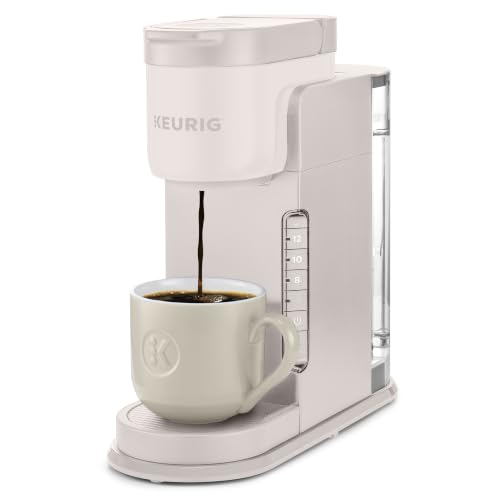
The Warm Stone K-Express is the same machine as the black K-Express — 42 oz removable reservoir, three brew sizes, Strong Brew button, travel mug friendly, compatible with all K-Cup pods — wearing a softer, stone-toned finish. That makes the choice between them a kitchen-design decision rather than a coffee decision, and there is no shame in that: a machine that lives on the counter every day should look like it belongs there. The warm neutral tone sits comfortably beside pale wood, stone worktops and stainless appliances, and it is more forgiving of the light dusting of coffee grounds and water spots that accumulate around any brewer. Everything said about the K-Express routine applies here unchanged: pod in, size chosen, cup brewed, with several cups available before the reservoir needs attention. If your household has already decided the K-Express feature set is right, Warm Stone is simply the version for kitchens where black reads too stark.
Warm Stone performs the identical office service to the black K-Express, and its case is the client-facing workplace: the studio, the agency, the practice whose kitchen is visible to visitors and whose equipment is part of the impression. A warm neutral machine in a designed kitchen says the office sweats its details, and it hides the multi-user evidence — the dusting of grounds, the water marks of twenty users a day — better than black or white between the cleaner’s visits. The capability underneath is the office standard described above. In workplaces where nobody sees the machine, save the deliberation and buy black; where everybody sees it, Warm Stone is a small, daily piece of brand management.
Strengths
- Same 42 oz reservoir and three brew sizes as the black version
- Warm Stone finish hides everyday marks better than gloss black
- Strong Brew button for a more intense cup when wanted
Trade-offs
- Functionally identical to the other K-Express colours
- Pods only in normal use, with no grounds basket in the box story
- No dedicated iced or cold-brew programme
Key specifications
- Format: Single-serve K-Cup pod coffee maker
- Brew sizes: 3 brew sizes
- Reservoir: 42 oz, removable
- Feature: Strong Brew button
- Mug fit: Travel mug friendly
- Finish: Warm Stone
Best for: Design-conscious workplaces wanting K-Express service in a softer finish / Not suited for: Back-of-house stations where finish is irrelevant

Elite Gourmet EHC111A
Badge: Best Desk Satellite for Grounds
The Elite Gourmet EHC111A takes the opposite route to the pod machines around it: instead of a capsule, it brews through a reusable filter filled with your own ground coffee, and it will handle loose-leaf tea as well. That single design choice changes the running relationship completely, because your coffee choice becomes whatever bag is open in the cupboard rather than whatever pods you remembered to order. At 600W with one-touch operation it is intentionally simple, aimed at a 14 oz travel mug brewed directly and taken away. Auto shut-off removes the worry of leaving a small appliance on in a dorm, office or spare room, and the dishwasher-safe parts make the reusable filter routine realistic rather than a chore that quietly gets abandoned after the first week. Its compact shape fits the corners of a kitchen that larger machines cannot use: beside a student desk, on an office credenza, in a spare room when guests stay over.
The Elite Gourmet’s office role is the sanctioned exception: the desk machine for the employee whose coffee standards are personal — their own grounds, their own dose, brewed at their desk through a reusable filter, with auto shut-off answering the safety question every facilities manager asks about desk appliances. It also brews loose-leaf tea, covering the tea drinker the pod station forgot. As a satellite it is excellent, removing one demanding drinker from the break-room queue entirely. As a shared machine it would be a category error — one filled cup at a time, with rinsing, in a queue of colleagues — and the guide places it firmly, and warmly, at the desk where it belongs.
Strengths
- Reusable filter brews your own grounds, with no pods to stock
- Also handles loose-leaf tea, which pod machines cannot do natively
- Auto shut-off and dishwasher-safe parts suit dorms and offices
Trade-offs
- No reservoir, so every cup starts with a fresh fill
- 600W output means a gentler pace than larger machines
- One mug at a time, with no batch option
Key specifications
- Format: Single-serve coffee maker for grounds
- Capacity: 14 oz brew
- Power: 600W
- Filter: Reusable filter for grounds and loose-leaf tea
- Feature: Auto shut-off
- Care: Dishwasher-safe parts
Best for: Individuals who want their own grounds coffee at their own desk / Not suited for: Shared break-room duty
Keurig K-Mini Mate
Badge: Best Desk Machine
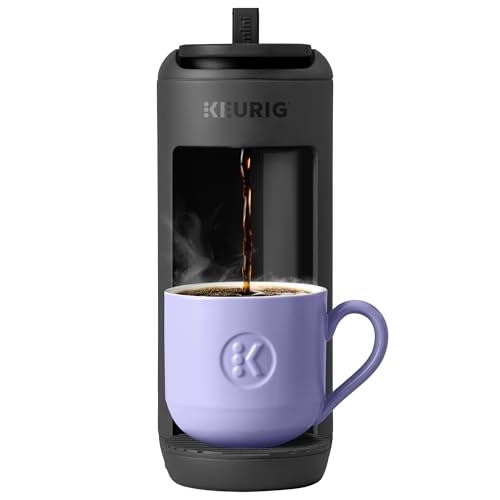
The Keurig K-Mini Mate is the K-Cup idea reduced to its smallest sensible form: a compact, portable single-serve machine that brews up to a 12 oz cup and is aimed squarely at small spaces, dorms and offices. There is no reservoir to manage; you add water for the cup you are about to brew, which keeps the machine tiny and makes it easy to move between a desk, a dorm shelf and a kitchen counter. That fill-per-cup routine is the trade at the heart of the design. For one person making one or two cups a day it is barely a thought, and the machine disappears into spaces where a full-size brewer simply cannot live. For a household queueing for coffee it would be a bottleneck. Judged on its own brief — personal coffee in a small footprint, with the whole K-Cup pod range available — the K-Mini Mate is coherent, honest and easy to recommend to the right owner.
The K-Mini Mate is the pod version of the satellite idea: one person, one cup, fresh water every time, in a footprint that fits the corner of a desk or a shelf in a two-person satellite office. It solves real office problems — the long walk to a distant kitchen, the meeting that runs over, the early starter who arrives before the shared station is awake — without pretending to solve the break room’s. Its 12 oz ceiling and fill-per-cup rhythm are features at this scale, keeping the machine small, fresh and personal. Offices that equip a few satellites alongside a proper station will find the whole system works better than any single machine could make it.
Strengths
- Compact footprint fits dorms, desks and tiny counters
- Brews up to a 12 oz cup, enough for most mugs
- Simple one-cup-at-a-time routine with familiar K-Cup pods
Trade-offs
- Fill-per-cup design means no reservoir rhythm for groups
- Maximum 12 oz rules out the largest travel mugs in one pass
- Pods only, so grounds drinkers need a different machine
Key specifications
- Format: Single-serve K-Cup pod coffee maker
- Brew size: Up to 12 oz per cup
- Design: Compact and portable
- Intended spaces: Small spaces, dorms and offices
- Finish: Black
Best for: Personal desks, small satellite offices and hot-desking corners / Not suited for: Any shared station with a morning rush
The order above is a casting sheet as much as a ranking: the Ninja is cast as the station, the K-Express models as its simpler understudies, the K-Elite as the meeting-room specialist, and the two small machines as satellites whose reviews define them by what they are not. An office that reads the ranking as casting will buy a system; an office that reads it as a league table will buy a machine and repeat the exercise next year. The table that follows supports the system reading, with each pick’s honest role beside its facts.
Comparison Table
Read this table by office role: reservoir and format for the break-room rows, footprint and simplicity for the satellite rows. The comparison that matters is not machine against machine but machine against the job it is honestly cast for.
| Pick | Format | Water capacity | Standout trait | Link |
|---|---|---|---|---|
| Ninja Single Serve Coffee Maker PB051 | K-Cup pods and grounds | 56 oz reservoir | Four brew styles, cups up to 24 oz | Check on Amazon |
| Keurig K-Elite | K-Cup pods | Reservoir format, size not confirmed in listing | Brushed silver premium finish | Check on Amazon |
| Keurig K-Express (Black) | K-Cup pods | 42 oz reservoir | Strong Brew button, three brew sizes | Check on Amazon |
| Keurig K-Express (Warm Stone) | K-Cup pods | 42 oz reservoir | Warm Stone finish, full K-Express feature set | Check on Amazon |
| Elite Gourmet EHC111A | Grounds with reusable filter | Fill per cup, 14 oz brew | Auto shut-off suits office safety rules | Check on Amazon |
| Keurig K-Mini Mate | K-Cup pods | Fill per cup, up to 12 oz | Compact and portable design | Check on Amazon |
How to Choose an Office Coffee Setup That Survives Monday
Size the station by the rush, not the headcount. The office coffee problem is a peak problem: two fifteen-minute windows carry most of the day’s demand, and a station is judged entirely inside them. Count the drinkers who arrive in the peak window, multiply by their cups, and choose the reservoir that serves that number without a refill — 56 oz at the top of this pool, 42 oz for gentler peaks. Offices that size by daily totals buy machines that are adequate at noon and impossible at nine.
Choose the format for the least trainable user. Somewhere in every office is a person who will load the machine wrongly, leave it dirty and complain about the coffee, and the format must survive that person. Pods survive everyone, which is why they own the break room. Grounds belong where a named enthusiast owns the routine — a satellite desk, a small team with a rota. Mixed stations work when the pod path is the obvious default and the grounds path is clearly the enthusiast’s option, as on the Ninja.
Plan the system, not just the machine: a station owner, a stock system with a visible reorder point, a cleaning rota that survives holidays, and satellites for the drinkers whose needs are genuinely personal. Offices that plan the system find the machine choice almost easy, and offices that buy the machine alone repeat the purchase within a year. Readers setting up very small or design-led spaces will find the Best Compact Coffee Makers guide a helpful final check before ordering.
How to Run an Office Coffee Station Without Complaints
Set the station like a professional from day one. Machine on a stable, visible counter; pods in a labelled system that shows stock at a glance, including decaf and tea; mugs or a clear bring-your-own policy; a small bin for used pods within arm’s reach; and a one-line instruction card for visitors and new starters. Most office coffee complaints are not about coffee — they are about mess, stock-outs and uncertainty — and the station setup prevents all three before the first cup is brewed.
Run the closing and opening rituals. Whoever opens the office checks the reservoir and the pod stock; whoever closes wipes the splash zone, empties the drip tray and bins the day’s used pods. Descale on a calendar owned by a named person, because shared machines without named owners are maintained by nobody. Keep a simple log — descaled when, filters or parts replaced when — in a drawer by the machine. These are five-minute habits that separate offices whose coffee is a perk from offices whose coffee is a running joke.
Problem: the nine o’clock queue → the station is under-reservoired or the travel-mug crowd is double-brewing; step up capacity, or add a satellite for the heaviest users. Problem: the station is always dirty by afternoon → ownership has lapsed; reinstate the rota and shrink the mess sources, starting with a bin and a towel at the station itself. Problem: half the office hates the coffee → it is a variety problem wearing a quality costume; widen the pod library, add the decaf and tea properly, and let the grounds satellite absorb the enthusiast.
Review the system quarterly like any other infrastructure. Count the stock that ran out, the complaints that recurred and the cups the reservoir actually served, and adjust one variable at a time. Office coffee is a small system that rewards small management — and punishes its absence every single morning, in front of everyone.
The Satellite Strategy: Why Good Offices Have More Than One Machine
Mature office coffee setups are rarely one machine. They are a system: a capable station where the team gathers, plus satellites that peel off the drinkers a shared station serves worst — the early starter, the grounds enthusiast, the executive assistant making client coffee in a meeting room, the satellite office across town. Each satellite in this guide has its role written plainly: the K-Mini Mate for the desk pod drinker, the Elite Gourmet for the desk grounds drinker, the K-Elite for the meeting room. Offices that forbid satellites on tidiness grounds usually discover the rule produces worse clutter: unauthorised kettles, personal machines in desk drawers, and a break-room queue that never shortens.
The strategy’s discipline is that satellites supplement a station rather than replacing it. The station carries the rush, the variety and the social function — the break room is where an office actually talks to itself — while satellites carry the exceptions. Budget and cleaning ownership should follow the same split: the station is the office’s, the satellite is its user’s, and both sides of that bargain are understood by everyone it touches.
Office Coffee Economics Without a Single Price Tag
This guide prints no prices, but office buyers think in budgets, so the shape of the economics deserves a section. The machine is the smallest line in office coffee; the recurring lines are pods or grounds, milk, cups where provided, and the staff time spent managing stock and cleaning. Pod systems convert all of that into a predictable per-cup pattern with minimal management time, which is why finance-minded offices so often land on them: the cost is visible, the waste is countable, and nobody’s salary is spent coaxing a complicated machine through a Monday.
The hidden line is satisfaction, and it is not soft. Coffee is the most frequently consumed perk in most offices, and its quality is read — unfairly but reliably — as a signal of how the organisation treats people. A station that is stocked, clean and capable buys a daily, small renewal of goodwill that no annual gesture matches. Offices choosing between the picks here should weigh the management hours and the signal alongside the hardware, because at office scale those are the larger numbers.
When the Office Outgrows This Pool
There is a size at which honesty requires leaving this guide: the floor whose rush is continuous, the venue whose coffee is sold, the workplace where a machine failure stops a service rather than disappointing a team. Those settings need plumbed commercial brewers, duty ratings and service contracts — the world the Best Commercial Coffee Makers Bunn benchmark describes — and no reservoir arithmetic in this pool changes that. The signposts are consistent: queues that outlast the break, reservoirs refilled more than twice a day, and complaints that survive every system fix.
Below those signposts, this pool is not a compromise but the correct category, and offices should resist the vanity of buying commercial hardware for a light-duty life. The right machine is the one sized to the actual rush, owned by an actual person, and stocked by an actual system. Everything else — including several famous names — is decoration on that foundation.
The Break Room as an Office’s Smallest Culture Signal
Every office has a room where its real culture is visible, and it is usually the one with the kettle in it. The break room is where hierarchies relax, where new starters learn how the place actually works, and where the organisation’s care for its people is either confirmed or quietly contradicted, daily, at scale. Coffee sits at the centre of that room, which is why a neglected station does damage out of all proportion to its cost: it tells forty people, every morning, that the details of their day are not worth attention. A stocked, clean, capable station tells them the opposite with the same frequency.
That is the true return on the system this guide recommends — the owner, the rota, the stock rhythm, the machine sized to the rush. None of it is expensive beside an office’s other costs, and all of it compounds. Offices that understand this treat the coffee station as infrastructure with a culture budget attached; offices that do not, rediscover it in every engagement survey ever written. The picks above are hardware, but the purchase they belong to is that understanding, and the hardware should be chosen to serve it: capable enough to be invisible, simple enough to be everyone’s, and supported by habits that keep it both.
One practical addition belongs in every office plan, and it concerns the drinks nobody in the purchasing meeting drinks. Somewhere in the team are the decaf drinker, the tea drinker and the person who simply wants hot water, and a station that serves only the majority’s coffee will be quietly routed around by all three — the Best Commercial Pour Over Coffee Makers conversation exists in this cluster partly because offices keep discovering one of those drinkers is a pour-over devotee. Stock the exceptions from day one, in the pod library and beside it, and the station becomes the office’s rather than the majority’s.
Procurement for People Who Hate Procurement: A Simple Office Method
Office coffee purchases fail in predictable ways: the decision is made by whoever cares most rather than by the office’s actual pattern, the machine arrives without its system, and the first stock-out or dirty Monday begins the long decline. A simple method prevents all of it, and it fits on an index card. One: count the rush — how many drinks in the busiest quarter hour, honestly observed for a week. Two: name the owner — the person whose name is attached to stock, cleaning and the descale calendar. Three: choose the format for the least careful user, which in shared space almost always means pods at the station. Four: buy the machine whose reservoir covers the rush from step one, and write the reorder point on the stock shelf the day it arrives.
The method’s power is that it converts a taste argument into an operations decision, which offices are good at. Nobody has to win the debate about whose coffee is best; the rush count picks the capacity, the least-careful-user rule picks the format, and the owner rule guarantees the system around whichever machine results. The picks in this guide map cleanly onto the method’s outputs: the Ninja for the counted rush that needs capacity and formats, the K-Express for the office that values invisibility, the K-Elite for the room where the coffee is hospitality, the satellites for the people the station cannot serve.
Review the purchase after one quarter with the same operational eye: did the reservoir survive the rush, did the stock system hold, did the rota survive a holiday, and where do the complaints actually cluster? Adjust the system before replacing the machine, because most office coffee failures are system failures wearing a machine’s face. An office that runs this loop once will run its coffee well for years — and will have become, in the smallest and most daily way, the kind of workplace that handles things properly.
A brief word on sustainability, since offices increasingly ask. A pod station generates a visible waste stream, and an honest office should look at it directly: the mitigations are mundane but real — a dedicated collection point so pods are not scattered through general waste, participation in whatever recycling route the pod maker offers, and the grounds satellite for the drinkers happy to switch, which removes their share of the stream entirely. None of this changes the ranking above, but an office that sets the collection point up on day one will have a cleaner station and a clearer conscience than one that discovers the question in month six.
Common Buying Mistakes
The classic office mistake is buying a home-sized machine for a floor-sized rush and blaming the team for queueing. The peak is the specification; an office that has not counted its nine o’clock window has not started shopping yet.
The second mistake is choosing a format the least careful user cannot operate. Grounds in an anonymous break room become mess, misuse and quiet sabotage of the whole perk. Pods are not a lesser choice in shared space; they are the professional one.
Third, do not launch a station without an owner, a stock system and a cleaning rota, however informal. Unowned office equipment decays on a schedule as reliable as any specification in this guide, and the decay is always blamed on the machine.
Finally, avoid exiling the exceptions. The decaf drinker, the tea drinker and the grounds enthusiast are part of the office, and a station that pretends otherwise will sprout satellites, complaints and a second, shadow coffee culture. Serve them in the plan and the plan holds.
Final Recommendation
For the break room itself, the first choice is the Ninja Single Serve Coffee Maker PB051: the reservoir, formats and cup sizes to carry a team’s rush with the least friction. Offices that prize simplicity above all should take the Keurig K-Express (Black), the station nobody has to think about, in whichever finish the workplace wears best.
Complete the system with satellites where they belong — the Keurig K-Mini Mate on the desks that need it — and run the whole setup with an owner, a stock rhythm and a rota. Do that, and office coffee becomes what it should be: the perk that works every day, quietly, for everyone.
Related guides
Frequently Asked Questions
What size office can the Ninja PB051 serve?
A small office or team break room, sized by the rush rather than the headcount: its 56 oz reservoir and up-to-24 oz cups carry a team’s peak window gracefully. Floors with continuous demand through the day need true commercial equipment, as the guide’s boundary sections explain.
Why are pods recommended for shared offices?
Because every user can operate them with one sentence of instruction, every drinker gets their own choice including decaf and tea, and there is no grounds mess for colleagues to inherit. In shared spaces, operability and cleanliness decide satisfaction more than brewing nuance.
Where does the K-Elite belong in an office?
In executive offices, meeting rooms and reception areas, where coffee is hospitality for small numbers and presentation matters. It is not a break-room machine for a whole floor, and its review places it in its niche deliberately.
Should an office allow desk coffee machines?
Managed well, yes. Satellites like the K-Mini Mate and the Elite Gourmet — which has auto shut-off for exactly this concern — peel demanding or distant drinkers off the shared queue and raise total satisfaction. The rule that works is simple: the station is the office’s, the satellite is the user’s to maintain.
How often should an office machine be descaled?
On a calendar set by your water hardness and volume, owned by a named person — shared machines descaled by consensus are descaled by nobody. Heavy office use shortens the interval compared with a home, and the log by the machine keeps it honest.
When should an office buy true commercial equipment?
When the rush becomes continuous, when reservoirs need refilling more than twice a day as routine, or when coffee is served to customers as part of the business. At that point duty ratings, plumbing and service contracts stop being luxuries and become the purchase.
Should the office provide mugs or ask staff to bring their own?
Bring-your-own is the system that scales: no washing rota, no disappearing mugs, and cup sizes that match each machine’s clearance because owners choose them sensibly. A small set of office mugs for visitors and new starters covers the exceptions, and a note by the station keeps the policy friendly rather than bureaucratic.


