Disclosure: topratedkitchenware.com is reader-supported. When you buy through links on our site, we may earn an affiliate commission from Amazon and other retailers, at no extra cost to you.
Where to buy
The six picks below are the verified shortlist for this guide to best descaler for coffee makers. Each name links to its Amazon listing, where you can check the latest price on Amazon, confirm the current configuration, and read the newest owner feedback before you decide.
- Essential Values Coffee Machine Descaler 2 Pack
- Essential Values Universal Descaling Solution 2 Uses
- Durgol Swiss Espresso Descaler 4 Pack
- Keurig Descaling Solution
- Tillbrook Espresso Machine Compatible Descaler
- Urnex Dezcal Descaler 900g
Read the full guide ↓ for the detailed reviews, the honest limitations of every pick, and the buying checks that matter more than any headline claim.
The best descaler for coffee makers is the one matched to your machine, your water, and the rhythm you will actually keep. Scale is not dirt and it is not a defect in your coffee. It is the mineral residue your water leaves behind every time it is heated, and it builds exactly where you cannot see it: on heating elements, inside boilers, and along the narrow paths a pump pushes water through. Left alone it slows the brew, cools the cup, strains the pump, and eventually writes the machine off entirely.
This guide compares six verified descaling products across the formats that matter: universal liquids, a maker-made pod machine solution, an espresso-focused pre-measured option, a concentrate, and a cafe-grade powder. They are not interchangeable in style even when they overlap in compatibility, and the reviews below are honest about which machine each one serves best. Owners of mixed counters will also want the routine view in Best Descaling For Coffee Makers, which treats the schedule as seriously as the product.
One rule runs through everything that follows: your machine manual outranks any bottle, including the excellent ones here. Descaling is maintenance the makers expect, and most publish guidance on approved products and cycle steps. Match the product to that guidance and the rest is simple.
Key Takeaways
- Scale builds on heating elements and in boilers; descaling is scheduled maintenance, not a rescue treatment.
- Universal liquids suit mixed-brand counters; maker-made solutions remove every compatibility question.
- Pre-measured bottles trade flexibility for a repeatable, no-measuring routine.
- Powder formats suit heavy use and multiple machines, provided the powder is fully dissolved first.
- Your machine manual is the final authority on approved products and cycle steps.
In this guide
Quick Picks
| Pick | Badge | Key details | Check |
|---|---|---|---|
| Essential Values Coffee Machine Descaler 2 Pack | Best Overall | Format: liquid descaling solution, pack of 2 · Supply framing: 1 year supply | Check on Amazon |
| Essential Values Universal Descaling Solution 2 Uses | Best Simple Routine | Format: liquid universal descaling solution · Uses per pack: 2 | Check on Amazon |
| Durgol Swiss Espresso Descaler 4 Pack | Best for Espresso Machines | Format: liquid, pack of 4 · Size: 4.2 fluid ounces per bottle | Check on Amazon |
| Keurig Descaling Solution | Best for Keurig Machines | Format: liquid descaling solution · Compatibility stated: Keurig 2.0 and 1.0 K-Cup pod coffee makers | Check on Amazon |
| Tillbrook Espresso Machine Compatible Descaler | Best Concentrated Value | Format: concentrated liquid, 16 oz · Uses: 4 uses, framed as 1 year supply | Check on Amazon |
| Urnex Dezcal Descaler 900g | Best Powder for Heavy Use | Format: powder, 900g bottle · Action: activated scale remover | Check on Amazon |
The table is the shortcut; the reviews below are the reasoning. Badges are used consistently across the Quick Picks, the detailed reviews, and the comparison table, so a pick you spot here is easy to find again further down the page.
How These Picks Were Chosen
These picks were chosen from verified listings by comparing stated compatibility, format, number of uses, and the type of machine each product is honestly built for. Only products whose listings confirmed a descaling function for coffee or espresso machines were considered; general kitchen cleaners and vinegar-style substitutes were left out of the linked picks. The set was balanced deliberately: a household with one pod machine, a household with one espresso machine, and a household with both should each find a first choice here without forcing a product into a job it does not claim.
The ranking weighs correct fit first, then routine simplicity, then supply value. A descaler only works if it is used, so formats that lower the friction of the task, pre-measured doses, concentrates that live in a cupboard for a year, scored as heavily as cleaning chemistry. This is research-led guidance drawn from listings, maker documentation, and recurring owner experience; it does not rest on laboratory scale-removal tests, and where a product’s compatibility is stated as compatible-with rather than made-by, the review says so.
Readers comparing phrasing as well as products will notice this guide’s sibling, Best Descaling Solution For Coffee Makers, ranks a near-identical shelf with a different emphasis; the overlap is real, because the honest answer to both searches is the same small group of products, differently ordered for different machines.
The 6 Best Options for Best Descaler for Coffee Makers
Six picks follow, in ranked order for best descaler for coffee makers. Each review follows the same honest pattern: what the product is, where it is strong, where it trades something away, the verified specifications, and a plain verdict about who should buy it and who should walk past it.

Essential Values Coffee Machine Descaler 2 Pack
Badge: Best Overall
Strengths
- Universal positioning covers the major automatic machine brands in one routine
- Two pack framed as a year supply, so the next descale is already in the cupboard
- Made in the USA, stated plainly on the listing
Trade-offs
- Universal formulas ask you to follow your machine maker dilution guidance
- A year supply only matches households that descale on a steady rhythm
- Liquid format needs careful storage away from other kitchen chemicals
Key specs
- Format: liquid descaling solution, pack of 2
- Supply framing: 1 year supply
- Compatibility stated: DeLonghi, Keurig, Breville, Nespresso and other automatic espresso and coffee makers
- Origin: made in the USA
This is the straightforward household choice: a universal liquid descaler, sold as a two pack, intended to keep a mixed-brand kitchen covered without a shelf of single-brand bottles. If your home runs a pod machine beside an espresso machine, one shared descaler that both makers accept in principle is the simplest system to actually maintain.
Universal is a promise you still have to check: a few machines tie warranty language to approved products, so read your manual line on descaling before the first use.
In practice, the Essential Values Coffee Machine Descaler 2 Pack earns its badge, Best Overall, at the moment of use rather than in the cupboard. Its defining detail, Format: liquid descaling solution, pack of 2, shapes how the cycle feels: how much measuring, how much waiting, how much doubt. That feel is not a soft consideration. Descaling is a task owners postpone precisely when it feels fiddly, and a product that makes the cycle feel simple gets used on schedule, which is when descaling actually protects a machine. Judge this pick by the routine it creates in your kitchen, not only by the chemistry it contains.
The ownership maths extend past the first cycle. Supply framing: 1 year supply sets the reorder rhythm, and a rhythm that matches your water is the difference between a cupboard that always has the next cycle ready and a machine that waits a fortnight for a delivery while scale keeps building. Owners who note the date and the dose on the box itself turn the Essential Values Coffee Machine Descaler 2 Pack into a small system: product, schedule, and record in one place, which is all that machine maintenance ever needed to be.
Best for: buyers who want an all-round first choice that balances the strengths in this category / Not suited for: buyers whose priorities run against the trade-offs listed for this pick above

Essential Values Universal Descaling Solution 2 Uses
Badge: Best Simple Routine
Strengths
- Two uses per pack keeps the commitment small and the routine clear
- Universal formula aimed at automatic coffee and espresso machines
- Made in the USA with the major brands named on the listing
Trade-offs
- Two uses disappear quickly in hard water areas
- Same universal caveat: confirm your maker guidance first
- No powder option for brewers who prefer dry storage
Key specs
- Format: liquid universal descaling solution
- Uses per pack: 2
- Compatibility stated: DeLonghi, Keurig, Breville, Nespresso
- Use case: all automatic coffee makers and espresso machines
Some households do not want a stockpile, they want the next two descalings handled. This pack is exactly that size, and its universal positioning suits the common two-machine kitchen. It is a good fit for a first descale on a machine you have owned a while, where the goal is to start the habit rather than optimise a supply cupboard.
In very hard water, two uses can be a single season rather than a year, so heavy-scale households will reorder sooner than the framing suggests.
In practice, the Essential Values Universal Descaling Solution 2 Uses earns its badge, Best Simple Routine, at the moment of use rather than in the cupboard. Its defining detail, Format: liquid universal descaling solution, shapes how the cycle feels: how much measuring, how much waiting, how much doubt. That feel is not a soft consideration. Descaling is a task owners postpone precisely when it feels fiddly, and a product that makes the cycle feel simple gets used on schedule, which is when descaling actually protects a machine. Judge this pick by the routine it creates in your kitchen, not only by the chemistry it contains.
The ownership maths extend past the first cycle. Uses per pack: 2 sets the reorder rhythm, and a rhythm that matches your water is the difference between a cupboard that always has the next cycle ready and a machine that waits a fortnight for a delivery while scale keeps building. Owners who note the date and the dose on the box itself turn the Essential Values Universal Descaling Solution 2 Uses into a small system: product, schedule, and record in one place, which is all that machine maintenance ever needed to be.
Best for: buyers who want the next two descalings handled with no stockpile / Not suited for: buyers whose priorities run against the trade-offs listed for this pick above

Durgol Swiss Espresso Descaler 4 Pack
Badge: Best for Espresso Machines
Strengths
- Formulated and positioned specifically around espresso machine care
- Single-serve bottles remove measuring and dilution guesswork
- Four pack keeps several maintenance cycles on hand
Trade-offs
- Espresso-first positioning is narrower than a universal cleaner
- Pre-measured bottles give you less flexibility on partial cycles
- Four small bottles create more packaging per descale
Key specs
- Format: liquid, pack of 4
- Size: 4.2 fluid ounces per bottle
- Positioning: espresso descaler for all coffee machine brands
- Origin framing: Swiss
Durgol has built its name on espresso descaling, and the pre-measured bottle format is the reason many owners stick with it: pour, run the cycle, rinse, done, with no dilution arithmetic at the sink. For a prosumer espresso setup where the boiler is the expensive heart of the machine, that repeatability is worth more than a bulk discount.
The same pre-measured convenience is the limitation: if your machine maker specifies a different dose, a fixed bottle gives you less room to adjust than a concentrate or powder.
In practice, the Durgol Swiss Espresso Descaler 4 Pack earns its badge, Best for Espresso Machines, at the moment of use rather than in the cupboard. Its defining detail, Format: liquid, pack of 4, shapes how the cycle feels: how much measuring, how much waiting, how much doubt. That feel is not a soft consideration. Descaling is a task owners postpone precisely when it feels fiddly, and a product that makes the cycle feel simple gets used on schedule, which is when descaling actually protects a machine. Judge this pick by the routine it creates in your kitchen, not only by the chemistry it contains.
The ownership maths extend past the first cycle. Size: 4.2 fluid ounces per bottle sets the reorder rhythm, and a rhythm that matches your water is the difference between a cupboard that always has the next cycle ready and a machine that waits a fortnight for a delivery while scale keeps building. Owners who note the date and the dose on the box itself turn the Durgol Swiss Espresso Descaler 4 Pack into a small system: product, schedule, and record in one place, which is all that machine maintenance ever needed to be.
Best for: buyers who want a pre-measured espresso descale with no measuring / Not suited for: buyers whose priorities run against the trade-offs listed for this pick above
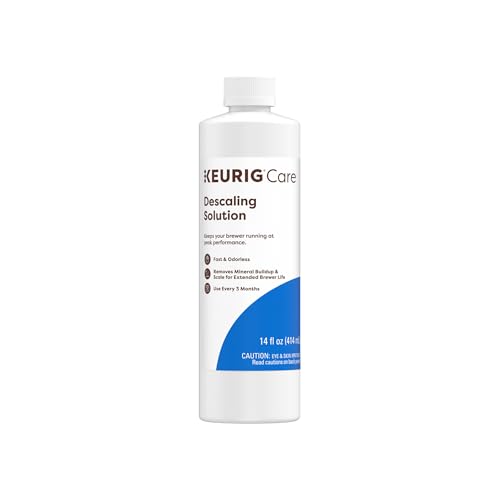
Keurig Descaling Solution
Badge: Best for Keurig Machines
Strengths
- Made by the machine maker, so compatibility questions disappear
- Formulated for both 2.0 and 1.0 K-Cup pod machines
- The safe choice where warranty language points to approved products
Trade-offs
- Brand specific: it is not the economical answer for other machines
- Pod machine focus means espresso owners should look elsewhere
- Single brand supply ties you to one maker range
Key specs
- Format: liquid descaling solution
- Compatibility stated: Keurig 2.0 and 1.0 K-Cup pod coffee makers
- Maker: Keurig
For a Keurig owner, the shortest path to a correct descale is the solution sold by the company that built the brewer. There is no compatibility research to do and no manual cross-checking, which matters because pod machines hide their scale problem until the pump is already straining. If the machine is under warranty, the maker own product is also the least arguable choice.
It only solves the Keurig problem: a household that also runs an espresso machine will still need a second product for that side of the counter.
In practice, the Keurig Descaling Solution earns its badge, Best for Keurig Machines, at the moment of use rather than in the cupboard. Its defining detail, Format: liquid descaling solution, shapes how the cycle feels: how much measuring, how much waiting, how much doubt. That feel is not a soft consideration. Descaling is a task owners postpone precisely when it feels fiddly, and a product that makes the cycle feel simple gets used on schedule, which is when descaling actually protects a machine. Judge this pick by the routine it creates in your kitchen, not only by the chemistry it contains.
The ownership maths extend past the first cycle. Compatibility stated: Keurig 2.0 and 1.0 K-Cup pod coffee makers sets the reorder rhythm, and a rhythm that matches your water is the difference between a cupboard that always has the next cycle ready and a machine that waits a fortnight for a delivery while scale keeps building. Owners who note the date and the dose on the box itself turn the Keurig Descaling Solution into a small system: product, schedule, and record in one place, which is all that machine maintenance ever needed to be.
Best for: buyers who want the maker-made solution for a Keurig brewer / Not suited for: buyers whose priorities run against the trade-offs listed for this pick above

Tillbrook Espresso Machine Compatible Descaler
Badge: Best Concentrated Value
Strengths
- Concentrated format stretches a single bottle across four uses
- Positioned across Breville, Keurig, Nespresso, and DeLonghi machines
- A year supply framing suits a steady quarterly rhythm
Trade-offs
- Concentrate means measuring carefully rather than pouring a ready dose
- Compatibility is stated as compatible-with, not made-by, each brand
- Sixteen ounces still needs safe, upright storage
Key specs
- Format: concentrated liquid, 16 oz
- Uses: 4 uses, framed as 1 year supply
- Compatibility stated: Breville, Keurig, Nespresso, DeLonghi and espresso machines
- Origin: made in USA
A concentrate is the format for the owner who descaled once, saw what came out, and decided to stay ahead of the problem. Four uses from one bottle keeps the per-cycle commitment low and the cupboard small, and the cross-brand positioning covers the mixed counter that is now normal in many kitchens.
Concentration shifts work to you: measure sloppily and you either waste product or run a weak cycle that leaves scale behind in the boiler.
In practice, the Tillbrook Espresso Machine Compatible Descaler earns its badge, Best Concentrated Value, at the moment of use rather than in the cupboard. Its defining detail, Format: concentrated liquid, 16 oz, shapes how the cycle feels: how much measuring, how much waiting, how much doubt. That feel is not a soft consideration. Descaling is a task owners postpone precisely when it feels fiddly, and a product that makes the cycle feel simple gets used on schedule, which is when descaling actually protects a machine. Judge this pick by the routine it creates in your kitchen, not only by the chemistry it contains.
The ownership maths extend past the first cycle. Uses: 4 uses, framed as 1 year supply sets the reorder rhythm, and a rhythm that matches your water is the difference between a cupboard that always has the next cycle ready and a machine that waits a fortnight for a delivery while scale keeps building. Owners who note the date and the dose on the box itself turn the Tillbrook Espresso Machine Compatible Descaler into a small system: product, schedule, and record in one place, which is all that machine maintenance ever needed to be.
Best for: buyers who want a concentrate that covers a year of cycles from one bottle / Not suited for: buyers whose priorities run against the trade-offs listed for this pick above
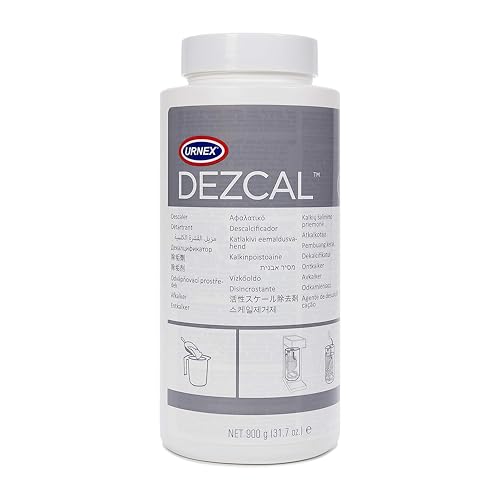
Urnex Dezcal Descaler 900g
Badge: Best Powder for Heavy Use
Strengths
- Large powder bottle suits frequent descaling and multiple machines
- Activated scale remover aimed at boilers and heating elements
- Also positioned for faucets, spray heads, and milk systems
Trade-offs
- Powder must be fully dissolved before the cycle starts
- Nine hundred grams is a lot of product for a single small machine
- Commercial breadth means home users should read dosing guidance carefully
Key specs
- Format: powder, 900g bottle
- Action: activated scale remover
- Targets: boilers, heating elements, faucets, spray heads, milk systems
- Maker: Urnex
Urnex comes from the cafe world, and Dezcal reads like it: a big powder bottle meant for machines that work hard and descale often. Home users with a prosumer espresso machine, or several machines under one roof, get a format that does not run out mid-season and a product line that also speaks to milk systems and spray heads.
Powder is the least forgiving format for a rushed user: undissolved granules should never enter a machine, so the dissolve step is part of the job, not an optional extra.
In practice, the Urnex Dezcal Descaler 900g earns its badge, Best Powder for Heavy Use, at the moment of use rather than in the cupboard. Its defining detail, Format: powder, 900g bottle, shapes how the cycle feels: how much measuring, how much waiting, how much doubt. That feel is not a soft consideration. Descaling is a task owners postpone precisely when it feels fiddly, and a product that makes the cycle feel simple gets used on schedule, which is when descaling actually protects a machine. Judge this pick by the routine it creates in your kitchen, not only by the chemistry it contains.
The ownership maths extend past the first cycle. Action: activated scale remover sets the reorder rhythm, and a rhythm that matches your water is the difference between a cupboard that always has the next cycle ready and a machine that waits a fortnight for a delivery while scale keeps building. Owners who note the date and the dose on the box itself turn the Urnex Dezcal Descaler 900g into a small system: product, schedule, and record in one place, which is all that machine maintenance ever needed to be.
Best for: buyers who want a high-volume powder for frequent descaling / Not suited for: buyers whose priorities run against the trade-offs listed for this pick above
Comparison Table
| Pick | Badge | Key attribute | Second attribute | Check |
|---|---|---|---|---|
| Essential Values Coffee Machine Descaler 2 Pack | Best Overall | Format: liquid descaling solution, pack of 2 | Supply framing: 1 year supply | Check on Amazon |
| Essential Values Universal Descaling Solution 2 Uses | Best Simple Routine | Format: liquid universal descaling solution | Uses per pack: 2 | Check on Amazon |
| Durgol Swiss Espresso Descaler 4 Pack | Best for Espresso Machines | Format: liquid, pack of 4 | Size: 4.2 fluid ounces per bottle | Check on Amazon |
| Keurig Descaling Solution | Best for Keurig Machines | Format: liquid descaling solution | Compatibility stated: Keurig 2.0 and 1.0 K-Cup pod coffee makers | Check on Amazon |
| Tillbrook Espresso Machine Compatible Descaler | Best Concentrated Value | Format: concentrated liquid, 16 oz | Uses: 4 uses, framed as 1 year supply | Check on Amazon |
| Urnex Dezcal Descaler 900g | Best Powder for Heavy Use | Format: powder, 900g bottle | Action: activated scale remover | Check on Amazon |
Read the table by columns, not by rows: find the attribute that matches your situation, then follow that column to the pick that carries it. The detailed reviews above explain what each attribute costs in trade-offs, which is the half of the story a table cannot tell.
How to Choose for Best descaler for coffee makers
Match the product to the machine before anything else
Pod machines, drip brewers, and espresso machines scale differently and descale differently. A pod machine hides a small water path that clogs quietly; an espresso boiler holds scale against its heating element where it insulates and overheats. Maker-made products, such as the Keurig and De’Longhi options here, remove the compatibility question entirely. Universal products earn their place on mixed counters, but the manual check comes first, especially while a machine is under warranty. Shoppers still choosing the machine itself can see how maintenance varies by format in Best Drip And Pod Coffee Makers.
Format: liquid, concentrate, pre-measured, or powder
Ready liquids are the simplest route and the bulkiest to store. Concentrates stretch one bottle across several cycles and ask for careful measuring in return. Pre-measured bottles remove measuring altogether, which is why busy espresso owners love them, but they fix the dose whether your machine wants it or not. Powder is the heavy-use format, economical across many cycles and machines, with one non-negotiable rule: dissolve it fully in water before it goes anywhere near the machine.
Water hardness decides your calendar
The same machine can need descaling twice a year on soft water and every few weeks on hard water. Learn your local water character, watch for the early signs, slower flow, cooler cups, a louder pump, and set the interval from evidence rather than from a generic calendar. Several picks frame their supply as a year, which assumes a moderate rhythm; hard-water households will move through that supply honestly faster, and that is the product working, not failing.
Descaling is not cleaning, and you need both
Descaler dissolves mineral scale; it does not remove coffee oils, and a cleaner does not dissolve scale. Machines suffer from both problems on different schedules. Keeping the two jobs separate, and using the product built for each, is the cheapest form of machine care there is. If your machine offers a descale programme or alert, treat it as the schedule speaking, and answer it with the product your manual approves. The design-led shopper can also browse Best Designed Coffee Makers for machines that make their maintenance paths unusually accessible.
How to Descale a Coffee Maker, Step by Step
Exact steps vary by machine, and your manual’s version always wins, but the universal shape of a descale looks like this.
- Empty and prepare. Remove pods, grounds, and the drip tray load; empty the water tank and rinse it.
- Mix the solution. Add the descaler to the tank at the dose the product and your manual agree on, with the water volume the cycle expects.
- Start the descale cycle. Use the machine’s descale programme if it has one; otherwise run the solution through in stages, letting it sit in the system between stages so it can work on the scale.
- Wait through the soak. The pause is the treatment. Rushing the solution through gives it no time to dissolve the deposits it was bought to remove.
- Rinse thoroughly. Empty and rinse the tank, refill with fresh water, and run at least one full clean cycle, more if the manual asks.
- Test with a plain brew. Run a water-only cup and taste it; any sharpness means another rinse cycle is needed.
- Reset the reminder. Clear the descale alert or note the date, so the next cycle is scheduled by the calendar rather than by a breakdown.
Work on a day when the machine can be out of service for the full cycle and soak. Descaling in a hurry, between the school run and the first meeting, is how rinse steps get skipped and the next morning’s coffee pays for it. Households watching for a machine deal while they maintain the current one can keep an eye on Best Discount Coffee Makers without letting a bargain distract from basic care.
Troubleshooting
Problem: the machine still runs slowly after a descale → the scale was heavy enough to need a second cycle; repeat with fresh solution rather than a stronger dose, and shorten the interval from now on.
Problem: the first coffees taste sharp or chemical → the rinse was too short; run additional fresh-water cycles until a plain water cup tastes neutral.
Problem: the descale alert will not clear → most alerts reset through a specific button sequence in the manual, not by completing the cycle alone; follow the reset steps for your model.
The Signs of Scale, in the Order You Will Meet Them
Scale announces itself politely before it announces itself expensively. First the cup runs a little cooler, because the element is heating a layer of mineral instead of water. Then the flow slows and the pump note changes, working harder against narrowing paths. Lukewarm, slow coffee is the machine asking for a descale in plain language. Later come the expensive dialects: temperature swings, leaks at stressed seals, and error states that need a technician. A descale costs a cycle and a dose of solution; a boiler costs a repair bill or a replacement machine. The entire economics of this guide rest on answering the polite request.
There is also a taste chapter to the story. Scale holds old coffee residue in its rough surface and releases stale notes into fresh brews, so a machine can be making worse coffee for weeks before it makes slower coffee. If a familiar bean suddenly tastes dull through a machine that has not been descaled in a year, maintenance is a likelier culprit than the roaster.
Hard Water, Soft Water, and Honest Intervals
Advice columns love a universal descaling calendar, and water refuses to cooperate with one. A household on soft municipal water may descale twice a year and find almost nothing to remove. A household on hard well water can scale a boiler noticeably in a season. The honest method is local: learn your water hardness from your utility or a simple test, watch the machine’s early signs, and let products framed as a year supply be a planning guide rather than a promise. The picks here span that range deliberately, from a two-use pack for the occasional descale to a powder bottle that assumes descaling is a way of life. Readers setting up a new drip routine can align their habits with Best Drip Brew Coffee Makers, where water quality shapes the cup just as directly.
What a Descaler Cannot Do, Said Plainly
Honest guides owe readers a list of limits, and descaling products have three that matter. First, a descaler cannot repair mechanical wear. A pump that has run dry, a seal that has perished, a valve that has warped: minerals may have contributed, but removing them will not rewind the damage, and repeated cycles aimed at a mechanical fault only delay the repair. Second, a descaler cannot compensate for water that keeps arriving loaded with minerals at a rate the schedule cannot match; at some hardness level, filtration or a different water source becomes part of the answer, and the descaler returns to its proper role as the second line of defence. Third, a descaler cannot clean coffee oil, and expecting it to is the most common disappointment in the category.
None of those limits diminishes the products in this guide; they define the job the products are actually for. Used on schedule, matched to the machine, and rinsed properly, a descaler is the cheapest insurance a coffee machine can carry, priced in minutes rather than in parts. The owners who get a decade from a brewer are rarely the ones with the most expensive machine. They are the ones whose descaler came out of the cupboard on the boring, correct dates, and this guide’s picks are ordered to make those dates as easy to keep as possible.
Common Buying Mistakes
- Waiting for the machine to fail before descaling, when the early signs, cooler and slower cups, arrived months earlier.
- Using a general kitchen cleaner or a home vinegar routine the manual does not approve, then discovering the warranty language cared about the difference.
- Skipping or shortening the rinse cycles and blaming the descaler for the sharp taste in the next morning’s coffee.
- Buying a single-brand product for a mixed counter, or a universal product without checking a warranty that names an approved one.
- Treating descaling and oil cleaning as the same job and expecting one product to do both.
Every mistake on that list has the same shape: a decision made on the wrong axis, size instead of fit, headline instead of specification, or hope instead of a routine. The sections above exist to put the decision back on the axis that decides how the product will actually live in your kitchen.
Reading a Descaler Listing Without Being Misled by It
Descaler listings speak a dialect worth learning. Universal describes a compatibility claim, not a guarantee, and it should always be read alongside your machine manual rather than instead of it. Supply framings, a year of descaling, a fifteen month supply, describe an assumed rhythm on assumed water, and your own water gets a vote. Compatible-with and made-by are different sentences wearing similar clothes, and the difference matters exactly as much as your warranty says it does. A reader who can translate those four phrases can shop this entire category in minutes, because the products themselves are few and genuinely distinct once the dialect is stripped away.
The second reading skill is matching the claim to the machine in front of you. A product can be honestly excellent for espresso boilers and honestly wrong for a pod machine’s narrow path, and the listing will not always volunteer the boundary. This guide has tried to state those boundaries in every review, because a descaler bought for the wrong machine is not a bargain at any tier; it is a postponed purchase plus a cycle that did not happen. The right product, used on the right machine, on a boring schedule, remains the whole secret of this category.
Finally, treat the first cycle with a new product as a calibration, not a verdict. Note the dose, the soak, the rinse count, and the result, and the second cycle becomes a routine instead of a research project. Machines reward owners who keep those small records, and descalers, humble as they are, sit at the centre of the record-keeping habit.
One more consideration belongs in any honest descaler guide, and it is the household with more than one kind of drinker. The espresso devotee, the pod-machine pragmatist, and the drip traditionalist often share a kitchen and a cupboard, and their machines scale on different schedules with different approved products. The temptation is to simplify the cupboard down to a single bottle and a single date, and this guide’s universal picks exist partly to make that simplification defensible. Where it is not defensible, where a warranty names a product or a programme names its own chemistry, the cupboard should stay plural and the calendar should stay specific. Simplicity is a virtue in maintenance only when it does not cost correctness.
The practical way to run a plural cupboard is embarrassingly simple: one shelf, products grouped by machine, each with its date written on it, and one shared calendar where every machine’s next cycle lives. That small arrangement converts a category that confuses many owners into a system a household can run without discussion. It is, in miniature, the argument of this entire guide: the products are good, the chemistry is proven, and the only variable left is whether the routine around them is designed or improvised. Design it once, and descaling takes care of itself for years.
And if this is your first descale on a machine you have owned for years, expect the first cycle to feel anticlimactic and the second cup afterwards to feel like an argument for the whole guide. Temperature returns quietly, flow returns measurably, and flavour returns in a way that makes you wonder how long it had been missing. That wondering is the correct response. Write the date down while it is still vivid, and the routine will have its first believer.
Final Recommendation
For most households the Essential Values two pack is the sensible default: universal, simple, and sized to a year of routine. Keurig owners should take the Keurig solution and end the compatibility question. Espresso owners who value a no-measuring routine will prefer the Durgol bottles, De’Longhi households have their maker’s own EcoDecalk, the Tillbrook concentrate suits the mixed counter, and the Urnex powder is the heavy-use answer. The best descaler is the one matched to your machine and actually used on schedule; pick yours, note the date, and let the machine stop asking.
Shortlist again, for the reader who scrolled: start with Essential Values Coffee Machine Descaler 2 Pack as the default, consider Essential Values Universal Descaling Solution 2 Uses for its particular strength, and look at Durgol Swiss Espresso Descaler 4 Pack if your situation matches its speciality. Each listing is the place to check the latest price on Amazon before you commit.
Frequently Asked Questions
How often should I descale my coffee maker?
It depends on your water and your machine’s guidance. Soft-water households may descale a couple of times a year; hard-water households may need it every few weeks. Follow the machine’s alert or manual first, and watch for slower flow and cooler cups as the practical signals between scheduled cycles.
Can I use vinegar instead of a descaler?
Some makers allow it and many advise against it; vinegar can linger in seals and flavour later brews, and warranty language sometimes names approved products. The products in this guide exist to remove that guesswork. Whatever you use, the manual for your specific machine is the authority.
What is the difference between descaling and cleaning?
Descaling dissolves mineral deposits from water; cleaning removes coffee oils and residue. They are different problems with different products and different schedules. A machine can need either, or both, and using one product for the other’s job leaves the real problem untouched.
Will descaling fix a machine that has already slowed down?
Often, yes, if scale is the cause: a cycle, sometimes two for heavy buildup, restores flow and temperature. If a full descale changes nothing, the problem is mechanical rather than mineral, and further cycles will not substitute for a repair.
Is a universal descaler safe for my espresso machine?
Universal products here state compatibility across the major espresso brands, and many owners use them without issue. The careful path is to confirm your manual’s wording first, especially under warranty, and to prefer a maker-made or espresso-focused product, such as the Durgol or the Breville-focused options, when you want the narrowest fit.
Why does my coffee taste off right after descaling?
Almost always, the rinse was too short. Run additional fresh-water cycles and taste a plain water cup before brewing coffee. A neutral water cup means the system is clear; a sharp one means keep rinsing.


