Disclosure: topratedkitchenware.com is reader-supported. When you buy through links on our site, we may earn an affiliate commission from Amazon and other retailers, at no extra cost to you.
Where to buy
The six machines below are the verified picks for this guide to the best drip coffee makers reddit walmart shoppers ask about most. Each name links to its Amazon listing, where you can check the latest price on Amazon, confirm the exact model and configuration, and compare it against the shelf version before you decide where to buy.
- KRUPS 12-Cup Programmable Thermal Carafe Coffee Maker
- Cuisinart PerfecTemp 12-Cup Thermal Drip Coffee Maker
- BLACK+DECKER 12 Cup Thermal Programmable Coffee Maker CM2046S
- Cuisinart 10-Cup Thermal Classic Coffeemaker
- SECPOEDR Grind and Brew Coffee Maker with Built-In Grinder
- Gevi 10-Cup Grind and Brew Coffee Maker
Read the full guide ↓ for how the community verdict and the big-store shopping reality were weighed together, plus the model-number checks that protect you from buying the wrong variant.
The search for the best drip coffee makers reddit walmart combines two different kinds of advice, and this guide respects both. The first half comes from community discussion, where owners judge machines by flavour, temperature, carafe quality, and whether the thing still works after a year of mornings. The second half comes from the way people actually shop at a giant general retailer: they want a familiar brand on the shelf, a painless return if the machine disappoints, replacement carafes and filters that are easy to find, and a model number that matches the one the forums praised, not a near-identical variant built to a different specification. A machine can win the community argument and still be a frustrating store purchase if its exact model is hard to find or its carafe is impossible to replace locally. The six picks below were chosen to survive both tests.
That dual test shapes the list in visible ways. Every pick here is a thermal or well-regarded mainstream design from a brand with real distribution, because the community side of the keyword demands good coffee and the retail side demands support. Two grind-and-brew machines make the list because forum interest in fresh-ground convenience is strong, but their reviews carry the honest cleaning warning that store shoppers, who often buy on a quick shelf decision, most need to hear before the purchase rather than after. You will also find a dedicated section on buying-channel checks: how to confirm a model number, why marketplace listings and store shelves sometimes describe the same name differently, and how return policies change the risk of trying a machine.
The structure follows the house pattern: quick picks with badges, an explanation of how the picks were chosen, detailed reviews with strengths, trade-offs, and verified specifications only, a comparison table, a how-to-choose section, a practical brewing and troubleshooting section, and a closing recommendation. Readers who arrived from the broader community discussion may want to keep Best Drip Coffee Makers Under $100 open as a neighbouring reference for how the category’s tiers are usually framed, while this guide stays focused on which specific machines satisfy both the forum verdict and the store shelf.
Key Takeaways
- Model numbers matter more than model names at big retailers; two of the picks here are Cuisinart thermal machines that differ in brewing temperature design and controls, and the reviews separate them clearly.
- Thermal carafes dominate this list because community consensus favours them and because a thermal carafe removes the most common store-return complaint, coffee that tastes cooked by mid-morning.
- Easy returns change the risk calculation, but they do not change the coffee; judge the machine first and the channel second.
- Replacement carafes, filters, and descaling supplies are part of the purchase, so favour brands whose parts ecosystem you can actually access.
- Grind-and-brew machines are the highest-maintenance picks here; buy one only if the fresh-ground payoff genuinely matters to your household.
- Check the latest price on Amazon for each pick and compare the exact configuration, since bundles and carafe types vary by channel.
In this guide
Quick Picks
| Pick | Badge | Why it made the list | Listing |
|---|---|---|---|
| KRUPS 12-Cup Programmable Thermal Carafe | Best Overall | Twelve-cup double-wall thermal carafe, three brew strengths, and 24-hour programming with no warming plate. | Check on Amazon |
| Cuisinart PerfecTemp 12-Cup Thermal | Best for Hotter Brewing | PerfecTemp hotter brewing with brew strength control in a double-wall stainless thermal design. | Check on Amazon |
| BLACK+DECKER 12 Cup Thermal Programmable CM2046S | Best Familiar-Brand Pick | A mainstream thermal machine with brew strength selection and VORTEX showerhead water distribution. | Check on Amazon |
| Cuisinart 10-Cup Thermal Classic | Best Compact Thermal | The simpler ten-cup programmable thermal option for smaller households that want no learning curve. | Check on Amazon |
| SECPOEDR Grind and Brew | Best Grind-and-Brew | Built-in grinder, ten-cup programmable brewing, and a two-hour keep warm in a stainless body. | Check on Amazon |
| Gevi 10-Cup Grind and Brew | Best Modern Controls | Touch screen, built-in grinder, reusable filter, and a 1.5-litre tank for a more contemporary take on the format. | Check on Amazon |
Read the badges as channel-aware shorthand. Best Overall is the machine to buy if you only read one review. Best for Hotter Brewing answers the single most common technical complaint in community threads. Best Familiar-Brand Pick is the machine whose name, parts, and support are easiest to deal with at a general retailer. The two grind-and-brew badges mark a different kind of purchase entirely, one where daily upkeep is part of the deal, and their reviews should be read in full before any shelf decision. If two badges both appeal to you, let your morning routine arbitrate: the household that drinks slowly should always let the carafe column outrank the feature column, because holding is the one property you will experience in every single cup.
How These Picks Were Chosen
This guide is research-led and says so plainly: it does not claim hands-on laboratory testing. The method combined three inputs. First, the verified product pool for this guide fixed exactly which machines, model numbers, and configurations could be linked and pictured, so nothing here rests on a remembered specification. Second, community discussion themes supplied the judging criteria: brew temperature, carafe behaviour, cleaning burden, and durability signals from owners months into use. Third, retail-channel practicality filtered the results, favouring brands and models with the distribution and parts support that a big-store shopper can realistically use.
That third filter is what separates this list from a pure forum ranking, and it cut both ways. It kept the list honest about grind-and-brew machines, which forums love debating and stores sell briskly, by insisting their maintenance cost be stated up front. It also kept two similar Cuisinart thermal machines on the list rather than pretending they are one product, because at retail the difference between them is exactly the kind of shelf confusion this keyword’s shoppers run into. Where a specification could not be confirmed from the verified data, the article does not claim it; the spec boxes contain only what the verified listings support.
Ordering follows the combined verdict. The KRUPS leads because it satisfies the community criteria most completely while remaining a mainstream, programmable, widely distributed machine. The PerfecTemp follows on the strength of its hotter-brewing design, the BLACK+DECKER represents the familiar-brand thermal route, the smaller Cuisinart serves compact households, and the two grind-and-brew machines close the list as the deliberate, higher-maintenance alternatives. Readers researching the certification end of the category can continue with Best Drip Coffee Makers Sca once the channel questions here are settled.
The 6 Best Drip Coffee Makers Reddit and Walmart Shoppers Agree On

KRUPS 12-Cup Programmable Thermal Carafe Coffee Maker
Badge: Best Overall
Strengths
- Double-wall thermal carafe keeps coffee hot for hours with no warming plate, matching the configuration community threads recommend most.
- Three brew strengths give a household real control over extraction without menu-diving.
- 24-hour programming covers the weekday wake-up routine completely.
Trade-offs
- Twelve-cup capacity is more machine than a solo drinker needs.
- Thermal carafes hide the coffee level, a small daily guess for some households.
- No grinder, so freshness depends on your beans and a separate grinder.
Key specs: 12-cup capacity; double-wall thermal carafe; 3 brew strengths; 24-hour programmable; no warming plate.
The KRUPS leads this list for the same reason it leads the pure community ranking: it is the most complete thermal programmable machine in the pool, and completeness is what survives both a forum thread and a store shelf. The double-wall carafe holding coffee hot for hours without a plate addresses the flavour complaint that drives more returns and more negative owner posts than any other in drip coffee. The three strength settings are not decoration; they are how a household rescues a light roast that brews thin or calms a dark roast that brews harsh, using the machine instead of rebuying beans.
From the retail side, this is a mainstream programmable model from an established kitchen brand, which is what the second half of the keyword is really asking for: a machine a shopper can find, compare, and get support for without hunting through specialty channels. The honest limitation is size and focus. It is a twelve-cup pot brewer with no single-serve tricks and no grinder, so households wanting either should keep reading. For the central use case — a family pot, brewed on a timer, held properly until the last cup — nothing else in this guide is as well rounded.
Best for: households wanting one complete thermal pot brewer / Not suited for: pod users or solo drinkers

Cuisinart PerfecTemp 12-Cup Thermal Drip Coffee Maker
Badge: Best for Hotter Brewing
Strengths
- PerfecTemp design brews hotter, answering the lukewarm-coffee complaint that dominates technical forum threads.
- Brew Strength control lets you adjust the cup without changing your coffee dose.
- Double-wall stainless steel thermal carafe holds heat the community-approved way, with no plate.
Trade-offs
- It overlaps heavily with the other Cuisinart in this guide, so compare model numbers carefully before buying anywhere.
- Twelve-cup thermal format is tall and heavy when full.
- No grinder and no single-serve mode; it is a dedicated pot brewer.
Key specs: 12-cup capacity; double-wall stainless steel thermal carafe; PerfecTemp hotter brewing; Brew Strength control; silver finish; model DCC-3400NAS.
If community threads have a technical villain, it is the brewer that never quite gets hot enough, leaving coffee sour and thin no matter what beans go in. The PerfecTemp line exists to answer that complaint, and its name describes the design intent: hotter brewing, paired with strength control so the household can tune the result. In a double-wall stainless thermal carafe, that makes this the pick for buyers whose current machine’s coffee tastes under-extracted and who have already ruled out their beans and their dose.
The retail warning attached to this pick matters as much as the praise. This guide contains two Cuisinart thermal machines, and store shelves and marketplace listings present similar names and similar photographs for different models. The PerfecTemp is the twelve-cup DCC-3400NAS with strength control; the Thermal Classic below is the ten-cup DCC-1170BKNAS. Check the model number on the box or listing before paying, because the name alone will not protect you. Buy the right one and you get the hotter-brewing thermal machine the technical end of the community asks for by description.
Best for: buyers whose current coffee tastes lukewarm or under-extracted / Not suited for: shoppers who will not check model numbers between similar listings
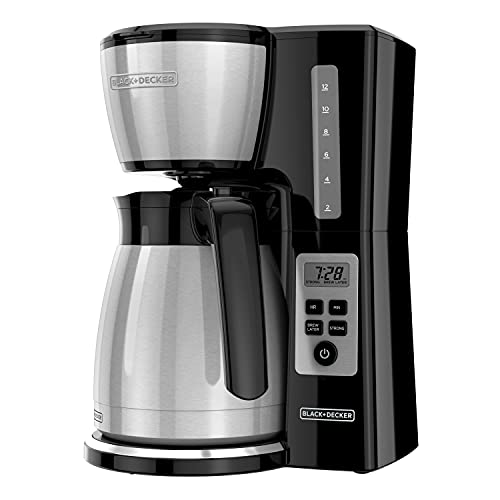
BLACK+DECKER 12 Cup Thermal Programmable Coffee Maker CM2046S
Badge: Best Familiar-Brand Pick
Strengths
- Thermal carafe with programmable brewing and brew strength selection from one of the most widely distributed small-appliance brands.
- VORTEX showerhead design aims for even saturation of the grounds, the distribution detail extraction depends on.
- Black and steel styling that fits the mainstream shelf this keyword’s shoppers are browsing.
Trade-offs
- Community purists rank its refinement below the KRUPS and Cuisinart picks, even while respecting its accessibility.
- Thermal format carries the usual invisible coffee level.
- No grinder, no pods, no iced mode; a focused pot brewer only.
Key specs: 12-cup capacity; thermal carafe; programmable; brew strength selection; VORTEX Technology showerhead; black/steel; model CM2046S.
This is the pick that best embodies the second half of the keyword. BLACK+DECKER is the kind of brand a general retailer stocks deeply, supports plainly, and replaces without drama, and the CM2046S is its proper thermal programmable machine rather than a stripped shelf special: twelve cups, a thermal carafe, strength selection, and a showerhead design that spreads water across the grounds instead of tunnelling through the middle. That last detail is not marketing garnish; uneven saturation is a real cause of the sour-and-bitter-in-the-same-pot complaint, and a showerhead is the standard engineering answer.
Community discussion treats this tier of machine with a particular respect: it is what many owners started with, and its ceiling is refinement rather than competence. Against the KRUPS you give up a strength setting and some polish; against the Cuisinarts you give up the hotter-brewing specialism. What you gain is the easiest ownership story in the guide for a mainstream shopper. If your priority is a thermal machine from the most familiar name on the shelf, with parts and support to match, this is the rational buy.
Best for: mainstream shoppers wanting a supported thermal brand name / Not suited for: enthusiasts chasing the last degree of refinement

Cuisinart 10-Cup Thermal Classic Coffeemaker
Badge: Best Compact Thermal
Strengths
- A mature, simple programmable thermal design from a brand with deep retail presence.
- Ten-cup size matches real two-person consumption better than oversized pots.
- Controls a guest or a half-awake owner can run without instructions.
Trade-offs
- No headline strength-control feature; tuning rests on dose and grind.
- Less capacity headroom for guests than the twelve-cup picks.
- Thermal carafe level remains invisible, as with all thermal picks here.
Key specs: 10-cup capacity; thermal carafe; programmable; black finish; model DCC-1170BKNAS.
Not every household needs twelve cups, and the Thermal Classic is the guide’s answer for the ones that do not. Its formula is deliberately conservative: a ten-cup programmable brewer with a thermal carafe from a brand any big retailer relationship can support. In community terms, this is the quiet machine, the one owners mention in passing as simply working, and in retail terms it is the lower-commitment way into the thermal format for a smaller kitchen.
Be clear about what separates it from its PerfecTemp sibling above, because the shelf will not always make it obvious. The Classic is ten cups, simpler, and without the hotter-brewing design emphasis; the PerfecTemp is twelve cups with strength control. Neither is a lesser version of the other so much as a different answer to household size and tuning appetite. The honest limitation is headroom: brunch for six will stretch it. For a couple’s daily pot with a timer and a proper carafe, it is sized exactly right.
Best for: couples and small households wanting classic thermal simplicity / Not suited for: regular hosts or strength-tuning enthusiasts

SECPOEDR Grind and Brew Coffee Maker with Built-In Grinder
Badge: Best Grind-and-Brew
Strengths
- Built-in grinder delivers the fresh-ground step that pre-ground coffee cannot match.
- Ten-cup programmable brewing with a two-hour keep warm function.
- Stainless steel body at a tier of the market where grind-and-brew is usually positioned far higher.
Trade-offs
- The grinder path needs regular cleaning; this is the highest-upkeep pick in the guide.
- A newer brand carries a thinner long-term owner record than the established names here.
- Keep-warm holding still means the last cup trails the first in flavour.
Key specs: 10-cup capacity; built-in grinder; programmable; 2-hour keep warm function; stainless steel.
Forum interest in grind-and-brew never dies, because the underlying fact is true: coffee ground seconds before brewing keeps aroma that pre-ground coffee loses on the shelf. The SECPOEDR is the accessible route into that format, combining the grinder, ten-cup programmable brewing, and a two-hour keep warm window in one stainless machine. For a store shopper, it collapses two purchases into one box and one outlet, which is a genuinely attractive shelf proposition.
The warning belongs in the same paragraph as the praise, because this is the pick most likely to be bought on impulse and regretted on upkeep. The grinder section collects oily residue, and owners who skip cleaning it end up flavouring every pot with stale grounds. Community threads on grind-and-brew machines are essentially maintenance threads with a coffee machine attached. If you will build the small cleaning habit, this is the freshest-tasting route in the guide at its tier. If you know you will not, the KRUPS above will make you happier for longer.
Best for: freshness-first buyers who accept grinder upkeep / Not suited for: impulse buyers wanting zero maintenance

Gevi 10-Cup Grind and Brew Coffee Maker
Badge: Best Modern Controls
Strengths
- Touch screen interface makes coordinating grind and brew settings legible at a glance.
- Built-in grinder with programmable timing, so fresh-ground coffee can be ready on schedule.
- Reusable filter and a 1.5-litre tank reduce consumables and refills.
Trade-offs
- Glass carafe on a 90-minute warm plate is the holding style community consensus ranks below thermal.
- Same grinder-cleaning obligation as the other grind-and-brew pick.
- Touch controls are a preference, not an upgrade, for button loyalists.
Key specs: 10-cup capacity; built-in grinder; touch screen; glass carafe; 90-minute warm plate; reusable filter; 1.5L tank.
The Gevi is the contemporary alternative in the grind-and-brew pair: same fresh-ground premise, wrapped in a touch screen interface with a reusable filter. The screen genuinely helps this format, because grind-and-brew asks more of the user than a plain brewer does, and a clear display reduces the half-awake setup errors that fill owner threads. The reusable filter removes the recurring paper purchase, a small but real convenience for a shopper thinking about the total ownership routine rather than the box alone.
Its limitation is holding style. A glass carafe on a warm plate for up to ninety minutes is fine for a household that drinks a pot promptly, and a poor match for one that grazes until noon, which is why the thermal machines lead this guide. Read it as a lifestyle split rather than a quality verdict: fast-drinking, interface-loving households will enjoy this machine; slow households should take the SECPOEDR’s keep-warm arrangement or, better, a thermal pick. Either way, budget the grinder cleaning into your week before the box reaches the checkout.
Best for: prompt-drinking households that like touch controls / Not suited for: slow grazers or anyone avoiding grinder maintenance
Comparison Table
| Model | Capacity | Carafe / holding | Standout trait | Listing |
|---|---|---|---|---|
| KRUPS Programmable Thermal | 12-cup | Double-wall thermal, no plate | 3 strengths, 24-hour timer | Check on Amazon |
| Cuisinart PerfecTemp Thermal | 12-cup | Double-wall stainless thermal | Hotter brewing, strength control | Check on Amazon |
| BLACK+DECKER CM2046S | 12-cup | Thermal carafe | VORTEX showerhead, familiar brand | Check on Amazon |
| Cuisinart Thermal Classic | 10-cup | Thermal carafe | Classic programmable simplicity | Check on Amazon |
| SECPOEDR Grind and Brew | 10-cup | 2-hour keep warm | Built-in grinder, stainless body | Check on Amazon |
| Gevi Grind and Brew | 10-cup | Glass carafe, 90-minute warm plate | Touch screen, reusable filter | Check on Amazon |
How to Choose the Right Drip Coffee Maker
Begin with the household count, translated honestly. Maker cups are small servings, so divide your household’s real mug count into the pot sizes here: ten-cup machines suit one to three regular drinkers, twelve-cup machines suit three to five or households that host. Buying above your count does not future-proof anything; it trains you to brew pots you half-waste, and stale coffee is a worse outcome than a second smaller brew.
Then settle the temperature question, because it is the technical heart of the category. Coffee needs sufficiently hot water, evenly distributed, to extract properly; too cool and the cup turns sour and thin, which is the complaint behind a large share of disappointed owner posts. The PerfecTemp pick exists specifically for buyers fighting that problem, and readers who want the formal standards behind the temperature debate should continue to Best Drip Coffee Makers That Brew Hotenough after this guide. In shelf terms, favour machines whose designs advertise their heating and showerhead distribution, and be sceptical of novelty features offered instead of them.
Next, think in terms of total ownership rather than the box. A drip machine consumes filters or a reusable basket, descaling solution, counter space, and minutes of cleaning every week for years. Thermal carafes cost more care in washing and hide their contents; glass carafes are simpler and more fragile. Grind-and-brew machines add a grinder’s upkeep to the ledger. None of these costs is a reason to avoid a category, but all of them belong in the decision, and the detailed reviews above assign each cost to the pick that carries it.
Finally, use the channel intelligently. A generous return policy is a safety net, not a research method: decide which machine fits your household using the criteria here, then let the channel’s convenience break ties. Shoppers comparing the wider tier landscape can also scan Best Drip Coffee Makers Under $75 for orientation on how features are usually bundled, while keeping this guide’s model-specific checks as the deciding layer.
How to Brew, Clean, and Troubleshoot Your Drip Coffee Maker
Set the machine up for its first pot by running a plain water cycle, which clears manufacturing residue and confirms the carafe, lid, and drip-stop all seat correctly. For daily brewing, fill with fresh cold water to the mark matching the mugs you want, dose grounds consistently, and change one variable at a time when adjusting flavour — dose before grind, grind before strength settings — so you learn what each change actually does. On the programmable picks, set the timer the night before with the carafe in place; the most common timer failure in owner stories is a forgotten carafe, not a failed clock.
Cleaning is a schedule, not an event. Rinse the carafe and basket daily, wash removable parts weekly, and wipe the grinder path on the grind-and-brew picks before residue builds. Descale whenever brewing slows, noise rises, or flavour dulls despite fresh beans, using the method the manufacturer describes for your model, followed by plain-water rinse cycles. Thermal carafes benefit from an occasional soak to clear the coffee film that builds inside where you cannot see it, which is also why their coffee sometimes tastes stale in a way owners misattribute to the machine.
Problem: the pot tastes sour and thin → suspect under-extraction; increase the dose slightly, then look at brew temperature and whether the showerhead is distributing water evenly rather than tunnelling. Problem: coffee overflows the basket or drips when the carafe is pulled → check that the filter sits flat, the carafe lid is aligned with the drip-stop, and grounds have not blocked the basket outlet. Problem: the last cup tastes cooked or stale → the holding method is the cause, not the beans; shorten the hold, switch the plate off after serving, or move to a thermal pick from this guide.
Buying at a Big Retailer Without Buying the Wrong Machine
The channel half of this keyword deserves direct advice, because most wrong purchases here are identification errors, not quality errors. Brand lines reuse names across years and tiers, and a shelf can hold two thermal machines from the same brand that differ in capacity, temperature design, and controls while looking near-identical in a hurry. The defence is boring and total: shop by model number. This guide prints the model numbers where the verified data provides them — DCC-3400NAS for the PerfecTemp, DCC-1170BKNAS for the Thermal Classic, CM2046S for the BLACK+DECKER — so compare those strings on the box or listing, not the photograph.
Marketplace listings add a second trap: third-party sellers sometimes describe a bundle, carafe type, or configuration that differs from the headline product. Before buying through any channel, confirm the carafe type, capacity, and included parts on the listing itself, and treat a price that seems detached from every other channel as a prompt to re-check the configuration rather than as a bargain. Readers who enjoy the pre-infusion side of brewing can explore Best Drip Coffee Makers That Blooming next, but for this purchase the rule stands: the right model, verified, beats a near-name at any channel.
What the Community Adds That a Shelf Cannot
A store shelf can tell you capacity, carafe type, and which features the box advertises. It cannot tell you that a lid is awkward to wash, that a water window is hard to read before dawn, or that a particular grinder needs its chute brushed weekly to behave. That layer of knowledge only exists because owners post it, which is the entire premise of this keyword. The healthiest way to combine the two sources is to let the shelf narrow your options to machines you can buy and support easily, then let community experience rank those options by lived quality, exactly the order this guide applied.
It is also worth copying the community’s habit of the follow-up report. Whatever you buy, note how it performs at one month and at six, even if only for yourself. Buyers who do this descale on time, notice carafe film before it flavours a pot, and know precisely which feature they actually used when the next purchase comes around. The machines in this guide were ranked to reward that kind of ownership: thermal holding that stays honest, controls that get used, and maintenance that is stated rather than discovered. There is a quieter benefit too: a buyer who tracks their own machine’s behaviour becomes immune to the next round of shelf marketing, because they know from their own kitchen which specifications changed their cup and which were decoration. That knowledge compounds across every appliance purchase that follows, and it begins with nothing more elaborate than paying attention to the pot you already own.
The First Week With a New Machine: A Routine That Prevents Most Regret
Most returns and most disappointed owner posts trace back to the first week, when a machine is judged before its owner has learned its habits. A better approach is to treat the first seven days as calibration. On day one, run the plain-water cycle, brew a first pot with your usual beans and dose, and taste it without adjusting anything; that pot is your baseline, not your verdict. Over the next pots, change exactly one variable at a time. If the cup is thin, raise the dose before touching strength settings. If it is harsh, lower the strength setting or serve sooner rather than blaming the beans. By the end of the week you will know which lever does what on your specific machine, knowledge no review can hand you because it depends on your water, your beans, and your grinder.
The first week is also when the machine’s fit with your kitchen reveals itself. Note whether the lid clears your cabinets when you fill the reservoir, whether the carafe pours cleanly at the sink, whether the timer routine survived a real weekday, and whether the cleaning the design demands actually happened. Those four observations predict year-two satisfaction more reliably than any feature list. If a genuine mismatch appears — a carafe style fighting your morning, a grinder routine you already resent — the return window is the time to act on it, which is one practical reason the channel half of this keyword matters. A well-chosen machine bought through a channel with a workable return policy is a lower-risk purchase than the same machine bought anywhere else, provided the choice itself was made on fit rather than impulse.
Grind-and-brew owners have one extra first-week task: learn the grinder’s cleaning access while it is still clean. Open the parts, see where grounds collect, and establish the brush-and-rinse habit before residue makes the job unpleasant. Owners who do this in week one describe the upkeep as trivial in later posts; owners who discover the grinder path at month three describe it as a betrayal. The machine did not change between those accounts. The habit did.
How the Community Verdict and the Shelf Verdict Differ, and Why You Need Both
It is worth being precise about what each half of this keyword contributes, because using only one produces a characteristic failure. The community verdict is a quality signal gathered over time: it knows which carafes stain, which hinges loosen, which heating designs hold their temperature, and which features owners quietly stop using. Its weakness is that it speaks in model names and memories, sometimes praising a configuration that has since changed or that a given store does not actually stock. The shelf verdict is an availability and support signal: it knows what can be bought today, returned tomorrow, and repaired or re-carafed next year. Its weakness is that it cannot taste coffee, and its incentives run toward moving boxes rather than matching households.
Combining them is a sequence, not a compromise. First, use community experience to define the design you want: in this category, that means a thermal carafe for slow mornings, a heating design that respects temperature, a capacity matched to real mugs, and a maintenance load you accept. Second, use the shelf to find that design in a model you can buy and support, verifying the model number so the design you researched is the design in the box. Third, use the first-week routine above to confirm the match while the return option still exists. Buyers who run that sequence rarely post regret threads, and the six picks in this guide were selected to be the machines that survive all three steps for the widest range of households. Readers whose next question is about formal brewing standards rather than channels will find the natural continuation in the certification-focused guides linked earlier in this article.
Strength Settings, Timers, and Showerheads: What the Features Actually Change
Three features recur across this list, and each deserves a plain explanation because shelf descriptions rarely give one. A brew strength setting changes how the machine manages contact between water and grounds, typically by altering flow or saturation so the same dose extracts more or less. Used well, it is a per-bean adjustment: a brighter, lighter roast that tastes thin on the standard setting often comes into balance on a stronger one, while a heavy dark roast that turns harsh can be calmed down. Used badly, it becomes a permanent maximum setting that extracts bitterness from everything. Treat it as seasoning, not as a quality dial, and change it only when the beans change.
The 24-hour timer is simpler and, for weekday households, more valuable than any other electronic feature here. Its real function is not convenience in the abstract; it moves the fiddly part of brewing — filling, dosing, seating the carafe — to the evening, when you have light and patience, leaving the morning with only a pour. The timer’s known failure mode is human rather than electronic: a carafe left in the sink, a basket left open, water measured for the wrong size of pot. The evening checklist is part of the feature, and households that build it get the wake-up coffee the box promises.
The showerhead, represented here by the BLACK+DECKER’s VORTEX design, addresses distribution. Water entering the basket at one point drills a channel through the grounds, over-extracting that path and under-extracting the rest, which is how one pot can taste sour and bitter at once. A showerhead spreads the water so the whole bed saturates together. You cannot see this feature work from outside the machine, which is why it rarely headlines a box, but its effect is in every cup. When comparing two otherwise similar machines on a shelf, the one that explains its water distribution is usually the one engineered by people who drink their own output.
Common Buying Mistakes
- Buying by model name instead of model number, and taking home the near-identical variant with the wrong capacity or carafe.
- Assuming a generous return policy substitutes for choosing the right holding style, then returning a glass-carafe machine a slow household should never have bought.
- Choosing a grind-and-brew machine on a quick shelf decision without budgeting its weekly grinder cleaning.
- Oversizing the pot for imaginary guests and wasting half of every weekday brew.
- Ignoring the parts ecosystem — replacement carafes, filters, and descaler — until the first breakage.
- Judging by a frozen score printed in an article instead of the current pattern of owner feedback on the listing.
Final Recommendation
Buy the KRUPS 12-Cup Programmable Thermal Carafe Coffee Maker if you want the single most complete answer to this keyword: community-approved thermal holding, three strengths, and a full timer in a mainstream machine. Choose the Cuisinart PerfecTemp if lukewarm, under-extracted coffee is the problem you are solving, and the BLACK+DECKER CM2046S if the easiest familiar-brand ownership story matters most. Smaller households should take the ten-cup Thermal Classic, and freshness-first buyers should choose between the two grind-and-brew machines with their eyes open about cleaning. In every case, verify the model number at the channel you buy from; that one habit prevents more regret than any feature comparison.
Frequently Asked Questions
Why does this guide keep insisting on model numbers?
Because drip coffee lines reuse names across different capacities, carafes, and control sets, and the differences decide satisfaction. The two Cuisinart thermal machines in this guide prove the point: similar names, different sizes and brewing designs. The model number is the only identifier that cannot drift between a shelf, a listing, and a review.
Is thermal really better than glass for a normal household?
For any household whose pot regularly lasts beyond an hour, yes, because insulation holds heat without cooking the coffee further. For a household that empties a pot quickly, glass on a plate is entirely respectable, and the Gevi in this guide serves exactly that routine. Match the carafe to the pot’s lifespan in your kitchen.
What does VORTEX or showerhead distribution actually do?
It spreads incoming water across the grounds bed instead of pouring it through one point. Even saturation extracts the grounds uniformly, avoiding the mixed sour-and-bitter cup that a single tunnelling stream produces. It is one of the few box features with a direct, understandable effect on flavour.
Are grind-and-brew machines a good store purchase?
They are a good purchase for the right owner: someone who values fresh-ground flavour and will clean the grinder path regularly. They are a poor impulse purchase, because the maintenance is real and skipping it flavours every pot. Both grind-and-brew reviews in this guide state the upkeep plainly so the decision happens before checkout.
How do I know if my current machine brews hot enough?
The practical signs are in the cup: coffee that tastes sour or thin despite correct dose and fresh beans often points at temperature or distribution. Owners commonly confirm with a kitchen thermometer in the basket stream. If the diagnosis holds, the PerfecTemp pick in this guide is the design aimed at that problem.
Should I buy on price, brand, or features first?
Buy on fit first: capacity, carafe style, and maintenance appetite decide daily satisfaction. Brand matters next, through support and parts. Features matter last, and only the ones your routine will actually use — a timer you set nightly is worth more than five modes you will never touch.
What should I check in the store or on the listing before paying?
Run a short identification routine. Confirm the model number matches the machine you researched, not merely the brand and product name. Confirm the carafe type in words — thermal or glass — because photographs of stainless-trimmed glass and true thermal carafes can look deceptively alike at thumbnail size. Confirm the capacity in cups and translate it into your household’s mugs. Confirm what is in the box, particularly whether a reusable filter or starter parts are included, and confirm the return route in case the first-week calibration exposes a genuine mismatch. That five-minute routine, applied to any pick in this guide and any channel, prevents the identification errors that account for most disappointed purchases behind this keyword.


