Disclosure: topratedkitchenware.com is reader-supported. When you buy through links on our site, we may earn an affiliate commission from Amazon and other retailers, at no extra cost to you.
Where to buy
Short on time? These are the verified picks for best power cookers. Each linked name goes to its Amazon listing, where you can check the latest price on Amazon, confirm the current configuration, and read current owner feedback. Any pick described as prose-only is covered in full below without a purchase link, for a reason explained honestly in its review.
- Instant Pot Duo 6 Qt 7-in-1 — Best True Power Cooker
- Cosori Pressure Cooker 6QT 9-in-1 — Best Power Cooker for Easy Cleanup
- MICHELANGELO Stovetop Pressure Cooker 4.2 qt — Stovetop Alternative — Prose Only
- Peterboo Stainless Steel Pressure Cooker 6 Quart Stovetop — Stovetop Alternative — Prose Only
- [3-IN-1] Pressure Cooker 12 Quart Stainless Steel Pressure Canner (RVGMBO) — Stovetop Alternative — Prose Only
- Peterboo 3Qt Stainless Steel Pressure Cooker Small — Stovetop Alternative — Prose Only
Read the full guide ↓ for how these picks were chosen, what each one does well, where each one falls short, and how to choose between them.
The best power cookers search carries a specific history: Power Cooker became a household phrase through the wave of electric, programmable pressure cookers sold under that style of name — plug-in machines that sear, pressure-cook, slow-cook, and keep dinner warm at the press of a button. This guide honours that meaning strictly, and it begins with the most important disclosure in any of our guides: of the six verified products assigned to this keyword, only two are true powered electric cookers. Those two are reviewed and linked normally. The other four are stovetop pressure cookers — good pots, honestly reviewed below, but they are not power cookers, they carry no purchase link in this guide, and each is labelled prose-only so no reader mistakes them for the powered appliances they searched for.
Why include the stovetop pots at all? Because a reader comparing powered cookers deserves to see the alternative they are choosing against, described fairly: a stovetop pressure cooker delivers the same pressure-cooked results using your burner’s power instead of its own element, with no programs, no timer, and no keep-warm. Some cooks prefer exactly that. But preference is not identity, and this guide will not blur the line — if you came for a plug-in power cooker, the Instant Pot Duo and the Cosori below are your shortlist, full stop.
The two true power cookers here split the decision cleanly. The Duo is the proven stainless-pot all-rounder with the deepest recipe support in the category; the Cosori answers with a ceramic-coated pot, sous vide, and a long safety list. Everything after those two reviews is context — stovetop alternatives for readers whose search broadens as they read, plus the buying guidance that applies to the whole pressure family, including neighbours like Best Power Pressure Cookers.
Key Takeaways
- Strictly defined, a power cooker is a powered electric pressure cooker — and only two of the six products here qualify; both are linked.
- The four stovetop pots in this guide are prose-only and unlinked, because linking them as power cookers would misrepresent what they are.
- Between the two true power cookers: stainless pot and recipe depth (Instant Pot Duo) versus ceramic pot, sous vide, and easy cleanup (Cosori).
- A stovetop pressure cooker is a legitimate alternative philosophy — your burner supplies the power — but it has no programs, timer, or keep-warm.
- Whichever style you choose, the pressure fundamentals are identical: liquid minimums, fill discipline, deglazing, and deliberate release choice.
In this guide
Quick Picks
| Pick | Badge | Listing |
|---|---|---|
| Instant Pot Duo 6 Qt 7-in-1 | Best True Power Cooker | Check on Amazon |
| Cosori Pressure Cooker 6QT 9-in-1 | Best Power Cooker for Easy Cleanup | Check on Amazon |
| MICHELANGELO Stovetop Pressure Cooker 4.2 qt | Stovetop Alternative — Prose Only | Prose-only — see review |
| Peterboo Stainless Steel Pressure Cooker 6 Quart Stovetop | Stovetop Alternative — Prose Only | Prose-only — see review |
| [3-IN-1] Pressure Cooker 12 Quart Stainless Steel Pressure Canner (RVGMBO) | Stovetop Alternative — Prose Only | Prose-only — see review |
| Peterboo 3Qt Stainless Steel Pressure Cooker Small | Stovetop Alternative — Prose Only | Prose-only — see review |
Read the badges literally. Best True Power Cooker and Best Power Cooker for Easy Cleanup are the two purchasing recommendations for the keyword as searched. The four Stovetop Alternative badges mark reference reviews: complete, honest, and deliberately without purchase links, so the structure of the guide itself enforces the distinction the intro explains.
If your search meant the powered appliance — as it almost certainly did — your decision is a two-horse race, and it is decided by pot material and whether sous vide matters to you. The rest of this guide exists to make sure that decision, and the stovetop alternative, are both fully informed.
How These Picks Were Chosen
This guide is research-led, and it is worth saying plainly what that means. We did not cook on every machine in a test kitchen. Instead, every pick was verified against Amazon’s own product data through the Creators API on 2026-11-20: the brand, model identity, capacity, function list, and pot material in each review come from the verified listing, not from memory or from other round-ups. Where a specification is not in the verified listing data, we leave it out rather than guess, which is why the spec boxes in this guide stay short and honest.
Selection for best power cookers weighed the things that decide whether a cooker earns its counter space: capacity matched to real households, pot material and the cleaning reality that comes with it, the usefulness — not just the count — of the function list, safety systems as listed by the maker, and the depth of recipes and spare parts behind the model. Function counts were treated with suspicion on purpose. A cooker with sixteen modes where four do the weekly work is not automatically better than a focused seven-function machine, and the reviews say so where it applies.
We also applied two standing honesty rules. First, no static prices and no fixed ratings appear anywhere in this guide, because both change constantly; the listings themselves are the only reliable place to check them. Second, any pick that does not genuinely fit the keyword is labelled prose-only with the reason stated, instead of being linked as if it fit. If a model in this guide is wrong for your household, the trade-off lists are designed to make that obvious quickly.
One further selection note applies to this keyword alone. The verified pool mixed two product families, and rather than quietly linking all six as if they were one category, we separated them in the open: powered electric cookers linked, stovetop pots prose-only with the reason printed in their reviews and in the sources file. That is the same honesty standard this programme applies everywhere, stated here in full because this keyword is where it matters most.
The 6 Best Options for Best power cookers
The two powered cookers come first, fully reviewed and linked. The four stovetop alternatives follow, reviewed with equal care and equal honesty about strengths and limits — but prose-only, without images or purchase links, because they do not meet the definition this search asks for.

Instant Pot Duo 6 Qt 7-in-1
Badge: Best True Power Cooker
Strengths
- The long-running reference design in electric pressure cooking, with a huge base of recipes written for it
- Stainless inner pot handles sautéing, deglazing, and dishwasher cleanup without a coating to baby
- 6-quart size is the practical middle: family dinners plus leftovers, without a huge footprint
Trade-offs
- 7-in-1 function set is leaner than newer 9- and 10-in-1 rivals
- No sous vide mode, which some newer competitors include
- The sealing ring absorbs strong food odours over time and eventually needs replacing
Key specs from the verified listing
- Capacity: 6 Qt
- Functions: 7-in-1: pressure cook, slow cook, rice, yogurt, steam, sauté, warm/sterilize (per listing)
- Inner pot: Stainless steel (per listing)
- Extras: App with a large recipe library (per listing)
The Instant Pot Duo is the model that turned electric pressure cooking into a mainstream habit, and its staying power is the point. Seven core functions cover the jobs most households actually repeat: pressure cooking for weeknight speed, slow cooking, rice, steaming, sautéing in the same pot before the lid goes on, yogurt, and keep-warm. The stainless steel inner pot is a quiet advantage — you can sear properly, scrape up browned bits with a metal spoon, and put the pot in the dishwasher without worrying about a nonstick surface wearing out. Controls are plain and direct, which is why so many published recipes simply assume this machine.
Treat the Duo as a one-pot workflow: sauté aromatics and meat first, add liquid, lock the lid, and let pressure do the long-cooking work in a fraction of the stovetop time. Respect the minimum liquid rule and the maximum fill lines, especially with foods that foam or expand like beans and grains. Natural release suits meats and broths; quick release suits vegetables and anything you do not want to overcook. A second sealing ring, one for savoury and one for sweet, is the cheapest quality-of-life upgrade owners discover.
Against the strict meaning of this search — a powered, programmable electric cooker — the Instant Pot Duo 6 Qt 7-in-1 must be placed honestly: if it is one of the two electric models, judge it on programs, pot, and unattended convenience; if it is a stovetop pot, judge it as an alternative that borrows its power from your burner and offers durability instead of automation. The review above keeps that distinction in front of you throughout.
Best for: households wanting the definitive powered pressure cooker with a stainless pot and unmatched recipe support / Not suited for: cooks who specifically want sous vide included
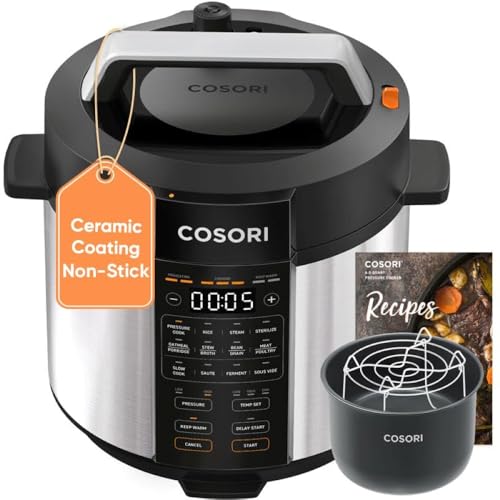
Cosori Pressure Cooker 6QT 9-in-1
Badge: Best Power Cooker for Easy Cleanup
Strengths
- Ceramic-coated pot releases rice and sticky sauces with noticeably easier cleanup
- Sous vide mode adds a precision function most rivals in this group leave out
- A dozen listed safety features make it a reassuring first pressure cooker
Trade-offs
- Coated pots need non-metal utensils and gentler handling than stainless
- Ceramic coating will not last forever the way a plain stainless pot can
- Fewer years of model-specific recipes and accessories than the market leader
Key specs from the verified listing
- Capacity: 6 QT
- Functions: 9-in-1 incl. rice, slow cook, sous vide, sauté (per listing)
- Inner pot: Ceramic coating pot (per listing)
- Safety: 12 safety features (per listing)
- Power: 1100W (per listing)
Cosori’s 6-quart cooker is the thoughtful challenger in this group: nine functions, a ceramic-coated inner pot, and sous vide capability that the classic designs skip. The ceramic pot changes daily life more than any preset does. Rice lifts out cleanly, cheesy and tomato-based sauces rinse away instead of soaking, and the whole cleanup routine shrinks — the thing that decides whether a cooker gets used weekly or gathers dust. The trade is care: wooden or silicone tools only, and no aggressive scrubbing, because the coating is the feature.
The 1100W element brings the pot to pressure briskly, and the listed safety systems cover the worries first-time pressure cooks bring with them. Use sous vide for the jobs pressure cannot do gently — eggs, custards, and proteins you want held at an exact doneness — and pressure for the speed work of beans, braises, and stocks. If your cooking leans sticky, saucy, and rice-heavy, this is arguably the most liveable pot in the line-up; if you are rough on cookware and love metal utensils, the stainless designs will forgive you more.
Against the strict meaning of this search — a powered, programmable electric cooker — the Cosori Pressure Cooker 6QT 9-in-1 must be placed honestly: if it is one of the two electric models, judge it on programs, pot, and unattended convenience; if it is a stovetop pot, judge it as an alternative that borrows its power from your burner and offers durability instead of automation. The review above keeps that distinction in front of you throughout.
Best for: powered-cooker buyers who prioritise easy cleanup and want sous vide at this size / Not suited for: metal-utensil users who would wear out a coated pot
MICHELANGELO Stovetop Pressure Cooker 4.2 qt
Badge: Stovetop Alternative — Prose Only
Strengths
- Compact 4.2-quart size suits small households that still want stovetop pressure speed
- One-hand easy-open lid is a real ergonomic upgrade when your other hand holds a spoon or a child
- Glass lid and steamer basket stretch it into everyday-pot duty beyond pressure work
Trade-offs
- Small capacity rules out big batches and large joints
- Stovetop-only: no programs, no timer, no keep-warm
- Two settings are simpler than some rivals’ multi-mode dials
Key specs from the verified listing
- Capacity: 4.2 qt
- Material: 304 stainless steel (per listing)
- Safety: 6-fold safety system (per listing)
- Lid: One-hand easy-open lid; 2 pressure settings (per listing)
- Extras: Steamer basket and glass lid included; induction compatible (per listing)
The MICHELANGELO 4.2-quart cooker is the small-format stovetop option: 304 stainless steel, two pressure settings, a six-fold safety system per the listing, and a one-hand opening lid that sounds like a gimmick until you use it mid-recipe with your other hand occupied. The included glass lid is quietly important — it lets the same pot simmer, steam, and serve as an ordinary saucepan, which is how a compact kitchen justifies giving it cupboard space. Induction compatibility keeps it valid on modern hobs alongside gas and ceramic.
For one to three people, 4.2 quarts covers soups, grains, small braises, and steamed vegetables without the leftovers problem of a family pot. Bring it to pressure over medium-high heat, settle to the lowest heat that holds pressure, and use the glass-lid mode for the finishing and reheating jobs. As with every stovetop model, check the vent and gasket before use and let pressure fall naturally for meats. It is a thoughtful, space-respecting design for small households that cook properly.
Against the strict meaning of this search — a powered, programmable electric cooker — the MICHELANGELO Stovetop Pressure Cooker 4.2 qt must be placed honestly: if it is one of the two electric models, judge it on programs, pot, and unattended convenience; if it is a stovetop pot, judge it as an alternative that borrows its power from your burner and offers durability instead of automation. The review above keeps that distinction in front of you throughout.
Best for: readers whose search broadens to small stovetop pots for one to three people / Not suited for: anyone who needs a powered, programmable appliance — this is not one
Prose-only pick: no purchase link is provided for this model in this guide, for the reason stated in its review above.
Peterboo Stainless Steel Pressure Cooker 6 Quart Stovetop
Badge: Stovetop Alternative — Prose Only
Strengths
- 3-ply composite base spreads heat evenly and resists the hot spots that scorch sauces
- Pressure indicator makes the pot’s state visible instead of guesswork
- Works across induction, gas, and ceramic, so it survives a change of stove
Trade-offs
- Value-brand support and spare gasket sourcing are less proven than Presto or T-Fal
- Manual stovetop control, with no programs or keep-warm
- Listing-led details are thinner than the big brands’ documentation
Key specs from the verified listing
- Capacity: 6 Quart
- Type: Stovetop pressure pot with pressure indicator (per listing)
- Base: 3-ply composite base (per listing)
- Compatibility: Induction, gas, and ceramic stoves (per listing)
- Cleaning: Dishwasher safe (per listing)
This Peterboo 6-quart stovetop pot competes on fundamentals: a 3-ply composite base for even heating, a clear pressure indicator, multi-safeguard devices per the listing, and compatibility with induction, gas, and ceramic hobs. The base matters more than it sounds — pressure cooking concentrates heat, and a thin, hotspot-prone bottom is how bean dishes scorch before they soften. A composite base also keeps the pot stable and efficient on induction, where contact and flatness decide performance.
Six quarts is the classic family size for stovetop work: a whole chicken, a serious pot of beans, or soup with leftovers. The dishwasher-safe body simplifies cleanup, though lids and gaskets last longer washed by hand and checked. Before buying, confirm spare gaskets for this model are easy to source, because every stovetop cooker eventually needs one and the pot is only as good as its seal. For shoppers who want stovetop simplicity with modern base construction, it is a sensible, honestly-priced-in-its-tier option.
Against the strict meaning of this search — a powered, programmable electric cooker — the Peterboo Stainless Steel Pressure Cooker 6 Quart Stovetop must be placed honestly: if it is one of the two electric models, judge it on programs, pot, and unattended convenience; if it is a stovetop pot, judge it as an alternative that borrows its power from your burner and offers durability instead of automation. The review above keeps that distinction in front of you throughout.
Best for: readers considering a modern 6-quart stovetop pot with an even-heating base / Not suited for: anyone who needs programs, a timer, or keep-warm — this has none
Prose-only pick: no purchase link is provided for this model in this guide, for the reason stated in its review above.
[3-IN-1] Pressure Cooker 12 Quart Stainless Steel Pressure Canner (RVGMBO)
Badge: Stovetop Alternative — Prose Only
Strengths
- 12-quart capacity is in another league — the only pick here sized for serious canning batches and crowd cooking
- 18/8 stainless construction suits a pot expected to work hard for years
- Glass lid and steamer rack extend it beyond pressure duty
Trade-offs
- Very large and heavy; needs storage, a strong burner, and two hands of respect when full
- Far more capacity than daily family cooking can justify
- For canning, you must follow tested recipes and the maker’s ratings exactly — capacity alone is not approval
Key specs from the verified listing
- Capacity: 12 Quart
- Material: 18/8 stainless steel (per listing)
- Type: Pressure cooker / canner, one-hand locking (per listing)
- Compatibility: Induction and gas stovetop (per listing)
- Extras: Glass lid and steamer rack included (per listing)
The RVGMBO 12-quart is the specialist giant of this group: an 18/8 stainless pressure cooker and canner with one-hand locking, a glass lid, and a steamer rack. Twelve quarts changes the category of jobs on the table — bulk stock, whole birds, festival-size batches, and home canning sessions where jar count per run decides whether the project is worth an afternoon. The listing positions it as a 3-in-1, and the included glass lid supports ordinary-pot use when pressure is not needed.
Size demands planning: check that the pot fits under your range hood and on your largest burner, and that you have somewhere to store it. For pressure canning, never improvise — use only tested recipes, confirm this pot’s stated suitability for the canning you intend, and follow altitude adjustments precisely; a large pot does not change the food-safety rules. For everyday pressure cooking it is simply more than most households need, and smaller pots will be faster and easier. Buy it for the big jobs it is genuinely built for.
Against the strict meaning of this search — a powered, programmable electric cooker — the [3-IN-1] Pressure Cooker 12 Quart Stainless Steel Pressure Canner (RVGMBO) must be placed honestly: if it is one of the two electric models, judge it on programs, pot, and unattended convenience; if it is a stovetop pot, judge it as an alternative that borrows its power from your burner and offers durability instead of automation. The review above keeps that distinction in front of you throughout.
Best for: readers whose real project is large-batch cooking or canning on a stovetop / Not suited for: anyone shopping for a powered countertop cooker
Prose-only pick: no purchase link is provided for this model in this guide, for the reason stated in its review above.
Peterboo 3Qt Stainless Steel Pressure Cooker Small
Badge: Stovetop Alternative — Prose Only
Strengths
- 3-quart stovetop size is purpose-built for one or two people — rare in stovetop pressure cooking
- Induction-compatible base keeps it current with modern hobs
- Multiple listed safety features address the usual first-timer concerns
Trade-offs
- Tiny capacity excludes batch cooking, guests, and most roasts
- Stovetop attention required; no programs or automatic keep-warm
- Value-brand documentation is lighter than the established names
Key specs from the verified listing
- Capacity: 3Qt
- Functions: 8-in-1 multi-cooker positioning (per listing)
- Safety: 8+ safety features (per listing)
- Compatibility: Induction compatible; stovetop and electric stove use (per listing)
- Intended use: For 1-2 people (per listing)
Stovetop pressure cookers are usually family-sized, which makes this 3-quart Peterboo a useful oddity: a small stainless pot with induction compatibility and a stack of listed safety features, aimed squarely at one or two people. Rice, lentils, a small stew, a few portions of soup — the jobs a solo cook actually makes — come to pressure quickly in a pot this size, with none of the cavernous-pot awkwardness of cooking two servings in a 6-quart vessel. The listing’s 8-in-1 positioning reflects its use with the included-style accessories and stove modes rather than electronic programs; this is a manual pot, and proud of it.
Small stovetop pots heat fast, so stay nearby during the come-up to pressure and drop the heat promptly to hold a steady state. It pairs naturally with small kitchens, dorms with real cooking ambitions, and RVs where one pot must do everything. Confirm gasket availability before purchase, as with any value-brand cooker. If you cook for one or two and prefer stovetop durability over electronic features, this is one of the few pressure pots designed for your life.
Against the strict meaning of this search — a powered, programmable electric cooker — the Peterboo 3Qt Stainless Steel Pressure Cooker Small must be placed honestly: if it is one of the two electric models, judge it on programs, pot, and unattended convenience; if it is a stovetop pot, judge it as an alternative that borrows its power from your burner and offers durability instead of automation. The review above keeps that distinction in front of you throughout.
Best for: solo cooks curious about a rare small stovetop pressure pot / Not suited for: anyone who needs a powered, programmable appliance — this is not one
Prose-only pick: no purchase link is provided for this model in this guide, for the reason stated in its review above.
Comparison Table
| Pick | Badge | Capacity | Key feature from listing | Listing |
|---|---|---|---|---|
| Instant Pot Duo 6 Qt 7-in-1 | Best True Power Cooker | 6 Qt | 7-in-1: pressure cook, slow cook, rice, yogurt, steam, sauté, warm/sterilize (per listing) | Check on Amazon |
| Cosori Pressure Cooker 6QT 9-in-1 | Best Power Cooker for Easy Cleanup | 6 QT | 9-in-1 incl. rice, slow cook, sous vide, sauté (per listing) | Check on Amazon |
| MICHELANGELO Stovetop Pressure Cooker 4.2 qt | Stovetop Alternative — Prose Only | 4.2 qt | 304 stainless steel (per listing) | Prose-only |
| Peterboo Stainless Steel Pressure Cooker 6 Quart Stovetop | Stovetop Alternative — Prose Only | 6 Quart | Stovetop pressure pot with pressure indicator (per listing) | Prose-only |
| [3-IN-1] Pressure Cooker 12 Quart Stainless Steel Pressure Canner (RVGMBO) | Stovetop Alternative — Prose Only | 12 Quart | 18/8 stainless steel (per listing) | Prose-only |
| Peterboo 3Qt Stainless Steel Pressure Cooker Small | Stovetop Alternative — Prose Only | 3Qt | 8-in-1 multi-cooker positioning (per listing) | Prose-only |
The table enforces the guide’s honesty rule visually: the two powered cookers carry listing links; the four stovetop alternatives are marked prose-only in every row. Capacity and features are from the verified listings. If a row cannot plug in, it is not a power cooker — whatever its other virtues, and several of these pots have real virtues.
How to Choose the Right Option for Best power cookers
Start with capacity, because it is the decision you cannot undo. As a working rule, 3 to 4 quarts suits one or two people and side dishes; 6 quarts is the family workhorse that most recipes are written for; 8 quarts and above serve big families, batch cooking, and entertaining. Remember that pressure cookers are never filled to the brim: two-thirds full is the usual working ceiling, and only half for foods that foam or expand like beans, grains, and porridge. That means a 6-quart pot really cooks about 4 quarts of everyday food — do the honest maths against the meals you actually make.
Choose the pot material for your cleaning tolerance. Stainless steel sears hard, tolerates metal utensils, goes in the dishwasher, and can serve for decades, at the cost of food sticking more readily. Ceramic or nonstick-style coatings release rice and sauces beautifully and rinse clean in seconds, but they need gentle tools and will eventually wear. Neither is wrong; the mistake is buying a coated pot with a metal-utensil habit, or a stainless pot while hating cleanup.
Count functions you will use weekly, not functions on the box. The core set — pressure, sauté, rice, steam, slow cook, keep warm — covers most households. Sous vide, yogurt, sterilise, and grains programs are worth having only if they match real habits. Every extra mode adds menu complexity, so a longer list is a benefit only when it overlaps your cooking. Similarly, decide early whether you want electric set-and-forget convenience or stovetop control and durability; they are different philosophies, and this guide includes both where the keyword allows.
Plan the unglamorous details. Measure your counter depth and cupboard height, including room for the lid to open or be lifted away. Check that spare sealing rings and gaskets for the model are easy to buy, because they are wear parts on every cooker. Think about weight: a full 8-quart pot is a serious lift from counter to sink. And consider your stove or circuit: electric models want a convenient outlet with slack in the cord, while stovetop models want a burner that matches the base diameter.
How to Use, Clean, and Troubleshoot a Power Cooker (and Its Stovetop Alternatives)
Good pressure cooking is a routine, not a talent. Step one: build flavour first. Use the sauté function on electric models, or medium heat on a stovetop pot, to brown meat and soften aromatics in a little oil. This step is where most of the final flavour is made, and skipping it is why some pressure-cooked meals taste boiled. Step two: deglaze. Add your liquid and scrape the bottom thoroughly. On electric cookers, stuck-on bits are the main trigger for burn warnings; on any pot, they are lost flavour. Step three: load in order. Liquids and sauces at the bottom, ingredients that should stay distinct on top, and do not stir thick sauces like tomato into the liquid — layer them so the bottom stays thin enough to boil and build steam.
Step four: respect the fill lines and the liquid minimum. Never fill past two-thirds, or past half for beans, grains, and foaming foods, and always include at least the minimum water or thin liquid your manual specifies — steam is the cooking medium, and the pot cannot pressurise without it. Step five: lock, set, and leave it alone. Check the sealing ring is seated and the valve is in the sealing position on electric models; on stovetop models, bring the heat up until the regulator signals pressure, then reduce to the lowest heat that holds it. Step six: choose your release deliberately. Natural release — letting pressure fall on its own — suits meats, beans, and broths and prevents sputtering. Quick release suits vegetables, eggs, and delicate foods you do not want to overcook. Many meals are best with a hybrid: ten minutes natural, then release the rest.
Cleaning and care decide how long the cooker serves you. Wash the inner pot after every use and dry it fully; check the sealing ring for odours and cracks, and keep a spare, because a tired ring is the most common cause of a pot that suddenly will not pressurise. Keep the steam release valve and anti-block shield clean per the manual, and never store the cooker with the lid sealed tight — storing it with the lid upside down or ajar keeps the ring from holding odours and taking a set. Stovetop gaskets deserve the same inspection, plus a check that the vent pipe is clear before every single use.
Troubleshooting. Problem: the pot will not come to pressure → check the sealing ring is seated evenly, the valve is set to sealing, and there is enough thin liquid; a ring that has gone slack with age is the usual culprit. Problem: a burn or scorch warning on an electric cooker → stop, release pressure safely, and scrape the bottom; the cause is almost always thick sauce or stuck food at the base, so add thin liquid and layer sauces on top next time. Problem: steam leaking around the lid edge → the ring is dirty, mis-seated, or worn, or food debris is on the rim; clean, reseat, or replace the ring before blaming the machine. Problem: food is undercooked after the timer → dense or frozen ingredients and an impatient quick release are the usual causes; give meats their natural release time, which is genuine cooking time.
What Power Cooker Actually Means — and Why This Guide Insists on It
Product names drift. A phrase that began as branding for a line of electric pressure cookers became, for many shoppers, the generic name for the whole powered category — the way any plug-in, programmable, multi-function pressure cooker gets called a power cooker at the kitchen table. That generic meaning is the one this guide uses, because it is the one the searcher almost always intends: a self-contained electric appliance that heats, pressurises, times, and keeps warm without a stove. Judged by that meaning, a stovetop pot is not a worse power cooker; it is not one at all, in the same way a bicycle is not a worse motorcycle.
Insisting on the distinction protects buyers in both directions. The shopper who needs unattended weeknight cooking must not be sold a pot that demands they stand at a burner. The shopper who actually wants stovetop durability deserves a guide — like our coverage in Best Pressrure Cookers and its neighbours — that presents those pots on their own considerable merits. Precision about names is not pedantry in a buying guide; it is the entire job.
If You Choose the Stovetop Alternative Instead
Suppose the prose-only reviews below persuade you that your burner, not a heating element, should power your pressure cooking. That is a respectable decision with real rewards: a stainless pot with no electronics can serve for decades, heats fast on a strong burner, and stores in a cupboard rather than occupying counter and outlet forever. The costs are equally real: you manage the heat, you time the cook, nothing keeps dinner warm, and there are no rice, yogurt, or slow-cook programs — there is a pot, a lid, and you. Households that cook attentively often love the arrangement; households that cook between other obligations usually do not.
If you go that way, buy the size your household fills — the compact MICHELANGELO and small Peterboo for one to three people, the 6-quart Peterboo for families, the 12-quart RVGMBO only for genuine bulk and canning projects — and budget for a spare gasket from day one. And if you later add a powered cooker for weeknights, you will own the complete pressure kitchen: craft on the weekend, automation on the weekday, one set of skills serving both, much like the pairing explored in Best Pressure And Slow Cookers.
Common Buying Mistakes
Buying the wrong size with confidence. A 3-quart pot bought for a family of five and an 8-quart pot bought for one person are the same mistake in opposite directions. Pressure cookers work in a fill band — too little food in a huge pot and too much food in a small one both cook badly. Match capacity to your household and your batch habits before looking at any feature list.
Chasing the longest function list. Sixteen functions sounds like value, but the honest question is which buttons you will press in an ordinary week. Buyers routinely pay for modes they never open while ignoring the things that matter daily: pot material, ease of cleaning, and whether the lid and ring are pleasant to live with. Judge the core five functions first and treat the rest as a bonus.
Ignoring the sealing ring and spare parts. Every pressure cooker depends on a rubber ring that ages, absorbs odours, and eventually stops sealing. Choosing a model whose rings and gaskets are easy to source — and buying a spare early — prevents the classic moment where a healthy machine becomes useless over a small rubber part. This matters even more for value brands, so check parts availability before you buy, not after the first failed seal.
Treating release method as an afterthought. Quick-releasing a pot of beans or a beef stew can toughen meat, sputter starchy liquid through the valve, and undercook the centre, while natural-releasing delicate vegetables turns them to mush. The release is part of the recipe. Recipes that do not specify one are a reason to learn the pattern — natural for meats, beans, and broths; quick for vegetables and eggs — rather than a licence to guess.
Filling past the line with expanding foods. Beans, grains, pasta, and porridge foam and swell under pressure. The half-full rule for these foods exists because foam can block the valve and because a pot needs headspace to work safely. Overfilling is the most avoidable error in pressure cooking, and it is entirely about patience, not skill. When in doubt, cook a second batch.
Final Recommendation
For the search as it is meant, the recommendation is the Instant Pot Duo: the powered, programmable, stainless-pot cooker that defines the category, with the Cosori as the equally valid alternative for cooks who value a ceramic pot, easier cleanup, and sous vide. Those are the two purchases this guide endorses for best power cookers, and they are the only two products linked in it.
The four stovetop pots remain worth the counter space of the readers they actually suit — and this guide has described them fully so that choice can be made with open eyes, in this guide or in a stovetop-focused one like Best Precision Cookers for the adjacent precision-cooking shelf. What they are not is power cookers, and no badge, table, or link here pretends otherwise.
Instant Pot Duo 6 Qt 7-in-1 — Check on Amazon · Cosori Pressure Cooker 6QT 9-in-1 — Check on Amazon
Frequently Asked Questions
What is a power cooker, exactly?
In common usage it means a powered electric pressure cooker: a plug-in, programmable appliance that pressure-cooks, sautés, slow-cooks, and keeps food warm without using your stove. The name grew from branded lines of such machines into a generic term for the category. A stovetop pressure cooker, however good, is a different product because it has no power or programs of its own.
Why are four products in this guide not linked?
Because they are stovetop pressure cookers, not powered cookers, and linking them under this keyword would misrepresent them to buyers. They are reviewed fully and honestly as alternatives, labelled prose-only in the quick picks, the reviews, and the comparison table, with the reason also recorded in this guide’s sources notes.
Instant Pot Duo or Cosori — which power cooker should I choose?
Choose the Duo for a stainless pot, hard searing, metal utensils, dishwasher cleaning, and the deepest pool of recipes written for a specific machine. Choose the Cosori for a ceramic-coated pot that cleans far more easily, plus sous vide and a longer listed safety set. Both are 6-quart, 1100W-class family machines; the pot and the extras decide it.
Can a stovetop pressure cooker do everything a power cooker does?
It pressure-cooks just as effectively, and on a strong burner sometimes faster. What it cannot do is everything around the pressure cooking: no programs, no delay timer, no automatic keep-warm, no slow-cook or yogurt modes, and it needs your attention on the heat throughout. Whether that matters is a lifestyle question, not a quality question.
Do power cookers use a lot of electricity?
They are generally efficient for the cooking they do, because the sealed, insulated pot holds heat and the cooking times are short compared with an oven or a long stovetop simmer. Exact consumption depends on the model and the meal, and this guide does not print figures the verified listings do not state — the honest comparison is against the oven you are not heating for hours.
What should I cook first in a new power cooker?
Start with something forgiving that teaches the machine: a pot of beans, a soup, or a simple braise. You will learn the sauté stage, the sounds of pressurising, and the difference between natural and quick release on food that tolerates mistakes — exactly the confidence base the how-to section in this guide is built to give you.


