Disclosure: topratedkitchenware.com is reader-supported. When you buy through links on our site, we may earn an affiliate commission from Amazon and other retailers, at no extra cost to you.
Where to buy
Short on time? These are the verified picks for best power pressure cookers. Each linked name goes to its Amazon listing, where you can check the latest price on Amazon, confirm the current configuration, and read current owner feedback. Any pick described as prose-only is covered in full below without a purchase link, for a reason explained honestly in its review.
- Instant Pot Duo 6 Qt 7-in-1 — Best Overall Power Pressure Cooker
- Cosori Pressure Cooker 6QT 9-in-1 — Best for Easy Cleanup
- Instant Pot Pro 6 Qt 10-in-1 — Best Premium Power Pick
- Instant Pot Duo Mini 3 Quart 7-in-1 — Best Compact Power Pick
- [3-IN-1] Pressure Cooker 12 Quart Stainless Steel Pressure Canner (RVGMBO) — Stovetop Alternative — Prose Only
- Peterboo 3Qt Stainless Steel Pressure Cooker Small — Stovetop Alternative — Prose Only
Read the full guide ↓ for how these picks were chosen, what each one does well, where each one falls short, and how to choose between them.
The best power pressure cookers are the powered half of the pressure world: electric machines that generate their own heat, manage their own pressure, and run programmed cycles while you do something else. This guide compares the strongest verified examples of that idea across sizes — a 3-quart compact, three distinct 6-quart philosophies, and, for honest contrast, two stovetop pots that appear in the assigned pool but do not belong to the powered category. Those two are reviewed fully and labelled prose-only without links, because a pot that borrows a burner’s power is not a power pressure cooker, and this guide does not pretend otherwise.
Within the powered four, the differences are the ones that matter daily. The Instant Pot Duo is the proven reference: stainless pot, seven functions, the deepest recipe ecosystem in the category. The Cosori is the cleanup-and-features challenger, with a ceramic pot, sous vide, and a dozen listed safety features. The Instant Pot Pro is the fullest program set of the family, and the Duo Mini proves the powered idea scales down gracefully for one or two people. Between them they cover nearly every household that wants pressure cooking on autopilot.
The buying guidance, how-to, and troubleshooting sections apply to the whole pressure family, because the fundamentals never change — only the source of the heat does. Readers comparing the slower arts as well will find Best Pressure Cooker V Slow Cookers the natural next read after this one.
Key Takeaways
- Power pressure cooker means a self-powered electric machine; four picks here qualify and are linked, two stovetop pots are prose-only context.
- Three of the powered picks are 6-quart models with different philosophies: proven (Duo), easy-clean with sous vide (Cosori), and fullest program set (Pro).
- The Duo Mini carries the powered idea down to 3 quarts for singles, couples, and small kitchens.
- Programs are the powered premium: unattended cooking, keep-warm, and repeatable cycles are what you pay for over a stovetop pot.
- Pot material still decides daily life — stainless for durability and searing, ceramic coating for the fastest cleanup.
In this guide
Quick Picks
| Pick | Badge | Listing |
|---|---|---|
| Instant Pot Duo 6 Qt 7-in-1 | Best Overall Power Pressure Cooker | Check on Amazon |
| Cosori Pressure Cooker 6QT 9-in-1 | Best for Easy Cleanup | Check on Amazon |
| Instant Pot Pro 6 Qt 10-in-1 | Best Premium Power Pick | Check on Amazon |
| Instant Pot Duo Mini 3 Quart 7-in-1 | Best Compact Power Pick | Check on Amazon |
| [3-IN-1] Pressure Cooker 12 Quart Stainless Steel Pressure Canner (RVGMBO) | Stovetop Alternative — Prose Only | Prose-only — see review |
| Peterboo 3Qt Stainless Steel Pressure Cooker Small | Stovetop Alternative — Prose Only | Prose-only — see review |
Best Overall goes to the Duo on the strength of its stainless pot and recipe ecosystem; the Pro is the premium pick for cooks who will use its extra programs, and the Cosori is the one to choose when cleanup friction is what kept your last cooker in the cupboard. The Mini is a size pick, not a compromise pick. The two prose-only stovetop entries close the table as labelled alternatives, present so the powered-versus-stovetop decision can be made inside one honest guide.
If you already know you want powered and programmable, your shortlist is the first four rows and the decision takes five minutes: size first, pot material second, program list third.
How These Picks Were Chosen
This guide is research-led, and it is worth saying plainly what that means. We did not cook on every machine in a test kitchen. Instead, every pick was verified against Amazon’s own product data through the Creators API on 2026-11-20: the brand, model identity, capacity, function list, and pot material in each review come from the verified listing, not from memory or from other round-ups. Where a specification is not in the verified listing data, we leave it out rather than guess, which is why the spec boxes in this guide stay short and honest.
Selection for best power pressure cookers weighed the things that decide whether a cooker earns its counter space: capacity matched to real households, pot material and the cleaning reality that comes with it, the usefulness — not just the count — of the function list, safety systems as listed by the maker, and the depth of recipes and spare parts behind the model. Function counts were treated with suspicion on purpose. A cooker with sixteen modes where four do the weekly work is not automatically better than a focused seven-function machine, and the reviews say so where it applies.
We also applied two standing honesty rules. First, no static prices and no fixed ratings appear anywhere in this guide, because both change constantly; the listings themselves are the only reliable place to check them. Second, any pick that does not genuinely fit the keyword is labelled prose-only with the reason stated, instead of being linked as if it fit. If a model in this guide is wrong for your household, the trade-off lists are designed to make that obvious quickly.
As with its sister keyword, the pool for this guide mixed categories, and the same open rule was applied: powered electric cookers are linked; the two stovetop pots are covered prose-only with the reason printed in their reviews, their badges, and the sources file. No stovetop product is presented anywhere in this guide as a powered appliance.
The 6 Best Options for Best power pressure cookers
The four powered cookers come first, in recommendation order, each with its verified specifications, strengths, trade-offs, and verdict. The two stovetop alternatives follow, reviewed with the same care and clearly marked prose-only.

Instant Pot Duo 6 Qt 7-in-1
Badge: Best Overall Power Pressure Cooker
Strengths
- The long-running reference design in electric pressure cooking, with a huge base of recipes written for it
- Stainless inner pot handles sautéing, deglazing, and dishwasher cleanup without a coating to baby
- 6-quart size is the practical middle: family dinners plus leftovers, without a huge footprint
Trade-offs
- 7-in-1 function set is leaner than newer 9- and 10-in-1 rivals
- No sous vide mode, which some newer competitors include
- The sealing ring absorbs strong food odours over time and eventually needs replacing
Key specs from the verified listing
- Capacity: 6 Qt
- Functions: 7-in-1: pressure cook, slow cook, rice, yogurt, steam, sauté, warm/sterilize (per listing)
- Inner pot: Stainless steel (per listing)
- Extras: App with a large recipe library (per listing)
The Instant Pot Duo is the model that turned electric pressure cooking into a mainstream habit, and its staying power is the point. Seven core functions cover the jobs most households actually repeat: pressure cooking for weeknight speed, slow cooking, rice, steaming, sautéing in the same pot before the lid goes on, yogurt, and keep-warm. The stainless steel inner pot is a quiet advantage — you can sear properly, scrape up browned bits with a metal spoon, and put the pot in the dishwasher without worrying about a nonstick surface wearing out. Controls are plain and direct, which is why so many published recipes simply assume this machine.
Treat the Duo as a one-pot workflow: sauté aromatics and meat first, add liquid, lock the lid, and let pressure do the long-cooking work in a fraction of the stovetop time. Respect the minimum liquid rule and the maximum fill lines, especially with foods that foam or expand like beans and grains. Natural release suits meats and broths; quick release suits vegetables and anything you do not want to overcook. A second sealing ring, one for savoury and one for sweet, is the cheapest quality-of-life upgrade owners discover.
As a power pressure cooker — a machine that makes and manages its own heat — the Instant Pot Duo 6 Qt 7-in-1 is judged on what powered cooking adds: unattended cycles, repeatable programs, and keep-warm convenience. If it is one of the two stovetop alternatives, that standard is exactly what it does not meet, and its review grades it instead as the manual alternative it honestly is.
Best for: most households wanting the proven powered cooker with a stainless pot / Not suited for: cooks who want sous vide in their powered machine

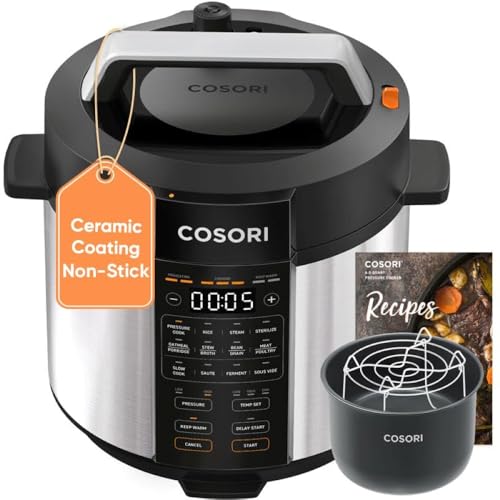
Cosori Pressure Cooker 6QT 9-in-1
Badge: Best for Easy Cleanup
Strengths
- Ceramic-coated pot releases rice and sticky sauces with noticeably easier cleanup
- Sous vide mode adds a precision function most rivals in this group leave out
- A dozen listed safety features make it a reassuring first pressure cooker
Trade-offs
- Coated pots need non-metal utensils and gentler handling than stainless
- Ceramic coating will not last forever the way a plain stainless pot can
- Fewer years of model-specific recipes and accessories than the market leader
Key specs from the verified listing
- Capacity: 6 QT
- Functions: 9-in-1 incl. rice, slow cook, sous vide, sauté (per listing)
- Inner pot: Ceramic coating pot (per listing)
- Safety: 12 safety features (per listing)
- Power: 1100W (per listing)
Cosori’s 6-quart cooker is the thoughtful challenger in this group: nine functions, a ceramic-coated inner pot, and sous vide capability that the classic designs skip. The ceramic pot changes daily life more than any preset does. Rice lifts out cleanly, cheesy and tomato-based sauces rinse away instead of soaking, and the whole cleanup routine shrinks — the thing that decides whether a cooker gets used weekly or gathers dust. The trade is care: wooden or silicone tools only, and no aggressive scrubbing, because the coating is the feature.
The 1100W element brings the pot to pressure briskly, and the listed safety systems cover the worries first-time pressure cooks bring with them. Use sous vide for the jobs pressure cannot do gently — eggs, custards, and proteins you want held at an exact doneness — and pressure for the speed work of beans, braises, and stocks. If your cooking leans sticky, saucy, and rice-heavy, this is arguably the most liveable pot in the line-up; if you are rough on cookware and love metal utensils, the stainless designs will forgive you more.
As a power pressure cooker — a machine that makes and manages its own heat — the Cosori Pressure Cooker 6QT 9-in-1 is judged on what powered cooking adds: unattended cycles, repeatable programs, and keep-warm convenience. If it is one of the two stovetop alternatives, that standard is exactly what it does not meet, and its review grades it instead as the manual alternative it honestly is.
Best for: powered-cooker buyers who value easy cleanup and sous vide / Not suited for: metal-utensil users and the roughest treatment of coated pots

Instant Pot Pro 6 Qt 10-in-1
Badge: Best Premium Power Pick
Strengths
- 10-in-1 range is the broadest in the Instant Pot picks here, including sous vide
- 6-quart capacity keeps the family-friendly middle size
- Grains program attention suits households that cook farro, barley, and mixed grains often
Trade-offs
- More programs mean more menu navigation for jobs a simpler dial handles
- Premium positioning in its line; the extra functions only pay off if you use them
- Black finish shows flour dust and fingerprints more than stainless
Key specs from the verified listing
- Capacity: 6 Qt
- Functions: 10-in-1 incl. pressure, slow, rice/grains, steam, sauté, sous vide, yogurt, warm, sterilize (per listing)
- Finish: Black (per listing)
The Instant Pot Pro is the step-up answer for cooks who outgrew the Duo’s seven functions. Ten modes add the things enthusiasts actually ask for — sous vide for precision work, a dedicated grains approach for more than plain rice, and the full pressure, slow, steam, sauté, yogurt, warm, and sterilize set around them. It keeps the sensible 6-quart footprint, so it swaps into the same counter space and the same recipe ecosystem, just with a wider repertoire. Think of it as the choice for the household that cooks from projects, not just from presets.
The Pro rewards a cook who plans: yogurt on the weekend, a sous vide project midweek, beans and braises under pressure when time is short. Because the program list is longer, spend ten minutes with the manual mapping the buttons to your real routines, and the machine becomes fast to drive. Everything said about pressure discipline elsewhere in this guide applies unchanged — liquid minimums, fill lines, and choosing natural versus quick release by ingredient. If you will genuinely use sous vide and grains, the Pro is the most complete electric pick here; if not, its simpler siblings do the core job for less fuss.
As a power pressure cooker — a machine that makes and manages its own heat — the Instant Pot Pro 6 Qt 10-in-1 is judged on what powered cooking adds: unattended cycles, repeatable programs, and keep-warm convenience. If it is one of the two stovetop alternatives, that standard is exactly what it does not meet, and its review grades it instead as the manual alternative it honestly is.
Best for: enthusiasts who will use the fullest program set, including grains and sous vide / Not suited for: buyers who want the simplest possible powered controls

Instant Pot Duo Mini 3 Quart 7-in-1
Badge: Best Compact Power Pick
Strengths
- 3-quart size is right-sized for one or two people, sides, and small kitchens
- Same 7-in-1 logic as its big sibling, so recipes scale down predictably
- Stainless pot sears and dishwashes like the full-size Duo
Trade-offs
- Too small for batch cooking, big roasts, or family-size meal prep
- Halving recipes takes a little judgement with liquid minimums
- Per-serving value drops if you regularly cook for four or more
Key specs from the verified listing
- Capacity: 3 Quart
- Functions: 7-in-1: pressure, slow, rice, steam, sauté, yogurt, warm/sterilize (per listing)
- Inner pot: Stainless steel (per listing)
- Extras: App recipe library (per listing)
The Duo Mini exists because the standard 6-quart advice is wrong for a large slice of households. Singles, couples, students, and RV or small-apartment kitchens do not need a pot that dwarfs the meal inside it. Three quarts cooks rice for two beautifully, handles a small batch of soup, steel-cut oats, a couple of chicken breasts, or a side dish while the main course happens elsewhere. It runs the same 7-in-1 playbook as the full-size Duo, so the enormous library of Instant Pot guidance still applies — you simply scale quantities and respect the smaller pot’s fill lines.
Small pots come to pressure faster with less liquid, which makes the Mini genuinely quicker for modest portions, not just smaller. It is also the natural second cooker in bigger households: rice or vegetables in the Mini while the main event pressure-cooks in a 6- or 8-quart pot. Watch minimum liquid — small pots still need enough water to build steam — and avoid forcing family recipes down by guesswork. For one or two people who cook real food in a small space, this is the size that gets used daily instead of admired monthly.
As a power pressure cooker — a machine that makes and manages its own heat — the Instant Pot Duo Mini 3 Quart 7-in-1 is judged on what powered cooking adds: unattended cycles, repeatable programs, and keep-warm convenience. If it is one of the two stovetop alternatives, that standard is exactly what it does not meet, and its review grades it instead as the manual alternative it honestly is.
Best for: one or two people wanting full powered convenience in a compact pot / Not suited for: families and batch cookers

[3-IN-1] Pressure Cooker 12 Quart Stainless Steel Pressure Canner (RVGMBO)
Badge: Stovetop Alternative — Prose Only
Strengths
- 12-quart capacity is in another league — the only pick here sized for serious canning batches and crowd cooking
- 18/8 stainless construction suits a pot expected to work hard for years
- Glass lid and steamer rack extend it beyond pressure duty
Trade-offs
- Very large and heavy; needs storage, a strong burner, and two hands of respect when full
- Far more capacity than daily family cooking can justify
- For canning, you must follow tested recipes and the maker’s ratings exactly — capacity alone is not approval
Key specs from the verified listing
- Capacity: 12 Quart
- Material: 18/8 stainless steel (per listing)
- Type: Pressure cooker / canner, one-hand locking (per listing)
- Compatibility: Induction and gas stovetop (per listing)
- Extras: Glass lid and steamer rack included (per listing)
The RVGMBO 12-quart is the specialist giant of this group: an 18/8 stainless pressure cooker and canner with one-hand locking, a glass lid, and a steamer rack. Twelve quarts changes the category of jobs on the table — bulk stock, whole birds, festival-size batches, and home canning sessions where jar count per run decides whether the project is worth an afternoon. The listing positions it as a 3-in-1, and the included glass lid supports ordinary-pot use when pressure is not needed.
Size demands planning: check that the pot fits under your range hood and on your largest burner, and that you have somewhere to store it. For pressure canning, never improvise — use only tested recipes, confirm this pot’s stated suitability for the canning you intend, and follow altitude adjustments precisely; a large pot does not change the food-safety rules. For everyday pressure cooking it is simply more than most households need, and smaller pots will be faster and easier. Buy it for the big jobs it is genuinely built for.
As a power pressure cooker — a machine that makes and manages its own heat — the [3-IN-1] Pressure Cooker 12 Quart Stainless Steel Pressure Canner (RVGMBO) is judged on what powered cooking adds: unattended cycles, repeatable programs, and keep-warm convenience. If it is one of the two stovetop alternatives, that standard is exactly what it does not meet, and its review grades it instead as the manual alternative it honestly is.
Best for: readers whose real need is very large stovetop batches or canning / Not suited for: anyone who needs a powered, programmable cooker — this is not one
Prose-only pick: no purchase link is provided for this model in this guide, for the reason stated in its review above.
Peterboo 3Qt Stainless Steel Pressure Cooker Small
Badge: Stovetop Alternative — Prose Only
Strengths
- 3-quart stovetop size is purpose-built for one or two people — rare in stovetop pressure cooking
- Induction-compatible base keeps it current with modern hobs
- Multiple listed safety features address the usual first-timer concerns
Trade-offs
- Tiny capacity excludes batch cooking, guests, and most roasts
- Stovetop attention required; no programs or automatic keep-warm
- Value-brand documentation is lighter than the established names
Key specs from the verified listing
- Capacity: 3Qt
- Functions: 8-in-1 multi-cooker positioning (per listing)
- Safety: 8+ safety features (per listing)
- Compatibility: Induction compatible; stovetop and electric stove use (per listing)
- Intended use: For 1-2 people (per listing)
Stovetop pressure cookers are usually family-sized, which makes this 3-quart Peterboo a useful oddity: a small stainless pot with induction compatibility and a stack of listed safety features, aimed squarely at one or two people. Rice, lentils, a small stew, a few portions of soup — the jobs a solo cook actually makes — come to pressure quickly in a pot this size, with none of the cavernous-pot awkwardness of cooking two servings in a 6-quart vessel. The listing’s 8-in-1 positioning reflects its use with the included-style accessories and stove modes rather than electronic programs; this is a manual pot, and proud of it.
Small stovetop pots heat fast, so stay nearby during the come-up to pressure and drop the heat promptly to hold a steady state. It pairs naturally with small kitchens, dorms with real cooking ambitions, and RVs where one pot must do everything. Confirm gasket availability before purchase, as with any value-brand cooker. If you cook for one or two and prefer stovetop durability over electronic features, this is one of the few pressure pots designed for your life.
As a power pressure cooker — a machine that makes and manages its own heat — the Peterboo 3Qt Stainless Steel Pressure Cooker Small is judged on what powered cooking adds: unattended cycles, repeatable programs, and keep-warm convenience. If it is one of the two stovetop alternatives, that standard is exactly what it does not meet, and its review grades it instead as the manual alternative it honestly is.
Best for: solo cooks curious about a small stovetop pressure pot / Not suited for: anyone who needs powered programs and unattended cooking
Prose-only pick: no purchase link is provided for this model in this guide, for the reason stated in its review above.
Comparison Table
| Pick | Badge | Capacity | Key feature from listing | Listing |
|---|---|---|---|---|
| Instant Pot Duo 6 Qt 7-in-1 | Best Overall Power Pressure Cooker | 6 Qt | 7-in-1: pressure cook, slow cook, rice, yogurt, steam, sauté, warm/sterilize (per listing) | Check on Amazon |
| Cosori Pressure Cooker 6QT 9-in-1 | Best for Easy Cleanup | 6 QT | 9-in-1 incl. rice, slow cook, sous vide, sauté (per listing) | Check on Amazon |
| Instant Pot Pro 6 Qt 10-in-1 | Best Premium Power Pick | 6 Qt | 10-in-1 incl. pressure, slow, rice/grains, steam, sauté, sous vide, yogurt, warm, sterilize (per listing) | Check on Amazon |
| Instant Pot Duo Mini 3 Quart 7-in-1 | Best Compact Power Pick | 3 Quart | 7-in-1: pressure, slow, rice, steam, sauté, yogurt, warm/sterilize (per listing) | Check on Amazon |
| [3-IN-1] Pressure Cooker 12 Quart Stainless Steel Pressure Canner (RVGMBO) | Stovetop Alternative — Prose Only | 12 Quart | 18/8 stainless steel (per listing) | Prose-only |
| Peterboo 3Qt Stainless Steel Pressure Cooker Small | Stovetop Alternative — Prose Only | 3Qt | 8-in-1 multi-cooker positioning (per listing) | Prose-only |
Links appear only on the four powered rows; the stovetop rows are marked prose-only, in the table as in the text. Capacities and headline features come from the verified listings. Let the table’s structure make the guide’s central point one last time: powered is a property of the machine, not a style of cooking.
How to Choose the Right Option for Best power pressure cookers
Start with capacity, because it is the decision you cannot undo. As a working rule, 3 to 4 quarts suits one or two people and side dishes; 6 quarts is the family workhorse that most recipes are written for; 8 quarts and above serve big families, batch cooking, and entertaining. Remember that pressure cookers are never filled to the brim: two-thirds full is the usual working ceiling, and only half for foods that foam or expand like beans, grains, and porridge. That means a 6-quart pot really cooks about 4 quarts of everyday food — do the honest maths against the meals you actually make.
Choose the pot material for your cleaning tolerance. Stainless steel sears hard, tolerates metal utensils, goes in the dishwasher, and can serve for decades, at the cost of food sticking more readily. Ceramic or nonstick-style coatings release rice and sauces beautifully and rinse clean in seconds, but they need gentle tools and will eventually wear. Neither is wrong; the mistake is buying a coated pot with a metal-utensil habit, or a stainless pot while hating cleanup.
Count functions you will use weekly, not functions on the box. The core set — pressure, sauté, rice, steam, slow cook, keep warm — covers most households. Sous vide, yogurt, sterilise, and grains programs are worth having only if they match real habits. Every extra mode adds menu complexity, so a longer list is a benefit only when it overlaps your cooking. Similarly, decide early whether you want electric set-and-forget convenience or stovetop control and durability; they are different philosophies, and this guide includes both where the keyword allows.
Plan the unglamorous details. Measure your counter depth and cupboard height, including room for the lid to open or be lifted away. Check that spare sealing rings and gaskets for the model are easy to buy, because they are wear parts on every cooker. Think about weight: a full 8-quart pot is a serious lift from counter to sink. And consider your stove or circuit: electric models want a convenient outlet with slack in the cord, while stovetop models want a burner that matches the base diameter.
How to Use, Clean, and Troubleshoot a Power Pressure Cooker
Good pressure cooking is a routine, not a talent. Step one: build flavour first. Use the sauté function on electric models, or medium heat on a stovetop pot, to brown meat and soften aromatics in a little oil. This step is where most of the final flavour is made, and skipping it is why some pressure-cooked meals taste boiled. Step two: deglaze. Add your liquid and scrape the bottom thoroughly. On electric cookers, stuck-on bits are the main trigger for burn warnings; on any pot, they are lost flavour. Step three: load in order. Liquids and sauces at the bottom, ingredients that should stay distinct on top, and do not stir thick sauces like tomato into the liquid — layer them so the bottom stays thin enough to boil and build steam.
Step four: respect the fill lines and the liquid minimum. Never fill past two-thirds, or past half for beans, grains, and foaming foods, and always include at least the minimum water or thin liquid your manual specifies — steam is the cooking medium, and the pot cannot pressurise without it. Step five: lock, set, and leave it alone. Check the sealing ring is seated and the valve is in the sealing position on electric models; on stovetop models, bring the heat up until the regulator signals pressure, then reduce to the lowest heat that holds it. Step six: choose your release deliberately. Natural release — letting pressure fall on its own — suits meats, beans, and broths and prevents sputtering. Quick release suits vegetables, eggs, and delicate foods you do not want to overcook. Many meals are best with a hybrid: ten minutes natural, then release the rest.
Cleaning and care decide how long the cooker serves you. Wash the inner pot after every use and dry it fully; check the sealing ring for odours and cracks, and keep a spare, because a tired ring is the most common cause of a pot that suddenly will not pressurise. Keep the steam release valve and anti-block shield clean per the manual, and never store the cooker with the lid sealed tight — storing it with the lid upside down or ajar keeps the ring from holding odours and taking a set. Stovetop gaskets deserve the same inspection, plus a check that the vent pipe is clear before every single use.
Troubleshooting. Problem: the pot will not come to pressure → check the sealing ring is seated evenly, the valve is set to sealing, and there is enough thin liquid; a ring that has gone slack with age is the usual culprit. Problem: a burn or scorch warning on an electric cooker → stop, release pressure safely, and scrape the bottom; the cause is almost always thick sauce or stuck food at the base, so add thin liquid and layer sauces on top next time. Problem: steam leaking around the lid edge → the ring is dirty, mis-seated, or worn, or food debris is on the rim; clean, reseat, or replace the ring before blaming the machine. Problem: food is undercooked after the timer → dense or frozen ingredients and an impatient quick release are the usual causes; give meats their natural release time, which is genuine cooking time.
What the Power Actually Buys You
It is worth pricing the powered premium honestly, feature by feature. A powered cooker buys you a thermostat’s patience: it holds pressure without a human watching a burner, which turns beans and braises into background tasks. It buys repeatability — the same program produces the same result on a tired Thursday as on a fresh Sunday. It buys the supporting cast no stovetop pot can offer: keep-warm that holds dinner safely until the family lands, slow-cook and yogurt modes, and in the Cosori and Pro here, sous vide. And it buys accessibility: for cooks who are nervous around stovetop pressure, a managed electric cycle is simply easier to trust, which means the cooker gets used.
What it does not buy is better pressure. The food inside cannot tell whether the heat came from an element or a burner, and a skilled stovetop cook matches any result in this guide. That is why the powered decision is about your evenings, not about the food’s ceiling — a point worth remembering when a salesperson, or a search result, implies otherwise. The comparison guides like Best Precision Cookers make the same honesty argument for their own category’s premium features.
Sizing a Powered Cooker to a Real Household
Powered cookers concentrate at 6 quarts because that is where family cooking lives, and three of this guide’s powered picks sit there — which makes the size decision less about capacity and more about philosophy. The exception proves the rule: the 3-quart Duo Mini exists because a powered machine that is too big quietly stops being used by small households. A cavernous pot discourages small meals, wastes energy heating empty volume, and eats the counter space that justified buying compact in the first place. Match the machine to the meals of your last month, and let guests and holidays be the exception you handle with a second batch or the oven.
The stovetop alternatives in this guide bracket the extremes — 3 quarts and 12 quarts — which is its own lesson: manual pots serve the sizes electric lines underserve, from the solo small pot to the canning giant. A household can rationally own a 6-quart powered cooker for the week and borrow stovetop capacity for the harvest. Categories are tools, not teams, and the guides in this series — including Best Pressure Cookers And Multi Cookers — are written to be combined that way.
Common Buying Mistakes
Buying the wrong size with confidence. A 3-quart pot bought for a family of five and an 8-quart pot bought for one person are the same mistake in opposite directions. Pressure cookers work in a fill band — too little food in a huge pot and too much food in a small one both cook badly. Match capacity to your household and your batch habits before looking at any feature list.
Chasing the longest function list. Sixteen functions sounds like value, but the honest question is which buttons you will press in an ordinary week. Buyers routinely pay for modes they never open while ignoring the things that matter daily: pot material, ease of cleaning, and whether the lid and ring are pleasant to live with. Judge the core five functions first and treat the rest as a bonus.
Ignoring the sealing ring and spare parts. Every pressure cooker depends on a rubber ring that ages, absorbs odours, and eventually stops sealing. Choosing a model whose rings and gaskets are easy to source — and buying a spare early — prevents the classic moment where a healthy machine becomes useless over a small rubber part. This matters even more for value brands, so check parts availability before you buy, not after the first failed seal.
Treating release method as an afterthought. Quick-releasing a pot of beans or a beef stew can toughen meat, sputter starchy liquid through the valve, and undercook the centre, while natural-releasing delicate vegetables turns them to mush. The release is part of the recipe. Recipes that do not specify one are a reason to learn the pattern — natural for meats, beans, and broths; quick for vegetables and eggs — rather than a licence to guess.
Filling past the line with expanding foods. Beans, grains, pasta, and porridge foam and swell under pressure. The half-full rule for these foods exists because foam can block the valve and because a pot needs headspace to work safely. Overfilling is the most avoidable error in pressure cooking, and it is entirely about patience, not skill. When in doubt, cook a second batch.
Final Recommendation
The Duo remains the powered default: proven, stainless, and surrounded by recipes. The Cosori is the choice when cleanup and sous vide lead your list, the Pro when you want the fullest program set in the same footprint, and the Mini when your household is small enough that 6 quarts would be a burden. Those four are the power pressure cookers this guide recommends and links.
The two stovetop pots close the guide as honest alternatives for readers whose needs — tiny or enormous, manual and durable — point away from powered machines entirely. Choose by your evenings: if dinner must cook itself, go powered and never apologise for it. For the head-to-head with the slow side of the kitchen, Best Pressure And Slow Cookers is the follow-up read.
Instant Pot Duo 6 Qt 7-in-1 — Check on Amazon · Cosori Pressure Cooker 6QT 9-in-1 — Check on Amazon · Instant Pot Pro 6 Qt 10-in-1 — Check on Amazon
Frequently Asked Questions
What makes a pressure cooker a power pressure cooker?
Its own powered heating and programmed control. A power pressure cooker plugs in, generates heat with its own element, manages pressure automatically, and typically adds modes like slow cook, rice, yogurt, and keep-warm. A stovetop pressure cooker does the pressure cooking on your burner’s heat, with you managing the process — effective, but not a powered appliance.
Why are two products in this guide prose-only?
The RVGMBO 12-quart and the small Peterboo are stovetop pots assigned to this keyword’s pool. They are good products of their kind, but they are not powered cookers, so this guide reviews them fully as alternatives without purchase links or images, and records the reason in its sources notes. Linking them as power pressure cookers would mislead buyers.
Is 6 quarts the right size for a powered cooker?
For most households, yes — it is the size recipes assume, it fits family dinners and modest batches, and three of the four powered picks here use it. Drop to the 3-quart Mini for one or two people; the powered lines in this guide do not include a larger option, which is one place the stovetop alternatives genuinely differ.
Duo, Cosori, or Pro — how do I decide?
By pot and programs. The Duo: stainless pot, seven proven functions, deepest recipe support. The Cosori: ceramic-coated pot for easy cleanup, sous vide, and a long safety list. The Pro: the fullest program set including grains and sous vide, for cooks who will use them. All three are 6-quart powered machines; your habits, not the spec sheet, pick the winner.
Can a power pressure cooker also slow cook?
Yes — slow cook is among the listed functions of the powered picks in this guide, and it handles most slow-cooker recipes well after a short adjustment period. If slow cooking is your primary style rather than an occasional mode, a dedicated slow cooker may still serve you better, but as a combined appliance the powered pressure cooker is genuinely capable.
Are powered pressure cookers safe to leave unattended?
They are designed for it, with multiple listed safety systems managing pressure, temperature, and lid locking — the Cosori in this guide lists a dozen safety features. Unattended still means sensible: correct liquid, fill lines respected, the pot on a stable surface away from the counter edge, and the valve area kept clear. Within those basics, set-and-leave is the entire point of the category.


