Disclosure: topratedkitchenware.com is reader-supported. When you buy through links on our site, we may earn an affiliate commission from Amazon and other retailers, at no extra cost to you.
Where to buy
The six models below are the verified picks for anyone comparing the best progammable pressur cookers — programmable pressure cookers, in the spelling the search intends. Each name links to its Amazon listing, where you can check the latest price on Amazon, confirm the current configuration, and read the newest owner feedback before you decide.
- MICHELANGELO Stovetop Pressure Cooker Stainless Steel, 4.2 qt
- Peterboo Stainless Steel Pressure Cooker, 6 Quart Stovetop
- RVGMBO 12 Quart Stainless Steel Pressure Cooker and Canner
- Peterboo 3Qt Stainless Steel Pressure Cooker
- Instant Pot Duo 6 Qt 7-in-1 Electric Pressure Cooker
- Cosori Pressure Cooker 6QT 9-in-1
Read the full guide ↓ for an honest split between the genuinely programmable electrics and the manual stovetop alternatives, and what each style means for your cooking.
Yes, the search term is misspelled — best progammable pressur cookers — and no, that does not change what you are looking for: a pressure cooker whose cooking you can program, setting the time and pressure in advance and letting the machine run the cook. So here is this guide’s founding disclosure, printed before any pick is praised: of the six verified models in its pool, exactly two are genuinely programmable electric pressure cookers — the Instant Pot Duo 6 Qt and the Cosori 6QT. The other four are stovetop pressure cookers. They are excellent pots, and they are reviewed fully below, but they have no programs, no timers, and no electronics: on a stovetop cooker, the cook is the program. They are badged as manual alternatives everywhere they appear in this guide, because a shopper who wants programmability deserves to know precisely which picks deliver it, and a shopper who discovers they actually prefer manual control deserves good pots to choose from. What nobody deserves is a stovetop pot sold to them as programmable.
That split is not a defect of this pool; it is a map of the real market. Programmability is an electric feature. It lives in control panels, sensors, and stored programs, and it costs what electronics cost, including a finite service life. Manual stovetop cooking is the older discipline: stainless steel, a burner, a timer in your hand, and skills that transfer to every pot you will ever own. Many households begin certain they want the first and discover, reading honest guides, that their cooking life suits the second — or the reverse. This guide serves both discoveries. The two programmable electrics are reviewed as the headline answers to the search. The four stovetop alternatives are reviewed as what they are, with their genuine virtues — durability, capacity, precision, price — stated plainly and their lack of programs never once disguised.
Along the way you will find a full explanation of what programmability actually buys (and what it does not), a comparison table that marks every pick’s control type in plain words, a technique section covering both programmed and manual pressure cooking with troubleshooting for each, and the mistakes buyers make when these two worlds blur in a listing title. If your search continues toward the correctly spelled mainstream, Best Programmable Pressure Cookers covers the same ground from that angle, and Best Programmable Cookers widens the lens to programmable cooking generally.
Key Takeaways
- Only two picks here are truly programmable: the Instant Pot Duo 6 Qt and the Cosori 6QT, both electric. They are the headline answers to this search.
- The other four picks are manual stovetop cookers — durable, capable, and honestly badged as alternatives. They have no programs or timers; the cook supplies both.
- Programmability buys automation: set time and pressure, walk away, return to a finished cook held warm. It does not buy better pressure or better flavour by itself.
- Manual stovetop cooking buys longevity, capacity, and control, at the price of your attention during the cook.
- Preset counts are not programmability. A programmable cooker lets you set time and pressure yourself; judge by that, not by how many buttons carry food names.
- Check the latest price on Amazon for each pick, and decide first whether you are buying a program or a pot.
In this guide
Quick Picks
| Pick | Badge | Control type | Capacity | Link |
|---|---|---|---|---|
| Instant Pot Duo 6 Qt | Best Programmable Overall | Programmable electric | 6 Qt | Instant Pot Duo 6 Qt |
| Cosori Pressure Cooker 6QT | Best Programmable Feature Set | Programmable electric | 6 Qt | Cosori Pressure Cooker 6QT |
| RVGMBO 12 Quart | Best Manual Alternative for Scale | Manual stovetop — not programmable | 12 Qt | RVGMBO 12 Quart |
| Peterboo 6 Quart | Best Manual Alternative for Modern Hob | Manual stovetop — not programmable | 6 Qt | Peterboo 6 Quart |
| MICHELANGELO 4.2 qt | Best Manual Alternative for Precision | Manual stovetop — not programmable | 4.2 Qt | MICHELANGELO 4.2 qt |
| Peterboo 3Qt | Best Manual Alternative for Small Batches | Manual stovetop — not programmable | 3 Qt | Peterboo 3Qt |
The control type column is this guide’s conscience. Two rows say programmable; four say manual, in so many words. Any guide for this search that does not make that distinction visible is asking you to buy blind.
How These Picks Were Chosen
This is a research-led guide built on a verified product pool checked against Amazon’s catalogue data. Verification did the decisive work here: each pick’s control type was established from its catalogue record, separating the two electric multi-cookers with genuine programmable controls from the four stovetop pots whose listings describe manual operation. In a search category where titles blur exactly this line — where “multi-cooker” language drifts across both worlds — that verification is the difference between a guide and a trap. The picks were then organised honestly around the finding: programmable electrics as the headline answers, stovetop models as labelled alternatives chosen for real virtues (scale, hob compatibility, precision, small-batch safety) rather than as padding.
Judgement within each camp followed the usual disciplines. The electrics were weighed on the honesty and flexibility of their programming — whether you can set time and pressure yourself or only choose presets — plus pot material, safety systems, and ecosystem depth. The stovetop alternatives were weighed on construction, safety architecture, base and hob compatibility, and parts availability. Across both camps, long-term owner feedback patterns informed the ordering: which machines stay in weekly use, and which gather the specific complaints — failed seals, confusing panels, perished gaskets — that predict regret.
No prices are printed anywhere in this guide, and no stovetop pick is ever described as programmable, timed, or automatic. Those two refusals are the same refusal: to let marketing language stand in for fact. The links lead to live listings where today’s prices can be judged against the control-type truth table above. Readers whose interest is quality across the whole cooker category, beyond the programmable question, will find Best Quality Cookers a useful broader frame.
The Best Progammable Pressur Cookers, Split Honestly
Two programmable electrics first, in full. Then four manual alternatives, also in full, with their non-programmable nature stated in every review. Choose your camp before you choose your cooker.

Instant Pot Duo 6 Qt 7-in-1 Electric Pressure Cooker
Badge: Best Programmable Overall
Strengths
- Genuine programmability in the mainstream form: set pressure and time, or use the program set — pressure cook, slow cook, rice, steam, sauté, yogurt, warm, sterilise — and let the machine run the cook.
- Stainless steel pot and the deepest accessory ecosystem in the category, which keeps a programmable machine maintainable for years.
- The 6-quart size matches family cooking, so the automation serves real batches rather than side dishes only.
Trade-offs
- Electronics set its lifespan horizon; a stovetop pot will outlive it, and that is the honest price of automation.
- The panel rewards a little learning; the first week involves the manual more than stovetop cooks expect.
- The sealing ring absorbs strong flavours, so a spare ring belongs in the plan for varied cooking.
Mini spec box
- Capacity: 6 Qt
- Control type: programmable electric, 7-in-1
- Functions: pressure cook, slow cook, rice, steam, sauté, yogurt, warm, sterilise (per listing)
- Construction: stainless steel
- Extras: companion app with a large recipe library (per listing)
This is the cooker the search is actually asking for, in its most proven form. Programmability on the Duo means the two things that matter: you can hand the machine a pressure level and a time and trust it to execute both, and you can lean on its built-in programs for the standard jobs — rice, slow cooking, steaming, yogurt — when you would rather not think. The machine manages the ramp to pressure, the hold, and the transition to keep-warm afterwards. For a household whose evenings are crowded, that management is not a convenience feature; it is the difference between pressure cooking happening and not happening. Add the stainless pot and the category’s deepest bench of accessories and spares, and the Duo is the programmable benchmark against which the rest of this guide — including its own electric sibling-rival below — should be measured.
Its limitations are the format’s. A programmable cooker is an appliance, with an appliance’s failure modes and an appliance’s expected life; the stovetop alternatives in this guide will very likely still be cooking when a Duo bought today has retired. It also asks a small tuition: an evening with the manual, a water test, a first forgiving stew. Pay that tuition and the Duo repays it in years of unattended dinners.
Best for: households that want real programmability — set it, leave it, eat — in a proven family-size machine / Not suited for: buyers who prioritise decades-long durability over automation, who should read the stovetop alternatives below
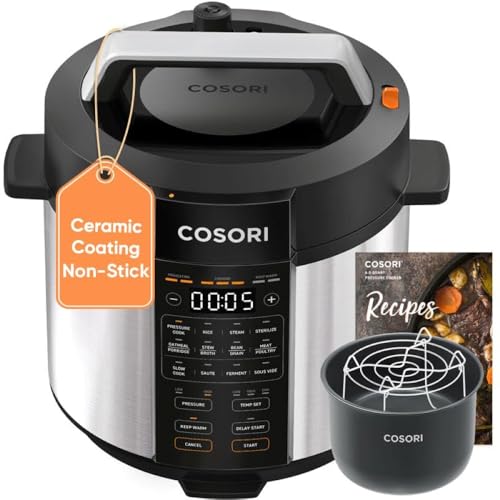
Cosori Pressure Cooker 6QT 9-in-1
Badge: Best Programmable Feature Set
Strengths
- Programmable electric cooking with a broader function set than the benchmark, including sous vide alongside pressure, rice, slow cook, and sauté.
- A dozen listed safety features wrap the automation in reassurance for newer pressure cooks.
- The ceramic-coated pot makes sticky programmed staples — rice, porridges, grains — release and clean up easily.
Trade-offs
- The ceramic coating is a wear item in a way stainless is not; gentle utensils are part of the deal.
- Its accessory ecosystem is smaller than Instant Pot’s, so spares take more deliberate sourcing.
- At 1100W it is powerful, but very large or frozen loads still need realistic time-to-pressure expectations.
Mini spec box
- Capacity: 6 Qt
- Control type: programmable electric, 9-in-1
- Functions: pressure cook, rice cooker, slow cook, sous vide, sauté (per listing)
- Inner pot: ceramic coating
- Power: 1100W
- Safety: 12 safety features (per listing)
The Cosori is the programmable alternative for cooks who read feature lists closely, because its programming reaches one job further than the benchmark’s: sous vide, the precise low-temperature technique that turns the same countertop box into a completely different instrument. Around that headline, the package is thoughtful — rice cooking designed in rather than bolted on, a strong safety count, and a ceramic pot that suits the sticky end of the programmable repertoire, where unattended cooking meets starch and easy cleanup matters most. If your programmed cooking will range widely, from grains to slow cooks to sous vide weekends, the Cosori makes the broadest case in this pool.
The trade is the coated pot’s lifecycle against the Duo’s stainless permanence, plus a thinner accessory bench. Neither is disqualifying; both are the kind of thing a buyer should weigh with their habits in view. Treat cookware gently and prize easy cleanup, and the Cosori’s balance tips in its favour. Cook hard, scrub harder, and keep machines for a decade, and the Duo’s steel wins the same argument.
Best for: feature-focused cooks who want programmable breadth including sous vide, with easy-clean ceramic / Not suited for: coating-averse buyers or those who want the largest accessory ecosystem

RVGMBO 12 Quart Stainless Steel Pressure Cooker and Canner
Badge: Best Manual Alternative for Scale
Strengths
- Twelve quarts of 18/8 stainless capacity that doubles as a pressure canner — a scale no programmable electric in this pool approaches.
- One-hand locking lid, induction and gas compatibility, and a glass lid and steamer rack included.
- Nothing electronic to fail: the pot’s working life is measured in decades and gasket changes.
Trade-offs
- NOT programmable: no timer, no presets, no keep-warm. You bring the pot to pressure, hold it with burner control, and time it yourself.
- Very large and heavy; storage, lifting, and burner fit all need planning.
- The learning curve is real, and at this scale process discipline matters most.
Mini spec box
- Capacity: 12 Qt
- Control type: manual stovetop — NOT programmable
- Material: 18/8 stainless steel
- Type: 3-in-1 stovetop pressure cooker and canner
- Compatibility: induction and gas stovetop (per listing)
- Included: glass lid, steamer rack (per listing)
The stovetop alternatives begin with the giant. The RVGMBO appears in a programmable search’s pool for one reason: scale. If your pressure cooking involves canning days, community batches, or freezer-filling runs, no 6-quart electric — however clever its panel — cooks your workload, and this 12-quart stainless pot does. Its virtues are the manual format’s virtues at maximum size: indestructible construction, dual cooker-canner identity, and a service life that electronics cannot promise. Experienced stovetop cooks often describe large manual pots as more controllable than electrics, not less, because the feedback is immediate and the heat is theirs.
But the badge tells the truth and so does this review: if you came here for a machine that runs a program while you are elsewhere, the RVGMBO is not that machine, full stop. It is the alternative for shoppers who realise, mid-search, that their real requirement was never automation — it was volume, durability, and a pot that answers to them directly. Serve that requirement and it is superb. Buy it expecting a timer and you will be disappointed by a pot that never claimed to have one.
Best for: canners, large households, and manual cooks whose priority is 12-quart scale / Not suited for: anyone who wants programmed, unattended cooking — choose the Duo or Cosori above

Peterboo Stainless Steel Pressure Cooker, 6 Quart Stovetop
Badge: Best Manual Alternative for Modern Hob
Strengths
- A 3-ply composite base with the pool’s broadest hob compatibility: induction, gas, and ceramic.
- A pressure indicator and multi-safeguard devices give a manual pot modern feedback and protection.
- Dishwasher safe stainless at the family 6-quart size, with no electronics anywhere in the design.
Trade-offs
- NOT programmable: the indicator tells you the pressure state, but timing and heat remain entirely yours.
- Newer brand; the long-term gasket pipeline is less proven than heritage makers’.
- Manual attention throughout every cook, which is the format’s deal.
Mini spec box
- Capacity: 6 Qt
- Control type: manual stovetop — NOT programmable
- Base: 3-ply composite base (per listing)
- Compatibility: induction, gas, and ceramic stoves (per listing)
- Features: pressure indicator, multi safeguard devices (per listing)
- Care: dishwasher safe (per listing)
The Peterboo is the manual alternative most likely to seduce a programmable shopper, because it closes part of the feedback gap that separates the two worlds. Its pressure indicator answers the manual cook’s constant question — are we at pressure, and is it safe — with a clear visual signal, and its composite base behaves on the induction hobs that fill modern kitchens. What it does not do, and does not claim to do, is time anything. Think of it as the pot for a cook who likes driving but appreciates a dashboard: the control is manual, the information is modern.
In a programmable guide, its honest role is the family-size manual option for kitchens whose hobs or whose philosophy rule electrics out. If you read the two electric reviews above and felt a flicker of resistance — to panels, to apps, to appliances that think — this pot is where that instinct leads at 6 quarts. Confirm a spare gasket’s availability when you buy, and it will serve as long as your stove does.
Best for: manual cooks on induction or mixed hobs who want modern pressure indication at family size / Not suited for: anyone wanting set-and-forget programmed cooking
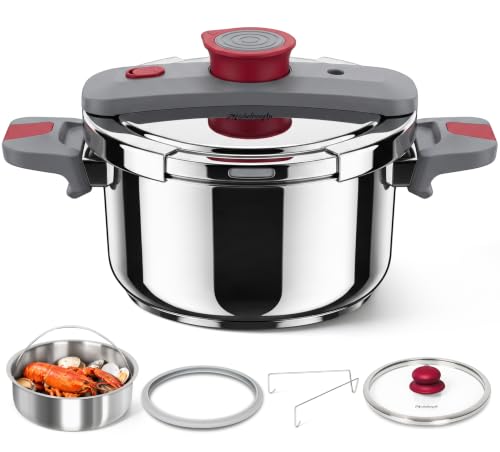
MICHELANGELO Stovetop Pressure Cooker Stainless Steel, 4.2 qt
Badge: Best Manual Alternative for Precision
Strengths
- 304 stainless steel with a 6-fold safety system — premium material and protection in a compact pot.
- Two pressure settings give manual cooking a finesse most small pots lack, for delicate versus hearty loads.
- One-hand easy-open lid, steamer basket and glass lid included, induction compatible.
Trade-offs
- NOT programmable: its two settings are pressure levels you select and govern by burner, not programs that run themselves.
- Capacity is compact at 4.2 quarts; batch cooking is beyond it.
- Premium small-pot pricing per quart.
Mini spec box
- Capacity: 4.2 qt
- Control type: manual stovetop — NOT programmable
- Material: 304 stainless steel (per listing)
- Safety: 6-fold safety system (per listing)
- Settings: 2 pressure settings (per listing)
- Included: steamer basket and glass lid (per listing)
- Compatibility: induction (per listing)
The MICHELANGELO earns its alternative badge on precision. Its two pressure settings deserve a clarifying word, because they are exactly where an unwary shopper might imagine programmability: they are two pressure levels, chosen by you and held by your burner management — a refinement of manual control, not an automation of it. Around that refinement, the pot is admirably complete: serious steel, a deep safety stack for its size, a lid that opens one-handed mid-service, and both a steamer basket and a glass lid in the box. For a small household that cooks attentively, it is the connoisseur’s compact.
Its place in this guide is to prove that “manual alternative” is not a euphemism for “lesser”. Judged as a pot, it is one of the finest objects in the pool. Judged as a programmable cooker, it is not one at all — and holding both judgements at once, clearly, is the entire discipline this guide exists to teach.
Best for: precision-minded small households wanting premium manual control / Not suited for: anyone who wants the cooker to run a timed program unattended

Peterboo 3Qt Stainless Steel Pressure Cooker
Badge: Best Manual Alternative for Small Batches
Strengths
- Eight-plus listed safety features — the densest safety package in the pool relative to size.
- Stainless and induction compatible at a true one-to-two-person scale, pressurising small loads quickly.
- An 8-in-1 multi-cooker positioning that stretches a compact pot across many small jobs.
Trade-offs
- NOT programmable in the electric sense: despite the multi-cooker language, this is a stovetop pot you operate manually.
- Three quarts is a firm ceiling for batch ambitions.
- Newer-brand parts diligence applies, as with its larger sibling.
Mini spec box
- Capacity: 3 Qt
- Control type: manual stovetop — NOT programmable
- Material: stainless steel
- Safety: 8+ safety features (per listing)
- Compatibility: induction (per listing)
- Sized for: 1–2 people (per listing)
The small Peterboo closes the alternatives with the pool’s most instructive labelling lesson. Its listing speaks of multi-cooker versatility, and in the loose language of marketplaces that phrase drifts toward electric implications. The verified facts are simpler: this is a compact stainless stovetop pot with an exceptional safety count, sized for one or two people. As that pot, it is genuinely appealing — fast to pressure, easy to store, protected well beyond its class’s norm, and a natural companion second cooker beside a large electric. As a programmable cooker, it does not exist, and this guide’s badge says so in plain words.
Buy it, if you buy it, for the small-batch manual role: grains and sauces for two, a side dish under pressure while the main cooks elsewhere, a beginner’s well-guarded first pot. In that role it needs no borrowed electric glory to justify itself.
Best for: singles, couples, and beginners wanting a compact, safety-rich manual pot / Not suited for: shoppers who want genuine programmability — the Duo and Cosori are the picks for that
Comparison Table
| Pick | Programmable? | Capacity | What runs the cook | Link |
|---|---|---|---|---|
| Instant Pot Duo 6 Qt | Yes — electric programs + manual settings | 6 Qt | The machine | Check on Amazon |
| Cosori 6QT | Yes — electric programs + manual settings | 6 Qt | The machine | Check on Amazon |
| RVGMBO 12 Quart | No — manual stovetop | 12 Qt | You and your burner | Check on Amazon |
| Peterboo 6 Quart | No — manual stovetop | 6 Qt | You and your burner | Check on Amazon |
| MICHELANGELO 4.2 qt | No — manual stovetop, 2 pressure levels | 4.2 Qt | You and your burner | Check on Amazon |
| Peterboo 3Qt | No — manual stovetop | 3 Qt | You and your burner | Check on Amazon |
If you read one element of this guide, read this table. “What runs the cook” is the whole category in five words, and every price in it should be judged against that column first.
How to Choose: Program or Pot?
Interrogate your evenings, not your aspirations. Programmability pays when cooking competes with commuting, children, work, and fatigue — when the choice is between a machine that cooks unattended and a dinner that does not happen. If your evenings reliably include twenty attentive minutes at the stove, the manual format’s durability and control may serve you better and longer. Be honest about which evening is yours on an ordinary Tuesday.
Understand what a program really is. A preset is a stored combination of pressure and time. True programmability means you can also set those variables yourself, overriding the presets for your recipes and your altitude. Both electrics here offer real manual control beneath their programs, which is what separates a programmable cooker from a button panel. When comparing any electric, look for time and pressure adjustability, a keep-warm that follows the cook, and a delay option if your schedule needs one — the COMFEE’-style long timer covered elsewhere in this series, under Best Quality Electric Pressure Cookers, shows how much a good timer can matter.
Count the whole cost of each camp. Electrics cost more to buy, carry electronics’ lifespan, and ask for rings and occasional parts through brand channels. Stovetop pots cost less over decades but charge you attention on every cook and demand a compatible hob. Neither ledger is hidden; the mistake is reading only one side of your chosen camp’s.
Let capacity arbitrate ties. If your workload is canning-scale or crowd-scale, the manual camp wins by default, because programmable electrics in this pool top out at 6 quarts. If your workload is family dinners on autopilot, the electric camp wins by the same logic. Size and automation are not independent variables; they are the two axes of the whole decision.
How to Cook: Programmed and Manual, Side by Side
- Load identically. Both camps need sufficient thin liquid, fill below two-thirds (half for grains and beans), and browning done before sealing — by sauté program on the electrics, by open-pot searing on the stovetops.
- Set the cook. Electric: choose the program or set pressure and time manually, confirm the valve is set to sealing, and start. Manual: lock the lid, bring the pot up on high heat, and watch for the pressure signal.
- Hold the pressure. Electric: the machine holds it; your job is done until the beep. Manual: drop the burner to the lowest heat that holds pressure steadily, start your timer, and stay within earshot.
- Release by the food, not by habit. Both camps: quick release for vegetables and delicate foods; natural release for meats, grains, and foamy or full pots. On the electrics the machine counts the natural release down for you; on the stovetops, your timer does.
- Rest, serve, record. A short rest settles textures in both formats. Note the settings that worked — program and time on an electric, heat and time on a stovetop — because both disciplines reward a notebook.
- Clean the sealing system. Rings, lids, valves: identical discipline, identical payoff, in both camps.
Troubleshooting
Problem: an electric cooker will not start its program or flashes a lid error → the lid is not fully locked or the valve is mis-set; reseat the lid, confirm the valve position, and restart the program from the beginning rather than mid-cycle.
Problem: a stovetop pot’s pressure surges and vents aggressively → the burner is too hot for the hold phase; reduce heat in small steps until the release settles to an occasional gentle hiss, and note that holding heat for your stove and this pot.
Problem: food is undercooked in either format → the usual causes are shared: too little time at pressure, a load beyond the fill line, or pressure lost mid-cook through a dirty seal. Correct one variable, note it, and rerun; both camps forgive methodical cooks.
What Programmability Cannot Do
A closing honesty section, because the word “programmable” attracts expectations no cooker can meet. A program cannot judge your ingredients. It does not know that today’s beans are older and drier than last month’s, that your chicken is larger, or that your altitude lengthens every timing in the book. It executes the time and pressure it was given with perfect fidelity, including when the time and pressure were wrong. This is why experienced electric cooks still keep notebooks, still adjust, and still treat presets as starting points rather than scripture — and why the manual cooks in the stovetop camp are not practising an inferior discipline, merely a differently distributed one. The machine holds the variables; the cook supplies the judgement, in both camps, always. Buy programmability for your time and attention, which is what it genuinely sells. Do not buy it as a substitute for learning your ingredients, because no panel in this pool — or any pool — sells that.
Delay Start and Keep-Warm: The Supporting Programmes
Two supporting features decide much of programmability’s real-world value, and they deserve scrutiny beyond the headline programs. Keep-warm is the first: after a programmed cook ends, a good electric holds food at a safe serving temperature until you are ready, which converts precise timing into forgiving timing. It is what makes a programmed stew finished at five o’clock still dinner at seven, and it is the feature manual cooking structurally cannot offer — a stovetop pot off the heat is cooling, however slowly. When comparing electrics, check that keep-warm engages automatically after pressure cooking and that it can be cancelled for delicate foods that would overcook sitting warm.
Delay start is the second, and it needs a food-safety caveat alongside its convenience. Loading a cooker in the morning for an evening cook means raw ingredients sit at room temperature inside the pot for hours, which is safe only for foods that tolerate it — dried beans, grains, sturdy vegetables, frozen-to-start dishes where the manual allows — and genuinely unwise for raw meats and dairy in a warm kitchen. Used within those limits, a delay timer is a small marvel: the pot begins its program while you are still at work, and dinner’s hardest hour disappears. Used carelessly, it is the one programmable feature that can trade safety for convenience. Neither pick in this guide should be bought for its delay function alone, but both camps of reader should understand the feature’s shape — and manual cooks should note that their format’s answer to scheduling is the pressure-cooked dish that reheats beautifully, which is most of them.
Altitude: Where Programs Need a Human Editor
Altitude is the quiet variable in all pressure cooking, and it interacts with programmability in a way worth understanding before you buy. As elevation rises, water boils at lower temperatures and pressure cookers operate against a thinner atmosphere, so cooking times lengthen and liquid evaporates differently. Preset programs are calibrated near sea level. At meaningful altitude, a preset is a starting suggestion, not an answer, and the cook must add time — sometimes substantially for beans and large cuts — and occasionally liquid. This is where genuine manual adjustability earns its keep on an electric: a cooker that lets you override the preset’s time is altitude-capable; one that locks you into fixed programs is not, however many buttons it wears.
Stovetop cooks meet the same physics with different tools. A manual pot’s pressure is governed by its regulator and your heat, and experienced high-altitude stovetop cooks adjust times in their notebooks exactly as electric owners adjust their settings. Neither camp escapes altitude; both camps handle it through the cook’s knowledge. If you live high, weight this section heavily in your choice: favour the electrics’ manual override, favour stovetop models whose pressure behaviour you can learn precisely, and treat every timing in every recipe — including the ones implied by this guide — as a sea-level draft awaiting your local edit.
A Week of Programmed Cooking: What Automation Actually Changes
To ground the whole programmable-versus-manual argument in lived routine, consider what a week looks like on each side. On the electric side, Monday’s beans go on before work with a delay start and are waiting, held warm, at dinner. Tuesday’s rice cooks itself while the main is grilled elsewhere. Wednesday’s stew is loaded at lunch, programmed, and forgotten until the beep. The pattern is not that the food is better — the stovetop week produces identical dishes — but that the cook’s presence is required only at the ends of each cook: the loading and the serving. For households where the middle of the cooking hour belongs to commutes, homework, or a second job, that redistribution of attention is the entire value of the category, and it is real.
On the stovetop side, the same week asks for the cook at the middle as well: the bring-up, the heat adjustment, the timer. In exchange, the stovetop cook reports a different texture of satisfaction — a closer feel for the food, skills that deepen weekly, and equipment that never interrupts dinner with an error code. Many households, honestly examined, contain both kinds of evening: three that need automation and two that reward attention. That is why the two-camp framing of this guide should not be read as a war. It is a fleet decision, and plenty of well-run kitchens end up owning one of each — a programmable electric for the week’s logistics and a stainless stovetop pot for its decades of weekends. Buy the camp your Tuesdays need first. The other camp will still be there, in steel, whenever you are ready.
A Note on Resale, Hand-Me-Downs, and Second Cookers
One practical consequence of the two camps deserves a mention for value-minded shoppers. Stainless stovetop pots hold their usefulness — and therefore their second-hand value and hand-me-down appeal — almost indefinitely, because their condition is fully visible: steel, gasket, lid, done. A used stovetop pot with a fresh gasket is a known quantity in a way a used electronic cooker, with its invisible sensor health and unknown cycle history, can never quite be. Programmable electrics, by contrast, are best bought new, where warranties and return windows cover the invisible risks, and their value to a household is consumed as convenience during their first ownership rather than preserved as an asset. Neither fact should dominate a purchase, but both belong in a complete accounting: the manual camp’s pots are heirlooms that happen to cook, while the electric camp’s machines are services that happen to sit on your counter. Price them, and keep them, accordingly.
Common Buying Mistakes
- Believing a stovetop pot is programmable because its title says “multi-cooker”. Multi-cooker language drifts. Check for a control panel, a timer, and settable time and pressure — or accept the pot as manual.
- Counting presets instead of checking adjustability. Twenty presets with no manual time setting is less programmable than six presets with full manual control.
- Buying automation for a workload that needs capacity. A programmable 6-quart will not can your harvest. Match the camp to the job first.
- Buying manual for a life that needs automation. A durable pot you never use because your evenings are full is not a bargain at any price.
- Ignoring the valve and seal in either camp. Programmability does not exempt an electric from seal maintenance, and durability does not exempt a stovetop pot from gasket changes.
- Judging by the search’s spelling. Misspelled searches return real products through real listings; verify control type from the listing’s specifications, not its title, every time.
Final Recommendation
If you want a programmable pressure cooker — the thing this search, however spelled, is asking for — buy the Instant Pot Duo 6 Qt for the proven mainstream package, or the Cosori 6QT if sous vide breadth and ceramic easy-clean matter more to you. If this guide’s honest split has shown you that your real priorities are scale, durability, or manual control, then the RVGMBO and its stovetop companions are excellent pots that will never run a program and never claimed to. Choose the camp first, the cooker second, and check the live price last — in that order, and this category cannot fool you.
Frequently Asked Questions
What does “progammable pressur cookers” mean?
It is a common misspelling of “programmable pressure cookers” — electric pressure cookers whose time and pressure you can set in advance, with built-in programs for common foods. This guide uses the correct term in its content while answering the search as typed, and it identifies exactly which of its picks are genuinely programmable.
Which picks in this guide are actually programmable?
Two: the Instant Pot Duo 6 Qt and the Cosori 6QT, both electric. The RVGMBO, both Peterboo models, and the MICHELANGELO are manual stovetop cookers with no programs or timers, included and labelled as alternatives.
Can a stovetop pressure cooker be programmable?
Not in the sense this search means. Stovetop cookers have no electronics to store or execute a program; some offer two pressure levels or indicators, which refine manual control without automating it. On a stovetop pot, the cook sets the heat, watches the pressure, and keeps the time.
Are presets the same as programmability?
No. Presets are stored settings chosen by the manufacturer. Programmability means you can set time and pressure yourself, adjusting or replacing the presets for your own recipes. The best electrics, including both picks here, offer both: presets for convenience, manual control for real cooking.
Is a programmable cooker worth it for a beginner?
Often, yes. Automation removes the two hardest beginner variables — holding pressure and timing — and keep-warm forgives imperfect scheduling. The stovetop alternatives here are also beginner-viable, especially the safety-rich small Peterboo, but they ask for attention a beginner may prefer to spend on the food itself.
Can I program a cooker to start while I am out?
Many electrics offer a delay start, and within food-safety limits it is a genuinely useful feature: suitable for dried beans, grains, sturdy vegetables, and dishes designed to start from frozen where the manufacturer allows. It is not suitable for leaving raw meat or dairy sitting in a warm pot for hours. Load with that distinction in mind, keep the delay as short as your schedule allows, and remember that keep-warm after the cook is the safer half of the scheduling magic — a dish cooked promptly and held warm beats a dish started late from a risky wait.
What if I buy programmable and never use the programs?
You will be in large company, and it is not a disaster: a programmable cooker still works as a manually set pressure cooker, and many owners settle into two or three trusted settings for everything. But it does mean the premium for broad programmability was partly wasted, which is why this guide pushes the camp question so hard before purchase. If your honest self-assessment says you cook by instinct and notebook, the stovetop alternatives will serve you longer for less. If it says your evenings are chaos, the programs will earn their keep within a month.
Do programmable cookers last as long as stovetop pots?
Generally not. Electronics, sensors, and control boards give electrics more failure modes and a shorter expected service life than a stainless stovetop pot, whose only real consumable is its gasket. That longevity gap is the manual camp’s core argument, and it is a true one — weigh it against the automation you will actually use.


