Disclosure: topratedkitchenware.com is reader-supported. When you buy through links on our site, we may earn an affiliate commission from Amazon and other retailers, at no extra cost to you.
Where to buy
The models below are the verified picks for this guide to 1250-watt microwaves. Linked names go to each model’s Amazon listing, where you can check the latest price on Amazon and confirm the rated wattage in the specifications. One compact is reviewed in full without a link, because its 700 watts sit far below this class and presenting it as a 1250-watt option would mislead you.
- TOSHIBA Countertop Microwave Oven with Inverter Technology, 1.6 Cu.Ft, 1250W, Black Stainless Steel
- Panasonic Countertop Microwave Oven, 1.2 Cu. Ft., 1250W, Inverter Technology, Stainless Steel — NN-SN67QS
- TOSHIBA Countertop Microwave Oven, 1.2 Cu.Ft, 1000W, Stainless Steel
- Chefman Countertop Microwave Oven 0.7 Cu. Ft., 700 Watts, Black — prose-only entry (see its review for why)
- BLACK+DECKER Countertop Microwave Oven, 0.9 Cu.Ft, 900W, Stainless Steel
- TOSHIBA Microwave Oven, 0.9 Cu.Ft, 900W, Black Stainless Steel
Read the full guide ↓ for what 1250 watts actually buys you over the common 1000W class, which foods notice the difference and which never will, and the detailed review of every pick.
The best microwaves 1250 watts can offer sit at the top of the mainstream countertop power range, and they attract two kinds of buyers: households tired of waiting on a slow compact, and cooks who treat the microwave as a real cooking appliance rather than a reheating box. Both are shopping for the same underlying thing — headroom. At 1250 watts, a microwave stops being the bottleneck in a weeknight dinner: frozen meals finish briskly, large portions reheat in one run, and dense dishes get the energy they need without the edges surrendering first. This guide ranks the verified models that deliver that headroom, and it does so with the wattage honesty this class demands. Two picks are true 1250W machines. Two are 900W compacts included as the class’s smaller alternatives, clearly labelled with their real ratings. One is a 1000W sensor model for buyers who decide, on reflection, that intelligence beats raw power. And one 700W compact is reviewed prose-only, without a link, because no honest guide should sell it under a 1250-watt headline.
It is worth pausing on what the extra watts do and do not do, because the class is often oversold. Wattage is speed of energy delivery, nothing more mystical. A 1250W oven heats a mug of water meaningfully faster than a 1000W oven and dramatically faster than a 700W compact, and that advantage compounds across big, dense, frozen loads. But wattage does not improve evenness by itself — that comes from cavity design, turntable or sensor systems, and, above all at this level, inverter delivery, which both true-1250W picks here use to apply their power continuously at reduced settings. Buyers comparing against the reference class below can apply the same conversion maths in reverse, and those whose real constraint is a huge cavity rather than power should cross-check Best Microwaves 20 Cubic Ft before deciding which specification leads.
Inside the guide: six reviews with true wattages stated, a comparison table, a buying section on when 1250 watts is worth its premium tier, a how-to section on cooking fast without scorching, and a frank section on the foods that will never notice your extra 250 watts.
Key Takeaways
- 1250 watts is the top of the mainstream countertop range: the gain over 1000W is real on frozen and dense foods, and modest on drinks and small portions.
- Both true-1250W picks here are inverter models, and the inverter matters as much as the wattage — continuous low power defrosts and melts without cooked edges.
- Every pick states its true rated wattage; the 900W and 1000W alternatives are labelled as such, and the 700W compact is prose-only rather than mislabelled.
- At 1250W, package directions written for lower wattages need time trimmed — roughly a tenth versus 1100W directions, more versus 1000W ones — plus early checks on delicate items.
- Capacity must rise with power for family duty: the 1.6 cu ft Toshiba pairs the class’s speed with the class’s family size.
- If your week is drinks and single portions, this class is more than you need; the money is better spent on a sensor model at lower wattage.
In this guide
Quick Picks
- Best Overall — Panasonic Countertop Microwave Oven, 1.2 Cu. Ft., 1250W, Inverter Technology, NN-SN67QS. Genius Sensor cooking and benchmark inverter delivery in a balanced family size. Check on Amazon
- Best Large Capacity — TOSHIBA Countertop Microwave Oven with Inverter Technology, 1.6 Cu.Ft, 1250W. The biggest cavity here on a 13.6-inch turntable, with smart sensor and auto defrost. Check on Amazon
- Best Sensor Alternative — TOSHIBA Countertop Microwave Oven, 1.2 Cu.Ft, 1000W, Stainless Steel. Humidity-sensor reheating and 12 menus for buyers who value intelligence over the last increment of speed. Check on Amazon
- Best Compact Alternative — BLACK+DECKER Countertop Microwave Oven, 0.9 Cu.Ft, 900W, Stainless Steel. Push-button door and household-brand simplicity in a smaller cabinet, honestly rated below the class. Check on Amazon
- Best Apartment Alternative — TOSHIBA Microwave Oven, 0.9 Cu.Ft, 900W, Black Stainless Steel. Child lock, mute, and LED interior lighting in a compact 900W body. Check on Amazon
- Compact Reviewed Prose-Only — Chefman Countertop Microwave Oven 0.7 Cu. Ft., 700 Watts, Black. A decent dorm compact, reviewed without a link because 700 watts is far below this class.
How These Picks Were Chosen
Selection began with verification: every model was confirmed against its manufacturer’s listing data through the Creators API, and the wattage in each spec box is that verified rated output. We then applied the class test strictly. A pick earns a link in a 1250-watt guide if it either delivers 1250 watts or offers a clearly labelled reason to consider it alongside — a sensor system that changes reheating outcomes, or a compact format for buyers whose counters cannot house the full-size machines. The two inverter flagships pass on power and technology together. The 1000W Toshiba passes as the intelligence alternative. The two 900W models pass as honest compact alternatives, badged as alternatives rather than as class members. The 700W Chefman fails the class test by too wide a margin for either treatment, so it appears as this guide’s prose-only review: full assessment, no link, no image, and the reason stated in the open.
Ranking within the linked picks follows cooking value. The Panasonic leads because its sensor-plus-inverter package is the most complete expression of what this wattage class is for. The big Toshiba follows on capacity. The sensor Toshiba leads the alternatives because reheating intelligence is the feature lower-wattage buyers feel most. The two 900W compacts split by household type: the BLACK+DECKER for simple small-household duty, the Toshiba 0.9 for apartment families who need its lock, mute, and lighting. This is research-led assessment of verified specifications and documented design, not hands-on laboratory testing, and no performance figures beyond the manufacturers’ own ratings are claimed anywhere in the guide. Readers arriving from older test literature can use Best Microwaves 2017consumer Reports to translate that era’s high-wattage favourites into today’s equivalents.
The Best Microwaves 1250 Watts Can Offer — and Their Honest Alternatives

TOSHIBA Countertop Microwave Oven with Inverter Technology, 1.6 Cu.Ft, 1250W, Black Stainless Steel
Badge: Best Large Capacity
Strengths
- True 1250W inverter power matched to a 1.6 cu ft cavity, so big loads get both the space and the energy density they need.
- 13.6-inch turntable rotates full-size plates and family casseroles without catching.
- Smart sensor and auto defrost automate the two jobs a large household repeats daily.
Trade-offs
- The largest footprint in this guide; measure counter depth, door swing, and overhead clearance before ordering.
- Small portions at full power overshoot quickly — use reduced levels or the sensor for single servings.
- Premium tier, as expected for the class’s biggest full-technology model.
Spec box: Capacity 1.6 cu ft · Rated power 1250W · Finish: black stainless steel · Inverter technology · Smart sensor · Auto defrost · 13.6-inch turntable
Power and capacity only pay off together, and this Toshiba is the guide’s clearest demonstration. A 1250W supply driving a small cavity is a party trick; driving 1.6 cu ft, it becomes a family tool that cooks a large frozen lasagne evenly in one run, reheats a quartet of portions without a queue, and defrosts a family pack of chicken with the inverter’s characteristic gentleness — continuous low power, no cooked edges, no icy centre. The smart sensor reads reheating so the cook does not have to, and auto defrost handles the labelled pack by weight class. In a household of four or more that uses the microwave as a primary cooking appliance, this is the machine that ends the compromises.
Its demands are space and a little discipline. The cabinet is a serious countertop presence, and its full power is genuinely brisk: a single mug or a small bowl of leftovers deserves a reduced power level or the sensor rather than a full-power blast timed by habit from a weaker oven. Households of one or two should take the Panasonic’s identical technology in a proportionate box and spend the saved counter space on anything else.
Best for: large families and batch cooks who microwave as a primary cooking method / Not suited for: small kitchens or single-person households

Panasonic Countertop Microwave Oven, 1.2 Cu. Ft., 1250W, Inverter Technology, Stainless Steel — NN-SN67QS
Badge: Best Overall
Strengths
- The class’s benchmark pairing: 1250W inverter power governed by the Genius Sensor for reheating and cooking.
- 1.2 cu ft is the family sweet spot — full plates and medium casseroles without the 1.6 cu ft footprint.
- Inverter defrosting is the most even available in a mainstream countertop model.
Trade-offs
- Premium tier reflecting the technology package.
- The very largest family dishes still belong to the 1.6 cu ft Toshiba.
- Stainless finish asks for soft-cloth cleaning.
Spec box: Capacity 1.2 cu ft · Rated power 1250W · Finish: stainless steel · Inverter technology · Genius Sensor · Model NN-SN67QS
If one machine defines this class, it is this Panasonic. The headline is the wattage, but the ownership experience is the sensor: the Genius Sensor reads the steam rising from food and adjusts the cycle in real time, so the class’s extra power is applied with judgement rather than bravado. Reheating — the task where 1250W could most easily bully a plate of leftovers into rubber — becomes the machine’s party piece. Defrosting runs on continuous inverter power and thaws evenly. Frozen meals cook briskly with times trimmed against their lower-wattage directions. And the 1.2 cu ft cabinet keeps all of it inside a footprint that ordinary family counters accept, which is why this pick, rather than the larger Toshiba, takes Best Overall: it is the most complete 1250-watt package for the most households.
Choose the big Toshiba instead only when capacity is the binding constraint — the weekly dish that does not fit decides that argument. Choose down the list when the budget is the constraint. For everyone else shopping this class seriously, this is the recommendation, and it is the model against which the alternatives below should be measured. Buyers fitting it into a tight kitchen run should also consult Best Microwaves 21 Inch Width for the placement discipline this size class rewards.
Best for: families who want the class’s best balance of power, sensing, and size / Not suited for: the largest dishes or the tightest budgets

TOSHIBA Countertop Microwave Oven, 1.2 Cu.Ft, 1000W, Stainless Steel
Badge: Best Sensor Alternative
Strengths
- Humidity-sensor cooking delivers the class’s most valued outcome — properly reheated food — at a lower wattage and tier.
- 12 auto menus, mute, ECO mode, and an Easy Clean interior make a complete household package.
- Same family-practical 1.2 cu ft size as the Best Overall pick.
Trade-offs
- 1000W is a fifth less power than the class headline; frozen and dense foods take noticeably longer.
- Conventional pulsed low power, so defrosting lacks inverter evenness.
- Buyers who came for maximum speed will feel the difference on big loads.
Spec box: Capacity 1.2 cu ft · Rated power 1000W · Finish: stainless steel · Smart humidity sensor · 12 auto menus · Mute function · ECO mode · Easy Clean interior
Every power class needs its reality check, and this Toshiba is the 1250-watt guide’s. It exists for the buyer who reads the class promise, looks at their actual week — reheating plates, warming soup, cooking vegetables, the occasional frozen meal — and concludes that judgement matters more than the last increment of speed. Its humidity sensor reheats as intelligently as anything here; food comes out hot through without the dried edges that fixed timers at any wattage produce. The 12 auto menus, the mute, the ECO standby, and the wipe-clean interior complete a package with no obvious hole. What it will not do is match the flagships’ pace on a large frozen load, and it defrosts the conventional way, in pulses that ask for turning and patience.
That is a legitimate trade, openly made: this is the pick for households whose microwave work is reheating-led. If your week is defrost-led or frozen-meal-led, stay with the inverter flagships above — the class exists for you. If it is reheat-led, this alternative may serve you better than the headline models, at a gentler tier.
Best for: reheat-led households who value sensor intelligence over maximum wattage / Not suited for: speed-first buyers or frequent defrosters
Chefman Countertop Microwave Oven 0.7 Cu. Ft., 700 Watts, Black — Prose-Only Review
Badge: Compact Reviewed Prose-Only
Strengths
- As a compact, it is well specified: 10 power levels, 6 presets, one-touch express cook, child safety lock, and a mute button.
- Small black cabinet suits dorms, offices, and the tightest apartment counters.
- Controls are simple enough for any user without a manual.
Trade-offs
- 700 watts is barely more than half this class’s power; frozen meals take roughly half again the 1250W time and cook less evenly.
- 0.7 cu ft excludes family dishes and large plates entirely.
- It cannot follow the timing guidance of this class with any small correction — it belongs to a different category.
Spec box: Capacity 0.7 cu ft · Rated power 700W · Finish: black · 10 power levels · 6 cooking presets · One-touch express cook · Child safety lock · Mute button · (Prose-only in this guide: no purchase link, no product image, because its wattage sits far below the 1250-watt class)
This entry follows the same honesty rule as the prose-only review in our 1100-watts household guide. The Chefman 0.7 is a perfectly serviceable compact microwave that has no business being sold as a 1250-watt option: its rated power is a little over half the class figure, its cavity is a dorm size, and a buyer who ordered it expecting this class’s performance would be disappointed on the first night. So it is reviewed here in full — the features are real, the compact use case is real — but without a purchase link or a product image, and with its wattage stated as plainly as the flagships’ wattages are. If you are shopping for one person in a small space, take this model seriously in a compact guide, where it competes fairly. If you are shopping this class, let this review mark the floor far below you and return to the picks above.
Best for: single users reading compact guides on its own merits / Not suited for: anyone shopping the 1250-watt class
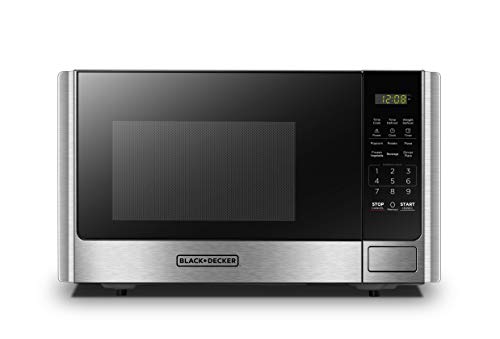
BLACK+DECKER Countertop Microwave Oven, 0.9 Cu.Ft, 900W, Stainless Steel
Badge: Best Compact Alternative
Strengths
- The strongest compact alternative here: 900W is meaningfully brisker than 700W compacts on real food.
- Push-button door and child safety lock suit small households and families in apartments.
- A household-name brand with the support footprint that implies.
Trade-offs
- 900W remains well below the class headline; frozen meals need substantial added time versus 1250W directions.
- 0.9 cu ft limits plates and dishes compared with the family models.
- No sensor or inverter features.
Spec box: Capacity 0.9 cu ft · Rated power 900W · Finish: stainless steel · 10 power levels · Push-button door · Child safety lock · 6 auto cook presets
Some buyers land on this class with a counter that simply cannot house it, and for them the question becomes which smaller machine gives up the least. The BLACK+DECKER is the strongest answer in this guide: at 900W it cooks real food — frozen meals, reheated plates, steamed vegetables — at a pace a household can live with, in a 0.9 cu ft cabinet that fits apartment counters, with the push-button door and child lock that family use wants. It is badged honestly as an alternative, not a class member: expect to add significant time to anything written for the full class wattage, and expect family dishes to stay with the larger models.
Between this and the Toshiba 0.9 below, the choice is brand-and-door simplicity versus family features like mute and LED lighting. Either is a respectable compact; neither should be bought by a household that actually has room for the flagships, because the class difference is one you will feel at every frozen meal. Space-poor buyers comparing the wider compact field, including the odd sizes filed under Best Microwaves 9 Cu Ft, should keep the same discipline: true wattage stated, capacity measured against real dishes.
Best for: small households whose counters exclude the full-size class / Not suited for: families with room for a 1.2 cu ft model

TOSHIBA Microwave Oven, 0.9 Cu.Ft, 900W, Black Stainless Steel
Badge: Best Apartment Alternative
Strengths
- Child lock, mute, and LED interior lighting — the apartment-family feature set — in a 900W compact.
- Removable 10.6-inch turntable lifts out for proper washing.
- Black stainless finish suits modern small kitchens.
Trade-offs
- 900W and 0.9 cu ft are alternative-class figures, not 1250-watt performance.
- Six auto menus is a shorter list than the larger Toshibas carry.
- The 10.6-inch turntable limits plate size.
Spec box: Capacity 0.9 cu ft · Rated power 900W · Finish: black stainless steel · 6 auto menus · Mute function · Child lock · LED lighting · 10.6-inch removable turntable
The second compact alternative tailors itself to a specific home: the apartment with children, where the microwave is small because the kitchen is small, but the usage is full family usage. The child lock manages small hands, the mute manages nap time, the LED interior lighting manages the midnight check on a warming bottle or a late supper, and the removable turntable manages the cleaning that family use demands. At 900W it reheats and cooks single-family portions credibly, with the same honest caveat as its BLACK+DECKER rival: this is the alternative class, and its timings stretch well beyond the flagships’ on anything large or frozen.
Pick it over the BLACK+DECKER when the lock-mute-lighting trio matters; pick the BLACK+DECKER for the push-button door and the plainer panel. Pick neither if the counter can take a 1.2 — the whole point of the 1250-watt class is that family cooking stops being a compromise, and these compacts, good as they are, remain one.
Best for: apartment families needing lock, mute, and lighting in a compact body / Not suited for: households with space for the full class
Comparison Table
| Pick | Badge | Rated power | Capacity | Role in this guide | Link |
|---|---|---|---|---|---|
| TOSHIBA 1.6 Cu.Ft Inverter | Best Large Capacity | 1250W | 1.6 cu ft | True class member, family size | Check on Amazon |
| Panasonic NN-SN67QS | Best Overall | 1250W | 1.2 cu ft | True class member, best balance | Check on Amazon |
| TOSHIBA 1.2 Cu.Ft Stainless | Best Sensor Alternative | 1000W | 1.2 cu ft | Sensor intelligence over raw speed | Check on Amazon |
| Chefman 0.7 Cu. Ft. (prose-only) | Compact Reviewed Prose-Only | 700W | 0.7 cu ft | Below the class — no link | Reviewed without a link (see review) |
| BLACK+DECKER 0.9 Cu.Ft | Best Compact Alternative | 900W | 0.9 cu ft | Strongest small-counter alternative | Check on Amazon |
| TOSHIBA 0.9 Cu.Ft Black Stainless | Best Apartment Alternative | 900W | 0.9 cu ft | Compact with family features | Check on Amazon |
How to Choose a 1250-Watt Microwave — and When to Choose Something Else
The case for this class is a cooking pattern, not a number. Add up your week: if frozen meals, large reheats, and defrosting appear several times, 1250 watts with inverter delivery returns its premium in minutes saved and edges un-ruined, every single week. If the tally is mostly drinks, porridge, and single plates, the class is surplus — the sensor Toshiba in this guide, or a good 1000W model generally, will make you happier per unit of money and counter. The second question is capacity pairing. Power without room wastes both: family buyers should hold out for the 1.2–1.6 cu ft flagships, while space-limited buyers should accept the alternative class knowingly, with its true wattage in view, rather than buying a full-size machine that turns the kitchen into an obstacle course.
The third question is control. Raw speed punishes inattention: at 1250W, the gap between perfect and scorched on a small portion is short. Sensors and inverter power levels are the class’s answer, which is why both flagships carry them and why we rank them above any hypothetical conventional model of equal wattage. If you cook small, delicate portions often — a single fish fillet, a baby’s bottle of milk warmed in a water bath, a small sauce — weight the sensor more heavily than the wattage when you choose between the flagships and the sensor alternative. Finally, do the counter audit this guide keeps insisting on: the 1.6 cu ft machine’s door swing and depth are part of its specification in every way that matters to your kitchen, a point the fit-focused research under Best Microwaves 22 Cu makes for the sizes above this class as well.
How to Cook Fast Without Scorching: Technique at 1250 Watts
High power rewards technique and punishes autopilot. The core habit is trimming times: against directions written for the 1100W reference, use about a tenth less; against 1000W directions, closer to a fifth less; then check early, because at this wattage the last stretch of cooking happens quickly. Use standing time religiously — it is where the centre finishes without the edges paying for it. For small or delicate portions, drop the power level instead of shortening a full-power blast: 1250W machines, especially the inverter pair, deliver genuinely gentle power at low settings, which is the correct tool for melting, softening, reheating fish or eggs, and warming sauces without splitting them. Arrange food evenly, cover it to hold steam, and stir or rotate halfway on anything dense; speed does not repeal the physics of uneven fields, it merely shortens the time in which you must manage them.
Troubleshooting at this wattage has its own patterns. Problem: edges scorch while the centre is still cool → the portion was too dense for a single full-power run; split it, lower the power level, and add standing time. Problem: liquids boil over violently → the container was too full or the power too high for a small volume; use a larger vessel, a reduced level, and stop to stir. Problem: defrosted food has cooked patches → the cycle ran at full class power in pulses on a conventional model, or the pieces stayed in one frozen block; separate at the first pause, shield thin edges as your manual allows, and prefer the inverter models’ defrost programs for this job. None of these are machine faults; they are the tuition this class charges, paid once and remembered.
The Foods That Will Never Notice Your Extra Watts
Honesty about a power class includes its irrelevancies. A mug of water for tea heats quickly at any wattage in this guide, and the flagship’s advantage is a handful of seconds. Butter melts at low power everywhere. A single portion of soup reheats kindly in the sensor alternative and the flagships alike. Popcorn follows its bag directions within a small correction at every rating here. If your microwave week is built from those jobs, the correct conclusion is not that this class is a fraud — it is that your class is lower, and the sensor Toshiba or a good compact will serve you identically for less money and counter. The 1250-watt premium is bought with frozen meals, family portions, defrosting, and dense real cooking, or it is not bought at all. Guides that pretend otherwise are selling wattage; this one would rather sell you the right oven, including when the right oven is further down its own list — a standard the older roundups discussed under Best Microwaves 2107 rarely applied to themselves.
1250 Watts in Three Real Kitchens
Consider the class through the households that actually buy it. The first is the family of five whose freezer is a second pantry: batch-cooked portions, supermarket frozen meals on busy nights, a whole chicken’s worth of defrosting on Sundays. For them the 1.6 cu ft Toshiba is not an extravagance but the removal of a daily queue — one run instead of two, defrosting that does not need babysitting, reheating judged by a sensor while the cook does something else. The second household is the couple who cook properly and use the microwave as a sous-chef: melting, proofing, steaming vegetables, defrosting a single portion of fish without cooking its edges. For them the Panasonic’s inverter subtlety is the purchase, and its full power is almost a bonus — the class bought for its floor rather than its ceiling. The third is the apartment family that landed here by search and stays by honesty: their counter takes neither flagship, and the guide’s service to them is the labelled alternatives — a 900W compact bought knowingly, or the sensor Toshiba if a 1.2 cu ft run can be found along a different wall.
Notice what none of the three needed: a wattage beyond this class, a feature beyond these six machines, or a promise this guide has not made. The class is a ceiling for domestic countertop cooking not because more power is impossible, but because beyond it the returns vanish into circuit loads, cavity sizes, and cooking physics that stop rewarding the household. Shopping at the top of a sensible range is a different discipline from shopping at the top of an endless one, and it is why this guide can be definite: within the mainstream countertop market, these flagships are where the power story ends.
Ownership Notes: Heat, Noise, and the Counter It Lives On
High-power microwaves ask a little more of their surroundings. They vent more heat during long runs, which makes the manufacturer’s clearances a genuine operating requirement rather than fine print — a flagship pushed flush into a corner will run hot, cook inconsistently, and age its electronics early. They draw heavily while running, so the direct wall outlet and the unshared circuit from the how-to section are part of the installation, not accessories. Their fans work harder at full power, which makes the mute function and, on the inverter models, the generally smoother acoustic profile worth having in open-plan homes. And their cabinets are the largest in the countertop mainstream, so the counter they live on should be planned like furniture: landing space for hot dishes on the opening side, the splatter cover and trivet stored within reach, and nothing heat-sensitive stored directly above the vents.
None of this is a warning against the class; it is the normal respect a powerful appliance deserves, and it is cheaper to plan it before delivery than to rearrange a kitchen around a machine that does not fit the spot chosen for it. Measure twice, leave the gaps, plug it in properly, and a 1250-watt flagship will repay the courtesy with a decade of being the fastest, calmest appliance in the room.
How the Top of the Range Got Here
The 1250-watt class makes more sense with its history in view. Domestic microwaves began as low-power reheating boxes, and for years the market’s centre sat where the compact picks in this guide still sit. As the appliance moved from warming coffee to cooking family meals, wattages climbed through the 900s and past 1000, and package directions standardised around the reference figures those generations established. The last decade’s real change was not the final climb to 1200–1250 watts but the arrival of affordable inverter power supplies and competent sensors in mainstream models: suddenly the top of the range was not merely faster but gentler and smarter than the middle, which had never been true when extra wattage arrived as raw pulsed power. That is why the modern flagship class is defined by a combination — maximum mainstream wattage, inverter delivery, sensor judgement — rather than by the number alone, and why this guide’s two true-1250W picks are also its two most automated. A buyer comparing across eras, as readers of the older-roundup analysis in Best Microwaves 2017consumer Reports are doing, should translate with that shift in mind: yesterday’s high-wattage winner is today’s mid-range machine, because the class moved in kind, not just in watts.
Common Buying Mistakes
- Buying wattage without inverter or sensor control. At 1250W, delivery and judgement matter as much as the number; the flagships here carry both for a reason.
- Pairing top power with a tiny cavity for family duty. Speed cannot fix a dish that does not fit. Capacity and wattage must be chosen together.
- Running full power on small portions by habit. The class’s most common disappointment is self-inflicted: trim times, drop levels, use the sensor.
- Accepting a low-wattage compact under a high-wattage headline. Check the rated output in the specifications — this guide’s prose-only entry shows why.
- Skipping the counter audit for the 1.6 cu ft class. Door swing, depth, and clearance decide whether the flagship is a joy or an obstruction.
- Paying the class premium for a drinks-and-porridge week. If the foods that notice wattage are absent from your routine, buy the sensor alternative and bank the difference.
Final Recommendation
Buy the Panasonic NN-SN67QS for the class at its best: true 1250W inverter power, sensor judgement, and a size most family counters accept. Step up to the TOSHIBA 1.6 Cu.Ft Inverter when the dishes demand the room, and step sideways to the TOSHIBA 1.2 Cu.Ft sensor model when your week is reheat-led and the budget is real. That is the honest shape of the best microwaves 1250 watts shoppers can choose from today: two flagships that earn the headline, alternatives that are labelled as alternatives, and one compact reviewed without a link because it never belonged under the headline at all.
Frequently Asked Questions
Is 1250 watts too much power for everyday reheating?
Not with the controls these models carry. Use the sensor for reheating, drop power levels for small or delicate portions, and trim times against lower-wattage directions. The problems people attribute to excessive wattage are almost always full-power habits carried over from a weaker oven; a week of adjusted technique ends them.
How much faster is 1250W than 1000W in practice?
Roughly a fifth faster on comparable loads, with the gap most noticeable on large, dense, or frozen foods and least noticeable on drinks and small portions. On a family frozen meal the saving is minutes; on a mug of water it is seconds. Judge the class by the foods you cook most.
Why are both 1250W picks inverter models?
Because at the top of the power range, how power is delivered decides whether the extra speed is usable. Inverter delivery applies continuous reduced power for defrosting and delicate work, where conventional pulsing at high wattage is at its roughest. The pairing of maximum power with the smoothest delivery is what defines the modern flagship class.
Can a 900W compact substitute for a 1250W microwave?
For one or two people reheating and cooking modest portions, it can serve as the household’s microwave — the two compact alternatives here are respectable machines. It cannot substitute on class terms: family frozen meals take substantially longer, large dishes do not fit, and defrosting lacks the flagships’ evenness. Buy it as a compact, not as a discounted flagship.
Do I need to adjust popcorn and packaged-food directions at 1250W?
Yes, modestly. Start with about a tenth less time than directions written for the 1100W reference — more against 1000W directions — and stay within earshot: popcorn is done when the popping slows, whatever the clock says. After two or three runs you will know your oven’s exact correction for your usual brands.
What size circuit or outlet does a 1250W microwave need?
These are standard countertop appliances that run from an ordinary kitchen outlet, but they are heavy loads: plug directly into the wall, never through an extension lead or power strip, and avoid running another high-draw appliance on the same circuit at the same time, especially in older homes.
Will a 1250W microwave noticeably raise my electricity bill?
No. It draws more power while running but runs for less time, and per meal it typically uses less energy than heating the same food in a full-size oven. Across a year of ordinary family use, the difference between this class and a 1000W model is negligible compared with the standby habits ECO modes address. Buy the wattage for cooking, not for the bill.
Does a 1250W microwave cook food more evenly than a 1000W model?
Not by wattage alone — a conventional 1250W oven can be as uneven as any other, only faster. Evenness in this guide’s flagships comes from their inverter delivery and sensor control, which is why those features headline their reviews. When you compare any two models, ask about delivery and sensing after you ask about watts; the order of those questions decides whether the extra power becomes better food or merely quicker mistakes.
What is the smallest kitchen that should consider this class?
One that can give the 1.2 cu ft flagship its measured footprint, its ventilation gaps, and landing space beside the door — in practice, a standard family counter run rather than a galley corner. If the tape measure says no, the honest move is the sensor alternative or a labelled compact from this guide, not a flagship wedged into a space that will make it run hot and live awkwardly.
Should I replace a working 1000W microwave with a 1250W model?
Only if your cooking has outgrown it — family portions splitting into two runs, defrosting that frustrates weekly, frozen meals that anchor busy nights. If the current oven reheats your actual week comfortably, the upgrade buys seconds you will not feel. Replace on workload, not on wattage envy, and when you do replace, let the sensor and inverter package — not the number alone — be the reason.
How do I clean a high-power microwave without damaging it?
Steam and softness: run a bowl of water until the cavity steams, let it sit closed for a few minutes, then wipe with a soft cloth. Wash the turntable and ring separately, keep the door seal and vents clear, and never use abrasive pads or oven cleaner inside. High power does not change the chemistry — it only bakes spills on faster when they are left for the next cycle, which is an argument for wiping early rather than scrubbing late.
Are 1250W microwaves louder than smaller models?
They move more air at full power, so fan noise is somewhat greater during long, hard runs — and largely irrelevant during the short reheats that fill most days. The ownership detail that matters more is the end-of-cycle signal, which is why the mute-equipped models in this guide earn their mention: at any wattage, a silenced beep is the difference between a midnight snack and a woken household.
What accessories do I actually need with a 1250W microwave?
Very few: a microwave-safe splatter cover, a trivet for hot dishes, and containers rated for microwave use at full power. Everything else is optional. Spend the accessory budget on the surge protector instead — it protects the electronics that make this class worth owning.


