Disclosure: topratedkitchenware.com is reader-supported. When you buy through links on our site, we may earn an affiliate commission from Amazon and other retailers, at no extra cost to you.
Where to buy
This guide to the best microwaves under 200 collects six verified countertop models that sit in the most competitive band in the category. Each name below links to its Amazon listing, where you can check the latest price on Amazon, confirm the current finish and configuration, and read recent owner feedback before you decide. Prices in this band move with promotions, so treat the listing — not any roundup — as the final word on what a model costs today.
- TOSHIBA Countertop Microwave Oven, 1.2 Cu.Ft, 1000W, Stainless Steel
- Chefman Countertop Microwave Oven 0.7 Cu. Ft., 700 Watts, Black
- BLACK+DECKER Countertop Microwave Oven, 0.9 Cu.Ft, 900W, Stainless Steel
- TOSHIBA Microwave Oven, 0.9 Cu.Ft, 900W, Black Stainless Steel
- TOSHIBA Countertop Microwave Oven, 1.2 Cu.Ft, 1000W, Black
- COMFEE’ Countertop Microwave Oven, 0.7 Cu.Ft, 700W, Black
Read the full guide ↓ for the ranking logic, the honest limitations of every pick, and the sizing checks that matter more than any headline feature.
Shopping for the best microwaves under 200 puts you in the sweet spot of the countertop market, and that is exactly why the choice is confusing. This band is where manufacturers stop stripping features to hit a rock-bottom number and start competing on the things you feel every day: sensor reheating that does not turn leftovers into rubber, a turntable wide enough for a dinner plate, a mute function for early mornings, and an interior that wipes clean instead of trapping last week’s soup. Below that band you mostly trade away power and space. Above it you mostly pay for inverter technology, convection, or designer finishes. Inside it, six distinct designs cover almost every kitchen, from a dorm room that needs a compact 0.7 cubic foot box to a family counter that reheats full plates three times a night.
This guide compares those six verified models side by side. Every pick gets a badge, a detailed review with three strengths and three honest trade-offs, a mini spec box limited to facts confirmed in its verified listing, and a plain verdict about who should skip it. You will also find a comparison table, a buying guide that explains capacity and wattage in practical terms, a how-to section on setup, everyday use, cleaning, and troubleshooting, and answers to the questions buyers in this band ask most. If your budget is tighter still, the research behind Best Microwaves Under $50 shows how quickly the feature set shrinks, while Best Microwaves Under $75 covers the compact class that anchors the bottom of this guide.
Key Takeaways
- Capacity decides satisfaction more than wattage: 0.7 cubic feet suits mugs and single bowls, 0.9 cubic feet handles most plates, and 1.2 cubic feet is the comfortable family size in this band.
- Around 900 to 1000 watts is the practical ceiling here, and it is plenty: it reheats evenly without the long waits of 700-watt compacts.
- Sensor reheating is the standout upgrade in this band. The two Toshiba 1.2 cubic foot models use a humidity sensor to judge doneness instead of guessing from time alone.
- Mute functions and ECO modes sound minor until you live with them; three of these six picks offer a mute option for quiet kitchens and shared walls.
- Measure your counter and your largest plate before ordering. Turntable diameter — 10.6 inches on the compact Toshiba, 12.4 inches on the larger one — tells you more than the cubic-foot headline.
- Every pick here is a verified listing, so check the latest price on Amazon at decision time; band pricing shifts too often for any printed figure to stay honest.
In this guide
Quick Picks
| Pick | Badge | Capacity | Power | Standout trait |
|---|---|---|---|---|
| TOSHIBA 1.2 Cu.Ft Stainless Steel | Best Overall | 1.2 cu ft | 1000W | Smart humidity sensor, 12 auto menus |
| Chefman 0.7 Cu. Ft. | Best for Small Spaces | 0.7 cu ft | 700W | Compact footprint, mute button |
| BLACK+DECKER 0.9 Cu.Ft | Best Value Staple | 0.9 cu ft | 900W | Push-button door, 10 power levels |
| TOSHIBA 0.9 Cu.Ft Black Stainless | Best for Apartments | 0.9 cu ft | 900W | LED lighting, mute function |
| TOSHIBA 1.2 Cu.Ft Black | Best for Families | 1.2 cu ft | 1000W | 12.4-inch turntable, sensor cooking |
| COMFEE’ 0.7 Cu.Ft | Best for Dorms and Offices | 0.7 cu ft | 700W | ECO mode, sound on/off |
Badges reflect the job each model does best, not a laboratory ranking. A dorm buyer and a family of five can both shop in this band and correctly choose different winners, which is why the detailed reviews below spell out who each pick is not suited for as plainly as who it serves.
How These Picks Were Chosen
We built this shortlist from a verified pool of countertop microwaves confirmed through the Creators API, which means every model name, capacity, wattage, and feature mentioned in this guide comes from its live listing data rather than from memory or from a manufacturer’s marketing page. From that pool we kept six models that genuinely belong to this price band’s class: mainstream countertop designs in the 0.7 to 1.2 cubic foot range, without the premium inverter flagships and convection hybrids that belong to a higher tier and are covered in Best Microwaves Under $500 Dollars. Within the band we prioritised variety of use case — two family-size sensor models, two balanced 0.9 cubic foot all-rounders, and two compacts — over six near-identical boxes.
Our evaluation weighted the things owners feel daily: reheating evenness, defrost behaviour, control clarity, noise, footprint, and how easily the cavity cleans. We compared listed features across the pool, read the patterns in owner feedback for recurring complaints such as door latches, turntable noise, and control panels that are hard to read in low light, and discounted any feature that only appears in a headline but not in the confirmed specification. This is a research-led guide, not a hands-on laboratory test, and we say so plainly: where we describe performance, we describe the documented behaviour of the technology — for example, how a humidity sensor works — rather than claiming we cooked a test menu in each machine. Shoppers comparing a wider field may also find Best Microwaves Under $5000 useful as a reminder of how little the top of the market adds for everyday reheating.
The Best Microwaves Under 200 in Detail
Each review follows the same pattern: what the machine is, its badge, three strengths, three trade-offs, a mini spec box drawn only from verified listing facts, and a verdict. Read the trade-offs as carefully as the strengths — in a band this competitive, the right choice is usually the one whose compromises you will never notice.

TOSHIBA Countertop Microwave Oven, 1.2 Cu.Ft, 1000W, Stainless Steel
Badge: Best Overall
Strengths
- Smart humidity sensor adjusts reheat and cook cycles based on steam, so leftovers and vegetables finish hot without dried edges.
- Twelve auto menus cover the everyday presets households actually use, reducing guesswork for new cooks.
- Easy-clean interior and an ECO mode pair daily convenience with lower standby draw.
Trade-offs
- The 1.2 cubic foot footprint is the joint-largest in this guide and will crowd a shallow counter.
- Stainless steel shows fingerprints and needs a wipe to keep the front looking sharp.
- Sensor menus reward standard portions; very small amounts can finish before the sensor reads them well.
Mini spec box: Capacity 1.2 cu ft · Power 1000W · Finish: stainless steel · Smart humidity sensor · 12 auto menus · Mute function · ECO mode · Easy-clean interior.
This is the model we would hand to a household that wants one microwave to do everything without drama. The humidity sensor is the real story: instead of running a fixed timer and hoping, the oven measures the steam food releases and adjusts the cycle, which is why reheated rice stays fluffy and a plate of pasta heats through without a cold centre and scorched rim. At 1000 watts it has enough pace for family use, and the cavity swallows a full dinner plate or a medium casserole without the awkward tilt smaller ovens demand. The mute function matters more than it sounds — no beeps when you warm milk at midnight — and ECO mode trims the standby consumption that quietly adds up across a year.
Who should skip it? Anyone measuring a counter in a studio flat, because the two 0.7 cubic foot picks below do the reheating basics in far less space. And if you specifically want an inverter oven that holds a true low power for delicate melting and defrosting, that technology lives in a higher tier; this Toshiba cycles power the conventional way, competently but conventionally. As an all-rounder in this band, though, nothing else in the six matches its combination of size, sensor intelligence, and everyday manners.
Best for: households wanting one do-everything family microwave / Not suited for: very small counters or buyers set on inverter technology

Chefman Countertop Microwave Oven 0.7 Cu. Ft., 700 Watts, Black
Badge: Best for Small Spaces
Strengths
- Genuinely compact 0.7 cubic foot cabinet that fits dorm shelves, office corners, and caravan counters.
- Ten power levels and six cooking presets give more control than most compacts offer.
- Mute button and child safety lock make it considerate in shared and family spaces.
Trade-offs
- At 700 watts it is the joint-slowest here; packaged meals need the time adjustment explained in the how-to section.
- The cavity fits mugs, bowls, and small plates, but not a full-size dinner plate laid flat in all cases.
- One-touch express cook is convenient, though fine control still means using the power levels manually.
Mini spec box: Capacity 0.7 cu ft · Power 700W · 10 power levels · 6 cooking presets · One-touch express cook · Child safety lock · Mute button · Finish: black.
The Chefman earns its place by respecting small spaces without feeling like a toy. Its control set is unusually complete for the compact class — ten power levels rather than a token few, six presets, and express cook for the mug-of-soup moments that make up most compact-microwave use. In a dorm room, a studio kitchen, or an office breakout corner, those are exactly the jobs that matter: reheating a bowl, melting butter, warming a drink that went cold during a meeting. The mute button is a thoughtful touch where walls are thin and roommates sleep at odd hours.
Be honest with yourself about the limits before choosing it as a main kitchen microwave. Seven hundred watts reheats a single portion perfectly well, but a large frozen meal takes noticeably longer and benefits from a stir and a rest halfway, and the cavity simply cannot host the big plates and dishes a family oven handles. Treat it as a specialist — the best small-space tool in this band — and it will not disappoint. Treat it as a family workhorse and the two 1.2 cubic foot Toshibas above and below are the honest answer.
Best for: dorms, studios, offices, and secondary reheating stations / Not suited for: family-size dishes or impatient cooks reheating large frozen meals
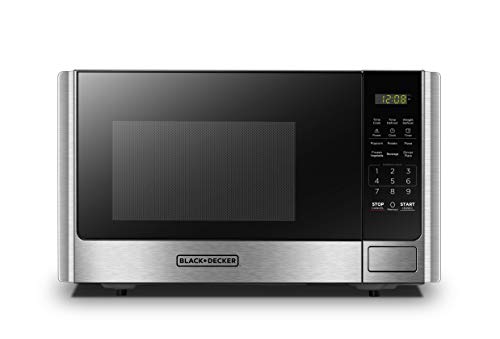
BLACK+DECKER Countertop Microwave Oven, 0.9 Cu.Ft, 900W, Stainless Steel
Badge: Best Value Staple
Strengths
- The 0.9 cubic foot, 900-watt middle ground suits most plates and most kitchens without excess bulk.
- Push-button door opens with an elbow or a full hand, easier than pull handles when carrying hot dishes.
- Ten power levels and six auto cook presets cover the standard repertoire without menu overload.
Trade-offs
- No sensor reheating, so results depend on your time and power judgement.
- No mute function is listed, so beeps stay on in quiet households.
- The stainless front is a fingerprint magnet like its Toshiba rival.
Mini spec box: Capacity 0.9 cu ft · Power 900W · Finish: stainless steel · 10 power levels · Push-button door · Child safety lock · 6 auto cook presets.
If the sensor Toshibas are the clever picks, this BLACK+DECKER is the sensible one. Nine hundred watts is the quiet workhorse specification of the countertop world: fast enough that reheating does not become an event, gentle enough at low power settings for melting and softening, and paired here with a cavity that accepts ordinary dinner plates without drama. The push-button door deserves its mention — anyone who has tried to pull a microwave door open while holding a hot bowl in both hands understands the design immediately.
What you give up is automation. There is no humidity sensor deciding when your leftovers are done, so you will learn your own timings for the meals you repeat, which most owners do within a fortnight anyway. For a first apartment, a rental kitchen, or a household replacing a dead oven without wanting a research project, that trade is often exactly right: a known brand, a balanced specification, and controls a guest can use without instructions. Shoppers who want the carousel behaviour itself explained can compare notes in Best Microwaves W Carousel, since every pick in this guide uses a rotating turntable design.
Best for: first kitchens and no-fuss replacements / Not suited for: buyers who want sensor automation or a mute option

TOSHIBA Microwave Oven, 0.9 Cu.Ft, 900W, Black Stainless Steel
Badge: Best for Apartments
Strengths
- Black stainless finish hides smudges better than bright stainless and suits modern apartment kitchens.
- Mute function plus LED interior lighting make late-night use quiet and easy to monitor.
- The 10.6-inch removable turntable handles standard plates and lifts out for washing.
Trade-offs
- Six auto menus is a shorter list than the twelve on the larger Toshibas.
- No humidity sensor at this size, so reheating is timed rather than sensed.
- The dark finish shows dust and light-coloured splashes more readily than it shows fingerprints.
Mini spec box: Capacity 0.9 cu ft · Power 900W · Finish: black stainless steel · 6 auto menus · Mute function · Child lock · LED lighting · 10.6-inch removable turntable.
Toshiba clearly aimed this model at apartment life, and the details line up: a finish that does not demand constant polishing, a mute switch for thin walls, LED lighting so you can watch cheese melt at midnight without a harsh bulb, and a footprint that leaves room for a kettle and a chopping board on the same counter. The 900-watt output matches the BLACK+DECKER above, so cooking pace is identical; the choice between them is about finish, the mute and lighting extras, and brand preference rather than raw performance.
The removable turntable is worth a sentence of its own. At 10.6 inches it covers the plates most singles and couples own, and because it lifts out, the weekly wipe-down that keeps a microwave fresh takes two minutes instead of a contortion act. If your household regularly reheats oversized plates or a family casserole, step up to the 12.4-inch turntable on the 1.2 cubic foot Toshiba in black. If your plates are standard and your kitchen is compact, this is the polished, quiet neighbour of the range.
Best for: apartment dwellers who value quiet operation and a smudge-hiding finish / Not suited for: oversized plates or buyers wanting sensor cooking at this size

TOSHIBA Countertop Microwave Oven, 1.2 Cu.Ft, 1000W, Black
Badge: Best for Families
Strengths
- The 12.4-inch removable turntable is the widest here, swallowing family plates and larger bowls.
- Smart humidity sensor with twelve auto menus takes the guesswork out of batch reheating.
- Mute function and ECO mode keep a busy family kitchen calmer and leaner on standby power.
Trade-offs
- Same large footprint as the stainless version; measure before committing counter space.
- The black finish can make the control panel harder to read in a dim corner.
- Families wanting inverter defrosting still need to look above this band.
Mini spec box: Capacity 1.2 cu ft · Power 1000W · Finish: black · 12.4-inch removable turntable · Smart humidity sensor · 12 auto menus · Mute function · ECO mode · Easy-clean interior.
This is the stainless Best Overall pick in a black finish, and for many families the better buy of the two. The specification is the same where it counts — 1.2 cubic feet, 1000 watts, humidity sensor, twelve menus, easy-clean interior — but the black cabinet disappears into a busy kitchen, forgives the odd splash between cleans, and pairs with the black appliances many households already own. The wide turntable is the family feature: reheating two portions in sequence is normal, but fitting the big serving bowl or the Sunday roast plate without tilting it through the door is what owners end up grateful for.
Sensor cooking earns its keep most in family service, where the microwave reheats a child’s pasta, a parent’s curry, and a plate of vegetables back to back, all different, all judged by steam rather than by whoever remembers the right number of seconds. Add the mute function for sleeping-baby hours and you have the most considerate big oven in the band. Its honest limitation is shared with its stainless twin: conventional power cycling rather than inverter delivery, and a footprint that small kitchens should measure twice.
Best for: families reheating varied meals daily / Not suited for: tiny counters or inverter seekers


COMFEE’ Countertop Microwave Oven, 0.7 Cu.Ft, 700W, Black, ECO Mode
Badge: Best for Dorms and Offices
Strengths
- ECO mode cuts standby draw, a real saving in rooms where the oven sits plugged in all term.
- Sound on/off control silences beeps for shared offices and quiet dorm floors.
- One-touch buttons keep the common jobs — popcorn, drinks, reheating — to a single press.
Trade-offs
- Seven hundred watts means longer cook times and the adjustment routine described below.
- The 0.7 cubic foot cavity is mug-and-bowl territory, not dinner-plate territory.
- Fewer presets and power refinements than the Chefman compact it competes with.
Mini spec box: Capacity 0.7 cu ft · Power 700W · Finish: black · ECO mode · Sound on/off · One-touch buttons · Child safety lock · Intended for dorm, apartment, and office use.
The COMFEE’ compact is the minimalist of the six: a small black box that does the reheating basics, stays silent when asked, and sips standby power in ECO mode. That combination is precisely what dormitories and small offices ask for. Nobody in a shared kitchen wants a symphony of beeps at midnight, and nobody’s facilities manager wants a row of appliances drawing power around the clock. The one-touch buttons match how these ovens are actually used — a drink, a bowl of noodles, a bag of popcorn — and the child safety lock is a sensible inclusion for family homes using it as a second oven.
Choosing between this and the Chefman compact comes down to control depth. The Chefman offers ten power levels and six presets for cooks who like to fine-tune; the COMFEE’ offers a simpler panel and the ECO emphasis for buyers who want set-and-forget basics. Both share the compact class limits — 700 watts and a small cavity — so read the wattage guidance in the buying guide before either becomes your only microwave. As a dedicated reheating station, the COMFEE’ is easy to recommend.
Best for: dorm rooms, offices, and ECO-conscious small households / Not suited for: cooks who want granular power control or family capacity

Comparison Table
| Model | Capacity | Power | Sensor | Mute | Link |
|---|---|---|---|---|---|
| TOSHIBA 1.2 Stainless Steel | 1.2 cu ft | 1000W | Yes, humidity | Yes | Check on Amazon |
| Chefman 0.7 | 0.7 cu ft | 700W | No | Yes | Check on Amazon |
| BLACK+DECKER 0.9 | 0.9 cu ft | 900W | No | Not listed | Check on Amazon |
| TOSHIBA 0.9 Black Stainless | 0.9 cu ft | 900W | No | Yes | Check on Amazon |
| TOSHIBA 1.2 Black | 1.2 cu ft | 1000W | Yes, humidity | Yes | Check on Amazon |
| COMFEE’ 0.7 | 0.7 cu ft | 700W | No | Sound on/off | Check on Amazon |
Read the table by columns that match your life. If you reheat family plates, filter by capacity and turntable size first. If you live with thin walls, filter by mute. If you cook from frozen often, remember that none of these six is an inverter model — a point the buying guide explains, and one reason some shoppers stretch toward Best Microwaves Under $800 Watts discussions in reverse, chasing power rather than limiting it.
How to Choose a Microwave in This Band
Start with the plate test, not the cubic-foot headline. Capacity figures measure the whole cavity, but your life is measured in dishes. A 0.7 cubic foot oven reheats a mug, a cereal bowl, or a single-serve meal happily. A 0.9 cubic foot oven adds the standard dinner plate. A 1.2 cubic foot oven adds the large plate, the family bowl, and the medium casserole. Measure your largest everyday plate, compare it with the turntable diameters in the spec boxes — 10.6 inches on the compact Toshiba, 12.4 inches on the large one — and let that decide your size class before you look at any other feature.
Match wattage to patience and portion size. Wattage is cooking speed. At 1000 watts, a mug of soup is hot in about the time packaged directions assume, because most packaged timings are written for 1000 to 1100 watt ovens. At 900 watts, add a small margin. At 700 watts, add roughly a third more time and stir or rotate halfway for even results. None of these speeds is wrong; the mistake is buying 700 watts for a household that reheats large frozen dinners nightly, or paying for family capacity that will only ever warm coffee.
Decide whether sensor cooking matters to you. A humidity sensor measures steam escaping from food and ends the cycle when the food is actually hot, which removes the guesswork from reheating mixed plates. In this band it appears on the two 1.2 cubic foot Toshibas. If your microwave life is mostly reheating varied leftovers, the sensor is the single feature most likely to please you daily. If your life is popcorn, drinks, and defrosting by weight, a simpler timed oven serves you just as well for less complexity.
Weigh the quiet features honestly. Mute functions, ECO standby modes, LED lighting, and push-button doors look like brochure filler until the first week of use. Households with babies, night-shift workers, thin apartment walls, or an oven that lives within earshot of a bedroom feel these features every day. Single households in detached kitchens may never think about them again. Rank them by your walls, not by the brochure.
Check the physical fit twice. Measure counter depth, the height under wall cabinets, and the swing of the door, then add breathing room at the vents. A microwave that fits on paper but vents against a wall will run hot and unhappy. Also confirm the outlet situation: these are countertop appliances that want their own properly rated socket, not a chain of adapters behind the toaster.
How to Set Up, Use, and Care for Your Microwave
Setup in the first ten minutes. Unpack the oven, remove every film and transit piece, and confirm the turntable ring and glass tray are seated so the tray sits level and turns without rocking. Place the oven on a flat, stable counter with the clearance the manual specifies at the back and sides. Plug it directly into a wall outlet, set the clock, and run a cup of water for a minute as a first test: it should come out steaming, with the tray rotating smoothly and no unusual noise. Register the product and keep the manual — preset behaviour and error codes are model-specific, and the manual is the fastest reference you own.
Everyday use that gets even results. Arrange food in a ring or an even layer rather than a mound, cover it with a microwave-safe lid or vented wrap to hold steam, and let it stand for a minute after the cycle so temperatures equalise. Stir or turn food halfway through longer cycles, especially at 700 watts. Use power levels deliberately: high for water-based reheating, medium for dense or delicate foods, low for melting butter and chocolate or softening ice cream without liquefying it. Defrost in short bursts with rests between them, separating pieces as they loosen, so edges do not cook while centres stay frozen.
Cleaning without damaging the cavity. Wipe spills the day they happen; baked-on splatter is a chore, fresh splatter is a cloth. For a deeper clean, heat a bowl of water with a slice of lemon until the cavity steams, wait a few minutes, then wipe — the steam loosens film so you rarely need force. Wash the glass turntable and ring in warm soapy water, dry them fully, and reseat them carefully. Use soft cloths and mild detergent only; scouring pads and harsh chemicals scratch the interior finish and can damage the door mesh and seals, which are safety components, not decoration.
Troubleshooting mini-guide.
- Problem: food heats unevenly, with cold centres → what to do: reduce portion depth, stir or rearrange halfway, add standing time, and confirm the turntable is seated and rotating; very dense foods also benefit from a lower power level for longer.
- Problem: the oven runs but the tray does not turn → what to do: stop the cycle, reseat the glass tray on its ring and coupler, and check for debris under the ring; if it still will not turn, do not run the oven loaded off-centre — contact the manufacturer’s support with the model number.
- Problem: sparking or arcing inside the cavity → what to do: stop the oven immediately, check for metal trim on dishes, twist ties, or foil fragments, and inspect the interior for damaged paint or a burnt waveguide cover; if the cover is damaged, have it serviced rather than improvising a repair.
What This Band Gives You — and What It Deliberately Does Not
It helps to name what this price band is for. Inside it you get the complete mainstream countertop experience: enough power for packaged meals at their printed timings, enough space for real plates, sensor automation at the top of the band, and the quiet-life features — mute, ECO, LED light — that used to be premium garnish. What you do not get is equally consistent: no inverter power delivery, so low settings cycle on and off rather than holding a steady gentle heat; no convection or air-fry combination cooking; and no built-in or over-the-range formats, which live in different price and installation worlds entirely.
That boundary is healthy for buyers. If your cooking genuinely needs an inverter’s defrost finesse or a combination oven’s roasting, you should know before ordering that the step up is a tier change, not a haggling problem. If your cooking is the national repertoire of reheating, defrosting, melting, and packaged meals, this band is not a compromise at all — it is the category’s centre of gravity, and the six picks above are its strongest current shapes.
How the Six Divide the Everyday Jobs
Reheating mixed plates. This is where the two sensor Toshibas separate themselves from the field. A plate holding rice, chicken, and vegetables has three different densities and three different ideal endpoints; a timer can only serve one of them. The humidity sensor reads the steam the whole plate releases and stops when the load as a whole is hot, which is why sensor owners report fewer plates going back for a second blast. The timed ovens here reheat perfectly well once you learn your portions — the difference is the learning curve, not the ceiling.
Defrosting meat and bread. None of these six is an inverter model, so all of them defrost by cycling full power on and off at low settings. Used patiently — short bursts, rests between them, pieces separated as they loosen — that method works fine for mince, chicken portions, and bread. Used impatiently on a high setting, it cooks edges while the centre stays icy, in any oven at any price. The Farberware-style defrost-by-weight approach is not present in this six; here you defrost by time and power level, which rewards attention and punishes autopilot equally across all six picks.
Popcorn, drinks, and the small jobs. For the quick jobs, the compacts are not the compromise they appear to be. A mug of soup or a drink reheats to the same endpoint in a 700-watt oven; it simply takes a little longer, and the one-touch buttons on the COMFEE’ and the express cook on the Chefman are designed for exactly these moments. Popcorn deserves one caution everywhere: use the bag maker’s timing as a ceiling, listen for the pops slowing, and never walk away, because bag sizes and oven wattages interact in ways no preset fully predicts.
Vegetables, rice, and reheating for one. Singles and couples often ask whether the 0.9 cubic foot class is the true sweet spot, and for their cooking the answer is usually yes. It fits the standard plate, runs at the useful 900-watt pace, and leaves counter room for everything else. The 1.2 cubic foot models earn their footprint when a second portion, a serving bowl, or a casserole enters the routine — which is a question about your week, not about the ovens.
Power Levels, Explained Without the Mystique
Every pick in this guide offers multiple power levels — ten on the Chefman compact and the BLACK+DECKER — and most owners use exactly one of them. That is a waste of a genuinely useful control. On a conventional microwave, a power level is a duty cycle: at fifty percent power the oven delivers full wattage in pulses, resting between them so heat can spread through the food by conduction. That pulsing is why medium power reheats a dense lasagne more evenly than a full-power blast, why low power melts chocolate without seizing it, and why defrosting works at all.
A practical map is worth memorising. High power is for water, soup, vegetables, and reheating thin or watery foods. Medium-high handles reheating plates and cooking rice. Medium is the lasagne and casserole setting, and the one for reheating anything with a sauce you do not want to split. Low settings are for melting, softening butter and ice cream, keeping a plate warm briefly, and patient defrosting. The sensor models automate some of this judgement for reheating, but the manual skill transfers to every microwave you will ever own, including the office one with the mysterious dial.
Counter Space, Cabinets, and Venting: The Fit Check Nobody Does
More microwaves are returned for fit than for performance, and the fit failures follow a pattern. The oven arrives, the box fits the counter, and then the door cannot open fully because a wall or a tall appliance blocks its swing, or the top vent sits an inch below a wall cabinet and bathes it in steam at every use, or the plug does not reach the outlet without an extension lead the manual forbids. Five minutes with a tape measure prevents all of it. Record counter depth, the height from counter to cabinet underside, and the clear width between anything tall on either side. Then compare those three numbers with the dimensions on the listing of the model you choose, adding the clearance the manufacturer specifies at the back and sides.
Steam deserves a thought of its own. Every reheated meal releases moisture, and an oven tucked tightly under timber cabinets will season that timber with steam daily. If your only spot is under a cabinet, favour the models whose vents direct air forward or to the side rather than straight up, keep the clearance honest, and run the range hood or open a window during long cycles. It is a small discipline that protects both the oven’s electronics and the kitchen around it.
Common Buying Mistakes
- Buying by cubic feet alone. A tall, narrow cavity can post a big number and still refuse your favourite dish. Turntable diameter and interior height decide real fit.
- Ignoring the wattage on packaged meals. A 700-watt oven cooks every packaged dinner more slowly than its box assumes. That is fine when planned for and irritating when discovered nightly.
- Forgetting door swing and vent space. An oven wedged tight against walls and cabinets overheats, steams its neighbours, and annoys everyone who opens it.
- Paying for presets you will never press. Twelve menus help households that use them; a cook who only reheats needs a clear keypad and a reliable sensor more than a long menu list.
- Skipping the mute check in a small home. Beeps are trivial in a house and genuinely disruptive in a studio. If your walls are thin, treat mute as a core feature, not a bonus.
- Assuming any dark finish is low maintenance. Black finishes hide fingerprints but advertise dust; bright stainless does the reverse. Choose the maintenance you mind least.
Final Recommendation
For most households, start with the TOSHIBA 1.2 Cu.Ft in stainless steel: it pairs the band’s best sensor automation with family capacity and the quiet features that age well. Families who prefer a black finish should take its twin, the 1.2 cubic foot Toshiba in black reviewed above, which keeps the same sensor, menus, and wide turntable. Small-space buyers should choose the Chefman 0.7 Cu. Ft. and enjoy a compact that still offers ten power levels and a mute button, while anyone wanting a balanced, no-fuss all-rounder should take the BLACK+DECKER 0.9 Cu.Ft or its Toshiba black-stainless rival with the mute function and LED lighting. Dorm and office buyers are well served by the COMFEE’ compact and its ECO mode. Whichever you choose, check the latest price on Amazon on the day you order, because this band’s pricing moves faster than any guide can print.
Frequently Asked Questions
Is 900 watts enough for everyday cooking?
Yes, for the everyday repertoire of reheating, defrosting, vegetables, and packaged meals, 900 watts is a comfortable middle speed. Packaged timings written for slightly stronger ovens need a small time margin, and large dense dishes benefit from a stir halfway. Households reheating big frozen dinners nightly may prefer the 1000-watt models in this guide.
What size microwave fits a standard dinner plate?
Look at turntable diameter rather than the capacity headline. A turntable around 10.6 inches, as on the 0.9 cubic foot Toshiba, handles standard plates. Larger plates and serving bowls are happier on the 12.4-inch turntable of the 1.2 cubic foot models. When in doubt, measure your largest everyday plate and compare it directly.
Does a humidity sensor really make a difference?
For reheating, yes. By reading the steam food releases, the sensor ends the cycle when the food is hot rather than when a timer guesses it should be, which reduces the dried edges and cold centres of mixed plates. It helps least with very small portions, which release little steam, and with foods you cook by a known fixed routine.
Can a 700-watt compact be my only microwave?
It can, if your portions are single-size and your patience is realistic. Expect longer cook times than packaged directions suggest, stir halfway, and accept that large plates and family dishes do not fit. For a single-person household reheating bowls and mugs, that trade is often perfectly sensible.
How long should a countertop microwave in this band last?
Longevity depends more on use and care than on the band: keep the cavity clean, keep vents clear, treat the door and its latches gently, and avoid running the oven empty. A well-kept mainstream countertop oven typically serves for years of daily use; when heating becomes weak or uneven despite correct use, replacement is usually more sensible than repair at this tier.
Why do prices in this band change so often?
Countertop microwaves are heavily promoted appliances, with retailer events and model-year rotations moving street prices regularly. That is why this guide never prints a fixed figure for a pick and instead asks you to check the latest price on Amazon at the moment you decide — the listing is the only price that can actually be true.


