Disclosure: topratedkitchenware.com is reader-supported. When you buy through links on our site, we may earn an affiliate commission from Amazon and other retailers, at no extra cost to you.
Where to buy
All six picks in this guide to the best low maintenance kitchen faucets are listed below with direct Amazon links, so you can check the latest price on Amazon and confirm the finish, fit and feature set against your sink before ordering. Low maintenance is a specification you can read before you buy: look for easy-clean spray nozzles, spot-resistant or brushed finishes, ceramic cartridges and silhouettes without crevices — the reviews below grade every pick on exactly those points, including the one design whose style asks for a little more of your time.
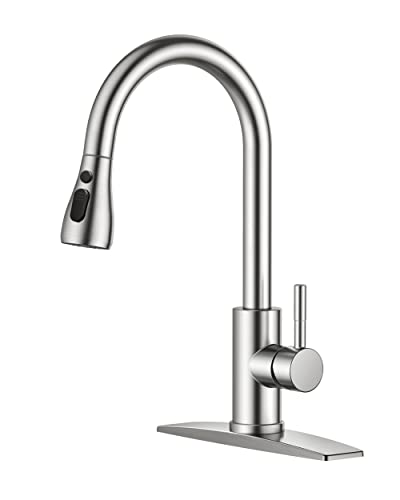
- FORIOUS Kitchen Faucet with Pull Down Sprayer — Best Simple Upkeep. Check on Amazon for the current listing details.
- Moen Essie Pulldown Kitchen Faucet 87014SRS — Best Finish That Hides Wear. Check on Amazon for the current listing details.
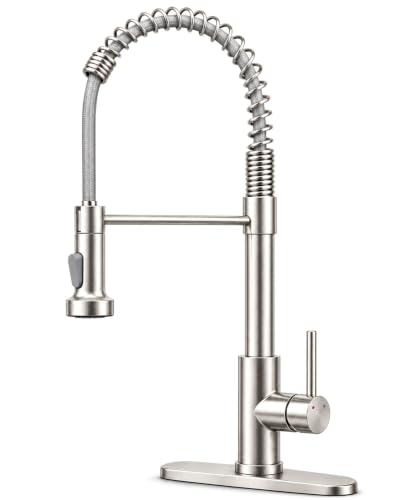
- OWOFAN Kitchen Faucet with Pull Down Sprayer — Best Serviceable Design. Check on Amazon for the current listing details.
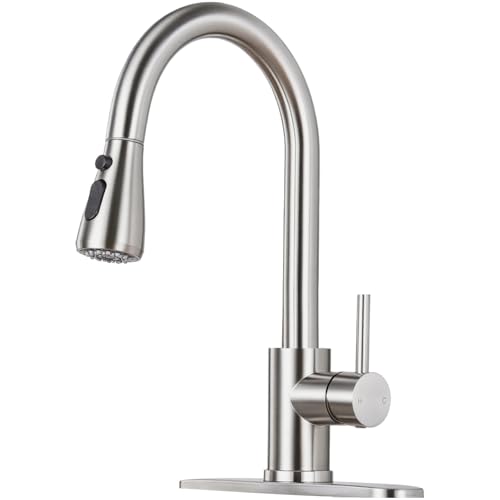
- WEWE Pull-Down Kitchen Faucet — Best Easy-Clean Spray Head. Check on Amazon for the current listing details.
- LUFG Brushed Nickel Kitchen Faucet — Best All-Round Low Effort. Check on Amazon for the current listing details.
- Moen Adler Pulldown Kitchen Faucet 87233SRS — Best Traditional Low Effort. Check on Amazon for the current listing details.
Read the full guide ↓ for the five maintenance jobs every faucet eventually demands, which designs make each one trivial, and the honest upkeep price of the one sculptural exception.
The best low maintenance kitchen faucets are chosen by a different question than most guides ask. Not “what can it do?” but “what will it ask of me?” Every faucet makes five recurring demands: keeping the spray face free of mineral scale, keeping the finish presentable, keeping the cartridge sealing crisply, keeping the hose retracting smoothly, and keeping the base and deck dry and clean. A low maintenance faucet is one where each of those jobs is either rare, trivial, or — best of all — designed out of existence. Silicone nozzles you descale with a fingertip. A finish that hides spots instead of displaying them. A ceramic cartridge that goes years without a thought. A silhouette with no crevice where grease and water conspire. None of this is glamorous, and all of it decides whether your faucet feels like an appliance or a chore.
The six verified picks below are graded on that basis, feature by feature, with the evidence drawn from their listings: easy-clean nozzles named outright, spot-resist finish engineering, ceramic cartridges, stainless bodies that shrug off the under-sink environment, and — in one case — an exposed-spring design whose serviceability is excellent but whose coils honestly ask for a regular wipe, a trade the review states plainly rather than smoothing over. Low maintenance does not mean no maintenance, and this guide will also give you the small routine that keeps any of these faucets at its best: minutes a month, not hours.
If you have lived with a high-maintenance faucet — the polished chrome that spotted if you looked at it, the spray head that needed a vinegar bath and a pin every month, the handle that loosened on a schedule — you already know the stakes. The difference between the best and worst designs in this category is not visible in a showroom. It is visible in your calendar. Readers weighing upkeep against purchase cost will find the money side of the same argument in Best Low Cost Kitchen Faucets.
Key Takeaways
- Rub-clean silicone nozzles are the single biggest maintenance saver in hard-water homes — descaling becomes a fingertip job.
- Brushed nickel and Spot Resist finishes hide the daily evidence; polished finishes turn wiping into a hobby.
- Ceramic cartridges minimise the drip-and-repair cycle; named cartridges in a listing are a maintenance feature.
- Smooth, crevice-free silhouettes clean in one wipe; exposed springs look superb and ask for a deliberate grease routine.
- Single-handle designs halve the seals, handles and parts to maintain versus two-handle layouts.
- A five-minute monthly routine — wipe the base, rub the nozzles, glance under the sink — keeps any pick here at its best.
In this guide
Quick Picks
| Pick | Badge | Maintenance headline | Amazon |
|---|---|---|---|
| FORIOUS Pull Down | Best Simple Upkeep | Standard layout, few mechanisms, nothing exotic to service | Check on Amazon |
| Moen Essie | Best Finish That Hides Wear | Spot Resist stainless shrugs off fingerprints and water marks | Check on Amazon |
| OWOFAN Spring | Best Serviceable Design | Exposed parts are visible and reachable; coils need a grease wipe | Check on Amazon |
| WEWE Updated | Best Easy-Clean Spray Head | Easy-clean nozzles, ceramic cartridge, tool-free install | Check on Amazon |
| LUFG | Best All-Round Low Effort | Easy-clean class design, 3 modes, sealed deck-plate fit | Check on Amazon |
| Moen Adler | Best Traditional Low Effort | Spot Resist finish and soft, wipe-friendly curves | Check on Amazon |
Badges stay consistent through the detailed reviews. If your low-maintenance brief is really about the faucet’s physical footprint and daily visual calm, Best Low Profile Kitchen Faucets covers the neighbouring ground.
How These Picks Were Chosen
The six picks were drawn from a verified pool checked against Amazon’s catalogue data on 2026-11-20, and screened on maintenance evidence rather than on feature count. The screen asked five questions of each listing. Does the spray face fight scale — silicone or easy-clean nozzles named? Does the finish forgive — brushed or spot-resistant rather than polished? Is the cartridge the long-life ceramic type, and is it named? Is the body stainless, so the under-sink years do not corrode the mounting? And is the silhouette cleanable in a wipe, without a thicket of joints, buttons and crevices at the splash zone? Models scored across those questions; the OWOFAN’s spring, the one design that concedes ground on the last question, is included deliberately and graded honestly, because its openness makes every other maintenance job easier and some households will rationally take that trade.
This is a research-led guide, not a year-long soak test. Maintenance judgements rest on the documented features above and on the category’s well-known behaviour — how scale forms, how finishes age, how cartridges wear — rather than on invented test results. Where a listing is silent on a point, the review does not credit the feature. That discipline is why the two Moen picks, whose listings in the verified data are comparatively terse, earn their places on the strength of the one maintenance feature their listings do document — the Spot Resist finish — plus the serviceability that comes with a legacy brand’s parts network, which is a maintenance fact in its own right.
One scope note: low maintenance in this guide means low effort for the owner, across cleaning, descaling, adjustment and repair. It does not mean the faucet needs no attention at all — no plumbed appliance earns that claim honestly — and the how-to section gives the minimal routine that the phrase should actually imply.
The 6 Best Low Maintenance Kitchen Faucets, Reviewed in Detail

FORIOUS Kitchen Faucet with Pull Down Sprayer
Badge: Best Simple Upkeep
Strengths
- A completely conventional layout: every part is standard, every service routine is the textbook one.
- Smooth high-arc silhouette with no crevices at the splash zone — one wipe cleans it.
- Deck plate seals the base across 1- or 3-hole sinks, keeping water out of the mounting.
Trade-offs
- No rub-clean nozzle system is named in the listing, so descaling follows the classic soak method.
- The listing names fewer internals than the WEWE or LUFG listings.
- Brushed nickel forgives a lot, but it is not a spot-resist engineered finish.
Mini spec box: Material: stainless steel · Finish: brushed nickel · Handle: single · Fit: 1- or 3-hole with deck plate · Settings listed: farmhouse, camper, laundry, RV, bar
The FORIOUS makes its maintenance case the old-fashioned way: there is very little to maintain. A single handle, a smooth arc, a standard wand, a sealed deck — the design contains no sensor to feed, no spring to degrease, no novelty mechanism with its own care instructions. For second sinks, rentals, campers and laundry rooms — the settings its listing names — that absence of agenda is precisely the virtue. Anyone who has maintained a property knows the best fixture is the one that never generates a conversation.
The upkeep it does ask for is the standard liturgy, easily done: wipe the base, soak the aerator when the stream wanders, keep the hose loop clear. The honest limitation is descaling technology — with no silicone nozzle system named, hard-water owners will use the vinegar-soak routine on the spray face rather than the fingertip rub the WEWE and LUFG picks allow. In soft-water districts that difference nearly vanishes; in hard-water districts it is the reason to rank this pick below them despite its simplicity.
Best for: rentals, second sinks and anyone who wants textbook-standard upkeep / Not suited for: hard-water homes wanting rub-clean nozzles
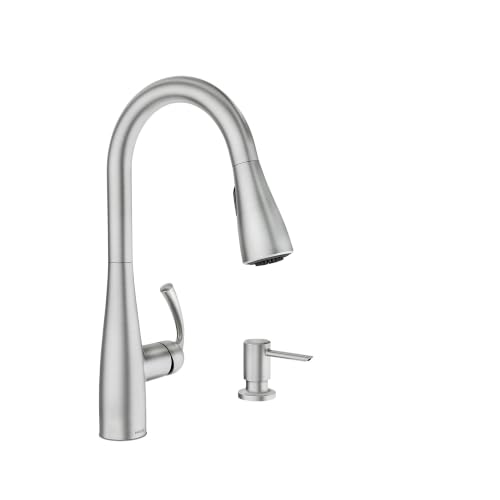
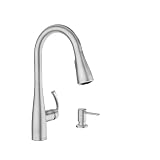
Moen Essie Pulldown Kitchen Faucet, Spot Resist Stainless (87014SRS)
Badge: Best Finish That Hides Wear
Strengths
- Spot Resist stainless is engineered against fingerprints and water spots — the two things owners actually wipe, daily.
- Moen’s parts network means the rare maintenance event is a small part, not a replacement faucet.
- A smooth, conservative silhouette with nothing to trap grime.
Trade-offs
- A higher tier than the direct-sale picks here.
- The verified listing data is terse; no easy-clean nozzle system is documented for this model here.
- Spot resist reduces wiping; it does not repeal the laws of limescale at the spray face.
Mini spec box: Brand model: Essie 87014SRS · Finish: Spot Resist stainless · Style: single-handle pulldown
Ask owners what faucet maintenance actually fills their weeks and the answer is not cartridges or hoses — it is wiping. Water spots after every use, fingerprints around the handle, the faint tide-mark at the base. The Essie’s Spot Resist finish is aimed squarely at that daily reality: a surface engineered to resist the marks, so the faucet looks kept on the days nobody kept it. In a busy household that single property can be worth more than every other maintenance feature in this guide combined, because it operates every day rather than every season.
The second maintenance asset is invisible until needed: Moen’s support ecosystem. When a cartridge eventually wants replacing, the part, the diagram and the instructions exist, and any plumber knows the model family. Maintenance burden is not only frequency; it is also the size of the job when it comes, and the Essie keeps that job small. The honest limitations are its tier and the undocumented nozzle story in the verified data — hard-water owners should plan on the standard aerator soak as part of ownership.
Best for: busy households whose real enemy is daily wiping / Not suited for: minimum budgets or buyers wanting documented rub-clean nozzles

OWOFAN Kitchen Faucet with Pull Down Sprayer
Badge: Best Serviceable Design
Strengths
- Everything is visible: the hose path, the spring, the connections — inspection takes seconds and nothing festers unseen.
- Lead-free NSF certified stainless construction shrugs off the under-sink environment.
- Deck plate included, sealing the base on 1- or 3-hole decks.
Trade-offs
- The spring’s coils collect cooking grease film and need a deliberate monthly wipe — the one real chore in this guide.
- The open structure shows dust and splashes that a smooth gooseneck hides.
- Tall profile needs clearance, as spring designs do.
Mini spec box: Material: lead-free stainless steel, NSF certified · Style: single-handle spring pull-down · Fit: 1- or 3-hole with deck plate · Settings listed: farmhouse, RV, bar, laundry
The OWOFAN is this guide’s honest trade, and it is included because the trade is genuinely worth considering. On serviceability it is the best design here: no hidden hose ageing invisibly inside an arc, no dock you cannot inspect, no connection you cannot reach. A weeping fitting announces itself immediately instead of soaking a cabinet floor for a season. Owners who do their own maintenance — the flashlight-and-towel school — will find every job on this faucet shorter than on any sealed design.
Against that, the spring asks for the one recurring cosmetic chore in the group: airborne cooking grease settles in the coils, and in a heavy-frying household the spring needs a monthly pass with a degreasing cloth to stay handsome. That is minutes, not hours, but it is minutes the other five picks do not demand, and this review will not pretend otherwise. Choose the OWOFAN if you value inspectability over wipe-and-forget; choose the WEWE or LUFG if the reverse. Either is a rational reading of “low maintenance” — they simply locate the effort in different places.
Best for: DIY-minded owners who inspect their plumbing and cook seriously / Not suited for: buyers who want a literally wipe-free silhouette

WEWE Pull-Down Kitchen Faucet (Updated Model)
Badge: Best Easy-Clean Spray Head
Strengths
- Easy-clean nozzles: scale is removed with a fingertip rub, no soaking, no pins, no disassembly.
- Ceramic cartridge — the fit-and-forget valve technology.
- Tool-free installation and braided supply hoses start ownership with zero special tools and no tired lines.
Trade-offs
- Single-hole fit only, so some sinks need a plate plan or a different pick.
- Rub-clean nozzles still need the rub — monthly in hard water — even if it takes ten seconds.
- Two similar WEWE models circulate; order by exact ASIN.
Mini spec box: Body: SUS 304 stainless steel · Cartridge: ceramic · Fit: 1-hole · Swivel: 360° · Supply hoses: 304 braided · Install: tool-free
If one feature could be voted the emblem of low maintenance faucet design, it is the rub-clean nozzle, and this WEWE wears it in a compact, single-hole package. Mineral scale is the most frequent maintenance event at any kitchen sink in hard-water country; converting it from a soak-and-scrub session into a gesture you perform while waiting for the kettle changes the owner’s entire relationship with the chore — which is to say, the chore gets done, on time, before the spray pattern ever degrades.
The rest of the specification continues the theme. A ceramic cartridge removes the drip-watch that washer designs impose. Braided supply hoses in the box remove the temptation to reuse ageing lines. Tool-free installation removes the last excuse for a slightly crooked mount that would collect water at one side of the base forever. The honest limitations are fit — single-hole only — and the small truth that easy-clean still means clean occasionally. Among the six, this is the pick that asks the least of its owner per month.
Best for: hard-water homes and compact kitchens wanting the lightest routine in the guide / Not suited for: 3-hole sinks without a deck plate plan
LUFG Brushed Nickel Kitchen Faucet with Pull Down Sprayer
Badge: Best All-Round Low Effort
Strengths
- A balanced modern specification — SUS 304 body, three spray modes, full swivel — in a smooth, wipe-clean silhouette.
- Deck plate included: the base seals properly on either hole pattern, keeping water out of the mounting from day one.
- Certified waterways (NSF372, NSF61, cUPC) signal tested internals that age predictably.
Trade-offs
- Brushed nickel forgives spots well but lacks the Moen picks’ engineered spot-resist surface.
- Three spray modes mean a selector on the wand to keep rinsed in greasy kitchens.
- The brand’s long-term parts story is shorter than Moen’s.
Mini spec box: Material: SUS 304 stainless steel · Handle: single · Spray modes: 3 · Swivel: 360° · Fit: deck plate included · Certifications: NSF372, NSF61, cUPC
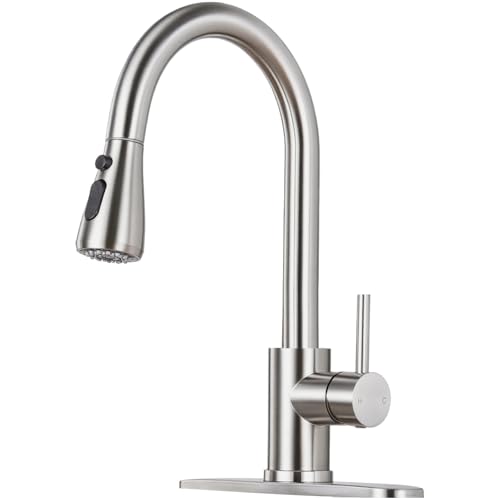
The LUFG is the pick with no maintenance argument against it. Its silhouette is smooth where grease lands, its base is sealed by the included deck plate, its body is the corrosion-proof grade of stainless, and its certifications indicate internals that were tested rather than merely assembled. Nothing about owning it requires a system, a schedule taped inside a cabinet door, or a tolerance for visible grime. It is the faucet for the household that wants to think about its faucet approximately never.
Its three spray modes deserve a maintenance note of their own: mode selectors on wands live in the splash zone, and a quick rinse of the wand during washing-up keeps the selector moving freely — a two-second habit that this guide recommends for every multi-mode pick. The honest limitations are comparative rather than absolute: the finish is forgiving rather than engineered spot-resistance, and the parts network behind it is a seller’s, not Moen’s. Balanced against the whole field, the LUFG is the lowest-effort all-rounder, and for many kitchens that is the correct superlative. The durability-first reading of the same model appears in Best Long Lasting Kitchen Pull Out Faucets, where its certification stack gets the lifespan treatment.
Best for: most households — the lowest-effort complete package here / Not suited for: buyers who prioritise a legacy brand’s parts counter

Moen Adler Pulldown Kitchen Faucet, Spot Resist Stainless (87233SRS)
Badge: Best Traditional Low Effort
Strengths
- Spot Resist stainless keeps a traditional silhouette looking kept with minimal wiping.
- Soft curves have no ledges or crevice lines for grime to colonise.
- Moen’s parts and support network keeps the rare repair small and standard.
Trade-offs
- A higher brand tier than the direct-sale picks.
- No easy-clean nozzle system is documented in the verified data for this model.
- The gentle traditional styling will not sharpen a contemporary kitchen.
Mini spec box: Brand model: Adler 87233SRS · Finish: Spot Resist stainless · Style: single-handle pulldown
The Adler brings the Essie’s two maintenance assets — the spot-resisting finish and the legacy parts network — to kitchens styled traditionally, where the WEWE and LUFG’s modern lines might look like visitors. Its soft curves are a cleaning feature in disguise: grime accumulates at edges, ledges and seams, and a faucet drawn in continuous swells offers it almost nowhere to start. A single wipe travels the whole body without changing cloth angle once.
In service, the Adler asks for the standard routine and nothing exotic: base wiped with the counters, aerator soaked when hard water demands, and the confidence that a cartridge, if ever needed, is a catalogue item rather than a research project. The honest limitations mirror the Essie’s — brand tier, and no documented rub-clean nozzle system in the verified data — plus a styling commitment to traditional rooms. For the household that wants low effort without a modern object at the sink, this is the guide’s answer.
Best for: traditional kitchens wanting Moen support and a forgiving finish / Not suited for: contemporary schemes or minimum spend

Comparison Table
| Pick | Descaling | Finish behaviour | Service story | Amazon |
|---|---|---|---|---|
| FORIOUS | Classic aerator soak | Brushed nickel, forgiving | Fully standard parts layout | Check on Amazon |
| Moen Essie | Standard aerator care | Spot Resist stainless | Deepest parts network | Check on Amazon |
| OWOFAN Spring | Visible head, easy inspection | Brushed nickel; coils need grease wipe | Most serviceable design | Check on Amazon |
| WEWE Updated | Rub-clean nozzles | Brushed nickel | Ceramic cartridge, tool-free install | Check on Amazon |
| LUFG | Easy-clean class design | Brushed nickel | Certified internals, sealed base | Check on Amazon |
| Moen Adler | Standard aerator care | Spot Resist stainless | Deepest parts network | Check on Amazon |
How to Choose a Low Maintenance Kitchen Faucet
Shop by chore, not by feature list. Write down the five jobs — descaling the spray face, wiping the finish, keeping the cartridge sealed, keeping the hose travelling, keeping the base dry — and interrogate every candidate against each one. For descaling, the answer you want is silicone or easy-clean nozzles, named in the listing; anything else means the soak routine, which is fine if your water is soft and a sentence against the faucet if it is not. For the finish, brushed and spot-resist surfaces forgive; polished surfaces appoint you their full-time polisher. For the cartridge, ceramic and named beats anonymous every time. For the hose, look for adequate length and think about your under-sink geography: a clear loop is a maintenance feature. For the base, a deck plate that seals the footprint and a silhouette without a water-trapping collar are the quiet heroes.
Then be honest about your household’s two variables: water hardness and cleaning temperament. Hard water multiplies every descaling difference between designs, so it should push you toward the rub-clean picks — the WEWE updated model and its easy-clean classmates — even at a small premium of attention elsewhere. Cleaning temperament cuts the other way: a household that genuinely wipes the spring of an OWOFAN monthly can enjoy the most serviceable design in the guide, while a household that will not should not buy a chore it plans to resent. The cheapest maintenance is the kind matched to the people performing it.
Finally, count the mechanisms. Each added system — sensor, spring, multi-mode selector — brings a care line of its own. None of the picks here is overloaded, but the principle scales: the FORIOUS’s near-empty mechanism list is a legitimate specification, and for some homes it outranks every feature in this guide. Low maintenance is not the absence of quality; it is quality measured in the owner’s time. Readers applying the same time-first logic to water use will find it continued in Best Low Flow Kitchen Faucets.
The Low Maintenance Routine: How to Keep Any of These Faucets at Its Best
Here is the entire routine this guide recommends, and its brevity is the point. Weekly, or whenever you wipe the counters: wipe the faucet body and base with the same cloth, and rub the spray nozzles with a fingertip if your model has silicone or easy-clean nozzles. Monthly: run the wand in and out a few times and glance under the sink with a flashlight — hose loop clear, fittings dry, counterweight travelling freely; if you own the OWOFAN, give the spring its degreasing wipe during the same visit. Quarterly, or when the stream starts to wander: remove the aerator, rinse its screens, soak in vinegar if scale shows, and refit. Yearly: operate the shutoff valves once so they do not seize, and confirm the handle still shuts off crisply with no after-drip.
That is roughly five minutes a month, and it is the difference between a faucet that ages in dog years and one that simply matures. Two prohibitions protect the finish throughout: no abrasive pads, and no bleach-based sprays left sitting on the surface. Warm water, a microfibre cloth and an occasional mild detergent do everything else.
Troubleshooting pattern: Problem: the spray splays sideways → scale in the nozzles; rub them clean or soak the head before suspecting damage. Problem: a drip develops long after shutoff → the cartridge is announcing wear; on the named-cartridge picks here it is a replaceable part, not a replacement faucet. Problem: the wand retracts reluctantly → the hose loop is snagged or the weight has shifted; clear the under-sink path first, because it is almost never the hose itself.
Hard Water: The Variable That Rewrites Every Maintenance Claim
Every statement in this guide has an asterisk shaped like your postcode’s water report. In soft-water homes, the differences between these six picks narrow to finish preference and silhouette; even the classic aerator soak becomes a rare event. In hard-water homes, the ranking sharpens dramatically: descaling moves from quarterly to monthly, spray patterns distort faster, and the rub-clean nozzle stops being a convenience and becomes the feature that decides whether the faucet’s owner or the faucet’s scale wins the year. If you do not know your water’s hardness, a simple test strip or your utility’s published report will tell you, and it is worth the small effort before choosing — it changes which pick in this guide is genuinely “lowest maintenance” for your address more than any other fact about you. Households on well water should add sediment to the calculation: a whole-house sediment filter upstream protects every cartridge in the building, and monthly aerator rinses become part of the standing routine rather than a rescue.
Maintenance by Household Type: Who Should Weight What
The right low-maintenance pick depends on who is doing the maintaining, so here is the guide’s ranking translated by household. Busy families with hard water: start at the WEWE updated model, because the chore that will actually recur in your house — descaling — is the one it reduces to a gesture, and its compact body survives the traffic. Keen cooks in soft-water districts: the field opens up; the LUFG’s all-round calm or even the OWOFAN’s serviceable spring become pleasures rather than risks, because your water will not punish any of them weekly. Landlords and property managers: the FORIOUS’s standard-everything design or a Moen for its parts counter, because your maintenance is performed by other people, on a schedule, and standardisation is worth more than any single feature. Older owners and anyone planning to age in place: weight the finish and the handle — spot-resist surfaces that forgive a missed week, single levers that ask little grip, and the knowledge that a cartridge, if it ever calls, is a small booked job rather than an emergency. Second-home and seasonal properties: choose the design that tolerates neglect gracefully — stainless body, ceramic cartridge, nothing electronic to flatten a battery across a closed-up winter — which in this guide means the LUFG or the FORIOUS, winterised with the water off and the aerator left clean.
The Two-Minute Inspection That Prevents the One Big Repair
Almost every expensive faucet story begins as a cheap one that was not looked at. A fitting weeps for months inside a dark cabinet; the particleboard floor swells; by the time the smell arrives, the repair has grown from a washer to a cabinet. The prevention is embarrassingly small and this guide prescribes it for every pick: once a month, when you take out the cleaning products anyway, shine a phone light under the sink and look — really look — at the hose loop, the supply connections and the cabinet floor. Dry is success and takes five seconds to confirm. Damp is a five-minute job today and a four-figure job next season. The OWOFAN’s exposed design makes this inspection easiest of all, which is the deepest sense in which it is a low-maintenance faucet: it makes the owner’s one essential habit effortless. Pair the inspection with the nozzle rub and the base wipe from the routine section, and you have performed, in about two minutes a month, essentially the whole of faucet preventive medicine. Everything else in this guide — finishes, cartridges, nozzles — is about making those two minutes sufficient.
Seasonal and Second Homes: Maintenance When Nobody Is Watching
A faucet in a house that stands empty for weeks has a different maintenance profile from one in daily service, and it is worth a section because so many of these picks are listed for exactly the secondary settings — cabins, RVs, in-law suites, the laundry sink in a snowbird’s winterised home. Standing water and still air are unkind: seals dry and take a set, aerators crust undisturbed, and a slow weep that a daily household would notice in a day can run for a month against a cabinet floor. The defences are procedural and cheap. Before closing a property, run the faucet, wipe it dry, clean the aerator, and — where the climate or the absence demands — shut the water at the main and drain the lines, which converts every seal’s winter from a pressure test into a rest. On reopening, flush before first use and perform the two-minute inspection from the previous section before unpacking a single bag. Designs that tolerate this rhythm best are the mechanically simple, stainless-bodied ones — the FORIOUS and LUFG in this guide — while sensor models ask for their power to be managed as part of the closing routine. Chosen and winterised with that much attention, a low maintenance faucet in a second home stays what it was bought to be: the thing that is never the reason for a phone call.
When Low Maintenance Should Not Win the Argument
Honesty requires a closing counterweight. There are kitchens where upkeep should not lead the decision: the design-led renovation where a statement faucet is the room’s whole point and its owner happily accepts a wiping ritual as the price of theatre; the heritage restoration where period correctness outranks convenience; the professional-grade home kitchen where commercial equipment brings commercial maintenance as a known and accepted term. This guide’s picks were chosen for households that feel otherwise — which is most households, most of the time — but the principle underneath the ranking is the transferable part: know which chore you are buying, in what size, on what schedule, before the faucet is plumbed in. A maintenance burden chosen knowingly is a hobby or a fair price; the same burden discovered afterwards is a grievance. Read the reviews above in that spirit, pick the burden you mind least — or the near-absence of one, in the WEWE’s case — and the phrase “low maintenance” will have meant something real in your kitchen.
The Ten-Year View: What Low Maintenance Owners Actually Report
Project this guide’s routine forward across a decade and the shape of ownership becomes clear. The weekly wipe is a non-event, folded into tidying the counters. The monthly nozzle rub and under-sink glance consume less time across a year than a single trip to buy descaler used to. The quarterly aerator soak is the largest recurring appointment, and on the easy-clean picks even it shrinks toward optional. Somewhere in the middle years a cartridge may ask to be replaced — a booked, parts-level job on every pick here, smallest of all on the two Moens — and the hose, routed clear from day one, is the component most likely to need nothing at all. Total it honestly and a low maintenance faucet costs its owner perhaps an hour a year, against the several hours and low-grade resentment a poorly chosen one extracts. That difference, compounded across the decade and felt every single week, is the real product being sold in this category. The six picks were graded to deliver it — not the absence of care, which no plumbed object can promise, but care reduced to a size that fits inside a life.
A Final Practical Note
When the box arrives, do the one piece of paperwork this guide has recommended in every section: photograph the model label, save the manual where household documents live, and note the install date. Low maintenance is partly a property of the faucet and partly a property of the owner’s filing — the household that can name its cartridge model in year seven experiences a smaller repair than the household excavating its own purchase history. Ten minutes at installation buys that difference outright, and it is the cheapest maintenance in this entire guide.
One More Distinction: Low Maintenance Is Not No Pride
A closing nuance, because the phrase can be misread as an invitation to indifference. The owners who get the most from the picks in this guide are not the ones who ignore their faucets; they are the ones whose attention is well spent — a wipe that keeps a finish handsome, a glance that keeps a cabinet dry, a fingertip that keeps a spray true. Low maintenance design respects that attention by rewarding it completely: every small act of care on these six faucets actually finishes the job it starts. That reciprocity, more than any single feature, is what separates a faucet that feels like a possession from one that feels like a pending task.
Common Buying Mistakes
- Buying polished chrome in a hard-water, low-wipe household. The faucet will work beautifully and look neglected permanently — a maintenance mismatch, not a quality failure.
- Counting features instead of chores. Every mechanism is a care line. The right question is what the faucet will ask of you monthly, not what it can do on day one.
- Ignoring the spray face. Descaling is the most frequent faucet chore in most homes; a listing that names its nozzle system is telling you the chore’s size.
- Assuming brand tier equals low upkeep. Legacy brands win on parts and support; direct-sale brands here win on nozzle technology. Low maintenance has two different champions depending on the job.
- Skipping the base seal. A faucet without a proper deck seal lets water creep into the mounting, creating the one maintenance problem — hidden corrosion — that no routine can wipe away.
- Choosing a sculptural design with a minimalist’s schedule. The spring faucet is superb for owners who will wipe it and a resentment for owners who will not. Match the design to the temperament.
Final Recommendation
For the lightest all-round routine, choose the WEWE Updated: rub-clean nozzles, ceramic cartridge and tool-free installation ask the least of an owner per month. For the best balance of low effort and complete specification, the LUFG is the guide’s all-round recommendation. And if daily wiping is your true enemy, either Moen — the Essie for modern rooms or the Adler for traditional ones — turns the finish itself into the maintenance department. Pick the chore you least mind, then pick the faucet that makes it smallest.
Frequently Asked Questions
What makes a kitchen faucet low maintenance?
Five design properties: a spray face that resists or easily sheds mineral scale, a finish that hides water spots and fingerprints, a ceramic cartridge that seals for years without adjustment, a stainless body that does not corrode in a damp cabinet environment, and a smooth silhouette that cleans in one wipe without crevices for grease. The picks in this guide were screened on exactly those properties, and the detailed reviews show the evidence pick by pick.
How often does a kitchen faucet actually need maintenance?
With a well-chosen model, about five minutes a month: a wipe of the body and base, a fingertip rub of easy-clean nozzles, and a glance under the sink. Quarterly, the aerator wants a rinse or a vinegar soak in hard-water areas. The jobs that frighten people — cartridge replacement, hose issues — are measured in years, not months, on the designs here, and both are parts-level repairs rather than faucet replacements when they do arrive.
Are touchless faucets low maintenance?
They trade one ledger for another. A sensor removes handle wear and keeps the body cleaner, because dirty hands never touch it — a genuine daily saving. In exchange it adds batteries or power management and a sensor surface to keep clean and responsive. Households that cook with messy hands daily usually come out ahead; households that rarely do are often better served by a simple manual design like the FORIOUS or LUFG picks in this guide.
Which finish is easiest to keep looking clean?
Brushed and spot-resistant finishes, by a wide margin. Brushing scatters light so spots and fingerprints lose their contrast, and engineered spot-resist surfaces, like the Moen picks’ here, go further by resisting the marks themselves. Polished chrome is the most demanding common finish, and matte black sits in between — dramatic and modern, but honest owners in hard-water areas should expect a regular wipe to keep it looking deliberate.
Do ceramic cartridges really reduce maintenance?
Yes. The cartridge is the faucet’s main wear part, and ceramic disc designs resist the scoring and washer-hardening that make older valve types drip and need attention. A named ceramic cartridge in a listing — as in the WEWE picks here — is therefore a maintenance specification, not a luxury one. When a ceramic cartridge eventually does wear, it is a single replaceable part, which keeps the rare repair small.
Is a spring faucet a bad idea for low maintenance?
Not inherently — it depends which maintenance you mean. The OWOFAN’s exposed spring makes inspection and servicing easier than any sealed design, because every working part is visible and reachable. Its cost is cosmetic: the coils collect cooking grease and want a monthly degreasing wipe. Owners who value mechanical serviceability over wipe-and-forget looks can rationally choose it; owners who will resent the wipe should choose a smooth silhouette instead.