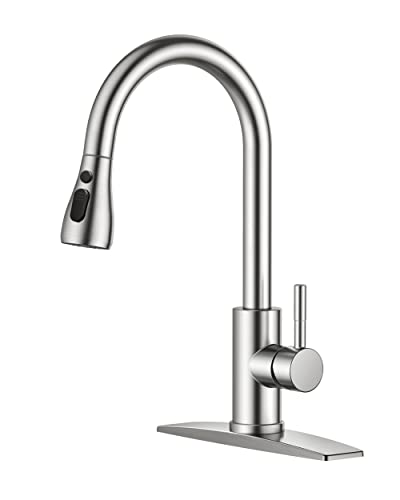
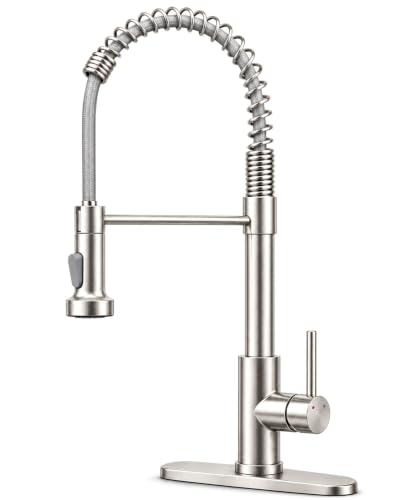
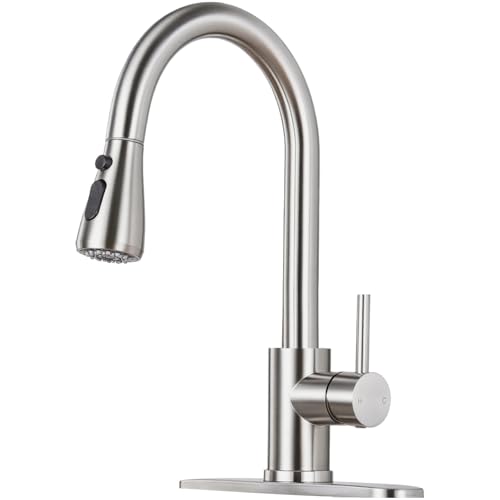
Disclosure: topratedkitchenware.com is reader-supported. When you buy through links on our site, we may earn an affiliate commission from Amazon and other retailers, at no extra cost to you.
Where to buy
Below are the six models assigned to this guide on the best low profile kitchen faucets. Three carry direct Amazon links so you can check the latest price on Amazon and read each listing’s dimension diagram against the space above your sink. Three are reviewed in prose only — no purchase link, no product image — because their own descriptions contradict the low-profile brief: the OWOFAN’s exposed spring is a tall commercial structure, and both the updated WEWE and the FEELSO describe themselves as high arc designs. A low profile guide earns its name by refusing to link tall faucets as short ones, so those models are explained honestly instead.
- OWOFAN Kitchen Faucet with Pull Down Sprayer — reviewed in prose only (exposed spring = tall profile).
- WEWE Pull-Down Kitchen Faucet — reviewed in prose only (listing states High Arc).
- LUFG Brushed Nickel Kitchen Faucet with Pull Down Sprayer — Best Overall Low Profile. Check on Amazon for the current listing details.
- Moen Adler Pulldown Kitchen Faucet 87233SRS — Best Traditional Low Profile. Check on Amazon for the current listing details.
- Lufeidra Kitchen Faucet with Pull-Down Sprayer — Best Farmhouse Low Profile. Check on Amazon for the current listing details.
- FEELSO Kitchen Faucet with Pull Down Sprayer — reviewed in prose only (listing states High Arc).
Read the full guide ↓ for what “profile” really measures — total height, visual bulk and handle travel — and how the three linked designs keep a sink zone calm without giving up the pull-down wand.
The best low profile kitchen faucets are the answer to a room problem, not just a plumbing problem. Profile is the whole object’s presence: how tall it stands, how much visual bulk it carries, how far its handle sweeps, how insistently it occupies the view between you and the window, the room, the garden. Tall goosenecks and spring towers are wonderful where a kitchen has the airspace and the drama to match them. But an enormous share of real sinks live under wall cabinets, in front of low windows, beneath shelves, inside compact apartment kitchens and on islands that face the living room — places where a faucet’s job is to serve the sink without becoming the room’s tallest conversation. Low profile design is for those places, and it is a discipline, not a downgrade: the wand still pulls down, the spray still works, the materials still matter. Only the silhouette is asked to behave.
This guide applies that discipline strictly. Of the six assigned models, three describe themselves — in their makers’ own words — as tall designs, and they are covered in prose with the reason named, because shoppers searching this keyword are precisely the people a tall faucet has already failed once. The three linked picks are genuinely different readings of a restrained profile: a balanced modern LUFG, a soft traditional Moen Adler, and a classic Lufeidra for farmhouse rooms. Each is reviewed for presence as much as for plumbing: how it sits under cabinets, how it reads from across the room, how its handle behaves in a tight sink run.
A vocabulary note, because the searches blur together: profile is the whole object, arc is the spout’s curve. The arc-specific discussion lives in Best Low Arc Kitchen Faucets; this guide is about the total silhouette — body, handle, deck and all — and the kitchens that need it small. If your constraint is a window that opens inward over the sink, a shelf of jars, or simply a room that feels crowded by hardware, you are in the right guide.
Key Takeaways
- Profile means total presence — height, bulk, handle sweep and visual weight — not just the spout’s arc.
- Three assigned models are prose-only because their listings claim high arc or spring structures: the opposite of this brief.
- A pull-down wand removes the functional penalty of a restrained profile; the parked silhouette is low, the working sprayer travels.
- Single-handle, deck-tidy designs keep the whole sink zone calm, which is the point of the category.
- Measure total height and handle travel against your lowest obstruction, and confirm on the listing’s dimension diagram.
- Low profile is also a composition choice: on islands and in open-plan rooms it keeps sightlines clean even with no cabinet above.
In this guide
Quick Picks
| Pick | Badge | Profile note | Amazon |
|---|---|---|---|
| OWOFAN Spring Faucet | Most Serviceable — But Tall | Exposed spring structure; prose-only here | Prose-only in this guide |
| WEWE Updated | Neatest Deck — But High Arc | Listing states High Arc; prose-only here | Prose-only in this guide |
| LUFG | Best Overall Low Profile | Balanced silhouette, deck plate, parks flat via 360° swivel | Check on Amazon |
| Moen Adler | Best Traditional Low Profile | Soft curves read lower than angular designs; Spot Resist finish | Check on Amazon |
| Lufeidra | Best Farmhouse Low Profile | Classic proportions that respect shelves and racks | Check on Amazon |
| FEELSO | Most Elegant — But High Arc | Listing states High Arc; prose-only here | Prose-only in this guide |
The badges repeat in the detailed reviews. Shoppers whose low-profile interest is driven by a tight project budget will find the value angle in Best Low Cost Kitchen Faucets.
How These Picks Were Chosen
The pool was verified against Amazon’s catalogue data on 2026-11-20. The screen for this keyword was applied to each listing’s own description of its geometry. A model was eligible to be linked if nothing in its verified listing data claimed height — no “high arc” language, no exposed-spring structure — and if its overall design read as a standard, composed single-handle pull-down. Three models failed that screen on their own words and were moved to prose-only coverage with the reason printed beside their names: the OWOFAN, whose spring is tall by structural necessity; the updated WEWE, an excellent compact faucet whose listing nonetheless specifies a high arc; and the FEELSO, whose listing leads with its high arc design. Relabelling any of them “low profile” for the convenience of a longer linked list would mislead the exact readers this page serves.
The three survivors were then ranked on presence and practicality together: how completely the silhouette settles under typical obstructions, how the handle travels, how tidy the deck installation is, and whether the internals — stainless bodies, a ceramic cartridge where named, certifications where held — justify keeping the faucet for the long term. A low profile faucet is often bought during a renovation and kept for a decade; the guide treats it that way.
This is a research-led guide. No model was bench-measured for it, and where the verified data does not publish a total height, none is invented here. The guide instead teaches the two measurements that decide fit — deck to obstruction, and handle travel — and directs you to the dimension diagram on each listing, which is where honest numbers for this keyword live.
The 6 Best Low Profile Kitchen Faucets, Reviewed in Detail
OWOFAN Kitchen Faucet with Pull Down Sprayer
Badge: Most Serviceable — But Tall (prose-only)
Strengths
- Lead-free NSF certified stainless construction, with every working part visible and reachable.
- The spring wand’s working sweep is the widest in this pool.
- Deck plate included for 1- or 3-hole decks.
Trade-offs
- An exposed spring stands tall by design — it is the opposite of a low profile.
- Its visual bulk dominates compact sink zones rather than settling into them.
- No purchase link or image in this guide, deliberately.
Mini spec box: Material: lead-free stainless steel, NSF certified · Style: single-handle spring pull-down · Fit: 1- or 3-hole with deck plate
The OWOFAN opens this guide as a boundary marker, and it deserves a fair sentence before the verdict: as a faucet, it is genuinely appealing — certified stainless, a commercial spring action that keen cooks love, and a serviceability no sealed design can match. Its disqualification here is purely geometric. A spring faucet’s height is its mechanism; the coil needs vertical room to flex, sweep and dock, and the resulting silhouette is the tallest in this pool. In a guide for shoppers measuring centimetres under cabinets, linking it would be a betrayal of the brief.
It is covered in prose so that you recognise it when it appears — as it will, prominently — in your own search results for this keyword, and understand that the algorithm matched “kitchen faucet,” not “low profile.” If your measurements come back generous, the OWOFAN is reviewed with links in this site’s design-led and durability-led faucet guides, where tall is a virtue rather than a disqualification. Here, the line is drawn where the keyword draws it.
Best for: readers who measure up and discover a tall, open sink run / Not suited for: the restricted spaces this guide serves
WEWE Pull-Down Kitchen Faucet (Updated Model)
Badge: Neatest Deck — But High Arc (prose-only)
Strengths
- The tidiest deck in the pool: single-hole fit, SUS 304 body, ceramic cartridge, braided supply hoses included.
- Easy-clean nozzles and tool-free installation.
- A compact body that would suit small kitchens beautifully in most respects.
Trade-offs
- Its listing specifies a High Arc design — the spout’s rise contradicts the low-profile brief.
- That arc is exactly what low windows and cabinets reject.
- No purchase link or image in this guide, deliberately.
Mini spec box: Body: SUS 304 stainless steel · Cartridge: ceramic · Fit: 1-hole · Swivel: 360° · Supply hoses: 304 braided · Install: tool-free
This is the hardest exclusion in the guide, and the reasoning deserves to be visible. In almost every respect the updated WEWE is a low-profile shopper’s friend: a compact single-hole body, nothing wasted on the deck, internals that promise a quiet decade. But its own listing describes the spout as a high arc design, and profile is decided by the tallest element, not the average of them. A compact body carrying a high arc is a high-profile faucet where it matters — at the top, where your cabinet lives.
The guide’s rule is that the maker’s own description outranks a reviewer’s optimism. So the WEWE updated model stands here in prose: recommended warmly in this site’s other faucet guides where its arc is an asset — it appears, linked, in the durability and maintenance coverage — and passed over, honestly, in this one. If your obstruction is low and forward rather than directly above the deck, study its dimension diagram; geometry has edge cases. But the default verdict for a strict low-profile brief must be no, and a guide that will not say no to a popular model is not screening at all.
Best for: readers whose obstruction sits forward of the arc’s apex, after a careful diagram check / Not suited for: strict low-clearance briefs
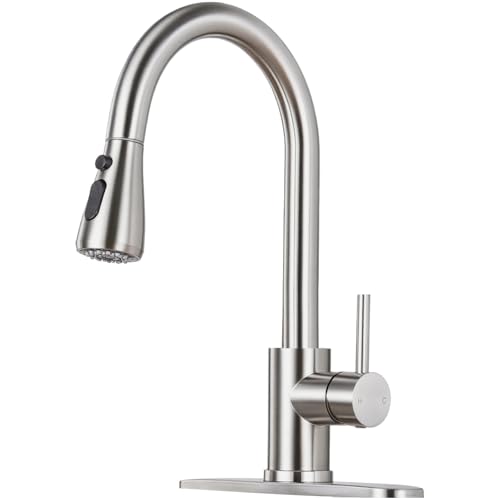
LUFG Brushed Nickel Kitchen Faucet with Pull Down Sprayer
Badge: Best Overall Low Profile
Strengths
- A balanced, composed silhouette with no element claiming extra height or bulk.
- 360-degree swivel parks the spout flat against the backsplash, minimising the working profile further.
- Deck plate included, sealing the base tidily on 1- and 3-hole sinks alike.
Trade-offs
- Balanced is not ultra-low; extreme clearances still deserve a diagram check.
- Three spray modes put a selector on the wand — a small presence in the splash zone.
- Brushed nickel is the finish story in this listing.
Mini spec box: Material: SUS 304 stainless steel · Handle: single · Spray modes: 3 · Swivel: 360° · Fit: deck plate included · Certifications: NSF372, NSF61, cUPC
The LUFG earns the top linked spot by being the faucet nothing in the room has to make allowances for. Its proportions are the composed middle of the category — an arc with manners, a single handle with a modest sweep, a deck presence tidied by the included plate — and in the kitchens this keyword serves, that composure is the entire product. Under a wall cabinet it fits. In front of a window it does not argue with the view. On an island it keeps the horizon clean. It is the rare faucet whose best feature is the absence of incidents.
Nor is the restraint a disguise for weak internals: a 304 stainless body, certified waterways and a three-mode pull-down wand put it on equal working footing with the taller designs it replaces. The swivel deserves emphasis in a profile guide, because a spout that parks flat returns both physical and visual space to a compact sink zone every single day. The honest limitation is degree: if your clearance is truly extreme — a shelf nearly at splashback height — even this balanced design should be verified against its listing’s dimension diagram before ordering. For the broad middle of restricted kitchens, it is the answer.
Best for: cabinet-fronted, window-fronted and island sinks wanting a calm, complete faucet / Not suited for: extreme clearances without a measurement check

Moen Adler Pulldown Kitchen Faucet, Spot Resist Stainless (87233SRS)
Badge: Best Traditional Low Profile
Strengths
- Soft curves read visually lower than angular profiles — the room perceives calm before it measures anything.
- Spot Resist finish keeps the restrained silhouette looking kept without polishing.
- Moen’s parts network supports the installation for the long term.
Trade-offs
- A higher brand tier than the direct-sale linked picks.
- Traditional softness will not satisfy a sharp contemporary scheme.
- Confirm total height on the listing’s diagram; “restrained” is a character, not a number.
Mini spec box: Brand model: Adler 87233SRS · Finish: Spot Resist stainless · Style: single-handle pulldown
Profile is partly a measurement and partly a perception, and the Adler is the pick that understands the perception half. Its continuous curves contain no vertical exclamation — no squared shoulder, no tower, no spring — so the eye slides over it and the sink zone reads as a low, settled arrangement even before a tape measure is consulted. In traditional kitchens, where the faucet must also agree with raised-panel cabinetry and an apron sink, that softness is doing double duty: stylistic belonging and visual humility at once.
The working side is standard Moen competence: a pulldown wand for the tasks a restrained spout delegates, a finish engineered against the spotted look, and the support ecosystem that keeps a decade-old installation serviceable with catalogue parts. The honest limitations are its tier and the standing instruction of this guide — verify the total height figure on the listing against your own obstruction, because no adjective in any review, including “restrained,” is a substitute for your number. Do that five-minute check and the Adler is the traditional kitchen’s low-profile answer.
Best for: traditional kitchens, window-front sinks, buyers who value brand support / Not suited for: minimum budgets or ultra-modern schemes


Lufeidra Kitchen Faucet with Pull-Down Sprayer
Badge: Best Farmhouse Low Profile
Strengths
- Classic proportions drawn for rooms with shelves, racks and low cabinets over the sink.
- SUS304 stainless body and ceramic cartridge — substance under the period line.
- Fits 1- or 3-hole decks, suiting older farmhouse sinks and retrofits.
Trade-offs
- Period styling commits the room’s voice; modern kitchens should choose the LUFG.
- The listing is quieter on spray configuration than the LUFG’s.
- Like all restrained profiles, it leans on its wand for tall vessels.
Mini spec box: Material: SUS304 stainless steel · Cartridge: ceramic · Fit: 1- or 3-hole · Settings listed: kitchen, laundry, RV, bar
Farmhouse kitchens are the low-profile heartland. Their defining furniture — open shelving, plate racks, hanging rails, low beams in the genuine old houses — colonises exactly the airspace a tall faucet wants, and their apron-front sinks push the whole arrangement forward. The Lufeidra’s classic drawing, described by its maker in pot-filler terms, belongs to that world by birth: a composed curve at a neighbourly height, in a brushed finish that agrees with enamel, wood and aged metal alike.
The modernity is underneath, where it should be: a 304 stainless body and ceramic cartridge give the period silhouette a contemporary service life, and the pull-down wand supplies the reach the classic spout shape never had. The honest limitation is stylistic range — this is a voice, and it speaks traditional. In its own rooms, though, it solves the profile problem so naturally that visitors will assume the faucet and the kitchen arrived together, which is the highest compliment a retrofit can earn.
Best for: farmhouse, cottage and traditional kitchens with shelving over an apron sink / Not suited for: contemporary minimalist schemes
FEELSO Kitchen Faucet with Pull Down Sprayer
Badge: Most Elegant — But High Arc (prose-only)
Strengths
- A tall, sweeping arc of genuine grace, in lead-free NSF certified stainless steel.
- Flexible 1- or 3-hole fitting across many settings.
- Single-handle pull-down practicality.
Trade-offs
- Its listing states “High Arc” — height is the design’s whole proposition, and this guide’s brief is the opposite.
- The apex will meet the cabinets and sills that define low-profile shopping.
- No purchase link or image in this guide, deliberately.
Mini spec box: Style: high arc (per listing), single handle · Material: stainless steel, lead-free NSF certified · Fit: 1 or 3 hole
The FEELSO closes the reviews as the second boundary marker, opposite in spirit to the OWOFAN: too tall by elegance rather than by engineering. Its arc is the most graceful line in the pool, and in a tall room — a vaulted ceiling, a high window, an island with pendants — it would be the design pick of the six. But grace at height is still height, and the shoppers for this keyword have usually already measured a gooseneck’s failure against their own cabinet. Linking the FEELSO here would repeat that failure with better prose.
So it stands in prose, with its virtues acknowledged and its geometry decisive. If your tape measure surprises you — if the obstruction you feared turns out to clear a tall arc comfortably — the FEELSO is covered as a linked design piece in this site’s style-led faucet guide, where its line gets the context it deserves. Within this guide’s borders, the three linked picks above are the ones whose silhouettes keep the promise in the title.
Best for: readers whose measurements retire the low-profile requirement / Not suited for: restricted sink runs — this guide’s subject
Comparison Table
| Pick | Profile character | Key features | Fit | Amazon |
|---|---|---|---|---|
| OWOFAN Spring | Tall spring structure | Lead-free NSF certified stainless | 1- or 3-hole, deck plate | Prose-only — tall by design |
| WEWE Updated | High arc (per listing) | SUS 304, ceramic, braided hoses | 1-hole | Prose-only — high arc |
| LUFG | Balanced, composed | 3 modes, 360° swivel, SUS 304 | Deck plate included | Check on Amazon |
| Moen Adler | Soft traditional | Spot Resist stainless, pulldown wand | Single-handle | Check on Amazon |
| Lufeidra | Classic proportions | SUS304, ceramic cartridge | 1- or 3-hole | Check on Amazon |
| FEELSO | High arc (per listing) | Lead-free NSF certified stainless | 1 or 3 hole | Prose-only — high arc |
How to Choose a Low Profile Kitchen Faucet
Measure the whole object, not the brochure adjective. You need three numbers from your kitchen and three from any listing. From your kitchen: deck to the lowest obstruction; the forward distance from the faucet hole to that obstruction’s front edge, because profiles lean; and the handle’s available sweep, tested against your backsplash and any window that opens inward. From the listing’s dimension diagram: total height, outlet height, and spout reach. A candidate passes only if its total height clears your obstruction at the point where the two actually meet — usually the arc’s apex, several inches forward of the deck — with the handle’s full travel also accounted for. This is the arithmetic that excluded half of this guide’s assigned pool, and it takes ten minutes.
Then judge presence, the part numbers cannot settle. Stand where you enter the kitchen and consider the sightline to the sink: a low profile faucet should let the window, the room or the garden hold the view, with the faucet reading as a quiet horizontal accent at the counter line. On islands, apply the same test from the living side. Silhouette language helps here: continuous curves (the Adler, the Lufeidra) read lower than angular or mechanical profiles of similar height, and a spout that parks against the backsplash (the LUFG’s full swivel) shrinks the working profile to almost nothing between uses.
Finally, refuse to trade away the inside for the outside. A low profile bought with a plated body, an unnamed cartridge or a stubby, strained hose is a small faucet that will still fail like a cheap one. The linked picks hold the line — stainless bodies across the three, a ceramic cartridge named on the Lufeidra, certifications on the LUFG — because the households that need low profiles are usually renovating once and living with the result for years. Small should mean considered, never flimsy. The upkeep dimension of the same three picks is graded in Best Low Maintenance Kitchen Faucets.
How to Install a Low Profile Faucet in a Tight Sink Run
The installation sequence is standard, with the dry-fit elevated from courtesy to necessity. First, supplies off, old faucet out, deck cleaned completely. Second — before any tightening — set the new faucet in place and rehearse the geometry: spout through its full swivel, handle through its full travel, wand out to full extension and back to its dock, watching the apex against the cabinet or sill and the handle against the window or splashback throughout. In a tight run this rehearsal is the installation; everything after it is fastening. Third, tighten the mounting evenly, connect the supplies, and route the hose loop with genuine care — in compact cabinets the loop competes with disposals and stored bottles, and a snagged loop will pull the wand’s dock out of true, adding a visible tilt to the profile you bought for its straightness. Fourth, flush with the aerator removed, refit, leak-check with a dry towel, and repeat the check the next day.
Living with the result asks for two habits: park the spout to the side or against the backsplash when the bowl is needed whole, and fill tall vessels with the wand rather than engineering stacks of pots under a spout that was never meant to clear them. Both become automatic within a week.
Troubleshooting pattern: Problem: the faucet clears the cabinet but the handle taps the window → handle travel, not height, is the binding constraint; a few degrees of body rotation within mounting tolerance, or a compact-lever design at replacement, resolves it. Problem: the wand docks at a slight angle and spoils the line → the hose loop is twisted or the counterweight has shifted; re-route under the sink. Problem: the sink zone still feels crowded → audit the deck, not the faucet: dispensers, racks and brushes at the base add more visual bulk than any of the linked silhouettes.
Low Profile on Islands and in Open-Plan Kitchens
The island case deserves its own section because it inverts the usual motive: nothing is above an island sink, yet low profile is often the right specification there. An island faucet is visible from every seat in an open-plan room, across every sightline, in every photograph taken in the space. A tall design plants a permanent vertical in the middle of that shared view and competes with the pendants that were chosen to hold the vertical role. A low profile design keeps the island’s surface reading as one calm plane, lets the cook face the room rather than a piece of hardware, and still — via the wand — does every job the sink exists for. Designers who specify low profiles for islands are not compromising; they are composing. If your island is the household’s social centre, weight this section heavily: the LUFG’s parkable swivel and the Adler’s soft line were practically drawn for it, and the value of the choice compounds every evening the room is used. The design-led treatment of the same sightline question appears in Best Looking Kitchen Faucets.
Low Profile in the Rooms Around the Kitchen
The logic of this guide travels, and the linked picks’ own listings say so — the LUFG and Lufeidra both list bar, laundry and RV settings alongside the kitchen. Those rooms compress even harder than kitchens do: a bar sink under a family-room cabinet, a laundry tub beneath a shelf of bottles, a galley in a van where the ceiling is a rumour. In each, a restrained faucet is not an aesthetic preference but the difference between a fixture that works with the room and one that must be ducked around, and the pull-down wand earns its keep even more, because secondary sinks wash awkward things — paint trays, plant pots, sports kit — that no fixed spout of any height handles gracefully. Standardising on the same finish family as the main kitchen keeps these utility spaces looking intentional, and standardising on standard connections keeps their maintenance in the same toolbox. If the main kitchen takes the LUFG, a bar sink in the same house could do far worse than its own LUFG; if the farmhouse takes the Lufeidra, the laundry inherits its classic calm. Profile discipline, applied house-wide, is simply what a well-planned home looks like from the sink up.
What Low Profile Teaches About the Rest of the Kitchen
There is a reason designers reach for this category early in a renovation rather than as a rescue: a low profile faucet is a commitment device for the whole room’s proportions. Once the sink zone is calm, the eye starts demanding the same discipline elsewhere — pendants hung at a considered height rather than a dramatic one, shelving that stops short of crowding, appliances chosen for fit before theatre. Kitchens designed from that centre tend to age gracefully, because nothing in them was sized to shout over anything else. The three linked picks in this guide each offer a dialect of that calm — modern, traditional, farmhouse — and the three prose-only entries mark the boundary where calm ends. If you take one idea from this page beyond the purchase itself, let it be the measuring habit: objects sized honestly to their spaces, verified against diagrams rather than adjectives. It is the whole of good kitchen design, learned at the sink.
Small-Sink Technique: Getting Full Service from a Restrained Faucet
Owners new to a low profile sometimes undersell their own faucet for a month, working around it with tall-arc habits the design has made unnecessary. The technique reset is short. Fill at the wand, always: the largest pot you own goes in the bowl or on the counter and the hose does the travelling, which is faster than the old lift-and-tilt under a high spout once it becomes reflex. Rinse large flat things — trays, boards, oven racks — by tilting them through the stream at the bowl’s diagonal, where a low spout’s shorter fall actually wets more surface with less ricochet than a high stream bouncing off a flat sheet. Use the swivel as a second pair of hands: spout parked left while the right bowl soaks, spout centred for washing-up, spout flat to the backsplash when the whole sink becomes a workspace for dough or flowers. And let the gentle spray mode be the default register; at low-profile distances it cleans with a calm that full pressure never achieves in a compact bowl. Households that make these four adjustments stop describing their faucet as a compromise within a fortnight — the usual report is that the sink feels bigger, which, in every way that matters at 7 a.m., it is.
Profile and Resale: The Quiet Signal a Restrained Faucet Sends
A final, practical audience for the low profile choice is the future buyer of your home. Estate agents have a phrase for kitchens like the ones this guide serves — “well considered” — and they reach for it when the fittings match the architecture instead of fighting it: a faucet that fits under the cabinets it was given, a deck that looks composed in the listing photographs, hardware whose scale agrees with the room. A towering faucet crammed under a low cabinet reads, in a photograph and in person, as a measurement error the next owner will pay to correct; a restrained, quality faucet in stainless or spot-resist finish reads as money spent by someone careful. None of this should lead the decision — you live in the kitchen, the market merely visits — but it is a genuine secondary dividend of the profile discipline, and it costs nothing beyond the measuring you were already doing. Choose the faucet that fits your room and your decade first; the photograph in some future listing will take care of itself.
The Ten-Year View: Living Small on Purpose
Live with a correctly fitted low profile faucet for a decade and a pattern emerges that no showroom can demonstrate: the faucet never once becomes a topic. It does not block the photograph of the garden through the window. It does not catch the shelf, the sleeve or the eye. Its cartridge, on the picks chosen here, is a mid-life errand rather than a crisis; its finish, wiped with the counters, presents itself adequately in every year; its wand, routed clear at installation, docks in year ten as it did in week one. Owners of tall statement faucets often love them loudly, and good luck to them — but there is a distinct and underrated pleasure in the opposite outcome, a fitting so well matched to its room that it achieves invisibility in service. That is the ten-year promise of the three linked picks in this guide, and it is why the guide guarded its links so strictly: a profile promise is only worth making with faucets whose own descriptions make it too. Measure once, choose honestly, and the smallest faucet in the room may turn out to be the one that serves it longest.
A Final Practical Note
When the box arrives, stage the installation like the geometry rehearsal this guide prescribed: parts laid out, dimension diagram open, tape measure on the counter, and the old faucet’s photograph on your phone for the supply layout. In a tight sink run the dry-fit is the moment the purchase is truly made — spout swung, handle swung, wand docked — and a conflict discovered then costs nothing but a decision. Photograph the model label before the packaging leaves, file the manual with the household documents, and the low profile you chose on paper becomes the low profile that lives, undisturbed and unremarked, above your sink for years. That unremarkable success is the entire ambition of this category, and with the three linked picks here it is an ambition well within a careful hour’s work.
One More Distinction: Low Profile Is Not Low Quality
It is worth saying once, plainly, because the vocabulary of the category invites the confusion: in this guide “low” describes a silhouette, never a standard. The three linked picks carry stainless bodies, certified or ceramic internals where their listings name them, and the full pull-down mechanism of their taller rivals. A small faucet built to a high standard will out-serve a tall faucet built to a low one in every year of its life, and it will do so in the kitchens where the tall one could not be installed at all. Judge the profile by your measurements and the faucet by its materials, in that order, and the category’s name stops sounding like a compromise and starts sounding like what it is — a fit.
Common Buying Mistakes
- Measuring only the spout. Profile is the whole object: body, handle at full travel, and anything mounted on the deck. The tallest moving part makes the rule.
- Trusting search results to respect the phrase. Half this guide’s assigned pool described itself as tall. Algorithms match words loosely; your tape measure must not.
- Sacrificing internals for silhouette. A small faucet with a plated body and anonymous cartridge is still a short-lived faucet. Stainless and named cartridges exist at this profile.
- Forgetting the wand audition. The lower the parked profile, the more the wand does. Reach, docking and swivel deserve the scrutiny the arc’s photograph usually steals.
- Overlooking the deck crowd. A low faucet surrounded by tall dispensers and racks gains nothing. Compose the whole sink zone.
- Assuming low profile suits only small kitchens. Islands and open-plan rooms choose it for sightlines, not clearance. Judge your room, not your square footage.
Final Recommendation
Among the honestly low profiles here, the LUFG is the default recommendation: composed silhouette, sealed deck, full working specification. Traditional rooms should take the Moen Adler, whose curves read lowest of all and whose finish forgives daily life. Farmhouse kitchens with shelving belong to the Lufeidra. Measure the whole object, honour the numbers over the adjectives — including this guide’s — and the low profile you install will be a design decision, not an apology. It will also be, in the experience of most owners who choose this way, the last time the faucet crosses your mind for years at a stretch — which is precisely the point.
Frequently Asked Questions
What does “low profile” mean for a kitchen faucet?
It describes the faucet’s total presence: overall height, visual bulk, handle sweep and deck footprint, taken together. A low profile faucet is designed to sit calmly in restricted or visually sensitive sink zones — under cabinets, in front of low windows, on islands — without dominating the space. There is no regulated threshold, which is why this guide screens listings on their own stated geometry and sends you to dimension diagrams for the deciding numbers.
Why are three models in this guide not linked?
Because their own descriptions contradict the keyword. The OWOFAN’s exposed spring is tall by structural necessity, and both the updated WEWE and the FEELSO are described by their makers as high arc designs. They are good faucets in the wrong category, so the guide reviews them in prose, names the mismatch, and reserves its links for the three models whose stated geometry is genuinely restrained. A low profile guide that linked tall faucets would be advertising, not guidance.
Can a low profile faucet still fill tall pots?
Yes — with its pull-down wand, which is why every linked pick here has one. The wand travels to the pot, in the sink or on the counter beside it, so the parked silhouette never has to clear your tallest cookware. What changes is the ritual: filling becomes a wand job rather than a park-the-pot-under-the-spout job. Most households adapt within days and then prefer it, because the wand also rinses the pot afterwards.
Is low profile a good choice for an island sink?
Often the best choice. Nothing restricts an island faucet’s height, but a tall design interrupts every sightline across an open-plan room and competes with pendant lighting. A low profile keeps the island’s surface calm and lets the cook face the room. All three linked picks suit islands — the LUFG’s spout parks flat, the Adler’s line is soft from every angle, and the Lufeidra suits traditional island cabinetry.
How do I know if a low profile faucet will fit under my cabinets?
Measure from the mounting deck to the underside of the cabinet at the forward point where the faucet’s apex will sit — arches lean toward the bowl, so the critical spot is rarely at the wall. Compare that number with the listing’s published total height, then add the handle’s travel: swing room matters as much as static height. Taping the silhouette on the cabinet front at full size for a day settles any remaining doubt.
Does a low profile faucet splash more or less?
Generally less, in the same sink: the stream falls a shorter distance, so it lands more calmly, which shallow sinks especially appreciate. The exception is technique — full pressure at close range into a shallow bowl will splash from any faucet — and the remedy is built into these picks: use the gentler spray mode for rinsing and let the wand work close to the surface it is cleaning.