Disclosure: topratedkitchenware.com is reader-supported. When you buy through links on our site, we may earn an affiliate commission from Amazon and other retailers, at no extra cost to you.
Where to buy
The picks for the best low arc kitchen faucets are listed below. Four carry direct Amazon links so you can check the latest price on Amazon and confirm dimensions against your cabinet or window clearance. Two models — the FEELSO and the GIMILI — are reviewed in prose only, without purchase links: their own listings describe a high arc and an exposed commercial spring respectively, which are the opposite of the low-arc brief, and this guide does not link a product as “low arc” when its maker describes it as tall. They stay in the guide because shoppers meet them in every search, and you deserve an honest account of why they do not fit this particular brief.
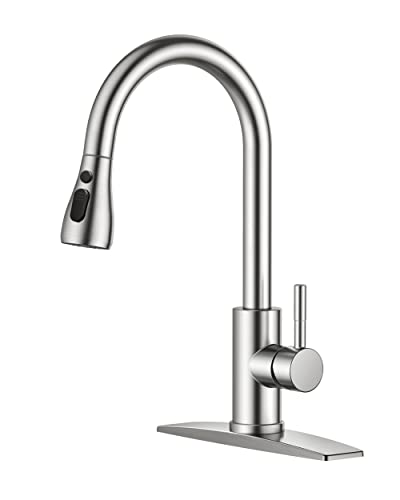
- LUFG Brushed Nickel Kitchen Faucet with Pull Down Sprayer — Best Overall. Check on Amazon for the current listing details.
- Moen Adler Pulldown Kitchen Faucet 87233SRS — Best Soft Traditional Profile. Check on Amazon for the current listing details.
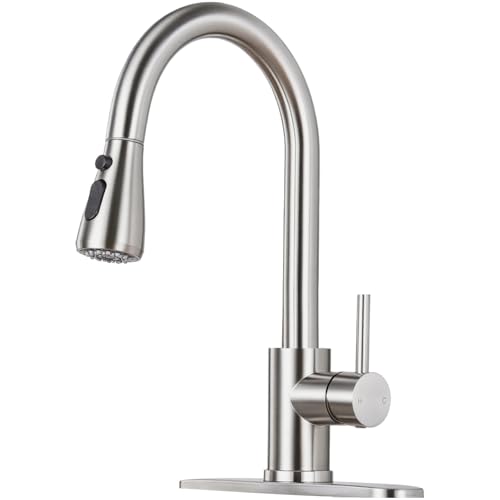
- Lufeidra Kitchen Faucet with Pull-Down Sprayer — Best for Farmhouse Low Clearance. Check on Amazon for the current listing details.
- FEELSO Kitchen Faucet with Pull Down Sprayer — reviewed in prose only (listing states High Arc).
- WEWE Touchless Kitchen Faucet with Soap Dispenser Set — Best Hands-Free Option. Check on Amazon for the current listing details.
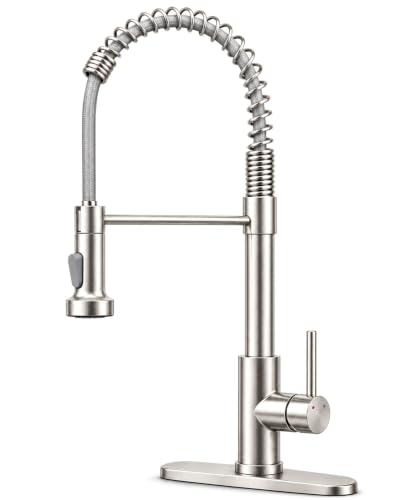
- GIMILI Matte Black Touchless Kitchen Faucet — reviewed in prose only (exposed spring = tall commercial profile).
Read the full guide ↓ for how to measure your clearance properly, how a pull-down wand compensates for a lower arc, and which of these designs suits your sink.
The best low arc kitchen faucets exist because of a measurement most faucet guides mention last: the vertical space above your sink. Standard gooseneck faucets have grown taller for a decade, chasing the dramatic arc that photographs well, and they now collide with real kitchens — the underside of wall cabinets that overhang the sink run, the low sill of a window that opens inward, a shelf, a pendant, or the simple fact that in a small kitchen a towering faucet makes the whole counter feel crowded. A low arc faucet keeps its spout closer to the sink, trading some of that drama for clearance, calmer proportions and, often, less splash, because the water falls a shorter distance into the bowl.
The fear that stops shoppers is pot clearance: if the arc is low, how do you fill a stockpot? The modern answer is the pull-down wand. Every linked pick in this guide pairs its restrained profile with a spray wand that pulls out of the spout, so the fixed arc only has to clear everyday glasses and pans, while the wand travels to the pot wherever the pot sits — in the sink, beside it, or on the counter. Judged that way, the low arc stops being a compromise and becomes a deliberate layout choice, and this guide ranks the options on exactly that basis: profile discipline first, wand usefulness second, build quality throughout.
Two honesty notes before the picks. First, “low arc” is a relative term with no industry standard, so this guide works from what each listing actually states about its own design — and where a listing proudly states the opposite, as the FEELSO’s does, the model is covered in prose without a link rather than relabelled. Second, if your clearance problem is really about overall height rather than the arc itself, the sibling discussion in Best Low Arch Kitchen Faucets approaches the same geometry from the arch-shape angle, and the two guides cross-check each other.
Key Takeaways
- Measure from the counter to the lowest obstruction above the sink before shopping; that single number defines your arc budget.
- A pull-down wand removes the classic low-arc penalty: fixed-arc height matters far less when the sprayer travels to the pot.
- Lower arcs splash less in shallow sinks because the stream falls a shorter distance.
- Two assigned models (FEELSO, GIMILI) are prose-only here because their listings describe high-arc and spring profiles — the opposite of this brief.
- Deck plates and single-handle layouts keep a low-profile installation visually calm and easy to seal.
- Touchless operation, offered by the WEWE set, pairs naturally with low arcs: no tall lever arcs sweeping through your clearance zone.
In this guide
Quick Picks
| Pick | Badge | Profile note | Amazon |
|---|---|---|---|
| LUFG Brushed Nickel Faucet | Best Overall | Balanced arc, deck plate included, 360° swivel parks tight | Check on Amazon |
| Moen Adler 87233SRS | Best Soft Traditional Profile | Gentle curves, Spot Resist stainless, restrained presence | Check on Amazon |
| Lufeidra Pull-Down Faucet | Best for Farmhouse Low Clearance | Classic proportions that sit comfortably under cabinets and shelves | Check on Amazon |
| FEELSO High Arc Faucet | Most Elegant — But Not Low Arc | Listing states High Arc; covered in prose for honesty | Prose-only in this guide |
| WEWE Touchless Set | Best Hands-Free Option | Sensor operation, soap dispenser included, 3-mode sprayer | Check on Amazon |
| GIMILI Spring Touchless | Best Statement — But Tall | Exposed spring is a high commercial profile; covered in prose | Prose-only in this guide |
Badges are repeated in the detailed reviews so each pick is easy to relocate. If your kitchen’s problem is less about height and more about cost of the overall project, Best Low Cost Kitchen Faucets looks at the same category through a budget lens.
How These Picks Were Chosen
The picks come from a verified product pool checked against Amazon’s catalogue data on 2026-11-20. Selection for this keyword applied a profile screen on top of the usual quality screen. The quality screen required a single-handle pull-down design in stainless or brushed nickel from a listing with coherent specifications. The profile screen then asked what the listing itself says about the faucet’s geometry. Models whose listings describe compact, classic or standard proportions were linked. Models whose listings explicitly claim the opposite geometry — a stated high arc, or an exposed commercial spring, which is a tall structure by design — were kept in the guide as prose-only entries with the reason stated, because a shopper comparing low arc options will encounter these popular models and is better served by an explanation than by silence.
This guide is research-led; no faucet was installed and measured on a test bench for it. Where a listing does not publish an exact arc height, the review does not invent one — it describes the profile in the listing’s own terms and tells you which measurement to confirm on the listing’s dimension diagram before ordering. That discipline matters more for this keyword than for most: a low-arc purchase succeeds or fails on a tape measure, not on adjectives.
Within the linked picks, ranking favours designs that compensate best for their lower arc: a wand with useful reach, a swivel that lets the spout park out of the work zone, and spray modes that make rinsing a wide bowl practical without raising the spout. Finish and brand support break ties.
The 6 Best Low Arc Kitchen Faucets, Reviewed in Detail
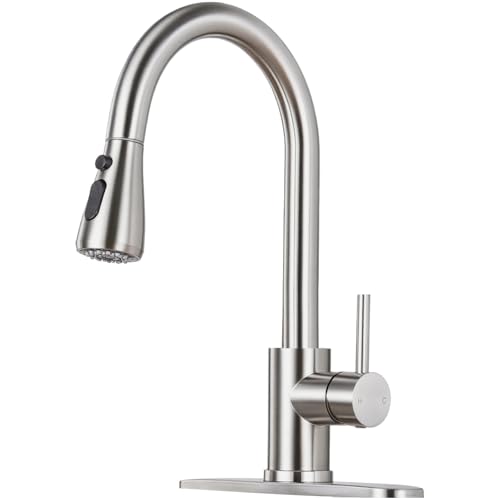
LUFG Brushed Nickel Kitchen Faucet with Pull Down Sprayer
Badge: Best Overall
Strengths
- Balanced, disciplined arc that behaves in cabinet-fronted sink runs where goosenecks loom.
- Deck plate included, so 1- and 3-hole sinks both get a sealed, level base.
- 360-degree swivel lets the spout park flat against the backsplash, returning counter space visually and physically.
Trade-offs
- Its arc is balanced rather than ultra-low; kitchens with extreme clearance limits should confirm the listing’s dimension diagram.
- Three spray modes live in the wand, so mode switching is a wand-in-hand habit.
- Brushed nickel is the finish story here; no darker option in this listing.
Mini spec box: Material: SUS 304 stainless steel · Handle: single · Spray modes: 3 · Swivel: 360° · Fit: deck plate included · Certifications: NSF372, NSF61, cUPC
The LUFG takes the top spot because it understands the assignment: a composed, mid-height arc that does its work without annexing the airspace above the sink. In the most common problem layout — a sink run with wall cabinets above and a worktop that doubles as prep space — that restraint is the difference between a faucet that fits the room and one the room has to accommodate. The SUS 304 body and the certification stack (NSF372, NSF61, cUPC) mean the modest profile is not hiding modest internals.
Daily use is where the swivel earns its keep. Park the spout to one side and the bowl is fully open for a baking tray; swing it back and the wand covers the corners. The honest limitation is one of degree: if your obstruction sits very low — a shelf almost at splashback height — even this balanced arc deserves a tape-measure check against the listing diagram before ordering. For the great majority of cabinet-fronted kitchens, though, this is the low-arc brief answered without drama, and it is also listed for RV, laundry and bar sinks, where ceiling and cabinet clearances are tighter still.
Best for: standard kitchens with cabinets over the sink and anyone wanting one faucet that fits everywhere / Not suited for: extreme low-clearance installs without a dimension check

Moen Adler Pulldown Kitchen Faucet, Spot Resist Stainless (87233SRS)
Badge: Best Soft Traditional Profile
Strengths
- Soft, rounded drawing keeps visual height lower than angular designs of similar reach.
- Spot Resist finish hides the spots that low, light-catching spouts tend to show.
- Moen’s parts network supports the faucet for the long term.
Trade-offs
- A higher brand tier than the direct-sale picks in this guide.
- Traditional softness will not satisfy a sharp contemporary scheme.
- Confirm the listing’s height figure against your own clearance; “restrained” is not a measurement.
Mini spec box: Brand model: Adler 87233SRS · Finish: Spot Resist stainless · Style: single-handle pulldown
The Adler is the traditional kitchen’s answer to the low-arc brief. Its curves do visual work that numbers cannot: a rounded shoulder reads lower and calmer than a squared modern profile of the same physical height, so in a room with a window over the sink — the classic clearance pinch — the Adler feels like it belongs under the sill rather than competing with it. Moen designs this model for the broad middle of American kitchens, and the proportions show that discipline.
Practically, the pulldown wand covers the pot-filling duty that a restrained arc delegates, and the Spot Resist finish keeps the whole arrangement looking kept with minimal wiping — relevant because lower spouts sit closer to splash range. The honest limitation is price positioning and precision: the Adler sits in a higher tier than the LUFG, and because this guide will not invent an arc height the listing does not state in the verified data, your tape measure and the listing’s dimension diagram make the final clearance call. That is a five-minute check, and for a faucet backed by Moen’s support network it is worth doing properly.
Best for: traditional kitchens, window-over-sink layouts, buyers who value brand support / Not suited for: strict budget builds or ultra-modern schemes


Lufeidra Kitchen Faucet with Pull-Down Sprayer
Badge: Best for Farmhouse Low Clearance
Strengths
- Classic proportions sit comfortably under the shelves and cabinets typical of farmhouse kitchens.
- SUS304 stainless body and ceramic cartridge — substance under the period styling.
- Fits 1- or 3-hole decks, suiting older farmhouse sinks and modern retrofits alike.
Trade-offs
- The classic styling is a period choice; stark modern rooms should look elsewhere in this guide.
- Listing detail on spray modes is thinner than the LUFG’s or WEWE’s.
- Like all restrained arcs, it leans on its wand for tall-pot duty.
Mini spec box: Material: SUS304 stainless steel · Cartridge: ceramic · Fit: 1- or 3-hole · Settings listed: kitchen, laundry, RV, bar
Farmhouse kitchens create a specific geometry problem: open shelves or plate racks often sit lower over the sink than standard cabinets, and the apron-front sink pushes the faucet deck forward, changing every angle. The Lufeidra’s classic profile — the maker describes the styling in pot-filler terms — was drawn for exactly that world. It keeps a composed, period-appropriate line at a height that respects shelving, while the pull-down wand supplies the reach that a fixed classic spout never could.
The internals keep the choice honest: a 304 stainless body and ceramic cartridge are the same durability pairing as the modern picks here, so choosing the period look does not mean choosing period plumbing. The honest limitation is aesthetic range and information depth — the styling commits to a traditional room, and the listing says less about its spray configuration than rivals. For the kitchen it was designed for, neither point matters much; for a glass-and-steel kitchen, choose the WEWE touchless below instead.
Best for: farmhouse and cottage kitchens with shelves or cabinets over an apron sink / Not suited for: contemporary minimalist schemes
FEELSO Kitchen Faucet with Pull Down Sprayer
Badge: Most Elegant — But Not Low Arc (prose-only)
Strengths
- A genuinely graceful tall arc, in lead-free NSF certified stainless steel.
- Flexible 1- or 3-hole fitting and a settings list spanning farmhouse, laundry, RV and bar.
- Single-handle simplicity with a pull-down sprayer.
Trade-offs
- Its own listing states “High Arc” — the direct opposite of this guide’s brief.
- That height will collide with exactly the cabinets and sills that bring shoppers to a low-arc guide.
- Covered here without a purchase link or product image, by design.
Mini spec box: Style: high arc (per listing), single handle · Material: stainless steel, lead-free NSF certified · Fit: 1 or 3 hole
This entry exists so the guide stays honest. The FEELSO is a perfectly respectable faucet — certified lead-free waterways, stainless construction, flexible fitting — and it appears in low-arc searches because search engines match “arc,” not “low.” But its listing describes a high arc design, and recommending it with a purchase link inside a low-arc guide would mislead exactly the shoppers this page exists to help: people whose cabinets, shelves or window sills have already rejected a tall faucet once.
If your clearance turns out to be generous after measuring — it happens; many shoppers overestimate the problem — then a tall, elegant arc is a legitimate pleasure, and the FEELSO’s sweeping line is covered in its proper context in the design-led guide to good-looking faucets. Here, the verdict is narrower: for a true low-arc requirement, pass. Treat this entry as the guide keeping its promise that the badge on the page matches the geometry in the listing.
Best for: readers whose measurement check reveals they have clearance for a tall arc after all / Not suited for: any genuinely restricted sink run — which is this guide’s whole brief
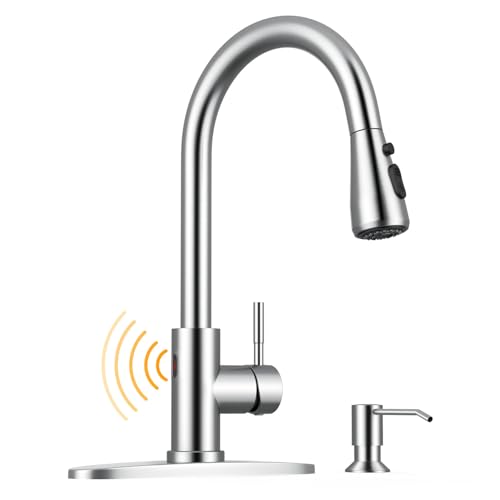
WEWE Touchless Kitchen Faucet with Soap Dispenser Set
Badge: Best Hands-Free Option
Strengths
- Touchless operation removes the tall lever-sweep problem: no handle arc swinging through your clearance zone.
- SUS 304 body, ceramic cartridge and easy-clean nozzles under the technology.
- Included soap dispenser completes the deck in one matched set.
Trade-offs
- Sensor systems add batteries or power management that a manual faucet never asks for.
- The set’s dispenser needs its own hole or deck space — plan the layout.
- Touchless behaviour takes a week of habit-building for the whole household.
Mini spec box: Body: SUS 304 stainless steel · Cartridge: ceramic · Spray: 3-mode sprayer · Swivel: 360° · Fit: 1- or 3-hole · Extras: soap dispenser included
The WEWE touchless set earns its place in a low-arc guide through a side door: handle geometry. On many faucets the tallest moving part is not the spout but the lever at full travel, and in tight sink runs that lever is what kisses the backsplash or the window frame. Sensor operation deletes the problem — a wave starts and stops the water, the handle can sit parked, and the whole installation keeps the calm, low profile this brief is about. The 3-mode sprayer and pull-down hose handle the working side, and the rub-clean nozzles suit hard-water homes.
The included soap dispenser is a small design mercy: one matched object on the deck instead of a mismatched bottle, which matters disproportionately in the compact kitchens that choose low arcs. The honest limitations are the standing ones for touchless technology — power to manage, a sensor zone to learn, and behaviour that can surprise guests. Households that cook with messy hands daily usually convert within a week and never go back; households that entertain a rotating cast of visitors should weigh the guest-learning curve honestly.
Best for: compact kitchens, keen cooks with messy hands, anyone whose lever clearance is the real problem / Not suited for: buyers who want zero electronics at the sink
GIMILI Matte Black Touchless Kitchen Faucet with Spring Pull Down Sprayer
Badge: Best Statement — But Tall (prose-only)
Strengths
- Matte black finish and motion-sensor operation make it the most dramatic design in the assignment pool.
- Spring pull-down gives a wide, commercial-style working sweep.
- Single-hole installation keeps the deck itself simple.
Trade-offs
- An exposed spring is a tall structure by design — it cannot be a low arc faucet.
- The commercial profile will overwhelm the compact kitchens this guide serves.
- Covered here without a purchase link or product image, by design.
Mini spec box: Style: spring pull-down, motion sensor · Finish: matte black · Handle: single · Fit: single hole
The GIMILI is the other honesty entry in this guide, and the reasoning is geometric, not qualitative. An exposed-spring faucet stands tall because the spring is the structure: it needs height to flex, sweep and dock. That makes it a fine choice for a spacious, modern farmhouse sink run with open air above it — and a contradiction in a guide for shoppers measuring centimetres under a cabinet. Its matte black finish and sensor operation are genuinely appealing, and in a kitchen with the airspace to carry it, it would be a protagonist piece.
So why include it at all? Because it will appear in your search results for this keyword, prominently, and a guide that quietly linked it would send some readers a faucet that physically cannot fit their sink run. The prose-only treatment is the guide doing its one job: matching geometry to geometry. If your measurements come back generous, revisit it in a general guide; if they come back tight, the four linked picks above were chosen for exactly your numbers.
Best for: readers who measure up and discover they have room for a statement piece / Not suited for: restricted-clearance sinks — the subject of this guide
Comparison Table
| Pick | Profile | Key features | Fit | Amazon |
|---|---|---|---|---|
| LUFG | Balanced arc | 3 spray modes, 360° swivel, SUS 304 | Deck plate included | Check on Amazon |
| Moen Adler | Soft traditional | Spot Resist stainless, pulldown wand | Single-handle | Check on Amazon |
| Lufeidra | Classic proportions | SUS304, ceramic cartridge | 1- or 3-hole | Check on Amazon |
| FEELSO | High arc (per listing) | Lead-free NSF certified stainless | 1 or 3 hole | Prose-only — not low arc |
| WEWE Touchless | Compact, sensor-run | 3-mode sprayer, soap dispenser set | 1- or 3-hole | Check on Amazon |
| GIMILI Spring | Tall spring profile | Matte black, motion sensor | Single hole | Prose-only — tall by design |
How to Choose a Low Arc Kitchen Faucet
Begin with the tape measure, and take three numbers. First, counter-to-obstruction: from the deck where the faucet will sit to the underside of the lowest cabinet, shelf or window trim directly above the sink. Second, deck-to-sill or deck-to-shelf depth, because a faucet’s arc leans forward as it rises and the highest point is rarely above the mounting hole. Third, your sink’s depth, because arc height and sink depth work as a pair — a low arc over a deep sink is comfortable, while the same arc over a shallow sink can feel like it is pouring onto your wrists. Compare those numbers with the dimension diagram on any listing you shortlist; reputable listings publish one, and this guide deliberately sends you to it rather than guessing heights the verified data does not state.
Then think about what the wand must do. In a low-arc kitchen the pull-down wand is not a bonus feature; it is the mechanism that makes the whole layout work. It should pull smoothly, reach the sink’s corners and ideally let you fill a pot standing on the counter beside the sink for the largest stockpot you own. Spray modes help at low heights specifically: a wide, gentle mode rinses a big bowl without the splash-back that a forceful stream at short distance can cause, while a focused mode still scours. The linked picks all integrate multi-mode sprayers for this reason.
Consider handle travel as part of clearance. A side lever at full swing needs its own airspace, and in window-front sinks it is often the lever, not the spout, that meets the sill. Front-facing or compact levers, and the WEWE’s sensor operation, exist to solve exactly that collision. Finally, weigh splash honestly: lower arcs genuinely reduce splash in shallow sinks, a daily quality-of-life gain that tall-arc owners quietly envy — one of the points where this brief stops being a compromise and starts being a preference. If water economy is also on your list, the aerator and spray discussion in Best Low Flow Kitchen Faucets pairs naturally with a low-arc choice.
How to Install a Low Arc Faucet and Set It Up Well
Installation follows the standard single-handle pattern, with two low-arc-specific checks. First, shut off the supplies, remove the old faucet and clean the deck fully. Second, dry-fit the new faucet with its deck plate if your sink has three holes, and — before tightening anything — swing the handle through its full travel and swivel the spout through its full arc, watching the clearances you measured. This is the moment a conflict is free to fix. Third, mount and tighten evenly, connect the braided or supplied lines, and route the pull-down hose in a clear loop with its counterweight positioned so the wand docks flush. Fourth, flush the line with the aerator removed, refit it, and test the wand’s reach to your largest pot in its real position. Fifth, check for leaks with a dry paper towel at every fitting, and again the following day.
Setup habits for low arcs: park the spout to the side when washing very large items rather than forcing them under the arc; use the wand, not wrist gymnastics, for anything tall; and keep the spray face clean, because at shorter distances a partially scaled nozzle sprays sideways onto the counter instead of down into the bowl.
Troubleshooting pattern: Problem: the handle taps the window or backsplash at full hot → the lever’s travel, not the faucet, is oversized for the gap; rotate the faucet body a few degrees within its mounting tolerance if the design allows, or prioritise a compact-lever or sensor model at replacement time. Problem: water splashes out of a shallow sink → drop to the gentler spray mode and lower the flow at the handle; a low arc plus full pressure is the usual culprit. Problem: the wand feels short for counter-side pots → check the hose loop under the sink for snags before concluding the hose is short; a caught loop steals reach silently.
Low Arc vs Low Profile vs Standard Arc: Clearing Up the Vocabulary
Shoppers meet three overlapping phrases and listings use them loosely, so here is the working distinction this guide applies. “Low arc” describes the spout’s rise: the outlet sits closer to the sink, shortening the water’s fall. “Low profile” describes the whole object’s visual height and bulk, which includes the body, the handle and any spring or sensor housing — the wider topic explored in Best Low Profile Kitchen Faucets. “Low arch” is essentially the low-arc idea described from the shape of the curve rather than the height of the outlet. A faucet can be low arc yet not especially low profile if its body is chunky, and a slim faucet can still carry a high arc. When you measure your space, measure for both: outlet height for splash and pot behaviour, total height for the collision with cabinets and sills. The two prose-only entries in this guide fail the brief on total structure — one by its stated high arc, one by its spring — which is why the distinction is worth the paragraph it takes to explain.
Who Should Not Buy a Low Arc Faucet
Honesty cuts both ways. If your sink run has open air above it, you cook with very tall stockpots weekly, and you love the theatre of a high arc, a low arc faucet will feel like a needless restraint — buy the tall design and enjoy it; the FEELSO’s prose entry above points that way. If your sink is extra deep and your household fills tall vessels at the spout rather than by wand, the fixed-arc height does real work and you will miss it. And if your clearance problem is actually a shallow cabinet that a standard faucet already clears comfortably, you may be solving a problem you do not have. Measure first, then let the numbers, not the search term, assign you to this category or out of it. Shoppers who discover their real priority is upkeep rather than geometry will find their guide at Best Low Maintenance Kitchen Faucets.
Working at a Low Arc Sink: Technique That Makes the Layout Feel Generous
Owners coming from a tall gooseneck sometimes spend their first week with a low arc faucet fighting habits the new geometry does not reward. A short technique reset fixes nearly all of it. Fill tall vessels with the wand, not under the spout: pull the wand down, rest the pot in the bowl or on the counter, and let the hose do the travelling it was designed for. Rinse big trays and boards by angling them through the stream rather than trying to park them flat under the arc; a low spout over a tilted tray actually reaches more of its surface than a high spout over a flat one. Use the swivel as a workspace tool — park the spout over the smaller bowl of a double sink when the big bowl is soaking, and the whole counter feels larger. And modulate the handle: low arcs reward a three-quarter flow for most tasks, reserving full pressure for scouring, which keeps splash near zero and makes the sink feel calm rather than constrained.
There is also a genuine ergonomic dividend that tall-arc guides rarely mention. A lower spout means a shorter reach over the sink for shorter cooks and for children washing hands, and the handle of a compact single-lever design sits closer to the counter’s edge, where a wet hand finds it without stretching across a deep bowl. In households cooking with older family members, that geometry is not a compromise at all — it is the accessible choice, and it pairs well with the lever-free operation of the WEWE touchless set reviewed above. Layouts are only compromises when they fight the people using them; measured and matched properly, the low arc layout fits its households better than the default tall arc ever did.
What to Check on the Listing Before You Order a Low Arc Faucet
Because “low arc” is unregulated vocabulary, the pre-order check is where this purchase is really made. Work through it in order. Find the dimension diagram — not the hero photograph — and read the total height and the spout outlet height as two separate numbers. Compare total height against your counter-to-obstruction measurement with a small margin for the handle’s highest point in its travel. Confirm the hole configuration and whether a deck plate is included or merely compatible; the LUFG includes one, which settles the question for 3-hole sinks. Confirm the wand’s hose behaviour in the listing text — pull-down reach and swivel range, 360 degrees on the LUFG and WEWE picks here, tell you how much of the low arc’s work the wand can take over. Check the supply connections against your shutoff valves so the install does not stall halfway for an adapter. And read the finish name precisely: brushed nickel, spot-resist stainless and matte black all behave differently under your lighting and your water, and the listing’s finish is the one that will arrive. Ten minutes of this checking is the entire difference between a faucet that fits the brief and a return label.
Low Arc Faucets in Open-Plan and Island Kitchens
One layout deserves its own paragraph because it reverses the usual reasoning: the island or peninsula sink in an open-plan room. There, nothing is above the faucet at all — no cabinet, no sill — yet a low arc is often the best-looking and best-living choice. A tall gooseneck on an island becomes a vertical exclamation in the middle of the room’s main sightline, visible from the sofa, the dining table and the door. A low arc keeps the island’s horizon clean, lets pendant lights hold the vertical role alone, and keeps the person washing up visually connected to the room instead of framed behind hardware. Several designers now specify low profiles for island sinks by default for exactly this reason. If that is your layout, the linked picks here serve you directly: the LUFG’s parkable swivel keeps the bowl open for entertaining prep, the WEWE set’s dispenser tidies the island deck that guests see from every side, and the Lufeidra suits the traditional island in a classic kitchen. Clearance brought many readers to this guide; composition may be the reason they stay.
Countertop and Backsplash Pairings That Flatter a Low Arc
Because a low arc faucet sits closer to the surfaces around it, its neighbours influence its look more than a tall faucet’s do. A visually busy backsplash — patterned tile, veined stone — argues for the calmest linked silhouettes, the LUFG or the Adler, whose lines will not compete at close range. A plain slab backsplash, by contrast, gives a low arc room to be the detail, and the Lufeidra’s classic drawing earns its place there. Counter depth matters too: on a shallow counter run, a low arc keeps the sink zone from feeling top-heavy over a narrow worktop, which is why the proportion suits galley kitchens and apartment layouts where every object is near every other object. Even the soap dispenser becomes a proportion decision at this scale — the WEWE set’s matched dispenser is sized to its faucet, a small mercy that mismatched bottle collections never achieve. Treat the sink zone as one composition of faucet, bowl, splashback and objects, and the low arc stops looking like a reduced faucet and starts looking like the correctly scaled one.
Apartment and Condo Kitchens: Where Low Arc Is Often the Only Arc
Renters and condo owners meet a version of this brief with extra rules: the cabinets are not yours to move, the window hardware is fixed, and the sink run was designed by a developer optimising for brochure photographs rather than for the height of a faucet. In those kitchens the low arc is frequently not a preference but the only geometry that installs without a negotiation. The good news from this guide’s linked picks is that the constraint no longer costs function — the LUFG’s swivel and wand, the WEWE set’s sensor, and the Lufeidra’s classic fit all install on standard decks, cover standard hole patterns with their plates, and remove as cleanly as they arrived when the tenancy or the renovation cycle ends. Keep the outgoing faucet, keep the packaging, and the low arc becomes the rare upgrade that is both fully effective and fully reversible.
Common Buying Mistakes
- Shopping the phrase instead of the measurement. “Low arc” has no standard definition; your counter-to-cabinet number is the only definition that matters.
- Forgetting handle travel. Levers collide with sills and splashbacks as often as spouts collide with cabinets. Swing everything before you tighten anything.
- Assuming low arc means weak rinsing. The wand and spray modes do the rinsing; judge those, not the resting height of the spout.
- Linking yourself to a tall faucet from a low-arc search. Search results mix geometries freely — including two models this guide deliberately covers without links.
- Ignoring sink depth. Arc height only means something relative to the bowl beneath it; a deep sink forgives, a shallow sink amplifies.
- Skipping the deck plate decision. On a three-hole sink, the plate is what makes a compact faucet look installed rather than improvised.
Final Recommendation
For most restricted sink runs, start with the LUFG Brushed Nickel Faucet: balanced arc, sealed deck-plate fit and a swivel that parks the spout out of your way. Traditional rooms should look first at the Moen Adler, whose soft profile and spot-resist finish suit window-front sinks beautifully. And if handle clearance is your true constraint, the WEWE Touchless Set removes the lever from the equation entirely. Measure honestly, and a low arc stops being a limitation and becomes the layout that finally fits.
Frequently Asked Questions
What counts as a low arc kitchen faucet?
There is no regulated threshold; the term describes a spout whose outlet sits noticeably closer to the sink than the tall gooseneck designs that dominate showrooms. In practice, treat your own clearance as the definition: a faucet is “low arc” for your kitchen if its full silhouette — spout, body and handle at full travel — fits comfortably under your lowest obstruction with room to work. Always confirm against the listing’s dimension diagram.
Can I still fill a tall stockpot with a low arc faucet?
Yes, with the pull-down wand, which is why every linked pick in this guide has one. The wand travels to the pot — in the sink, or standing on the counter beside it — so the fixed arc never has to clear your tallest cookware. What you give up is filling a tall pot hands-free under a fixed spout; what you gain is clearance, calmer proportions and less splash. Most households find the wand routine becomes automatic within days.
Do low arc faucets splash less?
Generally yes, in the same sink. Splash is largely a function of how far the stream falls and how forcefully it lands, so a shorter fall at the same pressure produces a calmer entry into the bowl — a genuine advantage in shallow sinks. The exception is technique: running a low spout at full pressure into a shallow bowl at close range can still splash, which is why multi-mode sprayers with a gentle setting pair so well with low arcs.
Why are two models in this guide not linked?
Because their own listings contradict the brief. The FEELSO is described by its maker as a high arc faucet, and the GIMILI’s exposed spring is a tall commercial structure by design. Both are legitimate faucets for kitchens with airspace; neither is a low arc faucet. Rather than quietly linking them anyway, the guide reviews them in prose, explains the mismatch, and reserves its links for models whose stated geometry matches the keyword.
Will a low arc faucet look undersized on a large sink?
It can, if the sink is both wide and deep and the room is grand — proportion is a relationship, not a rule. On an oversized farmhouse sink with open space above, a restrained arc may read as timid, and a taller design could be the better composition. The tape test helps: outline the faucet’s silhouette on the wall behind your sink at full size and live with it for a day before deciding.
Are low arc faucets suitable for RV and small-space kitchens?
They are often the best suited of all. Tight ceiling lines, low cabinets and compact sinks are the low arc’s home territory, and several picks here — the LUFG and Lufeidra among them — are listed by their makers for RV, bar and laundry use as well as kitchens. Just confirm supply connections and deck configuration against your vehicle’s or compact sink’s existing setup before ordering.