Disclosure: topratedkitchenware.com is reader-supported. When you buy through links on our site, we may earn an affiliate commission from Amazon and other retailers, at no extra cost to you.
Where to buy
All six picks in this guide to the best low cost kitchen faucets are listed below with direct Amazon links. This site never prints static prices — listings change too often for a printed figure to stay honest — so use the links to check the latest price on Amazon, and judge each faucet by the value logic in its review: what it is made of, what it includes in the box, and how long it is likely to serve before it asks for parts. In a low cost guide, the cheapest number on the day is the least interesting fact about a faucet.
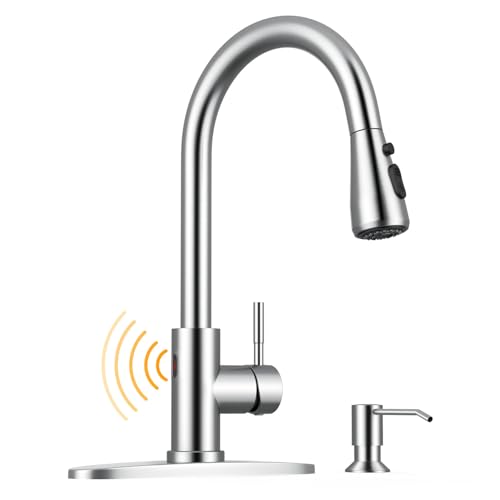
- WEWE Touchless Kitchen Faucet with Soap Dispenser Set — Best Feature Value. Check on Amazon for the current listing details.
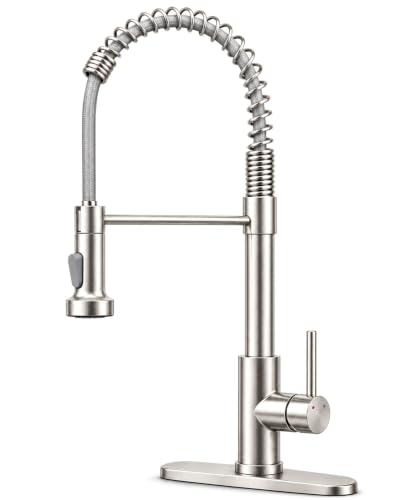
- GIMILI Matte Black Touchless Kitchen Faucet — Best Style Value. Check on Amazon for the current listing details.
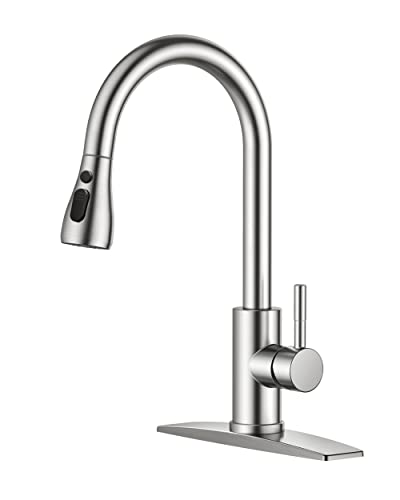
- VFAUOSIT Kitchen Faucet with Pull Down Sprayer — Best Certified Value. Check on Amazon for the current listing details.
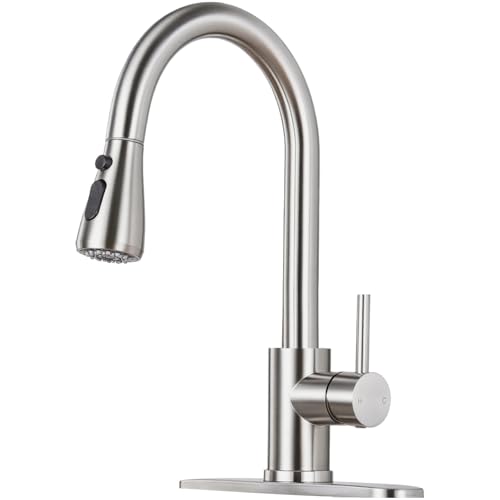
- WEWE High-Arc Pull-Down Kitchen Faucet — Best Overall Value. Check on Amazon for the current listing details.
- FORIOUS Kitchen Faucet with Pull Down Sprayer — Best Budget Classic. Check on Amazon for the current listing details.
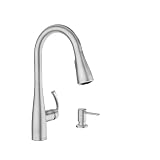
- Moen Essie Pulldown Kitchen Faucet 87014SRS — Best Long-Term Value. Check on Amazon for the current listing details.
Read the full guide ↓ for where money in a faucet actually goes, which corners are safe to cut, and which “savings” turn into a second purchase within two years.
The best low cost kitchen faucets are not the cheapest faucets. That sentence is the whole guide in miniature, because a kitchen faucet is the worst product in the house to buy purely on ticket price: it is plumbed in, it is used dozens of times a day, its failure mode involves water inside your cabinet, and replacing a bad one costs either a plumber’s visit or a Saturday. The intelligent low-cost question is not “what is the smallest number?” but “what is the smallest number that buys stainless or certified construction, a named cartridge, a proper hose, and everything needed for installation in the box?” This guide answers that question with six verified picks, ranked by value logic rather than by headline price — which this site does not print anyway, because a price written into an article is a price that will be wrong soon, and wrong numbers help nobody shop.
What “value” means here, concretely: cost per year of service, not cost per purchase. A faucet in a lower tier that serves eight years is cheaper than a faucet in a bargain tier that drips in year two and is replaced in year three — cheaper in money, in time, and in the small misery of mopping a cabinet. So the reviews below keep returning to the durability signals that predict years: SUS 304 stainless bodies, ceramic cartridges, lead-free certifications, braided supply lines, included deck plates and dispensers that spare you a second purchase. Features that do not predict years — extra spray theatre, novelty finishes — are noted as pleasures, not as value.
Two of the six picks are touchless models, and their presence in a low-cost guide needs one sentence of framing now rather than confusion later: they are not the lowest-tier tickets here, they are the feature-value picks — the least costly way to buy sensor operation from a coherent specification, for households whose cooking style makes hands-free control worth real money. The pure budget end of the guide is the FORIOUS and the two WEWE/VFAUOSIT manual designs. Readers whose low-cost project is really a low-profile project will find the geometry side covered in Best Low Profile Kitchen Faucets.
Key Takeaways
- Judge faucets by cost per year of service: materials and cartridge type predict years; headline price predicts almost nothing.
- SUS 304 stainless bodies and ceramic cartridges appear at value tiers — you do not have to buy premium to buy them, as the WEWE and VFAUOSIT picks prove.
- Box contents are hidden price: an included deck plate, dispenser or braided supply lines can erase a rival’s apparent saving.
- Certifications (NSF 61/372 lead-free, cUPC) are available at the value end and are worth prioritising over cosmetic extras.
- Touchless picks here are feature-value choices, not the cheapest tickets; manual picks carry the pure budget brief.
- A legacy brand like Moen can be the low-cost answer on a ten-year view, because parts availability prevents full replacement.
In this guide
Quick Picks
| Pick | Badge | Value logic | Amazon |
|---|---|---|---|
| WEWE Touchless Set | Best Feature Value | Sensor operation plus included soap dispenser in one box | Check on Amazon |
| GIMILI Spring Touchless | Best Style Value | Matte black statement design with sensor control | Check on Amazon |
| VFAUOSIT Pull Down | Best Certified Value | NSF 61/372 + cUPC, 23 in hose, tool-free install saves a fitting bill | Check on Amazon |
| WEWE High-Arc | Best Overall Value | SUS 304, ceramic cartridge, rub-clean nozzles, years of best-seller history | Check on Amazon |
| FORIOUS Pull Down | Best Budget Classic | Simple stainless classic with deck plate included | Check on Amazon |
| Moen Essie | Best Long-Term Value | Brand parts network stretches service life; Spot Resist finish | Check on Amazon |
Badges repeat in the detailed reviews. If your definition of low cost extends to running costs — water and energy — the efficiency discussion in Best Low Flow Kitchen Faucets is the natural companion read.
How These Picks Were Chosen
The six picks were drawn from a verified pool checked against Amazon’s catalogue data on 2026-11-20. Because this guide’s subject is value, selection weighted the specifications that predict service life and total project cost: body material, cartridge type, certifications, hose and supply-line construction, and included hardware. Models were excluded from the linked picks if their listings offered style without those signals, however attractive the styling. What survived is a deliberately mixed shelf — direct-sale value brands, two sensor models at the accessible end of touchless, and one legacy-brand faucet whose value argument is longevity — because “low cost” means different things to a renter, a landlord and a ten-year homeowner, and the guide serves all three honestly.
One methodological point matters here more than in most guides: no prices are quoted, compared or ranked anywhere in this article, by standing policy. Prices move with promotions, seasons and stock, and a value ranking built on a scraped number rots within weeks. The ranking below is therefore built on the durable facts — what each faucet is, what it includes, what it is likely to cost you in years and in extras — and the live number is left where it belongs, one click away on the listing, current at the moment you actually shop. Treat any guide that prints a confident price table for faucets with suspicion; it is telling you what the market was, not what it is.
This is a research-led guide, not a bench test. Durability judgements rest on materials and named components in the verified listing data and on the category’s well-documented failure modes — worn cartridges, tired hoses, finishes that fail cosmetically long before the plumbing does.
The 6 Best Low Cost Kitchen Faucets, Reviewed in Detail
WEWE Touchless Kitchen Faucet with Soap Dispenser Set
Badge: Best Feature Value
Strengths
- Sensor operation at the accessible end of the touchless market, on a SUS 304 body with a ceramic cartridge.
- The soap dispenser is in the box — a second purchase and a finish-matching problem you do not have.
- Easy-clean nozzles keep hard-water maintenance free of parts and callouts.
Trade-offs
- It is a feature-value pick, not the lowest ticket in this guide.
- Sensors add batteries and a learning curve that manual picks never impose.
- The set wants a deck layout planned around two objects, not one.
Mini spec box: Body: SUS 304 stainless steel · Cartridge: ceramic · Spray: 3-mode sprayer · Swivel: 360° · Fit: 1- or 3-hole · Extras: soap dispenser included
Touchless faucets used to be a premium-tier indulgence. This WEWE set is the evidence that the technology has come down to earth: the sensor sits on the same stainless, ceramic-cartridge platform as the brand’s manual models, and the box includes the soap dispenser that most buyers would otherwise purchase separately and then struggle to match. Priced as a package against buying sensor faucet plus dispenser plus the time to coordinate them, the value case writes itself — for the household that actually wants hands-free operation.
That qualifier matters. If your cooking rarely involves raw chicken, dough or garden hands, the sensor buys you little and the manual WEWE below buys you the same platform for less outlay. The honest limitation of the set is the standing touchless one — power to manage and a sensor zone to learn — plus the discipline of planning a two-object deck. Buy it as a deliberate feature decision and it is the smartest way to own the feature; buy it as a gadget and it is money a manual pick would have saved you.
Best for: keen cooks who want sensor control without entering premium tiers / Not suited for: strict minimum-spend briefs
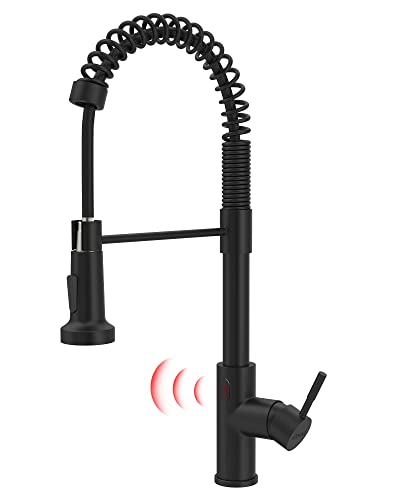
GIMILI Matte Black Touchless Kitchen Faucet with Spring Pull Down Sprayer
Badge: Best Style Value
Strengths
- A matte black, exposed-spring statement design — a look that usually lives in far higher tiers.
- Motion-sensor, hands-free control included in the same specification.
- Single-hole installation keeps fitting simple and cheap.
Trade-offs
- Matte black shows water spots and soap film more readily than brushed nickel; budget a wipe habit.
- The spring profile is tall and theatrical — it will not suit compact or traditional kitchens.
- Like the WEWE set, it is a feature/style value pick rather than the floor price of the category.
Mini spec box: Style: spring pull-down, motion sensor · Finish: matte black · Handle: single · Fit: single hole
The GIMILI is the pick for the renovator whose mood board says “designer” and whose budget says “absolutely not.” Exposed-spring faucets in matte black, with sensor control, are a specification that designer brands sell at multiples of the direct-sale tier; the GIMILI delivers the same visual and functional checklist — spring sweep, dark finish, hands-free operation, single-hole fit — through the value channel. For a kitchen being refreshed around black hardware, it can carry the whole scheme’s look almost single-handedly.
Value honesty requires the maintenance note: matte black is the least forgiving common finish for water spots and dried soap film, and in hard-water homes it asks for a quick wipe routine to keep the drama looking deliberate. There is also less long-run information about the brand than about WEWE or Moen, so keep the model documentation with your household records. Judged as style-per-outlay, though, nothing else in this guide is close — it is the cheapest route to a faucet guests will comment on.
Best for: style-led refreshes on a budget, black-hardware schemes, modern farmhouse kitchens / Not suited for: hard-water homes unwilling to wipe, or compact traditional rooms

VFAUOSIT Kitchen Faucet with Pull Down Sprayer
Badge: Best Certified Value
Strengths
- Lead-free NSF 61/372 and cUPC certification at a value tier — tested waterways without the legacy-brand premium.
- Tool-free installation design can remove a plumber’s fitting fee from the project entirely.
- A 23-inch retractable hose out-reaches most of the category at any tier.
Trade-offs
- A younger brand; long-term parts support is less proven than Moen’s.
- Three spray modes and cold-start logic are features to learn, briefly.
- Tool-free still demands a careful leak check — the saving is the fee, not the diligence.
Mini spec box: Spray modes: 3 · Hose: 23 in retractable · Certifications: NSF 61/372 lead-free, cUPC · Handle: single, cold-start · Install: tool-free design
Total project cost is where the VFAUOSIT makes its case. The faucet itself sits in the value tier; then the savings compound. Tool-free installation, honestly executed with a flashlight and a dry towel, can keep a professional fitting fee out of the project. Certified lead-free waterways mean you are not trading safety for the saving. And the cold-start handle quietly reduces hot-water cycling for every quick rinse, a small daily energy kindness that adds up across years of ownership in a way few faucet features do.
The honest limitation is brand age. WEWE has years of best-seller history and Moen has decades; VFAUOSIT has a strong specification and a shorter record. The mitigation is free: photograph the model label, save the manual, keep the order confirmation. With that file in a drawer, a future cartridge conversation with the seller is a five-minute email instead of an archaeological dig. For buyers comfortable with that small discipline, this is arguably the most specification per unit of money in the entire guide.
Best for: DIY installers and value hunters who want certification without the brand premium / Not suited for: buyers who only purchase legacy brands
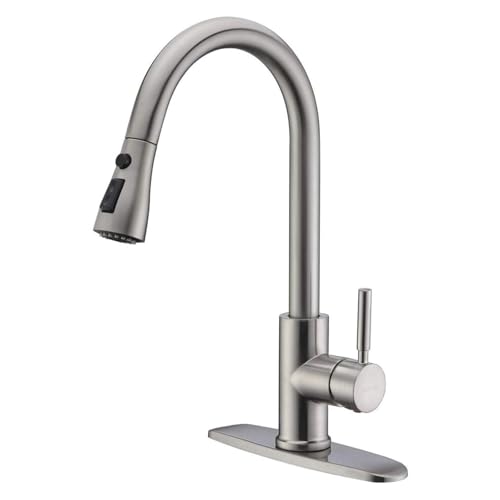
WEWE High-Arc Pull-Down Kitchen Faucet
Badge: Best Overall Value
Strengths
- The complete durability checklist at a value tier: SUS 304 body, ceramic cartridge, silicone rub-clean nozzles.
- 20-inch pull-down reach and 360-degree swivel — full-size working geometry.
- A long best-seller track record, which is itself a value signal: the design’s weaknesses are known and few.
Trade-offs
- The high arc needs overhead clearance; compact kitchens should measure or choose a lower sibling design.
- Brushed nickel is the finish; no dark or warm option in this listing.
- Its popularity means counterfeits and lookalikes exist — buy the exact ASIN from the listing.
Mini spec box: Body: SUS 304 stainless steel · Cartridge: ceramic · Reach: 20 in pull-down · Swivel: 360° · Fit: 1- or 3-hole · Nozzles: soft silicone, rub-clean
If a single faucet had to defend the claim that low cost and long life can coexist, it would be this WEWE. The specification reads like a durability seminar — stainless body, ceramic cartridge, nozzles that descale under a fingertip — yet the model has spent years in the value tier because the brand sells direct and the design is long amortised. That history matters to a value shopper in a specific way: a design sold in large numbers for years has had its failure modes discovered publicly, and this one’s reputation survived the discovery.
In the kitchen it behaves like a faucet from a higher shelf: a proper 20-inch wand reach, a full swivel, three spray modes and a high arc that clears the stockpot. The limitations are fit and finish choice, not quality — measure your overhead space, and accept brushed nickel as the palette. For renters upgrading a landlord’s tired faucet, for landlords fitting a unit they will maintain, and for homeowners who simply refuse to pay brand premiums, this is the guide’s default answer. The value-per-year arithmetic in Best Made Inexpensive Kitchen Faucets reaches a similar conclusion from the build-quality side.
Best for: almost everyone shopping this keyword — the default value recommendation / Not suited for: low-clearance sinks or buyers needing a dark finish

FORIOUS Kitchen Faucet with Pull Down Sprayer
Badge: Best Budget Classic
Strengths
- The classic brief, honestly executed: stainless build, single handle, deck plate in the box.
- Few novelty mechanisms — and every absent feature is a part that cannot fail or be paid for.
- Listed for farmhouse, camper, laundry, RV and bar use, so one model can serve several budget projects.
Trade-offs
- The listing is thinner on named internals than the WEWE or VFAUOSIT listings.
- One finish, one silhouette: flexibility lives in the fitting, not the styling.
- Budget brands reward owners who keep their purchase documentation.
Mini spec box: Material: stainless steel · Finish: brushed nickel · Handle: single · Fit: 1- or 3-hole with deck plate · Settings listed: farmhouse, camper, laundry, RV, bar
The FORIOUS is the floor of this guide, and it is a respectable floor. Where the cheapest faucets in the wider market cut the body material, the cartridge and the hose all at once, the FORIOUS keeps a stainless build and a completely standard single-handle layout, and saves its money on novelty: no sensor, no spring, no designer silhouette. That is the right order of economies for a budget faucet, and it is why this model, rather than an unknown bargain-bin alternative, carries the budget-classic badge.
Its versatility is a budget feature in disguise. A household fitting out a rental, a laundry sink and a camper in the same year can standardise on one model, one cartridge familiarity and one installation routine — the kind of hidden saving that never appears in a price comparison. The honest limitation is information: the listing names fewer internals than the top value picks, so the durability confidence here rests on material and simplicity. Keep the paperwork, install it carefully, and it should repay the modest outlay for years.
Best for: rentals, second sinks, campers and the strictest budgets that still refuse junk / Not suited for: buyers wanting documented premium internals
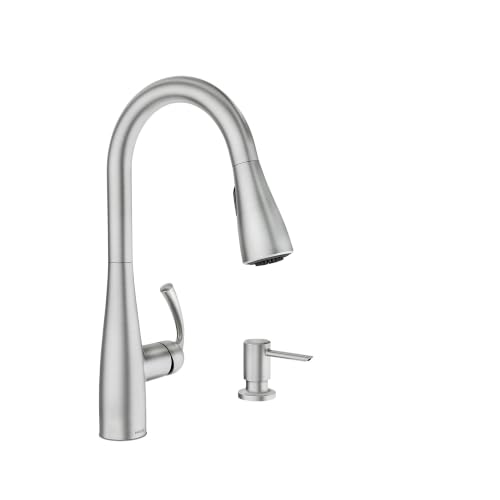
Moen Essie Pulldown Kitchen Faucet, Spot Resist Stainless (87014SRS)
Badge: Best Long-Term Value
Strengths
- The deepest parts and support network in the guide — the faucet most likely to be repaired rather than replaced in year eight.
- Spot Resist finish prevents the cosmetic tiredness that triggers premature replacement.
- A proven, conservative design that any plumber in the country knows on sight.
Trade-offs
- The highest upfront tier in this guide; the value only wins across years, not at the till.
- Conservative styling will not transform a kitchen’s look.
- If you are furnishing a short-tenancy rental, the long view may not be yours to collect.
Mini spec box: Brand model: Essie 87014SRS · Finish: Spot Resist stainless · Style: single-handle pulldown
The Essie in a low-cost guide looks like a contradiction until the arithmetic is done in years instead of dollars. Its upfront tier is the highest here. But a faucet’s true cost is purchase plus parts plus replacements plus the labour around all three, across the whole time you own the kitchen. Moen’s parts ecosystem attacks every term of that sum: cartridges stay available, diagrams stay published, and any plumber can service it without a research project. Add a finish engineered to resist the spotted look that makes owners replace working faucets, and the Essie’s decade cost can undercut a bargain faucet replaced twice.
The honest boundary of the argument is tenure. If you will leave this kitchen within a couple of years, you are buying longevity for the next owner, and the WEWE or FORIOUS is the rational spend. If this is your long-term home — the household that will still be standing at this sink in ten years — the Essie is the low-cost pick wearing a disguise, and the disguise is simply a higher first number. Value guides that cannot see past the first number are not value guides at all.
Best for: long-tenure homeowners optimising decade cost / Not suited for: short tenancies or minimum upfront spend
Comparison Table
| Pick | Value type | Key specification | Included extras | Amazon |
|---|---|---|---|---|
| WEWE Touchless Set | Feature value | SUS 304, ceramic cartridge, 3-mode sprayer | Soap dispenser | Check on Amazon |
| GIMILI Spring | Style value | Matte black spring design, motion sensor | — | Check on Amazon |
| VFAUOSIT | Certified value | NSF 61/372, cUPC, 23 in hose, cold-start | Tool-free install design | Check on Amazon |
| WEWE High-Arc | Overall value | SUS 304, ceramic cartridge, 20 in reach | — | Check on Amazon |
| FORIOUS | Budget classic | Stainless steel, single handle | Deck plate | Check on Amazon |
| Moen Essie | Long-term value | Spot Resist stainless, brand parts network | — | Check on Amazon |
How to Choose a Low Cost Kitchen Faucet Without Buying Twice
Work through the faucet as a bill of materials and ask, for each part, whether the maker spent money there. Body: stainless steel — ideally the 304 grade the WEWE picks name — is the spend that protects everything else, because a corroded body ends the faucet regardless of its other virtues. Cartridge: ceramic is the long-life technology and it is available at value tiers, so treat its absence from a listing as a question to ask, not a saving to celebrate. Hose: the pull-down hose is the hardest-working component; length you will not strain (20 inches and up in this guide) and a smooth under-sink path matter more than any spray-mode count. Supply lines: braided is the standard worth having. Finish: brushed and spot-resist finishes are the value choice disguised as a style choice, because cosmetic failure is the most common reason serviceable faucets get replaced early.
Then audit the box. A deck plate included is a purchase avoided. A dispenser included is a purchase avoided and a finish matched for free. A tool-free or genuinely DIY-friendly install can remove the single largest line item in a faucet project after the faucet itself. Add those avoided costs to the rival that looked cheaper by a small margin and the ranking often inverts — which is precisely why this guide ranks by logic and sends you to the listing for the live number.
Finally, match the spend to the tenure. Short horizon — a rental you maintain, a pre-sale refresh, a temporary kitchen: the FORIOUS and WEWE manual picks are the rational ceiling. Long horizon — your decade home: the Essie’s parts network or the WEWE high-arc’s proven platform will cost less across the period that matters. The expensive mistake is crossing the two: a bargain faucet in a forever home, or a longevity faucet in a six-month tenancy. Shoppers whose cost thinking extends to the whole kitchen’s build quality will find a kindred analysis in Best Made Kitchen Faucets.
How to Install a Budget Faucet Yourself and Keep the Saving
The largest controllable cost in a faucet project is labour, and modern value faucets are designed to let a careful homeowner keep it. The sequence: first, photograph the existing under-sink connections before touching anything. Second, shut off both valves, open the old faucet to drain, and remove it, cleaning the deck completely. Third, dry-fit the new faucet and deck plate, swing the handle and spout through their full travel, then mount and tighten evenly. Fourth, route the pull-down hose in a clear loop, position the counterweight so the wand docks flush, and connect the supply lines — replacing tired old lines rather than reusing them, since a value project is not the place to keep the system’s weakest part. Fifth, flush with the aerator removed, refit it, and leak-check every fitting with a dry paper towel. Sixth, check again tomorrow; a dry cabinet on day two is the certificate that the saving was real.
Know the honest limits of DIY: corroded shutoff valves that will not close, supply stubs in poor condition, or a deck damaged by the old faucet’s leaks are all reasons to spend on a plumber for the plumbing and still save on the faucet. The value strategy is not “never pay for help”; it is “pay for judgement, not for routine.”
Troubleshooting pattern: Problem: a slow weep at a new fitting → snug it a quarter turn; if it persists, re-seat the washer rather than tightening harder, which crushes seals and creates the leak it fears. Problem: the wand will not dock → the hose loop is snagged or the weight has slipped; fix the routing before suspecting the faucet. Problem: weak flow after install → remove and rinse the aerator; installation debris collects there by design.
The False Economies: Where Cheap Faucets Actually Cost You
Four traps account for most low-cost faucet regret. The plated-alloy body that looks like stainless in photographs and pits at the base within a few years, taking the whole faucet with it. The unnamed cartridge that drips early and cannot be sourced later, converting a small part’s failure into a full replacement. The missing deck plate that sends you back to the store mid-install, or worse, leaves spare holes funnelling water into the cabinet. And the novelty finish — a colour bought for excitement that spots, chips or simply dates, until a working faucet is replaced for looking tired. Every linked pick in this guide was screened against those four traps specifically; that screening, more than any tier label, is what “best low cost” means on this page. The maintenance dimension of the same argument — designs that cost little to keep — is developed in Best Low Maintenance Kitchen Faucets.
Landlords, Renters and Second Kitchens: A Shorter Brief
Rental and secondary installations deserve their own logic because the buyer and the user are different people. For landlords, the metric is callouts avoided: a proven platform like the WEWE high-arc, or a dead-simple classic like the FORIOUS, minimises both failures and the “how does this work?” questions that sensor models can generate in a new tenancy — though the WEWE touchless set’s dispenser-included completeness is tempting for higher-end units. For renters with permission to swap, reversibility is the brief: keep the original faucet boxed, choose a deck-plate model that covers existing holes, and photograph every connection you disturb. For second sinks — laundry, bar, workshop — standardise on the same model as the main kitchen where possible; one set of spares and one learned installation serve the whole house, and that standardisation is a saving no price tag shows.
Timing the Purchase: When Value Faucets Get Cheaper
Because this guide prints no prices, a word about timing is the honest substitute. Faucet pricing in the direct-sale segment moves with the retail calendar — the big promotional events, holiday weekends and the model-refresh cycles when a brand clears the outgoing version of a long-running design. A shopper with a working faucet and a flexible month can legitimately wait for one of those windows; a shopper with a dripping cartridge cannot, and should not let a hoped-for promotion talk them into living with a leak that is damaging a cabinet in the meantime. The middle path is the one this guide is built for: decide the model now, using the durable logic of materials and box contents, set the listing aside, and buy it when its number next dips — or immediately if the incumbent faucet is failing. Either way the decision quality comes from the specification work, and the timing merely discounts it. Never reverse that order: a promotion on the wrong faucet is not a saving, it is a discounted mistake, and the return shipping on a plumbed-in product is where bargain hunters go to be educated.
The Second-Hand and Open-Box Question
Frugal shoppers eventually ask about open-box and warehouse-deal faucets, and the honest answer is “selectively.” A faucet is a pressure-bearing plumbing fitting with seals, a cartridge and a hose; a returned unit may be perfect, or may have been installed, stressed and stripped of its mounting hardware by the previous buyer. If you go this route, the non-negotiables are: the exact model and ASIN matching a pick you have already chosen on specification, every mounting part and the deck plate present, the hose and spray head undamaged, and a return route you trust. Missing hardware converts the saving into a parts hunt, and a suspect cartridge converts it into a gamble. For most households the cleaner saving is the one this guide has argued throughout — a correctly specified new faucet, self-installed, kept for its full service life. That is not the most exciting sentence in frugal shopping, but low cost in plumbing is a long game, and long games reward boring discipline.
What a Warranty Is Worth at the Value End
At premium tiers a warranty is a paragraph in a brochure; at the value end it is a working part of the purchase, and it deserves thirty seconds of reading before you order rather than after something drips. What matters is not the headline duration but the mechanism: how a claim is made, whether the seller responds through the marketplace or a support channel of their own, and whether wear parts like cartridges are treated as replaceable components or as the owner’s problem. Direct-sale brands live on their marketplace reputation, which gives a documented buyer’s claim real leverage — another reason this guide repeats the documentation habit: order confirmation saved, model label photographed, manual filed. A value faucet with a responsive seller behind it is a genuinely different product from the identical faucet sold by a vanishing storefront, and the difference never appears in a specification table. Check the seller’s identity and history on the listing as carefully as the faucet’s materials; at this end of the market, the seller is part of the specification.
Reading a Value Listing Like an Engineer
Since the live price is only one click away and this guide will not print it, the skill that protects a low-cost buyer is reading the rest of the listing forensically. Start with the materials line and translate it: “stainless steel” with a grade named — SUS 304 on the WEWE picks — is a commitment; the same words without a grade are a hope. Find the cartridge sentence; ceramic named is a decade-scale promise, silence is a question to ask the seller before ordering, not after. Inventory the box from the listing’s contents list — deck plate, supply lines, dispenser, mounting hardware — and price the missing items into any rival comparison. Read the certification marks as evidence of outside testing. Then read the most recent owner reports with a filter: ignore star-shaped opinions, mine them for specifics about hose behaviour, docking and leaks at month six, which are the facts that predict your own ownership. A listing that survives that reading at a value tier — as the six picks here were chosen to do — is not a gamble. It is the market working exactly as it should.
The One-Year Check: Auditing a Value Purchase Honestly
Value claims are easy at checkout and testable at the first anniversary, so here is the audit this guide recommends — five minutes, once, a year after installation. Is the cartridge still shutting off crisply, with no after-drip and no new stiffness in the handle? Is the wand docking exactly as it did on day one, and does the hose still travel without a catch? Is the finish presentable after nothing more than your normal wiping — no pitting at the base, no freckles at the edges? Are the under-sink fittings dry and the cabinet floor sound? And has the faucet generated any cost beyond its purchase — a part, a callout, a replacement accessory? A value pick that passes those five questions has done what this guide promised, and the six models here were chosen because their specifications — stainless bodies, named or standard cartridges, certified waterways, complete boxes — are the ones that pass it. If a faucet fails the audit early, the documentation habit this guide keeps recommending converts the failure into a warranty conversation instead of a second purchase. Either way, the audit closes the loop that a price tag opens: low cost is not what you paid, it is what the year says you paid.
A Last Word on Confidence
Value shopping in plumbing carries an unfair reputation for anxiety, as if spending less must mean worrying more. The picks in this guide exist to retire that feeling: read the specification, buy the complete box, install it carefully, file the paperwork, and then — this is the part bargain hunters forget to schedule — stop thinking about the faucet. A correctly chosen value faucet should generate exactly as much ongoing thought as a premium one, which is to say almost none, and the six models here were screened until that was a reasonable expectation for each of them.
Common Buying Mistakes
- Ranking by the day’s price alone. Promotions shuffle rankings weekly; materials and cartridges decide the decade. Use the listing for the live number and this guide for the logic.
- Cutting the body material. A plated alloy body is the one saving that cannot be undone later. Stainless at a value tier exists — buy it.
- Ignoring box contents. Deck plates, dispensers and braided lines are money. Compare equipped projects, not bare faucets.
- Paying for features you will not use. A sensor for a household that rarely cooks messy is a subscription to battery changes with no dividend.
- Reusing old supply lines to save a little. The oldest, weakest component should never survive a faucet upgrade.
- Skipping the documentation habit. Budget brands reward owners who keep model numbers; a lost model identity turns a small part into a full replacement.
Final Recommendation
The default answer for this keyword is the WEWE High-Arc: a stainless, ceramic-cartridge platform with a long public track record, at a value tier. If certification and DIY savings lead your brief, choose the VFAUOSIT. If the horizon is a decade in the same home, the Moen Essie is the low-cost pick on the only arithmetic that matters — cost per year. Spend on body, cartridge and box contents, save on novelty, and a low cost faucet stops being a gamble.
Frequently Asked Questions
How much should a good low cost kitchen faucet actually cost?
This site does not print prices, because they change constantly and a stale figure misleads. The better question is what your money must buy at whatever the current value tier is: a stainless or certified body, a ceramic cartridge, a proper pull-down hose, and the deck hardware your sink needs in the box. If a faucet at the day’s lowest tier offers all four, it is a bargain; if it offers none, it is a future expense wearing a bargain’s clothes. Check the live number on the listing and judge it against that checklist.
Are budget faucets from direct-sale brands reliable?
The category has matured: brands like WEWE sell stainless, ceramic-cartridge faucets in large volumes, and their long-selling models have public track records you can inspect. Reliability risk concentrates in no-name listings with unnamed internals and no certification. The discipline is to buy the specification, not the logo — named materials, named cartridge, named certifications — and to keep your model documentation, which is good practice at every tier.
Is it worth paying more for a brand like Moen?
Over a long ownership, often yes — not because the water flows better, but because parts, diagrams and plumber familiarity stretch the faucet’s serviceable life and prevent full replacements. Over a short horizon, usually no: you would be buying years you will not use. Match the brand premium to your tenure in the home and the question answers itself.
Can I install a low cost faucet myself?
In most cases yes, and doing so is where much of the saving lives. Modern value faucets, the VFAUOSIT’s tool-free design among them, are built for homeowner installation with standard connections. The prerequisites are working shutoff valves, a clean deck and the patience to leak-check twice. If the existing plumbing is corroded or the valves will not close, pay for that part of the job and still keep the faucet saving.
What is the cheapest faucet feature to skip?
Novelty. Extra spray patterns beyond a stream and a spray, decorative finishes that spot easily, and electronics your cooking style does not need are all safe omissions. What is never safe to skip: body material, cartridge quality and installation hardware. A useful test for any feature is whether it will still be earning its keep in year five — rub-clean nozzles pass that test easily; a third decorative spray mode rarely does.
Should landlords buy the same faucets as homeowners?
Largely yes, with the emphasis shifted further toward proven platforms and simple operation. A landlord’s true cost includes tenant callouts and void-period repairs, so a long-selling model with standard parts — the WEWE high-arc or the FORIOUS classic in this guide — usually beats both the cheapest listing and the most feature-rich one. Standardising one model across units compounds the advantage: one spare cartridge on the shelf serves every kitchen you own.