Disclosure: topratedkitchenware.com is reader-supported. When you buy through links on our site, we may earn an affiliate commission from Amazon and other retailers, at no extra cost to you.
Where to buy
All six picks in this guide to the best looking kitchen faucets are listed below with direct Amazon links, so you can check the latest price on Amazon, study the finish photographs closely, and confirm dimensions against your sink and backsplash before deciding. Looks are personal, but proportions are measurable: use the listings to compare arc height, spout reach and handle style against the space the faucet will actually live in. We never print fixed prices here, because listings change and a design decision should rest on the design.
- OWOFAN Kitchen Faucet with Pull Down Sprayer — Best Statement Piece. Check on Amazon for the current listing details.
- WEWE Pull-Down Kitchen Faucet — Best Clean Modern Look. Check on Amazon for the current listing details.
- LUFG Brushed Nickel Kitchen Faucet — Best Classic Silhouette. Check on Amazon for the current listing details.
- Moen Adler Pulldown Kitchen Faucet 87233SRS — Best Soft Traditional Look. Check on Amazon for the current listing details.
- Lufeidra Kitchen Faucet with Pull-Down Sprayer — Best Vintage-leaning Charm. Check on Amazon for the current listing details.
- FEELSO Kitchen Faucet with Pull Down Sprayer — Best Tall, Elegant Arc. Check on Amazon for the current listing details.
Read the full guide ↓ for how each design behaves in real kitchens, which styles each one flatters, and the proportion mistakes that make even a beautiful faucet look wrong.
The faucet is the hardest-working piece of sculpture in your home, which is why the search for the best looking kitchen faucets deserves more rigour than scrolling photographs. It sits at eye level, catches the light from the window and the pendants, and gets touched more often than any cabinet pull you so carefully chose. A good-looking faucet is not simply a pretty object in a listing photo; it is the right silhouette at the right scale, in a finish that agrees with your cabinet hardware, your sink material and the way light moves through your kitchen during the day. Get those relationships right and the whole room feels resolved. Get them wrong — a towering commercial spring faucet in a delicate cottage kitchen, a dinky low arc lost behind a deep farmhouse sink — and the eye snags on it every single morning.
This guide judges six verified pull-down faucets on design first: line, proportion, finish and presence. Function is not ignored — every pick is a working single-handle pull-down with a spray wand, and the practical details are in each review — but the ranking question here is which designs earn their place visually in which kitchens. Each review names the style of kitchen the faucet flatters, the one it fights, and the honest visual limitation you should accept before ordering. If your shortlist is really about a specific finish family, the companion notes in Best Looking Black Kitchen Faucets go deeper on the darkest end of the palette.
One principle before the picks: in photographs, every faucet is alone. In your kitchen it never will be. It will stand in front of a backsplash, under cabinets or a window, beside a soap dispenser and a paper-towel holder, in front of the view to the garden. The reviews below keep returning to those relationships, because that is where “good looking” is actually decided.
Key Takeaways
- Proportion beats decoration: match arc height and spout reach to your sink depth and the space under cabinets or windows before falling for any style.
- Brushed nickel and spot-resist stainless finishes, used by every pick here, are the most forgiving good-looking finishes — they hide spots and fingerprints that polished surfaces advertise.
- Silhouette families: exposed-spring designs read industrial, smooth high arcs read modern or transitional, and softer curved profiles read traditional.
- One handle keeps the deck visually calm; a deck plate can tidy a 3-hole sink or add visual weight, depending on the design.
- Coordinate the faucet with cabinet hardware and lighting metal, not necessarily by exact match — a deliberate two-metal scheme looks designed, an accidental one looks like a mistake.
- The best looking faucet is the one that still looks right at year three: finishes that hide daily wear keep a kitchen looking intentional.
In this guide
Quick Picks
| Pick | Badge | Design character | Amazon |
|---|---|---|---|
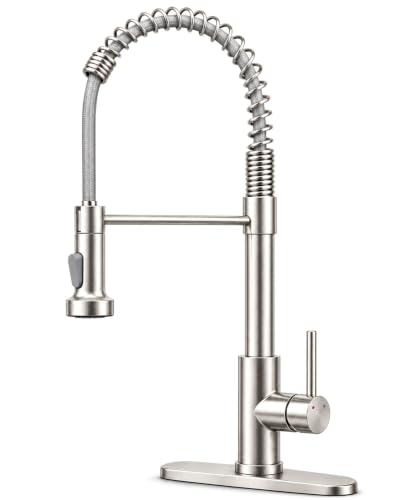
| OWOFAN Spring Faucet | Best Statement Piece | Exposed-spring commercial profile; instant focal point | Check on Amazon |
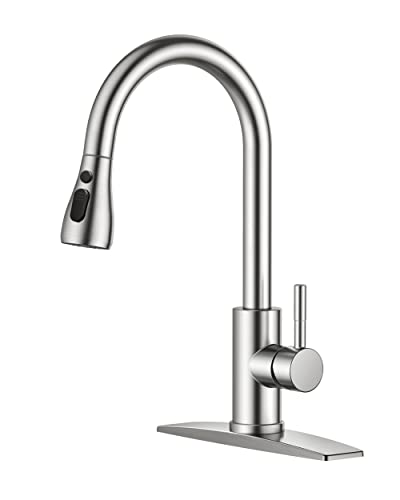
| WEWE Pull-Down (updated) | Best Clean Modern Look | Tidy single-hole silhouette, brushed nickel, minimal deck clutter | Check on Amazon |
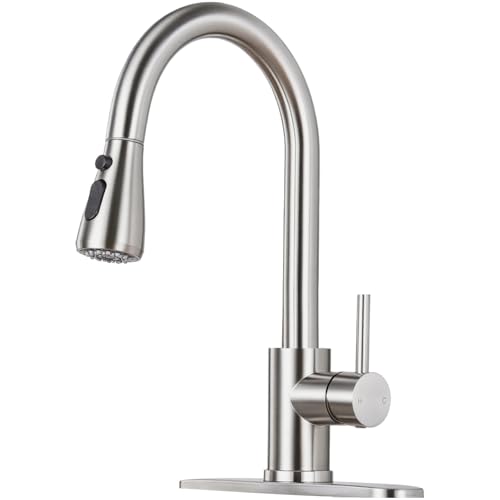
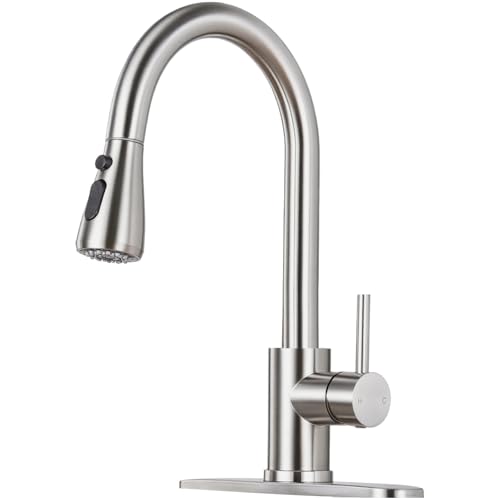
| LUFG Brushed Nickel Faucet | Best Classic Silhouette | Balanced high-arc profile with deck plate for a finished deck line | Check on Amazon |
| Moen Adler 87233SRS | Best Soft Traditional Look | Gentle curves and Spot Resist stainless from a legacy design house | Check on Amazon |
| Lufeidra Pull-Down Faucet | Best Vintage-leaning Charm | Classic pot-filler-inspired styling with modern pull-down function | Check on Amazon |
| FEELSO High Arc Faucet | Best Tall, Elegant Arc | Sweeping high arc that gives a standard sink a designed feel | Check on Amazon |
The badges stay consistent through the detailed reviews, so a design you fall for here is easy to find again below. Readers whose kitchens demand a lower silhouette for window or cabinet clearance will find the proportion discussion continued in Best Low Profile Kitchen Faucets.
How These Picks Were Chosen
This is a research-led design guide. The six picks come from a verified product pool checked against Amazon’s catalogue data on 2026-11-20, so the finishes, configurations and features described are the manufacturers’ own listing facts, not impressions copied from other sites. Within that pool, models were selected to span the main silhouette families a shopper actually chooses between — exposed spring, clean modern single-hole, classic deck-plate high arc, soft traditional, vintage-leaning and tall elegant arc — rather than six near-identical goosenecks in slightly different boxes. A guide to good-looking faucets that only shows one shape would not be a guide at all.
Design judgements here are necessarily partly subjective, and the guide handles that honestly: instead of declaring one winner of beauty, each review describes the design’s character precisely — its line, its visual weight, the kitchens it suits — so you can match it to your own taste and room. Where a listing photograph could mislead, the review says so; tall arcs photograph smaller than they stand in a real kitchen, and brushed finishes photograph flatter than they look under warm evening light. Specifications quoted are only those present in the verified listing data; nothing about dimensions or materials has been invented to fill a spec box.
Function was the entry ticket, not the ranking: every pick is a single-handle pull-down sprayer faucet in stainless or brushed nickel with flexible 1- or 3-hole fitting where the listing states it, so the design conversation never has to apologise for a faucet that cannot rinse a sink. Beauty that cannot fill a stockpot is a photograph, not a kitchen fitting.
The 6 Best Looking Kitchen Faucets, Reviewed in Detail

OWOFAN Kitchen Faucet with Pull Down Sprayer
Badge: Best Statement Piece
Strengths
- The exposed spring is pure visual theatre — the faucet becomes the room’s focal point on purpose.
- Brushed nickel softens the industrial geometry, keeping it kitchen-appropriate rather than canteen-harsh.
- The open structure reads light for its size; it adds presence without a heavy solid column.
Trade-offs
- It dominates. In a quiet, traditional kitchen it will shout over everything else.
- The spring coils catch light and grease alike; the look depends on a regular wipe.
- Tall commercial proportions need a sink and ceiling line that can carry them.
Mini spec box: Style: single-handle spring pull-down · Finish: brushed nickel · Material: lead-free NSF certified stainless steel · Fit: 1- or 3-hole with deck plate
Some faucets are chosen to disappear; the OWOFAN is chosen to be looked at. The exposed-spring silhouette borrows the language of professional kitchens — coiled steel, an articulated wand, hardware that shows how it works — and in the right room it is magnificent: loft-style spaces, kitchens with black or steel appliances, open shelving, concrete or butcher-block counters. The brushed nickel finish is the diplomatic choice here, taking the edge off the industrial form so it reads “chef’s kitchen” rather than “cafeteria.”
Styling it well means giving it room. It pairs naturally with a deep single-bowl sink and minimal deck clutter — move the soap dispenser to the counter’s far side or choose a simple one, because busy small objects at the base make the composition fussy. The honest limitation is temperament: this design has a point of view, and if the rest of your kitchen does not share it, the faucet will look like a prop. Buy it because your kitchen wants a centrepiece, not because the photograph was exciting.
Best for: industrial, loft and chef-style kitchens that want a deliberate focal point / Not suited for: quiet traditional rooms or low-clearance sink runs

WEWE Pull-Down Kitchen Faucet (Updated Model)
Badge: Best Clean Modern Look
Strengths
- Single-hole installation leaves the deck almost empty — the calmest visual footprint in this guide.
- Smooth, unbroken arc line with no visible mechanism; the silhouette is one gesture.
- Brushed nickel over SUS 304 stainless gives a soft, even sheen that suits pale modern kitchens.
Trade-offs
- Minimalism is unforgiving: every object near it shows, so the counter styling has to stay disciplined.
- Single-hole only, so a 3-hole sink needs a plate plan that slightly compromises the clean look.
- Buyers wanting ornament or vintage detail will find it plain.
Mini spec box: Body: SUS 304 stainless steel · Cartridge: ceramic · Fit: 1-hole · Swivel: 360° · Spray modes: 3 · Install: tool-free
If the OWOFAN is a statement, the updated WEWE is a held breath. Its design virtue is restraint: a single smooth arc, one handle, nothing on the deck that does not need to be there. In slab-front cabinets, handleless drawers, quartz counters and integrated appliances — the modern kitchen vocabulary — this is the faucet that completes the sentence instead of interrupting it. The 360-degree swivel keeps the spout parkable tight against the backsplash, which matters visually in small kitchens where a spout jutting over the bowl makes the whole sink zone look unsettled.
The finish deserves a word: brushed nickel reads warmer than chrome and cooler than gold-toned metals, which makes it the peacemaker finish for kitchens mixing stainless appliances with warmer wood or painted cabinetry. The honest limitation is that restraint cuts both ways — in a kitchen full of traditional detail, shaker doors, a patterned tile splashback, this faucet can look like it wandered in from another house. Match its calm to a calm room and it is the most elegant option here per unit of visual effort.
Best for: modern and minimalist kitchens, small sink runs, single-hole counters / Not suited for: ornate traditional schemes wanting visible detail
LUFG Brushed Nickel Kitchen Faucet with Pull Down Sprayer
Badge: Best Classic Silhouette
Strengths
- The balanced high-arc profile is the classic pull-down shape, executed without gimmicks.
- Included deck plate gives a finished, deliberate deck line on 3-hole sinks instead of exposed spare holes.
- Three spray modes are integrated into the wand without changing the wand’s clean outline.
Trade-offs
- Classic also means familiar; it will not be the most talked-about object in the room.
- The deck plate adds a horizontal element some minimalists prefer to avoid.
- Brushed nickel only — no darker or warmer finish option in this listing.
Mini spec box: Material: SUS 304 stainless steel · Handle: single · Spray modes: 3 · Swivel: 360° · Fit: deck plate included, RV/laundry/bar listed · Certifications: NSF372, NSF61, cUPC
There is a reason the classic high-arc pull-down became the default image of “kitchen faucet”: the proportions simply work in the widest range of rooms. The LUFG is that archetype done tidily — a confident arc, a wand that docks flush so the line stays unbroken, a single lever that reads as part of the body rather than an attachment. It is the pick for the large middle of kitchen design: transitional rooms, shaker cabinets in any colour, stone or stone-look counters, tile or slab splashbacks. It agrees with all of them because it argues with none of them.
The deck plate is a design feature here, not just an install convenience. On a three-hole sink, the plate converts three holes and a faucet into one composed horizontal unit; the eye reads a designed object instead of a compromise. LUFG also lists the faucet for RV, laundry and bar sinks, and the classic styling travels well to those secondary spaces. The honest limitation is excitement: nobody will ask where you got it. Many owners consider that the highest praise a kitchen fitting can earn.
Best for: transitional kitchens and 3-hole sinks wanting a composed, classic look / Not suited for: buyers chasing a dramatic or ultra-minimal statement

Moen Adler Pulldown Kitchen Faucet, Spot Resist Stainless (87233SRS)
Badge: Best Soft Traditional Look
Strengths
- Gentle, rounded transitions instead of hard modern angles — the friendliest silhouette in the group.
- Spot Resist stainless keeps the surface looking clean between wipes, which is a look in itself.
- Moen’s design restraint means it coordinates with the widest range of existing hardware.
Trade-offs
- The softness that flatters traditional kitchens can look slightly plain in a sharp contemporary scheme.
- It sits in a higher brand tier than the direct-sale picks here.
- One finish story in this listing; mixing-metal schemes need care.
Mini spec box: Brand model: Adler 87233SRS · Finish: Spot Resist stainless · Style: single-handle pulldown
The Adler’s design language is curves managed with discipline. Where modern faucets draw straight lines and sharp shoulders, the Adler swells and tapers, and in kitchens built from raised-panel or shaker cabinetry, warm wood tones, apron sinks and patterned curtains, that softness looks like belonging. It is also the easiest faucet here to live with visually day to day, because the Spot Resist finish refuses to show the spotted, fingerprinted tiredness that creeps over glossier surfaces by Wednesday.
Moen’s decades of designing for the broad middle of the market show in the proportions: nothing is exaggerated, the arc is tall enough for stockpots without looming, and the handle is shaped for a wet hand rather than for a photograph. The honest limitation is drama — there is none, deliberately. If your kitchen renovation has a mood board with the faucet circled as the hero, choose the OWOFAN or the FEELSO. If the hero is the range, the island or the view, the Adler is the supporting actor that never upstages and never dates.
Best for: traditional and transitional kitchens, busy households that hate polishing / Not suited for: high-drama contemporary schemes


Lufeidra Kitchen Faucet with Pull-Down Sprayer
Badge: Best Vintage-leaning Charm
Strengths
- Classic styling cues — the listing describes a pot-filler-inspired profile — bring period warmth to a modern mechanism.
- Brushed nickel keeps the vintage note subtle rather than costume-like.
- SUS304 stainless body and ceramic cartridge mean the charm is not fragile.
Trade-offs
- Vintage-leaning design polarises: in a stark modern kitchen it will look out of period.
- The classic profile deserves a considered pairing with sink style; a sharp zero-radius steel sink fights it.
- Fewer listing details on spray configuration than some rivals.
Mini spec box: Material: SUS304 stainless steel · Cartridge: ceramic · Fit: 1- or 3-hole · Settings listed: kitchen, laundry, RV, bar
Farmhouse and cottage kitchens have a faucet problem: most pull-downs are drawn in a modern hand, and their clean arcs can look like appliances visiting a period room. The Lufeidra answers with classic proportions — a profile the maker describes in pot-filler terms — that sits comfortably with apron-front sinks, beadboard, open wood shelving and enamelled ranges. It gives those kitchens the pull-down convenience their owners want without the visual argument.
The brushed nickel finish is doing quiet diplomacy here too: bright enough to feel fresh against white cabinetry, muted enough not to clash with aged brass or iron elsewhere in the room — and deliberate two-metal schemes are covered in the buying guide below. The honest limitation is range: this is a faucet with a period, and periods exclude. In a handleless lacquered kitchen it would look as lost as the WEWE would in a farmhouse. Choose it when the room’s story is already being told in a traditional voice.
Best for: farmhouse, cottage and traditional kitchens wanting pull-down function in period dress / Not suited for: stark contemporary schemes

FEELSO Kitchen Faucet with Pull Down Sprayer
Badge: Best Tall, Elegant Arc
Strengths
- The high arc is drawn as one sweeping gesture — the most graceful line in this group.
- Lead-free NSF certified stainless construction backs the elegance with substance.
- On a plain sink, the arc alone supplies the “designed” feeling renovators chase.
Trade-offs
- Height is the whole idea; under low windows or cabinets it simply will not fit the composition — or the space.
- A tall arc increases splash drama in shallow sinks if the wand is used carelessly.
- The elegance is formal; very casual, rustic rooms may prefer the Lufeidra’s warmth.
Mini spec box: Style: high arc, single handle · Material: stainless steel, lead-free NSF certified · Fit: 1 or 3 hole · Settings listed: farmhouse, laundry, RV, bar
Proportion is the FEELSO’s argument: take the standard gooseneck, stretch it upward, and a utilitarian object becomes a line drawn in the air. In kitchens with tall ceilings, a window over the sink, or an island sink facing the room, that vertical gesture gives the sink zone a sense of occasion that lower faucets cannot. It is the pick most likely to make a builder-grade sink look intentional, because the eye goes to the arc and reads “chosen” over the whole arrangement.
The design asks two things in return. First, clearance: measure from counter to the underside of cabinets or the window trim, and be honest about the number — the low-silhouette alternatives in Best Low Arc Kitchen Faucets exist for kitchens where this arc cannot stand. Second, a reasonably deep sink, so the height works as clearance rather than as a splash amplifier. Meet those two conditions and the FEELSO delivers the most architecture per faucet in this guide.
Best for: tall spaces, window-over-sink layouts and plain sinks needing a designed focal line / Not suited for: low-clearance runs or very shallow sinks
Comparison Table
| Pick | Silhouette | Finish | Best room match | Amazon |
|---|---|---|---|---|
| OWOFAN Spring | Exposed spring, commercial | Brushed nickel | Industrial / loft | Check on Amazon |
| WEWE Updated | Clean single-hole arc | Brushed nickel | Modern minimalist | Check on Amazon |
| LUFG | Classic high arc + deck plate | Brushed nickel | Transitional | Check on Amazon |
| Moen Adler | Soft curved pulldown | Spot Resist stainless | Traditional | Check on Amazon |
| Lufeidra | Classic, pot-filler-inspired | Brushed nickel | Farmhouse / cottage | Check on Amazon |
| FEELSO | Tall sweeping high arc | Brushed nickel | Formal / tall spaces | Check on Amazon |
How to Choose a Kitchen Faucet That Looks Right in Your Kitchen
Start with the room, not the faucet. Name your kitchen’s style honestly — not the style of the kitchens you save on social media, but the one your cabinets, counters and floor actually make. Then choose the silhouette family that speaks that language: spring for industrial, clean single-hole arc for modern, classic deck-plate arc for transitional, soft curves for traditional, period profiles for farmhouse, tall formal arcs where the architecture is grand. A faucet from the wrong family can be a fine object and still look like a mistake every day.
Next, proportion. Three measurements decide most of it. Arc height against the space above the sink: leave comfortable clearance under cabinets and do not let the arc fight a window’s muntins or a pendant’s line of sight. Spout reach against sink depth: the stream should land near the drain of a single bowl or between bowls of a double, not against the back wall where it splashes and looks awkward. And visual weight against sink size: a deep, wide farmhouse sink can carry the OWOFAN’s spring or the FEELSO’s arc; a small bar sink disappears under either and wants the WEWE’s restraint. Tape the silhouette on the wall behind the sink at full size before ordering — five minutes with painter’s tape has saved more design regrets than any other step in this guide.
Then finish coordination. The modern rule is not “match everything”; it is “make it look deliberate.” Brushed nickel and stainless sit comfortably with stainless appliances and with most cabinet hardware, and they bridge warm and cool palettes. If your hardware is a strong colour — black, brass, bronze — either commit the faucet to the same family or make the contrast clearly intentional by repeating the faucet’s metal in one other place, such as lighting or a rail. A single unmatched metal reads as an accident; a repeated one reads as a scheme. Readers planning the dark version of that scheme will find the dedicated discussion in Best Looking Black Kitchen Faucets useful alongside this guide.
Finally, judge the finish by Wednesday, not by the showroom. Polished surfaces photograph beautifully and spot relentlessly; brushed and spot-resist finishes, which is to say every pick in this guide, keep a kitchen looking composed between cleanings. “Best looking” over a five-year ownership is mostly a maintenance equation, and the forgiving finishes win it.
How to Install a New Faucet Without Wrecking the Look
A beautiful faucet installed carelessly looks crooked forever, so treat the fitting as part of the design work. First, clear and clean the deck completely; old sealant ridges tilt a new base by a degree you will see every day. Second, dry-fit the faucet and deck plate, step back, and check the spout is centred on the sink and the handle’s swing clears the backsplash through its full travel. Third, tighten mounting hardware evenly, alternating sides, rather than fully on one side first — that is how bases end up level instead of cocked. Fourth, align the wand so it docks perfectly flush; a wand seated a few degrees off breaks the silhouette line that made you choose the design. Fifth, route the hose loop so it cannot push the faucet body as it travels, connect the supplies, flush debris with the aerator off, then stand at conversational distance and sight along the arc. Sixth, wipe every fingerprint off before the first photograph or the first guest — brushed finishes forgive a lot, but the reveal moment deserves the polish.
Keeping the look is a small routine: wipe the base when you wipe the counters, dry the wand after heavy use, rub scale from nozzles before it crusts, and never hang a heavy spray bottle or a dripping brush from the spout — the silhouette you bought assumes an unburdened arc.
Troubleshooting pattern: Problem: the faucet looks slightly crooked after a week → the mounting nut has settled; re-level the body and re-tighten evenly rather than twisting the spout against its stops. Problem: water spots keep appearing on one side → that side catches the spray or the window light; a quick daily wipe of just that face, or re-aiming the wand’s rest angle, solves most cases. Problem: the wand no longer docks flush → check the hose loop and counterweight position under the sink before blaming the dock; a shifted weight changes the wand’s seating angle.
Finish Guide: Living with Brushed Nickel and Stainless
Every pick in this guide wears a brushed or spot-resist silver finish, so it is worth understanding what you are choosing. Brushing is a texture of fine parallel lines that scatters light; that scattering is exactly why these finishes hide fingerprints, water spots and micro-scratches that a mirror polish displays in high definition. The trade is ultimate shine: a brushed faucet will never give you that liquid-chrome gleam, and in a kitchen designed around high-gloss drama it can read quiet. Stainless-bodied models add a second virtue — the colour is the material, so worn edges do not reveal a different metal beneath, and the faucet ages as a softening of sheen rather than a patchwork.
Care is simple and specific: warm water and a microfibre cloth for routine cleaning, a mild detergent for grease film, vinegar on a cloth for scale marks, and a firm rule against abrasive pads and bleach sprays on the finish. Dry after washing-up sessions when you can; the thirty-second wipe is the difference between a faucet that looks chosen at year five and one that looks tired. If your wider scheme leans toward easy upkeep as the top priority, Best Low Maintenance Kitchen Faucets ranks this same territory by effort rather than by looks.
Small Kitchens and Rental Kitchens: Getting the Look Without the Renovation
Small kitchens punish visual clutter more than any other fault, so the design brief there is calm: single-hole silhouettes like the WEWE, spouts that park against the backsplash, and nothing on the deck that does not earn its place. A compact arc in a small room reads as intention; a tall or spring design reads as crowding. If the sink is under a low window, borrow the proportion rules from the low-arc discussion rather than forcing a favourite silhouette into a space that contradicts it.
Renters and light renovators get more design leverage from a faucet swap than from almost any other single change, because the faucet is the one object every visitor touches. The rules: keep the original faucet boxed for reinstatement, choose a model whose deck plate covers the existing hole pattern so no drilling is involved, and photograph the under-sink connections before touching them. A classic LUFG-style arc on a plate transforms a dated three-hole deck in an afternoon, and because every pick here is a standard single-handle layout, the swap is reversible and plumber-optional for confident DIYers.
Styling the Sink Zone: What Around the Faucet Decides How It Looks
Interior stylists talk about the sink zone as a composition with five elements: faucet, sink, backsplash, window or wall behind, and the small objects that live on the deck. The faucet is only one of the five, and it is judged against the other four every time someone walks into the room. A deep, dark sink makes a brushed nickel faucet glow by contrast; a white sink with a white backsplash flattens the same faucet into the background, which can be exactly the calm you want or a disappointment if you bought it as a feature. Before ordering, look at your sink zone and decide the faucet’s role in that composition: protagonist, supporting line, or near-invisible utility. The OWOFAN and FEELSO are protagonists. The LUFG and Adler are supporting lines. The WEWE updated model is the master of near-invisibility. Mismatches of role — a protagonist faucet in a zone already starring a dramatic backsplash and patterned counter — are the most common reason a “beautiful” faucet looks wrong at home.
The small objects matter more than their size suggests. A tall pump dispenser beside a tall faucet creates a thicket of verticals; a low, wide soap dish or a dispenser in the faucet’s own finish family keeps the base calm. Paper-towel holders, dish racks and drying mats all enter the frame. None of this requires buying anything new — it requires arranging what you own with the same intention you brought to choosing the faucet. Move the clutter two feet left for a week and watch how much better the faucet you already chose suddenly looks; then decide whether the upgrade you actually needed was composition rather than hardware. If a new faucet is still the answer, you will choose it with a clearer eye for the role it has to play, and the proportion and finish guidance in the buying-guide section above will do the rest.
Lighting is the final stylist. Under-cabinet lights graze across brushed finishes and reveal every water spot at night that daylight forgave; pendant light from above models an arc’s curve kindly. Stand at your sink at the hour you cook most and look at the current faucet’s surface — that is the light your new faucet will live in, and brushed or spot-resist finishes are popular precisely because they behave well under both.
How the Six Silhouettes Photograph vs How They Live
A final design skill worth naming, because so much faucet shopping now happens through images: learning to translate a listing photograph into a lived object. Manufacturers photograph faucets against seamless pale backgrounds, lit to make the arc glow, with the wand docked and the deck empty. Your kitchen will offer none of those courtesies. The translation rules are simple. Add visual competition: imagine the faucet in front of your busiest backsplash tile, not a blank wall, and ask whether the line still reads. Add scale references: a faucet photographed alone always looks smaller than it will beside your kettle and fruit bowl, so trust the dimension figures over the picture’s impression, especially for the FEELSO’s tall arc and the OWOFAN’s spring. Add time: picture the finish after a week of ordinary use, not after a polish — this is where brushed nickel quietly defeats chrome in real homes, whatever the photographs suggest. And add people: a faucet is operated by wet, soapy, hurried hands, and a handle that photographs as a jewel but turns awkwardly will be judged by your hands every day and by your eyes only occasionally.
None of this argues against choosing beauty — this entire guide argues for it. It argues for choosing the beauty that survives contact with your actual kitchen: its light, its clutter, its water, its people. The six picks were shortlisted because each has a silhouette strong enough to hold its own in that translation, from the OWOFAN’s deliberate theatre to the WEWE’s disciplined calm. Pick the one whose character still makes sense after you have imagined it spotted, docked at an angle, and framed by a drying rack — that is the one that will still please you in year three.
A Note on Trends: What Dates a Faucet and What Does Not
Design-conscious buyers often ask a fair question before spending on looks: will this silhouette embarrass me in seven years? The honest pattern from kitchen design history is that extreme gestures date fastest and quiet proportions date slowest. The dramatic spring faucet is a deliberate exception — it borrows from commercial kitchens, a visual language that has been stable for half a century, so its theatre is oddly timeless. The riskiest purchases are neither the boldest nor the calmest but the most fashionable: the finish or shape that appears in every showroom in a single season. Every pick in this guide was chosen partly for trend resistance — brushed nickel over novelty finishes, classic or cleanly modern curves over decorative flourishes — because a faucet is plumbed in, not hung on a wall, and changing your mind later involves a wrench. Choose the design you can defend in a sentence about your room, not the one you can defend with a magazine cover, and the odds are strong it will still look deliberate when the next trend cycle has passed through twice.
One Faucet, Two Rooms: Coordinating Kitchen and Bar or Laundry Sinks
Many of these designs are listed by their makers for bar, laundry and RV sinks as well as the main kitchen, which raises a styling opportunity worth taking deliberately. Repeating the kitchen faucet’s finish family — not necessarily the identical model — in the secondary sink ties the house’s wet rooms into one scheme, and choosing a quieter sibling silhouette for the smaller space keeps the hierarchy right: the main sink carries the statement, the bar echoes it. The LUFG’s classic arc in the kitchen with the compact WEWE at the bar is one natural pairing from this guide; the Lufeidra in a farmhouse kitchen with a simple brushed design at the laundry sink is another. What fails is the accidental version — whatever was cheapest that week, in whatever finish — because guests read secondary rooms as evidence of whether the main room’s design was intention or luck.
Common Buying Mistakes
- Choosing from listing photos alone. Photographs crop out cabinets, windows and scale. Tape the silhouette at full size on your own wall before ordering.
- Matching metals anxiously — or not at all. Either commit to a family or repeat a contrast deliberately. One lonely unmatched metal reads as an error.
- Ignoring the view from the doorway. The faucet is usually judged from across the room, framed by pendants and window light, not from directly above the sink.
- Over-sizing the statement. A spring or tall-arc design in a small, quiet kitchen does not look bold; it looks lost. Scale the drama to the room.
- Forgetting the deck. Spare holes, a missing deck plate, or a crowded soap-dispenser cluster will undo a beautiful faucet’s effect at its base.
- Buying a polished look for an unpolished life. If nobody will wipe it, choose brushed or spot-resist and let the finish do the forgiving.
Final Recommendation
Match the silhouette to the room and one of these six will look right for years. For a deliberate focal point, the OWOFAN Spring Faucet is the boldest design here. For the broadest number of real kitchens, the LUFG Classic is the safest beautiful choice — balanced arc, finished deck line, no arguments with any style. And for modern rooms that prize calm, the WEWE Updated leaves the cleanest deck in the guide. Decide the room’s story first; the faucet is punctuation, and punctuation only works when the sentence is clear.
Frequently Asked Questions
What faucet finish looks best with stainless steel appliances?
Brushed nickel and brushed stainless are the most natural partners: close enough in tone to feel coordinated, textured enough not to demand an exact match with every appliance brand’s slightly different steel. Spot-resist stainless, like the Moen Adler’s, adds the practical bonus of hiding the fingerprints that accumulate around a busy sink. Exact matching is less important than consistent temperature — keep all the metals in the room either warm or cool in feel.
Should my faucet match my cabinet hardware exactly?
Not necessarily. An exact match is the safe classic scheme, but a deliberate two-metal scheme — for example brushed nickel faucet and sink fittings with darker or warmer cabinet pulls, repeated in the lighting — looks designed and is common in professionally styled kitchens. What fails is the accidental mismatch: one metal appearing once, nowhere else, at a slightly different tone from everything around it. Repeat any contrast at least twice in the room.
Is a high arc faucet always better looking than a low arc?
No — it is better looking only where the space can carry it. A tall arc under a generous window or high cabinets draws an elegant line; the same arc crammed under low cabinets looks like a mistake in measurement. Low arcs have their own composed, horizontal elegance and suit sinks under windows and shelves. Proportion to the room, not height itself, is what the eye rewards.
How do I stop a good-looking faucet from looking tired?
Mostly by choosing a forgiving finish and wiping the base. Brushed and spot-resist finishes hide the daily evidence; a ten-second wipe when you finish washing up prevents the mineral ring at the base that ages any design. Rub scale from the spray nozzles before it crusts white, keep abrasive cleaners off the surface, and the faucet you chose for its looks will keep them.
Does a deck plate improve or hurt the look?
It depends on the sink and the style. On a three-hole sink, a well-proportioned plate turns exposed spare holes into one composed unit and usually improves the look considerably, as with the LUFG and OWOFAN here. On a clean single-hole counter, a plate adds a horizontal element the design may not need. Judge it as part of the silhouette, not as an accessory.
Can a pull-down faucet look traditional?
Yes, if the drawing hand is traditional. Soft curves like the Moen Adler’s, or period-leaning profiles like the Lufeidra’s, carry pull-down mechanics in a traditional visual language, and brushed finishes keep them from looking like appliances. What reads modern is not the pull-down wand itself but sharp angles, exposed mechanisms and minimal ornament — choose the opposite of those and the function disappears into the style.