Disclosure: topratedkitchenware.com is reader-supported. When you buy through links on our site, we may earn an affiliate commission from Amazon and other retailers, at no extra cost to you.
Where to buy
For the best kitchen sinks for quartz countertops, the fitting matters as much as the bowl: quartz rewards a correct undermount and punishes a careless one. The six bowls below — four stainless undermounts and two fireclay apron fronts — are this guide’s shortlist for quartz installations. Each is linked so you can check the latest price on Amazon, confirm dimensions against your cabinet, and read the full review before your fabricator templates the cutout.
- Oxwiser 30×18 Inch Undermount Sink Set — Best Overall for Quartz
- Delironexu 30 Inch Undermount Sink — Best Handmade Look
- Oxwiser 32×18 Inch Undermount Sink Set — Best for Larger Quartz Runs
- Kraus KHU640-33 33 Inch Undermount Sink — Best Extra-Wide
- Miuara 30 Inch Fireclay Farmhouse Sink — Best Farmhouse Contrast
- Miuara 33 Inch Fireclay Farmhouse Sink — Best Statement Size
Read the full guide below for the reasoning, the trade-offs, and the fitting advice behind each pick.
Quartz has become the default premium countertop because it is consistent, hard-wearing, and free of the sealing ritual natural stone demands — and the search for the best kitchen sinks for quartz countertops is really a search for the bowl that honours those qualities. A quartz counter and its sink succeed or fail together at one place: the cutout. The bowl hangs beneath it or stands proud in front of it, water lives at that junction daily, and every decision — reveal, seal, support, bowl material — is effectively permanent once the slab is fabricated. This guide treats the sink as half of a quartz system, not as an accessory bought afterward.
The good news is that quartz is an undermount-friendly material: it is strong, non-porous at the surface, and fabricated to precise cutouts, so the clean wipe-in fitting that suits modern kitchens is fully available. Four of the six picks here are stainless undermount bowls from 30 to 33 inches; the other two are white fireclay apron fronts, included because the contrast of glazed ceramic against engineered stone is one of the defining looks of current kitchen design, and because fireclay’s stain resistance pairs intelligently with quartz’s own. Shoppers comparing fitting decisions across counter types will find the broader cluster useful, starting with Best Kitchen Sinks For Sale for buying logistics.
What quartz asks in return is respect for its two sensitivities. It dislikes sustained high heat at a point, so trivets remain a habit even beside a heat-resistant bowl, and its resin content means aggressive solvents have no place in sink care. Neither constraint touches any pick here — all six are compatible with quartz when fitted correctly — but the fitting chapters of this guide, on reveals, sealing, and support, are where quartz projects are won. Readers whose priority is pure working function over material pairing should also see Best Kitchen Sinks Functional, where these same bowl families are judged on workflow alone.
Key Takeaways
- Quartz suits undermount fitting perfectly: precise cutouts, a non-porous surface, and wipe-in cleaning with no rim.
- Choose the reveal deliberately — negative, flush, or positive — because it changes cleaning, looks, and fabricator cost.
- The undermount seal is a maintenance item: inspect it, and reseal at the first sign of a gap, to protect the cabinet below.
- Stainless and fireclay are the two proven quartz partners: steel for lightness and thin profiles, fireclay for contrast and glaze.
- Support is structural, not adhesive: bowls — above all fireclay apron fronts — must be carried by the cabinet, not hung from the slab.
- Order the sink before fabrication: quartz cutouts are made to the actual bowl and its template.
In this guide
Quick Picks
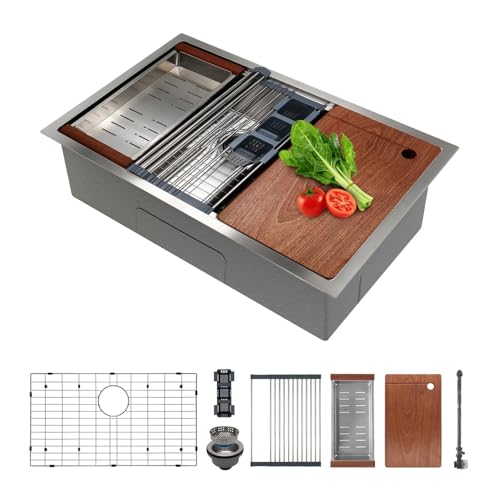
Oxwiser 30×18 Inch Undermount Sink Set — Best Overall for Quartz
The complete quartz pairing: 30 x 18, 16 gauge, with grid and drain parts bundled to protect both bowl and stone. Key specs: Size: 30 x 18 inch; Mount: Undermount; Material: Stainless steel, 16 gauge. Check on Amazon
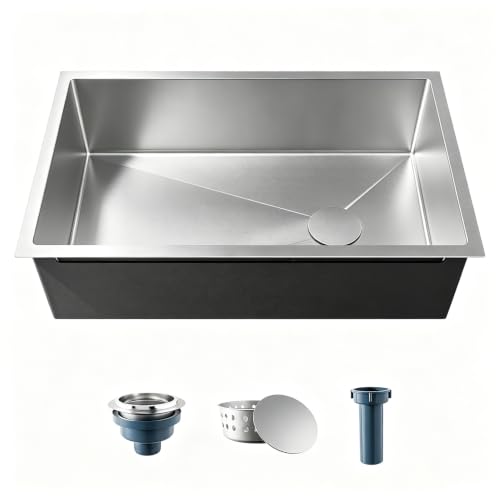
Delironexu 30 Inch Undermount Sink — Best Handmade Look
The design match: handmade 30 x 18 x 9 bowl whose crisp lines sit naturally under engineered stone. Key specs: Size: 30 x 18 x 9 inch; Mount: Undermount; Material: 18 gauge stainless steel. Check on Amazon
Oxwiser 32×18 Inch Undermount Sink Set — Best for Larger Quartz Runs
The scaled set: the Oxwiser bundle at 32 x 18 for longer quartz counters and bigger cookware. Key specs: Size: 32 x 18 inch; Mount: Undermount; Material: Stainless steel, 16 gauge. Check on Amazon
Kraus KHU640-33 33 Inch Undermount Sink — Best Extra-Wide
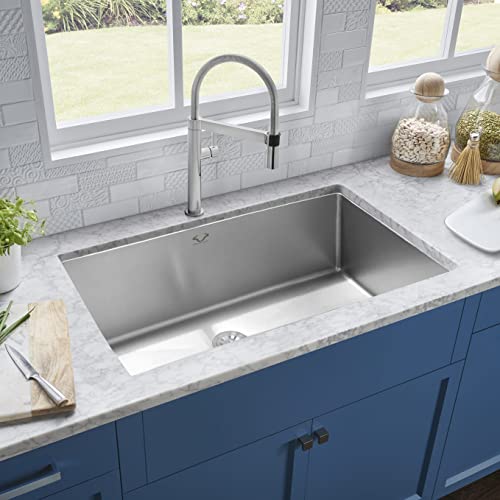
The width leader: 33 inches with rounded corners and channel drainage under the stone. Key specs: Size: 33 inch; Mount: Undermount; Material: 18-gauge stainless steel. Check on Amazon
Miuara 30 Inch Fireclay Farmhouse Sink — Best Farmhouse Contrast
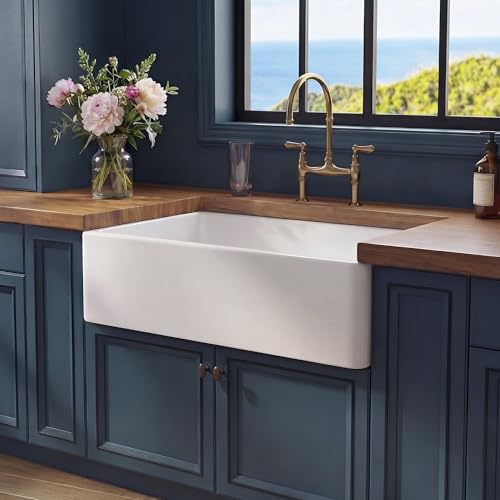
The contrast piece: 30 x 18 white fireclay apron front against coloured or veined quartz. Key specs: Size: 30 x 18 inch; Type: Farmhouse apron front; Material: White fireclay. Check on Amazon
Miuara 33 Inch Fireclay Farmhouse Sink — Best Statement Size
The statement: 33 x 18 fireclay farmhouse scale for kitchens designed around the sink. Key specs: Size: 33 x 18 inch; Type: Farmhouse apron front; Material: White fireclay. Check on Amazon
How These Picks Were Chosen
Selection for this guide applied a quartz-specific filter to the usual sink criteria. First, every pick had to mount in a way quartz handles well: undermount for the four steel bowls, apron front for the two fireclay bowls, with no drop-in rims to sit on the slab and trap moisture against it. Second, verified specifications had to support a durable installation — steel gauge adequate to the bowl’s span so the rim sits true against the slab, drainage design that keeps water moving rather than pooling at the seal line, and corner treatments that can be cleaned right up to the reveal.
Third, box contents were weighed with fabrication in mind. Quartz projects run to a templating date, and a set that bundles its grid and drain assembly removes procurement risk from a schedule that cannot slip without cost. The fireclay picks were assessed on the cabinet work they demand — apron sinks need a built support structure — and both Miuara sizes were retained because quartz kitchens are designed at both the standard 30 inch scale and the statement 33 inch scale. No hands-on testing is claimed; rankings rest on verified specifications and established quartz fabrication practice.
The result divides cleanly. The Oxwiser sets offer completeness at 30 and 32 inches, the Delironexu offers the handmade profile contemporary quartz designs favour, the Kraus offers maximum steel width with drainage detailing, and the Miuara pair offer the glazed alternative. If your quartz is going into a compact footprint rather than a full kitchen, the cabinet cautions in Best Kitchen Sinks For Tiny Homes apply with full force — quartz weight plus a wide bowl is a serious demand on a small cabinet.
Our Picks for best kitchen sinks for quartz countertops, Reviewed One by One

Oxwiser 30×18 Inch Undermount Sink Set
Badge: Best Overall for Quartz
Strengths
- The 5-item bundle covers the parts buyers most often forget: bottom grid, drain assembly, and drain cap arrive with the sink.
- 16 gauge steel at the most versatile 30 x 18 size fits the standard family-kitchen cabinet without drama.
- The bottom grid protects the bowl floor from pan scratches and lifts dishes out of standing water from day one.
Trade-offs
- No integrated ledge, so it works as a classic bowl rather than a sliding-accessory workstation.
- A bundled towel is a nice extra, not a buying reason; judge the set on the grid and drain hardware.
- Single bowl flexibility means no divider for households that insist on separated wash and rinse zones.
| Size | 30 x 18 inch |
| Mount | Undermount |
| Material | Stainless steel, 16 gauge |
| Bowl | Single bowl |
| Bundle | 5 items: sink, bottom grid, drain assembly, drain cap, towel |
The Oxwiser 30 x 18 is the set-minded pick. Its verified listing is explicit about the bundle — sink, bottom grid, drain assembly, drain cap, and towel — and that completeness is the product’s real argument. Sink projects stall on small parts more than on big ones: the grid ordered separately, the drain that does not match, the cap nobody thought about. Here the essentials arrive in one box, matched to one bowl, which makes this the lowest-friction route from old sink to working sink.
The sink itself is the consensus specification: 30 x 18 inches, 16 gauge stainless steel, single bowl, undermount. Thirty inches is the family-kitchen sweet spot — wide enough for sheet pans and stockpots, narrow enough for the standard base cabinet — and 16 gauge is the thickness that feels solid under daily cookware without specialty weight. The bottom grid earns its place immediately, cushioning the floor against pan scratches and keeping glassware out of the puddle layer while the bowl drains.
What it does not attempt is workstation theatre: there is no ledge, so prep happens on the counter in the conventional way. Buyers should also keep expectations calibrated about bundle extras — the towel is a courtesy, while the grid and drain assembly are the value. Judged on its actual promise, a complete, correctly specified 30 inch sink with its working parts included, it delivers exactly that.
Under quartz, this set’s bundled bottom grid does double duty: it protects the bowl, and by cushioning every pan landing it reduces the shock loads transmitted to the undermount rim and its seal. The 30 x 18 size also templates cleanly into the most common quartz fabrication — a standard cabinet, a standard cutout, no drama at the fabricator. It is the low-risk quartz pairing in the guide.
Best for: quartz kitchens wanting a complete 30 inch undermount set with grid protection from day one / Not suited for: buyers who want a workstation ledge system

Delironexu 30 Inch Undermount Sink
Badge: Best Handmade Look
Strengths
- Handmade design with a brushed finish gives the tailored, modern profile at the most useful 30 x 18 x 9 dimensions.
- The listing is unusually honest — drain kit included, no additional accessories — so planning starts from facts, not assumptions.
- Nine inches of depth keeps spray contained and lets tall pots stand properly under the faucet.
Trade-offs
- 18 gauge steel is lighter than the 16 gauge picks here, with the usual give in dent resistance and sound deadening.
- No bottom grid is included, so protecting the handmade floor means adding one separately.
- Handmade corners need a brush as part of the cleaning routine to stay bright.
| Size | 30 x 18 x 9 inch |
| Mount | Undermount |
| Material | 18 gauge stainless steel |
| Bowl | Single bowl |
| Build | Handmade design, brushed finish |
| Included | Drain kit (no additional accessories) |
The Delironexu is the minimalist’s 30 inch sink: handmade construction, brushed finish, 30 x 18 x 9 inch dimensions, a drain kit in the box, and — in a touch of listing honesty the guide appreciates — an explicit note that no additional accessories are included. What you see is the whole proposition: a clean-lined, modern bowl at the most versatile size in the guide, without bundle padding.
Handmade fabrication is the aesthetic decision here. The bowl’s planes and corners are formed rather than pressed, giving the flat floor and straight walls that sit comfortably under stone counters and alongside contemporary cabinetry. The brushed finish helps daily life too, softening the visibility of the fine marks stainless collects. At nine inches deep it matches the guide’s deeper bowls, containing spray and swallowing tall cookware in a way shallow sinks never manage.
The compromises are stated plainly. Eighteen gauge steel is the lighter class: fine for ordinary cooking loads, less forgiving of dropped cast iron than the 16 gauge bowls, and livelier acoustically under a running tap. And because no grid is bundled, owners who care about the floor’s finish should add one from the start rather than after the first scratches. For buyers who want the handmade look, honest contents, and nothing they did not ask for, that is a fair exchange.
Handmade bowls and quartz are a visual natural: the stone’s engineered precision deserves a bowl with deliberate lines rather than pressed curves, and the Delironexu’s flat floor and straight walls deliver that dialogue. Under quartz its lighter gauge asks one favour — a properly supported rim so the thin steel sits perfectly true against the slab, which any competent fabricator provides as routine.
Best for: contemporary quartz designs where handmade lines should echo the stone’s clean edges / Not suited for: heavy cookware households that need 16 gauge steel

Oxwiser 32×18 Inch Undermount Sink Set
Badge: Best for Larger Quartz Runs
Strengths
- All the completeness of the 30 inch Oxwiser set — grid, drain assembly, cap — scaled to a 32 inch bowl.
- 32 inches of single bowl flattens the biggest pans and still arrives with its floor protected by the included grid.
- 16 gauge steel keeps the larger bowl rigid and resistant to the flex a big span of thin steel can show.
Trade-offs
- The wide format needs a wide base cabinet; measure before falling for the capacity.
- No ledge system, so workstation fans should look at the Kraus KWU110-32 instead.
- A bigger bowl is a bigger cleaning surface and takes more water to fill for a full soak.
| Size | 32 x 18 inch |
| Mount | Undermount |
| Material | Stainless steel, 16 gauge |
| Bowl | Single bowl |
| Bundle | 5 items: sink, bottom grid, drain assembly, drain cap, towel |
Take the Oxwiser formula — a correctly specified stainless bowl with its working parts bundled — and widen it to 32 x 18 inches, and you get this set. The verified bundle mirrors its smaller sibling: sink, bottom grid, drain assembly, drain cap, and towel. At 32 inches the grid stops being a nicety and becomes close to essential, because a floor this wide collects more pan traffic, more cutlery drops, and more opportunities for scratches; having it fitted and included from day one protects the finish when it is newest and most vulnerable.
Capacity is the reason to choose it. The extra two inches over the 30 inch sets are the difference between a roasting tin lying flat and a roasting tin propped at an angle shedding water down your front. Batch cooks, bakers with full-size sheet pans, and households washing up after gatherings will use that width weekly. The 16 gauge steel matters at this span too — a wide bowl floor in thin steel can flex and drum, while 16 gauge keeps the structure composed.
The limits mirror the 30 inch set, scaled up: no ledge for sliding accessories, a cabinet-width requirement that must be verified rather than assumed, and the simple physics that a larger bowl takes more water and more wiping. Buyers with the cabinet for it get the most complete big-bowl package in this guide; buyers without it should step down to the 30 inch set and lose nothing but width.
Longer quartz runs deserve a bowl in proportion, and this 32 inch set fills a wide slab without leaving the sink looking lost in the stone. The bundled grid matters more at this width: a broad bowl under a broad counter collects the household’s largest pans, and the floor protection arriving in the same box means the protection starts with the very first wash.
Best for: longer quartz runs and larger cabinets ready for a bundled 32 inch bowl / Not suited for: compact quartz kitchens without the cabinet width

Kraus KHU640-33 33 Inch Undermount Sink
Badge: Best Extra-Wide
Strengths
- At 33 inches it is the widest bowl in this guide — maximum flat capacity for oversize cookware.
- Rounded corners and channel grooves keep even this large floor draining fully and cleaning easily.
- NoiseDefend pads tame the acoustics that a very large steel bowl would otherwise amplify.
Trade-offs
- 18 gauge steel in the widest bowl here is the combination most likely to feel lively; heavy pans should be set down, not dropped.
- Needs the widest base cabinet of any pick in this guide — verify the cabinet before anything else.
- Its scale dwarfs small kitchens and short counter runs; proportion is a real constraint, not a taste question.
| Size | 33 inch |
| Mount | Undermount |
| Material | 18-gauge stainless steel |
| Corners | Rounded, resist buildup |
| Drainage | Channel grooves |
| Sound | NoiseDefend pads |
The KHU640-33 is the maximum-capacity entry: 33 inches wide, the broadest bowl in this guide, built for kitchens where the sink is a genuine workstation for volume cooking. Turkey roasters, double batches of sheet-pan vegetables, the preserving pot that appears twice a year and defeats every normal sink — this is the bowl that takes them flat and upright respectively. If your recurring frustration is cookware that does not fit, width is the cure and this is the widest dose available here.
Kraus equips the big bowl with the detailing that keeps large sinks liveable. Rounded corners resist the buildup that plagues wide floors, channel grooves give a broad sheet of water a directed exit so the bowl drains rather than ponds, and NoiseDefend pads work hardest exactly here, because a 33 inch steel box under a running tap would otherwise be the loudest object in the kitchen. The design intent is clear: capacity without the maintenance penalty.
The compromise is in the verified gauge. At 18 gauge, this widest bowl is also built from the lighter steel class, so it asks for reasonable handling — set heavy cookware down rather than dropping it, and let the pads do the sound work. It also demands the largest cabinet in the guide. Kitchens that can house it and cooks who will fill it get an unmatched working volume; everyone else is better served by the thicker 32 inch Kraus.
At 33 inches this is the bowl for quartz counters that run long and kitchens that cook in volume. Its channel grooves earn special mention in a quartz context: water guided to the drain is water that is not standing against the undermount seal line, and the seal is the one part of a quartz installation that asks for periodic attention. Good drainage is seal preservation by other means.
Best for: maximum bowl width under a quartz counter in a high-volume kitchen / Not suited for: small cabinets or owners who drop heavy pans carelessly
Miuara 30 Inch Fireclay Farmhouse Sink
Badge: Best Farmhouse Contrast
Strengths
- Fireclay’s glazed surface resists staining in a way stainless never quite matches — tomato, turmeric, and red wine wipe off a sound glaze.
- The reversible bowl lets you choose the apron face that suits the kitchen at installation time.
- At 30 x 18 it brings the farmhouse look to the standard cabinet size rather than demanding a remodel around it.
Trade-offs
- Fireclay is heavy and unforgiving of installation shortcuts; the cabinet needs proper support built for the apron load.
- A hard glaze can chip if heavy cast iron strikes the rim or apron edge — it resists scratches, not impacts.
- The white apron front is a strong style statement that commits the kitchen’s look; it does not blend quietly like steel.
| Size | 30 x 18 inch |
| Type | Farmhouse apron front |
| Material | White fireclay |
| Bowl | Reversible single bowl |
| Resistance | Stain, crack, heat and scratch resistant |
| Install | Apron front or drop-in (undermount) |
The Miuara 30 inch brings the material argument into a guide dominated by steel. Fireclay is ceramic fired at high temperature until the glaze and body fuse, producing the dense, glassy surface that made farmhouse sinks a fixture of working kitchens long before they were a style trend. The verified claims are the practical ones: resistance to stain, crack, heat, and scratch. In daily terms that means the sauces and spices that shadow stainless — turmeric, tomato, coffee, red wine — sit on a glaze they cannot penetrate and leave with a wipe.
The apron front format changes the ergonomics as well as the look. With no counter strip between you and the bowl, you stand closer to the work, which tall cooks and anyone washing large items feel immediately in their back. The bowl is reversible, so the apron face presented to the room is a choice made at fitting time, and the 30 x 18 footprint keeps that farmhouse presence within the standard cabinet class rather than forcing a bespoke build.
Respect the material’s terms and it repays you for decades. Fireclay is heavy, so the cabinet must be framed to carry it, with the apron load supported rather than hung. The glaze resists scratching and heat superbly but can chip under a sharp, heavy impact — a dropped cast-iron rim on the apron edge is the classic accident — so heavy pans are carried, not swung. Owners who accept those two disciplines get the easiest-cleaning, most characterful bowl in this guide.
Against quartz, white fireclay does what steel cannot: it contrasts. On a grey-veined or dark quartz slab, the Miuara’s apron is the kitchen’s focal point, and its glaze out-resists the stone itself for staining — the pair share a wipe-clean philosophy. The cabinet must be built for the apron, but in a quartz project the cabinet is being built anyway; specifying the support at design stage costs nothing extra in planning.
Best for: quartz kitchens wanting white fireclay contrast and an apron front at standard size / Not suited for: cabinets not built to support a farmhouse apron load

Miuara 33 Inch Fireclay Farmhouse Sink
Badge: Best Statement Size
Strengths
- The widest fireclay bowl here: 33 inches of apron-front capacity for the largest roasters and gatherings.
- All the glaze advantages of the 30 inch Miuara — stain, heat, crack and scratch resistance — at statement scale.
- Reversible bowl keeps the installation choice open until the apron is actually being fitted.
Trade-offs
- The heaviest proposition in this guide: a 33 inch fireclay apron sink demands serious cabinet support and a two-person lift.
- Needs a wide farmhouse-ready cabinet; retrofitting it into a standard sink base is a project, not a swap.
- White fireclay at this width dominates the kitchen visually — commit to the look before committing to the sink.
| Size | 33 x 18 inch |
| Type | Farmhouse apron front |
| Material | White fireclay |
| Bowl | Reversible single bowl |
| Resistance | Stain, crack, heat and scratch resistant |
| Install | Apron front or drop-in (undermount) |
Everything the 30 inch Miuara argues, the 33 inch version argues at full scale. This is the widest fireclay bowl in the guide, an apron-front statement for kitchens built around gathering: the roaster that feeds a table of twelve, the canning pot, the drinks tub pressed into service at a party. The verified fireclay specification is identical — reversible single bowl, resistance to stain, crack, heat, and scratch — so the choice between the two Miuaras is purely about cabinet width and appetite for presence.
The glaze is the working advantage that survives the honeymoon. Stainless bowls, however well kept, develop a patina of fine marks; a sound fireclay glaze keeps its depth of shine and its refusal to hold stains year after year, provided it is cleaned with non-abrasive products. The apron front at 33 inches also delivers the ergonomic benefit at scale — standing close to a very wide bowl, reaching its centre without leaning across a counter strip, matters when the bowl is full of water and crockery.
The costs are structural and absolute. A 33 inch fireclay sink is among the heaviest fixtures a kitchen takes, the cabinet must be built or rebuilt to carry it with the apron supported, and installation is a planned two-person job. The white apron will also be the first thing every visitor sees, which is either the point or the problem. Kitchens designed around it will love it; kitchens merely accommodating it should choose the 30 inch.
This is the quartz kitchen designed sink-first: a 33 inch fireclay apron around which the slab is templated and the cabinet built. At this scale the apron front changes the quartz conversation — the cutout becomes a notch for the apron rather than a full undermount opening — and fabricators handle it routinely when the sink is on site at templating, which this guide insists on for every pick and this one most of all.
Best for: large quartz installations designed around a 33 inch farmhouse centrepiece / Not suited for: retrofits into standard sink bases or quiet, blend-in designs
Comparison Table
The table below lines the six best kitchen sinks for quartz countertops picks up on the attributes that decide daily use — size, build, and the design details that affect drainage and cleaning. Prices and ratings are deliberately absent: both change constantly, and neither describes the sink. Use the table to shortlist, then read the full reviews before deciding.
| Pick | Badge | Size | Build | Standout detail | Check |
|---|---|---|---|---|---|
| Oxwiser 30×18 Inch Undermount Sink Set | Best Overall for Quartz | 30 x 18 inch | Stainless steel, 16 gauge | 5-item bundle with bottom grid | Check on Amazon |
| Delironexu 30 Inch Undermount Sink | Best Handmade Look | 30 x 18 x 9 inch | 18 gauge stainless steel | Handmade, drain kit included | Check on Amazon |
| Oxwiser 32×18 Inch Undermount Sink Set | Best for Larger Quartz Runs | 32 x 18 inch | Stainless steel, 16 gauge | 5-item bundle with bottom grid | Check on Amazon |
| Kraus KHU640-33 33 Inch Undermount Sink | Best Extra-Wide | 33 inch | 18-gauge stainless steel | Widest bowl, channel grooves | Check on Amazon |
| Miuara 30 Inch Fireclay Farmhouse Sink | Best Farmhouse Contrast | 30 x 18 inch | Farmhouse apron front; White fireclay | Reversible fireclay apron front | Check on Amazon |
| Miuara 33 Inch Fireclay Farmhouse Sink | Best Statement Size | 33 x 18 inch | Farmhouse apron front; White fireclay | Reversible fireclay apron front | Check on Amazon |
How to Choose a Sink for Quartz Countertops
Decide the reveal before anything else, because the fabricator will ask and the answer changes the cutout. A negative reveal hides the bowl’s rim entirely under the stone, showing only bowl interior; it looks seamless and keeps the rim protected, but the stone edge overhangs into the splash zone and must be wiped. A flush reveal aligns stone edge and bowl rim for the crispest line and the easiest wipe. A positive reveal shows a step of bowl rim, which forgives fabrication tolerances and protects the stone edge from pan strikes, at the cost of a ledge that catches crumbs. Most quartz kitchens choose flush or a small negative; all four steel picks here suit any of the three.
Then match bowl material to your quartz and your habits. Stainless is light, thin, and quiet about its presence — the choice when the quartz itself is the visual event. Fireclay is the choice when the sink should share the stage, and its glaze beats steel for stain resistance beside a light quartz that shows every coffee ring on its surface. Gauge follows span: wider steel bowls want the support of 16 gauge or a fabricator’s cradle, which is why the widest steel pick here leans on its drainage and corner design rather than its gauge, and why heavy-pan households should read its trade-offs honestly.
Finally, plan the support and the seal as a system. Undermount bowls are carried by clips, rails, or a cradle fixed to the cabinet — never by sealant alone — and fireclay aprons are carried by a built shelf. The silicone seal at the rim is a waterproofing line, not a structure, and it is the one element you will renew during the sink’s life. Readers from the brand-research end of this cluster, arriving via Best Kitchen Sinks Franke, will find the same support logic applies whatever badge is on the bowl: quartz does not care about brands, only about weight, fit, and sealing.
How to Fit, Seal, and Care for a Sink in Quartz
Fitting sequence for quartz is fixed by the material: template with the actual sink, fabricate the cutout and faucet holes, dry-fit the bowl, then mount. Steel undermounts are offered up to the slab’s underside on their support system, the rim sealed with sanitary silicone, and the seal tooled smooth before it skins. Apron fireclay bowls are set onto their cabinet support first, the apron aligned to the cabinet face, and the quartz — templated around the installed bowl position — closes over the arrangement. In both cases the fabricator, not the calendar, decides when the sink must be on site: before templating, without exception.
Sealing deserves its own paragraph because it is the quartz installation’s only recurring job. Inspect the rim seal twice a year by eye and by fingertip: you are looking for gaps, lifting, or darkening that suggests moisture behind the line. A failing seal is renewed by cutting out the old silicone fully, cleaning both surfaces, drying them completely, and applying a fresh continuous bead. Do not smear new sealant over old — the sandwich fails quickly and hides the moisture path you are trying to close. Protecting that seal is also why drainage design matters: bowls whose floors guide water to the drain keep the rim zone drier between uses.
Care of the pair — bowl and quartz — is mostly shared habits. Wipe spills promptly on light quartz, use trivets for pans straight off high heat, clean both surfaces with mild, non-abrasive products, and keep solvents and oven cleaners away from the sink zone entirely. Problems that recur: Problem: a dark line developing at the undermount reveal → moisture and residue in a tired seal; reseal as above. Problem: the bowl sounding hollow or flexing at the rim → a support clip has loosened; have the mounting checked rather than adding sealant. Problem: dull patches on quartz near the faucet → mineral scale from standing water; dry the deck after use and treat scale with a quartz-safe cleaner. The same drying discipline serves the compact installations discussed under Best Kitchen Sinks For Van Life — scale and seals fail the same way at any scale.
Undermount Reveals Explained: Positive, Negative, and Flush
The reveal is the relationship between the stone’s cut edge and the bowl’s rim, and it is the most consequential aesthetic decision in a quartz sink installation. A negative reveal cuts the stone slightly inside the bowl’s opening, so the slab overhangs the bowl: the rim vanishes, the look is architectural, and the stone’s underside edge becomes a surface that needs a wipe and can chip if a pan rim finds it. A positive reveal cuts the stone slightly outside the rim, exposing a narrow steel step: fabrication-friendly, edge-protective, and honest about the junction, with a small ledge to keep clean.
Flush sits between them and is the connoisseur’s choice and the fabricator’s challenge — stone edge and bowl rim in one plane, demanding an accurate cutout and a true bowl. Handmade bowls like the Delironexu, with their fabricated rims, are often chosen for flush work because their edges are consistent. Whichever reveal you choose, choose it in writing with the fabricator before templating; it cannot be adjusted afterward by any amount of goodwill.
Protecting Quartz Around the Sink Cutout
The cutout is the slab’s weakest geography: a large opening, a wet zone, and a place where heavy objects are lifted, swung, and occasionally dropped. Protection is behavioural before it is chemical. Lift pans out of the bowl rather than dragging them across the reveal. Keep the deck dry, because standing water at the faucet base is where scale and grime establish themselves. Use the bowl’s grid — bundled with both Oxwiser sets — so that the heaviest traffic lands on steel rails, not near the stone edge.
Heat discipline matters at the junction too. Quartz tolerates everyday kitchen heat well but resents a pan fresh off a fierce burner set directly on the slab beside the sink; the bowl itself, steel or fireclay, takes that pan without complaint, so the habit to build is simple: hot things go in the sink or on a trivet, never on the stone between them. Follow that, keep the seal sound, and the cutout zone will look fabricated-fresh for years.
Common Buying Mistakes
The unforgivable quartz mistake is templating without the sink. Cutouts are made to a specific bowl; a sink substituted afterward — even at the same nominal size — can differ in rim and corner geometry enough to ruin a reveal. The sink is on site before the fabricator arrives, or the appointment moves.
Second is hanging a bowl from sealant. Silicone is waterproofing, not structure; an undermount carried on adhesive alone will creep, gap, and eventually leak into the cabinet. Third is neglecting the seal for years and discovering the failure as a swollen cabinet floor. Fourth is cleaning quartz like granite — no sealing is needed, but abrasive pads and harsh solvents damage the resin surface, and the sink zone is exactly where owners reach for the strongest cleaner they own.
Fifth is forgetting the cabinet when choosing fireclay. An apron front is a structural commitment: the support shelf, the apron notch in the cabinet face, and the plumbing positions all change. It is a wonderful choice made at design stage and an expensive one made as an afterthought.
Final Recommendation
For most quartz kitchens, the Oxwiser 30 x 18 set is the starting recommendation: a complete, correctly gauged undermount package whose bundled grid protects bowl and installation alike, templating cleanly into the standard cabinet. Step up to the 32 inch Oxwiser set for longer runs, and choose the Delironexu where the design calls for handmade lines against the stone.
Choose the Kraus KHU640-33 when width is the priority and its drainage detailing can shine, and choose either Miuara when the kitchen wants the fireclay statement — 30 inches for the standard build, 33 for the designed-around-it one. In every case the quartz rules hold: sink on site before templating, support by structure not sealant, and a seal you inspect like you mean it. Buyers still at the browsing stage may find the listings guidance under Best Kitchen Sinks For Van useful for one transferable habit — measuring the cabinet before falling for the bowl — which quartz projects reward more than any other.
Start your shortlist here: Oxwiser 30×18 Inch Undermount Sink Set, Delironexu 30 Inch Undermount Sink, and Oxwiser 32×18 Inch Undermount Sink Set cover the strongest combinations of fit, build, and everyday usability in this guide — check the latest price on Amazon for each and confirm the dimensions against your own cabinet before ordering.
One More Consideration
Quartz owners should know one number-free fact about their counter: it is heavy, and a wide bowl plus a disposal plus a cabinet full of plumbing concentrates load in one cabinet run. When the design is drawn, confirm the floor and cabinet construction carry the combined weight comfortably — a five-minute conversation at design stage that no later reinforcement matches.
Frequently Asked Questions
What type of sink is best for quartz countertops?
Undermount sinks are the standard recommendation for quartz: the material is fabricated precisely, supports the fitting well, and gives the wipe-in, rim-free result modern kitchens want. Stainless steel is the most common pairing; fireclay apron fronts are the established alternative where a farmhouse look is wanted. All six picks in this guide are quartz-appropriate when fitted and supported correctly.
Can you undermount a sink in quartz?
Yes — quartz is one of the best countertop materials for undermounting. The bowl is carried by clips, rails, or a cradle fixed to the cabinet, and the rim is sealed with sanitary silicone. The sealant waterproofs the junction; it must never be the structure. A competent fabricator or installer treats this as routine work.
Will a fireclay farmhouse sink work with quartz?
Yes, and it is a popular pairing. The cabinet is built with a support shelf for the apron load and a notch for the apron front, and the quartz is templated around the bowl’s position. The sink must be on site before templating. Both Miuara picks in this guide are specified for apron-front installation and suit quartz projects planned that way.
How do I stop water damaging the cabinet under a quartz undermount sink?
Keep the rim seal sound. Inspect it twice a year, reseal at the first gap or lift, and favour bowls whose drainage design keeps water moving to the drain instead of standing at the seal line. Wipe the reveal dry after heavy use. A sound seal plus a dry habit makes cabinet water damage a non-event.
Does quartz need sealing around the sink?
The quartz itself does not need sealing — it is a non-porous engineered surface. The junction between bowl and slab does: that silicone line is what you inspect and renew. Confusing the two leads owners to seal the stone and ignore the one line that actually keeps water out of the cabinet.
What reveal should I choose for a quartz undermount sink?
Flush for the crispest line and easiest wiping, a small negative reveal for a seamless architectural look, or a positive reveal to protect the stone edge and forgive tolerances. Decide with your fabricator before templating, because the reveal is cut into the slab and cannot be revised afterward.