Disclosure: topratedkitchenware.com is reader-supported. When you buy through links on our site, we may earn an affiliate commission from Amazon and other retailers, at no extra cost to you.
Where to buy
The best made kitchen sinks share a trait you can verify before you spend anything: their specifications agree with each other. The gauge matches the weight, the features named in the title are real construction details — rounded corners, drainage grooves, sound pads, included hardware — and nothing important is left vague. The six sinks below passed that test. Check the latest price on Amazon for each, and read the full guide ↓ for how to judge the making of a sink like an inspector rather than a browser.
- KRAUS KWU110-32 Stainless Steel 32 in Undermount Workstation Sink — Check on Amazon
- KRAUS KHU100-32 Stainless Steel 32 in 16 Gauge Undermount Kitchen Sink
- Oxwiser Kitchen Sink 30×18 Inch Undermount, 16 Gauge Single Bowl Bundle
- Delironexu 30 Inch Undermount Kitchen Sink, 18 Gauge Handmade, Drain Kit Included
- Oxwiser Kitchen Sinks 32×18 Inch Undermount, 16 Gauge Single Bowl Bundle
- KRAUS KHU640-33 Stainless Steel 33 in 18 Gauge Undermount Kitchen Sink
Most sink guides rank by appearance or by price. This one ranks by making — by what happened in the factory before the sink ever met a kitchen. That distinction matters more than it might seem, because a kitchen sink is a fabricated object under daily mechanical stress: it is flexed by thermal shock, drummed by water, dented by cast iron, and asked to do all of it while looking like a piece of furniture. Two sinks can share a photograph and differ completely in the qualities that decide whether they survive that life gracefully — the thickness and grade of their steel, the consistency of their forming, the finishing of their corners, the engineering of their drainage, and the discipline of their sound treatment.
The good news is that good making leaves evidence, and the evidence is readable from a specification if you know where to look. Gauge numbers that are stated rather than hinted at. Steel described by its actual trade specification, like the TRU16 in the Kraus bowls here. Features that solve physical problems — grooves that move water, pads that absorb vibration, grids that take the scratches so the bowl does not have to. Included components that fit properly because they were made for the bowl they ship with. The six picks in this guide were selected by reading for exactly that evidence, and the reviews below show the working for each one, including where each maker’s discipline runs out.
You will notice this list is entirely stainless steel and entirely single-bowl undermounts. That is not a lack of imagination; it is what the evidence produced. In this size and price landscape, the best-documented making — the verifiable gauges, named steels and engineered details — currently lives in this format. Other materials make their case in other guides; here, the question is narrower and harder: of the sinks you can actually inspect on paper, which are made best?
That framing also explains what this guide refuses to do. It does not rank by the beauty of photography, because photographs are the one part of a sink the maker does not fabricate. It does not treat a famous badge as evidence, because badges are inherited while making is done fresh on every unit. And it does not forgive a thin specification because a sink is inexpensive for its class, or condemn a complete one because its maker is less famous. The evidence is the evidence: numbers, names, features and fit, weighed the same way for all six. If that sounds like a demanding way to buy a sink, it is — and it is exactly the demand the best makers in this category have been quietly hoping buyers would make.
Key Takeaways
- Gauge is the headline of making: 16-gauge bowls dominate this list because thickness is where build quality becomes feel, sound and dent resistance.
- Named steel matters — TRU16 in the Kraus picks is a specification, not an adjective.
- Corner and floor finishing separate the made from the merely formed: rounded corners and drainage grooves appear again and again below.
- Bundles are a build-quality signal too: the Oxwiser sets ship the grid, drain assembly, cap and towel made to fit the bowl.
- Handmade fabrication (Delironexu) buys crisp lines; pressed heavy-gauge construction (Kraus) buys refined drainage and sound behaviour.
- Sound pads are a making detail, not a luxury extra — they are fitted in the factory or not at all.
In this guide
Quick Picks
| Pick | Badge | Build highlight | Link |
|---|---|---|---|
| KRAUS KWU110-32 Workstation | Best Overall Build | 16-gauge TRU16 steel, integrated ledge, board and rack included | Check on Amazon |
| KRAUS KHU100-32 32 in | Best Classic Build | TRU16 steel, rounded corners, channel grooves, NoiseDefend | Check on Amazon |
| Oxwiser 30×18 Bundle | Best Complete Package | 16-gauge bowl with grid, drain assembly, cap and towel in the box | Check on Amazon |
| Delironexu 30 Inch Handmade | Best Handmade Value | Handmade 30x18x9 bowl, brushed finish, drain kit included | Check on Amazon |
| Oxwiser 32×18 Bundle | Best Large Complete Package | The full bundle treatment at a wider 32-inch scale | Check on Amazon |
| KRAUS KHU640-33 33 in | Best Wide Build | Rounded corners, channel grooves and NoiseDefend at 33 inches | Check on Amazon |
Each badge names a different theory of good making — system completeness, classic pressed construction, handmade fabrication, or a package where every part was made to fit. The detailed reviews test each theory against the evidence of its own specification, and where a specification runs out — where a maker stops stating and starts implying — the review says so in plain, honest language, because in a guide about making, silence is a finding too.
How These Picks Were Chosen
This is a research-led assessment of making, built from verified product data: stated gauge, named steel specifications, construction method where the listing declares it, corner and drainage design, sound treatment, and included components. We scored what a maker chose to specify precisely — precision is itself evidence of a disciplined factory — and we penalised vagueness: where a listing omits a detail, our spec boxes omit it too, and the review notes the silence rather than filling it with invention. No sink here was hands-on tested by us; the judgements are specification judgements, made transparently, and they are the same judgements a contractor makes from a submittal sheet.
Two honest biases shaped the list. First, we favoured thickness: in a fabricated steel bowl, gauge is the one variable that improves strength, sound, dent resistance and perceived quality simultaneously, so 16-gauge construction anchors the rankings. Second, we favoured completeness: a sink whose maker also made its grid and drain to fit is, in a real sense, better made as a product than a bare bowl of equal steel. Readers who want the steel-specific cut of this same question should continue to Best Made Stainless Steel Kitchen Sinks, and those focused on the undermount format specifically to Best Made Stainless Steel Undermount Kitchen Sinks. The wider question of which material deserves this level of making at all is taken up in Best Materialfor Kitchen Sinks, this cluster’s companion on materials.
The 6 Best Made Kitchen Sinks

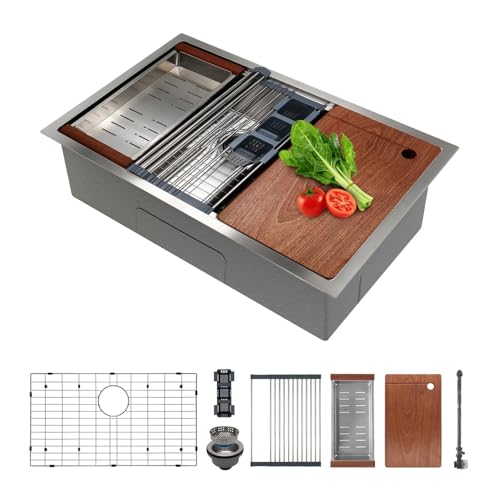
KRAUS KWU110-32 Stainless Steel 32 in Undermount Workstation Sink
Badge: Best Overall Build
Strengths
- 16-gauge TRU16 steel: a named, verifiable specification rather than a marketing adjective.
- The integrated ledge is fabricated into the bowl — a harder making task than a plain basin, done cleanly.
- Cutting board and roll-up rack included and made for the ledge they serve, plus NoiseDefend soundproofing.
Trade-offs
- A fabricated ledge system has more parts to keep and clean than a plain bowl.
- 32-inch width demands the cabinet run to match.
- The specification is functional rather than decorative; it will not read as “ornate” in a traditional kitchen.
Mini spec box: Size: 32 inch · Mount: undermount · Material: stainless steel, TRU16 · Gauge: 16 · Bowl: single with integrated ledge · Included: cutting board, roll-up rack · Features: NoiseDefend soundproofing.
Judge a maker by the hardest thing it attempts. A plain pressed bowl is a solved problem; a workstation bowl with a true, level, integrated ledge — one that a cutting board can bridge without rocking — is a fabrication exercise in tolerance. The KWU110-32 attempts it in 16-gauge TRU16 steel and completes the system with accessories made for the ledge rather than adapted to it. Add the NoiseDefend soundproofing, which has to be bonded evenly across the bowl’s underside to work at all, and you have a specification in which every line describes a factory doing something deliberate. That accumulation of deliberate acts is what “best made” means in practice.
The ownership consequence is a sink that behaves like equipment: boards sit flat, racks roll true, water sounds damped, and the bowl’s mass shrugs off the daily impacts that record themselves on lesser steel. If we had to defend one sink in this guide as the most completely made object, this is the one — not because any single feature is unique, but because none of its features is careless.
Best for: buyers who judge a sink as a fabricated system and cook at the sink daily / Not suited for: minimalists who want a bare bowl and nothing else

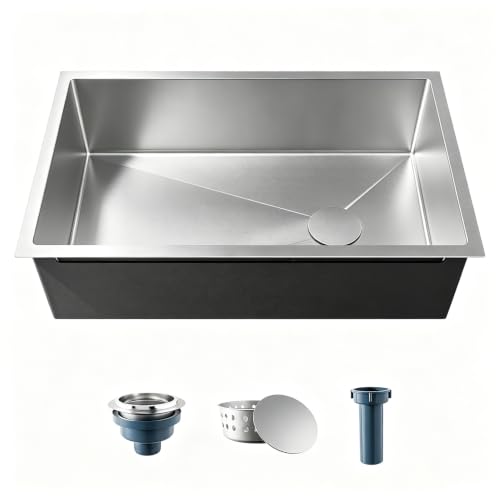
KRAUS KHU100-32 Stainless Steel 32 in Undermount Kitchen Sink
Badge: Best Classic Build
Strengths
- 16-gauge TRU16 construction with the finishing details — rounded corners, channel grooves — that separate refined pressing from basic pressing.
- NoiseDefend pads fitted as part of the specification, not an afterthought.
- A mature, widely deployed design: the making has been proven across a long production life.
Trade-offs
- No ledge and no listed accessories; the making is concentrated in the bowl itself.
- Conventional appearance — quality you feel more than you see.
- Needs a 32-inch cabinet run.
Mini spec box: Size: 32 inch · Mount: undermount · Material: stainless steel, TRU16 · Gauge: 16 · Bowl: single · Features: rounded corners, channel grooves, NoiseDefend pads.
There is a kind of build quality that only shows up in the second decimal place: corners rounded to a radius chosen for cleaning rather than for the convenience of the press, a floor grooved so water sheets toward the drain instead of beading where it falls, sound pads that cover the panels that actually vibrate. The KHU100-32 is the classic expression of that discipline. Its specification reads like a checklist written by people who have cleaned sinks, not just sold them — and in a plain bowl with no accessories to hide behind, that discipline is the entire product.
It also benefits from maturity. A design produced at scale over years accumulates small corrections — a clip improved, a radius adjusted — that a new design has not yet earned. For buyers who believe the best-made version of anything is usually the one whose maker has had the longest to perfect it, this is the strongest candidate in the guide, and the material story beneath it is unpacked in Best Material For Stainless Steel Kitchen Sinks.
Best for: traditionalists who want the plain bowl perfected / Not suited for: workstation seekers or accessory bundlers

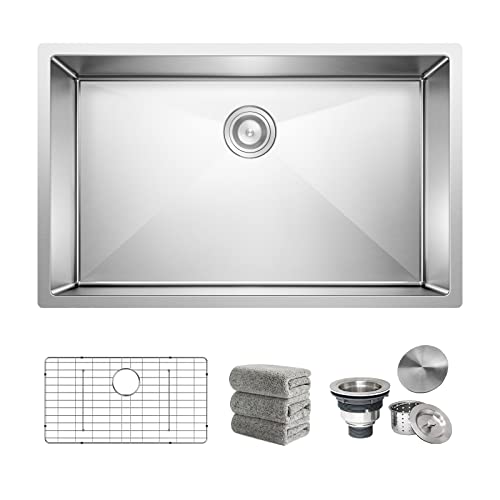
Oxwiser Kitchen Sink 30×18 Inch Undermount Bundle
Badge: Best Complete Package
Strengths
- 16-gauge single bowl — the thickness this guide treats as the premium standard.
- Five-item bundle: sink, bottom grid, drain assembly, drain cap and towel, each made to fit the bowl it ships with.
- The included grid protects the floor from day one, preserving the making rather than merely admiring it.
Trade-offs
- No sound-pad specification appears in the verified data, so we make no claim for its acoustic treatment.
- The bundle’s completeness suits buyers who want one decision, not component shoppers.
- 30-inch size is the standard footprint — large-pan households may prefer its 32-inch sibling.
Mini spec box: Size: 30 x 18 inch · Mount: undermount · Material: stainless steel · Gauge: 16 · Bowl: single · Bundle: sink, bottom grid, drain assembly, drain cap, towel.
The Oxwiser makes a different argument about what “well made” includes: the product, whole. A beautifully formed bowl paired with a third-party drain that almost fits and a grid bought by guesswork is a well-made component inside a badly made purchase. This set eliminates the mismatch risk at the factory door — the drain assembly and cap are the bowl’s own, the grid is its exact floor size, and even the towel acknowledges the one maintenance habit (drying) that keeps brushed steel honest. Underneath the packaging, the bowl itself meets this guide’s central standard: 16-gauge steel in the most standard footprint in the category.
For a buyer furnishing a kitchen in one pass — a renovation finishing weekend, a rental being brought up to standard — that completeness is a form of quality no single component can match. Everything arrives, everything fits, and the sink begins its life protected by the grid its maker intended for it.
Best for: one-purchase renovators who want the whole system made to fit / Not suited for: component-by-component customisers

Delironexu 30 Inch Undermount Kitchen Sink, Handmade
Badge: Best Handmade Value
Strengths
- Handmade fabrication produces the crisp, architectural lines pressed sinks cannot achieve.
- Generous 30 x 18 x 9 inch proportions — a deep, serious bowl in the standard width.
- Drain kit included; the listing is candid that no additional accessories are bundled, which is its own kind of specification honesty.
Trade-offs
- 18-gauge steel gives ground on thickness to the 16-gauge picks.
- Handmade corners are tighter by nature and ask a little more of a cleaning cloth.
- No grid included, so floor protection is a follow-up purchase.
Mini spec box: Size: 30 x 18 x 9 inch · Mount: undermount · Material: stainless steel · Gauge: 18 · Bowl: single · Included: drain kit (no additional accessories) · Style: handmade, brushed finish.
Handmade is a word this category uses loosely, so it is worth saying what it means when it is true: the bowl is cut, folded and welded from sheet by a fabricator rather than drawn in a press, and the result is geometry a press cannot copy — flat planes, square shoulders, a tailored, almost architectural presence. The Delironexu is that object at the accessible end of this guide, with proportions (a full 9 inches of depth) that respect the cook and a brushed finish that forgives daily use. Its listing even declines to oversell, noting plainly that beyond the drain kit, no additional accessories are included. In a guide about making, that candour counts as evidence about the maker.
The trade is thickness: at 18 gauge it will not match the Kraus bowls’ mass or the Oxwiser bundles’ completeness. What it offers instead is fabrication character at the tier where most handmade sinks begin — the pick for a buyer who wants the made-by-hand look and feel, honestly specified, without paying for the heaviest steel in the category.
Best for: design-led buyers who value handmade fabrication and depth / Not suited for: maximum-gauge seekers

Oxwiser Kitchen Sinks 32×18 Inch Undermount Bundle
Badge: Best Large Complete Package
Strengths
- The complete five-item bundle — grid, drain assembly, cap, towel — scaled to a 32-inch, 16-gauge bowl.
- Width that takes the largest cookware flat, with the floor protected by its made-to-fit grid.
- One specification, one box, zero compatibility gambles.
Trade-offs
- Needs the cabinet width to match its size.
- As with its 30-inch sibling, no sound-pad claim appears in the verified data.
- The bundle approach will not suit buyers who already own accessories they love.
Mini spec box: Size: 32 x 18 inch · Mount: undermount · Material: stainless steel · Gauge: 16 · Bowl: single · Bundle: sink, bottom grid, drain assembly, drain cap, towel.
Everything the 30-inch Oxwiser argues about completeness, this model argues at the scale keen cooks actually want. The 32-inch bowl swallows the roasting pan and the stockpot together; the 16-gauge shell gives that width structural confidence; and the bundle means the big bowl’s floor — the largest scratch target in the guide — is protected by its fitted grid from the first wash. Wide sinks are where mismatched aftermarket accessories fail most obviously, because non-standard floors expose every guess. Here, there is no guessing: the maker sized the parts to its own bowl.
Choose between the two Oxwiser bundles purely on cabinet and cookware: the making, the steel and the system are the same, and that consistency across sizes is itself a small lesson in manufacturing discipline. The wider metal-and-material context for both is covered in Best Metal For Kitchen Sinks.
Best for: keen cooks who want the complete system at full width / Not suited for: 30-inch cabinets or existing-accessory owners

KRAUS KHU640-33 Stainless Steel 33 in Undermount Kitchen Sink
Badge: Best Wide Build
Strengths
- Kraus’s finishing discipline — rounded corners that resist buildup, channel grooves, NoiseDefend pads — at the guide’s widest 33-inch scale.
- A single uninterrupted bowl is itself a fabrication achievement at this width: flat, draining, true.
- The specification is fully declared, feature by feature.
Trade-offs
- 18-gauge steel: at this width, the mass argument belongs to thicker bowls, and gentle treatment of heavy pans is advised.
- 33 inches is a genuine cabinet constraint.
- No accessories are listed in the verified data.
Mini spec box: Size: 33 inch · Mount: undermount · Material: stainless steel · Gauge: 18 · Bowl: single · Features: rounded corners, channel grooves, NoiseDefend pads.
Width is a stress test for making. The wider a pressed bowl becomes, the harder it is to keep its floor true, its drainage honest and its panels from drumming — which is why the KHU640-33’s specification matters: the same rounded corners, drainage grooves and sound treatment that define Kraus’s smaller bowls, executed at 33 inches. The corners resist the buildup that wide bowls usually invite at their far reaches, the grooves keep a broad floor moving toward the drain, and the pads keep a large steel surface from behaving like a sail in a storm of running water.
Its honest limitation is gauge: 18-gauge steel at this span asks for a grid and a little respect with cast iron. Within that understanding, it is the wide pick for buyers who want a maker’s name and a fully declared specification behind the largest bowl in the guide.
Best for: wide kitchens that want proven finishing at maximum width / Not suited for: heavy-pan households unwilling to fit a grid
Comparison Table
| Pick | Material | Size | Gauge | Making signature | Link |
|---|---|---|---|---|---|
| KRAUS KWU110-32 | Stainless steel TRU16 | 32 in | 16 | Fabricated ledge + full system | Check on Amazon |
| KRAUS KHU100-32 | Stainless steel TRU16 | 32 in | 16 | Refined pressing, grooves, pads | Check on Amazon |
| Oxwiser 30×18 Bundle | Stainless steel | 30 x 18 in | 16 | Complete made-to-fit bundle | Check on Amazon |
| Delironexu Handmade | Stainless steel | 30 x 18 x 9 in | 18 | Handmade fabrication | Check on Amazon |
| Oxwiser 32×18 Bundle | Stainless steel | 32 x 18 in | 16 | Bundle completeness at width | Check on Amazon |
| KRAUS KHU640-33 | Stainless steel | 33 in | 18 | Finishing discipline at 33 in | Check on Amazon |
How to Choose a Well-Made Kitchen Sink
Read specifications the way an inspector reads them: for what is stated, and for what is missing. A stated gauge you can compare; a stated steel specification (TRU16, or a named grade) you can hold the maker to; stated features — grooves, pads, radii — you can verify with your hands in a showroom. Vagueness is also data. A listing that will not name its gauge is telling you the gauge is not the story it wants told, and in a category where thickness drives strength, sound and dent resistance simultaneously, that silence should cost it your shortlist place.
Then weigh the two philosophies of making against your kitchen. Pressed heavy-gauge construction (the Kraus bowls) offers refined drainage, mature designs and sound engineering at its best. Handmade fabrication (the Delironexu) offers architectural lines and depth of character. Bundled systems (the Oxwiser sets) offer the guarantee that every part fits the bowl it serves. None is universally “best made” — the question is which kind of making your project values, and whether the specific model’s evidence supports its philosophy. Finally, match ambition to cabinet: the best-made sink in this guide is worthless to a kitchen it does not fit, so let the tape measure speak before the specification sheet does.
One more inspector’s habit: compare weights when weights are stated, and be suspicious when they are not. Steel thickness, bowl size and sound treatment all add mass, so within a size class, the heavier specification is usually the more honest one — and a maker who publishes a weight is again offering a checkable claim. None of the judgements in this guide required faith. That is the standard to hold every candidate to, including the ones that did not make this list: if a sink’s virtues cannot survive thirty seconds of verification, they were never virtues, only vocabulary.
How to Inspect a New Sink Like a Maker
When your sink arrives, you have one brief window in which you are effectively its final quality inspector. Use it.
- Sight along the flange. A well-made undermount flange is flat; waviness here becomes an uneven reveal and a sealant gap later.
- Feel the corners. Run a fingertip around every internal corner. The radius should be consistent all the way around — consistency is the signature of controlled forming or careful fabrication.
- Check the floor’s fall. Rest a marble or a splash of water in the bowl and watch it travel. A well-made floor sends it to the drain without persuasion.
- Rap the panels. Knuckle each wall and the floor. Even, damped responses suggest even material and well-bonded pads; a bright, buzzy panel deserves a second look at the clips later.
- Dry-fit the accessories. Grid, drain and any ledge items should sit as if they grew there — because in the best cases in this guide, they effectively did.
Troubleshooting. Problem: the grid rocks slightly on the bowl floor → what to do: check for a bent foot or debris beneath it before assuming the floor is untrue; grids are the softer part and usually the culprit. Problem: a faint vibration from one wall under running water → what to do: verify the mounting clips on that side are evenly tensioned; panels drum against looseness, not against water. Problem: water beads and stalls midway on the floor → what to do: confirm the sink is level front-to-back and side-to-side; drainage geometry assumes the level its maker intended.
Pressed, Handmade and Bundled: Three Theories of Good Making
It is worth pausing on the three philosophies in this guide, because “best made” debates in this category usually talk past each other by mixing them. The pressed theory holds that a sink is an engineered surface: value lives in material thickness, drainage science and sound control, perfected across production runs. The handmade theory holds that a sink is a fabricated object: value lives in the precision of its folds, the crispness of its lines and the character of work done by identifiable processes rather than a single press stroke. The bundled theory holds that a sink is a system: value lives in the fit between bowl, grid, drain and cap, guaranteed because one maker specified all of them.
Each theory fails characteristically, too. Pressed sinks can be anonymous. Handmade sinks can prioritise line over thickness. Bundles can include parts you would not have chosen individually. The six picks here were chosen as the strongest current examples of each theory — which is why the final recommendation below is organised by philosophy rather than by a single podium. Decide which failure mode you can live with and which virtue you cannot live without, and the shortlist resolves itself.
The Underside Story: What the Part You Never See Tells You
Turn any sink over — in a showroom, ask; on delivery, look — and the underside will tell you the truth about its making faster than the showroom face. A well-made bowl’s underside is orderly: sound-dampening pads are large, evenly placed and firmly bonded over the panels that span widest, because those are the panels that drum. The flange is clean and flat, free of the waviness that telegraphs careless forming. Welds or folds, on handmade models, are consistent in width and finish, the way a good seam is consistent on a well-made garment. Even the mounting hardware tells a story: clips that feel stamped from real stock, with threads that run true, belong to a maker who expected the sink to be installed by someone who would notice.
A neglected underside is equally eloquent. Pads that are small, patchy or peeling at the corners predict a loud sink no matter what the brochure promises. A flange that rocks on a flat surface predicts a sealant seam that will open, darken and demand attention within a few years. None of this requires expertise to judge — it requires only the willingness to look at the half of the product that marketing photography never shows. Every pick in this guide was selected with its underside in mind: the named sound systems, the stated gauges and the bundled hardware are all, in the end, claims about the part of the sink you will never see again after install day. Make the inspection count, because install day is the last time the evidence is available.
Making Quality Over a Decade: Where Cheap Sinks Confess
A new sink is the worst time to judge making, because every sink is at its best on the day it is installed. The confessions come later, on a schedule experienced owners know well. In year one, thin steel announces itself acoustically and collects its first dents around the drain, where pans land hardest. By year three, square or poorly finished corners have grown their permanent shadow lines, floors that never quite drained have etched their rings, and sound pads that were skimped or badly bonded have begun to peel in the damp under-cabinet dark. By year five, the difference between a well-made bowl and a merely shiny one is no longer a matter of taste; it is visible from the doorway.
Now run the same calendar over the picks in this guide. The 16-gauge bowls reach year five with their panels true and their sound intact, because thickness is a permanent property, not a coating. The rounded Kraus corners never start the grime line, because the geometry that prevents it is also permanent. The Oxwiser bowls, floored by their fitted grids, show their wear on a replaceable accessory instead of on the steel itself. The handmade Delironexu keeps its crisp lines because folded and welded sheet does not relax back toward a press shape. This is the real return on build quality: not a better first month, but a tenth year indistinguishable from the second. When you choose between two sinks that look alike in photographs, you are not choosing between photographs at all — you are choosing which decade story you would rather live inside.
How a Stainless Kitchen Sink Is Actually Made
Understanding the making starts with a flat sheet of stainless steel and two divergent roads. On the pressed road, the sheet is drawn — stretched by enormous force over and into a die — until it takes the bowl’s shape in a single violent, elegant operation. The physics are unforgiving: the sheet thins most where it stretches most, typically at the corners, which is why corner thickness and radius are the connoisseur’s checkpoints on any pressed bowl, and why heavy starting gauge matters so much — a 16-gauge sheet can afford its corners; a thin one spends them. After forming come trimming, the cutting of the drain opening, surface finishing to the brushed grain, and the bonding of sound pads to the underside.
On the handmade road, there is no single forming moment. The sheet is cut into panels, folded along brake lines to create the bowl’s planes, and welded at the seams by a fabricator; the welds are then ground and finished until the corners read as crisp geometry rather than joints. This is slower, more skilled work, and it produces the architectural look — flat planes, square shoulders, zero-radius styling — that pressing cannot reach. It also concentrates quality in human consistency: the best handmade bowls are triumphs of repeatability, fold after fold and weld after weld landing in the same place.
Both roads converge on the same final disciplines: the drain opening must be true, because every drain assembly in the world assumes it; the flange must be flat, because the countertop seal depends on it; the grain must run consistently, because the eye reads inconsistency as damage; and the underside must be treated, because the kitchen will hear whatever the factory skipped. When this guide praises a specification, it is praising evidence that those disciplines were observed. When it notes a silence in the data, it is noting a discipline you are being asked to take on faith. Best made, in the end, is not a style or a price point — it is the sum of disciplines a maker observed when nobody was watching, recorded in numbers for anyone who cares to read them.
The Installer’s Half of “Well Made”
An uncomfortable truth completes any honest discussion of build quality: half of a well-made sink’s performance is installed, not manufactured. The flattest flange in the world seals badly against a dirty countertop underside. The best-grooved floor drains poorly in a bowl mounted a few degrees off level. The most thoroughly padded panels can be made to drum by clips tensioned unevenly, one side singing against the counter while the other floats. Makers know this, which is why the best specifications in this guide read partly like instructions to the installer — level reveals, even clipping, drainage that assumes the level it was designed on.
For the buyer, the implication is practical rather than philosophical: budget your attention for install day as carefully as you budgeted money for the bowl. Choose an installer who has set undermounts before — or, if the installer is you, dry-fit patiently, seal continuously, tighten clips in rotation, and leak-test with a dry hand before the cabinet is refilled. A well-made sink installed carelessly becomes a mediocre kitchen experience, and the sink will be blamed for it in every retelling. Conversely, the picks in this guide reward a careful install completely: their drainage, quiet and fit are designed systems, and a correct installation is simply the last manufacturing step, performed in your kitchen instead of the factory.
Common Buying Mistakes
- Judging making by photographs — the camera cannot show gauge, and gauge is half the story.
- Accepting “premium steel” as a specification instead of asking for the number and the name.
- Ignoring the drain and grid until mismatched third-party parts undermine a well-made bowl.
- Skipping the arrival inspection — the flange, corners and floor checks take five minutes and are only possible before install.
- Buying the philosophy you admire rather than the one you will use — a workstation system in a non-prep kitchen is clutter, however well made.
- Forgetting the cabinet measurement in the excitement of comparing specifications.
Final Recommendation
If one sink must stand for the best made in this guide, it is the KRAUS KWU110-32: TRU16 steel, a fabricated ledge held to working tolerance, accessories made for the system, and soundproofing fitted as standard. If your faith is in the perfected plain bowl, the KRAUS KHU100-32 is its finest expression here. Choose the Oxwiser bundles when completeness is your definition of quality — 30-inch for standard runs, 32-inch for wide ones — the Delironexu when handmade character leads, and the KHU640-33 when width itself is the requirement. In every case, you are buying verified making rather than adjectives, and that is the only kind of “best” worth paying for.
A last word on method, because it transfers to every other fabricated object in your kitchen: the makers worth trusting are the ones whose claims can be checked. A gauge can be checked. A steel name can be checked. A corner radius, a drainage groove, a pad’s coverage, a grid’s fit — all checkable, in a showroom or on your own doorstep, with hands and eyes and thirty unhurried seconds. The six sinks above invite that checking, and a category becomes healthier every time a buyer accepts the invitation. Be that buyer, and the phrase “best made” stops being a slogan on a box and becomes a description of the object under your hands, three times a day, for as long as you own the kitchen around it.
Frequently Asked Questions
What is the single best indicator of a well-made kitchen sink?
A precisely stated specification — above all the steel gauge, ideally with a named steel type. Makers with disciplined factories state numbers because their numbers survive comparison. Beyond the paperwork, even corners, a floor that drains unaided, and a flat flange are the physical signatures of good making, all checkable in minutes.
Does thicker steel really make a sink better made?
It makes it stronger, quieter and more dent-resistant, which covers most of what owners mean by quality in daily use. Thickness is not the whole of making — corner finishing, drainage and sound treatment matter too — but it is the foundation the other virtues stand on, which is why 16-gauge construction anchors this guide.
Are handmade sinks better made than pressed sinks?
They are differently made. Handmade fabrication achieves crisper lines and architectural forms; pressing at heavy gauge achieves refined drainage geometry and production maturity. Judge each by its own evidence — fold consistency and steel honesty for handmade, gauge and finishing detail for pressed — rather than by the label.
Why do bundles count as build quality?
Because fit is quality. A grid sized exactly to the bowl floor, a drain assembly made for the bowl’s outlet and a cap that seats properly all remove the small mismatches that make a good bowl behave like a mediocre product. A maker who specifies the whole system has done more of the making for you.
What should I check when a new sink is delivered?
Flange flatness, corner consistency, floor drainage, panel sound, and accessory fit — the five checks in the inspection section above. Do them before installation, while exchange is simple, and photograph anything questionable.
Do sound pads indicate a better-made sink?
They indicate a maker who finished the job. Sound dampening must be applied in the factory, evenly, to the panels that vibrate; its presence signals a production process thinking about the sink’s life in a kitchen, not just its photograph. Combined with real gauge, it is part of the complete making picture. It is also one of the few quality features with no aftermarket substitute — an owner can add a grid or a rack at any time, but no one retrofits factory sound treatment under a mounted bowl — so its presence or absence deserves real weight at the moment of choosing, not regret afterwards.
How long should a well-made sink last?
A heavy-gauge stainless bowl, protected by a grid and cleaned without abrasives, is realistically a decades-long component — often outliving the countertop around it. Making quality is what buys that horizon: thickness resists the dents, finishing resists the grime traps, and sound treatment never wears out at all. The practical way to think about lifespan is to ask what would have to fail first. On a well-made bowl, the honest answer is usually something around the sink — a faucet, a seal, a countertop finish — rather than the sink itself, and that inversion of the usual order is the whole point of buying the making rather than the photograph.