Disclosure: topratedkitchenware.com is reader-supported. When you buy through links on our site, we may earn an affiliate commission from Amazon and other retailers, at no extra cost to you.
Where to buy
The question behind the best material for kitchen sinks sounds simple and is not, because a sink material is not a finish or a colour — it is the substance that decides how the bowl handles heat, impact, stains, sound and twenty years of daily cleaning. This guide answers it with six real sinks in the two materials that dominate serious kitchens: glazed fireclay and stainless steel, in several gauges and constructions. Check the latest price on Amazon for each pick, and read the full guide ↓ for the material-by-material reasoning, including the materials we did not pick and why.
- Miuara Farmhouse Sink 30 x 18 Inch White Fireclay Apron Front Kitchen Sink — Check on Amazon
- Miuara Farmhouse Sink 33 x 18 Inch White Fireclay Apron Front Kitchen Sink
- SANYCASA 30 Inch Undermount Kitchen Sink, 11 Gauge Stainless Steel Workstation
- KRAUS KHU100-30 Stainless Steel 30 in 16 Gauge Undermount Kitchen Sink
- cozhao 30 Inch Undermount Kitchen Sink, 18 Gauge 304 Stainless Steel with Drain Assembly
- MAYESAR 28 Inch Undermount Kitchen Sink, 16 Gauge, 9 Inch Deep
Every other sink decision — size, mount, bowl count — is negotiable in a way material is not. Choose the wrong width and you adapt your pans; choose the wrong material and you adapt yourself, daily, to a surface whose relationship with stains, noise, heat and impact was fixed in a factory before you ever saw it. That is why experienced renovators argue about material longer than about any other specification, and why this guide treats the question as the serious one it is: not “which material is best?” in the abstract, but “which material’s strengths match your cooking, and whose weaknesses you will mind least across a decade?”
The honest answer, argued in full below, is that two materials currently earn the serious buyer’s money. Fireclay — ceramic fired hard and glazed — offers the most stain-proof, heat-proof surface in the category and the farmhouse form that showcases it. Stainless steel offers the best all-round engineering: strength at low weight, tolerance of abuse, quiet competence in thick gauges, and formats from classic bowls to workstation systems. The six picks embody both answers at several sizes and tiers, so the comparison stays concrete: not materials in the abstract, but materials as you can actually buy them, with the trade-offs printed on the label.
It is also worth naming what this guide means by “best,” because material debates attract absolutists. We do not crown a universal winner; we map virtues to households. The sections that follow the reviews do that mapping four different ways — by the four daily tests of heat, impact, stain and sound; by the myths that distort the market; by lifetime and environmental ledgers; and by three questions that compress the whole survey into a decision. Read the reviews for the objects, read the sections for the reasoning, and hold both against your own kitchen’s evidence. A material chosen that way is not a gamble on a stranger’s taste; it is a conclusion you can defend at your own sink, every day it serves you.
Key Takeaways
- Fireclay’s glaze is the stain champion: it resists stain, crack, heat and scratch, and food pigments rinse off rather than soaking in.
- Stainless steel is the all-rounder: strong, light for its strength, abuse-tolerant, and available from 18 gauge up to the SANYCASA’s exceptional 11 gauge.
- Within steel, gauge is a material decision too — thickness changes sound, dent resistance and feel as surely as changing alloys would.
- Fireclay’s costs are weight and installation: apron-front cabinet work is the price of the glaze, paid once, on install day, in exchange for decades of the easiest surface in this entire category to live with, daily, without exception at all.
- Steel’s costs are cosmetic discipline: water spots in hard-water homes and fine scratching, both managed by grids and a dry-wipe habit — a small, learnable routine that this guide’s care section reduces to its essentials.
- Match material to your dominant annoyance — stains, noise, dents or upkeep — and the choice usually makes itself, because each material in this guide is the clear answer to one of those annoyances and a reasonable answer to the rest.
In this guide
Quick Picks
| Pick | Badge | Material case | Link |
|---|---|---|---|
| Miuara Farmhouse 30 x 18 | Best Fireclay | The glaze’s stain immunity in the standard farmhouse size | Check on Amazon |
| Miuara Farmhouse 33 x 18 | Best Large Fireclay | The same material virtues at full farmhouse scale | Check on Amazon |
| SANYCASA 30 Inch Workstation | Best Heavy-Gauge Steel | 11-gauge steel: the material at its most substantial | Check on Amazon |
| KRAUS KHU100-30 30 in | Best All-Round Steel | 16-gauge TRU16 steel with refined corners, grooves and quiet | Check on Amazon |
| cozhao 30 Inch 304 Steel | Best Named-Grade Value | 304 stainless named in the listing, drain assembly included | Check on Amazon |
| MAYESAR 28 Inch | Best Compact Steel | 16-gauge steel and a deep bowl where space is tight | Check on Amazon |
How These Picks Were Chosen
We selected for material representation with quality inside each material: the two fireclay picks are the same maker’s design at two sizes, which isolates the size variable and lets the material speak; the four steel picks span the category’s real material range — 11, 16 and 18 gauge, a named 304 grade and a named trade specification (TRU16), pressed and handmade construction. Every specification in the reviews comes from verified product data; where a listing is silent, the review is silent too. No hands-on testing is claimed — this is a materials assessment built from specifications and from the well-documented behaviour of these two material families.
Other materials exist — granite composite, enamelled cast iron, copper and more — and the guide assesses them honestly in a dedicated section, without picks, because no verified examples were in this guide’s pool. Readers who want to go deeper on steel alone should continue to Best Material For Stainless Steel Kitchen Sinks; readers weighing the metals question specifically will find Best Metal For Kitchen Sinks useful.
The 6 Best Material for Kitchen Sinks Picks, Reviewed
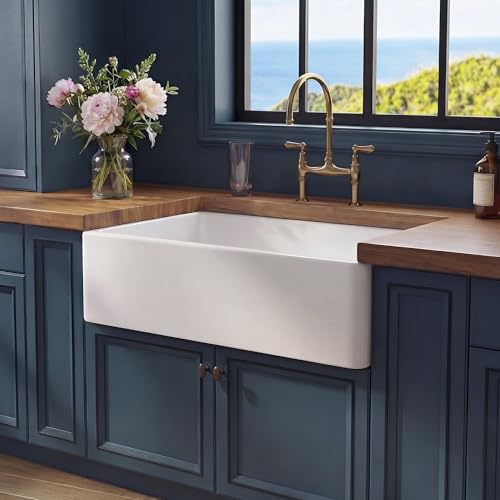
Miuara Farmhouse Sink 30 x 18 Inch White Fireclay
Badge: Best Fireclay
Strengths
- The glaze resists stain, crack, heat and scratch — the strongest surface-level résumé in this guide.
- Ceramic mass gives the bowl a solidity and thermal calm steel cannot imitate.
- Reversible apron front; the material is also the styling.
Trade-offs
- Weight: fireclay is the heaviest material here, and the apron front demands cabinet work and support.
- Ceramic is hard but not elastic — a truly violent impact is the one insult it cannot shrug off the way steel does.
- White shows the day’s splashes until wiped.
Mini spec box: Size: 30 x 18 inch · Mount: apron front (also drop-in/undermount per listing) · Material: fireclay · Bowl: single, reversible · Surface: glazed white, resistant to stain, crack, heat and scratch.
Fireclay is clay fired at high temperature until it vitrifies — becomes, in effect, a single piece of stone-like ceramic — and then glazed, so the working surface is glass fused to ceramic. That structure explains its behaviour better than any marketing: pigments cannot soak into glass, so stains sit on the surface and rinse away; the glaze is harder than the foods, pans and utensils that meet it, so scratching is minimal; and the mass beneath gives hot pans a calm, unshockable landing. The Miuara in 30-inch form is the material’s standard-bearer in this guide: a reversible single bowl whose apron front turns the material itself into the kitchen’s visual anchor.
Choose fireclay when your cooking is colourful and your project is a build or remodel that can absorb the installation honestly. Its compromises are all front-loaded — weight, cabinet work, care on install day — and its virtues are all back-loaded, arriving daily for decades in the form of a white bowl that simply refuses to keep score of what you cooked.
Best for: stain-heavy cooking, farmhouse design, renovation projects / Not suited for: quick swaps, unmodified cabinets, or anyone who drops cast iron from heights

Miuara Farmhouse Sink 33 x 18 Inch White Fireclay
Badge: Best Large Fireclay
Strengths
- All of fireclay’s material virtues across a wider, flatter-working bowl.
- Large ceramic pieces are the hardest to fire and glaze well — size here is itself a material credential.
- Apron front shortens reach; reversible profile.
Trade-offs
- The heaviest installation in the guide, without close competition.
- Requires a 33-inch farmhouse cabinet arrangement.
- The white-glaze wipe habit applies at larger scale.
Mini spec box: Size: 33 x 18 inch · Mount: apron front (also drop-in/undermount per listing) · Material: fireclay · Bowl: single, reversible · Surface: glazed white, resistant to stain, crack, heat and scratch.
Scaling fireclay is not like scaling steel. A steel bowl grows by pressing a larger sheet; a fireclay bowl grows by firing a larger ceramic body evenly, glazing it consistently and shipping it intact — each step harder than the last, which is why wide fireclay sinks are rarer and why this one’s existence at 33 inches is a statement about its maker. The ownership experience scales pleasantly in the other direction: the wider bowl takes sheet pans flat, the apron keeps the working reach short, and the glaze’s stain immunity covers the larger canvas without any change in routine.
If the material decision has already landed on fireclay and the kitchen is being built to farmhouse scale, this is the complete expression of the choice in this guide — the same substance as its sibling, with nothing diluted by the size.
Best for: large farmhouse kitchens committed to fireclay / Not suited for: standard cabinets or lightweight installs
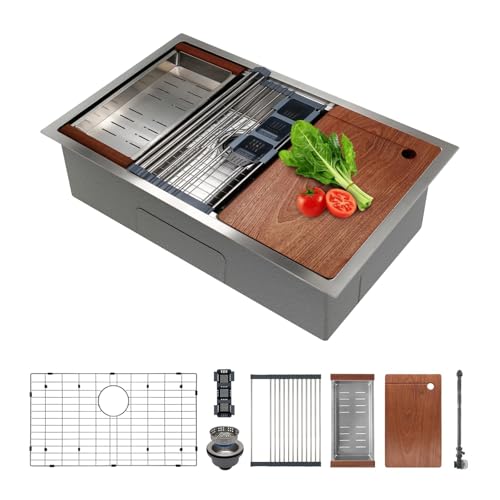
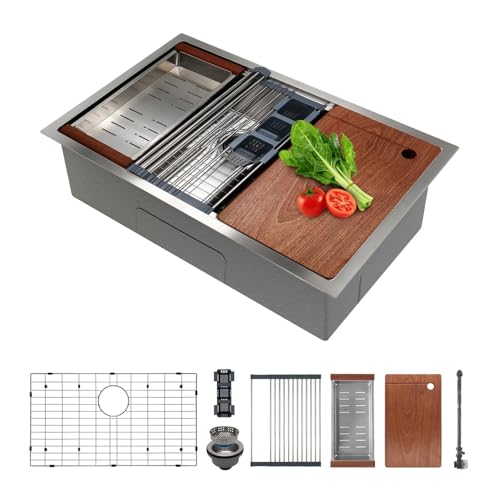
SANYCASA 30 Inch Undermount Workstation Sink, 11 Gauge
Badge: Best Heavy-Gauge Steel
Strengths
- 11-gauge (3mm) stainless steel — the material argument for steel, made at maximum thickness.
- Integrated ledge workstation format exploits steel’s formability.
- Dent resistance that keeps the surface true, and therefore easy to clean, for years.
Trade-offs
- Heavy to handle and support; a two-person install.
- Steel’s cosmetic rules still apply: wipe in hard-water homes, protect from careless abrasives.
- The ledge must suit your cooking to earn its place.
Mini spec box: Size: 30 inch · Mount: undermount · Material: stainless steel · Gauge: 11 (3mm) · Bowl: single with integrated ledge · Style: multifunctional workstation set.
If fireclay’s case is its surface, steel’s case is its structure — and the SANYCASA is that case at full strength. Stainless steel’s chromium-rich alloy resists rust from within, its toughness absorbs impacts that would chip ceramic, and at 11 gauge — three millimetres, commercial territory — the bowl acquires a permanence that reframes what a domestic sink can be. Water sounds damped by mass alone; pans land without flex; the ledge carries workstation loads like a shelf. This is what the material does when nobody asks it to be thin.
The SANYCASA also demonstrates steel’s other structural virtue: formability in service of function. A workstation ledge is a shape ceramic cannot practically take; steel takes it in stride. Buyers whose material question is really “which substance lets a sink do the most?” will find their answer standing here, three millimetres thick.
Best for: buyers who want steel’s structural case at maximum / Not suited for: light installs or ledge sceptics

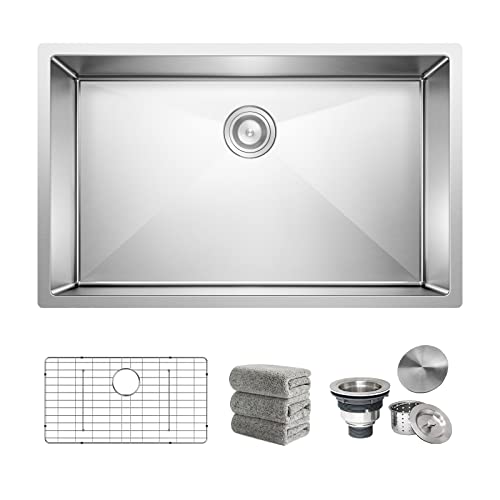
KRAUS KHU100-30 Stainless Steel 30 in Undermount Kitchen Sink
Badge: Best All-Round Steel
Strengths
- 16-gauge TRU16 steel — a named trade specification at the premium standard thickness.
- Rounded corners and channel grooves show the material finished for cleaning and drainage.
- NoiseDefend pads answer steel’s one native weakness: noise.
Trade-offs
- No ledge; a classic bowl in a workstation age.
- Brushed steel asks for the dry-wipe in hard-water homes.
- No accessories are listed in the verified data.
Mini spec box: Size: 30 inch · Mount: undermount · Material: stainless steel, TRU16 · Gauge: 16 · Bowl: single · Features: rounded corners, channel grooves, NoiseDefend pads.
Most kitchens that choose steel should choose something very much like this. The KHU100-30 pairs the material’s structural virtues — 16-gauge thickness, a named TRU16 specification — with the finishing that answers its cosmetic ones: corners a cloth can follow, grooves that keep the floor honest, pads that hush the panels. It is the material argument in balanced form, neither the extreme mass of the SANYCASA nor the lightness of the value tier, and its 30-inch undermount footprint fits the largest number of real kitchens without negotiation.
For the undecided reader of a materials guide, this is the control sample: the sink against which fireclay’s glaze and the heavier and lighter steels can all be measured. Start here, and let your specific annoyances — stains, noise, width, budget tier — argue you away from it if they can.
Best for: the majority of steel buyers; balanced material virtues in a standard size / Not suited for: workstation seekers or stain-obsessed cooks (see fireclay)

cozhao 30 Inch Undermount Kitchen Sink, 304 Stainless Steel
Badge: Best Named-Grade Value
Strengths
- The listing names its grade — 304 stainless steel, the food-contact standard this category revolves around.
- Handmade modern construction shows steel’s formability at the accessible tier.
- Drain assembly included.
Trade-offs
- 18-gauge thickness concedes mass and quiet to the 16- and 11-gauge picks.
- Sound treatment is not specified in the verified data.
- A newer brand; judge by the stated specification, which is the right way to judge any of these.
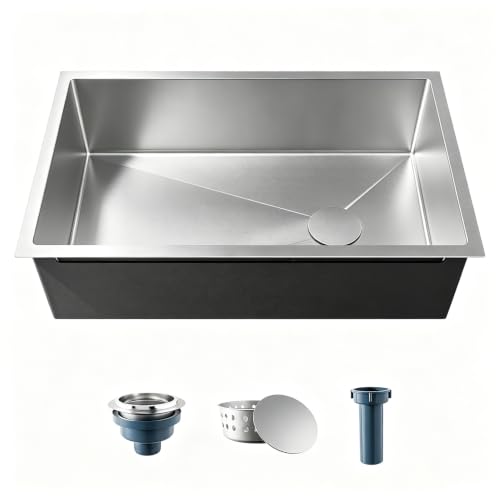
Mini spec box: Size: 30 inch · Mount: undermount · Material: 304 stainless steel · Gauge: 18 · Bowl: single · Included: drain assembly · Style: handmade, modern.
The cozhao earns its place in a materials guide for one admirable habit: it names its alloy. “304” is the grade designation buyers are taught to ask for — the chromium-nickel balance associated with food-grade corrosion resistance — and a listing that prints it invites the verification that vague “premium steel” listings avoid. Around that honest core sits a handmade, modern bowl in the standard 30-inch undermount format, with the drain assembly included so the visible hardware matches the material story.
Its tier is the accessible one, and the review keeps it there: 18-gauge steel is lighter in every sense. But as a demonstration that material honesty is available at every level of this market — and as a working sink for ordinary loads — it makes the guide’s point from the value end. The scratch-resistance angle on grades like this is pursued in Best Non Scratch Kitchen Sinks.
Best for: value buyers who still want a named 304 grade / Not suited for: heavy-load households wanting maximum gauge

MAYESAR 28 Inch Undermount Kitchen Sink, 16 Gauge
Badge: Best Compact Steel
Strengths
- 16-gauge steel at compact width — the material’s premium thickness without the footprint.
- 9-inch depth gives a small bowl a grown-up working volume.
- Brushed finish and round corners: steel’s forgiving face, easy to keep.
Trade-offs
- 28-inch width limits the largest pans.
- Handmade styling is understated.
- Deep bowls can require trap adjustment on install.
Mini spec box: Size: 28 x 18 inch · Mount: undermount · Material: stainless steel · Gauge: 16 · Depth: 9 inch · Bowl: single · Finish: brushed, round corners.
The MAYESAR closes the guide’s material survey with a useful proof: steel’s virtues are not size-dependent. At 28 inches wide it keeps the 16-gauge substance of the standard premium picks and spends its design effort on depth, producing a compact bowl that contains splashes, hides soaking and feels like equipment rather than apology. The brushed finish does what brushed finishes exist to do — absorb the visual evidence of daily life into the grain — and the rounded corners keep the small bowl’s cleaning as quick as its footprint promises.
For small kitchens, the material question often gets answered by default, with whatever thin compact sink the range offers. This pick exists to say the default is wrong: the same alloy, the same gauge and the same finishing standards are available at 28 inches, and a small kitchen deserves them exactly as much as a large one.
Best for: compact kitchens refusing a material compromise / Not suited for: cooks whose largest pans must lie flat
Comparison Table
| Pick | Material | Size | Gauge / Surface | Material signature | Link |
|---|---|---|---|---|---|
| Miuara 30 x 18 | Fireclay | 30 x 18 in | Glazed | Stain-proof surface | Check on Amazon |
| Miuara 33 x 18 | Fireclay | 33 x 18 in | Glazed | Stain-proof at scale | Check on Amazon |
| SANYCASA Workstation | Stainless steel | 30 in | 11 gauge (3mm) | Maximum structural steel | Check on Amazon |
| KRAUS KHU100-30 | Stainless steel TRU16 | 30 in | 16 gauge | Balanced all-round steel | Check on Amazon |
| cozhao 30 Inch | 304 stainless steel | 30 in | 18 gauge | Named grade, value tier | Check on Amazon |
| MAYESAR 28 Inch | Stainless steel | 28 x 18 in | 16 gauge, 9 in deep | Compact substance | Check on Amazon |
How to Choose a Kitchen Sink Material
Interrogate your own kitchen first, because materials answer annoyances, not abstractions. If your sink history is a chronicle of stains — the turmeric shadow, the berry ring, the tomato ghost — fireclay’s glaze is the only surface in this guide that ends the chronicle outright, and its installation demands are simply the price of that ending. If your history is dents, noise and a bowl that feels like a drum, steel in a serious gauge is your answer, with the gauge ladder (18 for value and lightness, 16 for the premium standard, 11 for the heavy-duty extreme) letting you dial the substance to the abuse. If your history is upkeep fatigue, weigh the geometries that ride on each material — rounded corners and grooves on steel, the wipe-clean glaze on fireclay — because maintenance is where materials are actually lived.
Then check the project’s constraints honestly. Fireclay needs a remodel’s freedom and a cabinet that can be modified and braced. Steel undermounts need a suitable counter and respect its existing cutout on replacements. Small kitchens should refuse the thin-compact default and look for full-gauge small bowls like the MAYESAR. And whatever material survives those filters, verify its specification in writing: a named grade, a stated gauge, a declared surface. Materials are the one part of a sink that cannot be upgraded later, which is why this decision deserves the guide’s length — and your patience.
There is one more filter, unfashionable and decisive: who else has to live with the choice? A material that one partner adores and the other merely tolerates will be re-argued at every stain and every clang for a decade, and the re-arguing costs more happiness than any specification saves. Walk the four tests in the dedicated section below with the whole household’s habits in mind — the teenager’s soaking pans, the toddler-era of dropped everything still to come, the grandparents’ heavy roasters at holidays. Materials are chosen once but experienced by everyone, daily; the best material for a kitchen is the one whose weaknesses the whole household can shrug at together.
How to Care for Each Material: Two Short Routines
Fireclay. Wash with warm water and ordinary detergent on a soft sponge — the glaze needs nothing stronger, ever. Wipe splashes as they happen, not because the glaze will stain (it will not) but because a white bowl shows them until you do. Avoid dropping the heaviest cast iron from height; the glaze’s one enemy is a violent point impact. That is the entire routine, for decades.
Stainless steel. Rinse after use; dry the bowl in hard-water homes to prevent mineral spots. Clean along the brushed grain with soft cloths. Keep a bottom grid on the floor if your model did not include one, and lift it weekly to rinse beneath. Treat rust-coloured marks from wet steel objects as surface deposits to be wiped away, not as the sink rusting — the alloy’s oxide skin is intact beneath them.
Troubleshooting. Problem: white mineral spotting on steel → what to do: wipe with a vinegar-dampened cloth, rinse, dry, and adopt the dry-wipe for a week to break the cycle. Problem: a grey shadow that will not lift from a white fireclay bowl → what to do: it is almost always a surface deposit, not a stain in the glaze; a baking-soda paste on a soft cloth, worked gently, lifts it without touching the glaze beneath. Problem: fine bright lines appearing on brushed steel → what to do: someone is cleaning across the grain or with an abrasive pad; switch tools and direction, and let the grain re-blend the evidence over time.
The Other Materials, Honestly Assessed
A materials guide owes you the whole landscape, even where it offers no picks. Granite composite — stone particles in resin — is genuinely hard, quiet and available in dark, forgiving colours; its trade-offs are weight, a surface that can be marked by extreme heat carelessness, and a feel some buyers find less premium than its price suggests. Enamelled cast iron pairs a heavy, silent core with a glossy enamel skin; the enamel is beautiful and stain-resistant but can chip at the rim under impact, and the weight rivals fireclay’s. Copper is the character actor: antimicrobial by nature, developing a living patina that devotees love and neat households cannot abide, and soft enough to demand a gentle owner. Solid-surface and integrated sinks erase the seam entirely but tie the bowl’s fate to the counter’s material and maker.
None of these is a bad material; each is a bet on a different virtue. They are not linked in this guide because this guide’s verified pool contained fireclay and steel — and because, for most kitchens, the contest genuinely does narrow to those two: the glaze that cannot stain, or the alloy that can do everything else. If your heart is set on one of the others, buy it with its trade-offs in writing, from a maker who states them as plainly as the picks here state theirs. The material-by-material thinking in Best Materialfor Kitchen Sinks continues this survey from a second angle.
Material and the Life of the Kitchen Around It
Material choices echo. A fireclay apron front pulls a kitchen toward farmhouse fittings, bridge faucets and warm metals, and it will make a hyper-modern tap look like a guest who arrived at the wrong party. Brushed steel is the great diplomat: it sits under stone, wood and composite counters without arguing, pairs with any faucet finish in its family, and lets the rest of the room change around it across decades of redecoration. Weight echoes too — into the cabinet, the floor and the install day — and sound echoes most of all: a kitchen of hard surfaces amplifies a thin steel bowl, while mass, pads and ceramic calm it. Choose the material whose echoes your room can absorb, and the sink stops being an object in the kitchen and becomes part of its architecture. That, in the end, is what “best material” means: not the winner of a laboratory contest, but the substance your particular kitchen can live with longest and complain about least.
Heat, Impact, Stain, Sound: The Four Tests Every Material Faces
It helps to grade materials the way a kitchen will: not by brochures, but by the four insults a sink absorbs daily. Heat first. A boiling pot, a roasting tray straight from the oven, a kettle’s dregs — fireclay takes them with ceramic indifference, its glaze unbothered by temperatures that would make lesser surfaces flinch; steel takes them too, expanding and contracting without complaint, because metal’s relationship with heat is elastic rather than brittle. Honours are close to even, with fireclay’s surface the calmer of the two. Impact second — and here the order reverses. Steel yields microscopically and survives; its worst outcome is a dent, and thick gauges make even that unlikely. Ceramic does not yield: within its generous limits it is flawless, beyond them it chips, and the difference between those outcomes is the height and hardness of what falls. Households with heavy cast iron and higher shelves should weight this test heavily.
Stain third, and fireclay wins it outright, for the structural reason this guide keeps returning to: glass does not absorb. Steel’s brushed surface can hold pigment in its grain until cleaned and will shadow under standing tomato or tea if neglected — recoverable, but a chore fireclay simply never assigns. Sound fourth: mass is quiet, and both materials at their best are massive — fireclay by nature, the SANYCASA’s steel by deliberate thickness, the padded Kraus by engineering. Thin steel is the only genuinely loud option in this landscape, which is why gauge and pads recur in this guide like a chorus. Score your own kitchen’s four tests honestly — which insult do you deliver most? — and the material ranking writes itself: the glaze for the staining kitchen, thick steel for the dropping kitchen, either for the kitchen that mostly boils pasta and minds its manners.
Material Myths That Cost Buyers Money
Three myths circulate in this category, and each one misdirects real budgets. The first: that stainless steel is a single thing. It is a family — of grades, gauges and finishes — whose members differ more from each other than steel differs from some rival materials; the distance between an unnamed 18-gauge bowl and the 11-gauge SANYCASA is a distance of kind, not degree, and buyers who treat “stainless” as a complete specification have stopped reading one line too early. The second myth: that white sinks are impractical. White fireclay is, on the evidence of its glaze, the most forgiving surface in this guide against the thing owners actually fear — permanent staining; what it shows is temporary splashes, and confusing visibility with vulnerability has steered thousands of stain-prone cooks toward surfaces that stain quietly and permanently instead.
The third myth is the subtlest: that the premium material is the one with the premium name. Copper, composite, ceramic, steel — each has a tier inside it where the making is honest and a tier where the name is doing the work. The defence is the same at every tier and in every material, and it is the method of this guide: demand the specification in writing. Grade, gauge, surface, construction. A maker who prints them has made a claim you can check; a maker who prints adjectives has made a claim you can only believe. Materials do not lie, but descriptions of them can, and the distance between the two is exactly the distance a careful buyer travels before paying.
The Lifetime Ledger: Material, Longevity and What Happens at the End
A sink is one of the longest-lived objects in a house, and its material decides what that longevity costs the world and the owner. Stainless steel’s ledger is unusually clean: it is made substantially from recycled content in most modern production, it is fully recyclable at the end of its life, and its working life — in the gauges in this guide — is measured in decades, which is the greenest property any product can have. A steel sink bought once and used for thirty years has a smaller footprint than a “natural” sink replaced three times. Fireclay’s ledger reads differently: ceramic firing is energy-intensive at birth, but the product then serves for generations — farmhouse sinks routinely outlive the kitchens built around them and are inherited by the next renovation like architectural features. Its end-of-life is inert landfill rather than recycling, a real but distant cost weighed against an exceptionally long service.
For the owner, the lifetime maths are simpler and point the same way for both materials: buy the substance once. The expensive sink, environmentally and financially, is the one that has to be replaced — the thin bowl that dents into ugliness, the surface that stains into embarrassment, the format that forces a second renovation. Every pick in this guide was chosen to be a final purchase for its kitchen: materials with no coating to fail, no finish to wear through, no structural shortcut waiting for year seven. That is the deepest sense in which the material question matters — not the first year, when everything is beautiful, but the twentieth, when only the honest materials still are.
The Material Decision in Three Questions
If the full survey feels like a lot of evidence for one purchase, it compresses honestly into three questions. First: what does your cooking do most — stain, drop, or scorch? Staining points at fireclay’s glaze with very little argument left over. Dropping points at steel, the thicker the better, because elasticity is the only true answer to gravity. Scorching is the one test both materials pass, so let it abstain. Second: what is your project — a build, a remodel, or a replacement? Builds and remodels can pay fireclay’s installation price inside work already happening; replacements should almost always stay with steel undermounts in standard sizes, where the material decision can be made without reopening the cabinetry question. Third: what is your temperament at the sink — wipe as you go, or clean in battalions? Wipers thrive with either material. Battalion cleaners should choose fireclay, whose glaze forgives a week of neglect in a single session, or steel with a grid and rounded corners, whose geometry keeps the battalion’s work shallow.
Answer the three and the shortlist usually collapses to one or two names, at which point the remaining decision is size and tier rather than substance — the ordinary, manageable kind of choosing. What the three questions protect you from is the category’s one expensive error: a beautiful sink in a material whose weaknesses are precisely your habits, bought because a photograph argued better than your own kitchen did. The six picks in this guide cover the realistic outcomes of the three questions; trust your answers over anyone’s display, including ours.
Common Buying Mistakes
- Choosing material by photograph — white bowls and brushed steel both photograph beautifully; their ownership stories differ completely.
- Ignoring the installation the material demands — fireclay’s cabinet work is part of its price, in every sense.
- Treating gauge as a detail within steel; it is a material decision that changes sound, strength and feel.
- Accepting unnamed steel when named grades and trade specifications are available at every tier in this guide.
- Buying for the cook you wish you were — stain-prone, pan-dropping reality should pick the material, not aspiration.
- Forgetting the faucet and counter pairing until the material’s echoes become arguments.
Final Recommendation
If staining is your kitchen’s defining problem and your project can carry the install, choose fireclay — the Miuara 30 x 18 for standard farmhouse runs, its 33-inch sibling for grander ones — and enjoy the only surface here that simply refuses to keep score. For everyone else, stainless steel is the material answer, tiered by gauge: the KRAUS KHU100-30 as the balanced standard, the SANYCASA above it in mass, the cozhao below it in tier with its grade honestly named, and the MAYESAR proving the standard survives at compact size. Decide by your dominant annoyance, verify the specification in writing, and the material question — the one decision you cannot revisit cheaply — will have been made properly.
One last encouragement, whichever substance you choose: commit to it fully. The households happiest with their sinks a decade on are rarely the ones that found a theoretically perfect material; they are the ones that chose a good material for stated reasons, installed it properly, learned its one small routine, and then stopped comparison-shopping their own kitchen. Both families in this guide — the fired glaze and the drawn alloy — reward that commitment completely. Pick yours, install it once, and let the material do the quiet, daily work it was made for.
Frequently Asked Questions
What is the most durable kitchen sink material?
It depends on the threat. Against staining, fireclay’s glaze is the most durable surface here — pigments cannot penetrate it. Against impact and denting, thick stainless steel wins, because it yields slightly instead of chipping and its brushed grain hides the evidence. Against time itself, both materials in this guide are decades-long; the choice is which kind of durability your kitchen actually tests. Think of it as choosing which accident you are insuring against: the slow, daily accident of staining, which fireclay renders impossible, or the sudden, rare accident of the dropped Dutch oven, which steel renders survivable. Most kitchens, audited honestly, commit the first accident a thousand times for every once they commit the second — which is why this guide’s top material recommendation leans toward the glaze for cooks, and toward steel for everyone whose kitchen life is more physical than colourful.
Does stainless steel rust?
Proper stainless grades resist rust through a self-repairing chromium oxide layer — one reason named grades like the cozhao’s 304 and named specifications like TRU16 matter. Rust-coloured marks do occasionally appear on stainless sinks, but they are almost always surface deposits left by wet iron or steel objects resting in the bowl, and they wipe away; the sink itself is not rusting.
Is fireclay better than stainless steel?
On staining, yes, clearly. On weight, installation ease, format variety and impact tolerance, steel answers back just as clearly. The guide’s position is that “better” is a property of the match, not the material: fireclay for stain-driven cooks in remodels, steel for almost everyone else, with gauge deciding the tier inside steel.
What gauge of stainless steel should I choose?
Sixteen gauge is the premium standard for most homes — dent-resistant, quiet and solid. Eighteen gauge suits lighter use and value tiers, especially with a bottom grid. The 11-gauge SANYCASA shows the heavy extreme, worthwhile for workstation loads and the heaviest cookware. Lower number, thicker steel, in every case.
Can a fireclay sink chip?
Fireclay is hard and its glaze resists scratching, heat and staining, but ceramic does not bend: a sufficiently violent point impact — heavy cast iron dropped from height onto an edge — is the one insult that can chip it. Ordinary daily use, including heavy pans handled normally, is well within its design life, which is why it has been a sink material for generations. Context matters here: the same drop that might chip a fireclay edge would dent a thin steel bowl and crack many countertop materials, so fireclay is not fragile — it is simply honest about being ceramic, and households that handle their heaviest cookware with ordinary care will never meet its limit.
Which material is easiest to maintain?
Fireclay needs the least specialised care — ordinary washing, nothing more — but shows splashes on white until wiped. Stainless asks for a quick dry in hard-water areas and grain-direction cleaning, and rewards it by hiding fine wear in its finish. Both are easy; they are easy differently, and the routines are spelled out in the care section above. The deciding question is which small habit your household will actually keep: the household that reliably wipes as it goes will find fireclay effortless, while the household that cleans in weekly sessions often prefers steel’s discretion, because brushed steel keeps a week’s secrets better than white glaze does.
Does sink material affect noise?
Profoundly. Ceramic’s mass is naturally quiet. Steel’s noise depends on thickness and treatment: thin, unpadded bowls drum, while heavy gauges and fitted sound pads — the NoiseDefend models in this guide — bring steel close to ceramic calm. In open-plan kitchens with hard surfaces, treat noise as a material specification, not an afterthought. A practical test in any showroom: a knuckle rap — rap each candidate bowl and listen for the difference between a ring and a thud. Your ears are measuring mass and dampening at once, and they will not deceive you the way a finish photograph can.