Disclosure: topratedkitchenware.com is reader-supported. When you buy through links on our site, we may earn an affiliate commission from Amazon and other retailers, at no extra cost to you.
Where to buy
The six sinks below are the verified picks behind this guide to the best sinks for kitchen remodel projects — bowls chosen to survive contact with real timelines, real cabinets, and real countertop templating. Each name links to its Amazon listing, where you can check the latest price on Amazon, confirm dimensions and inclusions, and read the newest owner feedback. Start with the remodel pick that adds the most function per project dollar of effort: Check on Amazon.
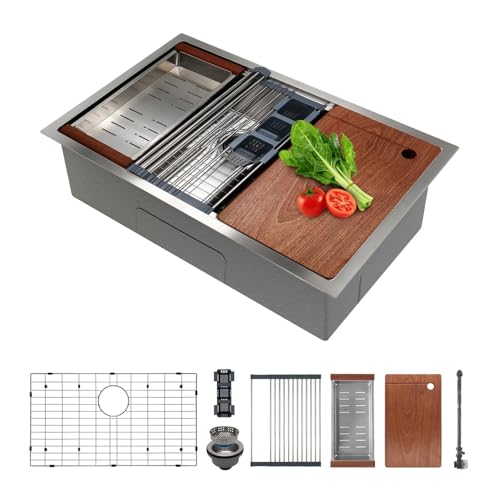
- KRAUS KWU110-32 32 Inch Undermount Workstation Kitchen Sink
- KRAUS KHU100-32 32 Inch 16 Gauge Undermount Kitchen Sink
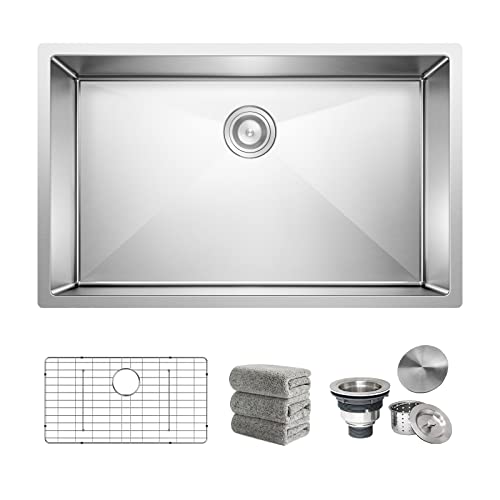
- Oxwiser 30×18 Inch Undermount Kitchen Sink Set, 16 Gauge, 5 Item Bundle
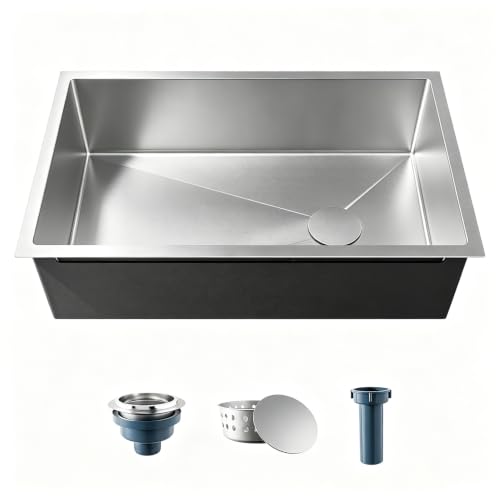
- Delironexu 30 Inch Undermount Kitchen Sink, 18 Gauge, Drain Kit Included
- Oxwiser 32×18 Inch Undermount Kitchen Sink Set, 16 Gauge, 5 Item Bundle
- KRAUS KHU640-33 33 Inch 18 Gauge Undermount Kitchen Sink
Read the full guide ↓ for the remodel sequencing that protects your schedule — sink on site before templating, cabinet measured before ordering — plus the per-pick reasoning, the buying guide, and the install and care routine.
A remodel changes what “best sink” means. In a finished kitchen, the best sinks for kitchen remodel projects are the ones that fit the cabinets you are keeping or the ones you have ordered, arrive undamaged before the countertop fabricator needs them, install without inventing new problems for the plumber, and then serve for a decade without becoming the kitchen’s weak point. A showroom-pretty bowl that misses the templating date is a bad remodel sink; a mainstream, well-specified bowl that slots into the sequence is a great one. This guide compares six verified undermount single bowls — two Kraus designs in two widths, two complete Oxwiser bundles, a value handmade bowl, and a 33 inch wide option — and reads each one the way a remodel actually unfolds: cabinet first, counter second, plumbing third, daily life for years after.
The picks span the remodel situations that matter. Keeping standard cabinets? The 30 inch Oxwiser set and the Delironexu serve you. Building new wide cabinetry? The 32 inch workstation and its plain-bowl sibling, plus the 32 inch bundle, open up. Replacing everything including the layout? The 33 inch KHU640-33 is on the table. Around the reviews you will find a comparison table, a buying guide organised by remodel phase rather than by product, and a how-to layer covering the installation sequence, the temporary-sink survival tactics every remodel household needs, and care that keeps the new bowl looking new. The close cousin of this search — the full renovation, where walls and layouts move too — is treated in our companion guide to Best Sinks For Kitchen Renovation, and the two share most finalists for good reason.
Key Takeaways
- Order the sink early and have it on site before countertop templating; the fabricator needs the sink or its exact template.
- Measure the cabinet you are keeping before falling for a width; new cabinets free the 32 and 33 inch picks, kept cabinets usually mean 30 inches.
- All six picks are undermount single bowls in stainless steel, spanning 16 and 18 gauge, plain, bundled, and workstation formats.
- Complete bundles (Oxwiser) remove parts coordination from a schedule that has enough coordination already.
- Decide the reveal, the faucet, and the disposal stack while the plan is still paper; all three are expensive to improvise in stone.
- Inspect the sink the day it arrives — shipping damage found at templating costs a week; found at delivery it costs an email.
In this guide
Quick Picks
| Pick | Badge | Size and build | Link |
|---|---|---|---|
| KRAUS KWU110-32 Workstation Sink | Best Overall for Remodels | 32 inch, 16 gauge TRU16 steel, ledge, cutting board and roll-up rack included | Check on Amazon |
| KRAUS KHU100-32 | Best for Easy Cleaning | 32 inch, 16 gauge TRU16 steel, rounded corners, NoiseDefend pads | Check on Amazon |
| Oxwiser 30×18 Sink Set | Best Complete Kit | 30 x 18 inch, 16 gauge, 5 item bundle with grid and drain assembly | Check on Amazon |
| Delironexu 30 Inch Undermount Sink | Best Value Pick | 30 x 18 x 9 inch, 18 gauge, handmade design, drain kit included | Check on Amazon |
| Oxwiser 32×18 Sink Set | Best Large Kit | 32 x 18 inch, 16 gauge, 5 item bundle with grid and drain assembly | Check on Amazon |
| KRAUS KHU640-33 | Best Extra Wide | 33 inch, 18 gauge steel, rounded corners, NoiseDefend pads | Check on Amazon |
The badges are remodel roles: the workstation for kitchens gaining prep space, the bundles for schedules that need parts certainty, the value bowl for budget-led projects, the wide bowl for full rebuilds. If your remodel keeps a compact footprint, the sizing discipline behind these picks is explored further in our guide to Best Small Kitchen Sinks.
How These Picks Were Chosen
Remodel fitness was the first screen: every pick is a mainstream undermount design with published dimensions, standard drain placement, and availability that does not depend on a single fragile supply line, because a remodel cannot wait on a back-ordered sink while a fabricator’s slot evaporates. Specifications were verified from product data — size, gauge, included components, corner design, sound treatment — and owner feedback was read specifically for remodel-relevant patterns: packaging survival, template accuracy, installer comments, and how the bowl behaves once the project dust settles.
We also weighted decision completeness. A remodel asks a household to make hundreds of choices; picks that close their own questions — a bundle that includes the grid and drain, a workstation that includes its board and rack — earn their place by reducing the project’s open loops. Bare bowls from an established maker earn theirs by refinement and track record. What this guide does not do is invent hands-on testing: it is a research-led comparison, and the reviews frame performance through specification and reported experience, with the project’s sequencing advice drawn from how remodels actually succeed and fail.
The 6 Best Sinks for Kitchen Remodel Projects, Reviewed

KRAUS KWU110-32 32 Inch Undermount Workstation Kitchen Sink
Badge: Best Overall for Remodels
Strengths
- Workstation ledge adds prep capacity without adding cabinets — pure remodel leverage.
- Cutting board and roll-up rack included, so the format works the day the kitchen reopens.
- 16 gauge TRU16 steel with NoiseDefend soundproofing: a durable, quiet 32 inch bowl.
Trade-offs
- Needs new or wide cabinetry; most kept-cabinet remodels cannot take 32 inches.
- Ledge tracks add a cleaning edge.
- Premium tier within a budget that has many claimants.
Mini spec box: Mount: undermount. Size: 32 inch. Material: 16 gauge TRU16 stainless steel. Bowl: single bowl with integrated ledge. Included: cutting board, roll-up rack. Features: NoiseDefend soundproofing.
A remodel is the one moment when a kitchen’s workflow can be redesigned rather than endured, and the KWU110-32 is the pick that redesigns it. The workstation ledge effectively adds a prep station the floor plan did not have: rinsing, chopping, and staging all move onto the bowl, which matters most in the remodels that cannot add counter length — galleys gaining new cabinets, L-shaped kitchens keeping their footprint. Because the board and rack are included, the redesigned workflow starts on day one, not after a follow-up order.
Project-wise, it asks for the standard workstation discipline: confirm the wide cabinet in the cabinet order, have the sink on site for templating, and plan the disposal stack under a bowl that will work hard. The 16 gauge TRU16 construction and NoiseDefend treatment make it a decade-grade choice, which is the correct horizon for money spent inside a remodel. If your project includes new wide cabinetry and your cooking justifies a prep system, this is the remodel’s highest-leverage sink; if cabinets are being kept at standard width, the same ambition should be redirected to the 30 inch picks below.
Best for: remodels with new wide cabinets and prep-heavy cooking. / Not suited for: kept standard cabinets or ledge-sceptical households.

KRAUS KHU100-32 32 Inch Undermount Kitchen Sink
Badge: Best for Easy Cleaning
Strengths
- 32 inch bowl with rounded corners: the remodel’s low-maintenance flagship.
- 16 gauge TRU16 steel, channel grooves, and NoiseDefend pads.
- Established design with the track record remodelers trust mid-project.
Trade-offs
- No ledge and no included accessories; the grid is a separate line item.
- Wide cabinet required.
- Plain styling — the drama must come from elsewhere in the design.
Mini spec box: Mount: undermount. Size: 32 inch. Material: 16 gauge TRU16 stainless steel. Bowl: single bowl, rounded corners. Features: channel drain grooves, NoiseDefend sound pads.
Many remodels are not about theatre; they are about ending a decade of small daily irritations. The KHU100-32 is the pick for that brief. Its rounded corners abolish the grey corner buildup of the old sink, its drain grooves end the pooling that made the old bowl look tired, and its padded 16 gauge body ends the drumming that made the old kitchen loud. At 32 inches it also ends the pan problem for households gaining wider cabinets. Each of those endings is modest; together they are what a successful remodel feels like at month six.
As a project component it is equally obliging: a mainstream design whose template fabricators know, standard plumbing geometry, and nothing proprietary to strand the schedule. The omissions are the honest ones — no workstation, no bundle — and they are easily closed with a grid order placed alongside. For remodels whose design energy is spent on cabinets and stone, this bowl provides the quiet, competent centre the rest of the kitchen deserves.
Best for: new-cabinet remodels that prize low upkeep and quiet. / Not suited for: standard-width kept cabinets or workstation seekers.

Oxwiser 30×18 Inch Undermount Kitchen Sink Set
Badge: Best Complete Kit
Strengths
- Five item bundle — sink, grid, drain assembly, drain cap, towel — closes the sink’s parts list in one order.
- 16 gauge single bowl in the 30 x 18 inch size that fits kept standard cabinets.
- Grid included means the new bowl is protected from its first day of use.
Trade-offs
- Standard size; big-pan households with new wide cabinets should take the 32 inch set.
- Grid lifts out for deep cleans.
- Utilitarian styling.
Mini spec box: Mount: undermount. Size: 30 x 18 inch. Material: 16 gauge stainless steel. Bowl: single bowl. Bundle: sink, bottom grid, drain assembly, drain cap, towel (5 items).
The Oxwiser 30 inch set is the remodel pick for the most common project in the country: new counters, kept or standard cabinets, a schedule with no slack. Its bowl is the proven 30 by 18 inch single in 16 gauge steel, and its bundle is a project-management gift — the grid, the drain assembly, and the finishing pieces arrive together, verified to belong together, so the sink’s line on the project plan can be marked complete the day the box lands. Anyone who has watched a countertop install stall over a missing drain flange will understand why that completeness ranks as a headline feature here.
In the finished kitchen it behaves exactly as a family bowl should: pans fit, the grid keeps the floor fresh, and the single volume handles the week’s rhythm from pasta night to baking day. The limits are the standard size’s limits, and they are acceptable precisely because the standard size exists to serve the standard cabinet. Remodels keeping their cabinetry should start their shortlist here and only leave if the pan test or the cooking style demands otherwise.
Best for: countertop-led remodels and kept-cabinet projects on a schedule. / Not suited for: wide-cabinet builds that can take more bowl.

Delironexu 30 Inch Undermount Kitchen Sink
Badge: Best Value Pick
Strengths
- Full remodel dimensions — 30 x 18 x 9 inch — at the value end of the list.
- Handmade design and brushed finish deliver the current look for a refresh project.
- Drain kit included; the box is honest about containing no further accessories.
Trade-offs
- 18 gauge steel: lighter sound and dent resistance.
- Squared corners need a brush routine in the new kitchen.
- Add a grid separately to protect the floor.
Mini spec box: Mount: undermount. Size: 30 x 18 x 9 inch. Material: 18 gauge stainless steel. Bowl: single bowl, handmade design. Finish: brushed. Included: drain kit (no additional accessories).
Every remodel has a budget frontier, and the Delironexu is for projects that would rather spend theirs on stone, cabinets, or the faucet — the elements hands and eyes meet most — while still landing a proper sink. The specification protects the essentials: full 30 inch width, a real 9 inch depth, the handmade profile that makes a refreshed kitchen photograph as current, and the drain kit in the box. What it spends less on is steel thickness, and in a careful household that is a rational allocation of the project’s money.
The remodel-specific virtue is schedule simplicity: a standard footprint, standard plumbing, nothing exotic for the fabricator. The ownership caveats are the class caveats — expect more sound than the padded 16 gauge picks (a grid helps), expect the corners to join the cleaning routine, and place cookware rather than dropping it. Rental remodels, first-home refreshes, and phased projects where the sink may be revisited in a later phase will find this the sensible allocation; forever-kitchen projects should weigh the 16 gauge picks before deciding the savings are worth it.
Best for: budget-led remodels, rentals, and phased projects. / Not suited for: buyers seeking the quietest, thickest bowl.

Oxwiser 32×18 Inch Undermount Kitchen Sink Set
Badge: Best Large Kit
Strengths
- The complete Oxwiser bundle at 32 x 18 inches for new wide cabinetry.
- 16 gauge steel with grid and drain hardware included and matched.
- One order closes the sink, its protection, and its plumbing parts.
Trade-offs
- Wide cabinet required — confirm in the cabinet plan, not at delivery.
- Large grid is a two-hand lift for deep cleaning.
- No workstation ledge.
Mini spec box: Mount: undermount. Size: 32 x 18 inch. Material: 16 gauge stainless steel. Bowl: single bowl. Bundle: sink, bottom grid, drain assembly, drain cap, towel (5 items).
The 32 inch Oxwiser set is the bundle logic applied to the new-cabinet remodel. Households ordering wider cabinetry gain the big-pan floor; the set ensures that the first thing the new bowl receives is not a scratch but a grid, and that the plumber’s visit needs nothing the box did not bring. In a project where the cabinet order, the stone, and the appliances are all in flight simultaneously, a sink that arrives as a closed system is worth more than its parts.
Against the same-size Kraus bowls, the trade is character: the Oxwiser gives you completeness and a handmade-style bowl; the KHU100-32 gives you rounded corners and an established maker’s plain-bowl refinement; the KWU110-32 gives you the workstation. All three are defensible remodel choices at 32 inches, and the deciding voice should be your cleaning tolerance and your prep style rather than any specification hair. Verify the wide cabinet in writing in the cabinet plan — that single confirmation is this pick’s whole risk profile.
Best for: new-cabinet remodels wanting a large bowl as a closed system. / Not suited for: kept standard cabinets.

KRAUS KHU640-33 33 Inch Undermount Kitchen Sink
Badge: Best Extra Wide
Strengths
- 33 inch single bowl for full-rebuild remodels with a wide cabinet run.
- Rounded corners resist buildup; channel grooves manage drainage at width.
- NoiseDefend pads keep a big bowl’s acoustics civilised.
Trade-offs
- 18 gauge steel where the 32 inch Kraus bowls use 16.
- Only suits remodels whose cabinet plan is genuinely wide.
- Grid is a separate — and at this size, essential — purchase.
Mini spec box: Mount: undermount. Size: 33 inch. Material: 18 gauge stainless steel. Bowl: single bowl, rounded corners. Features: channel grooves for draining, NoiseDefend pads.
The KHU640-33 belongs to the remodels that change everything: walls move, the sink run is re-planned, and the cabinet order is written from a blank page. In that context, 33 inches of bowl is a design decision the project can actually honour, and the payoff is a washing station that absorbs holiday-scale cooking, preserving days, and two-cook evenings without choreography. Kraus’s rounded corners and drain grooves keep the wide floor maintainable, and the padding keeps it quiet.
The specification note is the same one this model carries everywhere: 18 gauge steel, chosen to deliver the width at its tier. Inside a full rebuild, that trade should be made consciously against the 16 gauge 32 inch picks — an inch of width against a tier of steel — and households that drop cookware should take the steel. Households that place it, and that will use the width weekly, will never regret the floor space. Either way, this pick is a plan-first purchase: cabinet run, countertop span, and disposal stack all confirmed before the order.
Best for: full-rebuild remodels with wide runs and high-volume cooking. / Not suited for: kept cabinets or rough-handling households.
Comparison Table
| Pick | Size | Gauge | Remodel role | Link |
|---|---|---|---|---|
| KRAUS KWU110-32 | 32 inch | 16 gauge | Workstation for new wide cabinets | Check on Amazon |
| KRAUS KHU100-32 | 32 inch | 16 gauge | Low-upkeep flagship | Check on Amazon |
| Oxwiser Set 30 | 30 x 18 inch | 16 gauge | Complete kit for kept cabinets | Check on Amazon |
| Delironexu Undermount | 30 x 18 x 9 inch | 18 gauge | Value refresh bowl | Check on Amazon |
| Oxwiser Set 32 | 32 x 18 inch | 16 gauge | Complete kit, large bowl | Check on Amazon |
| KRAUS KHU640-33 | 33 inch | 18 gauge | Full-rebuild maximum width | Check on Amazon |
How to Choose a Sink During a Kitchen Remodel
Let the remodel’s scope choose the size class before you look at models. Keeping cabinets fixes your ceiling — usually the 30 inch class — and that is not a deprivation: the 30 inch picks here include a complete 16 gauge bundle and a deep value bowl, either of which will out-serve the tired double bowl most remodels are replacing. Ordering new cabinets opens 32 inches, and a full layout change opens 33; in both cases, write the sink’s minimum cabinet size into the cabinet order itself, so the two documents cannot drift apart.
Then sequence the purchase inside the project calendar. The sink should be ordered when cabinets are ordered, delivered and inspected before templating, and physically present — or its manufacturer template in hand — when the fabricator measures. Decide the reveal style with the fabricator at the same visit. Choose the faucet in the same week, because its hole pattern and reach belong to the same countertop conversation. And settle the under-sink stack on paper: bowl depth, disposal, trap, and any pull-out storage compete for one cabinet, and the remodel is the last cheap moment to arbitrate between them.
Finally, allocate the sink’s share of the budget by contact frequency. You will touch the faucet more, but you will see the sink’s finish every day and hear its steel at every wash. Within this list, that argues for 16 gauge where the budget allows, for the grid that protects the floor, and for sound treatment — the quality our sound-focused research treats in depth at Best Sound Deadened Kitchen Sinks — in any kitchen open to living space. The value pick remains the right answer when the budget’s frontier is elsewhere; the mistake is not choosing it, but choosing it unknowingly.
How a Remodel Sink Gets Installed — and How to Survive the Interval
The installation sequence inside a remodel runs: cabinets set and levelled; sink delivered and inspected; countertop templated with the sink or its template present; counter fabricated with the cutout and faucet holes; sink sealed and supported beneath the counter (rails or harness, silicone at the flange); counter set; drain, disposal, and faucet connected; leak test with dry paper towels at every joint; and a first-week recheck of the trap connections once the system has thermal cycles behind it. Your role in that sequence is logistics: be the person who knows where the sink is, that it is undamaged, and that its hardware box is complete, because each trade assumes another trade verified it.
Surviving the interval is its own craft. Most remodels include days or weeks without a kitchen sink, and the households that cope best set up a temporary station on day one: a utility tub or a bathroom-based washing routine, a kettle for hot water, a dish rack that drains into a basin, and a deliberate shift to low-washing cooking — sheet-pan dinners, grill nights, and the occasional takeaway treated as project infrastructure rather than indulgence. Keep the old sink if it comes out intact; plumbed into a laundry area later, it is a gift to your future self.
After the install, the care routine is the standard stainless liturgy: soft sponge, dish soap, wipe along the grain, rinse acids promptly, dry at day’s end, baking soda paste for film, and a grid between the steel and the cast iron. Troubleshooting in the new kitchen: Problem: a faint drip appears under the new sink in week one → dry everything, identify the joint with a paper towel, and have the plumber reseat it while the project warranty conversation is still warm. Problem: the new bowl seems loud → confirm the sound pads and the disposal mount before blaming the sink. Problem: water spots show on the new finish → that is the dry-down habit not yet formed; two weeks of evening wipes and the bowl settles into its even look.
The Remodel Decisions That Outlive the Sink Choice
Three remodel decisions will matter longer than which of these six bowls you pick, and a good guide should say so. The first is the countertop material and its cutout: the sink is captive to it, so a durable bowl in a standard size protects you if a future replacement is ever needed. The second is the cabinet itself — its width class decides every future sink you can own, which is an argument for ordering the widest sink base the layout honestly allows even if today’s bowl is a 30. The third is plumbing position: a drain centred where the bowl wants it, with a trap arrangement that leaves usable cabinet space, will be appreciated at every under-sink reach for decades.
Notice that all three decisions reward the mainstream. Standard sizes, standard drains, and standard mounts are not a failure of imagination; in a remodel they are how you buy future flexibility with today’s money. The picks in this guide were chosen inside that philosophy — every one is a standard-format undermount with published dimensions and replaceable hardware — so that the boldest choice available to you, the workstation’s workflow or the 33 inch bowl’s scale, is bold in use rather than in infrastructure.
Budgeting the Sink Inside a Remodel: Where the Money Actually Goes
Households are often surprised that the sink’s purchase price is the smallest part of its remodel cost. The full accounting includes the countertop cutout work the sink dictates, the faucet that belongs to the same conversation, the drain and disposal hardware, the plumber’s connection visit, and — the line nobody budgets — the cost of delay if any of those pieces is missing when its trade is on site. Read against that accounting, the bundle picks in this guide are easier to understand: the Oxwiser sets convert several uncertain line items into one known box, and the workstation’s included board and rack remove two accessory purchases from the project’s tail. Conversely, a bare bowl’s apparent savings should be totalled honestly, with its grid and any drain hardware added, before it is declared the cheaper route.
The other budgeting truth is about tiers. Moving from an 18 gauge value bowl to a 16 gauge bowl, or from a plain bowl to a workstation, costs a modest increment inside a five-figure remodel, while living with the lesser choice costs a small irritation thousands of times. That asymmetry argues for buying the sink one tier above your instinct when the project’s total can absorb it — and for being ruthless in the opposite direction when it cannot, because the Delironexu-class value bowl, knowingly chosen, serves a careful household perfectly well. What the budget should never fund is indecision: a sink changed after templating pays for two cutouts’ worth of consequences. Decide early, decide in writing, and let the project’s money flow to the decisions that are still genuinely open.
Countertop Pairings: What Each Surface Wants From the Sink
Because every pick here is an undermount, the countertop conversation is really about edges and honesty. Quartz and granite — the remodel’s default stones — take undermount cutouts beautifully and show a polished interior edge that becomes part of the sink’s visible finish; agree the reveal with the fabricator and inspect the cut edge at templating, because you will see it daily at sink height. Butcher block offers warmth and a forgiving, repairable rim, at the price of disciplined sealing around the cutout where water lives. Solid surface materials allow the most integrated looks. Laminate, the budget classic, is the one common surface that argues against undermount entirely — its core cannot live at a wet rim — so a laminate remodel should either upgrade the counter plan or step out of this guide’s undermount field entirely.
Sound belongs in the pairing conversation too, especially where the new kitchen opens to living space. A stone counter transmits less vibration than a thin one, a padded bowl transmits less than a bare one, and the combination decides whether the disposal is a background event or a household announcement; shoppers who rank quiet near the top of the brief will find the dedicated treatment in our notes on Best Sound Proof Kitchen Sinks worth the detour before the cabinet order locks the question. The general principle is that a remodel is a system being assembled once: sink, stone, faucet, and disposal should be chosen as one acoustic and visual composition, not as four separate bargains.
Keeping Your Cabinets? The Refresh Remodel Playbook
A large share of remodels keep their cabinet boxes — they are sound, the layout works, and the money is better spent on counters, fronts, and fixtures. That decision writes the sink brief by itself. The cabinet’s interior width fixes the size class, almost always the 30 inch picks in this guide. The existing plumbing position usually survives, which keeps the plumber’s scope to connections rather than relocations. And the project’s drama concentrates where it should: on the new countertop, whose templating is the one appointment the sink must attend. The Oxwiser 30 inch set is the natural protagonist of this playbook — standard size, complete parts, a grid to protect the new bowl — with the Delironexu as the value alternate when the refresh budget is tight.
Two refresh-specific traps deserve naming. The first is assuming the old sink’s cutout tells you the new sink’s size: drop-in cutouts and undermount cutouts are different geometries, and the new counter will be cut for the new sink regardless, so choose the bowl by the cabinet and the cookware, not by the hole being discarded. The second is forgetting that a deeper new bowl changes the under-cabinet stack against a disposal and trap that were fitted to the old bowl’s depth. Measure the stack with the new bowl’s depth in hand before the counter is cut, while the arbitration is still free. A refresh that handles those two traps delivers ninety percent of a full remodel’s daily improvement for a fraction of its disruption, and the sink — new steel, new geometry, new quiet — is where most of that improvement is felt.
A last word on choosing between the two 32 inch Kraus philosophies, because remodelers write to us about it in effect every season. The workstation and the plain bowl share steel, size, and sound treatment; they differ in what they ask of you. The workstation asks for a routine — wipe the ledge, home the accessories — and repays it with prep capacity. The plain bowl asks for nothing and repays it with calm. Remodels freeze a household’s habits into stone and steel for a decade, so the honest question is not which sink is better but which household you actually are, on an ordinary Wednesday, when nobody is performing. Answer that, and the remodel’s most-used fixture will feel chosen rather than inherited from a showroom’s staging.
Common Buying Mistakes
The remodel classics: ordering the sink after the countertop is templated, so the cutout guesses at the bowl; measuring the old sink instead of the cabinet and discovering the new width does not fit; falling for a 32 or 33 inch bowl while the cabinet order quietly says standard; forgetting the disposal stack until the plumber is kneeling in the new cabinet; choosing a finish for the photograph rather than for the decade; and letting the sink arrive the same week as the install, uninspected, so a shipping dent becomes a schedule crisis. Each is a logistics failure wearing a product costume, and each is prevented by the same habit: sink decisions early, in writing, alongside the cabinet order.
Final Recommendation
Match the pick to the project. Kept or standard cabinets: the Oxwiser 30×18 Sink Set, complete and schedule-proof. New wide cabinets: the KRAUS KWU110-32 if your cooking wants the workstation, the KHU100-32 if your temperament wants calm. Budget-led refresh: the Delironexu, knowingly. Full rebuild: the KHU640-33, planned properly. Order early, inspect on arrival, and let the fabricator meet the sink before the stone is cut — the remodel will thank you in the only currency it has, which is days.
Frequently Asked Questions
When should I order the sink during a remodel?
With the cabinets. The sink needs to be on site — inspected and undamaged — before countertop templating, because the fabricator works from the physical sink or its exact template. Ordering early also protects you against a model going temporarily unavailable mid-project. Keep the packaging and paperwork until the install is leak-tested and complete.
Can I keep my cabinets and still get a bigger sink?
Only within the cabinet’s interior dimensions, which usually means the same width class as the old sink. Measure the base’s inside width and compare it with the new sink’s minimum cabinet requirement. Many remodels discover their kept cabinet takes a 30 inch bowl comfortably and nothing wider; the good news is that a modern 30 inch single bowl, like the Oxwiser set, is a dramatic functional upgrade over the divided sinks most remodels replace.
Should the sink or the countertop be chosen first?
Choose them together, and let the sink’s physical reality lead at templating time. The countertop material decides which mounts are possible — undermount needs a solid surface — and the sink decides the cutout. In practice: select the countertop material and the sink in the same planning pass, order the sink early, and have it present when the fabricator templates.
What is a sink reveal, and which should I choose?
The reveal is how the countertop cutout relates to the sink’s rim: a positive reveal shows a small ledge of the sink’s interior edge, a negative reveal lets the counter overhang slightly, and a flush reveal aligns them. A small positive reveal is the forgiving, common choice — it eases cleaning access to the rim and tolerates handmade bowls’ slight irregularities. Decide it with your fabricator before cutting, because it cannot be changed afterward.
Do I need a new garbage disposal with a new sink?
Not necessarily, but the remodel is the moment to check compatibility: the drain assembly, the disposal flange, and the under-cabinet stack of bowl depth plus disposal plus trap. Bundles that include the drain assembly simplify the sink side of that check. If the existing disposal is old or loud, replacing it while the plumbing is open is cheaper than returning later — a sequencing decision, like everything else in a remodel.
How do I protect a new sink during the rest of the remodel?
Ask the trades to treat it as a finished surface from the day it is set: no mortar buckets, no tool parking, no using it as a washout for paint or grout. A piece of cardboard or the manufacturer’s protective film over the bowl during adjacent work prevents the classic remodel injury — a perfect new sink scratched by the project that installed it. Photograph it at install; if damage appears later, the photo dates it.
Should I match the sink finish to my appliances?
Loosely, yes; exactly, no. Brushed stainless sinks sit comfortably beside stainless appliances because both share the same family of tones and the same forgiving relationship with fingerprints. Chasing an exact match is a fool’s errand — steel finishes vary by maker and by light — and the sink’s brushed grain is deliberately the most neutral surface in the room. Spend the matching energy on the faucet and cabinet hardware, which sit at eye and hand level, and let the bowl be the calm background it is designed to be. If your appliances are black or panelled, the calculus barely changes: brushed steel remains the kitchen’s neutral, and it coordinates by receding rather than by matching.
Can I install the new sink before the new countertop arrives?
Not in its final position — an undermount sink’s home is the underside of the countertop itself. What you can and should do before the counter arrives is everything else: confirm the cabinet is level and ready, dry-fit the sink against the template, assemble the drain parts, and agree the support method with the installer so counter day is execution rather than discussion. Some installers mount the sink to the counter in the shop or on sawhorses before setting the slab, which is another reason the sink must be on site early. The bowl you see in the finished kitchen is the last piece placed, even though it was the first one decided.
What if my remodel uncovers plumbing problems at the sink wall?
It happens often enough that good remodelers budget emotional room for it: corroded traps, tired shut-off valves, and drain lines that have sagged over decades are routinely discovered when the old sink comes out. The sink choice itself rarely changes — every pick here uses standard drain geometry — but the schedule should flex to let the plumber renew what the wall reveals while it is open, because returning later costs multiples of the same repair. Treat shut-off valves in particular as automatic renewals in any remodel old enough to need one; they are the cheapest insurance in the entire project, and the day you need one to work is the day you will be glad it is new.
How long does the sink part of a remodel take?
The sink’s own labour is measured in hours — setting, sealing, and connecting are a single visit’s work for each trade involved. The sink’s schedule footprint is measured in weeks, because it touches the cabinet order, the templating appointment, the fabrication window, and the plumbing trim-out in sequence. That is why this guide treats the sink as a logistics object as much as a product: chosen with the cabinets, delivered before templating, and installed near the end. Households that respect that footprint rarely think about the sink’s timing again; households that order it late think about little else for a fortnight.
Is a workstation sink worth it in a remodel?
A remodel is when it is most worth it, because the cabinet and counter decisions that a workstation needs are already open. If your cooking involves sequential rinsing and chopping and your counters are limited, the KWU110-32’s ledge adds a prep station the floor plan could not. If your remodel already yields generous counters, the plain bowls deliver the same steel and size with less upkeep — spend the difference on the faucet.