Disclosure: topratedkitchenware.com is reader-supported. When you buy through links on our site, we may earn an affiliate commission from Amazon and other retailers, at no extra cost to you.
Where to buy
The six sinks below are the verified picks behind this guide to the best sound proof kitchen sinks — the models that come closest to genuine soundproofing through engineered pads, extreme steel thickness, or solid fireclay mass. Each name links to its Amazon listing, where you can check the latest price on Amazon, confirm dimensions and specifications, and read the newest owner feedback with an ear for the noise reports. Start with the large, grid-equipped steel system here: Check on Amazon.
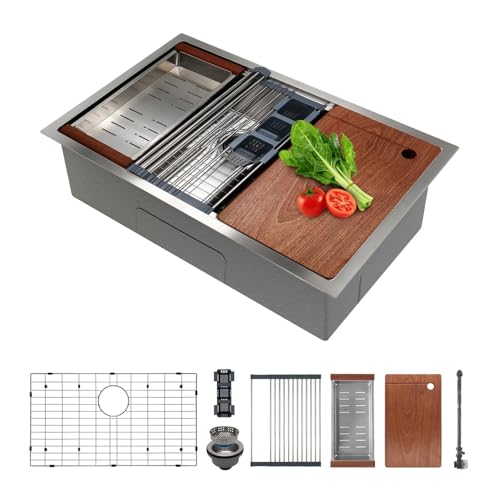
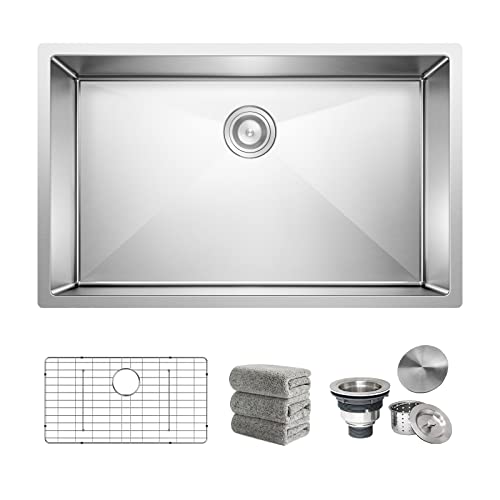
- Oxwiser 32×18 Inch Undermount Sink Set, 16 Gauge, 5 Item Bundle
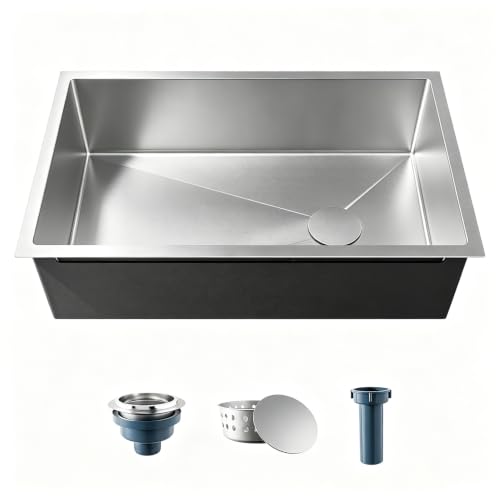
- KRAUS KHU640-33 33 Inch 18 Gauge Undermount Sink with NoiseDefend
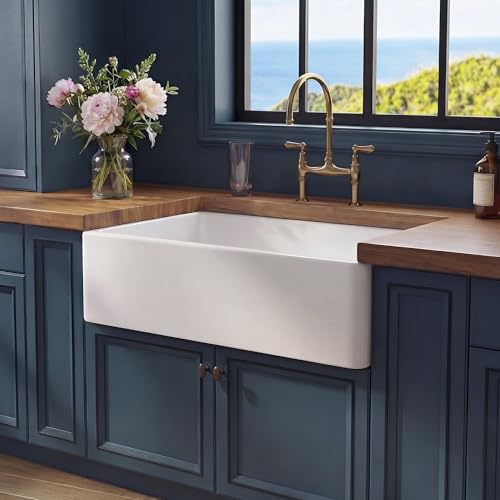
- Miuara Farmhouse Sink 30 x 18 Inch White Fireclay Apron Front
- Miuara Farmhouse Sink 33 x 18 Inch White Fireclay Apron Front
- SANYCASA 30 Inch Undermount Kitchen Sink, 11 Gauge Stainless Steel Workstation
- KRAUS KHU100-30 30 Inch 16 Gauge Undermount Kitchen Sink
Read the full guide ↓
Let us start with the honest definition this category deserves: no kitchen sink is literally soundproof, because running water and grinding disposers make noise in any material ever fired or folded. What the best sound proof kitchen sinks actually deliver is the closest practical approach to it — bowls engineered or built so that the sharp, carrying, metallic noises of wash-up are absorbed at the source, leaving a soft, local sound that stays in the kitchen and lets the rest of the home live in peace. For a nursery next door, a home office sharing a wall, a condo with neighbours below, or an open-plan evening that should not be narrated by rinsing sounds, that difference is not a refinement. It is the whole point of the purchase.
The six picks here reach that goal by three distinct routes, and this guide keeps them clearly separated so you can choose your route deliberately. Route one is engineered absorption: rubber pad systems bonded under steel, exemplified by the KRAUS sinks and their NoiseDefend specification. Route two is mass in steel: gauges far beyond the norm, crowned by an 11 gauge workstation sink whose 3mm walls barely know how to ring. Route three abandons metal altogether: fireclay sinks whose dense ceramic construction is soundproof by nature. Around the picks, the guide covers the system around the sink — mounting, disposer, cabinet and habits — because true soundproofing is a system outcome, a theme our companion guide to Best Stainless Kitchen Sinks echoes when it ranks heavy-use builds.
Key Takeaways
- “Soundproof” in practice means killing the ring: short, dull, local sounds instead of sharp metallic ones that travel through walls.
- Three routes get there — engineered pads (KRAUS NoiseDefend), extreme steel mass (the SANYCASA’s 11 gauge / 3mm walls), and fireclay ceramic, which cannot ring at all.
- The KRAUS KHU100-30 pairs NoiseDefend pads with 16 gauge steel, the most complete steel recipe in this guide.
- Fireclay (both Miuara picks) is the only route that removes the metallic voice entirely rather than damping it.
- The sink is half the system: rigid mounting, a well-seated disposer and a grid for dish impacts decide the rest.
- Judge by owner noise reports and named specifications, not by the word “quiet” in a headline.
- Budget the grid with the sink, not after it: impact noise is half the problem, and the grid is its only real cure.
In this guide
Quick Picks
| Pick | Badge | Why it stands out | |
|---|---|---|---|
| Oxwiser 32×18 Sink Set | Best Large Quiet System | 32 x 18 inch, 16 gauge steel, 5 item bundle with grid to silence dish impacts | Check on Amazon |
| KRAUS KHU640-33 | Best Engineered Soundproofing | 33 inch, 18 gauge steel, NoiseDefend pads, rounded corners, channel grooves | Check on Amazon |
| Miuara Farmhouse Sink 30 Inch | Best Soundproof by Material | 30 x 18 inch white fireclay, reversible single bowl, apron front or undermount | Check on Amazon |
| Miuara Farmhouse Sink 33 Inch | Best Large Soundproof | 33 x 18 inch white fireclay, reversible single bowl, family-scale silence | Check on Amazon |
| SANYCASA 30 Inch Workstation Sink | Best Heavy-Gauge Mass | 30 inch, 11 gauge (3mm) stainless steel, integrated ledge workstation | Check on Amazon |
| KRAUS KHU100-30 | Best All-Round Soundproof Steel | 30 inch, 16 gauge TRU16 steel, NoiseDefend pads, rounded corners, channel grooves | Check on Amazon |
How These Picks Were Chosen
This guide is research-led and specification-driven. Every pick’s ASIN, title and stated features come from the verified Amazon Creators API pool, checked on the date in the sources file. For a soundproofing keyword we applied a stricter evidence bar than usual: a pick had to show its quiet in the verified data — a named pad system, an exceptional gauge, or a material with inherent damping — and not merely in adjectives. We then cross-read aggregated owner feedback for the acoustic story: which bowls owners describe as a thud, which as a clang, and which purchases were specifically made to replace a sink the household could hear through a wall.
That bar is why this list looks the way it does. Two picks carry KRAUS’s NoiseDefend in their specifications, one of them over 16 gauge TRU16 steel. One pick, the SANYCASA, brings 11 gauge steel — 3mm sheet, closer to commercial fabrication than residential norms — whose mass is itself a deadening strategy. Two picks are fireclay, the material route. The remaining pick, the 32 inch Oxwiser set, earns its place as a system: 16 gauge steel plus the included bottom grid that silences the impact noise pads cannot reach. Where a specification does not claim pads, the review says so and credits only what is there — you will find no invented undercoatings in these pages. Readers who want the broader deadening landscape, including value routes, will find it in our sound-deadened research referenced throughout this guide, and the steel-quality background in Best Ss Kitchen Sinks Scratching. One further filter deserves naming: every pick is also a genuinely good sink before it is a quiet one — right sizes, honest gauges, reputable constructions — because a soundproof sink that washes badly would be a Pyrrhic victory no household thanks you for.
The 6 Best Sound Proof Kitchen Sinks

Oxwiser 32×18 Inch Undermount Sink Set — 16 Gauge, 5 Item Bundle
Badge: Best Large Quiet System
Strengths
- At 32 inches — the size where steel bowls boom worst — 16 gauge construction starts inherently deader than the 18 gauge norm.
- The included bottom grid silences pan and dish impacts, the noise class that dominates real wash-ups.
- Complete 5 item bundle: sink, grid, drain assembly, drain cap and towel in one box.
Trade-offs
- The verified specification names no dedicated pad system; its soundproofing is gauge plus grid, not engineered absorption.
- Needs a wide cabinet, typically 36 inch class.
- Large-bowl water noise remains audible, as in any big steel sink.
Mini spec box
- Size: 32 x 18 inch, undermount
- Material / gauge: stainless steel, 16 gauge
- Bowl: single bowl
- Included: 5 item bundle — sink, bottom grid, drain assembly, drain cap, towel
Large steel sinks are the hardest soundproofing problem in the kitchen: broad, uninterrupted sheets of metal vibrate freely, and a 32 inch bowl in thin steel can boom like a kettle drum every time the tap runs. The Oxwiser set is the system answer at this size. Its 16 gauge steel removes the worst of the flex and ring before any accessory is considered — thicker sheet simply stores less vibration — and the bundled bottom grid then handles the dominant real-world noise, which is not the bowl at all but the cookware striking it. A roasting pan lowered onto a grid makes a fraction of the sound of the same pan on bare steel, multiplied across every wash-up, every day.
The bundle completeness serves the sound goal in a second way: fit. A grid made for this exact 32 x 18 floor covers it properly, edge to edge, so there is no bare steel landing strip where pans inevitably find the metal. The drain assembly and cap in the box mean the whole installation — the moment when mounting tightness, the other half of soundproofing, is decided — happens in one planned session rather than in stages with parts missing. As a working sink it is the family standard: sheet pans flat, stockpots upright, one deep single bowl for the whole load.
Its boundary is stated plainly in its own spec box: there is no named pad system here. If your home’s problem is specifically the ring of the bowl itself — heard through a bedroom wall — the padded KRAUS picks or the fireclay pair below aim at that target more directly. If your problem is the general percussion of a big family wash-up, this set’s gauge-and-grid system is the most practical soundproofing at 32 inches, and the easiest to buy in one decision.
Best for: large households whose noise problem is wash-up percussion at family scale / Not suited for: buyers whose priority is engineered pad absorption above all else

KRAUS KHU640-33 — 33 Inch 18 Gauge Undermount Sink with NoiseDefend
Badge: Best Engineered Soundproofing
Strengths
- NoiseDefend pads are in the verified specification — engineered absorption bonded where vibration starts.
- Delivers that control at 33 inches, the widest and potentially loudest format in the guide.
- Rounded corners resist buildup; channel grooves keep the wide floor draining and drying.
Trade-offs
- 18 gauge steel relies on its pads rather than mass for deadening.
- The widest cabinet requirement in the guide.
- No grid bundled; add one to silence dish impacts and complete the system.
Mini spec box
- Size: 33 inch width, undermount
- Material / gauge: stainless steel, 18 gauge
- Bowl: single bowl, rounded corners
- Features: NoiseDefend soundproofing pads, channel grooves for draining
Engineered soundproofing means treating vibration where it is born, and that is the KHU640-33’s design brief. Its NoiseDefend pads — rubber absorbers bonded across the bowl’s underside — intercept the steel’s vibration and dissipate it as negligible heat instead of letting the bowl radiate it as ring. The result, in owner language that recurs across this model’s feedback, is a sink that answers a dropped pan with a thud and running water with a hush. That KRAUS achieves it at 33 inches and 18 gauge is the engineering statement: the largest, thinnest bowl in the guide is among its quietest, because the deadening was designed rather than inherited from thickness.
For open-plan homes this is the steel pick to beat. The wide bowl swallows the biggest cookware flat — the pans whose washing defines family noise — while the pads keep that washing local to the kitchen zone. The rounded corners and drainage grooves are the day-300 details: no grit traps in a bowl this size, no standing water filming the floor, a quick wipe restoring the whole surface. It is a big sink that behaves, acoustically and hygienically, like a much smaller one.
Complete the system honestly: the verified listing bundles no grid, and dish impacts on any steel floor remain the loudest single events in a wash-up, so budget for the grid as part of the soundproof purchase rather than an accessory afterthought. And measure the cabinet with respect — 33 inches of undermount wants a genuinely wide base, and no pad system can help a sink that does not fit. Within those terms, this is the engineered benchmark of the guide.
Best for: open-plan and noise-sensitive homes wanting engineered deadening at maximum width / Not suited for: standard or narrow cabinets, or buyers wanting a bundled grid
Miuara Farmhouse Sink 30 x 18 Inch — White Fireclay Apron Front
Badge: Best Soundproof by Material
Strengths
- Fireclay cannot ring: dense fired ceramic answers impacts with a short knock and running water with a soft, local sound.
- Reversible single bowl; apron-front presence with drop-in/undermount flexibility per the manufacturer.
- Resists stains, cracks, heat and scratches per the verified specification; no water spotting, ever.
Trade-offs
- Heavy: apron-front fireclay needs a properly supported cabinet, planned in advance.
- Ceramic chips under severe edge impacts rather than denting.
- The white farmhouse aesthetic is a commitment steel does not ask for.
Mini spec box
- Size: 30 x 18 inch, apron front (also drop-in/undermount per manufacturer)
- Material: white fireclay
- Bowl: reversible single bowl
- Properties: resistant to stain, crack, heat and scratch (per manufacturer title)
If the sound you cannot live with is specifically the metallic voice of steel — the chime of cutlery, the ring under the tap, the bright clang that reads as “kitchen noise” through a wall — then no pad or gauge fully answers it, because they all still begin with a metal bowl. The Miuara changes the material, and the problem changes with it. Fireclay is ceramic fired to stone-like density; struck, it knocks; filled, it murmurs; it has no resonance to deaden because it never develops one. In the strictest sense available to this category, it is the soundproof pick: not the best-damped steel, but the absence of the thing that needs damping.
It helps that the silent material arrives in a beautiful, practical form. The apron front makes the sink the kitchen’s focal point, the reversible bowl lets you choose a plainer or more detailed face, and the manufacturer’s specification also permits drop-in or undermount fitting where the apron plan does not suit. The glazed surface resists the stains of a working kitchen, takes heat that would mark other materials, and never wears the water-spot film that steel owners wipe daily. For a household building a kitchen around quiet and around this look, the two ambitions turn out to be the same purchase.
The planning costs are real and front-loaded: weight that demands a supported, often purpose-built sink base, and a ceramic’s intolerance of the worst drops — a cast-iron skillet falling edge-first can chip what it would merely dent in steel. A grid or mat is cheap insurance and standard practice in fireclay homes. Households renovating around an existing standard cabinet should weigh the steel picks instead; households designing the kitchen can give this sink the cabinet it deserves and enjoy the quietest bowl in the guide. The farmhouse form in all its materials is explored further in our Best Stainless Farmhouse Kitchen Sinks guide.
Best for: households for whom the metallic sound itself is the problem, in a remodel that can support it / Not suited for: like-for-like swaps into existing standard cabinets

Miuara Farmhouse Sink 33 x 18 Inch — White Fireclay Apron Front
Badge: Best Large Soundproof
Strengths
- Fireclay’s inherent silence at the largest scale here — capacity grows, noise does not.
- Reversible bowl and apron-front presence sized for wide cabinet runs.
- Stain, crack, heat and scratch resistance per the verified specification; a surface that always looks clean.
Trade-offs
- The heaviest installation in the guide; the sink base is effectively engineered furniture.
- Wide, often custom cabinet work required.
- Chip risk under severe impacts, as with all ceramics.
Mini spec box
- Size: 33 x 18 inch, apron front (also drop-in/undermount per manufacturer)
- Material: white fireclay
- Bowl: reversible single bowl
- Properties: resistant to stain, crack, heat and scratch (per manufacturer title)
Scale usually defeats quiet: the bigger the sink, the louder the wash-up. The 33 inch Miuara is the exception that proves the material rule, because fireclay’s silence does not depend on size. Thirty-three inches of dense ceramic holds a holiday’s worth of roasting pans and still answers the evening’s work with knocks and splashes instead of ring and clang. For the large household in a full remodel — the family whose sink works hardest and latest, nearest the bedrooms it must not wake — this is the most complete soundproof answer in the guide, wearing the apron-front presence that anchors a farmhouse kitchen.
The supporting details match the flagship role. The reversible bowl adapts its face to the room, plainer or more detailed. The glaze resists stains, heat and scratching per the verified specification and presents the same clean white after a rinse that it did at installation — no spotting, no patina management, none of steel’s daily cosmetic labour. At this scale the single bowl is a genuine production space: pans flat, pots soaking, produce washing in sequence without a divider ever vetoing a load.
Everything about the installation must be planned at design stage — support structure, cabinet width, delivery route for a very heavy object — and that is the honest price of the material at this size. It is not a replacement sink for an existing kitchen; it is a founding decision for a new one. Households in that position, who also rank quiet at the top of the brief, will not find a better answer in any material. Households mid-stream in a standard remodel should take the same soundproofing intent to the KRAUS picks, which ask nothing of the cabinet beyond width.
Best for: large families in full remodels wanting maximum capacity with inherent, material-level quiet / Not suited for: existing kitchens, renters, or any project without structural planning
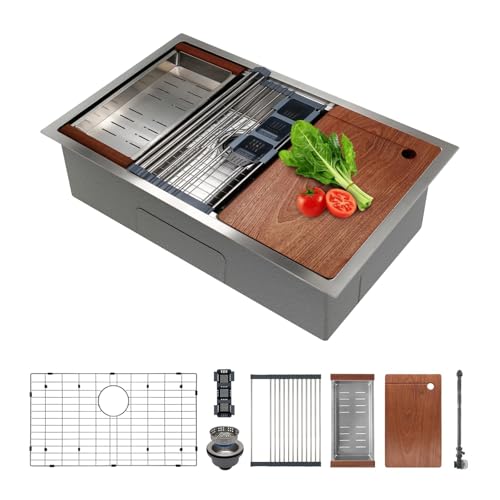
SANYCASA 30 Inch Undermount Kitchen Sink — 11 Gauge Workstation
Badge: Best Heavy-Gauge Mass
Strengths
- 11 gauge (3mm) steel is mass as a sound strategy: walls this thick flex so little that ring barely starts.
- Integrated ledge workstation — prep over the bowl, with accessories held above the waterline.
- Single 30 inch bowl in the standard cabinet footprint; dents and dings from heavy pans are shrugged off.
Trade-offs
- Very heavy — installation and undermount support must be planned for the weight.
- No named pad system in the verified specification; its quiet is thickness, not absorption engineering.
- The ledge rewards accessory use; as a plain bowl it is superb but over-built for light duty.
Mini spec box
- Size: 30 inch width, undermount
- Material / gauge: stainless steel, 11 gauge (3mm)
- Bowl: single bowl, integrated ledge workstation
- Drain: Superior Drain design (per manufacturer title)
There are two ways to stop a bell from ringing: wrap it, or cast it so thick it cannot swing. The SANYCASA is the second philosophy in sink form. Its 11 gauge, full 3mm stainless steel is roughly twice the substance of the 16 gauge mainstream and far beyond the 18 gauge norm, and the acoustic consequence is direct — a bowl floor that does not flex under a landing pan does not drum, walls that barely vibrate do not sing, and the whole sink has the damped, expensive solidity that thin sinks imitate with pads. Rap the side of this bowl and the answer is a knock a fireclay owner would recognise.
That mass is wrapped around a genuinely useful design. The integrated ledge runs the bowl’s length, holding cutting boards, racks and colanders over the sink, so the 30 inch footprint works in two layers: prep above, soaking below. In sound terms the ledge even helps — a board seated on the rails is a stable, quiet work surface compared with one balanced on a rim — and in durability terms the package is close to indestructible by residential standards. This is the sink for households whose pans are heavy, whose cooking is daily and whose patience for delicate equipment is short. Our heavy-use research in Best Stainless Kitchen Sinks For Heavy Use reaches the same conclusion from the durability side.
Candour requires two notes. The verified specification names no pad system, so buyers comparing engineered absorption figures should know this sink’s quiet is a property of mass alone — formidable, but differently distributed than pads (it excels at impact thud, slightly less at absorbing a disposer’s hum than a padded bowl). And the weight is a real installation factor: support, handling and a helper are not optional. For the standard-cabinet household that wants maximum solidity and quiet in one object, neither note outweighs the steel itself.
Best for: hard-use households wanting the deadest steel bowl available in a standard footprint / Not suited for: fragile cabinets, or buyers who want a named pad system’s absorption profile

KRAUS KHU100-30 — 30 Inch 16 Gauge Undermount Sink
Badge: Best All-Round Soundproof Steel
Strengths
- The complete steel recipe: 16 gauge TRU16 mass plus NoiseDefend pads — both soundproofing routes in one bowl.
- Rounded corners and channel grooves: easy cleaning, fast draining, no standing water.
- The mainstream 30 inch size fits standard cabinets, so the quiet asks nothing exotic of the kitchen.
Trade-offs
- No workstation ledge or bundled grid; add a grid to complete impact-noise control.
- Single bowl only — no divided option in this design.
- Steel, however well damped, retains a faint metallic character fireclay does not have.
Mini spec box
- Size: 30 inch width, undermount
- Material / gauge: TRU16 stainless steel, 16 gauge
- Bowl: single bowl, rounded corners
- Features: channel grooves for draining, NoiseDefend soundproofing pads
If the soundproof brief must be answered with one steel sink for the average kitchen, this is it. The KHU100-30 is the only pick here that combines both steel strategies at once: 16 gauge TRU16 construction supplies the mass that keeps vibration from starting, and the NoiseDefend pad system absorbs what vibration remains. Pads over thin steel can feel like a patch; mass without pads leaves the disposer hum a path; the combination closes both doors. In the standard 30 inch footprint — the size that fits the common 33 inch cabinet and the average family’s cookware — it makes the soundproof decision almost suspiciously easy.
The supporting design is the proven KHU100 pattern. Rounded corners sweep clean in a single wipe, with no grit collecting where a quiet sink would otherwise grow a noisy household’s least favourite chore. Channel grooves in the floor keep water travelling to the drain, so the bowl dries rather than films. And the size discipline matters acoustically too: at 30 inches the bowl is large enough for sheet pans yet small enough that its surfaces never reach the broad, drum-like spans of the 33 inch class — the pads here are finishing a well-proportioned design, not rescuing an overextended one.
Add a bottom grid — the one accessory the verified listing leaves to you — and the system addresses all three noise classes: bowl ring (pads and gauge), dish impact (grid), and, with a properly seated disposer, under-sink hum. Households comparing the wider stainless field before deciding will find this model’s recipe is the one the category’s better sinks converge on, as our Best Stainles Steel Kitchen Sinks survey shows. For a soundproof brief in a standard kitchen, start and very likely finish here.
Best for: most households wanting the most complete soundproof steel sink in a standard size / Not suited for: buyers wanting a workstation ledge, or the total non-metallic quiet of fireclay
Comparison Table
| Pick | Size | Material / gauge | Soundproofing route | |
|---|---|---|---|---|
| Oxwiser Set 32 | 32 x 18 inch | Stainless, 16 gauge | Gauge + included grid system | Check on Amazon |
| KRAUS KHU640-33 | 33 inch | Stainless, 18 gauge | NoiseDefend engineered pads | Check on Amazon |
| Miuara Farmhouse 30 | 30 x 18 inch | White fireclay | Material mass — cannot ring | Check on Amazon |
| Miuara Farmhouse 33 | 33 x 18 inch | White fireclay | Material mass at family scale | Check on Amazon |
| SANYCASA Workstation 30 | 30 inch | Stainless, 11 gauge (3mm) | Extreme steel thickness | Check on Amazon |
| KRAUS KHU100-30 | 30 inch | Stainless TRU16, 16 gauge | Gauge + NoiseDefend pads combined | Check on Amazon |
How to Choose a Sound Proof Kitchen Sink
Rank your noise first, because the routes diverge. If the offender is the bowl’s ring and clang, engineered pads or extreme gauge are the direct answers, and fireclay is the total one. If the offender is the disposer, treat the sink as the amplifier and spend accordingly — a deadened bowl, a quality insulated disposer, and a mounting job done with unusual care. If the offender is crockery percussion, the grid is your soundproofing and the bowl is secondary. Most homes have a blend with one clear leader; buy for the leader and let the system habits in the next section mop up the rest.
Read specifications for evidence. A named pad system, an exceptional gauge figure like 11 gauge / 3mm, or a genuinely dense material are verifiable claims; the adjective “quiet” is not. Coverage matters within the pad route — pads across the floor and lower walls deaden far more than a token square under the drain — and within the mass route, remember that gauge numbers run backwards: lower is thicker. Sixteen gauge is the durable mainstream, 18 the lighter tier, and anything beyond 16 (like the SANYCASA) is specialty territory with specialty weight.
Finally, plan the installation as part of the purchase. Rigid mounting, a disposer seated dead true, supply lines dressed clear of the bowl, and a cabinet that is not a hollow drum are worth as much as a tier of product. If your project is a full remodel, also weigh the material decision honestly: fireclay asks for cabinet engineering up front and returns the only complete silence in the category; steel asks for nothing structural and returns 90 percent of the quiet with far more format choice. Neither answer is wrong — but they belong to different projects, and choosing the route that matches your project is the real decision this guide exists to support.
How to Install and Maintain a Sound Proof Sink
Installation for quiet. (1) Mount rigidly: clips snug in sequence, sealant continuous, zero rock anywhere — a flexing sink is a drum with a stand. (2) Seat the disposer perfectly: mounting ring fully engaged, unit plumb, no strain on the drain flange. (3) Dress the plumbing clear: supply and drain lines should not press against the bowl’s underside, where they pick up and re-radiate vibration. (4) Fill the cabinet’s emptiness: stored items under the sink genuinely reduce its life as a resonating chamber. (5) Test-listen from the next room with water running and the disposer grinding before the installer leaves; adjustments cost minutes then and a call-out later.
Daily quiet habits. Keep the grid in place for glass and cutlery loads; run the spray inside the bowl rather than from height; place, do not drop, the heavy pans — the soundproof bowl rewards the habit immediately. Keep the underside dry: fix drips promptly so pads and steel stay in their designed condition. Fireclay households add one rule: a mat or grid under cast iron, because ceramic’s only acoustic enemy is the impact that chips rather than rings.
Troubleshooting. Problem: the new sink is quieter but a buzz remains at one pitch → hunt for a line or the disposer body touching the bowl or cabinet side and re-dress it clear; single-pitch buzzes are almost always contact points. Problem: ring persists in a padded steel sink → verify pad coverage under the bowl; sparse padding can be supplemented on clean, dry steel before or during a refit. Problem: the whole cabinet hums with the disposer → the mount has relaxed or was never fully seated; re-seating the unit and confirming the sink’s own mounting tightness cures most cases without replacing anything.
Soundproofing the Whole Sink Zone: Cabinet, Faucet and Floor
The sink does not perform alone, and a truly soundproof brief eventually walks around the whole zone. The cabinet is a resonating box by construction — thin panels, a hollow interior, a hard floor beneath — and simple measures tame it: solid doors close the front, stored contents break up the air volume, and in a full remodel, a layer of mass on the cabinet’s interior panels or a denser cabinet construction pays acoustic rent every day. None of this is exotic; it is the same thinking as the sink’s pads, applied one level out.
The faucet is the zone’s other instrument. A high-arched faucet dropping water from a great height into a steel bowl manufactures splash noise no pad can remove, while a well-aimed stream at sensible pressure, or a pull-down spray worked low inside the bowl, is quiet in any sink. Aerated streams sound brighter; laminar streams land softer. When owners report that a new sink is “still loud,” a surprising share of the remaining sound is the water’s fall, not the bowl — a five-minute experiment with the spray head usually proves it. Even the floor plays a part: a mat at the sink position absorbs the foot-level clatter of a busy cook shifting pans, and costs almost nothing.
Treat the zone as a system and the picks in this guide deliver their full value. Treat the sink as a solo purchase and even the best of them will seem to underperform — not because the deadening failed, but because the room around it kept singing. The good news is that every element of the system is cheap or free compared with the sink itself: mounting care, line dressing, a grid, a mat, a faucet habit. Soundproofing, in the end, is mostly thoroughness.
Soundproof Picks by Household: Nurseries, Condos, Offices and Studios
Different homes prosecute sink noise for different reasons, and the right pick shifts with the charge sheet. The nursery household is fighting for sleep in short, precious windows, and its enemy is the single sharp event — the spoon dropped during a midnight bottle rinse. For that home, impact behaviour outranks everything: fireclay’s knock or a padded bowl under a grid, with the grid treated as non-negotiable equipment rather than an accessory. The condo household is fighting for neighbourliness through shared structure, where vibration, not volume, is the traveller; rigid mounting and a dead bowl matter most, and the engineered KRAUS picks are its natural shortlist.
The home-office household has a subtler problem: the sink that interrupts calls and concentration through a shared wall during the working day. Its wash-ups are ordinary but its timing is unforgiving, and it benefits from the all-round steel recipe — mass plus pads in a standard size — because its kitchen is usually a normal kitchen that must simply behave during business hours. The studio and open-plan household, finally, has no wall to hide behind at all: the sink performs in the living room, and it should choose as the open-plan cooks in our sound-deadened research do, weighting the fireclay pair and the wide padded KRAUS at full value, with the faucet’s stream height audited as part of the same decision.
What unites all four is that none of them is really buying a sink — they are buying back a room, a nap, a neighbourly silence or a working day. Framed that way, the modest premium of engineered deadening over a basic bowl is the easiest money in the remodel to justify, and the cost of choosing wrong is not a disappointing product but a daily, audible reminder. Match the pick to the household’s actual charge sheet and the soundproof brief solves itself.
Common Buying Mistakes
- Expecting literal silence. Soundproof sinks remove the ring and the carry; water and disposers still make sound. Buy for transformation, not magic.
- Trusting adjectives over specifications. Named pad systems, exceptional gauges and dense materials are evidence; “quiet design” is a mood.
- Forgetting the grid. The loudest single events in a wash-up are pans striking the floor; pads cannot help there, a grid can.
- Starving the installation. Loose mounts and a cocked disposer hand back everything the bowl’s engineering removed.
- Choosing fireclay without the cabinet plan. Its silence is real and so is its weight; the support conversation belongs at design stage.
- Blaming the bowl for the faucet. A long water fall is loud in any material; check the stream before condemning the sink.
Final Recommendation
For the soundproof brief in a standard kitchen, the KRAUS KHU100-30 is the answer: 16 gauge mass and NoiseDefend pads in one 30 inch bowl that asks nothing unusual of the cabinet — add a grid and the system is complete. If your sink must be wide, the KRAUS KHU640-33 carries the engineered route to 33 inches, and if sheer steel mass appeals, the SANYCASA’s 11 gauge walls are the deadest steel here. But if the metallic voice itself is the enemy and your project can carry the weight, change materials: the Miuara fireclay sinks, at 30 or 33 inches, are the only picks that do not deaden the ring — they never had one. Choose the route that matches your project, mount it like it matters, and listen from the next room before you sign off.
Frequently Asked Questions
Can a kitchen sink really be soundproof?
Not literally — water and disposers always make some sound. What the best models achieve is the removal of the sharp, metallic, far-carrying noises: ring becomes thud, clang becomes knock, and what remains is soft and local to the kitchen. For thin walls, nurseries, home offices and open-plan living, that transformation is the practical meaning of soundproof, and it is very achievable.
Which is quieter: padded steel or fireclay?
Fireclay, in character — it has no metallic resonance at all, so its sounds are shorter and duller than even well-padded steel. The best padded 16 gauge steel (the KHU100-30 here) closes most of the gap and wins on weight, format choice and cabinet simplicity. Choose fireclay when silence outranks convenience; choose padded steel when the project is a normal remodel.
Do sound pads really work, or are they marketing?
They work, with a condition: coverage. Pads bonded across the bowl’s floor and lower walls absorb the vibration that becomes ring, and the effect is immediately audible against an unpadded bowl. A token pad under the drain is closer to marketing. That is why this guide credits named systems in verified specifications and treats unnamed “quiet” claims with suspicion.
Why does gauge matter for sound?
Because vibration needs flex, and thicker steel flexes less. Sixteen gauge bowls sound deader than 18 gauge in the same design, and the SANYCASA’s 11 gauge (3mm) construction carries the principle to an extreme — its walls barely move, so there is little vibration for pads to absorb. Gauge is the slow, permanent form of soundproofing: it cannot peel, saturate or be installed wrong.
My disposer is the loud part. Will a soundproof sink help?
Partly. A deadened bowl radiates less of the disposer’s vibration than a live one, and rigid mounting helps further. But the disposer’s own motor and insulation set its floor, so pair the sink with a quality, well-seated unit and have the mount checked before blaming the bowl. In many “loud sink” kitchens, re-seating the disposer is the single biggest improvement available.
Can I soundproof my existing sink instead of replacing it?
The accessible half, yes: a grid or mat kills impact clatter immediately, and aftermarket pads can be bonded to a clean, dry bowl underside if you have access. Mounting tightness can also be checked and corrected. What you cannot retrofit is gauge or material — if the bowl itself is thin and live, replacement with a pick from this guide is the complete answer.
Does an apron-front sink change the sound equation?
The apron itself is mostly a style and ergonomics feature, but in this guide the apron-front picks are fireclay, and the material is the acoustic story: the exposed front is solid ceramic, which neither rings nor transmits the bowl’s sounds the way a thin steel front might. If you love the farmhouse look, fireclay lets you have it with the quietest material in the category.
How long does a soundproof sink stay quiet?
As long as its mounting stays tight and its pads stay dry — which, in a well-kept kitchen, means the life of the sink. Gauge and fireclay mass cannot degrade at all; bonded pads are fit-and-forget in a dry cabinet; the realistic ageing points are a disposer mount relaxing over years or a drip quietly soaking the underside. An annual under-sink look — mounts snug, everything dry, lines clear of the bowl — keeps a soundproof installation at its day-one performance indefinitely, and takes less time than the wash-up that follows it.