Disclosure: topratedkitchenware.com is reader-supported. When you buy through links on our site, we may earn an affiliate commission from Amazon and other retailers, at no extra cost to you.
Where to buy
The four linked models below are the verified electric induction picks for this guide to the best electric and induction cooktops; two further models from the research pool turned out to be gas cooktops and are covered in honest prose only, without links, in the reviews. Each linked name leads to its Amazon listing, where you can check the latest price on Amazon and confirm the current configuration before you buy.
- Nuwave Pro Chef Induction Cooktop, Commercial-Grade Portable Burner
- Duxtop 9600LS Portable Induction Cooktop with LCD Sensor Touch, 1800W
- Duxtop 8100MC Portable Induction Cooktop, 1800W, Gold
- ISILER 1800W Portable Induction Cooktop with Touch Control
- VEVOR Gas Cooktop 30 Inch, 5 Burners (covered in prose) (covered in prose below; no link for the reason explained in its review)
- ThermoMate 36 Inch Gas Cooktop, 5 Italy Sabaf Burners (covered in prose) (covered in prose below; no link for the reason explained in its review)
Read the full guide ↓ for the ranking logic, the honest limitations of every pick, and the buying checks that matter more than any headline claim.
The search for the best electric and induction cooktops usually starts with a confusion worth clearing up immediately: induction is electric, but not all electric cooking is induction. Radiant electric heats an element that heats the glass that heats your pan; induction turns the pan itself into the heat source. This guide covers the induction side of the electric family, in the portable formats the verified pool provides, because induction is where electric cooking now wins its arguments: faster boils, finer low-end control, cooler surrounding surfaces and easier cleaning than any radiant or coil design.
Four of the six models researched for this guide are genuine induction burners and carry links: two Nuwave models with very different ambitions, a compact ISILER, and two long-running Duxtop designs (one of which anchors the value end). The remaining two pool models turned out, on verification, to be gas cooktops; rather than dress them up as electric options, this guide reviews them in prose only, clearly labelled, so readers still weighing fuel types can see what the gas alternative looks like. If your kitchen project pairs a cooktop with a separate oven, Best Electric Cooktops And Wall Ovens covers that layout question directly.
Every pick below is portable, which shapes the advice: these are burners for renters, small kitchens, second cooking stations, renovation gaps and households testing induction before committing to a built-in. The buying guide explains when portable induction is the whole answer and when it is a trial run, and the how-to section covers the pan checks and power habits that make induction ownership uneventful.
Key Takeaways
- Induction is the electric technology that matters now: it heats the pan directly, boils fast, simmers gently and leaves the surrounding surface far cooler.
- Four picks here are linked induction burners; the two gas models in the pool are reviewed in prose only, because a gas hob is not an electric cooktop.
- All four linked picks run at up to 1800W, the practical ceiling for a standard household outlet.
- The Nuwave Pro Chef offers the finest temperature control in the guide, with 94 settings in 5°F steps.
- Portable induction is the cheapest honest way to test whether induction suits your cooking before a built-in commitment.
- Magnetic cookware is the one hard requirement; run the magnet test before ordering.
In this guide
Quick Picks
Four linked induction burners ranked first, then the two gas alternatives in clearly labelled prose-only rows. Badges match the detailed reviews.
| Pick | Badge | Standout trait | Where to check it |
|---|---|---|---|
| Nuwave Pro Chef Induction Cooktop, Commercial-Grade Portable Burner | Best Overall | 94 temperature settings in 5°F steps across 100°F–575°F; 8 inch coil; ceramic glass | Check on Amazon |
| Duxtop 9600LS Portable Induction Cooktop with LCD Sensor Touch, 1800W | Best Touch-Control Pick | LCD sensor touch panel on Duxtop’s established 1800W platform, silver finish | Check on Amazon |
| Duxtop 8100MC Portable Induction Cooktop, 1800W, Gold | Best Established Value | The long-running original Duxtop portable burner in gold, model BT-180G3 | Check on Amazon |
| ISILER 1800W Portable Induction Cooktop with Touch Control | Best Compact Preset Pick | 10 power and 10 temperature settings, 7 presets, timer and safety lock, compact body | Check on Amazon |
| VEVOR Gas Cooktop 30 Inch, 5 Burners (covered in prose) | Prose-Only: Gas Alternative | 30 inch built-in gas, 5 burners, NG/LPG convertible (prose-only in an electric guide) | Prose-only in this guide |
| ThermoMate 36 Inch Gas Cooktop, 5 Italy Sabaf Burners (covered in prose) | Prose-Only: Large Gas Alternative | 36 inch built-in gas, 5 Sabaf burners, 304 stainless, CSA certified (prose-only) | Prose-only in this guide |
How These Picks Were Chosen
Verification did real work in this guide. The research pool arrived labelled as electric and induction candidates, but checking each model’s verified listing data separated it into four induction burners and two gas cooktops. The gas models (a VEVOR 30 inch and a ThermoMate 36 inch) fail the keyword’s core attribute, fuel type, so under this site’s rules they cannot carry links or images here. They are reviewed in prose because the fuel decision is genuinely live for many readers of this keyword, and an honest description of the alternative serves those readers better than quietly pretending the models do not exist.
The four induction picks were ranked on control quality first, because control is where induction models actually differ. All of them offer up to 1800W, so headline power does not separate them; temperature granularity, preset design, coil size and interface do. The Nuwave Pro Chef’s 94 temperature settings are the standout specification in the group, while the Duxtop models counter with maturity and simplicity. Readers whose kitchens run on standard outlets alone may also want Best Electric Cooktops 110v, which ranks this same technology purely by plug-in practicality.
This is a research-led guide built from verified specifications and owner-report patterns, not hands-on testing, and it prints no prices or ratings because both change constantly. Use the links to check the latest price on Amazon at buying time, and treat the prose-only reviews as orientation for a fuel decision, not as recommendations within this category.
The Best Electric and Induction Cooktops: 4 Linked Picks and 2 Honest Alternatives
The first four reviews are the guide’s actual recommendations, each with a link. The last two are the gas alternatives, reviewed in full but deliberately unlinked, with the reason stated in each review and in this article’s source notes.

Nuwave Pro Chef Induction Cooktop, Commercial-Grade Portable Burner
Badge: Best Overall
Strengths
- 94 temperature settings in 5°F increments is the finest control in this guide
- A wide 100°F to 575°F range covers everything from holding to searing
- Shatter-proof ceramic glass surface and a large 8 inch heating coil
Trade-offs
- Commercial-grade positioning means a utilitarian design language
- Fine control is wasted on cooks who only ever boil and fry
- Single burner format
Mini spec box
- Type: Portable induction cooktop, commercial-grade
- Power: 1800W
- Temperature settings: 94 settings, 100°F–575°F in 5°F steps (per listing)
- Heating coil: Large 8 inch
- Surface: Shatter-proof ceramic glass
The Pro Chef earns the top badge on the specification that most separates serious induction from basic induction: control granularity. Its listing specifies 94 temperature settings spanning 100°F to 575°F in 5°F increments. In practical cooking terms that means the difference between a simmer that holds and a simmer that hunts: chocolate, butter sauces, slow braises and delicate custards all live in narrow temperature bands, and a burner that can be set in 5-degree steps stays in those bands instead of cycling around them. Cooks who have fought a coarse burner that pulses between too hot and off will recognise this as the entire ballgame.
The hardware around that control is equally deliberate: 1800W of power, a large 8 inch heating coil that matches standard pan bases, and a shatter-proof ceramic glass surface that shrugs off the thermal and physical knocks of daily use. Nuwave positions the model as commercial-grade, and the specification supports the claim better than most marketing uses of the phrase. As a primary burner for a small household, a precision tool for a keen cook, or a catering support burner, it covers more cooking than any other single unit in this guide.
Its limitations are about fit rather than quality. The design is professional rather than domestic, all function and no softening, and the fine control is genuinely wasted on a cook whose repertoire is pasta, eggs and stir-fries at full tilt; those cooks should save toward the simpler Duxtop models below. It is also, like every linked pick here, a single portable burner. Within that format, though, this is the most capable induction surface in the guide, and the one a serious cook will outgrow last.
Best for: Precision cooks, small households wanting one serious burner, and catering support / Not suited for: Casual cooks who will never use fine temperature control
Duxtop 9600LS Portable Induction Cooktop with LCD Sensor Touch, 1800W
Badge: Best Touch-Control Pick
Strengths
- Seamless LCD sensor touch panel is easy to clean and precise to set
- Duxtop’s mature 1800W platform with a long owner track record
- Silver finish shows less dust than black glass between cleans
Trade-offs
- Touch controls need dry fingers to respond
- Less temperature granularity than the Nuwave Pro Chef
- Single burner only
Mini spec box
- Type: Portable induction cooktop, countertop burner
- Power: 1800W
- Controls: LCD sensor touch (per listing)
- Model: 9600LS / BT-200DZ
- Finish: Silver
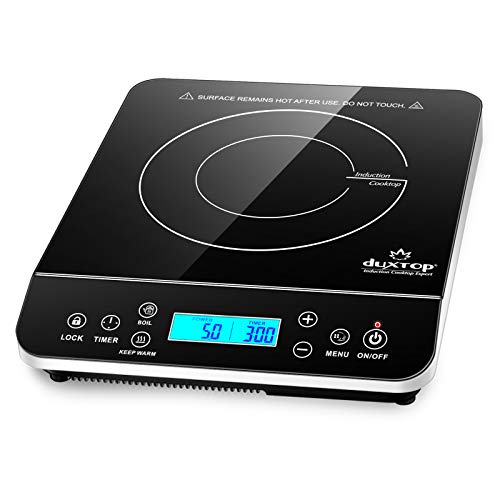
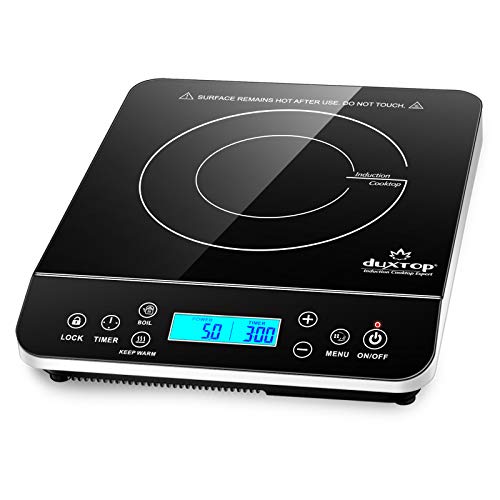
The 9600LS is Duxtop’s refined take on the portable induction burner, and its defining feature is the interface: an LCD sensor touch panel that sits flush with the surface. Settings are tapped rather than turned, the display keeps power and temperature legible, and when the cooking is done the entire face of the appliance is one wipeable plane with no seams for grease to colonise. For households that will keep the burner out on the counter permanently, that seamlessness is a daily dividend rather than a specification-sheet nicety.
Under the panel is the brand’s established 1800W platform, shared in spirit with the gold 8100MC reviewed below: fast response, dependable low-end behaviour for a portable, and the accumulated predictability of a model line that owners have been reporting on for years. The silver finish is a small but real practical choice too, showing less dust and fewer dried droplet marks than the black glass that dominates the category, which matters for an appliance that lives in view.
Against the Pro Chef it concedes control granularity; its settings are entirely adequate for mainstream cooking but not the 5-degree instrument the Nuwave offers. Against cheaper burners it asks a tier more, in exchange for the interface and the maturity. It is the pick for the cook who wants induction’s benefits in their most polished portable form and does not need laboratory temperature steps to be happy.
Best for: Countertop-permanent use, tidy kitchens and mainstream cooks wanting a polished interface / Not suited for: Precision cooks who want 5-degree temperature steps
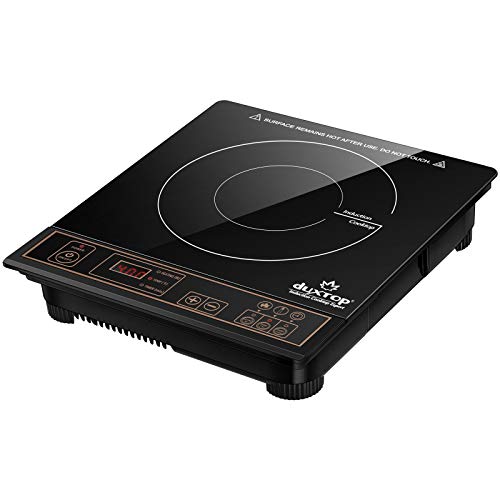
Duxtop 8100MC Portable Induction Cooktop, 1800W, Gold
Badge: Best Established Value
Strengths
- One of the longest-running portable induction models, with behaviour owners know well
- Full 1800W performance in a simple, compact countertop format
- A proven starter burner for households testing induction
Trade-offs
- An older design with fewer refinements than the 9600LS
- Controls and display are basic by current standards
- Gold finish will not suit every kitchen’s palette
Mini spec box
- Type: Portable induction cooktop, countertop burner
- Power: 1800W
- Model: 8100MC / BT-180G3
- Finish: Gold
- Brand: Duxtop
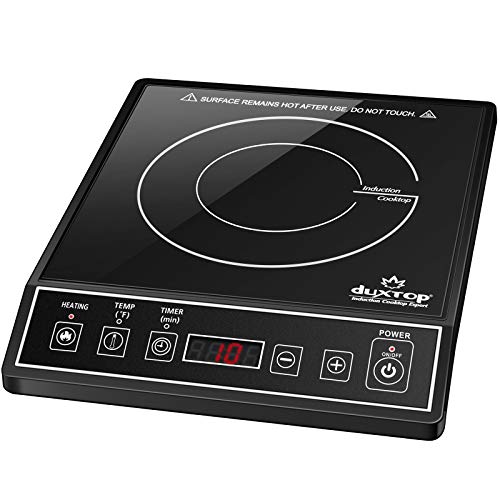
The 8100MC is where portable induction became a mainstream appliance, and its continued presence in this guide is earned rather than nostalgic. The specification is the category’s foundation: 1800W on a standard outlet, a compact countertop body, and induction’s core virtues of speed and responsiveness. For a household whose question is simply whether induction suits their cooking, this model answers it with the least fuss and the longest public track record of any pick here; there is very little about its behaviour that is not already documented by years of owners.
In daily use it does the things portable induction is bought for: a fast boil for pasta, a controlled simmer that radiant hotplates struggle to match, an extra burner on feast days, a primary burner in a studio or dorm. The gold finish divides opinion, which is worth stating plainly: in the right kitchen it reads as a deliberate accent, and in others it will always look like a guest. Check the listing photographs against your own counter before deciding, because you will be looking at it daily.
Its age shows in refinement rather than capability. Newer models, including its own sibling the 9600LS, offer sleeker interfaces and finer displays, and the Pro Chef’s temperature granularity belongs to another class. What the 8100MC offers instead is simplicity and proof. If your cooking is mainstream and your priority is a burner that has already survived a decade of other people’s kitchens, this remains a thoroughly rational purchase.
Best for: First-time induction buyers and anyone wanting the most proven portable burner / Not suited for: Buyers wanting the newest interface or a finish that disappears into the decor

ISILER 1800W Portable Induction Cooktop with Touch Control
Badge: Best Compact Preset Pick
Strengths
- Seven cooking presets simplify routine jobs for less confident cooks
- Timer and safety lock suit households with children or distracted cooking
- Compact portable design with an 8 inch heating plate
Trade-offs
- Ten-step control is coarser than the Pro Chef’s 94 settings
- Preset-driven cooking does not suit cooks who work by feel
- A newer, less documented model than the Duxtop pair
Mini spec box
- Type: Portable induction cooktop
- Power: 1800W
- Heating plate: 8 inch
- Settings: 10 power and 10 temperature settings
- Presets: 7 cooking presets
- Features: Timer and safety lock (per listing)
The ISILER is the preset thinker’s burner. Its listing specifies 10 power levels and 10 temperature settings, which is modest granularity, but wraps them in 7 cooking presets, a timer and a safety lock, a combination aimed squarely at cooks who want the appliance to remember how jobs are done. For a student, a less confident cook, or a household where the burner will be used by several people of different abilities, presets convert induction from a skill into a button, and the safety lock adds genuine peace of mind where children can reach the counter.
The hardware is standard in the good sense: 1800W, an 8 inch heating plate matched to everyday pans, touch control that keeps the surface wipeable, and a compact body that stores easily. Even heating is claimed in the listing, and the format’s physics support it for pans that match the plate. As a dorm burner, a caravan burner or the household’s second cooking surface, it covers the brief with the least learning curve of any pick in this guide.
Its ceiling is control. Ten steps cannot hold a delicate sauce the way the Pro Chef’s 94 can, and cooks who work by instinct may find the presets more interruption than help. It is also the least documented model here, without the Duxtops’ long owner history. Those are acceptable trades for its audience. Buy it for simplicity and safety features, and it will do exactly the job its specification promises.
Best for: Students, shared households and less confident cooks who value presets and a safety lock / Not suited for: Precision cooks or buyers who prioritise a long track record
VEVOR Gas Cooktop 30 Inch, 5 Burners (covered in prose)
Badge: Prose-Only: Gas Alternative
Strengths
- Five burners on a 30 inch built-in footprint for households committed to gas
- NG/LPG convertible, so it suits both mains gas and bottled supply
- Thermocouple protection and a stainless steel design per the listing
Trade-offs
- It is a gas appliance in a guide about electric and induction cooking, so it carries no link here
- Open flame means grates and caps to clean, the burden induction avoids
- Requires a gas supply and professional installation
Mini spec box
- Type: Built-in gas cooktop
- Size: 30 inch
- Burners: 5
- Output note: 12250 BTU (per listing)
- Fuel: Natural gas / LPG convertible
- Safety: Thermocouple protection (per listing)
This VEVOR appears in the guide deliberately and without a link, and the reason should be stated plainly: it is a gas cooktop, and this is a guide to electric and induction cooking. Including it as a linked recommendation would mislead the readers this page exists for. It is covered in prose because some shoppers arrive at this keyword still undecided between fuel types, and for them a concrete gas alternative is more useful than silence. As specified, it is a 30 inch built-in with five burners, convertible between natural gas and LPG, with thermocouple protection and a stainless steel design, aimed by its listing at apartments, RVs and camping-adjacent installations as well as ordinary kitchens.
If you choose this route, choose it knowing what it asks: a gas supply, professional installation, ventilation thought through, and the traditional cleaning load of grates and burner caps. What it gives back is flame: instant visual feedback, compatibility with every pan material including rounded woks, and cooking that continues through a power cut. Those are real virtues, and households that value them should buy a gas cooktop proudly rather than an induction burner reluctantly. But they should buy it from a gas guide, with gas comparisons, which is why this review informs without linking.
Best for: Readers who realise, mid-research, that they actually want flame cooking / Not suited for: Anyone committed to electric or induction, who should take the four linked picks above
ThermoMate 36 Inch Gas Cooktop, 5 Italy Sabaf Burners (covered in prose)
Badge: Prose-Only: Large Gas Alternative
Strengths
- A full 36 inch, five-burner layout for serious multi-pan cooking
- Italy Sabaf burners and 304 stainless steel construction per the listing
- CSA certified with thermocouple protection
Trade-offs
- Gas fuel places it outside this guide’s electric and induction brief, hence no link
- A 36 inch built-in is a permanent, professional installation
- All the cleaning and ventilation demands of open flame apply
Mini spec box
- Type: Built-in gas cooktop (gas hob)
- Size: 36 inch
- Burners: 5 Italy Sabaf power burners (per listing)
- Material: 304 stainless steel
- Fuel: NG/LPG convertible
- Certification: CSA certified, thermocouple protection (per listing)
The ThermoMate is the second prose-only entry in this guide, included for the same reason as the VEVOR and at a larger scale. On its own gas terms it is a substantial appliance: a 36 inch built-in hob with five Italy Sabaf power burners, a body of 304 stainless steel, NG/LPG convertibility, thermocouple protection and CSA certification, all per its verified listing. For a household building a serious gas kitchen, those are the right specification headings to compare, and this is plainly a heavy-duty domestic hob rather than a token alternative.
None of that changes the fuel question this page is organised around. A reader searching for electric and induction cooktops is usually doing so for reasons gas cannot answer: no gas supply to the property, a preference for flameless cooking around children, easier cleaning, or the precision and speed of induction. Linking a gas hob as if it were one more electric option would betray those readers. So the ThermoMate is described honestly, credited with its genuine strengths, and left unlinked. If its specification is the one that excites you, your real search is a gas cooktop guide, and you should follow that instinct properly rather than compromising here.
Best for: Large households who conclude they want a full-size gas hob after all / Not suited for: The electric and induction shoppers this guide is written for
Comparison Table
The table keeps the fuel column first for a reason: it is the attribute that decides whether a model belongs in this guide at all. The two gas rows are shown for orientation and carry no links.
| Pick | Fuel | Power / output | Format | Standout trait | Check |
|---|---|---|---|---|---|
| Nuwave Pro Chef Induction Cooktop, Commercial-Grade Portable Burner | Portable induction | 1800W | Single burner, 8 in coil | 94 temp settings, 5°F steps | Check on Amazon |
| Duxtop 9600LS Portable Induction Cooktop with LCD Sensor Touch, 1800W | Portable induction | 1800W | Single burner | LCD sensor touch, silver | Check on Amazon |
| Duxtop 8100MC Portable Induction Cooktop, 1800W, Gold | Portable induction | 1800W | Single burner | Established gold model | Check on Amazon |
| ISILER 1800W Portable Induction Cooktop with Touch Control | Portable induction | 1800W | Single burner, 8 in plate | 7 presets, safety lock | Check on Amazon |
| VEVOR Gas Cooktop 30 Inch, 5 Burners (covered in prose) | Built-in gas | 12250 BTU (listing) | 5 burners, 30 in | Prose-only: wrong fuel for this guide | Prose-only |
| ThermoMate 36 Inch Gas Cooktop, 5 Italy Sabaf Burners (covered in prose) | Built-in gas | 5 Sabaf burners | 36 in, 304 stainless | Prose-only: wrong fuel for this guide | Prose-only |
How to Choose Between Electric and Induction Cooktops
First, separate the three technologies honestly
Electric cooktops come in three forms. Coil and radiant electric heat an element, which heats the surface, which heats the pan: simple, cheap and slow to respond. Induction skips the middlemen and heats the pan directly, which is why every linked pick in this guide is an induction model: it is the electric technology that beats the others on speed, control and cleaning simultaneously. Gas is not electric at all, which is why the two gas models in the research pool appear here only as clearly labelled prose. Knowing which technology a listing describes is the first skill in this category, because marketing language blurs the lines deliberately.
Decide portable versus built-in by commitment, not by price
Portable burners plug into a standard outlet, move house with you, and ask for no installer. Built-ins offer more burners, more power per burner and a finished look, at the cost of cabinetry, wiring and permanence. The rational sequence for many households is the one this guide enables: live with a good portable induction burner for a season, learn whether your cooking loves induction, then commit to a built-in with evidence instead of hope. Households that already know, and cook multi-pan meals nightly, should skip the portable stage and shop built-ins directly, using guides like Best Electric Cooktops 36 Inch for the full-size format.
Value control granularity over headline wattage
Every linked pick here offers up to 1800W, because that is what a standard outlet supplies; wattage cannot separate them. Control can. The Pro Chef’s 94 settings in 5°F steps, mid-range models’ mid-teen levels, and the ISILER’s 10 steps describe genuinely different cooking experiences at the low end, where sauces, chocolate and slow simmers live. If your cooking is mostly high-heat and fast, granularity hardly matters and simplicity wins. If your cooking is delicate, granularity is the specification to pay for.
Audit your cookware before you audit burners
Induction’s single hard rule is magnetic pans. Cast iron and magnetic stainless pass; plain aluminium, copper and glass fail. The fridge-magnet test takes seconds per pan and should be run over the whole cupboard before any burner is ordered, because replacing a pan set can cost more than the burner. While you are there, check base flatness: flat bases heat evenly and spare the glass, warped bases rock, buzz and scratch. Radiant electric forgives any pan; induction forgives only the right ones, and rewards them with better cooking.
Plan the electrical reality
An 1800W burner wants most of a standard circuit’s comfortable capacity. Running it alongside a kettle or microwave on the same circuit invites tripped breakers, so think about which outlet the burner will own. Portable doubles and high settings share power by design. None of this is a reason to avoid portable induction; it is a reason to place it thoughtfully. Kitchens with limited circuits often do best with one strong single burner used deliberately, which is exactly the pattern the picks in this guide serve.
Let cleaning and safety cast their votes
Induction surfaces stay comparatively cool around the pan, so spills wipe rather than bake, and there is no open flame, no hot coil and no gas connection in the room. Households with children, elderly cooks or small, hot kitchens consistently rank these traits higher than spec-sheet performance, and they are right to. The seamless touch models in this guide are the easiest of all to keep clean. If those qualities headline your own priority list, Best Easiest To Clean Cooktops ranks this same technology purely on cleanup effort.
How to Get Started with Induction Cooking
Induction asks for a short apprenticeship even from experienced cooks, because its speed surprises everyone the first week. The steps below compress that learning curve.
- Run the magnet test on every pan: a fridge magnet should grip the base firmly. Mark the pans that fail and keep them off the burner; they will simply not heat.
- Start one setting lower than instinct says: induction delivers heat to the pan immediately, so the preheat you are used to barely exists. Water boils and oil shimmers faster than your habits expect.
- Centre the pan on the marked zone: the coil heats the area it covers, and an 8 inch coil under an off-centre or oversized pan gives uneven results and can trigger pan-detection errors.
- Learn the low end deliberately: spend one session holding a gentle simmer and melting butter or chocolate, noting which setting holds without cycling. That number is your burner’s most valuable setting.
- Lift to toss, do not slide: sliding pans grinds bases across the glass. Induction responds instantly when the pan returns, so lifting costs you nothing in heat control.
- Wipe the top while warm after cooking: the surface around the pan stays comparatively cool, so most spills lift with a damp cloth immediately, before they can set.
- Give the burner its own outlet where possible: avoid sharing the circuit with a kettle or microwave during cooking to prevent nuisance trips at the worst moment.
Expect two small adjustments in the first month. First, timing: recipes written for gas or radiant heat assume slower ramps, so your usual cues (a watched pot, a shimmering oil surface) arrive sooner; trust the cues, not the clock. Second, sound: some pans buzz faintly on induction, especially at high power and with layered-base cookware; it is normal physics, not a fault, and usually fades as the pan heats. Neither adjustment lasts, and most cooks who complete the month do not willingly return to slower technologies for daily cooking.
Troubleshooting
Problem: The burner shows an error and will not start → what to do: check the pan first: it must be magnetic, flat-based and centred on the zone, and large enough for the pan detector to register; swap to a known cast iron pan to confirm the burner is fine
Problem: Food scorches before you can react → what to do: lower the setting by more than feels necessary and remember the pan is the heating element; induction has no residual element heat to coast on, so reductions take effect almost at once once you make them
Problem: The breaker trips when other appliances run → what to do: move the burner to a different circuit or stop sharing the outlet with high-draw appliances like kettles; an 1800W burner plus a kettle exceeds what one standard circuit comfortably supplies
Induction vs Gas: The Honest Version
This guide links induction and describes gas in prose, so it owes readers a fair account of gas rather than a dismissal. Gas offers instant visual feedback, works with every pan ever made including round-bottom woks, and keeps cooking through power cuts. Its costs are slower boiling in most comparisons, waste heat that warms the kitchen, combustion by-products in the room’s air, and the heaviest cleaning load in the category. Households with a wok-centred repertoire or an unreliable power supply can rationally choose gas, and the two prose-reviewed models show the shape of that choice at 30 and 36 inches.
Induction’s case rests on speed, control and cleanliness: faster boils, finer low-end holding, surfaces that wipe clean, and no flame or fumes. Its costs are the cookware rule and a learning curve measured in weeks. The trend of the last decade, in both professional and domestic kitchens, runs toward induction for daily cooking, with gas retained where its specific virtues matter. The worst outcome is not choosing either technology; it is choosing one while believing you bought the other, which is precisely the confusion this guide’s linked and prose-only structure is designed to prevent.
Using a Portable Burner as a Whole-Kitchen Strategy
A single portable induction burner looks like a compromise until it is used strategically. As a renovation bridge it keeps a household cooking properly for months. As a second station it absorbs the overflow jobs (the rice, the sauce, the vegetables) that make feast cooking chaotic. As a heat-avoidance tool in summer it moves boiling outside the main kitchen’s air. And as an induction trial it converts an abstract technology debate into lived experience for the price of one appliance, which can later retire to any of the roles above even if a built-in follows.
The strategy fails only when it is asked to be a full family cooktop indefinitely: one burner cannot run a four-pan dinner, and pretending otherwise breeds resentment of a good appliance. Households in that position should treat the portable as the trial it is best at being, then move to the built-in formats covered in Best Electric Cooktops For Home, taking the portable along as the permanent second station. Used with that honesty, a portable burner is not a lesser cooktop; it is the most flexible cooking purchase in the kitchen.
What Portable Induction Cannot Do, and When to Go Built-In
Honesty about limits is what separates a guide from a sales page, so here is the portable format’s ceiling stated plainly. A single portable burner cannot run a four-pan Sunday dinner, cannot take the very largest stockpots and canning kettles with the evenness a big built-in zone provides, and cannot match the total simultaneous output of a hardwired cooktop whose burners each draw more than a wall outlet offers. Its fan makes a modest noise that built-ins hide inside cabinetry, and it occupies counter space that a built-in returns to the kitchen. Households whose cooking regularly hits those ceilings should treat every pick in this guide as a trial instrument rather than a destination, and should shop the built-in category with the confidence the trial gives them.
The built-in decision, when it comes, benefits enormously from the portable apprenticeship. You will know whether your pans are magnetic, whether your hand prefers tapped settings or turned knobs, what your true simmer setting feels like, and whether the cleaning dividend of a flat surface matters as much in your kitchen as it does on paper. You will also know the size question from experience rather than from a tape measure: cooks who spent a season on an 8 inch coil have a felt sense of whether a larger format would change their cooking. That is why this guide is comfortable recommending portables even to readers who will eventually install a built-in. The portable is not the enemy of the permanent kitchen; it is the research phase of it, and unlike most research, it cooks dinner while it works.
There is one more scenario where the portable is not a phase but the destination: the household that cooks simply by preference. Plenty of confident cooks run their entire repertoire through one or two burners, a sheet pan’s worth of oven work handled elsewhere, and for them a built-in’s extra zones would sit cold for years while its cost sat in the counter. If your cooking diary shows two pans on a busy night and one on an ordinary night, the portable format is not a compromise awaiting an upgrade. It is the correct size of appliance for your actual life, and the money it saves belongs in better pans, which induction will reward every single day.
Common Buying Mistakes
- Assuming every electric cooktop is induction. Radiant and coil models are also electric and cook very differently; read the technology line of any listing before comparing it with this guide.
- Buying before the magnet test. A non-magnetic pan collection turns an induction purchase into a cookware replacement bill.
- Chasing wattage in portables. Standard outlets cap everyone near 1800W; control granularity and coil size are where models actually differ.
- Treating a gas hob as an electric alternative. Fuel type is a core attribute, not a detail; the prose-only reviews in this guide exist to keep that line bright.
- Sharing the circuit carelessly. An 1800W burner plus a kettle on one circuit is a tripped breaker during dinner; plan the outlet.
- Sliding pans across the glass. Lift instead; induction loses nothing when the pan leaves the surface and returns.
Final Recommendation
The Nuwave Pro Chef is the recommendation for most readers: the finest temperature control in the guide, a large coil and a commercial-grade build make it the portable induction burner a serious cook will keep longest. It is the pick that turns an electric-and-induction search into a settled kitchen.
Start with the Nuwave Pro Chef Induction Cooktop, Commercial-Grade Portable Burner if you want the safest all-round choice in this guide. If its particular trade-offs do not fit your kitchen, the Duxtop 9600LS Portable Induction Cooktop with LCD Sensor Touch, 1800W is the strongest alternative for the reasons covered in its review, and the Duxtop 8100MC Portable Induction Cooktop, 1800W, Gold earns its place as the third route worth a serious look before you decide.
Adjust by need. The Duxtop 9600LS is the polished everyday alternative, the 8100MC the proven simple original, and the ISILER the preset-and-safety-lock choice for shared or student households. And if the two prose reviews taught you that your heart is actually set on flame, follow that honestly into a dedicated gas guide; a cooktop chosen against your own cooking style is the only real mistake available here.
Related guides
- Best Induction Cooktops For Home Brewing
- Best Induction Cooktops Australia
- Best Portble Induction Cooktops
- Best Prices For Induction Cooktops
Frequently Asked Questions
What is the difference between electric and induction cooktops?
Induction is a type of electric cooking, but a distinct one. Radiant electric heats an element that heats the surface that heats the pan. Induction creates heat directly in the pan using a magnetic field, which makes it faster, more responsive and cooler around the pan. When a listing just says electric, check which technology it actually uses.
Why are two models in this guide not linked?
Because verification showed they are gas cooktops, and this guide’s keyword is electric and induction. Fuel type is a core attribute, so gas models are reviewed in prose for readers still deciding, but they do not receive links or images in an electric guide. The same rule protects readers on every page of this site.
Can a portable induction burner replace a full cooktop?
For one and two-pan cooking, yes, and many small households use one as their main burner. For regular multi-pan family meals, a single portable is a bottleneck; a double portable or a built-in is the honest answer. Many households use a portable as a trial, then keep it as a second station after installing a built-in.
Do I need special pans for induction?
You need magnetic pans: cast iron and magnetic stainless steel work, plain aluminium and copper do not. The fridge-magnet test settles any pan in seconds. Flat, smooth bases are best, since they heat evenly and protect the glass surface.
Is 1800W enough power?
For portable burners on standard outlets, 1800W is the practical maximum and it is genuinely strong: induction delivers that power into the pan efficiently, boiling water faster than most domestic gas burners. What separates models at this wattage is control, which is why the Pro Chef’s 94 settings matter more than any headline number.
Are induction cooktops easier to clean than radiant electric?
Yes. Both have flat glass surfaces, but induction keeps the area around the pan much cooler, so spills do not bake onto it. A radiant top cooks spills onto hot glass; an induction top lets you wipe them off a warm one. The difference is small per meal and enormous per year.