Disclosure: topratedkitchenware.com is reader-supported. When you buy through links on our site, we may earn an affiliate commission from Amazon and other retailers, at no extra cost to you.
Where to buy
The six products below are the products assessed for this guide to the best mixers for protein shakes. Four are linked hand mixers — the format that genuinely suits shake-making — and two are stand mixers reviewed in full but left unlinked, because a 5.5-quart countertop bowl is the wrong tool for a single serving and this guide will not pretend otherwise. Each linked name leads to its Amazon listing, where you can check the latest price on Amazon, confirm the current attachment set, and read the newest owner feedback before you decide.
- KitchenAid 5 Ultra Power Speed Hand Mixer, KHM512, Empire Red — Check on Amazon
- KitchenAid 5 Ultra Power Speed Hand Mixer, KHM512, Contour Silver
- Hamilton Beach 6-Speed Hand Mixer with QuickBurst
- LILPARTNER 7-Speed Hand Mixer with 5 Accessories
- Cuisinart SM-50 Stand Mixer, Periwinkle Blue (reviewed prose-only — see below)
- Cuisinart SM-50 Stand Mixer, Ruby Red (reviewed prose-only — see below)
Read the full guide ↓ for the technique that actually ends clumpy shakes, why format matters more than power here, and the thirty-second cleanup habit that decides whether you still own a mixer in a year.
The search for the best mixers for protein shakes begins with the daily frustration that defines the category: the clump. Protein powder wants to float, clump, and weld itself to the side of the glass; a spoon makes lumps, a basic shaker makes smaller lumps, and the last mouthful of an under-mixed shake is a texture nobody chooses twice. A hand mixer solves the problem at its root, because powered beaters or a whisk in a tall jug do in fifteen seconds what shaking does imperfectly in a minute — full dispersion, a smooth body, and, if you want it, a controlled froth on top. The shake is also a daily ritual rather than an occasional project, which changes what “best” means: the winning mixer is not the most powerful machine but the one that is fast to grab, fast to use, and fast to clean at 6 a.m., every day, without negotiation.
That daily-use logic drives this guide’s most visible decision. Four hand mixers are linked, spanning the KitchenAid KHM512 platform in two finishes, a QuickBurst-equipped Hamilton Beach for thick shakes, and an accessory-rich LILPARTNER set. Two Cuisinart stand mixers from the same assignment pool are reviewed honestly and left prose-only: they are excellent machines in their own category, but a 5.5-quart stand mixer bowl cannot mix a single 300 ml shake — the liquid never reaches the whisk properly, the cleanup dwarfs the drink, and the format fails the keyword’s core use case. Rather than hide that mismatch, the guide documents it, because knowing why the big machine is wrong teaches you exactly why the hand mixers are right.
Key Takeaways
- Format is the first specification: a hand mixer in a tall jug matches a single-serving shake; a stand mixer’s bowl does not, which is why both stand mixers here are prose-only.
- Gentle starts matter — powder floats, and a slow first speed with submerged beaters keeps it in the liquid instead of on the counter.
- Technique beats hardware: liquid first, powder sprinkled onto it, mixer started low and raised briefly. The how-to section turns any pick here into a clump-free shake.
- Thick shakes with yogurt, nut butter, or oats need torque headroom — the Hamilton Beach’s 250 watt motor and QuickBurst are built for that lane.
- Cleanup speed is a daily-use feature: dishwasher-safe beaters and quick-release buttons decide whether the habit survives busy mornings.
- Rinse immediately. Dried protein residue is one of the most stubborn substances in a kitchen; thirty seconds now saves twenty minutes later.
In this guide
Quick Picks
| Pick | Badge | Speeds | Why it is here |
|---|---|---|---|
| KitchenAid KHM512, Empire Red | Best Overall | 5 | Turbo Beaters, lockable swivel cord, dishwasher-safe beaters; the daily driver’s platform |
| KitchenAid KHM512, Contour Silver | Best Neutral Finish | 5 | The identical KHM512 platform in a silver finish that suits modern kitchens |
| Hamilton Beach 6-Speed with QuickBurst | Best for Thick Shakes | 6 | 250 watt motor, QuickBurst for stubborn additions, bowl rest, snap-on case |
| LILPARTNER 7-Speed Hand Mixer | Best Accessory Set | 7 | 5 stainless steel accessories, dishwasher safe; the versatile experimenter’s kit |
| Cuisinart SM-50 Stand Mixer, Periwinkle Blue | Prose-Only: Wrong Format for Single Servings | 12 | A fine stand mixer whose 5.5 qt bowl cannot mix one shake |
| Cuisinart SM-50 Stand Mixer, Ruby Red | Prose-Only: Wrong Format for Single Servings | 12 | Same platform, same mismatch, in the classic finish |
How These Picks Were Chosen
This is a research-led guide, not a hands-on test report. Every product was verified against its Amazon listing data through the Creators API — exact model, speed count, motor figure where the maker publishes one, attachments, and features. Only listing-confirmed facts appear in the spec boxes. Where a listing states no wattage, none is claimed; where a feature is named — QuickBurst, Turbo Beaters — it is discussed in the maker’s own terms and translated into shake-making consequences.
Assessment ran in two passes, as it does across this site’s mixer library. The first pass is the format check against the keyword’s core use case: a protein shake is a single serving of a few hundred millilitres, made daily, in a glass or jug. Hand mixers pass that check by design. The two stand mixers — 12 speeds, 5.5-quart bowls, dough hooks and all — fail it structurally: their minimum practical batch is a bowl, not a glass, and no specification can repair a format mismatch, so they are reviewed fully and linked nowhere. The second pass ranked the four hand mixers on shake-specific criteria: start behaviour over floating powder, accessory range for texture variety, motor headroom for thick additions, and morning-proof cleanup. Two of the four are finishes of one KitchenAid platform — the guide states that sameness openly and treats the finish as the real choice between them, exactly as it treats the two stand mixers below. The same format-first discipline governs the site’s other categories — it is why the audio guides in this library, such as Best Mixers For Radio Stations, begin by matching the desk to the room it will serve rather than to its feature list.
A candour note: shaker bottles and blenders are the tools most people picture for protein shakes, and for some drinkers they remain the right answer. This guide’s brief is mixers — and within that brief, the hand mixer is a genuinely excellent shake tool, arguably the best of all for shakes with soft additions like yogurt, banana, and nut butter, where its beaters incorporate ingredients a shaker ball cannot touch. The reviews judge the picks as shake tools, on shake criteria, without borrowing glory from other categories.
The 6 Best Mixers for Protein Shakes, Assessed
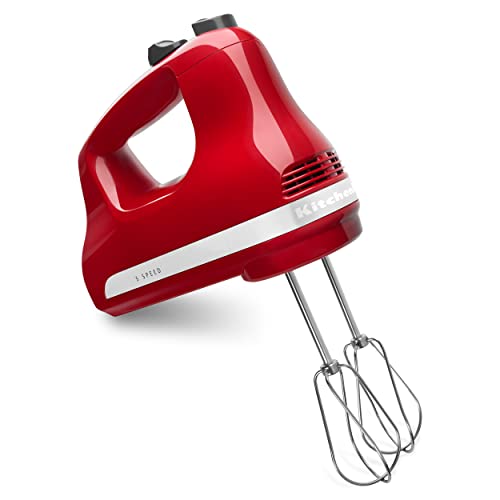
KitchenAid 5 Ultra Power Speed Hand Mixer, KHM512, Empire Red
Badge: Best Overall
Strengths
- Turbo Beaters and 5 well-chosen speeds cover the standard shake completely, with nothing to overthink at 6 a.m.
- Dishwasher-safe beaters and an easy-release button make the daily cleanup a one-minute routine.
- Lockable swivel cord stays out of the jug and off the counter’s wet zone; Empire Red is the classic KitchenAid finish.
Trade-offs
- No dedicated slow-start feature — powder discipline (liquid first, beaters submerged, lowest speed) is on you.
- Thick, heavily loaded shakes sit nearer its ceiling than the 250-watt Hamilton Beach’s.
- No storage case in the listing; the set lives in a drawer.
Mini spec box
- Type: Electric hand mixer
- Speeds: 5
- Features: Turbo Beaters, lockable swivel cord, easy-release button, dishwasher-safe beaters
- Finish: Empire Red
- Model: KHM512
Daily habits are won on friction, and the KHM512 in Empire Red is the low-friction champion of this guide — the platform the rest of the linked picks are measured against. The routine writes itself: jug, liquid, powder sprinkled over it, Turbo Beaters submerged, twenty seconds climbing the speeds, beaters popped off with the release button and into the dishwasher, mixer back in the drawer. KitchenAid’s hand mixer line is a mature, widely owned design, which means the muscle memory transfers, replacement beaters exist, and the Empire Red finish — the brand’s signature colour — looks composed living on the counter if drawer space is scarce. For the standard shake, its 5 speeds are not a limitation but a simplification: there is a right speed for each stage of the technique in this guide, and the dial has all of them.
Where it asks something of you is the start. Without a slow-start feature, the anti-splash discipline is manual: beaters submerged before switching on, lowest speed until the powder wets through, then climb. It is a two-day habit to learn and a lifetime habit to keep. Dense nut-butter builds also belong more naturally to the Hamilton Beach below. Within its lane — the daily standard shake, made fast and cleaned faster — this is the pick the guide hands to most readers, in whichever of its two finishes suits the kitchen.
Best for: The daily standard shake, made fast and cleaned faster / Not suited for: Thick, heavily loaded shakes as a daily routine

KitchenAid 5 Ultra Power Speed Hand Mixer, KHM512, Contour Silver
Badge: Best Neutral Finish
Strengths
- Turbo Beaters and 5 well-chosen speeds cover the standard shake completely, with nothing to overthink at 6 a.m.
- Dishwasher-safe beaters and an easy-release button make the daily cleanup a one-minute routine.
- Lockable swivel cord stays out of the jug and off the counter’s wet zone.
Trade-offs
- No dedicated slow-start feature — powder discipline (liquid first, beaters low) is on you.
- 5 speeds give less top-end variety than the 7-speed LILPARTNER for texture experimentation.
- No storage case in the listing; the set lives in a drawer.
Mini spec box
- Type: Electric hand mixer
- Speeds: 5
- Features: Turbo Beaters, lockable swivel cord, easy-release button, dishwasher-safe beaters
- Finish: Contour Silver
- Model: KHM512
This is the same KHM512 platform as the Best Overall pick — same 5 speeds, same Turbo Beaters, same lockable swivel cord, same dishwasher-safe beaters — in Contour Silver instead of Empire Red, and the guide lists it separately for the same reason it lists stand mixer finishes separately elsewhere: because the finish is a real ownership decision and pretending two listings are two different machines would be dishonest. Everything in the Empire Red review applies here word for word as far as shake performance goes. The daily routine is identical, the start discipline is identical, the cleanup is identical.
So the choice is purely about the kitchen it will live in. Contour Silver is the finish for stainless and monochrome kitchens, for renters matching landlord appliances, and for anyone who finds red a lot of personality before coffee. It also hides the pale dusting of protein powder and flour that a darker or brighter finish advertises between wipe-downs — a small, practical grace in a tool used daily with dry powder. If the platform is right for you and your kitchen runs silver, this is your unit; if it runs red, the pick above is. The shake will not know the difference, and neither will your mornings.
Best for: KHM512 buyers whose kitchens run silver and stainless / Not suited for: Anyone expecting a different machine from the Empire Red — it is the same platform

Hamilton Beach 6-Speed Hand Mixer with QuickBurst
Badge: Best for Thick Shakes
Strengths
- 250 watt motor — the strongest published figure among the linked picks — shrugs at yogurt, nut butter, and oat-thickened builds.
- QuickBurst gives a momentary extra surge for the stubborn pocket of powder or the last ribbon of peanut butter.
- Bowl rest and snap-on storage case keep a daily tool parked neatly between uses.
Trade-offs
- Power without a slow-start feature demands the submerged-beater habit from the first shake.
- 6 speeds are ample, but texture experimenters get a wider accessory range from the LILPARTNER.
- The white finish shows smoothie pigments; rinse-and-wipe is part of ownership.
Mini spec box
- Type: Electric hand mixer
- Speeds: 6, plus QuickBurst
- Motor: 250 watt
- Included: Traditional beaters, snap-on storage case
- Feature: Bowl rest
- Model: 62682G
There are two kinds of protein shake: the kind that pours, and the kind that nearly spoons. The second kind — Greek yogurt bases, peanut butter, ground oats, frozen banana worked in as it softens — is where weaker mixers fade and where this Hamilton Beach is aimed. Its 250 watt motor is the headroom those builds consume, and QuickBurst is the thoughtful detail: a press-for-power surge that breaks the last resistant pocket without stepping the whole shake up a speed and repainting the kitchen. The bowl rest, a small thing, suits the shake workflow precisely — park the mixer on the jug’s rim while you add the next ingredient, beaters dripping into the drink rather than onto the counter.
The trade is the familiar one between power and gentleness. Nothing in the listing promises a soft start, so your first-second technique carries the whole anti-splash burden, and with 250 watts behind a careless thumb the burden is real. Learn the submerged start — as the how-to section drills — and the power becomes pure insurance: the mixer never strains, never overheats on a thick build, and never leaves the ribbon of nut butter unincorporated at the bottom of the jug. For loaded shakes, this is the pick.
Best for: Thick, loaded shakes with yogurt, nut butter, oats, and fruit / Not suited for: Beginners unwilling to learn the submerged-beater start

LILPARTNER 7-Speed Hand Mixer with 5 Accessories
Badge: Best Accessory Set
Strengths
- 5 stainless steel accessories give the experimenter a tool for every shake texture, from whisked froth to beaten thickness.
- 7 speeds offer the finest speed gradation among the linked picks for texture control.
- Dishwasher-safe accessories keep the daily cleanup honest and fast.
Trade-offs
- A newer marketplace brand: thinner documentation and owner community than KitchenAid or Cuisinart.
- No storage case is named in the listing — five accessories need a home you provide.
- The light pink finish is a commitment to a look, charming or clashing depending on your kitchen.
Mini spec box
- Type: Electric hand mixer
- Speeds: 7
- Accessories: 5 stainless steel accessories (per listing)
- Care: Dishwasher safe accessories
- Finish: Light Pink
- Listing framing: Whipping dough, cream, cake
The LILPARTNER is the tinker’s pick. Where the other linked mixers optimise a routine, this one invites variation: five stainless steel accessories across seven speeds means the shake can be whisked light, beaten smooth, or worked thick, and the drinker who treats the morning shake as a small daily experiment gets a laboratory in one purchase. The dishwasher-safe accessories matter more in this category than in baking — protein residue is a daily adversary, and tools that clean themselves in the rack protect the habit. Its 7 speeds land in the range’s sweet spot for shake work, fine enough at the bottom for powder, strong enough at the top for froth.
The reservations are about ecosystem rather than performance: a newer brand means fewer years of owner knowledge to search when something puzzles you, and no case is named for the five accessories, so drawer discipline is yours to invent. Neither touches the mixing itself. For the buyer who values versatility per purchase and enjoys the gadgetry of a full accessory set, the LILPARTNER is the most playful serious option in the guide — and its pink finish, in a sea of chrome and white, at least guarantees you will always know which mixer is yours.
Best for: Experimenters who vary textures and want every accessory in the box / Not suited for: Buyers who prioritise established-brand support and included storage
Cuisinart SM-50 Stand Mixer, Periwinkle Blue
Badge: Prose-Only — Wrong Format for Single Servings
Strengths
- A genuinely capable stand mixer: 12 speeds, 5.5-quart stainless bowl, whisk, paddle, dough hook, splash guard.
- For batch production — a week’s shake bases or a household’s worth at once — its whisk in a full bowl works properly.
- The Periwinkle Blue finish is the low-fuss, attractive option in its line.
Trade-offs
- A single shake in a 5.5-quart bowl barely reaches the whisk; the drink cannot be mixed as designed.
- Cleanup of a full bowl and whisk assembly for one glass of shake is disproportionate to the point of habit-killing.
- It occupies permanent counter space to do a job a drawer-sized tool does better.
Mini spec box
- Type: Stand mixer
- Speeds: 12
- Bowl: 5.5-quart stainless steel
- Included: Chef’s whisk, mixing paddle, dough hook, splash guard with pour spout
- Finish: Periwinkle Blue (SM-50TQNAS)
- Status: Prose-only — no link, format mismatch with the keyword’s core use case
This review exists to document a mismatch, and to be fair to a good machine while doing so. The SM-50 is a fine stand mixer — in this site’s pizza and baking coverage it anchors recommendations — with a whisk that would whip a bowl of shake ingredients beautifully if the bowl held a batch. But a protein shake is not a batch. It is one serving, a few hundred millilitres, and in a 5.5-quart bowl that serving spreads into a shallow pool the whisk skims rather than mixes, leaving powder stranded at the edges while the centre aerates. You would then wash a full-size bowl, a whisk, and a splash guard to drink one shake. No one sustains that routine, and a tool whose routine collapses is the wrong tool however excellent its engineering.
The narrow exception proves the rule: if you batch-prepare shake bases for a household or a week — litres at a time, stored and portioned — a stand mixer’s whisk in a properly filled bowl becomes rational, and this platform would serve well. That use case belongs to meal-prep guides, not to this keyword, so the SM-50 in Periwinkle Blue is reviewed in full, credited honestly, and linked nowhere.
Best for: Batch meal-prep at household scale (outside this keyword’s brief) / Not suited for: Single-serving protein shakes — the subject of this guide
Cuisinart SM-50 Stand Mixer, Ruby Red
Badge: Prose-Only — Wrong Format for Single Servings
Strengths
- The identical SM-50 platform: 12 speeds, 5.5-quart bowl, full attachment set including the whisk.
- Ruby Red is the classic, forgiving finish — it hides smoothie and berry pigments between cleans.
- As a baking and dough machine in its own category, it needs no apology from this guide.
Trade-offs
- Identical format mismatch: one shake cannot engage a 5.5-quart bowl’s whisk as designed.
- Identical cleanup disproportion for a single serving.
- Buying it for shakes alone would strand a premium-tier machine on the wrong job.
Mini spec box
- Type: Stand mixer
- Speeds: 12
- Bowl: 5.5-quart stainless steel
- Included: Chef’s whisk, mixing paddle, dough hook, splash guard with pour spout
- Finish: Ruby Red (SM-50R)
- Status: Prose-only — no link, format mismatch with the keyword’s core use case
Everything said of the Periwinkle Blue machine applies here with the finish changed, because the platform — and the mismatch — is identical. Ruby Red is the heritage colour, the one that hides berry-shake splashes better than any finish in the SM-50 line, and if a household already owns this mixer for baking, an occasional batch of shake base in a full bowl is a legitimate use. But as a purchase for protein shakes, it fails the same first-principles test: the serving is small, the bowl is large, the whisk cannot engage, and the cleanup ends the habit. The guide’s linked hand mixers exist precisely because format fit outranks raw capability — a lesson that applies across this library’s categories, from the gaming-audio setups in Best Mixers For Ps4 to the bar, where the right-sized tool beats the impressive one every time.
It is therefore reviewed, credited, and unlinked, alongside its blue sibling. Readers who came here owning one should not feel criticised — they own a good baking machine. Readers who came here to buy a shake tool should buy a hand mixer and keep the stand mixer’s considerable talents for the jobs sized to it.
Best for: Existing owners batch-prepping at scale; bakers in its home category / Not suited for: Anyone buying a tool for daily single-serving shakes
Comparison Table
| Pick | Type | Speeds | Shake-relevant feature | Status |
|---|---|---|---|---|
| KitchenAid KHM512, Empire Red | Hand | 5 | Turbo Beaters; dishwasher-safe beaters; easy release | Check on Amazon |
| KitchenAid KHM512, Contour Silver | Hand | 5 | Identical platform, silver finish | Check on Amazon |
| Hamilton Beach 62682G | Hand | 6 + QuickBurst | 250 W motor for thick shakes; bowl rest | Check on Amazon |
| LILPARTNER 7-Speed | Hand | 7 | 5 stainless accessories; dishwasher safe | Check on Amazon |
| Cuisinart SM-50, Periwinkle Blue | Stand | 12 | 5.5 qt bowl — batch scale only | Prose-only — format mismatch |
| Cuisinart SM-50, Ruby Red | Stand | 12 | 5.5 qt bowl — batch scale only | Prose-only — format mismatch |
How to Choose a Mixer for Protein Shakes
Start with the serving, not the specs. Your shake is a few hundred millilitres in a glass or jug. The tool must work at that scale, in that vessel, daily. Hand mixers are built to exactly that geometry; stand mixers are built to the opposite one. Every other criterion in this section is a refinement of this first fit — the same fit-first reasoning that matches drinkers to the right bottle in Best Mixers For Raspberry Vodka and producers to the right desk in the audio guides.
Decide how thick your shake runs. Powder and liquid alone ask almost nothing of a motor — any linked pick excels. Yogurt, nut butter, oats, and frozen fruit ask for torque and surge: that is the Hamilton Beach’s 250 watts and QuickBurst, or the Cuisinart’s 220 W with range to spare. Be honest about your recipe’s centre of gravity; thick-shake drinkers who buy a light-duty mixer meet its limits every morning.
Value the start as much as the speed. Floating powder plus a violent start equals a redecorated kitchen. None of the linked listings here advertises a branded slow-start feature, so the submerged-beater technique — attachment under the surface, lowest speed until the powder wets through — is the gentle entry, and it is entirely sufficient. Judge candidate mixers by their first second, not their top speed.
Choose your texture tool. Beaters disperse and smooth; whisk-style accessories aerate and froth. If your ideal shake is dense and milkshake-like, beaters are the main attachment and any pick serves. If you chase a light, whipped top, accessory range matters — the LILPARTNER’s five stainless steel accessories, listed for whipping work, are the fleet to examine. Texture preference is a legitimate deciding vote between otherwise close picks.
Audit the cleanup like it is a specification. For a daily tool, it is one. Dishwasher-safe beaters (KitchenAid, LILPARTNER), quick-release buttons, and a case or drawer system that keeps the kit together decide whether day thirty looks like day one. Protein residue punishes delay ferociously — dried whey sets like glue — so the best cleanup feature is the routine you will actually perform, and the best mixer is the one whose routine is shortest.
How to Mix a Clump-Free Protein Shake, Step by Step
Step 1 — Liquid first, always. Pour your milk, water, or base into a tall jug or large glass before any powder approaches it. Powder added to a dry vessel clumps on contact with liquid poured over it; powder sprinkled onto liquid disperses. This single ordering rule prevents most lumps before the mixer is even switched on.
Step 2 — Sprinkle the powder over the surface. Dust the powder across the liquid rather than dumping it in one mound. A mound hydrates on the outside and seals a dry core — the classic clump. A sprinkled layer wets evenly and surrenders to the beaters immediately.
Step 3 — Submerge, start low, then climb. Lower the beaters or whisk into the liquid before switching on. Start at the lowest speed for a few seconds until the powder is fully wetted, then rise to mid-speed for ten to fifteen seconds of true mixing. This is the whole technique; everything else is variation.
Step 4 — Add the extras in the right order. Soft additions (yogurt, banana, nut butter) go in after the powder has dispersed, so the mixer meets one problem at a time. Frozen fruit goes in last and gets the highest speed or a QuickBurst-style surge. Ice, if used, is crushed by brief high-speed passes rather than a long grind.
Step 5 — Rest thirty seconds, then judge. A short rest lets foam settle and reveals the true texture. If a stray lump survived, five more seconds at mid-speed ends it. Drink from the jug or pour over fresh ice — and rinse the jug and beaters immediately, before the residue sets.
Troubleshooting
Problem: A dry lump survives in the middle of the shake → The powder was dumped in a mound or added before the liquid. Sprinkle onto liquid, start submerged at low speed, and give the lump a direct pass with the beaters at mid-speed.
Problem: Powder erupts over the rim at startup → The beaters were not submerged, or the first speed was too high. Always start with the attachment under the surface at the lowest setting; a slow-start model forgives, but position is the real cure.
Problem: The shake is frothy when you wanted it dense (or flat when you wanted froth) → Attachment and speed choice. Beaters at mid-speed give a dense, smooth body; a whisk at higher speed builds froth. Swap the attachment before you blame the powder.
Building a Shake Routine That Survives Busy Mornings
The best shake mixer is the one embedded in a routine with no decision points. Station the mixer, its beaters, the jug, and the powder in one zone of the kitchen so the morning sequence is reach, pour, sprinkle, mix, rinse — under two minutes, half-asleep-proof. Pre-portioning helps the busiest households: powder measured into small containers for the week turns step two into a tip-and-go. Keep a spare set of beaters if your dishwasher runs at night, so a dirty set never vetoes the morning shake. And protect the ritual’s feedback loop: a shake that tastes smooth and takes ninety seconds reinforces itself, while a clumpy shake from a buried, dirty, hard-to-reach mixer quietly trains you to skip days. This is why the guide weights cleanup and start behaviour so heavily — in a daily category, ergonomics is performance. The same routine-first thinking appears wherever a tool is used daily rather than occasionally, a theme this library returns to from the bar counter in Best Mixers For Red Stag to the studio desk: frequency forgives nothing, so design for the frequency.
Protein Powders Behave Differently — Mix Them Accordingly
Not all powders surrender at the same speed, and the drinker who rotates protein types learns to adjust the technique rather than blame the mixer. Whey-style powders are the cooperatives: they wet quickly, disperse at low-to-mid speed, and reward the standard sequence in this guide with a smooth, thin shake. Plant-based blends are the negotiators — often built from several protein sources with grittier textures, they benefit from an extra ten seconds at mid-speed and from being sprinkled in two portions rather than one, so each portion fully wets before the next lands. Slow-digesting, casein-style powders are the thickeners: they hydrate into a pudding-like body that climbs toward the Hamilton Beach’s end of this guide, and they punish haste with lumps that set rather than dissolve. Flavoured and sweetened ready blends sit somewhere in the middle, usually dispersing easily but foaming more readily, which argues for beaters over whisk-style accessories when a dense texture is the goal. The pattern across all four is the guide’s recurring theme: the material dictates the settings. Read your powder the way a baker reads a flour — by behaviour, not by label promises — and the same mixer will produce a consistently smooth shake from every tub in the cupboard.
What to Add, and What Each Addition Asks of the Mixer
A plain powder-and-liquid shake is the floor of this category, not its ceiling, and each popular addition changes the mixing problem in a specific way. Greek yogurt adds body and tang; it incorporates best when added after the powder has dispersed, in two spoonfuls rather than one slab. Nut butters add richness and the category’s stiffest resistance — warm the spoon under the tap so the butter releases cleanly, and expect the QuickBurst-style surge or the highest comfortable speed to earn its keep. Rolled oats, pre-soaked or added dry in small quantities, thicken the shake toward a meal; dry oats need the longest mixing pass and a brief rest to soften before drinking. Frozen berries contribute flavour, colour, and cold; added last, they break down progressively and chill the shake as they surrender. Greens and soft fruit are the easy citizens, folding in at mid-speed without argument. Coffee, cocoa, cinnamon, and other dry flavourings should be sprinkled with the protein powder itself, so they disperse through the same wetting stage rather than floating as a separate, stubborn layer. Built this way — base first, additions in order of stubbornness — a hand mixer produces shakes that a shaker bottle cannot attempt, which is the honest core of this guide’s case for the category.
Storing the Kit So the Habit Survives
Daily tools fail by disappearing into the kitchen’s geography — a mixer in one drawer, its beaters in another, the jug migrated to a high shelf — until the friction of assembly quietly ends the habit. The fix is a single shake zone: mixer and attachments together (a case, a dedicated drawer section, or a counter corner), the jug living beside them, and the powder tubs within the same reach. Households that pre-portion powder for the week can keep those containers in the same zone, turning the morning into a single unbroken motion. It sounds like tidiness advice; it is actually adherence engineering, and over a year it matters more than the difference between any two mixers in this guide. The best mixer is the one that is assembled, clean, and waiting — everything else is specifications.
Common Buying Mistakes
- Buying a stand mixer for single servings. The bowl cannot engage one shake, and the cleanup kills the habit. Format first.
- Judging by top speed. Shakes are made at low and mid speeds; the start and the middle of the dial are the product.
- Dumping powder in a mound. A technique error no mixer fully rescues. Sprinkle onto liquid, every time.
- Letting the jug sit. Protein residue sets fast and hard. The thirty-second rinse is the cheapest accessory you own.
- Ignoring the whisk. If froth is your goal, the attachment matters more than the motor. Check the set before you buy.
- Overloading a light-duty mixer with thick builds. Match the motor to your recipe’s thickest day, not its average day.
Final Recommendation
For most shake drinkers, the KitchenAid KHM512 in Empire Red — or its identical Contour Silver sibling — is the complete answer: Turbo Beaters that disperse powder cleanly, five speeds that map exactly onto the shake technique, and dishwasher-safe beaters that keep the daily habit alive. If your shakes run thick and loaded, step to the Hamilton Beach and its QuickBurst; if you want an accessory for every texture experiment, the LILPARTNER set is your laboratory. And leave the stand mixers — both of them, in both colours — to the baking they were built for: in this category, the right-sized tool wins, and it fits in a drawer. Set up your shake zone tonight, put the powder where your hand already reaches, and tomorrow’s shake will take ninety seconds and taste like it — smooth, cold, and completely free of the lump that used to wait at the bottom of the glass.
Related guides
Frequently Asked Questions
Can you really make a protein shake with a hand mixer?
Yes — very well. In a tall jug, a hand mixer’s beaters disperse protein powder more completely than a shaker ball, because the powder is actively worked through the liquid rather than merely agitated with it. The technique is simple: liquid first, powder sprinkled on top, beaters submerged, start low and climb briefly. The result is a smooth shake with no dry core in the last mouthful, and the mixer also handles soft additions — yogurt, banana, nut butter — that a shaker cannot incorporate at all.
Why not just use a stand mixer I already own?
Because of geometry and cleanup. A single shake in a 5.5-quart stand mixer bowl forms a shallow pool that the whisk skims instead of mixing, stranding powder at the edges; and washing the full bowl assembly for one glass is a routine nobody sustains daily. If you batch-prepare litres of shake base at once, a stand mixer becomes reasonable — that is the exception the prose-only reviews in this guide describe. For the daily single serving, a hand mixer is simply the right-sized tool.
Beaters or whisk — which is better for protein shakes?
It depends on the texture you want. Beaters are the generalists: they disperse powder fully and produce a dense, smooth, milkshake-like body, and they handle thick additions best. A whisk-style accessory incorporates air, giving a lighter, frothier shake that drinks more like a café beverage. Many drinkers use beaters for weekday shakes and a whipping accessory for weekend ones — the LILPARTNER’s five-accessory set is the pick in this guide built around that kind of range.
How do I stop the powder from clumping?
Attack the three causes in order. First, sequence: liquid in the jug before powder, always. Second, distribution: sprinkle the powder across the surface instead of dumping a mound, which seals a dry core inside a wet shell. Third, technique: beaters submerged before switching on, lowest speed until the powder wets through, then a short mid-speed mix. Followed together, these make clumps a rarity rather than a routine; a surviving lump yields to five seconds of direct beater attention.
Is a hand mixer hard to clean after shakes?
Only if you wait. Rinsed immediately, beaters and jug clean in seconds, and several picks here have dishwasher-safe beaters that make cleanup fully hands-off. The enemy is delay: protein residue, especially whey, dries into an adhesive film that demands soaking and scrubbing. The thirty-second rinse is the single most valuable habit in this category — more valuable, over a year of mornings, than any specification on any box in this guide.
Can a hand mixer handle frozen fruit and ice in a shake?
Soft-frozen fruit, yes, once the base is mixed — add it last and work at higher speed, letting the pieces break down progressively. Hard ice is a sterner test: small cubes or crushed ice in brief high-speed passes are manageable for the stronger picks like the 250-watt Hamilton Beach, but a hand mixer is not an ice crusher, and routinely attacking large cubes will shorten any hand mixer’s life. If your shake is built on heavy ice, that is a blender’s job; for the classic powder-and-soft-additions shake, the hand mixer is in its element.
What size jug should I use with a hand mixer?
A tall, narrow jug or large glass, filled no more than about two-thirds. Height gives the beaters submerged working room and contains the vortex; the headspace absorbs the rise when froth builds. A wide, shallow bowl invites splashing and lets powder escape at the edges — the same reason stand mixer bowls fail this task at the opposite extreme of scale. The humble measuring jug, already in most kitchens, is close to the ideal vessel — its handle steadies it against the mixer’s torque, its spout pours the finished shake without drips, and its measurement marks quietly teach you your own preferred powder-to-liquid ratio over the first week of mornings.


