Disclosure: topratedkitchenware.com is reader-supported. When you buy through links on our site, we may earn an affiliate commission from Amazon and other retailers, at no extra cost to you.
Where to buy
The six models below are the verified picks for this guide to the best drip coffee makers with insulated carafe. Each name links to its Amazon listing, where you can check the latest price on Amazon, confirm the current configuration, and read the newest owner feedback before you decide.
- BLACK+DECKER CaféCraft 12-Cup Thermal Coffee Maker
- Cuisinart 12-Cup PerfecTemp Thermal Coffee Maker, White
- BUNN Speed Brew Platinum Thermal Coffee Maker (CSB3T)
- Hamilton Beach FlexBrew Advanced 5-in-1 Coffee Maker
- KRUPS 12-Cup Programmable Thermal Carafe Coffee Maker
- Cuisinart 10-Cup Thermal Classic Coffeemaker (DCC-1170BKNAS)
If you follow only one link from this box, start with the KRUPS — Check on Amazon — whose double-wall insulated carafe is the clearest expression of what this search is for. Read the full guide ↓ for the ranking logic, the honest limitations of every pick, and the checks that matter more than any headline claim.
There is a moment every drip coffee drinker knows: the second cup, poured an hour after the first, that tastes like a memory of coffee instead of coffee. The search for the best drip coffee makers with insulated carafe is the search for the machine that deletes that moment. An insulated carafe does not reheat your coffee and does not cook it; it simply refuses to let the heat leave quickly, wrapping the pot in a double wall so the coffee coasts down gently from the temperature it was brewed at. No warming plate stewing the bottom of the pot, no microwave revival, no apologetic last cup. This guide ranks six verified drip makers that brew into insulated thermal carafes, and it treats insulation as the serious technology it is — how the walls are built, how the lid seals, how long the pot honestly stays worth drinking, and which brewer behind the carafe deserves to fill it.
The six picks share the insulated philosophy and differ in almost everything else: a hot-and-iced all-rounder, a small-batch specialist, a speed machine, a pod-capable hybrid, a long-holding purist, and a compact classic. That spread is deliberate, because insulation is a foundation, not a personality — once the carafe is right, the machine should be chosen for your routine. Around the reviews you will find a comparison table, a buying guide on insulation construction and heat maths, a how-to section covering preheating, cleaning, and troubleshooting, and a direct comparison with the warming-plate world this category replaces. Readers who want the same vessels ranked with the whole machine attached should also see Best Drip Coffee Makers With Thermal Carafe, the sister shortlist to this one.
Key Takeaways
- Insulated carafes hold heat by slowing loss, not by adding heat — which is why the coffee keeps its flavour instead of stewing.
- Double-wall construction is the meaningful specification; the KRUPS in this list states its holding time plainly and brews with no warming plate at all.
- All six picks insulate. They differ by talent: iced brewing, small batches, speed, pods, long holding, and compact size.
- The lid is half the insulation system. A sealed lid and a preheated carafe are worth more than any marketing adjective.
- Insulation rewards batch honesty: a reasonably full carafe holds heat better than a mostly empty one.
- Judge these machines by the cup poured at hour two and three, not by the first pour — that is the test they were built for.
In this guide
Quick Picks
| Pick | Badge | Why it is here | Link |
|---|---|---|---|
| BLACK+DECKER CaféCraft 12-Cup Thermal Coffee Maker | Best for Hot and Iced | A 12-cup insulated pot that also brews iced coffee. | Check on Amazon |
| Cuisinart 12-Cup PerfecTemp Thermal Coffee Maker, White | Best for Small Batches | PerfecTemp brewing and a 1-4 cup setting, held in a thermal carafe. | Check on Amazon |
| BUNN Speed Brew Platinum Thermal Coffee Maker (CSB3T) | Best for Speed | A fast brew sealed quickly into a 10-cup insulated carafe. | Check on Amazon |
| Hamilton Beach FlexBrew Advanced 5-in-1 Coffee Maker | Most Versatile | 12-cup insulated drip plus single-serve pods and grounds. | Check on Amazon |
| KRUPS 12-Cup Programmable Thermal Carafe Coffee Maker | Best Overall | Double-wall insulated carafe, hours of holding, no warming plate. | Check on Amazon |
| Cuisinart 10-Cup Thermal Classic Coffeemaker (DCC-1170BKNAS) | Best Compact Insulated Pot | A proven 10-cup programmable thermal machine in black. | Check on Amazon |
How These Picks Were Chosen
This guide is research-led and insulation-first. The first filter admitted only machines whose verified listings describe a thermal — that is, insulated — carafe; glass-and-plate machines were excluded by definition, however good their brewers. Within that field, picks were ranked on the quality of the insulation story (double-wall construction where stated, holding claims where published, lid and carafe design as reported by owners), the quality of the brewer behind the carafe (a named hotter-brewing system, a fast commercial-style cycle, an even-extraction design, or hybrid versatility), and the fit between machine and a recognisable household routine. Owner feedback was read specifically for the hour-two and hour-three reports — the comments about coffee still hot at mid-morning — because those are the only reviews that actually test this category’s promise.
Specifications come only from each model’s verified listing data. Where a listing states a holding duration, as the KRUPS listing does, this guide repeats it as the maker’s own description; where a listing is silent, the review describes the construction and the routine it suits without inventing hours or degrees. Prices are not printed, per house rule, because they move; every pick links to its live listing to check the latest price on Amazon. Readers weighing the insulated decision against the wider market should compare Best Drip Home Coffee Makers for routine-led rankings and Best Drip Pot Coffee Makers for the pot-first view of the same category.
The 6 Best Drip Coffee Makers With Insulated Carafe

BLACK+DECKER CaféCraft 12-Cup Thermal Coffee Maker
Badge: Best for Hot and Iced
Strengths
- 12-cup thermal insulated carafe holding the hot pot without a warming plate.
- Brews iced coffee as well — the insulated pot anchors a two-season machine.
- Programmable timing, so insulation preserves a fresh pot rather than an early one.
Trade-offs
- No visible coffee level through the insulated walls.
- Hot-only households pay for an iced talent they will not use.
- Fewer published brew-customisation details than the Cuisinart pair.
Mini spec box
- Capacity: 12-cup
- Carafe: Thermal (insulated)
- Modes: Hot and iced coffee
- Controls: Programmable
- Brand line: CaféCraft
The CaféCraft treats insulation as the platform and versatility as the feature. The platform is correct: a 12-cup thermal carafe that keeps a programmed, freshly brewed pot hot by insulation rather than by plate, so the household’s second and third cups are the same coffee as the first. On that platform sits the two-season talent — proper iced coffee brewing for the months when the insulated pot’s hot duty is done by mid-morning. It is worth noting that good iced coffee depends on the same discipline as good held coffee: a strong, fully extracted hot brew, which is why a machine can honestly offer both. For split households, this is the insulated pick that ends the argument about a second appliance.
The trade-offs are the standard thermal ones — a level you judge by cups poured, a preheat habit on cold mornings — plus the focus question: households that never drink iced coffee are buying a talent they will not use, and the KRUPS below directs all of its design at the holding job itself. But as an insulated all-rounder for a family kitchen, the CaféCraft covers more of the year than any other pick here.
Best for: families split between hot and iced coffee / Not suited for: hot-only purists who want a holding specialist

Cuisinart 12-Cup PerfecTemp Thermal Coffee Maker, White
Badge: Best for Small Batches
Strengths
- PerfecTemp thermal brewing system designed for hotter extraction.
- Dedicated 1-4 cup setting — small pots brewed properly, then insulated.
- Brew Pause and Brew Strength Control for deliberate drinkers.
Trade-offs
- Small batches in any large carafe lose heat faster than full ones; the preheat habit matters most here.
- White finish shows coffee splashes.
- Premium tier within this group.
Mini spec box
- Capacity: 12-cup
- Carafe: PerfecTemp thermal (insulated)
- Brewing system: PerfecTemp
- Settings: 1-4 cup setting, Brew Strength Control, Brew Pause
- Finish: Stainless steel, white
Insulation physics has a weak point, and it is the small batch: a few cups in a large carafe present more wall and more air per cup of coffee, so heat leaves faster than it does from a full pot. This Cuisinart is the pick that confronts that honestly. Its PerfecTemp system brews the small pot with a dedicated 1-4 cup setting rather than a truncated full cycle, so the coffee starts right; the thermal carafe then holds it, and the guide’s preheating habit — a minute of hot water in the carafe before brewing — closes most of the remaining physics gap. The result is the rare machine whose small weekday pot and large weekend pot are both first-class citizens.
Brew Pause serves the first impatient cup, and strength control lets the household tune the recipe the carafe will hold. The costs are cosmetic and financial: a white finish that shows its work, and a premium tier position in this group. Full-pot-only households should take the KRUPS or the silver PerfecTemp configuration instead; mixed households — small weekdays, full weekends — will find no insulated pick better matched to their actual life.
Best for: small weekday batches with full-pot weekends / Not suited for: always-full-pot households on a tight budget

BUNN Speed Brew Platinum Thermal Coffee Maker (CSB3T)
Badge: Best for Speed
Strengths
- Speed Brew cycle gets the pot into its insulated carafe fast, minimising exposed cooling time.
- Thermal carafe in stainless steel and black — insulation with a commercial build.
- 10-cup size suits households that drink the pot within its best window anyway.
Trade-offs
- Less programmable depth than the KRUPS or the Cuisinarts.
- 10-cup ceiling for entertainers.
- Its holding story is good design rather than a published long-duration claim.
Mini spec box
- Capacity: 10-cup
- Carafe: Thermal (insulated)
- Design: Speed Brew Platinum
- Finish: Stainless steel, black
- Model: 55200 CSB3T
The BUNN’s insulation story begins before the carafe: with time. Every minute brewed coffee spends dripping, sitting, and waiting in open air is a minute of heat leaving, so a machine that brews fast and seals the pot into an insulated carafe quickly starts the holding contest ahead. That is the Speed Brew proposition, bred in commercial settings where coffee must be ready and must stay ready. Paired with a stainless-and-black thermal carafe at an honest 10-cup size, it serves the household whose pattern is brew, drink, refill, done — the pot rarely needs to survive past mid-morning because it rarely does.
The limitations are the familiar BUNN ones: a focused feature set with less scheduling theatre than programmable rivals, and a 10-cup ceiling. There is also a candour point in this guide’s terms: the KRUPS publishes a holding duration for its double-wall carafe and the BUNN does not, so grazers who need the longest documented hold should choose accordingly. For the fast household, the BUNN’s combination — speed into insulation — is the most coherent design here.
Best for: fast households that finish the pot by mid-morning / Not suited for: long grazers and menu enthusiasts
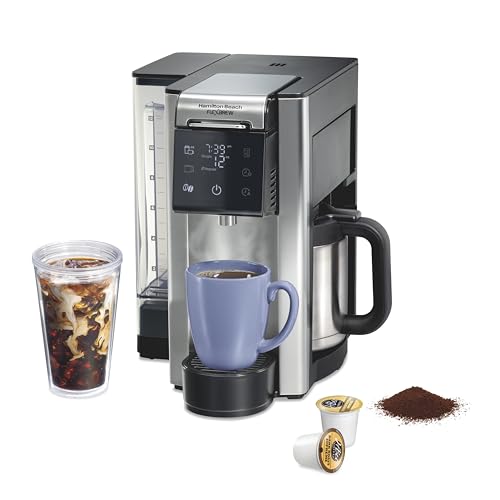
Hamilton Beach FlexBrew Advanced 5-in-1 Coffee Maker
Badge: Most Versatile
Strengths
- The drip side is a genuine 12-cup thermal programmable brewer — insulation included, not implied.
- Single-serve pods and grounds cover the hours when a fresh cup beats a held one.
- Removable 60 oz reservoir makes the fresh-water habit easy.
Trade-offs
- Two systems mean more cleaning and more counter presence.
- Pod habits raise per-cup running costs if they become the default.
- The insulated pot is one talent among five here, not the machine’s sole focus.
Mini spec box
- Configuration: 5-in-1 drip and single serve
- Drip capacity: 12-cup thermal (insulated), programmable
- Single serve: Pods and grounds, hot and iced
- Reservoir: Removable, 60 oz
- Finish: Black
The FlexBrew earns its insulated badge the honest way: its drip side brews a full 12-cup pot into a thermal carafe, programmably, which makes it a legitimate member of this category before its other talents are even mentioned. Those talents then solve the insulated pot’s one true weakness — the odd hour. No carafe, however good, makes a 4 p.m. cup from a 7 a.m. pot a good idea; a single-serve side that brews one fresh cup from pods or grounds does. The combination covers the whole day: insulated pot for the morning crowd, fresh singles for the stragglers, and a removable 60 oz reservoir that keeps the water fresh for both.
The costs are complexity and discipline. Two systems need cleaning, the footprint is the largest here, and pods must stay the exception or the running costs quietly climb. Households certain they want only a pot should take the KRUPS; households certain they want pods first should start at Best Drip Coffee Makers With Pod. Mixed households, though, get the only machine here that refuses to choose — and its insulation is real.
Best for: mixed households wanting an insulated pot plus fresh single cups / Not suited for: minimalists and single-system households

KRUPS 12-Cup Programmable Thermal Carafe Coffee Maker
Badge: Best Overall
Strengths
- Double-wall insulated carafe that the listing describes as keeping coffee hot for hours — up to 4 hours — with no warming plate.
- Three brew strengths and 24-hour programmability: the fullest pot-machine control set here.
- No plate means no stewed flavour at any hour of the pot’s life.
Trade-offs
- No published small-batch setting; full pots are its territory.
- No second talent — no iced mode, pods, or grinder.
- The coffee level is invisible through the insulated walls.
Mini spec box
- Capacity: 12-cup
- Carafe: Double-wall thermal (insulated), keeps coffee hot 4 hours
- Controls: 24-hour programmable, 3 brew strengths
- Warming plate: None
- Brand: KRUPS
If this category has a thesis, the KRUPS is its clearest statement. A double-wall insulated carafe, a published holding expectation measured in hours, and — the detail that separates believers from marketers — no warming plate at all. KRUPS did not hedge the insulation bet by bolting a plate underneath; the carafe is the whole heat strategy, and the coffee’s flavour across a long morning is the dividend. Three brew strengths tune the pot to the beans, 24-hour programmability starts it fresh, and nothing in the design spends money away from the pot. For the grazer household — the reader, the remote worker, the slow Sunday — this is the machine the search was invented for.
The limitations are range, not execution: no small-batch mode, no extra talents, no visible level. Buyers who need any of those should choose the pick that has it, because this machine’s purity is its point. Everyone else should recognise the KRUPS for what it is — the insulated category’s benchmark in this group, against which holding claims and carafe constructions should be measured. The same machine anchors the neighbouring ranking in Best Dripping Coffee Makers for readers comparing across drip styles.
Best for: long-morning grazers who want the purest insulated pot / Not suited for: small-batch brewers and multi-talent shoppers

Cuisinart 10-Cup Thermal Classic Coffeemaker (DCC-1170BKNAS)
Badge: Best Compact Insulated Pot
Strengths
- 10-cup insulated format — a right-sized carafe holds heat better than a half-empty large one.
- Programmable, from a proven line with findable replacement parts.
- Black finish for real kitchens.
Trade-offs
- No published strength menu or small-batch mode.
- Ten cups caps out for entertainers.
- Less brewing-system identity than the PerfecTemp models.
Mini spec box
- Capacity: 10-cup
- Carafe: Thermal (insulated)
- Controls: Programmable
- Finish: Black
- Model: DCC-1170BKNAS
Insulation has a sizing secret: it works best on a carafe that is reasonably full, because a mostly empty vessel gives the coffee a large volume of air and wall to surrender heat to. The Thermal Classic exploits that secret by being honestly sized. At 10 cups, it matches the two-to-four-drinker household’s real pot, so on an ordinary morning the carafe is working in its efficient zone — full enough to hold heat well, small enough that the pot is finished while it is still itself. Add programmability and Cuisinart’s parts support, and you have the insulated pick for buyers who value fit over features.
The trade-offs are headroom and control depth: no strength menu is published, no small-batch mode, and guests beyond the pot’s size mean a second brew. Households that regularly serve more should take a 12-cup pick above. Households that do not will find this the quietest success in the list — an insulated machine that disappears into the routine and keeps the second cup honest.
Best for: small households wanting right-sized insulation / Not suited for: entertainers and control-depth seekers
Comparison Table
| Model | Capacity | Insulated carafe | Holding approach | Standout feature | Link |
|---|---|---|---|---|---|
| BLACK+DECKER CaféCraft | 12-cup | Thermal | Insulation, programmable freshness | Hot and iced brewing | Check on Amazon |
| Cuisinart PerfecTemp, White | 12-cup | Thermal | Insulation, small-batch mode | 1-4 cup setting, Brew Pause | Check on Amazon |
| BUNN Speed Brew Platinum CSB3T | 10-cup | Thermal | Fast brew sealed into insulation | Speed Brew design | Check on Amazon |
| Hamilton Beach FlexBrew Advanced | 12-cup + single serve | Thermal | Insulated pot plus fresh singles | Pods and grounds, 60 oz reservoir | Check on Amazon |
| KRUPS Thermal Carafe | 12-cup | Double-wall thermal | Insulation only — no warming plate | Keeps coffee hot for hours, 3 strengths | Check on Amazon |
| Cuisinart Thermal Classic | 10-cup | Thermal | Right-sized insulation | Compact proven format | Check on Amazon |
How to Choose a Drip Coffee Maker With an Insulated Carafe
Start with the wall. Insulation quality in this category is mostly a construction story: a double-wall carafe, with an insulating gap between two walls, slows heat loss far better than a single wall, and in stainless steel it adds knock resistance glass cannot match. When a listing states the construction — as the KRUPS listing does with its double-wall design — that is a specification you can bank on. When a listing says only “thermal,” expect competent insulation of unstated depth and lean on owner reports about the second and third hours. Either way, treat any machine that pairs the word insulated with a warming plate as a hedge, not a commitment: the plate exists because the maker does not fully trust the carafe, and the coffee pays for the doubt in flavour.
Next, the lid — the most underrated component in the category. Heat rises and escapes at the top, so a lid that seals fully, pours without being removed entirely, and closes decisively between cups protects more temperature than any wall upgrade. Lid design also decides cleaning honesty: a mechanism you can rinse and inspect stays sweet; a sealed maze slowly seasons the pot. When you read owner feedback on any insulated model, weight the lid comments heavily; owners mention lids when they leak heat, dribble coffee, or trap old flavours, and silence on the subject is its own endorsement.
Then do the batch maths, because insulation is batch-sensitive. A carafe holds heat best when reasonably full: more coffee means more thermal mass and less air per cup. Count your household’s real morning — roughly two maker-cups per drinker — and choose the capacity whose full pot is near that number. The 10-cup picks here (BUNN, Cuisinart Classic) are not smaller versions of the 12-cup picks; for a two-drinker home they are better-insulated ones, because their carafes will actually be full. Small-batch households inside a 12-cup machine should look for a dedicated small-batch setting, like the white Cuisinart’s 1-4 cup mode, and adopt the preheating habit described below as standard practice.
Finally, choose the brewer as carefully as the vessel. Insulation preserves what it is given: a properly extracted, properly hot pot becomes hours of good coffee, while a thin pot becomes hours of thin coffee at a pleasant temperature. Named brewing systems, fast sealed cycles, strength control, and hybrid freshness are the differentiators among these six picks — match the talent to your routine using the badges, and let the carafe, which all six get right, recede into the background where good insulation belongs. Shoppers still torn between vessel philosophies can compare the alternate spellings of the same search in Best Drop Coffee Makers, where the wider drip field is ranked without the insulation filter.
How to Get the Most From an Insulated Carafe: Setup, Habits, and Care
The preheat habit. Rinse the carafe with hot tap water and let it stand full for a minute before brewing, then empty it and brew. Cold walls drink the first pot’s heat; warmed walls let the coffee keep it. No habit in this category returns more temperature per second of effort, and it matters most for small batches and cold kitchens.
Daily habits. Brew the batch your household will actually drink, because a right-sized pot holds heat better and tastes fresher. Close the lid fully between pours — most heat escapes at the top, and an open insulated carafe is a contradiction. Give the pot a gentle swirl before pouring the first cup so strength is even top to bottom. And when the pot is done, rinse the carafe promptly; coffee left standing in insulation stays warm enough to keep seasoning the walls.
Cleaning and care. Wash the carafe daily with hot soapy water and a bottle brush; soak weekly to lift the oil film that daily washing misses, and clean the lid mechanism and pour spout where old coffee hides. Inspect the lid seal whenever holding performance seems to fade — a tired seal impersonates a failed carafe at a fraction of the replacement cost. Descale the brewer on the maker’s schedule: scale slows the cycle and lowers brew temperature, and insulation cannot hold heat the water never had.
Troubleshooting.
- Problem: coffee is hot at brewing and lukewarm within the hour → preheat the carafe, close the lid between pours, and check the lid seal; heat is escaping at the top or into cold walls, not through double walls.
- Problem: the pot tastes stale by the second hour despite good beans → deep-clean the carafe and lid; rancid oil film seasons held coffee faster than fresh, because the coffee sits in contact with it for hours.
- Problem: small batches cool much faster than full pots → that is physics, not failure: preheat thoroughly, brew the smallest batch the machine handles well, or choose a right-sized carafe for your routine.
Insulated Carafe vs Warming Plate: The Flavour Argument
A warming plate and an insulated carafe answer the same question with opposite physics, and the difference is taste. The plate adds heat continuously, which keeps coffee warm while cooking it: aromatics drive off, the bottom of the pot over-extracts, and by the second hour the coffee has the stewed, bitter signature everyone recognises. Insulation adds nothing; it defends what brewing created, letting temperature coast down slowly while the flavour compounds stay where the brewer put them. That is why every pick in this guide insulates and why the KRUPS — the pick with no plate at all — is the category’s purest expression. The plate’s remaining honest advantages are a visible coffee level in glass and a lower purchase price, and for households that finish a pot in twenty minutes those advantages are real. For any pot with a second hour in its future, insulation is not the premium choice; it is the correct one.
The Physics of Holding Heat, in Plain Terms
An insulated carafe fights three enemies, and understanding them turns marketing into mechanics. The first is conduction: heat passing directly through the carafe wall into the counter and the air. Double-wall construction fights conduction by putting an insulating gap between the coffee and the outside world — the wider and better-sealed that gap, the slower the loss, which is why construction is the specification that matters most in this category. The second enemy is the headspace: the air inside a partly filled carafe, which the coffee must heat and keep heating. This is why a full carafe outlasts a half-empty one of identical construction, why right-sizing a machine to your batch is an insulation decision, and why small-batch drinkers should preheat religiously — warm walls and a warm headspace are the small pot’s only allies. The third enemy is the opening: every pour exchanges hot coffee for cool room air, and a lid left open between pours surrenders more heat than the walls ever will. The practical summary is short enough to tape inside a cupboard: full, preheated, and closed beats any specification sheet.
There is also a flavour clock running alongside the temperature clock, and it is worth separating them. Coffee in a good insulated carafe stays hot longer than it stays at its peak — the aromatics that make the first cup vivid fade gradually even at perfect temperature, which is why this guide speaks of a pot’s good hours rather than promising eternity. Insulation’s achievement is that the flavour clock, not the temperature clock, becomes the limit: the coffee cools in quality slowly, on its own terms, instead of being cooked into bitterness by a plate or chilled into flatness by thin glass. A pot that is still genuinely enjoyable at hour three is the realistic promise of this category, and the six picks here were chosen because their owners report exactly that.
Four Household Profiles for Insulated Shoppers
The brunch host. Your pot travels to the table and serves through a long, talkative meal. Stainless insulation is your format, capacity should be twelve cups, and the KRUPS or the CaféCraft — the latter if summer brunches turn iced — are your picks. The carafe that never needs a trivet or a trip back to a warming plate changes how a table feels.
The desk worker. You brew at eight and sip until noon between calls. Holding is your whole requirement, and the double-wall KRUPS, preheated and closed, is the machine that makes a four-hour pot a reasonable plan rather than an act of optimism. Size down to the Cuisinart Classic only if your mornings are truly two cups deep.
The early riser in a sleeping house. You brew before anyone else is awake and the pot must wait quietly for the second riser. Programmability plus insulation is your combination — the pot brewed fresh at your hour, still right at theirs — and every pick in this guide except the speed-focused BUNN leads with exactly that pairing.
The two-shift household. Mornings and evenings both run on coffee, and the afternoon cup matters as much as the dawn one. The FlexBrew is your pick: an insulated pot for the morning shift, a fresh single serve for the evening, and no reheated dregs at any hour of the day.
How to Read Owner Feedback on Holding Performance
Holding performance is the one specification in this category that owners can measure better than listings can state it, because they measure it in the only unit that matters — the state of the coffee when they actually pour it. Read their reports with three filters. First, time-stamp the praise: a carafe praised at the one-hour mark is ordinary; the same carafe praised at hour three, by an owner who mentions preheating or a full batch, is evidence. Second, discount reports from half-batch households judging full-size carafes, and from full-pot households judging compact ones; insulation verdicts are batch-relative, and a mismatch of sizes manufactures disappointment that the carafe did not earn. Third, treat seal and lid complaints as holding complaints in disguise — when several owners say a carafe “used to hold better,” the walls have not changed; the lid’s seal has tired, and that is a maintenance event, not a verdict on the model. Read this way, the feedback on this guide’s six picks tells a consistent story: constructions that are honestly double-walled and lids that seal are the ones still being praised in year two, which is precisely the ranking this page arrived at by design.
Insulation and Energy: The Quiet Saving
A warming plate is a small appliance that runs for hours: it draws power continuously to hold a pot at temperature, and in a household that keeps a pot on from breakfast to mid-morning, that draw is a daily habit measured across years. An insulated carafe draws nothing after the brew. The saving per day is modest — nobody should buy a carafe as an energy strategy — but it is real, it compounds, and it arrives attached to better-tasting coffee, which makes it the rare efficiency that costs no pleasure. There is a second, subtler saving: coffee that stays good gets drunk, while coffee that stews or chills gets poured away and rebrewed, and the rebrew spends water, beans, and energy on a cup the first pot should have provided. Households that switch from plate to insulation routinely report the same surprise — they brew less often, because the pot they brew lasts. That is the category’s whole argument in one sentence, and it is why the insulated format keeps winning converts who arrived for the temperature and stayed for everything else.
What Happens at Hour Four: Managing Expectations Honestly
Insulation deserves enthusiasm with a governor on it. At hour four, even the best double-wall carafe in this guide is holding coffee that has cooled somewhat and faded somewhat from its first-cup brilliance — the KRUPS’s own listing frames its holding in hours, not in promises of permanence, and that framing is the honest one. What insulation changes is the slope: instead of the plate’s stewed decline or glass’s quick chill, the pot descends gently, remaining recognisably itself far longer than any alternative allows. The practical art is matching the brew to the horizon. If the household’s real horizon is two hours, every pick here is generous. If it is four, choose the double-wall pick, preheat, brew full, and close the lid like you mean it. If it is six, no carafe in this category is the answer — brew a second, smaller pot, or use a hybrid’s single-serve side for the late cups, which is precisely the division of labour the FlexBrew was built for. Honest expectations are what turn a good technology into a satisfying purchase, and insulation, judged on its real slope rather than on fantasy, satisfies.
Insulated Carafes Beyond Coffee: Iced Drinks, Tea, and the Second Life of the Pot
An insulated carafe’s talents do not retire when the coffee does, and households that notice this get a second appliance’s worth of value from the vessel they already own. The same double wall that slows heat loss slows heat gain, which makes a thermal carafe a credible iced-tea and iced-coffee server long after the morning pot — a point the CaféCraft’s hot-and-iced design formalises, but which any insulated vessel in this guide performs passably on a summer table. Hot water for tea drinkers in a coffee household is another quiet use: a carafe filled at breakfast keeps water at a useful temperature for the odd cup, sparing the kettle’s full cycle. None of this should steer the purchase — you are buying a coffee maker, and this guide ranked it as one — but it should inform the household’s expectations of the object. The best kitchen tools are the ones whose physics keeps finding work, and insulation is unusually employable physics.
There is a care corollary worth stating while the vessel is being admired: a carafe that serves everything must be washed like it serves everything. Tea tannins and coffee oils are not enemies, but yesterday’s iced tea is not a seasoning today’s coffee ordered, and the daily hot-soapy wash this guide prescribes is what keeps a versatile carafe neutral. Households that adopt the second-life uses and keep the washing discipline get the best of both — a vessel that works all day and a pot that tastes like itself every morning.
A Last Word Before You Choose
Insulated coffee making rewards a particular kind of buyer: the one who knows how long their pot lives and refuses to let a plate or a thin wall decide how it ends. Every pick in this guide honours that refusal with a real insulated carafe; the differences among them — speed, size, talents, systems — are differences of household, not of honesty. Choose by your mornings, keep the lid closed and the carafe preheated, and the technology will do the quiet rest, cup after cup, hour after hour, year after year.
Common Buying Mistakes
- Trusting the word “thermal” without asking about construction. Double-wall is a specification; a bare adjective is a hope. Check what the listing actually states.
- Buying a 12-cup carafe for a four-cup routine. Insulation loves a full vessel. Right-size the carafe to the batch.
- Leaving the lid open or ajar between pours. The top is where the heat leaves. The best walls cannot defend an open lid.
- Skipping the preheat. Cold walls tax the first pot measurably. One minute of hot water is the cheapest upgrade in the category.
- Expecting insulation to fix a weak brew. A carafe preserves the pot it is given. If the coffee starts thin, it stays thin — warmly.
- Ignoring the lid seal at year two. Fading holding performance is usually a tired seal, not a dead carafe. Inspect before replacing.
Final Recommendation
For most shoppers, the best drip coffee maker with insulated carafe in this group is the KRUPS: a double-wall carafe with hours of plate-free holding and a real strength menu — Check on Amazon. Small households should take the right-sized Cuisinart Thermal Classic or the small-batch white PerfecTemp — Check on Amazon — fast households the BUNN, split households the CaféCraft, and mixed households the FlexBrew. Preheat the carafe, close the lid, size the batch honestly, and the second cup becomes the first cup’s equal.
Related guides
Frequently Asked Questions
How long does an insulated carafe keep coffee hot?
It depends on construction, batch size, and habits. A double-wall carafe like the KRUPS in this guide is described by its maker as keeping coffee hot for hours; smaller batches and un-preheated carafes shorten any model’s window, while a full, preheated, closed carafe extends it.
Is an insulated carafe better than a warming plate?
For any pot that lives beyond the first hour, yes. Insulation preserves the brewed coffee’s flavour while slowing cooling; a plate keeps temperature by continuing to cook the coffee, which turns it bitter and stewed. Plates suit only pots finished very quickly.
Why does my thermal carafe lose heat faster than expected?
The usual causes are an un-preheated carafe, a lid left open or a tired lid seal, and a batch much smaller than the carafe. All three are fixable habits or cheap parts, and they explain most disappointment in this category.
Does the coffee level being hidden matter?
It is the honest trade of every insulated carafe here: you judge the pot by cups poured instead of by sight. Most households adapt within a week; households that truly value visibility should consider a glass machine and accept the warm plate’s flavour window.
Can an insulated carafe go to the table?
Yes — that is one of its pleasures. A stainless thermal carafe serves at the table without a hot plate or trivet anxiety and keeps the coffee at temperature through a long meal, which is why insulated picks suit brunch and entertaining routines.
How do I clean an insulated carafe?
Hot soapy water with a bottle brush daily, a weekly soak for oil film, and regular cleaning of the lid and spout where old coffee hides. Never leave coffee standing in the carafe overnight, and inspect the lid seal if holding performance fades.
Is a 10-cup insulated carafe enough for a family?
For two to four regular drinkers, usually yes — and a full 10-cup carafe holds heat better than a half-filled 12-cup one. Larger households and frequent entertainers should take a 12-cup pick and brew a second pot when the gathering demands it.


