Disclosure: topratedkitchenware.com is reader-supported. When you buy through links on our site, we may earn an affiliate commission from Amazon and other retailers, at no extra cost to you.
Where to buy
If you are shopping for the best mixers for dry goods, the six hand mixers below are the shortlist this guide is built around. Dry goods work — combining flour blends, whisking spice rubs and seasoned coatings, making crumble and streusel, blending baking mixes and dry rubs — sounds gentle and is, mechanically: the enemies are not stiffness but dust, uneven distribution and over-processing. Every pick here is a hand mixer judged on low-speed control, start behaviour and containment. Prices and availability change often on Amazon, so use the links to check the current listing before you buy.
- Best Overall: Cuisinart Power Advantage Plus 9-Speed Hand Mixer, White (HM-90S) — Check on Amazon
- Best Accessory Range: LILPARTNER Hand Mixer Electric, 7-Speed, Light Pink — Check on Amazon
- Best for Big Prep Batches: Hamilton Beach 6-Speed Electric Hand Mixer with Easy Clean Beaters (62636J) — Check on Amazon
- Best Compact Pick: KitchenAid 5 Ultra Power Speed Hand Mixer, Black Matte (KHM512) — Check on Amazon
- Best for Small Kitchens: KitchenAid 5 Ultra Power Speed Hand Mixer, Contour Silver (KHM512) — Check on Amazon
- Best Prep-Station Set: WEPSEN 5-Speed Electric Hand Mixer with Mixing Bowls Set — Check on Amazon
Read the full guide below for the detailed reviews, the comparison table, the dry-goods technique sections and the advice on batching, storing and blending for special diets ↓
The best mixers for dry goods succeed at a job most mixer guides never isolate: mixing things that are not wet. A remarkable share of kitchen prep is dry — the flour and leavening that must be evenly married before liquid arrives, the spice rub whose salt, sugar and paprika must reach every gram of the blend, the seasoned flour for frying, the crumble topping whose butter must be cut into flour without melting, the pancake and baking mixes that home cooks batch for the pantry, the cocoa and sugar blends, the dry components of a granola or a dukkah. Dry mixtures fail in characteristic ways: they puff into the air at switch-on, they stratify so the bottom of the bowl is salt and the top is flour, and their delicate components — butter in a crumble, herbs in a rub — get destroyed by the same enthusiasm that mixes them thoroughly.
So this guide grades hand mixers by dry-work virtues: a first speed that is genuinely a stir, a start that ramps rather than lunges, speeds fine enough to stop at “just combined,” and handling that lets you walk the beaters through every corner of the bowl, because dry goods hide in corners. The Cuisinart HM-90S, with nine speeds and SmoothStart anti-splatter technology, is engineered almost comically well for this brief and leads the guide. Around it: the LILPARTNER’s broad accessory set, the Hamilton Beach 62636J’s whisk and stated motor for larger prep batches, the two compact KitchenAid finishes, and the WEPSEN set whose bundled bowls are, for prep work, half the point. Every review speaks to dust, distribution and restraint — the dry-goods trinity.
Key Takeaways
- Dry goods fail by dust, stratification and over-processing — not by stiffness. Grade mixers on start behaviour and low speeds.
- The Cuisinart HM-90S leads: SmoothStart ends the flour-cloud start, and nine speeds give a true stir for combining.
- Whisk-shaped attachments aerate and distribute dry blends evenly; the Hamilton Beach and WEPSEN listings name whisks.
- Stop at “just combined”: crumble butter, herbs and leavening all punish extra mixing.
- Bowls are dry-goods equipment — deep bowls contain dust, and the WEPSEN set’s four bowls run a whole prep session.
- Work in the bowl’s corners deliberately; dry ingredients stratify where beaters never visit.
- Batch at the scale of a month, label every jar, and let freshness — not storage capacity — set the size of your prep sessions.
In this guide
Quick Picks
| Pick | Badge | Speeds | Attachments named in listing | Dry-goods role |
|---|---|---|---|---|
| Cuisinart Power Advantage Plus 9-Speed (HM-90S) | Best Overall | 9 | Beater (as listed) | Gentlest start and finest low gears for flour work |
| LILPARTNER Hand Mixer Electric, Light Pink | Best Accessory Range | 7 | 5 stainless steel accessories | Broadest toolkit for blends, rubs and mixes |
| Hamilton Beach 6-Speed Hand Mixer (62636J) | Best for Big Prep Batches | 6 | Easy clean beaters, traditional beaters, dough hooks, whisk | Whisk plus stated 275 W for larger dry batches |
| KitchenAid KHM512, Black Matte | Best Compact Pick | 5 | Turbo Beaters | Small blends with tidy, cord-managed handling |
| KitchenAid KHM512, Contour Silver | Best for Small Kitchens | 5 | Turbo Beaters | Same platform, neutral finish |
| WEPSEN 5-Speed Hand Mixer Set | Best Prep-Station Set | 5 | Whisks, beater | Four bowls run the whole prep session |
How These Picks Were Chosen
This guide is research-led and built from verified listings: every specification used comes from the listing itself, and silences are reported as silences. The selection lens was dry work specifically. We weighted the bottom of the speed dial over the top, start behaviour over peak figures, and attachment shape — whisk forms distribute dry blends with less compaction than beaters — over attachment count. We also weighted containment and cleanup, because flour dust is the tax dry work levies on a kitchen, and the machines that minimise it get used for prep while the others get avoided.
All six picks are hand mixers; for dry goods that is the correct format, since the work is mobile, corner-seeking and stop-start in a way a fixed stand mixer serves poorly. Colour variants of the KitchenAid platform are identified as the same machine wherever they appear. We claim no hands-on testing; the assessments rest on verified specifications and on the consistent behaviour of dry mixtures, which any experienced cook can verify against their own flour bin.
The 6 Best Mixers for Dry Goods, Reviewed

Cuisinart Power Advantage Plus 9-Speed Hand Mixer, White (HM-90S)
Badge: Best Overall
Strengths
- SmoothStart anti-splatter ramps the motor in — the single most valuable dry-goods feature in this guide, ending the switch-on dust cloud.
- Nine speeds provide a true stir gear for combining and fine steps for finishing a blend without over-processing it.
- The snap-on case keeps the prep tool complete and findable.
Trade-offs
- The listing names a beater rather than a whisk; whisk-led distribution belongs to other picks.
- White shows cocoa, paprika and turmeric evidence until wiped.
- Its finesse is wasted if your dry work is a monthly pancake mix; simpler picks serve that life.
Mini spec box
- Format: electric hand mixer
- Speeds: 9
- Features: SmoothStart anti-splatter, snap-on storage case
- Listing positioning: cake mixer, hand held mixer
- Colour: White
Every dry-goods disaster begins in the same half-second: the beaters bite a bowl of loose flour at full starting speed and a percentage of the recipe leaves as weather. The HM-90S is the pick engineered against that half-second. SmoothStart brings the motor up gradually, so the first contact is a stir rather than an eruption, and nine speeds mean the stir can stay a stir for the whole combining — no reluctant step up into dust-throwing territory just to reach the bowl’s far side. For flour blends, baking mixes and cocoa work, that control is not a refinement; it is the difference between mixing the ingredients and wearing them.
The same gentleness serves the delicate end of dry work: a crumble topping, where the goal is butter distributed in pea-sized pieces rather than incorporated into paste, rewards a machine whose lowest gears can be trusted to stop on time. Its limitation for this keyword is attachment wording — the listing names a beater, and beaters compact dry blends slightly more than whisks do — but with control this fine, the practical difference narrows to almost nothing. For dry goods as a daily practice, this is the most capable tool in the pool.
Best for: bakers and cooks whose prep runs on flour blends, mixes and rubs, daily / Not suited for: cooks who want a confirmed whisk as their primary dry tool

LILPARTNER Hand Mixer Electric, 7-Speed, Light Pink
Badge: Best Accessory Range
Strengths
- Five stainless steel accessories — the broadest dry-work toolkit here, with shapes for blending, whisking and combining.
- Seven speeds give a cook’s spread from stir to whip.
- Dishwasher-safe attachments matter after flour work, which coats everything it touches.
Trade-offs
- No soft-start feature is named, so the first second in flour needs technique: beaters buried, speed at the floor.
- No wattage is stated in the listing.
- Light pink is the only finish in this listing.
Mini spec box
- Format: electric hand mixer
- Speeds: 7
- Accessories: 5 stainless steel accessories
- Listing-named jobs: whipping dough, cream, cake
- Attachments: dishwasher safe
- Colour: Light Pink
Dry work is varied work — a rub is not a crumble is not a pancake mix — and the LILPARTNER’s answer is range. Five stainless accessories let the cook match the tool to the mixture: whisk forms to aerate and distribute a spice blend evenly, beaters to combine a flour base, and the set’s breadth covering the in-between textures that make up a prep session. Seven speeds back the range with enough low-end steps to keep dust down when the technique is right.
That technique is the caveat: with no soft start named in the listing, the cook supplies the gentleness — beaters settled into the mixture before switch-on, the lowest gear until the surface is moving as one, and a deep bowl doing containment work. Practised that way, the LILPARTNER is the most versatile dry-goods hand mixer in this guide, and its dishwasher-safe cleanup closes the session without a floury sink saga.
Best for: varied prep work — rubs, blends, mixes and crumbles — in one accessory set / Not suited for: cooks who want a soft-start to do the first second for them
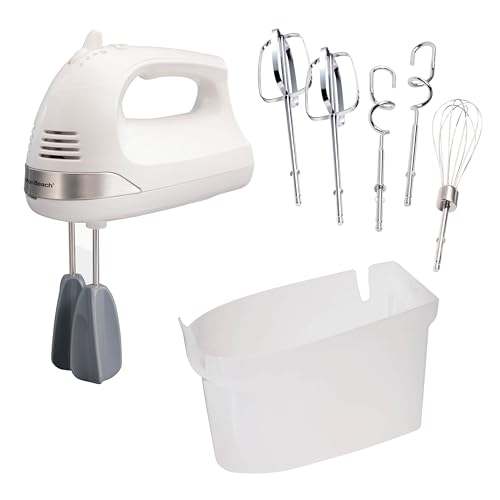
Hamilton Beach 6-Speed Electric Hand Mixer with Easy Clean Beaters (62636J)
Badge: Best for Big Prep Batches
Strengths
- A whisk is confirmed in the listing — the dry-blend attachment, for even distribution without compaction.
- A stated 275 watt motor is the strongest confirmed figure here, suiting larger prep batches of seasoned flour and rubs.
- Traditional and easy-clean beaters plus dough hooks make it the prep station’s all-rounder, cased as one unit.
Trade-offs
- Six speeds is a coarser low-end than the Cuisinart’s nine for the finest dust control.
- No soft-start feature is named in the listing.
- Its versatility is surplus if your dry work is small and occasional.
Mini spec box
- Format: electric hand mixer
- Speeds: 6
- Motor: 275 watts
- Attachments named in listing: easy clean beaters, traditional beaters, dough hooks, whisk
- Storage: snap-on storage case
- Colour: White
When dry work scales up — a big batch of seasoned flour for a fry night, a rub recipe made by the jar for gifts or a market stall, a pancake mix batched for a month of weekends — the Hamilton Beach is the pick that scales with it. The confirmed whisk does the distribution work dry blends need, lifting and aerating rather than pressing, and the stated 275 watt motor keeps the pace in a deep, full bowl where lesser machines slow and leave the bottom unmixed. The case keeps the whole prep kit — whisk, two beater styles, hooks for the dough work that follows prep in a real kitchen — in one grab.
Its dry-goods discipline is the shared one: no soft start is named, so starts are the cook’s responsibility, and six speeds give less low-end finesse than the leader’s nine. For the cook whose dry work is occasional and small, it is more machine than needed; for the cook whose prep day is a production, it is the correct tool in this pool.
Best for: batch prep — rubs, seasoned flours and mixes at volume / Not suited for: small, occasional dry jobs where its range goes unused

KitchenAid 5 Ultra Power Speed Hand Mixer, Black Matte (KHM512)
Badge: Best Compact Pick
Strengths
- Turbo Beaters move through dry blends without the packing that plain wires suffer in flour.
- The lockable swivel cord keeps the cable out of the bowl — and out of the flour dust’s favourite landing zone.
- One-button release and dishwasher-safe beaters make flour cleanup a non-event.
Trade-offs
- Five speeds gives the joint-coarsest low end here; dust discipline is technique-led.
- No whisk is named in the listing.
- Black matte displays flour dust at maximum contrast between cleans.
Mini spec box
- Format: electric hand mixer
- Speeds: 5
- Attachments named in listing: Turbo Beaters
- Features: lockable swivel cord, easy-release button, dishwasher-safe beaters
- Colour: Black Matte
The KHM512’s dry-goods case is tidiness. Small blends — a rub for tonight’s chicken, the dry half of a muffin recipe, a cocoa-sugar dusting mix — are quick, frequent jobs, and this machine’s whole design serves quick and frequent: out of the drawer, cord locked away from the bowl, Turbo Beaters keeping the blend moving rather than packing it into the wires, then beaters ejected into the dishwasher before the dust has settled on the counter. In a compact kitchen where prep happens in the same square foot as everything else, that loop is the product.
Its limits are the compact platform’s: five speeds ask the cook to supply the gentleness a soft start would automate, and there is no whisk for the cook who wants one named. At small-batch scale, with the beaters-buried start this guide teaches, neither limit bites hard.
Best for: small, frequent dry jobs in compact kitchens / Not suited for: large prep batches or whisk-first cooks

KitchenAid 5 Ultra Power Speed Hand Mixer, Contour Silver (KHM512)
Badge: Best for Small Kitchens
Strengths
- The identical KHM512 platform in a finish that hides a flour day more gracefully than black.
- Same tidy loop: swivel cord, one-button release, dishwasher-safe Turbo Beaters.
- Neutral styling for shared kitchens where the prep tool is everyone’s tool.
Trade-offs
- The same machine as the black matte model in every functional respect.
- The same five-speed, technique-led dust discipline applies.
- No whisk named, as with its sibling.
Mini spec box
- Format: electric hand mixer
- Speeds: 5
- Attachments named in listing: Turbo Beaters
- Features: lockable swivel cord, easy-release button, dishwasher-safe beaters
- Colour: Contour Silver
The silver KHM512 is the black one’s platform wearing the finish a flour-dusted kitchen would choose: silver-grey reads a dusting of flour as a shadow rather than a headline, which matters for a tool that may sit out through a whole prep session. Functionally the review is a mirror — compact, tidy, quick-loop dry work for small blends, with the platform’s five-speed ceiling and beater-only attachment list. It is included separately because the pool includes it, and because a reader choosing between the two listings deserves the plain statement that the difference is the colour, full stop.
Best for: small and shared kitchens wanting the compact platform in a forgiving finish / Not suited for: anyone expecting a functional difference from the black matte model

WEPSEN 5-Speed Electric Hand Mixer with Mixing Bowls Set
Badge: Best Prep-Station Set
Strengths
- Four large stainless nesting bowls are included — dry prep is a multi-bowl workflow, and depth contains dust.
- Whisks are named in the listing, the right shape for distributing dry blends.
- Measuring cups and spoons suit dry work, where ratios are the recipe.
Trade-offs
- The lightest-duty mixer here; large, dense dry batches belong to the Hamilton Beach.
- Equipped kitchens duplicate the bowls and measures.
- No soft start or case is named in the listing.
Mini spec box
- Format: electric hand mixer with bowl set
- Speeds: 5
- Included: 4 large stainless steel nesting bowls, measuring cups and spoons
- Attachments named in listing: whisks, beater
Dry prep is secretly a bowl discipline: the flour blend in one bowl, the rub in a second, the crumble waiting in a third, and the finished mix decanted into a fourth or a jar. The WEPSEN set is the only pick that ships the discipline with the machine. Its four large stainless bowls are deep enough to give dust somewhere to fall back into, light enough to handle with floury hands, and nest into a single footprint when the session ends. The named whisks do the distribution work, and the measuring tools suit a category where the recipe is a ratio.
The mixer itself is the modest part — five speeds, everyday duty — and at prep scale that is usually sufficient, because dry mixtures are light loads; the Hamilton Beach’s extra power only becomes relevant when batches grow. As a prep-station foundation for a kitchen that lacks bowls, the set is the most enabling purchase in this guide.
Best for: kitchens building a prep station, and multi-blend sessions / Not suited for: equipped kitchens or the largest dry batches
Comparison Table
| Pick | Speeds | Soft start | Whisk confirmed | Dry-goods strength | Link |
|---|---|---|---|---|---|
| Cuisinart HM-90S | 9 | Yes — SmoothStart | Not named | Dust control and fine low gears | Check on Amazon |
| LILPARTNER 7-Speed | 7 | Not named | Accessory set | Range across blend types | Check on Amazon |
| Hamilton Beach 62636J | 6 | Not named | Yes | Batch scale and distribution | Check on Amazon |
| KitchenAid KHM512, Black Matte | 5 | Not named | No | Small blends, fast cleanup | Check on Amazon |
| KitchenAid KHM512, Contour Silver | 5 | Not named | No | Small blends, fast cleanup | Check on Amazon |
| WEPSEN 5-Speed Set | 5 | Not named | Yes | Bowl ecosystem for prep | Check on Amazon |
How to Choose the Best Mixers for Dry Goods: Start, Speed and Containment
Choose by the first second. In dry work, the start is the incident: a mixer that lunges throws flour, and a mixer that ramps — the Cuisinart’s SmoothStart is the pool’s named example — keeps the recipe in the bowl. If the machine you buy lacks a soft start, you become the soft start, and the technique section below teaches that discipline; but a buyer choosing fresh should weight the feature heavily, because it fires on every single use. Choose by the bottom of the dial second: dry combining happens at stir speed, and the machine with the finest low gears — again the nine-speed Cuisinart, then the seven-speed LILPARTNER — gives you the most control over the moment a blend is done, which in dry work is a moment that arrives early and punishes lateness.
Choose by containment third: deep bowls, a bowl you can tilt, and — for the multi-blend session — enough bowls that finished mixes can rest undisturbed while the next one mixes. That is the WEPSEN set’s whole argument, and it is a strong one for kitchens still building their prep infrastructure. Readers whose dry work is one department of a wider baking life will find these same machines assessed for the full repertoire in our Best Mixers For Home Baking guide; this guide’s narrower lens is the prep bowl, where dust and distribution rule.
How to Mix Dry Goods Without the Cloud: Technique
- Choose a bowl deeper than the mixture needs by half. Depth is containment, and containment is the whole game.
- Settle the beaters or whisk into the mixture before switching on. A buried start is a calm start, soft-start machine or not.
- Begin at the lowest speed and stay there until the whole surface is moving as one body — usually fifteen to thirty seconds.
- Walk the mixer slowly around the bowl, tilting to reach the corners and the base, where dry ingredients stratify and hide.
- Step up one speed only if the blend needs aeration — a whisked flour for a light cake, for instance — and only once the dust risk has passed.
- Stop at “just combined”: the moment no pockets of unmixed ingredient remain. Every second beyond it is either dust or damage, depending on the mixture.
- Decant finished blends promptly into their jars or bags, and rinse attachments before flour paste sets in the wires.
Troubleshooting. Problem: a flour cloud at every start → the beaters are starting in air or the speed is too high; bury the beaters, drop to the lowest gear, and add ingredients in two stages for very full bowls. Problem: the blend tastes uneven — salty here, bland there → the corners and base were never visited; walk the mixer deliberately around the bowl’s perimeter and floor, and give dry blends a final fold with a spatula. Problem: crumble topping turned pasty → the butter warmed and the mixing ran long; work with cold butter, in short low-speed bursts, and stop while distinct pieces remain.
The Dry Pantry: Blends Worth Batching
A good dry-goods mixer earns its place by making batching pleasant, and the home pantry rewards batching generously. A house pancake and waffle mix, whisked evenly once, turns weekend breakfasts into a two-minute assembly for a month. A signature spice rub — the one guests ask about — can be mixed at a scale where its ratios stay exact, jarred, and kept consistent across a whole season of cooking. Seasoned flour for frying, blended thoroughly, coats more evenly than the shake-in-a-bag improvisation it replaces. Baking mixes for a favourite muffin or scone, pre-combined to the dry stage, cut a bake day in half. Even a crumble topping can be mixed in quantity and frozen, ready to crown a fruit dessert without a prep session. In each case the mixer’s contribution is the same unglamorous miracle: distribution — every spoonful of the batch tasting like every other — and that is why this unassuming keyword deserves a guide of its own.
Two of these blends deserve a technique footnote, because they punish the generic method. A rub containing brown sugar wants the sugar broken down and distributed before the spices join, or its moisture will clump the blend in the jar within a week; mix the sugar with the salt first, at a stir, until the lumps surrender. A blend containing dried herbs wants the opposite courtesy — the herbs added last and folded briefly, because sustained beating shreds leaves into dust and dusts the blend with bitterness. Sequence, in dry work, is a form of gentleness, and the cook who sequences well can make a five-speed machine outperform a nine-speed one driven carelessly.
A Note on the Word “Mixer”
The word also belongs to drinks and to audio. If your dry goods were actually the powdered kind that go into a glass — or if you arrived from the bar shelf via guides like the Best Mixers For Eggnog or the Best Mixers For Everclear — those are beverage pages. And if your search meant the Best Mixers For Each Application in a studio sense, that is another department again. This guide covers kitchen machines and the flour-dusted prep they serve, with a side glance at the Best Mixers For Every Day Use for readers whose dry work is part of a general routine.
Whisking, Sifting and the Aeration Question
Older recipes command you to sift flour mixtures, sometimes twice, and it is worth understanding what that instruction was buying so you can decide what your mixer owes you — because a cook who knows what sifting was for can judge every modern substitute, from the whisk to the food processor’s pulse, on evidence rather than on nostalgia. Sifting did three things: it broke lumps, it distributed leavening and salt evenly through a volume of flour that resists casual stirring, and it aerated the flour for lighter cakes. A whisk — hand or mixer-driven, at low speed — performs the first two completely and the third substantially, which is why modern baking has largely let the whisk inherit the sifter’s job, to the relief of everyone who ever washed a sifter. The picks in this guide with whisk forms confirmed or included — the Hamilton Beach and the WEPSEN — therefore cover the classic instruction directly, while the beater-led picks achieve the distribution with a few extra seconds of low-speed walking around the bowl, which is no hardship in work that takes a minute to begin with.
The exception worth respecting is the genuinely lump-prone ingredient: cocoa that has clumped in a humid pantry, icing sugar gone to gravel, brown sugar set like concrete, old baking soda with rocks in it. A mixer will eventually bully these smooth, but a thirty-second pass through a sieve first is cheaper in dust and time — and it illustrates the general principle of this whole guide, which is that dry work rewards the cook who sequences small hand steps around the machine rather than demanding the machine perform every step by force. The sifter, in other words, has not been made obsolete by the electric mixer; it has been promoted to its specialist — called in for the lumps, excused from the distribution, and all the happier for the narrower job description.
Storing What You Mix: Jars, Labels and the Life of a Blend
A blend is only as good as its storage, and a dry-goods routine that ends at the mixing bowl is half finished — the other half is jars, labels and the discipline to retire a blend whose leavening has faded rather than serving its flat results and blaming the recipe. Decant into airtight jars while the blend is fresh and its distribution is perfect; label with the blend’s name, its ratio if it is a house formula, and the date — because the tragedy of the home dry pantry is the unlabelled jar that could be pancake mix or seasoned flour, and the cook reduced to tasting raw flour to find out, usually in front of guests. Keep spice-forward blends away from heat and light, which tax their aromatics week by week; keep flour blends in the cool dark that discourages pantry pests; and refresh small, active blends often rather than banking a year’s supply whose leavening fades in the jar. Store the jars where the cooking happens, not in a distant cupboard — a blend that must be fetched is a blend that gets skipped, and the whole point of batching is that the seasoned flour, the rub and the pancake mix are closer to the pan than the individual ingredients ever were.
There is a mixer consequence hiding in storage discipline: blends made in honest batch sizes get used while they are at their best, which keeps the prep sessions frequent and the machine in regular, happy use. Appliances, like knives and cast iron, quietly prefer being used to being stored, and the dry pantry’s rhythm — a session every few weeks, a jar always in rotation — suits a hand mixer exactly as well as it suits the cook. The cook who batches enormously mixes rarely, stores anxiously and eventually throws away the tail of every batch. Size your batches to your month’s cooking, and the dry-goods routine becomes what it should be — a pleasant, floury half-hour, perhaps with music on, that stocks the pantry and exercises the mixer in the same motion.
Gluten-Free and Specialty Blends: Where Distribution Matters Most
If any corner of dry work justifies this guide’s fussiness about distribution — the corners walked, the base scraped, the final fold — it is specialty flour blending. Gluten-free baking runs on blends — rice flours, starches, gums in small decisive quantities — where a badly distributed batch does not merely taste uneven but behaves unevenly, because the gum or leavening that should have been in this scoopful is sitting in that one, and the loaf or cake made from the two scoopfuls will differ like two different recipes. The same is true of high-ratio baking mixes, protein-fortified blends and any formula where a minor ingredient carries the recipe — a teaspoon of gum or a tablespoon of leavening asked to leaven or bind an entire bowlful, with no second chance once the liquid lands. For these blends, the full technique of this guide applies at double strength: the deepest bowl, the gentlest start, the slowest walk around every corner, a pause halfway to scrape the bowl’s base with a spatula and redistribute what gravity settled, and a final spatula fold before decanting.
Cross-contact belongs in the same paragraph for households cooking for coeliac or allergic eaters: bowls, beaters and whisks that served wheat flour must be washed thoroughly before they serve a gluten-free blend, flour dust must be allowed to settle and surfaces wiped before the specialty ingredients come out, and the dishwasher-safe attachments in this pool make that discipline easier to keep than any amount of good intention. Specialty blending is where a cook’s mixer stops being a convenience and becomes part of the household’s safety system — one more reason the humble dry-goods keyword earned a guide of its own, and one more argument for dedicating a clearly marked set of attachments to the specialty work in households where the distinction is medical rather than culinary.
Common Buying Mistakes
Mistake one: buying by top speed for a job that lives at the bottom of the dial. Mistake two: starting the mixer in the air above the flour and redecorating the kitchen weekly instead of learning the buried start. Mistake three: mixing to “thorough” instead of “just combined,” pasting crumbles and bruising herbs in the name of diligence. Mistake four: working in a shallow bowl and blaming the machine for the dust that geometry guaranteed. Mistake five: assuming a whisk is in the box when the listing does not name one — read attachments literally, as this guide does. Mistake six: treating the two KitchenAid finishes as different tools and agonising over a choice that is purely visual. Mistake seven: batching a season’s worth of leavened mix in one heroic session and baking month three’s pancakes with month one’s faded lift. Mistake eight: leaving blends unlabelled, which converts a well-stocked pantry into a guessing game with raw flour as the oracle.
Final Recommendation
For dry goods as a daily practice, the Cuisinart HM-90S is the first choice: SmoothStart and nine speeds are, together, the closest thing this category has to a purpose-built dry-work instrument. For batch prep at volume, take the Hamilton Beach 62636J and its confirmed whisk; for a kitchen building its prep station, take the WEPSEN set and its bowls; for small daily blends, either KitchenAid finish will serve with tidy efficiency. Whichever you choose, learn the buried start and the early stop — technique and machine together are what keep the flour in the bowl and the blend in balance.
It is worth closing on the modesty of this whole category, because it is the source of its charm. Dry-goods mixing asks nothing heroic of a machine — no torque records, no marathon duty — and in return it offers the purest test of the qualities that make any mixer pleasant to live with: a gentle beginning, an honest low gear, attachments shaped for the material, and a cleanup that does not punish the work. A mixer that passes the dry-goods test will rarely annoy you anywhere else in the kitchen, which is why experienced cooks, choosing a hand mixer, so often reach for the flour bin as their audition.
Frequently Asked Questions
Why does flour explode out of the bowl when I start my mixer?
Because the beaters are striking loose flour at speed before the mixture has begun moving as a body. The fixes are technique and equipment in that order: settle the beaters into the mixture before switching on, start at the lowest speed, use a deeper bowl — and, at purchase time, prefer a soft-start design like the Cuisinart’s SmoothStart, which ramps the motor instead of lunging.
Is a whisk or beaters better for dry blends?
A whisk distributes dry ingredients with more aeration and less compaction, which suits flour blends, rubs and mixes; beaters are perfectly serviceable with good low-speed control, as the Cuisinart’s review describes. What matters most is low speed and full bowl coverage — corners and base included — whichever attachment you use.
Can a hand mixer cut butter into flour for crumble or pastry?
Yes, at the lowest speeds, in short bursts, with cold butter cut into small pieces first. The discipline is stopping while distinct butter pieces remain; a hand mixer’s power will take a crumble to paste if you let it run, and the difference between the two states is about ten seconds of inattention. Work cold, work briefly, and finish by hand if the mixture is close — the last stage of a crumble is a judgement, not a process, and cold fingers judge it better than any dial setting.
How do I stop dry blends from tasting uneven?
Mix at stir speed until the whole mass moves together, walk the mixer around the bowl’s corners and base where ingredients stratify, and fold once with a spatula at the end to catch anything the beaters missed. Then taste the blend if it is safe to taste — a rub, a seasoned flour — because the palate is the final distribution audit. Unevenness is almost always geography — an unvisited corner — rather than insufficient mixing time.
Are the two KitchenAid picks different machines?
No. Both are the KHM512 platform with identical speeds, Turbo Beaters, swivel cord and release button, in Black Matte and Contour Silver finishes. For dry work they perform identically; the silver finish merely shows flour dust less starkly between cleans.
What bowl depth is right for dry mixing?
Deeper than feels necessary — the mixture should occupy no more than half the bowl’s depth when mixing begins, because dry ingredients climb and billow as they move, and the headroom is what keeps them yours rather than the counter’s. A wide, deep bowl also lets you tilt the mixer to reach the base corners without lifting the beaters into the dust-throwing air above the mixture. The WEPSEN set’s large bowls are sized with exactly this headroom in mind, which is part of why a bundle that looks like a beginner’s kit keeps appearing in this guide’s serious recommendations.
How long do homemade dry blends keep?
Flour-based mixes keep well for weeks to a few months in airtight jars in a cool, dark place, with the caveat that their leavening slowly loses strength — a blend containing baking powder is at its best in its first weeks, and a blend kept past its prime will still work, merely with a flatter result that no mixer, however good, can rescue at the batter stage. Spice blends keep their character longer but fade gradually in heat and light. Label every jar with its date, batch at the scale of a month’s cooking, and let freshness, not storage capacity, set the batch size — the pantry you want is a working pantry, turning over, not a museum of good intentions.
Can I mix a rub with my hands instead?
You can, and for a single meal’s worth many cooks do. The mixer’s case is consistency at scale: hand-mixing a jar-sized batch leaves the bottom of the bowl salt-heavy and the top paprika-light in a way fingers rarely detect, while a low-speed whisked batch distributes evenly throughout — and stays distributed when you decant it, because every layer of the bowl was visited. The difference announces itself at the table: the hand-mixed jar seasons its first meals boldly and its last ones timidly, while the machine-mixed jar tastes the same in week four as it did on day one.
Do I need a stand mixer for dry goods?
Rarely. Dry combining is mobile, corner-seeking, stop-start work that a hand mixer serves naturally, and a stand mixer’s fixed beater leaves the bowl’s geography to chance. The exception is very large batch production, where a stand mixer’s bowl and hands-free running help — but for the home dry pantry, the hand mixer is not the compromise; it is the correct tool, and the cook who has tried to whisk a rub in a stand mixer’s cavernous bowl, chasing paprika around its curves, will not need persuading.


