Disclosure: topratedkitchenware.com is reader-supported. When you buy through links on our site, we may earn an affiliate commission from Amazon and other retailers, at no extra cost to you.
Where to buy
All six boards below are sold on Amazon, where you can check the latest price on Amazon for each model. This guide covers the best mixers for powered speakers: consoles and DJ mixers whose main outputs can feed active speakers directly at line level, giving a room one controlled, balanced stereo feed instead of a tangle of source-level guesswork.
- Numark M2 2-Channel Scratch DJ Mixer — Best Simple DJ Pick
- Numark Scratch 2-Channel DJ Scratch Mixer — Best Premium Pick
- Pioneer DJ DJM-250MK2 2-Channel DJ Mixer — Best Club-Style Pick
- Pioneer DJ DDJ-FLX4 2-Channel DJ Controller — Best for Beginners
- Riworal 6 Channel Audio Mixer with 16-Bit DSP — Best Overall
- FULUODE CT-80S 8 Channel Audio Mixer — Best for Larger Setups
Read the full guide ↓ for the ranking logic, the honest limitation of every pick, and the checks that matter more than any headline feature list.
Powered speakers simplified live sound: the amplifier lives inside the cabinet, so the speaker only asks for a clean line-level signal and a sensible level. The best mixers for powered speakers are the boards that supply exactly that — a proper main stereo output, honest gain staging, and enough channels for the microphones and playback sources the room actually uses. Get the mixer right and a powered rig becomes the easiest sound system most small venues, houses of worship, streamers and DJs will ever run.
The six picks here span the two families that feed powered speakers every day. Four are small consoles — from Riworal, FULUODE and the DJ side of the pool — built for microphones, media and small live work. Two are Numark DJ mixers and one is a Pioneer DJ mixer, with a Pioneer DJ controller completing the set; DJ rigs have fed powered speakers as their standard architecture for decades, so their main outputs are entirely at home in this conversation. The differences that matter are channel count, microphone provision, computer connection and workflow, not raw power — the speakers bring their own power.
Your room decides the ranking. A talk-and-music event needs mic channels and playback; a DJ night needs two good channels and a crossfader; a small venue that does both needs a console with a DJ-friendly source parked on a stereo channel. Readers mapping the wider small-rig landscape often pair this guide with Best Mixers For Pro Tools when the same speakers must serve recording duty too, because the boards overlap more than the keywords suggest.
Key Takeaways
- Powered speakers need a clean line-level feed, not power from the mixer — every pick here is judged on signal quality and control, not wattage.
- Match channel count to your busiest realistic event: microphones plus playback sources, plus one spare channel.
- Balanced main outputs, used with balanced cables, are the cheapest noise reduction in a powered-speaker rig.
- DJ mixers and consoles both feed powered speakers happily; choose by workflow — decks and crossfader, or mics and channels.
- Set gain at the mixer first, park the speaker level, and run the room from one main knob.
In this guide
Quick Picks
The shortlist below badges each board for the powered-speaker job it does best. All six are linked, because all six can feed powered speakers at line level; the reviews separate them by everything else.
| Pick | Badge | Format at a glance | Amazon |
|---|---|---|---|
| Numark M2 2-Channel Scratch DJ Mixer | Best Simple DJ Pick | Channels: 2; Type: Scratch DJ mixer, rack-mountable; EQ: 3-band per channel | Check on Amazon |
| Numark Scratch 2-Channel DJ Scratch Mixer | Best Premium Pick | Channels: 2; Crossfader: Innofader; Software: Serato DJ Pro included, with DVS license | Check on Amazon |
| Pioneer DJ DJM-250MK2 2-Channel DJ Mixer | Best Club-Style Pick | Channels: 2; Workflow: Club-style, 2-channel; Effects: Sound Color FX filter | Check on Amazon |
| Pioneer DJ DDJ-FLX4 2-Channel DJ Controller | Best for Beginners | Type: 2-channel DJ controller (not a standalone mixer); Pads: 16 performance pads; Finish: Graphite | Check on Amazon |
| Riworal 6 Channel Audio Mixer with 16-Bit DSP | Best Overall | Channels: 6; Computer connection: Audio interface (USB class); DSP: 16-bit, with reverb effect | Check on Amazon |
| FULUODE CT-80S 8 Channel Audio Mixer | Best for Larger Setups | Model: CT-80S; Channels: 8; Effects: Reverb | Check on Amazon |
Notice the spread: two boards are DJ surfaces, one is a controller, and three are consoles. That spread is deliberate. Powered speakers do not care which family feeds them, so the guide ranks by the work in front of the speakers, not by category loyalty.
How These Picks Were Chosen
Picks were verified against their listings on 2026-11-20, and only listing-stated facts are quoted anywhere in this guide: channel counts, phantom power where stated, Bluetooth and USB features, effects and software. Each board was then assessed for the powered-speaker role — the quality and type of its main output path, its microphone provision, its media handling and its fit for the rooms these rigs serve.
No board was excluded for belonging to the ‘wrong’ family, because powered speakers erase the old mixer-amplifier boundary: a DJ mixer’s main out and a console’s main out are both line-level feeds an active cabinet accepts. What did shape the ranking was honesty about limits — stereo USB paths rather than multitrack, preset effects rather than studio processing, and one controller that needs its laptop to make sound at all, which its review states plainly.
Prices are deliberately absent; check the Amazon links for the current position of any board you shortlist. The research trail behind this pool crosses some unlikely territory — the same mixer word serves kitchens and bars, as Best Mixers For Prosecco demonstrates — so every claim here was pinned to the audio listings themselves rather than to category assumptions.
The 6 Best Mixers for powered speakers Options, Reviewed in Detail
Each review covers the board’s verified feature set, the powered-speaker situations it suits, its genuine strengths in that role, and the limitation that should redirect the wrong buyer to a different pick.

Numark M2 2-Channel Scratch DJ Mixer
Badge: Best Simple DJ Pick
Strengths
- The replaceable, slope-adjustable crossfader is a genuine scratch-focused control
- 3-band EQ per channel gives real isolation control for cuts and blends
- Rack-mountable metal DJ format is built for transport and club-style installs
Trade-offs
- Two channels only, in a turntable-and-DJ layout rather than a general console layout
- The verified description lists no USB audio interface and no phantom power
- No performance pads, no software bundle and no built-in effects
Key specs from the verified listing
- Channels: 2
- Type: Scratch DJ mixer, rack-mountable
- EQ: 3-band per channel
- Microphone: Mic input
- Crossfader: Replaceable, slope-adjustable
The Numark M2 is a purpose-built 2-channel scratch DJ mixer: rack-mountable, with 3-band EQ, a mic input and a replaceable, slope-adjustable crossfader. Everything about that description is analogue DJ craft — two decks, a battle-style layout and a crossfader designed to be swapped when it wears. It comes from a DJ brand that has built battle mixers for decades, and it shows in the priorities.
In a powered-speaker rig the M2 plays its classic role: two decks in, one confident stereo feed out to the cabinets, with 3-band EQ per channel to shape the blend and a mic input for announcements. Small DJ setups — mobile rigs, bar corners, house parties that grew ambitions — are exactly where this architecture shines, because the powered speakers handle the heavy lifting and the M2 handles the music. Its rack-mountable build suits semi-permanent installs where the rig lives in one room. The limits are the familiar ones: two channels, no computer connection in the verified listing, no phantom power for a condenser. A DJ whose speakers are powered and whose sources are decks does not need those things. An events organiser who needs four microphones does, and should read the console reviews below instead. Within its lane, the M2 plus a pair of powered speakers is one of the most proven small rigs in audio.
Best for: small DJ rigs feeding powered speakers from decks and a media player / Not suited for: multi-microphone events or computer-based setups

Numark Scratch 2-Channel DJ Scratch Mixer
Badge: Best Premium Pick
Strengths
- The Innofader crossfader is a respected scratch component with a sharp, durable feel
- Serato DJ Pro and a DVS license are included, so timecode vinyl works out of the box
- FX paddles and eight performance pads bring modern performance control to a battle layout
Trade-offs
- Two channels in a DJ battle layout, not a multi-mic console layout
- Its computer path is built around DJ software rather than general recording workflows
- No phantom power is listed, so condenser studio microphones are not its world
Key specs from the verified listing
- Channels: 2
- Crossfader: Innofader
- Software: Serato DJ Pro included, with DVS license
- Performance: FX paddles and 8 performance pads
- Audio: 24-bit
The Numark Scratch is a 2-channel DJ scratch mixer built around an Innofader crossfader, with Serato DJ Pro included, a DVS license, FX paddles, eight performance pads and 24-bit audio. That is a modern battle mixer formula: analogue-style two-deck layout on the surface, software depth underneath, and a crossfader chosen specifically because scratch DJs wear crossfaders out.
The Numark Scratch turns a powered-speaker pair into a performance rig. Serato DJ Pro with a DVS license means real or timecode vinyl, the Innofader serves the cuts, the pads and FX paddles serve the performance, and the main output feeds the cabinets a 24-bit-sourced stereo mix. For a DJ room, a practice space or a small club corner, that is a complete and modern formula: the speakers provide the muscle, the mixer provides the artistry. The review’s honesty notes are the same as elsewhere in this guide — two channels, a battle layout, no phantom power in the listing — but in front of powered speakers those are barely limitations, because the job description is two decks and a microphone at most. Buyers who want their powered speakers to serve a DJ first and everything else second will find this the most complete DJ answer in the pool, at a premium position in the range.
Best for: performance DJs running Serato into powered speakers / Not suited for: events work needing several microphone channels

Pioneer DJ DJM-250MK2 2-Channel DJ Mixer
Badge: Best Club-Style Pick
Strengths
- Club-style layout mirrors the bigger Pioneer DJ mixers found in venues
- Sound Color FX filter gives one-knob creative control per channel
- The rekordbox DVS unlock lets timecode users play from a laptop library
Trade-offs
- Built for the rekordbox ecosystem, which is the wrong software family for some buyers
- Two DJ channels only, with no phantom power listed for studio microphones
- No performance pads and no general console features such as multiple mic channels
Key specs from the verified listing
- Channels: 2
- Workflow: Club-style, 2-channel
- Effects: Sound Color FX filter
- Software: Free rekordbox DVS unlock
- Colour: Black
Ecosystem is the key word. The DVS unlock ties it to rekordbox, Pioneer’s own software, which is a strength for rekordbox users and a genuine mismatch for anyone committed elsewhere. The verified description lists no phantom power and no multi-mic console features, because that is not the job. As a two-deck DJ mixer it is coherent and well aimed.
The DJM-250MK2 feeding powered speakers is the small-club formula in miniature: club-style layout, a Sound Color FX filter for transitions, rekordbox DVS for laptop libraries, and a main output that any active cabinet accepts. Rooms that host DJ nights with house powered speakers — bars, small venues, community halls with a DJ corner — benefit from the layout’s familiarity, because visiting DJs already know where everything is. That familiarity is a real feature in shared spaces and a real argument for this board over more obscure rivals. Its boundaries are equally clear: two channels, an ecosystem commitment to rekordbox, and no phantom power for studio microphones. As the front end of a powered DJ rig it is coherent and confident; as a general events console it is the wrong shape, and the FULUODE and Riworal reviews below cover that buyer instead.
Best for: DJ corners and small venues with house powered speakers / Not suited for: general events with multiple microphones
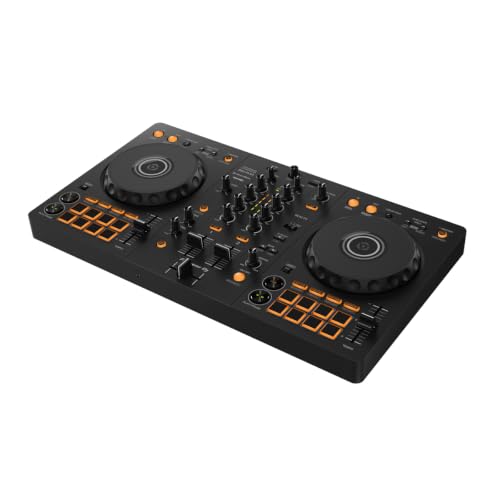
Pioneer DJ DDJ-FLX4 2-Channel DJ Controller
Badge: Best for Beginners
Strengths
- Smart Fader helps first mixes sound smooth while skills develop
- Sixteen pads and a controller layout make laptop DJ software feel hands-on
- A mic input aimed at livestreaming covers talk-over moments from one device
Trade-offs
- It is a controller, so it needs a laptop and software to make any sound at all
- The verified description lists no phantom power and no standalone mixer operation
- Two-deck controller workflow does not translate to multi-source console duties
Key specs from the verified listing
- Type: 2-channel DJ controller (not a standalone mixer)
- Pads: 16 performance pads
- Finish: Graphite
- Features: Smart Fader, streaming-ready
- Microphone: Mic input for livestreaming
For its intended job that design is a strength — beginners get software depth with physical control, and the Smart Fader smooths early transitions. But every judgement in this guide accounts for the difference: a controller cannot anchor a rig the way a true mixer can, it lists no phantom power, and its two-deck layout serves DJ performance rather than multi-microphone work.
The FLX4’s powered-speaker story runs through the laptop: the controller commands DJ software, the software’s audio exits through the controller’s output path, and the powered speakers play it. For beginners this is a friendly architecture — Smart Fader smoothing transitions, sixteen pads for cues and effects, a mic input for talk-over — and a pair of powered speakers completes a first rig that can genuinely entertain a room. Two cautions keep the review honest. The controller makes no sound without its computer, so the laptop is a permanent part of the rig, and its two-deck, performance-first layout does not grow into an events console. Buyers whose powered speakers serve a learning DJ or a bedroom-to-party pipeline will be well served; buyers equipping a venue should take the consoles or the standalone DJ mixers, which keep working when the laptop goes home.
Best for: beginner DJs building a first powered-speaker rig around a laptop / Not suited for: venue installs that must work without a computer

Riworal 6 Channel Audio Mixer with 16-Bit DSP
Badge: Best Overall
Strengths
- Six channels covers small groups, panels and duo-plus-playback desks comfortably
- +48V phantom power and a reverb-equipped DSP cover the common voice needs
- Bluetooth playback plus an audio interface path handles media in both directions
Trade-offs
- The DSP is a 16-bit preset design, useful flavour rather than studio processing depth
- Stereo USB class recording means the mix is captured, not each channel separately
- Six channels still runs out on larger community or band setups
Key specs from the verified listing
- Channels: 6
- Computer connection: Audio interface (USB class)
- DSP: 16-bit, with reverb effect
- Phantom power: +48V
- Playback: Bluetooth
The Riworal 6 channel board is a sound board mixing console with a 16-bit DSP, reverb effect, +48V phantom power and Bluetooth, described as a studio audio mixer for karaoke, studio, streaming and recording work. Six channels is the classic small-group size: two or three microphones, a stereo playback source and a spare, with an effects engine for the polish small rooms usually need.
The Riworal 6 channel board is this guide’s overall pick for powered speakers because it matches the most common real rig: a few microphones, a couple of playback sources, one pair of powered cabinets, and a person who wants it to work without drama. Six channels hold that event comfortably, +48V phantom power covers a condenser for the main voice, Bluetooth handles walk-in music from a phone, reverb adds the polish small rooms need, and the audio interface path lets a laptop join as source or recorder. Its main output feeding powered speakers is the simplest architecture in live sound, and this board executes it with the fewest missing pieces in the pool. The limits are class limits — preset DSP, stereo computer recording — rather than gaps. For community halls, worship spaces, fitness instructors, small bands and event hosts, this is the board to beat.
Best for: small venues, worship spaces and event hosts with a few mics and media / Not suited for: large productions past six sources

FULUODE CT-80S 8 Channel Audio Mixer
Badge: Best for Larger Setups
Strengths
- Eight channels is the most input room in this pool for groups and events
- Reverb, MP3 playback and Bluetooth cover the common live-event media needs
- 48V phantom power plus USB recording keeps mics and capture in one box
Trade-offs
- The largest footprint here, which matters on small desks and in portable kits
- Feature breadth is aimed at live sound and karaoke rather than studio precision
- More channels means more gain staging discipline to keep the mix quiet
Key specs from the verified listing
- Model: CT-80S
- Channels: 8
- Effects: Reverb
- Playback: MP3 player and Bluetooth
- Phantom power: 48V
- Recording: USB recording
The FULUODE CT-80S is an 8 channel professional sound system mixer board with reverb, an MP3 player, Bluetooth, a 48V phantom power supply and USB recording, aimed at studio, karaoke and live music work. In this pool it is the capacity pick: eight channels of console for the situations where four and six channel boards simply run out of inputs.
When the event outgrows six channels, the FULUODE CT-80S is the pool’s answer: eight channels of console feeding the powered speakers, with reverb for voices, an MP3 player and Bluetooth for media, 48V phantom power for condensers and USB recording for a simple capture of the day. School events, larger worship teams, karaoke productions and community theatre all share the same shape — many microphones, several playback moments, one pair of cabinets — and eight channels is what that shape costs. The trade-offs are size and live-first focus: this is the largest board here, and studio perfectionists will find its processing straightforward. But in front of powered speakers, capacity is a feature that cannot be improvised later. If your source list is honestly long, buy the channels now; a smaller board plus a second mixer chained in desperation is the false economy this pick exists to prevent.
Best for: larger community events, karaoke and small live music with many sources / Not suited for: tiny desks or buyers who will never pass six channels
Comparison Table
The comparison focuses on what a powered-speaker rig actually asks of a board: channels for the sources, the kind of surface, and the standout verified feature. Output power is absent from the table for the best reason — it lives in the speakers, not the mixer.
| Pick | Badge | Channels / type | Standout verified feature | Amazon |
|---|---|---|---|---|
| Numark M2 2-Channel Scratch DJ Mixer | Best Simple DJ Pick | 2 — type: Scratch DJ mixer, rack-mountable | 3-band per channel | Check on Amazon |
| Numark Scratch 2-Channel DJ Scratch Mixer | Best Premium Pick | 2 — crossfader: Innofader | Serato DJ Pro included, with DVS license | Check on Amazon |
| Pioneer DJ DJM-250MK2 2-Channel DJ Mixer | Best Club-Style Pick | 2 — workflow: Club-style, 2-channel | Sound Color FX filter | Check on Amazon |
| Pioneer DJ DDJ-FLX4 2-Channel DJ Controller | Best for Beginners | 2-channel DJ controller (not a standalone mixer) — pads: 16 performance pads | Graphite | Check on Amazon |
| Riworal 6 Channel Audio Mixer with 16-Bit DSP | Best Overall | 6 — computer connection: Audio interface (USB class) | 16-bit, with reverb effect | Check on Amazon |
| FULUODE CT-80S 8 Channel Audio Mixer | Best for Larger Setups | CT-80S — channels: 8 | Reverb | Check on Amazon |
How to Choose Mixers for powered speakers
Choosing a mixer for powered speakers is refreshingly physical: it is about sources, rooms and cables more than about processing power. Work through the factors below in order and the right board usually identifies itself.
Count sources at your busiest event
Write down the largest realistic version of your event: every microphone, every playback device, the laptop, the instrument. That total, plus one spare channel, is your size. Solo presenters and DJs live happily at two to four channels; small bands and worship teams land at six; community productions reach eight and beyond. The spare channel sounds like a luxury until a guest speaker, a second instrument or a failed input appears mid-event — then it is the cheapest insurance in the rig. Both oversizing and undersizing are mistakes, but undersizing is the one that fails publicly.
Decide the surface: console or DJ layout
Consoles arrange channels in a row of equals and suit microphones, speech and mixed media. DJ mixers arrange two channels around a crossfader and suit decks, blends and performance. Powered speakers accept either, so the choice is about hands and habits. Mixed-use rooms — a venue that hosts talks on Friday and a DJ on Saturday — usually do best with a console and the DJ’s sources parked on a stereo channel, because speech events punish DJ layouts and DJ nights tolerate consoles better than the reverse. Dedicated rooms should buy their dedicated surface without apology.
Take balanced outputs and cables seriously
A powered rig’s noise floor is set by cabling more than by any processor. Balanced main outputs on the mixer, balanced cables to the speakers, and sensible cable runs away from power supplies keep the system quiet at the levels powered speakers can reach. This is unglamorous and decisive: a modest board on balanced cables will sound cleaner in a real room than a fancier board on a nest of unbalanced leads draped over power bricks. When comparing boards, treat a proper balanced main output as a headline feature, not a footnote.
Match microphone provision to real microphones
Speech clarity is where small events are won. If your main voice uses a condenser microphone, the board must state phantom power — in this pool the Riworal and FULUODE consoles do, and the DJ mixers do not. If your microphones are dynamic, every board here can serve them. Also weigh how many mic inputs exist, not just total channels: line channels do not become mic channels with an adapter. Count microphones separately from sources, and let that count veto boards that look big enough on total channels alone.
Plan levels, monitoring and growth
A good powered rig runs from one main knob with the speaker levels parked, and lets the operator hear trouble before the audience does — a headphone feed for checking a source silently is worth real money at real events. Leave physical and channel headroom for the event you will plausibly host next year, not the festival you will not. Readers speccing a rig that must also record will find the overlapping boards compared from that angle in Best Mixers For Pro Tools 11, a useful second read before money moves.
The pattern across all five factors: buy for the room and the sources, not for the brochure. Powered speakers forgive many mixer sins, but they cannot add a channel, power a condenser or balance a cable run. Get those physical facts right and almost any board in this guide will sound like a professional rig.
How to Connect and Run a Mixer With Powered Speakers
The sequence below sets up any board in this guide with a pair of powered speakers. Order matters: signal path first, power last, levels from the source outward.
- Place and cable while everything is off. Put the speakers at ear height for the audience, angled at the room, and run balanced cables from the mixer’s main left and right outputs to the speakers’ line inputs. Keep audio runs away from power cables where you can.
- Connect sources. Microphones to mic channels with XLR cables, playback devices and laptops to line or stereo channels, DJ decks to the DJ mixer’s channels. Switch phantom power on only for condenser microphones, after their cables are seated.
- Power in order. Mixer and sources first, powered speakers last. This sequence keeps switch-on thumps in the mixer, where levels are down, instead of in the amplifiers, where they are not.
- Gain-stage each channel. With the channel fader near unity and the main level low, raise each input gain until its loudest real moment reads healthy on the meter without clipping, then back off a touch. Repeat per source; do not copy settings between a microphone and a phone.
- Set the room level once. Bring the main fader up to performance volume, then set each speaker’s own level control so the room is right with the mixer’s main knob in a comfortable middle range. After that, run the event from the mixer only.
- Sound-check the worst seat. Walk the room while someone speaks and plays music at show level. The far corner and the seat nearest a speaker tell you more than the operator position ever will.
During the event, mix on the channel faders and leave the gain knobs alone unless a source itself changes. Gains are calibration; faders are performance. If one source is consistently quieter — a phone at half volume is the classic — fix it at the source or its channel gain in a break, rather than riding the main level and throwing every other source off with it.
Troubleshooting: three problems this setup throws at everyone
Problem: a steady hum from both speakers that rises with the main level → what to do: suspect cabling and grounding before equipment failure. Swap in balanced cables, separate audio runs from power leads, and try the mixer and speakers on the same power circuit. Test with headphones at the mixer to learn whether the hum is generated before or after it.
Problem: one microphone distorts while everything else is clean → what to do: its channel gain is too high for that voice or instrument. Reduce the input gain until the loudest moment is clean, then restore level with the channel fader. Distortion at the input cannot be removed later in the chain.
Problem: the rig is loud enough at the back but harsh at the front → what to do: the speakers are aimed at the front rows and the level is set for the back. Re-aim the cabinets toward the middle of the room, raise them if you can, and accept a slightly lower front-row level; geometry fixes what EQ cannot.
Shut down in reverse — speakers off first, then the mixer — and coil the balanced cables like you will thank yourself next time, because you will. A powered rig’s professionalism is mostly this: a repeatable sequence, calmly followed, in rooms that are rarely calm.
Consoles and DJ Mixers in Front of the Same Speakers
New buyers often ask which family is ‘better’ for powered speakers, and the honest answer is that the speakers cannot tell the difference. A line-level stereo feed is a line-level stereo feed. What differs is everything upstream: how many microphones the surface welcomes, whether a crossfader sits under your hand, whether the computer joins as a source, a recorder or the entire instrument. The venue that understands this stops shopping by family and starts shopping by event list, which is the shift this whole guide is built around.
There is one asymmetry worth knowing. Consoles absorb DJ sources gracefully — decks or a controller on a stereo channel is a normal Tuesday — while DJ mixers absorb speech events badly, because microphone count and per-mic control are not their design centre. So mixed-use rooms default to consoles, single-purpose rooms buy their specialist, and nobody needs to feel they chose the ‘wrong kind’ of mixer for their powered speakers. They only need to have chosen for their own calendar.
Small-Rig Discipline: The Unglamorous Features That Matter
Ask experienced small-rig operators what separates a smooth event from a scrambling one and few mention effects or channel counts first. They mention a spare channel, a mute button they can find in the dark, a headphone feed for silent checks, cables long enough to place speakers properly, and a board whose layout a deputy can run after a two-minute briefing. Several picks in this guide earn their badges on exactly those grounds, and the comparison table’s plainness is deliberate: the features that save events rarely photograph well.
Build the same discipline into the kit around the mixer. Label both ends of every cable. Keep one spare of each cable type in the case. Write the working gain and level settings on a card taped inside the lid. None of this appears in any listing, and all of it decides whether your powered rig is a pleasure or a raffle. The boards here are capable; the discipline is what makes them reliable.
Placement, Power and the Room Itself
A powered rig’s last variables are physical. Speaker height decides whether the back of the room hears the consonants that make speech intelligible; cabinets at head height for a standing audience, angled slightly down from a stage, will outperform a more expensive board feeding speakers that point at knees. Distance matters in the opposite direction: the further the audience, the more the room’s reflections join the programme, and the more a modest level with clear midrange beats a loud level with everything pushed. Operators who walk the room during the first song and the first speech, every time, are not being fussy — they are doing the only EQ adjustment that cannot be done from the desk.
Power discipline completes the picture. Run the mixer and the speakers from the same circuit where you can, so the whole rig shares one ground reference and one switch-off point in an emergency. Keep a torch, a spare cable and the board’s saved settings in the same case, because the events that need them happen in the dark, mid-programme, with an audience watching. None of this appears in a listing, and all of it is the difference between a powered rig that feels professional and one that merely contains professional components. The boards in this guide supply the signal; the room craft supplies the rest.
Finally, respect the humble sound check as a creative act rather than a chore. The ten minutes before doors, spent walking the room with real programme material at real level, is when a small rig becomes a considered one: a speaker nudged, a microphone gain forgiven, a playback level civilised. Every board in this guide gives you the controls to act on what that walk teaches you. The venues that sound good month after month are not the ones with the newest desks; they are the ones where somebody always takes that walk, and where the desk’s saved state means the walk starts from last time’s answers instead of from silence and guesswork.
Keep that walk sacred even when the schedule presses. A skipped sound check is a loan taken against the evening, and the room always collects, with interest, in front of the audience.
Common Buying Mistakes
Powered-speaker rigs fail in predictable ways, and almost none of them are the speakers’ fault. These are the buying and setup errors behind most of them.
- Shopping for mixer wattage. A mixer for powered speakers supplies signal, not power. Any time spent comparing output watts is time not spent counting channels and checking outputs.
- Counting total channels instead of mic inputs. Eight channels with two mic inputs is a two-microphone rig. Count the inputs your sources actually need, type by type.
- Running unbalanced cables across a stage. Long unbalanced runs collect hum and interference that no processor removes. Balanced cables are the rig’s cheapest upgrade.
- Powering speakers on first. The thump that follows is the sound of a sequence skipped. Sources and mixer first, speakers last; reverse at shutdown.
- Buying a DJ mixer for a speech venue. Two channels and no phantom power cannot run a panel. Match the surface to the calendar, not to the most exciting event of the year.
- Setting levels from the operator’s chair only. The audience does not sit where you sit. Walk the room at show level before doors, every time.
Final Recommendation
For most powered-speaker rigs, the Riworal 6 Channel is the recommendation: enough channels for real events, phantom power for a proper main microphone, Bluetooth and an interface path for media, and a main output that makes a powered pair sound organised. Step up to the FULUODE CT-80S when your source list honestly reaches eight, and choose the Numark Scratch or the Pioneer DJ DJM-250MK2 when the rig’s heart is DJ performance — with the FLX4 as the beginner’s laptop-based route and the Numark M2 as the simple analogue DJ option.
Whichever board you choose, spend the saved deliberation on balanced cables and a calm setup routine; in a powered rig, those decide more of what the audience hears than the badge on the mixer does. Readers researching the wider small-rig market — a market where the same word also serves the cosmetics aisle at Best Mixers For Pressing Powders — should keep the habit this page has practised throughout: check what a product actually is before it joins the rig.
Start your shortlist here: Numark M2 Scratch DJ Mixer, Numark Scratch DJ Mixer, Pioneer DJ DJM-250MK2.
Frequently Asked Questions
Do powered speakers need a special kind of mixer?
No special kind — they need a mixer with a line-level main output, which every pick in this guide has. Powered speakers contain their own amplifiers, so the mixer’s job is signal quality, channel count and control rather than power. Consoles and DJ mixers both qualify; choose between them by the sources and workflow in front of the speakers, not by the speakers themselves.
Can a mixer damage powered speakers?
Used carelessly, any source can stress speakers — mainly through severe clipping, feedback and power sequencing thumps. Used with the routine in this guide — gains set without clipping, speakers powered last and off first, levels run from the mixer — a small console or DJ mixer is exactly what powered speakers are designed to be fed by. The danger is almost never the pairing; it is distortion and haste.
How many mixer channels do I need for two powered speakers?
The speakers do not decide the channel count; your sources do. One microphone and a laptop needs two to four channels. A small band or worship team needs six. A community production with many microphones needs eight or more. Count the sources at your busiest realistic event, add one spare channel, and buy that size — the speaker pair stays the same at every size.
Should I use balanced or unbalanced cables to powered speakers?
Balanced, whenever the mixer and speakers offer balanced connections, which the console-style picks here are built around. Balanced cables reject the hum and interference that long runs in real rooms collect, especially near lighting and power cables. Keep unbalanced leads short and for nearby line sources only. In a powered rig, cabling is not an accessory decision; it is most of your noise floor.
Can I plug a DJ controller straight into powered speakers?
A controller like the DDJ-FLX4 in this guide routes its software’s audio out through its own output path, so yes, it can feed powered speakers — with the standing caveat that the laptop is part of the rig and nothing plays without it. For a dedicated DJ corner that is fine. For a venue that must make sound on its own, a standalone mixer from this guide is the safer anchor.
Do I need phantom power with powered speakers?
Only your microphones can answer that. Phantom power matters if you use condenser microphones, and two picks here — the Riworal 6 channel and the FULUODE CT-80S — state a 48V supply in their verified listings. Dynamic microphones need none, and the DJ mixers in the guide serve them well. Decide by the microphones you own or plan to own, not by the speakers.


