Disclosure: topratedkitchenware.com is reader-supported. When you buy through links on our site, we may earn an affiliate commission from Amazon and other retailers, at no extra cost to you.
Where to buy
This guide to the best selection of rice cookers brings together six verified models that span the whole market, from a personal mini cooker to a premium fuzzy-logic machine, so that whatever your household size and budget tier, one of them fits. Each name below links to its Amazon listing, where you can check the latest price on Amazon and confirm the current configuration before you decide.
- BLACK+DECKER Rice Cooker 6-Cup (Cooked) with Steaming Basket
- AROMA Rice Cooker, 3-Cup (Uncooked) / 6-Cup (Cooked), ARC-363NG
- Zojirushi NS-ZCC10 Neuro Fuzzy Rice Cooker and Warmer
- Zojirushi NS-TSC10 5.5 Cup Micom Rice Cooker and Warmer
- Dash Mini Rice Cooker, 2-Cup, Ceramic Nonstick Pot
- BLACK+DECKER 16-Cup Rice Cooker, RC516
Read the full guide ↓ for how this selection was built, what separates a simple one-touch cooker from a fuzzy-logic flagship, and the capacity math that decides which size belongs on your counter.
Putting together the best selection of rice cookers is not about finding one winner. Rice cookers look interchangeable from a distance — a pot, a lid, a heating element — but they serve very different kitchens. A student cooking a single cup of jasmine rice in a dorm room, a couple who eat brown rice four nights a week, and a family feeding six people with a steamer basket of vegetables on top are shopping for three different appliances that happen to share a name. A good selection respects that spread. This guide therefore lines up six verified models across three tiers: simple one-touch cookers that do one job cheaply and reliably, mid-range machines with keep-warm and steaming flexibility, and Japanese-engineered fuzzy-logic cookers that adjust the cook moment by moment for noticeably more consistent results.
The differences are real, and they are worth understanding before you spend anything. At the simple end, a rice cooker is a thermostat and a switch: it cooks until the water is absorbed, then flips to warm. That simplicity is a feature, not a flaw, and for plain white rice it can be entirely sufficient. At the premium end, microcomputer control — the micom and fuzzy-logic systems in the Zojirushi models here — monitors the cooking process and fine-tunes heat and timing, which matters most with brown rice, mixed grains, and the small inconsistencies of real kitchens, where the rice, the water, and the room temperature are never exactly the same twice. Between those poles sit the family-size and mini machines that most households actually buy.
Capacity language is the other trap in this category, and this guide will keep returning to it. Rice cooker cups are not the measuring cups in your drawer: capacities are quoted in uncooked or cooked cups, and the same machine can be described either way. A 6-cup (cooked) model starts with roughly half that volume of dry rice. Every pick below states its capacity exactly as the manufacturer states it, so you can compare like with like. With that discipline, and with steaming, keep-warm, and cleanup weighed for each model, you can read this selection as a map of the whole category and land on the one machine your kitchen actually needs.
Key Takeaways
- This selection spans personal, family, and premium tiers: the Dash Mini at 2 cups cooked, family models at 6 to 16 cups cooked, and two Zojirushi fuzzy-logic and micom flagships.
- Simple one-touch cookers (both BLACK+DECKER models and the small Aroma) are the right buy for plain white rice and tight budgets; their virtue is reliability, not refinement.
- Fuzzy logic and micom control, in the Zojirushi NS-ZCC10 and NS-TSC10, earn their premium with brown rice, mixed grains, and repeat consistency.
- Always compare capacities on the same basis: uncooked cups in, cooked cups out, roughly double the volume after cooking.
- Steaming baskets on the BLACK+DECKER models turn a rice cooker into a simple two-part meal maker for vegetables, fish, and dumplings.
- Shoppers who want the Japanese-market perspective on this same shelf should also read our guide to the Best Selling Rice Cookers Japan.
In this guide
Quick Picks
| Pick | Badge | Capacity (as listed) | Standout trait | Link |
|---|---|---|---|---|
| BLACK+DECKER Rice Cooker 6-Cup (Cooked) | Best Simple Starter | 6-cup cooked | Steaming basket, removable non-stick bowl | Check on Amazon |
| AROMA ARC-363NG Rice Cooker | Best for Small Households | 3-cup uncooked / 6-cup cooked, 1.5 Qt | Auto keep warm, also cooks oatmeal and soup | Check on Amazon |
| Zojirushi NS-ZCC10 Neuro Fuzzy | Best Overall | Neuro Fuzzy format, white | Fuzzy logic control, delay timer, auto keep-warm | Check on Amazon |
| Zojirushi NS-TSC10 Micom | Best Premium Mid-Size | 5.5 cup, 1.0 L | LCD controls, delay timer, micom precision | Check on Amazon |
| Dash Mini Rice Cooker | Best Personal Size | 2-cup cooked, 1 cup uncooked | Ceramic nonstick pot, keep warm, grains beyond rice | Check on Amazon |
| BLACK+DECKER 16-Cup Rice Cooker RC516 | Best for Families and Batches | 16-cup cooked, 8-cup uncooked | One touch, steaming basket, removable bowl | Check on Amazon |
Read the badges as a map, not a ranking from best to worst. The Dash Mini is not a failed family cooker; it is a successful personal one. The Zojirushi flagships are not overkill for a brown-rice household; they are the point. Choose your row by household and habit first, then by tier.
How These Picks Were Chosen
A selection guide has a different job from a shootout. We built this pool to cover the genuine decision space of the category using only verified listings, and we checked each model’s confirmed specification for the traits its tier is supposed to deliver: steaming baskets and removable bowls at the simple end, auto keep-warm and multi-use cooking in the middle, and computerized control with delay timing at the premium end. Every capacity, function, and accessory mentioned in the reviews below comes from the manufacturer’s own confirmed listing for that exact model; nothing is borrowed from a sibling product or a different year’s version.
We also weighted the unglamorous factors that decide whether a rice cooker is still in use a year later. Removable inner bowls that wash easily, keep-warm modes that hold rice safely without drying it into a crust within the first hour, and footprints that fit real counters all counted. We made no hands-on testing claims: this is research-led guidance that synthesizes confirmed specifications and well-established cooking practice, and where a model’s listing is silent about a feature, we say so rather than guessing. Finally, we deliberately included two models from the same premium brand and two from the same value brand, because comparing within a brand’s own range is often the clearest way to see what the extra money actually buys.
The 6 Best Selection of Rice Cookers for Every Kitchen

BLACK+DECKER Rice Cooker 6-Cup (Cooked) with Steaming Basket
Badge: Best Simple Starter
Strengths
- Included steaming basket lets you cook vegetables or protein above the rice for a one-pot meal.
- Removable non-stick bowl lifts out for serving and washing, with no scrubbing of a fixed interior.
- One-job simplicity: load, switch on, and let it cook, ideal for first-time rice cooker owners.
Trade-offs
- 6-cup cooked capacity is a small-to-mid household size, not a crowd feeder.
- No computerized control, so brown rice and mixed grains get a basic treatment.
- White finish and basic styling are purely functional.
Mini spec box
- Capacity: 6-cup (cooked)
- Inner bowl: removable, non-stick
- Included: steaming basket
- Color: white
This is the rice cooker most people picture when they first decide to stop boiling rice on the stove, and it earns its place in any honest selection. The formula is complete but unadorned: a removable non-stick bowl, a steaming basket that sits above the rice, and a cook cycle that ends when the rice is done. For white rice, jasmine, and the everyday grains of a small household, that formula works, and the steamer basket quietly doubles the machine’s usefulness, because a tray of broccoli, carrots, or dumplings steaming over the rice turns a side dish into a meal with no extra pan.
Who should choose it? New rice cooker owners, small families, and anyone whose rice is mostly plain white rice served alongside something else. Its honest limitation is refinement: without computerized control it cannot adapt the cook to the quirks of brown rice or a mixed-grain blend the way the Zojirushi models below can, and cooks who eat those grains daily will eventually feel the difference. As a starting point in the category, though, it is hard to fault, and many households never need to move beyond it.
Best for: first-time buyers and small households cooking mainly white rice / Not suited for: daily brown-rice and mixed-grain cooks who want adaptive control

AROMA Rice Cooker, 3-Cup (Uncooked) / 6-Cup (Cooked), ARC-363NG
Badge: Best for Small Households
Strengths
- Compact 1.5 Qt format sized honestly for one to three people, so small batches cook properly.
- Auto keep warm holds finished rice at serving temperature without attention.
- Also handles oatmeal and soup, earning its counter space in a small kitchen.
Trade-offs
- 6 cups cooked is the ceiling; it will not serve a large family dinner.
- Basic control set, with no delay timer in the confirmed specification.
- Small pot means entertaining requires a second cooking method.
Mini spec box
- Capacity: 3-cup (uncooked) / 6-cup (cooked), 1.5 Qt
- Functions: rice cooker, oatmeal cooker, soup maker
- Keep warm: automatic
- Model: ARC-363NG, white
Small rice cookers are easy to get wrong: buy a big machine and cook tiny amounts in it, and the rice scorches at the edges and dries in the middle, because the pot was designed for a fuller load. The ARC-363NG avoids that trap by being genuinely small. Its 1.5-quart pot is proportioned for the one to three cups of cooked rice that singles and couples actually eat, and the auto keep-warm means the rice waits for the rest of dinner instead of the other way around.
The oatmeal and soup functions sound like marketing garnish until you live in a small apartment, where a single pot that makes breakfast porridge, a lunchtime soup, and dinner’s rice is doing the work of three appliances. That versatility is this model’s real argument. Its limitation is simply scale, stated plainly in its own capacity figures, and buyers who regularly cook for five or more should look at the 16-cup BLACK+DECKER below instead. Within its intended household, it is one of the most sensibly sized machines in this selection.
Best for: singles, couples, dorms, and small apartments / Not suited for: families cooking rice for five or more at a sitting
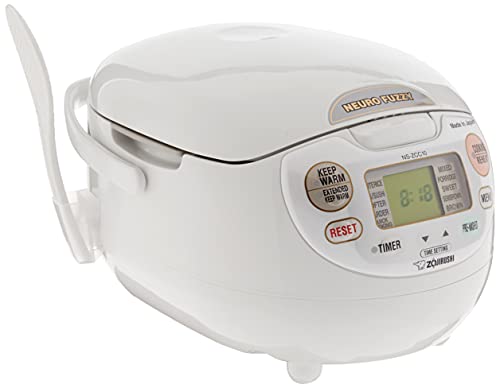
Zojirushi NS-ZCC10 Neuro Fuzzy Rice Cooker and Warmer
Badge: Best Overall
Strengths
- Neuro Fuzzy logic adjusts cooking in response to conditions, delivering unusually consistent results batch after batch.
- Automatic keep-warm and a delay timer support both immediate and scheduled cooking.
- Zojirushi’s rice-cooker specialization shows in the details of the cook, especially with varied grains.
Trade-offs
- Premium-tier positioning: this is the considered purchase of the selection, not the impulse one.
- More control logic means a short learning curve compared with a one-switch cooker.
- White finish only, per the confirmed listing.
Mini spec box
- Control: Neuro Fuzzy logic
- Functions: rice cooker and warmer
- Keep warm: automatic
- Timer: delay timer
- Color: white
If one machine in this selection represents what a rice cooker can be when a specialist brand engineers it without compromise, it is this one. Neuro Fuzzy logic is Zojirushi’s name for a control system that does not merely follow a fixed program: it responds to how the cook is actually progressing and adjusts, the way an experienced cook adjusts a stove. The practical result is consistency — the same bag of rice cooked on a cold morning and a warm evening comes out the same — and a noticeably better handling of brown rice and mixed grains, whose tougher bran layers punish rigid cooking programs.
The delay timer and automatic keep-warm complete the picture of a machine built for households where rice is a daily staple rather than an occasional side. Load it in the morning, and rice is ready at dinner, held properly warm. The honest trade-offs are price tier and complexity: this is a premium appliance, and a household that cooks plain white rice twice a month will never use what they paid for. For daily rice eaters, and especially for the brown-rice and sushi-rice faithful, it is the selection’s clear flagship, and it anchors the Japanese-engineering story told in our Best Selling Rice Cookers Japan guide.
Best for: daily rice households, brown rice and mixed grains, consistency seekers / Not suited for: occasional rice cooks who will not use the control sophistication

Zojirushi NS-TSC10 5.5 Cup Micom Rice Cooker and Warmer
Badge: Best Premium Mid-Size
Strengths
- Micom (microcomputer) control brings Zojirushi precision to a mid-size 5.5-cup, 1.0 L format.
- LCD controls make settings and timing legible at a glance.
- Delay timer supports scheduled cooking for workday households.
Trade-offs
- 5.5-cup size suits small-to-mid households, not large gatherings.
- Still a premium-tier purchase compared with the simple cookers in this selection.
- Shares the learning curve of any computerized cooker.
Mini spec box
- Capacity: 5.5 cup, 1.0 L
- Control: Micom (microcomputer)
- Display: LCD controls
- Timer: delay timer
The NS-TSC10 is the Zojirushi for households that want the brand’s cooking intelligence in a size matched to everyday life. At 5.5 cups and one liter, it is proportioned for couples and small families who cook rice often but not in banquet quantities, and right-sizing matters: a computerized cooker still cooks best with a sensible load in the pot. The LCD controls are a genuine ergonomic step up, making the selected setting and the timer state obvious rather than something you infer from a single indicator light.
Choosing between this model and the Neuro Fuzzy above is the most interesting decision in the selection. The NS-ZCC10’s fuzzy logic is the more adaptive system, the flagship approach; the NS-TSC10 counters with a tidier size, clear controls, and the same brand discipline about keep-warm and delay timing. Households that cook a wide rotation of grains and want the most responsive control should lean to the flagship. Households that cook excellent rice in modest amounts and value clarity and footprint should lean here. Either way, the step up from the one-touch tier is something you taste most in brown rice and in reheated-next-day consistency.
Best for: couples and small families wanting premium control in a right-sized pot / Not suited for: large-batch cooking or strict-budget shopping

Dash Mini Rice Cooker, 2-Cup, Ceramic Nonstick Pot
Badge: Best Personal Size
Strengths
- Genuinely personal format: 1 cup uncooked makes 2 cups cooked, the right amount for one meal.
- Removable ceramic nonstick pot is easy to rinse and serve from.
- Cooks oatmeal, quinoa, and other grains, not just rice, with a keep warm function.
Trade-offs
- Strictly a one-to-two-person machine; there is no scaling it up for guests.
- Basic control set without the timers of the premium tier.
- Small capacity means rice for a group recipe must be cooked in batches.
Mini spec box
- Capacity: 2-cup cooked (1 cup uncooked)
- Pot: removable ceramic nonstick
- Functions: rice, oatmeal, quinoa and grains, keep warm
- Color: black
Every selection needs its honest miniature, and the Dash Mini is a good one. Its proposition is portion control and footprint: a single cup of uncooked rice becomes two cups cooked, which is dinner for one with a little left for tomorrow’s lunch, and the machine itself takes up about as much counter as a mug tree. For dorm rooms, studio apartments, office kitchens, and solo cooks who are tired of the saucepan-and-lid gamble, that is exactly the right appliance.
The ceramic nonstick pot deserves its mention because at this size cleanup is the whole user experience: the pot lifts out, rinses in seconds, and doubles as the serving vessel. The keep warm function and the ability to cook oatmeal and quinoa stretch it beyond a single trick. Its limitation is absolute and obvious — capacity — and it makes no apology for it. Buy it as a personal cooker and it delights; buy it hoping to feed a family and no feature list could save it. Solo cooks comparing small machines across categories can also see how the same right-sizing logic applies in our Best Simple Pressure Cookers guide.
Best for: solo cooks, dorms, small spaces, portion-controlled meals / Not suited for: families or anyone cooking rice for a group

BLACK+DECKER 16-Cup Rice Cooker, RC516
Badge: Best for Families and Batches
Strengths
- 16-cup cooked (8-cup uncooked) capacity feeds a family or a meal-prep session in one cycle.
- One-touch operation keeps a big machine as easy to run as a small one.
- Steaming basket and removable non-stick bowl carry the simple tier’s best traits up to family size.
Trade-offs
- Large footprint and a big bowl to wash when you only needed two cups of rice.
- Simple control set: no fuzzy logic finesse for specialty grains.
- Small batches cook less happily in a pot this size.
Mini spec box
- Capacity: 16-cup cooked (8-cup uncooked)
- Operation: one touch
- Inner bowl: removable, non-stick
- Included: steaming basket
- Model: RC516
The RC516 takes the same honest formula as its 6-cup sibling and scales it to the households that actually run through rice: families, batch cookers, and anyone whose dinner regularly includes a steamer basket of vegetables over a big bed of rice. Sixteen cups cooked is a serious quantity — enough for a large family dinner with leftovers for fried rice tomorrow — and the one-touch control means the scale costs nothing in complexity. Press, wait, serve.
Its role in the selection is to prove that capacity and simplicity can coexist, and to mark the boundary of the simple tier. If your grains are white and jasmine rice for a crowd, this machine and the flagship Zojirushi will produce dinners your family enjoys; the difference appears in brown rice, in mixed grains, and in the tenth consecutive batch’s consistency. Buy the RC516 for volume and ease, and read our Best Selling Slow Cookers guide for the other family-size staple appliance that anchors a kitchen like this one.
Best for: families, meal prep, and entertaining with rice at the center / Not suited for: solo cooks or specialty-grain perfectionists
Comparison Table
| Model | Capacity | Control type | Steaming | Link |
|---|---|---|---|---|
| BLACK+DECKER 6-Cup | 6-cup cooked | Simple one-touch style | Steaming basket included | Check on Amazon |
| AROMA ARC-363NG | 6-cup cooked, 1.5 Qt | Basic with auto keep warm | Not listed | Check on Amazon |
| Zojirushi NS-ZCC10 | Neuro Fuzzy format | Fuzzy logic | Not listed | Check on Amazon |
| Zojirushi NS-TSC10 | 5.5 cup, 1.0 L | Micom with LCD | Not listed | Check on Amazon |
| Dash Mini | 2-cup cooked | Basic with keep warm | Not listed | Check on Amazon |
| BLACK+DECKER RC516 | 16-cup cooked | One touch | Steaming basket included | Check on Amazon |
How to Choose from a Selection of Rice Cookers
Choose capacity first, and choose it with the manufacturer’s own arithmetic. Rice roughly doubles in volume as it cooks, so a cooker described by cooked capacity holds about half that volume of dry rice. Work backwards from your table: one cup of uncooked rice makes roughly two cups cooked and serves two to three people as a side. A household of two eating rice three nights a week lives happily in the 5.5- to 6-cup cooked class. A family of five, or a meal-prepper cooking a week’s base grain at once, belongs in the 16-cup class. The personal tier exists because the reverse mistake — tiny batches in a huge pot — genuinely cooks worse, scattering heat across a mostly empty bowl.
Choose control second. If your rotation is white and jasmine rice, a simple cooker’s fixed program is not a compromise; it is the right tool. If brown rice, steel-cut oats, or mixed grains appear weekly, computerized control stops being a luxury, because those grains need longer, more carefully managed cooking that a basic switch delivers unevenly. The fuzzy-logic and micom models in this selection exist for exactly those kitchens. Third, weigh keep-warm behavior: households that eat in shifts need a warmer that holds rice pleasantly, while cooks who serve immediately can ignore it. Fourth, consider the steamer basket if you cook vegetables, fish, or dumplings often; on the BLACK+DECKER models it converts rice night into a complete one-appliance dinner, a trick our Best Shrimp Steam Cookers guide develops further for steamed meals. Finally, measure your counter and your sink. A removable bowl you can wash easily will be washed; a fixed interior that needs careful wiping will, in real life, sometimes not be.
How to Cook Better Rice in Any of These Machines
- Rinse the rice in a bowl, swirling and draining until the water runs mostly clear. This removes surface starch that makes cooked rice gummy.
- Measure water by the pot’s own markings for the rice type, not by a generic ratio, because cooker cups and markings are calibrated together.
- Let the rice soak in its cooking water for a short rest before switching on, especially for brown rice, to hydrate the grains evenly.
- When the cooker switches to warm, leave the lid closed for a further rest so the moisture redistributes from the bottom of the pot to the top.
- Fluff with a paddle using a folding motion, then serve. Stirring vigorously breaks grains and releases starch that turns the texture pasty.
- For steamer-basket meals, add quick-cooking vegetables partway through the rice cycle rather than at the start, so they finish tender instead of collapsed.
Care is simple but not optional. Wash the removable bowl with a soft sponge so the non-stick or ceramic surface survives; wipe the lid and the rim where starch water collects; and let the pot dry fully before storing it closed, which prevents the stale smell that otherwise greets the next batch. Descale occasionally if your water is hard and you notice mineral film on the heating plate area, following the manufacturer’s guidance for your model.
Troubleshooting
Problem: the rice is wet and porridge-like → too much water or the lid was lifted mid-cook, releasing steam and upsetting the cycle; measure by the pot markings and keep the lid shut until the resting step ends.
Problem: the bottom is crisped while the top is underdone → the batch was too small for the pot, or the rice was not rested after cooking; cook a size the pot is designed for and always rest before fluffing.
Problem: rice held on warm dries out and yellows → it has been held too long; keep-warm is for the span of a meal service, not an afternoon, so cook closer to serving time or use a delay timer where fitted.
Rice Varieties and the Cooker They Deserve
Long-grain white and jasmine rice are the forgiving grains: they cook well in every machine in this selection, and the simple tier was practically designed around them. Basmati rewards the resting step and a slightly restrained hand with water, and it too is content in a basic cooker. Sushi and other short-grain rices are stickier by nature and benefit from the even, adaptive heat of the computerized models, which keep the grains distinct within their stickiness rather than letting the bottom layer overcook while the top catches up.
Brown rice is the great divider. Its bran layer slows water absorption, so it needs a longer, more patient cook, and in a simple cooker the result can swing between chalky centers and a scorched base depending on the batch. This is the grain that justifies fuzzy logic more than any other, and households that eat brown rice several times a week should read the two Zojirushi reviews above as written directly for them. Mixed grains, wild rice blends, quinoa, and steel-cut oats sit between the poles: doable in basic machines with adjusted water and patience, better in computerized ones. The Dash Mini’s explicit oatmeal and quinoa capability makes it a quiet favorite for breakfast-grain households despite its size. The selection, in other words, is not six ways to do the same thing; it is a set of tools whose strengths map onto the grains you actually eat, which is why the honest first question is never which cooker is best, but which rice is on your table most often.
Selection by Household: A Quick Matching Guide
For one person, the Dash Mini or the small Aroma are the rational picks, with the Aroma ahead if soup and oatmeal matter and the Dash ahead if the smallest footprint and ceramic pot matter more. For two to three people, the Aroma ARC-363NG, the BLACK+DECKER 6-cup, and the Zojirushi NS-TSC10 form the decision set: basic and steaming, basic and versatile, or premium and precise. For four to six, the RC516’s capacity or the NS-ZCC10’s consistency lead, depending on whether your rice is a crowd-pleasing staple or a daily craft. For households that host often, remember that a mid-size cooker plus a stovetop pot for overflow is usually a better spend than a giant cooker that spends its life half empty.
Budget tier follows the same logic. The simple tier’s machines cost their owners little and ask little; the premium tier repays daily use over years. The waste in this category is almost never buying the expensive machine or the cheap one; it is buying the wrong size or the wrong control type for the grains on your table. Use this selection to avoid that specific waste, and the rest is preference.
Keep-Warm, Delay Timers, and the Rhythm of Real Kitchens
Two features in this selection quietly decide how a rice cooker fits a household’s rhythm, and both are easy to undervalue on a specification list. Keep-warm is the first. Every model here that lists it — the small Aroma with its automatic keep-warm, both Zojirushi machines, and the Dash Mini — is solving the same human problem: rice finishes when it finishes, and dinner is ready when everything else is. A good warmer holds the rice at a safe, pleasant serving temperature without continuing to cook it aggressively, so the pot can wait for the curry, the grilled fish, or the family member stuck in traffic. A poor holding experience shows up as a dried ring around the edge of the pot and a gummy center, which is why the computerized models, which manage heat more delicately even at rest, tend to hold rice more gracefully over longer spans.
The delay timer, listed on both Zojirushi models, works the other direction in time: instead of holding finished rice, it holds raw rice and water and starts the cook so that it finishes when you walk in the door. Used well, it is the feature that turns a rice cooker from an appliance into a routine. Rice and water are loaded in the morning, the timer is set for the evening, and the most repetitive part of dinner is simply done. Two cautions apply. First, raw rice sitting in water for many hours in a warm kitchen is a food-safety and texture question, so very long delays are best kept to cooler conditions and sensible spans. Second, the timer rewards households with predictable schedules; if your evenings are chaotic, keep-warm flexibility matters more than start-time precision. Reading this selection with your own timetable in mind — when rice is loaded, when it is eaten, and how long it waits in between — will tell you which of these features deserves your money far more reliably than any feature count.
Counter Space, Storage, and Living with the Machine
A rice cooker is one of the few appliances that often lives permanently on the counter, and its physical presence deserves a section of its own. The Dash Mini can tuck into a corner or a deep drawer; the RC516, with its 16-cup bowl, claims a footprint closer to a slow cooker and needs cabinet height to match when stored. Before choosing on capacity alone, measure the space between your counter and your upper cabinets, because a tall cooker that cannot open its lid under the cabinets will be moved every time it is used, and appliances that must be moved get used less. Cord storage, lid design, and where the steam vents all shape daily satisfaction in small ways that compound over years.
Steam deserves a specific mention. A rice cooker releases a steady plume of steam as it cooks, and parking it permanently under wooden cabinets bathes those cabinets in moisture daily. Many households pull the cooker forward for the cook and push it back afterward, or place it near the stove’s ventilation. The steamer-basket models add a second consideration: lifting a hot basket of vegetables out of a just-opened cooker is a small maneuver that wants clear space above and beside the machine. None of these points will appear in a specification list, yet together they decide whether the cooker you bought with such care is a pleasure in month six. The selection above was built with this lived reality in mind: right size, right control, and a machine whose daily handling suits the kitchen it will actually live in.
What the Extra Money Actually Buys in a Rice Cooker
Readers comparing a simple one-touch cooker with a fuzzy-logic flagship often ask a fair question: the rice goes in, the water goes in, the lid closes — what, exactly, does the premium purchase add? The first answer is sensing. A basic cooker knows one thing, that the pot’s temperature has risen past the point where free water remains, and it uses that single signal to end the cook. A computerized cooker tracks the cook as a curve rather than a switch, adjusting heat input as conditions change, which is why it forgives the small measurement errors, older rice, and cooler kitchens that make basic cookers inconsistent. The second answer is grain range. Programs shaped for brown rice, porridge-style grains, and mixed blends are not marketing decoration; they encode different soak, heat, and rest patterns that those foods genuinely need, and encoding them in the machine means the cook does not have to.
The third answer is time machinery: delay timers and more graceful keep-warm, discussed above, which together let the cooker fit a schedule instead of demanding one. The fourth is less visible — build details such as clearer controls, like the LCD panel on the NS-TSC10, and the general fit and finish of a specialist brand’s flagship line. None of this makes the simple tier a mistake. It makes the tiers answers to different questions. A household cooking jasmine rice twice a week is buying transportation, and a basic cooker drives fine. A household cooking three grains daily is buying a system, and the system is worth funding. This selection deliberately keeps both answers on one page so the comparison is honest, and so that whichever tier you choose, you choose it knowing what you traded.
A Note on Longevity and Replacement Parts of the Decision
One final selection criterion rarely appears in comparison charts: how long the machine will stay pleasant to use. The parts that age in a rice cooker are the inner bowl’s surface, the lid’s seal and steam path, and the clarity of the controls. A removable bowl, present across this selection, is the single best longevity feature because it can be washed properly, handled gently, and kept away from the abrasives that destroy non-stick surfaces. Cookers whose bowls are treated well routinely serve for many years; cookers whose bowls are scoured with metal utensils in month one begin sticking in month two, and the owner blames the machine. Choose the selection’s model that matches your habits in this respect too: the ceramic pot of the Dash, the non-stick bowls of the BLACK+DECKER pair, and the specialist build of the Zojirushi machines all reward the same gentle care, and all punish the same neglect. Buy once, wash gently, and the selection you made from this page will still be earning its counter space long after the decision itself is forgotten.
Common Buying Mistakes
- Comparing a cooked-cup capacity from one brand against an uncooked-cup capacity from another and concluding one machine is twice the other.
- Buying a family-size pot for a one-person household, then blaming the cooker for scorched small batches.
- Paying for fuzzy logic while cooking only plain white rice twice a month, or refusing it while eating brown rice daily.
- Ignoring the steamer basket’s existence until after purchase, then buying a separate steamer for the same job.
- Lifting the lid repeatedly during cooking to check progress, which dumps the steam the cycle depends on.
Final Recommendation
For most households reading a selection guide, the balanced first choice is the Zojirushi NS-ZCC10 Neuro Fuzzy: it is the model whose cooking intelligence covers the widest range of grains and habits, and its delay timer and automatic keep-warm fit real schedules. If your household is smaller and your budget is aimed at value with precision, the Zojirushi NS-TSC10 brings the same brand discipline to a 5.5-cup format.
Choose differently with confidence where your situation demands it: families cooking volume should take the BLACK+DECKER RC516, solo cooks the Dash Mini or the small Aroma, and first-time owners testing whether a rice cooker earns counter space at all should start with the 6-cup BLACK+DECKER and its steaming basket. Every model in this selection is verified and linked above; check the current listing for the one that matches your table, and you will have bought the category correctly.
Frequently Asked Questions
What size rice cooker does a family of four need?
A cooker in the 8- to 16-cup cooked class comfortably covers a family of four with leftovers. The RC516 in this selection sits at the top of that range. Smaller households should resist oversizing, because small batches cook unevenly in a large pot.
Is fuzzy logic worth it over a simple rice cooker?
It is worth it if you cook rice daily, eat brown or mixed grains, or want batch-to-batch consistency without attention. For occasional plain white rice, a simple one-touch cooker produces dinners most people are perfectly happy with, at a lower tier of cost and complexity.
Can these cookers cook grains other than rice?
Several list it directly: the Dash Mini cooks oatmeal, quinoa, and grains, and the small Aroma doubles as an oatmeal cooker and soup maker. Others handle grains like quinoa well in practice with adjusted water, but we only claim what each listing confirms.
What does a steaming basket actually let me cook?
Vegetables, dumplings, fish fillets, and similar quick-cooking foods, steamed by the rice’s own cooking steam in the BLACK+DECKER models here. It turns the cooker into a simple two-component meal maker with no extra pan to wash.
How long can rice stay on keep warm?
Keep warm is designed for the span of serving a meal and a reasonable buffer around it. Rice held for many hours gradually dries and changes flavor even in a good warmer, so use the delay timer on the premium models to finish cooking near serving time instead of holding all day.
Why does my rice stick to the bottom of the pot?
Usually a water measurement issue, an unrested batch fluffed too early, or a batch too small for the pot. Rinse the rice, measure by the pot’s markings, rest with the lid closed after the cycle, and fluff gently; the removable non-stick and ceramic bowls in this selection also make any sticking that does occur easy to clean.
How long should a rice cooker from this selection last?
With gentle care of the inner bowl and regular cleaning of the lid and steam path, a rice cooker is a long-service appliance, and the removable-bowl designs throughout this selection are built for exactly that care. Treat the bowl’s surface kindly, keep the steam vent clear, and the machine you choose today should still be cooking evenly years from now.
Should I buy one cooker with a steamer or a separate steamer?
If your steaming is vegetables and dumplings alongside rice, the basket models in this selection cover it with no extra appliance. Dedicated, large-volume steaming is a different job, and our guides to adjacent cooker categories, including the Best Shrimp Cookers, cover those cases.


