Disclosure: topratedkitchenware.com is reader-supported. When you buy through links on our site, we may earn an affiliate commission from Amazon and other retailers, at no extra cost to you.
Where to buy
The best mid range smokers are the machines below: four electric cabinets and two pellet grills that carry the features cooks actually use, without flagship extras. Each pick links to its Amazon listing so you can check the latest price on Amazon and judge the tier against live listings for yourself.
- Masterbuilt 30-Inch Analog Electric Smoker (MB20070210) — Check on Amazon
- EAST OAK 30-Inch Electric Smoker (Matte Black)
- EAST OAK 30-Inch Electric Smoker with Mobility Stand (Polar Night)
- Royal Gourmet SE2805 28-Inch Electric Smoker
- Traeger Pro 22 Wood Pellet Grill and Smoker
- Pit Boss 700 Carbon Series Pellet Grill and Smoker
Read the full guide ↓
The best mid range smokers occupy the smartest ground in the category: above the bare-bones models that skimp on capacity and control, below the flagships whose connectivity and chrome you may never use. This guide’s six picks — four electric cabinets from Masterbuilt, EAST OAK, and Royal Gourmet, and two pellet grills from Traeger and Pit Boss — were chosen on features and format, not on printed prices, because this guide prints none: tiers here are judged qualitatively, by what a machine includes and omits. Readers arriving from typo variants like Best Mmeat Smokers will find the same six machines ranked by the same logic.
What does mid-range buy in a smoker? At this level you get digital control on most models, capacities from 454 to 725 square inches in cabinets and up to 718 in pellet grills, side chip loaders, built-in probes on several models, and construction meant for weekly use. What you give up versus the flagship tier is mainly connectivity (WiFi appears on neither pellet pick here), the largest hoppers and cooking areas, and premium finish options — omissions most cooks will never feel.
The format split still applies. Cabinets are the economical specialists: cheap to run, compact, dedicated to smoking. Pellet grills are the versatile generalists: one machine that smokes and grills, at higher fuel cost. The reviews below take each pick on its merits, and the buying guide explains where the mid-range sweet spot sits for each format.
Key Takeaways
- Mid-range here is a feature judgment, not a price claim: digital control, real capacity, probes and loaders included; flagship connectivity omitted.
- Four electric cabinets (454–725 sq in) cover focused, economical smoking.
- Two pellet grills (572–718 sq in) cover the versatile, grill-and-smoke brief.
- The EAST OAK Matte Black’s digital timer package is the tier’s most complete cabinet spec.
- What you give up versus flagships: WiFi, the biggest hoppers, and the largest cooking areas — rarely missed.
In this guide
Quick Picks
| Pick | Badge | Cooking space | Link |
|---|---|---|---|
| Masterbuilt 30-Inch Analog Electric Smoker (MB20070210) | Best Analog Mid-Range | 535 sq in cooking area | Check on Amazon |
| EAST OAK 30-Inch Electric Smoker (Matte Black) | Best Overall Mid-Range | 725 sq in large cooking area | Check on Amazon |
| EAST OAK 30-Inch Electric Smoker with Mobility Stand (Polar Night) | Best Mid-Range Ergonomics | 725 sq in cooking area | Check on Amazon |
| Royal Gourmet SE2805 28-Inch Electric Smoker | Best Compact Mid-Range | 454 sq in cooking area | Check on Amazon |
| Traeger Pro 22 Wood Pellet Grill and Smoker | Best Mid-Range Pellet | 572 sq in cooking space | Check on Amazon |
| Pit Boss 700 Carbon Series Pellet Grill and Smoker | Best Large Mid-Range Pellet | 718 sq in cooking space | Check on Amazon |
How These Picks Were Chosen
The research for this guide started with verified listing data for each model — fuel type, cooking area, control system, and included accessories — and every specification printed here traces back to that data. Picks were then compared on the four questions that decide whether a smoker gets used or gathers dust: Is it the right size for real loads? Does it hold a steady low temperature? How much attention does a long cook demand? And what does it cost you in effort to clean and store?
Six picks survived because each one wins a different argument. Rather than ranking near-identical cabinets, the guide keeps the strongest example of each approach — analog and digital cabinets, compact and connected models, and pellet machines for buyers who want one appliance to do more. The assessments are research-based, drawn from specifications and design, and each review names an honest limitation so you can match a machine to your cooking instead of to a headline.
Best Mid Range Smokers: The 6 Picks in Detail
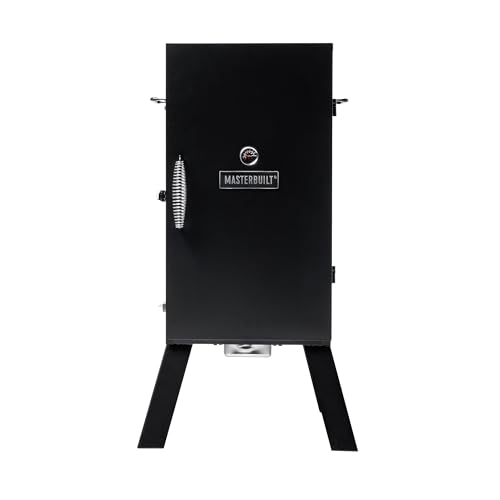
Masterbuilt 30-inch Electric Vertical Smoker with Analog Control
Badge: Best Analog Mid-Range
Strengths
- Analog dial control is simple, repairable, and has no screen to fail
- 535 sq in is a right-sized cabinet for most family cooks
- Masterbuilt’s long model history means parts and advice are easy to find
Trade-offs
- No digital timer or built-in probe in this configuration
- Smaller cooking area than the 710–725 sq in cabinets
- Analog dials give coarser temperature precision
Key specs (from the verified listing):
- 30-inch vertical electric cabinet
- Analog temperature control
- Chrome smoking racks
- 535 sq in cooking area
- Model MB20070210
- Color: Black
The MB20070210 is the traditionalist of this group: a 30-inch Masterbuilt electric cabinet with an analog temperature dial instead of a digital panel. There is a real case for analog in a smoker. A dial has no display to wash out in sunlight, no control board to glitch, and a learning curve measured in minutes — set the dial, let the cabinet settle, and cook. Generations of backyard cooks learned low-and-slow on exactly this pattern of machine, and the depth of owner knowledge around Masterbuilt cabinets makes troubleshooting advice easy to find.
The 535 square inches of cooking space on chrome racks is the honest size for most households: a couple of racks of ribs, a pork shoulder, a chicken or two, without heating a half-empty large cabinet for a Tuesday dinner. What you give up is instrumentation. There is no built-in probe and no digital timer here, so internal temperature checks are on you and your own thermometer, and the dial rewards a short settling period after each adjustment rather than constant fiddling. If your smoking style is a handful of weekend cooks a month and you value simplicity over readouts, this is the configuration that fits.
It is the tier’s floor done right: analog simplicity at a full 30-inch size, for buyers who want mid-range capacity without mid-range electronics.
Best for: traditionalists who want dial-simple controls and a right-sized cabinet / Not suited for: data-driven cooks who want digital control and a built-in probe

EAST OAK 30″ Outdoor Electric Smoker with Digital Timer and Wheels
Badge: Best Overall Mid-Range
Strengths
- Digital controls with a 12-hour timer suit set-and-forget scheduling
- Side chip loader stretches the time between refills
- Wheels make a 30-inch cabinet easy to move for storage or cleaning
Trade-offs
- No built-in meat probe listed, so a separate thermometer is wise
- Timer manages the session, not the food’s internal temperature
- Vertical layout is tall rather than wide
Key specs (from the verified listing):
- 30-inch vertical electric cabinet
- 725 sq in large cooking area
- Side wood chip loader (up to 6x longer on a single load, per maker)
- Digital control with 12-hour timer
- Easy-rolling wheels
- Color: Matte Black
Where the probe-and-window EAST OAK models chase monitoring, this Matte Black version chases scheduling. Its digital control panel includes a 12-hour timer, which changes how a long cook fits into a day: load the cabinet in the morning, set the session, and let the smoker hold its routine while you do other things. The side wood chip loader supports that hands-off style, because a single load is positioned to run up to six times longer than a basic tray, and fresh chips go in from outside without opening the door.
The 725 square inches of cooking area are arranged as stacked racks inside a 30-inch cabinet, and the easy-rolling wheels matter more than they sound — a loaded electric smoker is awkward to shuffle across a patio, and being able to roll it into a garage corner between cooks keeps it out of the weather. The trade-off to know about is monitoring: this configuration does not list a built-in meat probe, so doneness still depends on you checking internal temperature with a thermometer of your own at the right moments. Treat the timer as a session manager, not a doneness guarantee, and it is a very capable one.
This is the sweet spot in person — digital control, timer, side loader, 725 sq in — everything the tier promises, nothing it does not need.
Best for: planners who want a digital timer, long chip loads, and easy storage between cooks / Not suited for: cooks who want a built-in probe and will not use a separate thermometer
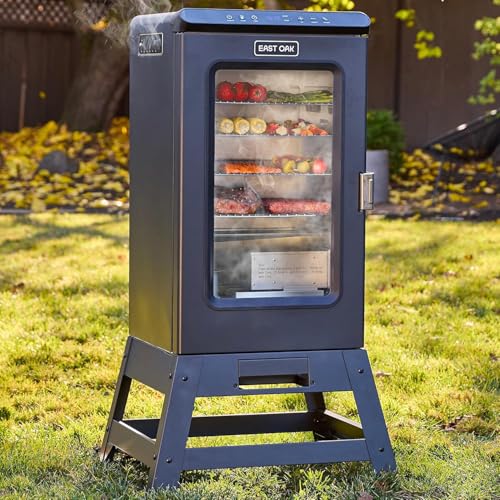
EAST OAK 30″ Outdoor Electric Smoker with Meat Probe and Mobility Stand
Badge: Best Mid-Range Ergonomics
Strengths
- Mobility stand raises the cabinet to a comfortable working height
- Built-in meat probe covers doneness without extra equipment
- Side loader keeps the door shut during long sessions
Trade-offs
- Stand adds footprint compared with a countertop-height setup
- Vertical cabinet still limits the widest cuts
- Probe is a single point of measurement on multi-cut loads
Key specs (from the verified listing):
- 30-inch vertical electric cabinet
- 725 sq in cooking area
- Built-in meat probe
- Mobility stand included
- Side wood chip loader (up to 6x longer uninterrupted smoke, per maker)
- Color: Polar Night
This Polar Night EAST OAK variant adds one ergonomic idea to the familiar formula: a mobility stand. A 30-inch vertical smoker sits low, and loading the bottom racks of a ground-level cabinet means crouching with a hot tray. Raising the cabinet on its stand puts the door, racks, and controls at a friendlier height, and it makes rolling the unit between its cooking spot and its storage spot simpler. For older cooks, or anyone with a bad back, that is not a cosmetic extra.
Underneath the stand, the cooking package is the strong EAST OAK combination: 725 square inches of rack space, a side chip loader that keeps smoke sessions running up to six times longer per load without door openings, and a built-in meat probe so internal temperature — the only doneness signal that matters — is always on the display. The cabinet format still shapes what you cook: stacked racks love ribs, wings, sausage, and chicken pieces, while the widest cuts need trimming or creative placement. A single probe also means one cut gets monitored continuously and the rest get spot-checked, which is normal for the class but worth planning around on mixed loads.
It spends its tier budget on ergonomics — stand and probe — a reminder that mid-range value is about fit, not just features.
Best for: cooks who value working height, mobility, and probe feedback in one cabinet / Not suited for: tight patios where the stand’s extra footprint is a problem

Royal Gourmet SE2805 28-Inch Electric Smoker
Badge: Best Compact Mid-Range
Strengths
- Compact 28-inch size fits smaller patios and balconies
- 1350W element is strong for the cabinet size
- Three grates still allow stacked, multi-item cooks
Trade-offs
- 454 sq in is the smallest cooking area in this guide
- Analog control means manual temperature management
- Fewer racks limit very large batch cooking
Key specs (from the verified listing):
- 28-inch vertical electric smoker
- 454 sq in cooking area
- 1350W heating element
- Analog temperature control
- 3 cooking grates
- Adjustable heat
- Color: Black
The Royal Gourmet SE2805 is the compact option in this lineup: a 28-inch vertical electric smoker with 454 square inches across three cooking grates and a 1350W element. That wattage matters in a small cabinet — a strong element in a modest volume recovers temperature quickly after the door opens, which is exactly when small smokers usually struggle. For apartment patios, small decks, and households cooking for two to four people, the size is the point rather than a compromise.
Controls are analog with adjustable heat, so running it is a dial-and-patience exercise: set, let it settle, and check with your own thermometer at the moments that matter. Three grates still allow genuinely stacked cooking — a small shoulder up top, ribs in the middle, vegetables below — you simply plan portions around the cabinet instead of filling it by instinct. The limitation is obvious and honest: this is not the smoker for a twenty-person barbecue or a pile of full packer briskets. It is a right-sized tool for regular small-batch smoking, and in that role the quick recovery and small footprint are real advantages rather than consolations.
The compact end of the tier: a complete three-grate cabinet for small households, where paying for capacity would be the real waste.
Best for: small patios and small households that smoke modest batches often / Not suited for: hosts who regularly cook for large groups

Traeger Pro 22 Wood Pellet Grill & Smoker
Badge: Best Mid-Range Pellet
Strengths
- One machine grills, smokes, bakes, and roasts — replaces two appliances
- 18 lb hopper supports long cooks between refills
- 450°F top end handles roasting and grilling, not just low-and-slow
Trade-offs
- Pellet fuel costs more to run than electric chips
- Horizontal format takes more patio width than a vertical cabinet
- Smoke flavor is milder than a dedicated chip-burning cabinet for some tastes
Key specs (from the verified listing):
- Wood pellet grill and smoker
- 572 sq in cooking space
- 6-in-1 versatility: grill, smoke, bake, roast, braise, BBQ
- Built-in meat probe
- 450°F maximum temperature
- 18 lb pellet hopper
The Traeger Pro 22 comes at smoking from the opposite direction of the vertical cabinets: it is a wood pellet grill first, with 572 square inches of single-level cooking space, a 450°F maximum temperature, and 6-in-1 versatility spanning grilling, smoking, baking, roasting, braising, and barbecue. That breadth changes the buying math. A cabinet smoker only smokes; this machine can smoke a brisket on Saturday and grill burgers on Tuesday, which is why pellet grills have become the default one-machine answer for many patios.
For smoking specifically, the pellet system feeds fuel automatically from an 18 lb hopper, so long cooks need hopper checks rather than chip reloads, and the built-in meat probe covers doneness. The single-level grate is the format advantage: wide cuts lie flat with room around them, and there is no rack-stacking Tetris. The trade-offs are running cost and character. Pellets cost more per cook than a handful of wood chips in an electric cabinet, the machine’s footprint is wider, and pellet smoke is a cleaner, milder smoke than a chip cabinet produces — some traditionalists find it less assertive on brisket. If you want one appliance that does everything well, it earns its place; if you want a dedicated smoke box, the cabinets are purer tools.
The mid-range pellet archetype: 6-in-1 versatility and an 18 lb hopper, without the connectivity premium of flagship pellet lines.
Best for: one-machine patios that grill as often as they smoke / Not suited for: purists who want a dedicated, chip-burning smoke cabinet

Pit Boss 700 Carbon Series Wood Pellet Grill & Smoker
Badge: Best Large Mid-Range Pellet
Strengths
- 718 sq in of single-level space fits wide cuts easily
- Wide 180–500°F range covers smoking through searing-range heat
- LCD controller and probe give clear session information
Trade-offs
- 13.5 lb hopper is smaller than some rivals, so very long cooks need a refill
- Pellet running costs exceed electric chip costs
- Horizontal footprint is larger than a vertical cabinet
Key specs (from the verified listing):
- Wood pellet grill and smoker
- 718 sq in cooking space
- LCD digital controller
- 180°F to 500°F temperature range
- Built-in meat probe
- 13.5 lb pellet hopper
- Color: Black
The Pit Boss 700 Carbon Series offers 718 square inches of single-level pellet cooking with an LCD digital controller, a 180°F to 500°F temperature range, and a built-in meat probe. The temperature range is the spec to notice: the low end sits in classic smoking territory, while the high end reaches heat that many pellet units cannot, which widens the machine from low-and-slow specialist toward genuine all-purpose cooker. The 718 square inches lie on one level, so briskets, spatchcocked birds, and multiple racks of ribs spread out flat with airflow around them.
Day to day, the LCD controller keeps the session legible — set temperature, actual temperature, probe temperature — and the pellet auger does the fuel work that chip cabinets ask you to do by hand. The hopper holds 13.5 lb, which covers most cooks but means an overnight session deserves a top-up check before bed. Running costs follow the pellet pattern: more per cook than electric chips, in exchange for automation and versatility. Compared with the cabinets in this guide, it is wider, heavier, and more versatile; compared with other pellet grills, its cooking area and temperature ceiling are its calling cards.
It stretches the tier upward — 718 sq in and a 500°F ceiling — for cooks whose ‘mid-range’ still means family-size.
Best for: pellet shoppers who want generous single-level space and a wide temperature range / Not suited for: small patios or buyers minimizing per-cook fuel cost
Comparison Table
| Pick | Format | Cooking area | Standout feature | Link |
|---|---|---|---|---|
| Masterbuilt 30-Inch Analog Electric Smoker (MB20070210) | Electric vertical cabinet | 535 sq in cooking area | Chrome smoking racks | Check on Amazon |
| EAST OAK 30-Inch Electric Smoker (Matte Black) | Electric vertical cabinet | 725 sq in large cooking area | Side wood chip loader (up to 6x longer on a single load, per maker) | Check on Amazon |
| EAST OAK 30-Inch Electric Smoker with Mobility Stand (Polar Night) | Electric vertical cabinet | 725 sq in cooking area | Built-in meat probe | Check on Amazon |
| Royal Gourmet SE2805 28-Inch Electric Smoker | Electric vertical cabinet | 454 sq in cooking area | 1350W heating element | Check on Amazon |
| Traeger Pro 22 Wood Pellet Grill and Smoker | Wood pellet grill & smoker | 572 sq in cooking space | 6-in-1 versatility: grill, smoke, bake, roast, braise, BBQ | Check on Amazon |
| Pit Boss 700 Carbon Series Pellet Grill and Smoker | Wood pellet grill & smoker | 718 sq in cooking space | LCD digital controller | Check on Amazon |
How to Choose Between Cabinet Smokers and Pellet Grills
The first decision is format, because format decides what cooking feels like. A vertical electric cabinet is a dedicated smoke box: food stacks on racks, wood chips smolder over an element, and the machine does one job with minimal fuss and low running cost. A pellet grill is a horizontal, automated wood-fired oven: it smokes, grills, roasts, and bakes on a single-level grate, feeds its own fuel, and asks more patio space and more money per cook in pellets.
Capacity reads differently across the formats. Cabinet figures — 454 to 725 square inches in this guide — are totals across stacked racks, which suit many medium items. Pellet figures — 543 to 932 square inches — are single-level, which suit wide cuts like full briskets and spatchcocked birds. Compare your biggest realistic load, not the headline number: a turkey or a full packer brisket cares about the largest single surface and the height above it, not the summed total.
Temperature control is the second filter. Electric cabinets specialize in the low-and-slow band and hold it cheaply and steadily. Pellet grills span a wider range — the models here run from 180°F up to 450 or 500°F — which is why they can grill on weeknights and smoke on weekends. If you will genuinely grill as often as you smoke, that range matters; if you will not, a cabinet’s focus is a virtue.
Last, count the ongoing costs in effort. Cabinets need chips, water-pan refills, and rack washing. Pellet grills need pellet storage, ash vacuuming, and auger care. Neither is onerous, but the right choice is the routine you will actually keep up, because a smoker that is annoying to maintain becomes patio furniture by August.
How to Run a Long Smoke Session, Whatever You Cook On
- Start with the fuel system. On an electric cabinet, load dry chips and fill the water pan. On a pellet grill, check the hopper level and make sure the fire pot is clean enough for reliable ignition.
- Preheat and stabilize. Bring the cooker to your target temperature and let it sit there for 20 to 30 minutes. Metal mass is a temperature battery; a stabilized cooker shrugs off the cold mass of the food far better.
- Season and load. Pat meat dry, season evenly, and load with space between pieces. Crowded food steams instead of smoking, and bark suffers.
- Place the probe correctly. Center of the thickest muscle, away from bone and fat pockets. On mixed loads, probe the cut that will finish last and spot-check the rest.
- Manage by exception. Good smoking is mostly leaving the cooker closed. Refill chips through the loader or check the hopper at planned intervals instead of peeking hourly.
- Finish, wrap, and rest deliberately. Many cooks wrap brisket or shoulder once the bark is set, then rest the meat at least 30 minutes before slicing against the grain.
After the cook, the routine is short but non-negotiable: empty ash and chip residue, scrape grates or wash racks, empty drip trays before they become a science project, and store fuel dry — pellets that absorb moisture swell and jam augers, and damp chips smoke poorly. A covered, dry storage spot extends the life of electronics, elements, and finishes alike.
Troubleshooting
Problem: temperature swings widely → check for wind exposure, a nearly empty hopper or chip tray, and a door or lid that is being opened too often; stabilize fuel and shelter the cooker first.
Problem: bark stays pale and soft → the surface was wet or the load was crowded; pat meat dry, space pieces apart, and give the bark time at temperature before wrapping.
Problem: pellet auger stops feeding → moisture-swollen pellets are the usual cause; empty the hopper, clear the jam, and refill with dry pellets stored indoors.
What ‘Mid-Range’ Actually Buys in a Smoker
Strip the label down to a checklist. A mid-range smoker should hold temperature without supervision, fit your real loads, feed its smoke or fuel with minimal door-opening, and tell you the food’s internal temperature. Every pick in this guide meets that checklist; the budget tier below it typically fails at least one item — a too-small cabinet, a dial with no probe path, a chip tray that needs constant attention — and the flagship tier above it adds reach (WiFi), scale (900+ sq in, 30 lb hoppers), and finish rather than fixing failures.
That framing turns shopping into auditing: for any model you consider, ask which checklist item it might fail, and read its listing for the answer. Capacity in realistic loads, control style, loading mechanism, probe provision — the four answers predict satisfaction better than any tier label. This guide applied the audit to its own picks and printed the failures it found in each review’s trade-offs, because a mid-range guide that hides weaknesses is just advertising. The same audit works for searches like Best Mudget Smokers, where the budget framing is even tighter.
Where Mid-Range Money Goes Furthest: Cabinet or Pellet?
In cabinets, mid-range money buys control and capacity: the step from analog and 535 sq in to digital, side loading, and 725 sq in is the step from supervising a cook to scheduling one. In pellet grills, mid-range money buys area and temperature range: the Pit Boss 700’s 718 sq in and 500°F ceiling cover cooks that smaller pellet units simply cannot fit or finish. Both are good trades; the wrong trade is spending mid-range money on the wrong format — a beautiful cabinet for a household that wanted to grill, or a pellet grill for a purist who only ever smokes.
Running costs belong in the tier math too. Cabinets sip chips and electricity; pellet grills consume pellets by the pound on long cooks. Over years of weekly smoking, that difference can rival the purchase gap between tiers — one more reason this guide judges the tier by total fit rather than by a headline figure. If your research continues into fuel variants, Best Natural Gas Smokers and Best Non Electric Smokers apply the same checklist to those formats.
Holding Temperature in Real Weather
Smokers do not cook in the laboratory conditions of their product photos. They cook in January wind, July heat, and the cold front that arrives, rudely, in hour six of a brisket. Understanding what weather does to your machine turns those cooks from gambles into routines. Cold and wind strip heat from the cabinet or grill body, so the element or auger works harder and fuel disappears faster; preheats stretch, and recovery after a door opening slows. The countermeasures are simple: shelter the machine from direct wind where safety allows, preheat longer, keep the door shut, and start with more fuel than a calm day would need.
Heat brings the opposite problem. A smoker sitting in full summer sun may idle above your target before the food even goes in, and low-temperature cooks — fish, cheese, jerky — get harder to hold gently. Shade is the fix, along with patience at startup: let the machine settle in its actual environment rather than chasing the dial. Digital controllers compensate within their range, which is one reason they dominate this guide’s shortlists, but no controller repeals physics; it only manages it more gracefully than a human checking every twenty minutes.
Rain deserves a flat rule: keep electric connections dry, keep pellets and chips out of the weather entirely, and never let a hopper or chip tray take on water. Beyond safety, moisture is the enemy of consistency — damp pellets swell and feed erratically, damp chips smolder reluctantly. A covered storage spot and a habit of checking the forecast before an overnight cook will do more for your results than any accessory you can buy.
Seasoning and Your First Three Cooks: A Playbook
Every smoker in this guide improves after its first sessions, and the cook who plans those sessions learns the machine fastest. The first run is a seasoning burn: no food, moderate temperature, a load of chips or a modest pellet burn, run long enough to coat the interior and burn off the residues of manufacture and shipping. Watch how the machine behaves while nothing is at stake — how long it takes to settle at temperature, how its display compares with a probe at cooking level, how much smoke it makes on a standard fuel load. Those three observations are the foundation of everything you will cook later.
Cook one should be pork shoulder, the most forgiving teacher in barbecue. It tolerates temperature swings, it is done across a wide window of tenderness, and it teaches the stall — the long plateau where internal temperature refuses to rise — without punishing you for meeting it. Cook two should be ribs, which teach timing, bark, and the bend test. Cook three can be chicken, which teaches moisture management and the value of the water pan in cabinets, or higher finishing heat in pellet grills. By the end of that sequence you will know your machine’s hot spots, its fuel appetite, and its honest preheat time.
Keep notes from the start, even if they are five lines in a phone: date, cut, weight, wood, temperature, and verdict. Smokers are consistent machines, and a short log converts that consistency into prediction. The cooks who plateau in this hobby are usually the ones re-learning the same lessons every season because nothing was written down; the ones who improve treat each session as data. It is not homework — it is how a new appliance becomes your smoker.
Common Buying Mistakes
- Choosing features before format. WiFi cannot fix a cabinet that is the wrong shape for your food. Decide cabinet versus pellet, and size, first.
- Trusting the dial or display blindly. Verify a new smoker’s temperature behavior with a probe at grate level during your first cooks so you know its habits.
- Smoking everything at one temperature. Poultry, ribs, and brisket reward different approaches; a single setting for all food flattens results.
- Forgetting the water pan. In cabinets that use one, a dry pan changes both moisture and temperature stability.
- Buying fuel in bulk before you like it. Chip and pellet flavors differ; try small bags of a few woods before committing to a large supply.
- Leaving electronics out in weather. Digital and WiFi models are outdoor appliances, not waterproof ones. Cover and shelter them.
Final Recommendation
The first choice in the tier is the EAST OAK Matte Black: digital control, a 12-hour timer, side loading, and 725 sq in make it the most complete mid-range cabinet here. Pellet shoppers should start with the Pit Boss 700, whose area and temperature range stretch the tier furthest — compare the two listings to decide which format your cooking actually is.
Choose the Masterbuilt analog for dial simplicity, the stand-equipped EAST OAK for ergonomics, the Royal Gourmet for small spaces, and the Traeger Pro 22 for the most established pellet package. If your search trail continues to format variants like Best Off Set Smokers or Best Offest Smokers, run the same four-point audit — capacity, control, loading, probe — before any tier label persuades you.
Quick links: Check the EAST OAK 30-Inch Electric Smoker (Matte Black) on Amazon | Check the Pit Boss 700 Carbon Series Pellet Grill and Smoker on Amazon
More Notes for Best Mid Range Smokers Shoppers
Tier labels age badly; checklists do not. Makers refresh lines, yesterday’s flagship features become today’s standard, and a model that was mid-range at launch may be the value pick of a later season. That is precisely why this guide defines its tier by included features and honest omissions rather than by numbers that would be stale on arrival. When you shop, carry the checklist, not the label, and let live listings supply the current figures.
One underrated mid-range virtue is parts availability. Machines at this tier sell in volume, which means racks, probes, elements, and controllers stay obtainable, and owner knowledge — the forum threads and videos that solve your exact problem at 11 p.m. — is deep. An obscure bargain with no parts pipeline is expensive in a way its listing never mentions; a popular mid-range model is cheap to keep alive for a decade.
Finally, buy the tier for the cook you are becoming, within reason. A mid-range machine forgives a beginner and still satisfies an enthusiast, which is a wider window than either extreme offers. Most owners who outgrow a smoker outgrow its capacity first — so if you are torn between two sizes in this tier, the larger one is usually the longer-lived purchase, provided your patio agrees.
Fuel storage deserves more respect than it usually gets. Wood chips should live in a sealed container indoors, where they stay dry and keep their aroma; a bag left open in a damp garage absorbs moisture and odor alike, and both show up in the food. Pellets are even less forgiving — they are compressed sawdust, and humidity swells them into a crumbly mass that feeds erratically and can jam an auger outright. Buy pellets in quantities you will use within a season, store them off the floor in a lidded bin, and never pour the dusty bottom of a bag into the hopper. Good fuel is invisible in the finished food; bad fuel is all you can taste.
Electrical safety is the unglamorous foundation of every cabinet in this guide. Plug the smoker into a proper outdoor-rated outlet, keep the cord off wet ground, and avoid extension cords where you can — if one is unavoidable, it should be a heavy-duty outdoor cord rated for the load, laid out so nobody trips it mid-cook. Never run an electric smoker in standing water or heavy rain, and give the plug and socket a glance each season for corrosion or damage. These are thirty-second habits that protect both the machine and the cook, and they cost nothing but attention.
The smoke ring deserves a short myth-busting paragraph, because it causes more beginner anxiety than any other topic. The pink ring under the bark is a chemical reaction between smoke gases and the meat’s surface pigments; it is pretty, it is traditional, and it is not a doneness signal, a smoke-penetration meter, or a quality grade. Electric cabinets, which burn chips rather than logs, often produce a fainter ring than offset pits while delivering excellent smoked flavor. Judge your cooks by tenderness, moisture, and taste — the ring will take care of itself, or not, without changing what is on the plate.
A few accessories genuinely earn their place next to any smoker in this guide. Heat-resistant gloves turn rack handling from a juggling act into a non-event. A sturdy sheet pan is the universal transport between kitchen and smoker. A spray bottle of water or apple juice helps bark set on long cooks. Butcher paper or foil for wrapping gives you control over the stall and the bark’s final texture. None of these is expensive, all of them get used weekly, and together they matter more to your results than any single feature upgrade on a spec sheet.
Leftovers are the dividend of smoking, and they reward a little planning. Large cuts almost always cook better in full size than in small portions, so cook the whole shoulder or brisket and treat the surplus as an ingredient: pulled pork for sandwiches and tacos, brisket for chili and hash, smoked chicken for soups and salads. Cool leftovers promptly, refrigerate them in shallow containers, and reheat gently with a splash of moisture to keep the texture you worked hours to create. Many cooks quietly admit the second-day dishes are why they really smoke.
A last word on patience, because it is the ingredient no listing can sell you. Smoking compresses badly: rushing a preheat, crowding a cabinet, opening a door every half hour, and slicing without a rest each tax the final plate in ways no machine can refund. The smokers in this guide were chosen to remove every obstacle except the clock — temperature, fuel, and monitoring are handled. What remains is the discipline to let a shoulder take the hours it takes. Cooks who make peace with that discover the hobby’s real pleasure: the food is almost a by-product of a well-run, unhurried day.
Frequently Asked Questions
What wood chips or pellets suit most meats?
Fruitwoods like apple and cherry are mild and forgiving, and suit poultry, pork, and fish. Hickory is the classic all-purpose barbecue wood with a stronger profile that stands up to brisket and shoulder. Oak is a middle path — present but not aggressive. Mesquite is the strongest common option and is best used sparingly or blended. When in doubt, start milder: you can add smoke time, but you cannot take harsh smoke back out of finished meat.
How long does a typical smoke session take?
It depends on the cut far more than the machine. Ribs commonly take several hours, a pork shoulder the better part of a day, and a brisket longer still, while fish and sausage are comparatively quick. Every smoker in this guide is built around holding a low, steady temperature for those durations; the real planning skill is starting early enough that the meat, not the guests, decides when dinner is.
Do I need to soak wood chips before smoking?
No. Soaking mostly delays smoke production while the water steams off, and it does not meaningfully extend useful smoke. Dry chips in the tray or loader, a settled thin stream of smoke, and a closed door produce cleaner flavor. The exception some cooks swear by is a small handful of soaked chips mixed into dry for a slower start — a preference, not a requirement.
Can I use an electric smoker in cold or windy weather?
Yes, with expectations adjusted. Cold and wind increase heat loss, so preheat longer, shelter the cabinet from wind where you safely can, and keep the door shut. Digital models compensate automatically to a point; analog models may need a slightly higher dial setting. Avoid using any outdoor electric appliance in rain, and keep cords and connections dry.
Is mid-range the right tier for a first smoker?
For most beginners, yes — it is the tier where the machine stops fighting you. Budget models can teach bad lessons (temperature chaos is not a skill issue), and flagships add systems a new cook does not need yet. A mid-range cabinet or pellet grill holds temperature honestly, fits real food, and leaves your attention free for the actual craft: seasoning, smoke management, and timing.
What is the first upgrade to make after buying a mid-range smoker?
Not an accessory — a habit. Learn your machine’s temperature behavior with a probe at cooking level, keep a short cook log, and master one cut completely before expanding. If a purchase must follow, make it a good instant-read thermometer habit for spot-checking cuts the built-in probe is not in; the machines in this guide otherwise arrive complete for their formats.


