Disclosure: topratedkitchenware.com is reader-supported. When you buy through links on our site, we may earn an affiliate commission from Amazon and other retailers, at no extra cost to you.
Where to buy
The six models below are the picks in this guide to best commercial air fryers for restaurants. Four carry direct listing links, because their verified listing titles state the large capacity a service kitchen needs. Two are reviewed in full but kept prose-only, because their titles state no capacity at all, and a restaurant guide should not link a machine whose scale it cannot verify. Every pick is reviewed in detail below, with an honest account of where domestic-built machines can serve a small operation and where they cannot.
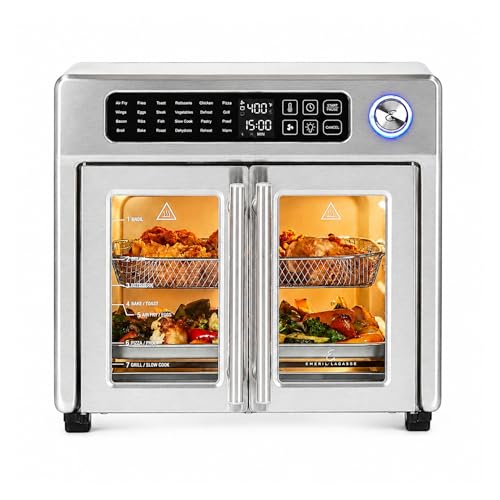
- Emeril Lagasse 26QT French Door Air Fryer Oven
- Nuwave Bravo XL Pro Air Fryer Toaster Oven
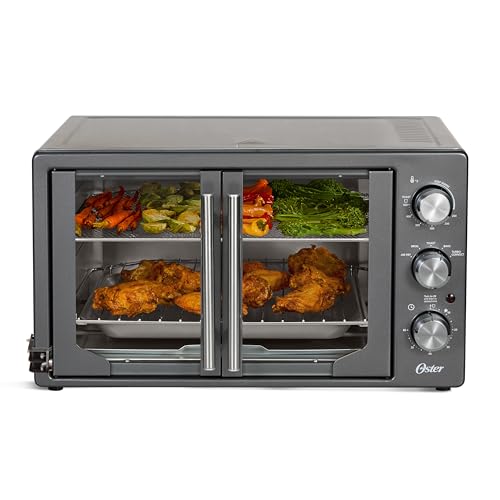
- Oster Extra-Large French Door Air Fryer Oven
- Emeril Lagasse Everyday 360 Air Fryer Oven — no capacity stated in its listing title, reviewed prose-only below
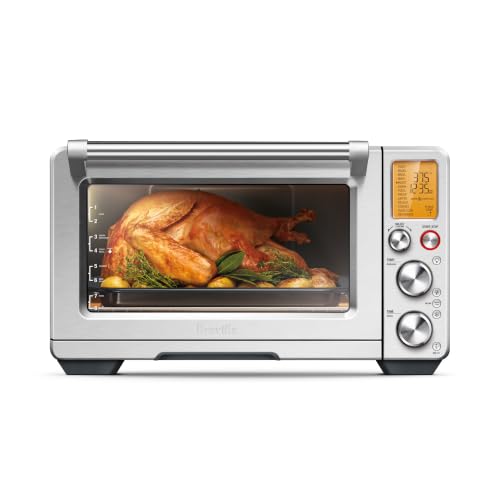
- Breville Smart Oven Air Fryer Pro — no capacity stated in its listing title, reviewed prose-only below
- Chefman XL 14-Quart Air Fryer
Read the full guide ↓ for the duty-cycle maths, the throughput reality, and the point at which a small operation should stop buying domestic machines and start buying true commercial equipment.
Searching for best commercial air fryers for restaurants usually means one of three real situations, and this guide is written for all of them honestly. A small café, food truck, bakery, or bar kitchen wants crisp sides, reheated items, or a small-batch station without a full fryer installation. A home-based food business has outgrown a domestic basket and needs verified capacity. Or a larger operation wants a supplementary countertop unit for a single station. What none of these situations needs is a domestic appliance flattered into a commercial costume, so this guide applies a strict rule from the start: a pick is linked only where its verified listing title itself states a large capacity, in quarts, in an extra-large interior, or in pan dimensions a service kitchen can plan around. Machines whose titles state no capacity, however good they are, are reviewed prose-only.
That rule produces a shortlist of large countertop ovens, which is the honest shape of this category at the level most small operations actually buy. These are domestic-built machines with service-scale cavities, and the guide treats them as exactly that: capable of real work in cafés, trucks, and small kitchens running countertop volumes, with cleaning and duty limits stated plainly, and not a substitute for certified commercial fryers in a high-volume line. Readers whose question is about build grade rather than restaurant service will find the companion angle in Best Commercial Grade Air Fryers; this guide stays with the working kitchen.
Key Takeaways
- Only picks whose verified titles state a large capacity are linked here; unstated capacity means prose-only, however strong the machine.
- These are large domestic-built countertop ovens suited to cafés, food trucks, and small kitchens, not certified replacements for high-volume commercial fryers.
- Throughput is tray area multiplied by cycles per hour; plan around your peak thirty minutes, not your average day.
- Cleaning design decides commercial viability more than cooking power, because service kitchens clean under time pressure, repeatedly.
- No prices are printed; check the latest price on Amazon for each linked pick and confirm the configuration and included accessories on the listing.
- Buy for the station the machine will actually run: sides, reheats, and small batches are its honest work.
In this guide
Quick Picks
| Pick | Badge | Why it earns its place | Listing |
|---|---|---|---|
| Emeril Lagasse 26QT French Door Oven | Best Overall for Small Restaurants | Extra large interior, French doors, and six included accessories for a working station. | Check on Amazon |
| Nuwave Bravo XL Pro | Best Capacity and Control | Thirty quarts, a temperature probe, and a wide range for disciplined batch work. | Check on Amazon |
| Oster Extra-Large French Door Oven | Best for High-Volume Sides | Fits fifteen by twelve inch pans, the service-friendly tray size in this guide. | Check on Amazon |
| Emeril Lagasse Everyday 360 | Most Versatile Prose-Only Pick | Nine functions and rotisserie, but no capacity stated in its title, so no link here. | See review |
| Breville Smart Oven Air Fryer Pro | Best Build Quality, Domestic Scale | Thirteen functions and flagship build, with no capacity stated in its title, so no link here. | See review |
| Chefman XL 14-Quart Air Fryer | Best Compact Station Pick | Fourteen stated quarts with a windowed door and rotisserie in a smaller footprint. | Check on Amazon |
Operators comparing these countertop ovens with the wider category often cross-check the moving-air performance claims in Best Convection Air Fryers, since convection strength is what a service station is really buying.
How These Picks Were Chosen
This guide is research-led, and its selection rule is stricter than a domestic guide’s. The six picks come from a verified pool for this product group, each included only where its identity, brand, and listing details could be confirmed. For a restaurant brief, one further screen was applied: capacity had to be stated in the listing title itself. Four picks passed that screen with large, plannable capacities, twenty-six quarts, thirty quarts, an extra-large interior specified by pan size, and fourteen quarts. Two picks did not state a capacity at all and are therefore prose-only, reviewed in full because both are genuinely relevant to small operations, but linked nowhere in this guide.
Beyond the screen, we compared the machines on the factors a working kitchen feels: tray area and how food loads, how fast a station can turn a batch around, how the interior and parts clean between services, and whether the accessories a station needs are included or must be chased separately. We make no certification claims for any pick, because none is stated in the verified titles, and no hands-on testing is claimed. Specifications in the boxes below come only from the listing titles themselves. That discipline is the guide’s value to a professional reader: what is stated can be planned around, and what is not stated is labelled as not stated.
The 6 Best Commercial Air Fryers for Restaurants
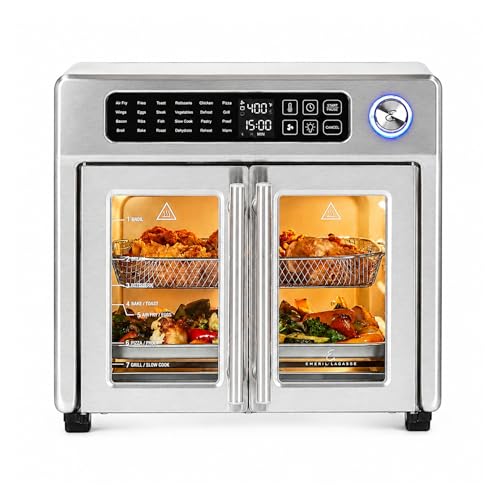
Emeril Lagasse 26QT French Door Air Fryer Oven
Badge: Best Overall for Small Restaurants
Strengths
- Twenty-six quart extra large interior, the tray capacity a small service station can build a menu item around.
- French doors open from the centre, which suits a pass where staff load and unload quickly without a dropped door in the way.
- Six cooking accessories included, so the station starts complete rather than waiting on a second order.
Trade-offs
- Domestic build and duty expectations; it is not a certified commercial fryer and should not be scheduled like one.
- Twenty-four presets are a domestic interface, more than a line cook needs and worth simplifying into house settings.
- A large footprint that a small kitchen must allocate permanently.
Spec box
- Capacity: 26QT, extra large interior
- Design: French door
- Type: countertop convection cooker
- Presets: 24 one-touch preset options
- Included: six cooking accessories
The Emeril takes the overall badge for small restaurants because it combines the three things a countertop station needs most: stated capacity, fast loading, and completeness out of the box. Twenty-six quarts behind French doors takes full trays of sides, par-cooked items for finishing, and reheats at a scale a café or bar kitchen can actually sell, and the centre-opening doors matter at service speed, where a drop-down door becomes an obstacle course with a hot tray in hand. The included six accessories close the usual gap between buying an oven and equipping a station, which is a real operational saving in time if not in headline price.
The professional cautions are equally clear. This is a domestic-built machine, and its honest role is the supplementary station: fries and sides, finishing, reheating, small batches, the work that frees a main line rather than replacing it. A kitchen that schedules it as a primary fryer across a full service will learn its limits expensively. Set house standards for its two or three menu jobs, train the presets down to those settings, and clean the interior on a service rhythm, and it will earn its counter. Ask it to be a commercial fryer and it will decline, audibly, during your busiest hour.
Best for: cafés, bars, and small restaurants needing a complete countertop finishing and sides station / Not suited for: high-volume primary frying duty

Nuwave Bravo XL Pro Air Fryer Toaster Oven
Badge: Best Capacity and Control
Strengths
- Thirty quarts, the largest stated capacity in this guide, for serious batch work.
- A temperature probe that cooks proteins to a target, the consistency tool a kitchen can standardise around.
- A fifty to five hundred degree Fahrenheit range and grill combo design for a wide station repertoire.
Trade-offs
- The most complex interface here; a service kitchen must train it down to house settings or lose its speed advantage.
- Domestic build, like every pick in this guide, with duty limits to respect.
- Large stainless footprint that anchors a station permanently.
Spec box
- Capacity: 30QT
- Design: air fryer toaster oven with grill combo
- Presets: 142
- Temperature range: 50–500F
- Probe: smarter probe included in the system description
- Material note: PFAS free
- Finish: stainless steel
The Nuwave is the pick for the operation that cooks with discipline. Its thirty quarts give it the deepest batch capacity here, but its defining tool for a professional is the probe: proteins cooked to a verified internal temperature, batch after batch, by whoever is on the station, which is how a small kitchen holds quality across staff changes. The wide temperature range extends the station’s repertoire from gentle holding and proofing-adjacent work to hard finishing at the top end, and the grill combo adds a surface the other ovens lack. For a food truck or café whose menu leans on a signature roasted or grilled item, this is the countertop machine that can own that item.
The cost of that control is complexity, and in service, complexity is paid in seconds and mistakes. The answer is procedural: decide the machine’s three or four house jobs, set them, label them, and forbid improvisation during service. A Nuwave run that way is a precision station; a Nuwave scrolled through its full preset library at the pass is a queue. The evaluation habit behind that discipline, measure, standardise, verify, is the same one explored from the consumer side in Best Convection Oven Air Fryers Consumer Reports, and it transfers to professional kitchens without changing its nature.
Best for: small operations standardising a signature roasted or grilled item / Not suited for: stations needing the simplest possible interface

Oster Extra-Large French Door Air Fryer Oven
Badge: Best for High-Volume Sides
Strengths
- Extra-large French-door design specified by the pans it fits, fifteen by twelve inches, a plannable service dimension.
- Six cooking presets, a short list that suits a station better than a library.
- Auto-shutoff timer, a small safety discipline built into the machine.
Trade-offs
- Six presets mean less guided range for varied menu work; house technique must supply the rest.
- Domestic build and cleaning expectations, like all picks here.
- Extra-large footprint, permanently allocated.
Spec box
- Design: extra-large French door
- Pan fit: fits 15 x 12 inch pans
- Presets: 6 cooking presets
- Oil claim: maker describes low-oil cooking
- Safety: auto-shutoff timer
The Oster earns its badge on a specification most domestic guides would skim past: it states the pan it fits. Fifteen by twelve inches is a dimension a kitchen can plan a station around, matching trays, portions, and service ware, and in a working environment that plannability is worth more than another ten presets. Its six presets reinforce the point. A sides station does a few things repeatedly, fries, roasted vegetables, reheats, finishing, and a short preset list with an auto-shutoff timer is an interface shaped like the job. French doors complete the service picture, loading and unloading at speed without a hot door dropped into the workspace.
Its limits are the mirror of its virtues. A kitchen wanting one machine to cover a wide and changing menu will find six presets and a technique-led approach demanding, and should look at the Emeril or the Nuwave. A kitchen that knows its sides menu to the item will find the Oster the most honest machine in this guide, the one whose specification reads like it was written by someone who has loaded a tray during a rush. As with every pick here, it is a domestic-built oven doing service work within its limits, and the guide’s duty-cycle section below describes how to keep it inside them.
Best for: sides and finishing stations with a fixed, repeated menu / Not suited for: wide, changing menus needing guided range
Emeril Lagasse Everyday 360 Air Fryer Oven
Badge: Most Versatile Prose-Only Pick
Strengths
- Nine functions in one countertop oven, including rotisserie, for a varied small menu.
- Three hundred sixty degree convection in the maker’s description, aimed at even cooking across the cavity.
- A well-known line with a broad domestic track record behind it.
Trade-offs
- No capacity is stated in its verified listing title, so this guide cannot verify its scale and links it nowhere here.
- Without a stated capacity, station planning, portions, and tray matching cannot be done from the listing alone.
- Domestic build, as with every pick in this guide.
Spec box
- Functions: 9-in-1
- Air circulation: 360° convection, as described by the maker
- Rotisserie: included in the function description
- Capacity: not stated in the verified listing title
The Everyday 360 is the review that demonstrates this guide’s rule by applying it to a machine many small operators genuinely use. On functions it is attractive: nine in one, rotisserie included, convection described in full-circle terms, the kind of oven a small café might run for a mixed counter menu. None of that is in dispute. What the verified title does not state is capacity, and for a restaurant reader capacity is not a detail; it is the difference between a station that covers a lunch item and one that collapses at the third ticket. A guide that linked this machine for restaurant use would be asking professionals to plan around a number it could not show them, so it does not.
The practical guidance follows from the rule. If your operation is small enough that you will verify the cavity in person, against your own trays and portions, the Everyday 360’s versatility is a real candidate, and its domestic reputation is a matter of record. Buy it, if you buy it, on measurements you have taken yourself, in a context where the seller’s full specification is in front of you. Within these pages it stands as a full review and an honest non-recommendation by link, which is what professional readers should want from a guide: the discipline to say what it cannot verify, in the place where verification matters most.
Best for: very small operations able to verify capacity in person / Not suited for: any station planned from the listing alone
Breville Smart Oven Air Fryer Pro
Badge: Best Build Quality, Domestic Scale
Strengths
- Thirteen functions, the broadest set in this guide, in a brushed stainless flagship build.
- A convection setting the maker describes as reducing cooking time by up to thirty percent.
- Refined controls and finish that suit a customer-facing counter.
Trade-offs
- No capacity is stated in its verified listing title, so it is prose-only in a restaurant guide.
- Premium domestic positioning; its strengths are refinement, not service throughput.
- A flagship tier that a working kitchen should interrogate hard before paying.
Spec box
- Model: BOV900BSS
- Functions: 13, including roast, bake, and dehydrate
- Convection: yes, described as reducing cook time by up to 30%
- Finish: brushed stainless steel
- Capacity: not stated in the verified listing title
The Breville is the finest domestic countertop oven in this guide and the clearest illustration of why finest and most suitable are different words. Its thirteen functions, its convection performance as the maker describes it, and its build quality would grace a demonstration kitchen or a premium café counter where the machine is part of the theatre. But its verified title states no capacity, its design brief is domestic refinement rather than service throughput, and its tier asks a working kitchen to pay for polish it cannot sell. Under this guide’s rule it is therefore prose-only, and under any honest analysis it is a considered purchase for a niche operation rather than a station workhorse.
Where it can make sense is narrow and real: a small, quality-led operation whose countertop oven works at domestic volumes, in view of customers, across a varied day of baking, roasting, and finishing, where the owner values the machine’s manners as part of the offer. That operation should still verify capacity from the full specification before committing, as with the Emeril 360 above. Everyone else should take the Breville’s presence here as the guide’s second lesson in its rule: in a professional brief, what cannot be verified cannot be linked, and what is built for a home should be bought, if at all, with open eyes.
Best for: small premium counters at domestic volumes / Not suited for: throughput-led service stations

Chefman XL 14-Quart Air Fryer
Badge: Best Compact Station Pick
Strengths
- Fourteen stated quarts in a windowed oven format, the compact end of verified service capacity.
- Rotisserie and dehydrator functions extend a small station’s menu without a second machine.
- Touchscreen controls wipe clean quickly between services, a genuine service virtue.
Trade-offs
- Fourteen quarts is a small station’s ceiling; peak demand will find it.
- Windowed door shows splatter and needs wiping to stay presentable at a customer-facing counter.
- Domestic build and duty limits, as throughout this guide.
Spec box
- Capacity: XL 14-quart
- Functions: 6-in-1, including rotisserie, food dehydrator, convection oven, bake, broil, and reheat
- Controls: touchscreen
- Door: windowed
- Colour: black
The Chefman closes the linked list as the compact station: fourteen verified quarts, a window that lets staff judge a batch without opening the door mid-service, and a rotisserie that gives a small operation a centrepiece item, a bird for sandwiches, a rotating special, without a dedicated machine. For a food truck, where counter is measured in centimetres and every appliance must justify itself twice, that combination is the argument. The touchscreen is a quiet service feature too, because a flat panel wipes down in seconds where knobs collect the day.
Its ceiling is stated in its own capacity figure, and a busy kitchen should believe it. Fourteen quarts runs a modest station well and a growing one breathlessly, so this is a pick for operations whose peak is genuinely compact, or for a second, specialised station beside a larger oven. The everyday cooking questions behind such a station, timing, layering, finishing, are the same ones home cooks ask, which is why the practical guidance in Best Cooking Air Fryers transfers to small service kitchens almost unchanged. Buy the Chefman for the station it can run, and it will run it well. In a truck, pair it with a written peak plan, because the vehicle cannot expand when the queue does, and the machine’s stated fourteen quarts should be treated as a menu-design constraint from the first day of trading rather than discovered as one during the first festival weekend.
Best for: food trucks and compact stations, including a rotisserie special / Not suited for: growing operations near their peak capacity
Comparison Table
| Pick | Badge | Stated capacity | Standout stated feature | Listing |
|---|---|---|---|---|
| Emeril Lagasse 26QT | Best Overall for Small Restaurants | 26QT | Six accessories included; French doors | Check on Amazon |
| Nuwave Bravo XL Pro | Best Capacity and Control | 30QT | Temperature probe; 50–500F range | Check on Amazon |
| Oster Extra-Large | Best for High-Volume Sides | Fits 15 x 12 inch pans | Six presets; auto-shutoff timer | Check on Amazon |
| Emeril Everyday 360 | Most Versatile Prose-Only Pick | Not stated in title | Nine functions; rotisserie | Prose-only |
| Breville Smart Oven Air Fryer Pro | Best Build Quality, Domestic Scale | Not stated in title | 13 functions; flagship build | Prose-only |
| Chefman XL 14-Quart | Best Compact Station Pick | 14-quart | Windowed door; rotisserie | Check on Amazon |
How to Choose a Countertop Air Fryer for a Small Restaurant
Begin with the station, not the machine. Write down the exact jobs the unit will run: which menu items, in what portions, across which peak window. Convert that into tray loads per hour at your busiest thirty minutes, because a machine that cruises at lunch average and drowns at the peak is the wrong machine bought with correct intentions. Then match stated capacity to that number with headroom, and prefer the pick whose capacity is stated in the unit your kitchen plans in: quarts for batch work, pan dimensions for tray work. The Oster speaks in pans and the Nuwave in quarts and degrees, and the right choice is partly a choice of which language your kitchen already thinks in.
Next, interrogate cleaning as an operating cost. A service kitchen cleans between rushes, with the next ticket already printing, so ask how the interior wipes, whether trays survive a commercial sink rhythm, and how the door glass is kept presentable if the counter faces customers. Then interrogate the interface as a training cost: presets must collapse into house settings that any trained hand can run identically. Finally, be honest about the ceiling. If the station’s success would immediately overload the machine, the correct purchase is not a bigger domestic oven but the entry point of true commercial equipment, and this guide’s shortlist becomes a bridge rather than a destination. Many small operations live happily on the bridge for years; the mistake is only in not knowing you are on it.
How to Run and Maintain a Countertop Station
Set the station up like a station. Allocate the counter permanently, with vent clearance behind and above, landing space for hot trays on the correct side for your pass, and the machine’s house settings labelled at the unit. Load in single layers with air gaps, because service pressure tempts crowding and crowding returns soggy product that no second blast fully repairs. For proteins, standardise on temperature-verified doneness where a probe is available, and on timed, portion-controlled batches where it is not. Keep a simple batch log for the first weeks: load, setting, result. It converts individual experience into house knowledge faster than any training session.
Maintenance is a rhythm with three beats. Between services, wipe the cavity and door while warm and empty crumbs and drips before they bake into the next service’s flavour. Daily, wash trays and racks fully, check door seals and hinges for the play that hard use introduces, and inspect the interior for the residue build-up that becomes smoke at the worst moment. Weekly, deep-clean according to the maker’s guidance and review the batch log for drift, the setting that used to work and slowly does not, which is usually residue or a tired seal announcing itself early enough to fix cheaply.
Troubleshooting at a station is triage. Problem: product browns unevenly across the tray → loads are crowded or the tray position is wrong for the item; thin the layer and standardise the position. Problem: cook times creep longer across a service → residue is insulating surfaces or the cavity is being opened too often; clean, and batch door openings. Problem: smoke during fatty items → drips are reaching a hot surface; use the rack-and-tray arrangement that keeps fat away from the element path and empty the tray between batches. A station run on these rules will give a domestic-built machine its longest and most profitable life.
Duty Cycles: The Honest Limit of Domestic Machines in Service
Every pick in this guide was designed for a home, where a heavy day might mean three cooking sessions. A restaurant station can ask for thirty. That gap, the duty cycle, is the real subject of any commercial air fryer guide, and it expresses itself in heat, wear, and cleaning rather than in any single failure. Heating elements and fans built for domestic rhythms will work in service, but they will age in dog years, and seals, hinges, and coatings will show it first. The practical response is not fear but scheduling: rotate heavy jobs if you own two units, let the machine cool between peak blocks rather than running it as a continuous furnace, and treat the cleaning rhythm above as part of the machine’s working specification rather than as housekeeping.
There is also a compliance honesty that belongs in this section. Commercial kitchens in many jurisdictions are expected to use equipment certified for commercial use, and nothing in the verified titles behind this guide states such a certification for any pick. A small operation should check its own local requirements, its insurer’s expectations, and its landlord’s terms before building a station on domestic equipment, however capable. The kitchens this guide suits best, the café adding a sides station, the truck, the home-based business formalising its setup, are the ones that make that check, document it, and then buy with the same clear eyes they apply to the capacity figures. Capability is a fact; permission is a separate fact; a professional keeps both in view.
Station Economics: What a Countertop Station Does to a Small Menu
The business case for a machine in this guide is rarely the machine itself; it is the menu items the station makes possible without a fryer installation. A café that can serve crisp sides, finished pastries, and properly reheated items from one countertop oven has added a page to its offer with no extraction, no oil contract, and no new line cook. A bar that can finish snacks to order at the pass has converted dead kitchen minutes into margin. A food truck built around one signature roasted item, the kind of item the Nuwave’s probe or the Chefman’s rotisserie can own, has its entire concept carried by a single verified-capacity machine. In each case the correct way to judge the purchase is against the items it enables and the covers they represent, not against the abstract category of commercial fryers, which serves a different kitchen at a different scale.
The same economics explain the ceiling honestly. A station that succeeds creates its own demand problem, and the operator should decide in advance what success triggers: a second countertop unit for redundancy and rotation, which also solves the duty-cycle problem by sharing load, or the step into certified commercial equipment for the station that has become a line. Both are good outcomes, and both are cheaper to reach from a running, revenue-producing countertop station than from a standing start. What is not economical is the middle failure, a domestic machine run past its rhythm until it fails mid-service and takes the menu page with it. The maintenance and scheduling rules in this guide exist to keep the station on the profitable side of that line, and they cost nothing but discipline, which is the cheapest input a small kitchen has.
There is a quieter economic point about the prose-only picks, and it is worth stating for operators tempted by them. A premium domestic machine bought for a working station ties up capital in refinement the tickets cannot taste, while an unverified-capacity machine risks the worse outcome of a station planned around a guess. The linked picks were chosen so that every figure in the plan, capacity, pan size, temperature range, is a figure the listing itself states. In a business, that is not pedantry. That is the difference between a plan and a hope, and it is why this guide holds its rule even when it excludes famous names.
Training a Station Team on One Machine
A countertop station is only as consistent as its least-trained shift, so the training design matters as much as the machine. Reduce the station to a card, kept at the unit: each menu job, its load in grams or pieces, its tray or basket arrangement, its setting, its time, and its finish check. Train to the card, not to the machine’s full interface, and treat the card as the recipe. New staff should run their first services supervised on the card alone, because a cook who has mastered four house jobs is an asset, while a cook who has explored forty presets is a variance. When a setting is improved, change the card, date it, and tell every shift; the batch log described earlier is where improvements earn their place on the card.
Cleaning training deserves the same formality. Show, once and properly, the between-service wipe, the daily wash, and the weekly deep clean, and put them on the closing and opening checklists where they will actually happen. The cooks who clean the station should be the cooks who run it, because the person who wipes a cavity notices the tired seal and the drifting cook time before anyone else does. Kitchens that rotate staff through the station with the card and the checklist in place find that a domestic-built machine gives its most consistent service, which is the practical meaning of the phrase commercial in a small operation: not a badge on the machine, but a system around it. Readers building that system from the cooking side will find the technique guidance in Best Cookig Air Fryers a useful companion, typo and all, since the underlying craft of timing, layering, and finishing is identical at a pass and at a home counter.
One more planning habit separates the stations that thrive from the stations that merely cope: rehearse the peak before it arrives. On a quiet afternoon, run the machine through your projected busiest thirty minutes at full house settings, with the actual staff, the actual trays, and a timer running. The rehearsal exposes everything a listing cannot: the landing space that is one tray short, the door that opens into a walkway, the setting that needs ninety more seconds, the cleaning step that cannot fit between batches. Every one of those discoveries is free on a quiet afternoon and expensive on a Friday night. Operators who rehearse buy their second machine, or their commercial machine, from evidence, and operators who skip the rehearsal buy from hope, which is the one ingredient no station in this guide can cook with.
Common Buying Mistakes
The first mistake is buying capacity by headline rather than by stated, plannable figures, which is the error this guide’s prose-only rule exists to prevent. The second is scheduling a domestic machine as a primary fryer and discovering duty cycles during a Friday service. The third is ignoring cleaning time in the throughput maths, when cleaning is throughput. The fourth is choosing a complex interface for a station staffed by rotating hands. The fifth is forgetting the compliance and insurance check until after the purchase. The sixth is the cheerful one: underestimating how popular a good sides station becomes, and buying the compact pick for an operation whose peak was already outgrowing it, a mistake the Chefman’s review names in advance.
Final Recommendation
For most small restaurants, the Emeril Lagasse 26QT is the station to build first: stated capacity, fast French-door loading, and accessories included. Kitchens standardising a signature item should choose the Nuwave and its probe; fixed-menu sides stations should choose the Oster and its pan-based planning; trucks and compact counters should take the Chefman. Treat the Emeril 360 and the Breville as what this guide has shown them to be, capable machines whose restaurant case you must verify yourself. Check the latest price on Amazon, confirm configurations, run the compliance check for your premises, and buy for the peak you can prove. Then rehearse that peak on a quiet afternoon, card on the wall and timer running, before the first real service asks the question.
Frequently Asked Questions
Can a domestic countertop oven really work in a restaurant?
Yes, in the roles this guide defines: a supplementary station for sides, finishing, reheating, and small batches in a café, bar, truck, or small kitchen. It cannot honestly replace a certified commercial fryer on a high-volume line, and it should not be scheduled as one. Matched to the right station and cleaned on a service rhythm, a large domestic oven is a legitimate and widely used piece of small-operation equipment.
Why are two well-known ovens reviewed without links?
Because their verified listing titles state no capacity, and a restaurant purchase must be planned around capacity. The rule is applied evenly: stated large capacity earns a link; unstated capacity earns a full prose review and an instruction to verify the figure yourself from the full specification before buying. It is a verification standard, not a quality judgement, and both machines are reviewed with their genuine strengths intact.
How much throughput can one of these stations handle?
Think in tray loads per peak hour rather than in covers. A large countertop oven running disciplined single-layer batches can sustain a steady sides or finishing programme for a small operation, especially with house settings and a batch rhythm. The moment your peak requires continuous back-to-back full loads with no recovery or cleaning window, you have outgrown the format and should price true commercial equipment for that station.
What should I check before using domestic equipment commercially?
Your local food and fire requirements for commercial kitchens, your insurer’s position, and any lease terms that govern equipment, because in many places commercial use expects certified equipment and none of these picks states such a certification in its verified title. Make the checks before purchase, keep the answers with your kitchen documentation, and let them inform which stations domestic machines may run in your premises.
Which pick suits a food truck best?
The Chefman XL 14-Quart is the natural truck pick: stated capacity in a compact footprint, a window for judging batches without opening the door in a tight space, a rotisserie for a signature item, and a touchscreen that wipes clean fast. Trucks with a larger, fixed sides menu should measure carefully for the Oster, whose pan-based capacity planning suits a truck running one repeated tray programme all day.
What is the single most overlooked cost of a countertop station?
Cleaning time, priced as labour and as throughput. A station that takes twenty minutes to return to a presentable, neutral-smelling state between dayparts has a hidden cover charge on every service, and a machine whose trays fight the sink will quietly train staff to avoid the menu items that soil it most, which are usually the profitable ones. When you compare the linked picks, compare their cleaning stories with the same seriousness as their capacities: how the cavity wipes, whether trays survive a fast commercial wash rhythm, and how the glass or door presents after a rush. In small operations, the machine that cleans fastest is frequently the machine that earns most, whatever its quart figure says.
Should a growing operation buy two countertop units or one commercial machine?
Let the station’s shape decide. Two countertop units give redundancy, rotation that rests each machine’s duty cycle, and the ability to run two programmes at once, which suits cafés and trucks whose peaks are broad rather than extreme. One certified commercial machine suits the station that has become a true line, with continuous frying volume and compliance expectations to match. Many successful small operations pass through the two-unit stage and some stay there permanently. The mistake is skipping the analysis and buying either answer by habit; run your peak numbers, check your premises requirements, and let those two documents choose.
How do I keep quality consistent across different staff?
Standardise ruthlessly. Reduce the machine to its house jobs, set and label the exact settings at the unit, portion the loads so a batch means the same thing on every shift, and use a probe where the machine offers one so doneness is a number rather than an opinion. Keep the batch log until the settings stop changing, then keep it anyway; consistency in a small kitchen is a system, not a talent, and the machines in this guide all reward being run as one.