Disclosure: topratedkitchenware.com is reader-supported. When you buy through links on our site, we may earn an affiliate commission from Amazon and other retailers, at no extra cost to you.
Where to buy
The six models below are the verified picks for this guide to the best low cost air fryers. Each linked name takes you to its Amazon listing, where you can check the latest price on Amazon, because value judgements need the current figure and this guide prints no static prices. Two picks are reviewed in prose only: they are the premium-tier machines in this pool, and linking them under a low-cost promise would mislead, for reasons explained plainly in their reviews.
- Oster Extra-Large French Door Air Fryer Oven
- Emeril Lagasse Everyday 360 Air Fryer Oven
- Breville Smart Oven Air Fryer Pro BOV900 (prose-only pick, see its review)
- Chefman XL 14-Quart Multifunctional Air Fryer
- Cuisinart French-Door Air Fryer Toaster Oven TOA-FD70 (prose-only pick, see its review)
- Cuisinart Air Fryer Toaster Oven TOA-55
Read the full guide ↓ for the detailed review of every pick, what low cost should and should not mean, and how to judge value without a price tag in front of you.
The best low cost air fryers are not the cheapest machines on the internet; they are the machines whose cost, spread over years of dinners, comes out lowest. That distinction matters because an air fryer is a daily appliance with hot, moving, greasy parts, and the failure modes of the truly cheap ones, peeling surfaces, failing fans, controls that die in year two, convert a bargain into a second purchase. This guide therefore reads “low cost” as a tier judgement: the linked picks are the models in this verified pool that sit in the value and mainstream tiers while still being complete, durable-looking, full-featured machines. The two premium-tier picks are reviewed in prose only, respectfully and in full, because they are good machines that simply do not belong under a low-cost promise. Readers who want the premium story told properly will find it in Best Manufacturer Of Air Fryers.
The value field here is oven-shaped. All six picks are countertop oven or hybrid formats rather than small baskets, which shapes the value argument: a low-cost oven that absorbs your toaster oven, reheats, bakes, and air fries is replacing several appliances, and its cost should be judged against that bundle, not against a single-purpose basket. The Oster and the Emeril 360 lead the guide as the clearest value propositions, the Chefman XL brings the biggest chamber to the value tier, and the Cuisinart TOA-55 shows what the mainstream tier adds when you step one rung up. Every specification is quoted from verified listing information, and no prices or ratings are printed anywhere in this guide.
A word on method for value shoppers: because prices move with promotions and seasons, any guide that printed a figure would be lying to you within weeks. The honest approach, used here, is to rank the tiers, explain what each tier buys and what it gives up, and send you to the listing for the number that is true today. If two linked picks are close in tier, the one on promotion that week is usually the right buy, and the reviews below tell you what you gain and lose either way.
Key Takeaways
- Low cost means lowest cost per year of use, not the lowest sticker: durability and versatility dominate the maths.
- The Oster and Emeril 360 are this pool’s clearest value-tier picks; the Chefman XL brings a 14-quart chamber to the same tier.
- The Breville BOV900 and Cuisinart TOA-FD70 are premium-tier machines, reviewed in prose only under a low-cost promise.
- The Cuisinart TOA-55 is the mainstream step-up: a bigger brand platform, 1800W, and 0.6 cu. ft. of cavity.
- Judge value against the appliances replaced: an oven-format fryer that absorbs a toaster oven is cheaper than it looks.
In this guide
Quick Picks
| Pick | Badge | Tier reading | Check |
|---|---|---|---|
| Oster Extra-Large French Door Air Fryer Oven | Best Overall Value | Value tier, extra-large cavity | Check on Amazon |
| Emeril Lagasse Everyday 360 Air Fryer Oven | Best Oven Value | Value-to-mainstream tier, 9-in-1 with rotisserie | Check on Amazon |
| Breville Smart Oven Air Fryer Pro BOV900 | Premium Flagship | Premium tier, 13 functions | Prose-only pick |
| Chefman XL 14-Quart Multifunctional Air Fryer | Best Big-Chamber Value | Value tier, XL 14-quart chamber | Check on Amazon |
| Cuisinart French-Door Air Fryer Toaster Oven TOA-FD70 | Premium French-Door | Premium tier, artisan French-door design | Prose-only pick |
| Cuisinart Air Fryer Toaster Oven TOA-55 | Best Mainstream Step-Up | Mainstream tier, 1800W, 0.6 cu. ft. | Check on Amazon |
The tier column is the heart of this guide, so read it carefully. Value tier does not mean flimsy; it means the maker spent the budget on the cooking chamber and the essentials and saved on ornament, preset libraries, and designer finishes. Premium tier does not mean foolish; it means the budget went to build, breadth of functions, and refinement, which some households happily pay for once and enjoy for a decade. The prose-only line is drawn where a machine’s tier clearly leaves the low-cost promise behind, and both machines beyond that line are described honestly enough for premium shoppers to judge them anyway. Mid-size households working to a budget may also want Best Medium Size Air Fryers, where the same tier logic is applied to smaller machines.
How These Picks Were Chosen
Picks come from the verified air fryer pool, with brand, model, and listing title confirmed against Amazon catalogue data. For this keyword, each pick was then placed in a qualitative tier using the evidence in its own listing: the breadth of its function set, its design positioning, its included features, and the segment its brand builds it for. Flagship and premium-design models, the Breville Smart Oven Air Fryer Pro with its 13-function pro platform and the Cuisinart TOA-FD70 with its artisan French-door positioning, sit clearly a tier above a low-cost brief and were set to prose-only. Value and mainstream models with complete specifications were linked.
No prices were consulted in the writing of the reviews and none are printed; tiers are structural judgements, not price snapshots, which keeps the guide true as promotions come and go. Specifications are quoted only as the verified listings state them. The comparison is research-led throughout, and where a cheaper machine gives something up, the review says exactly what it is, because a value guide that hides the compromises is just advertising with better manners.
The 6 Best Low Cost Air Fryers, Reviewed

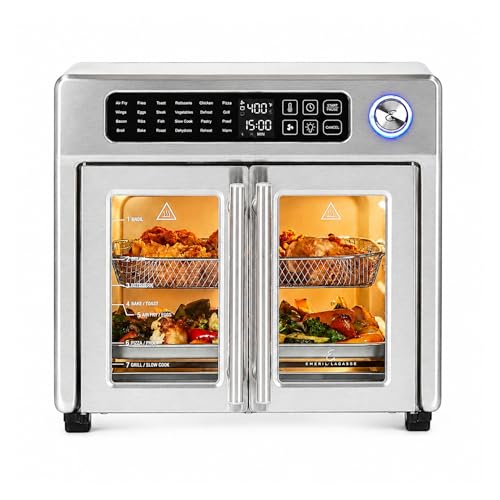
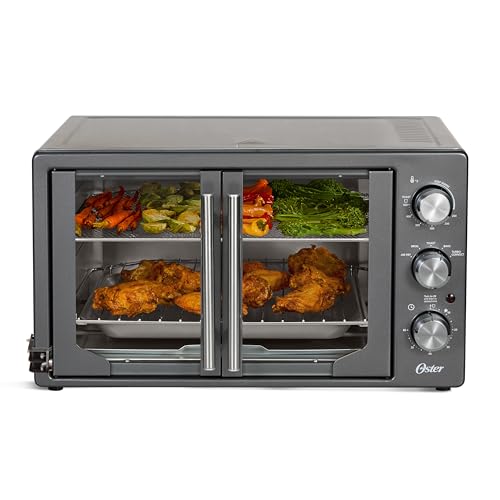
Oster Extra-Large French Door Air Fryer Oven
Badge: Best Overall Value
Strengths
- Extra-large French door cavity that fits 15 x 12 inch pans, per the listing, at a value-tier position
- Six cooking presets cover the everyday rotation without menu complexity
- Auto-shutoff timer, a safety essential, is present rather than cut
- Replaces a toaster oven outright, strengthening the value case
Trade-offs
- Six presets is a plain set; guided-cooking fans get more elsewhere
- Single cavity, one temperature at a time
- Finish and detailing are functional rather than luxurious
Mini spec box
- Format: countertop oven air fryer, French doors
- Pan fit: fits 15 x 12 inch pans, per listing
- Presets: 6 cooking presets
- Safety: auto-shutoff timer
The Oster is what intelligent low cost looks like. The money went into the cavity, an extra-large French door space that takes real 15 x 12 inch pans, and into the essentials, a working set of six presets and an auto-shutoff timer, while the savings came from the places a cook never tastes: a shorter preset list, plainer detailing, no companion app or designer finish. The result is a machine that cooks the same family dinners as ovens a full tier above it and asks the buyer to give up ornament, not meals. In a category where value models often shrink the chamber to hit a tier, an extra-large value cavity is a genuinely rare find.
Who it suits: families who cook from pans, first-time oven-fryer buyers, and anyone replacing a toaster oven on a budget. The honest limitation is ambition: cooks who want dual zones, a probe, or a deep preset library will outgrow it. Everyone else gets the strongest cost-per-dinner proposition in this guide, which is why it leads the list.
Best for: pan-based family cooking on a value tier / Not suited for: feature collectors or dual-zone cooks
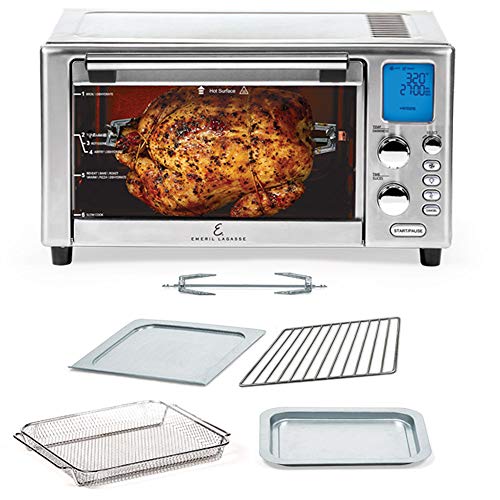
Emeril Lagasse Everyday 360 Air Fryer Oven
Badge: Best Oven Value
Strengths
- 9-in-1 oven platform, a broad function set for its tier
- Rotisserie included, a feature usually sold a tier up
- 360° convection for even browning across trays
- Everyday positioning aimed at simple family operation
Trade-offs
- Verified listing states no capacity figure; confirm dimensions before buying
- Single cavity, like all ovens here
- Brand-led design will not suit minimalists
Mini spec box
- Format: countertop air fryer oven, 9-in-1
- Air system: 360° convection
- Standout function: rotisserie
- Capacity: not stated in the verified listing title
The Everyday 360 is the value pick for buyers who want their low-cost machine to feel generous. Nine functions, a rotisserie, and 360° convection is a specification that reads a tier above its positioning, and the rotisserie in particular is the kind of feature value hunters are usually told to forget. For households whose cooking includes whole chickens and tray dinners in roughly equal measure, this is the most versatile honest budget in the guide, and its everyday framing, family controls, family meals, is exactly how a hard-working value appliance should present itself.
Who it suits: versatile family cooks and rotisserie fans on a budget. The honest limitation is documentary rather than culinary: the verified listing does not state a capacity, so measure carefully on the listing before ordering, especially if your pans are large. Subject to that check, it is the Oster’s closest rival here, and choosing between them comes down to pans versus rotisserie, which is a pleasant dilemma at this tier. Versatility seekers will find it cross-examined again in Best Multi Function Air Fryers.
Best for: versatile family cooking and rotisserie on a tier-conscious budget / Not suited for: buyers who need a stated capacity before shortlisting
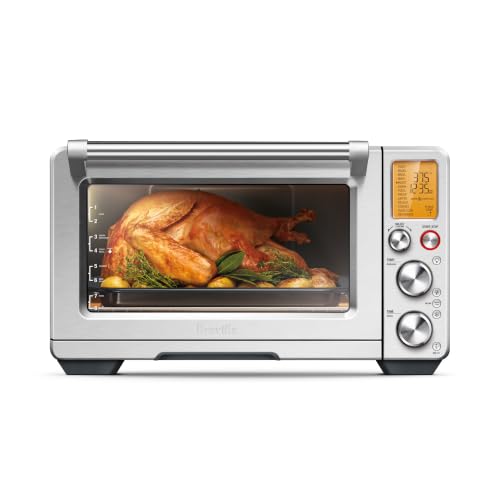
Breville Smart Oven Air Fryer Pro BOV900
Badge: Premium Flagship
Strengths
- 13 functions, the broadest set in this pool, spanning roast, bake, and dehydrate
- Convection system the listing credits with faster cooking
- Brushed stainless steel build from a premium oven specialist
- Pro-tier platform designed for heavy daily use
Trade-offs
- Premium tier, clearly above this guide’s low-cost promise; prose-only here
- Verified listing states no capacity figure
- Its refinements are wasted on households that only crisp and reheat
Mini spec box
- Format: countertop smart oven air fryer, model BOV900BSS
- Functions: 13, including roast, bake, dehydrate
- Air system: convection setting
- Finish: brushed stainless steel
Nothing in this review is a complaint. The Breville is a flagship: thirteen functions, a serious convection system, a stainless build with the fit and finish of a professional tool, from the brand that more or less defined the premium countertop oven. Owners who cook ambitiously and daily will feel where the money went every time they use it, and over a long life its cost per use may well shame cheaper machines that were replaced twice in the same span.
But this guide’s promise is low cost, and a flagship is not a low-cost appliance by any honest tier reading. Linking it here would tell budget shoppers that the premium tier is the answer to a value question, which is how people overspend. So the Breville stands in prose only: fully reviewed, genuinely respected, and recommended only to readers who came here comparatively and decide, knowingly, that the premium tier is where they live. They will not be disappointed; they will simply not have bought a low-cost air fryer.
Best for: ambitious daily cooks choosing the premium tier deliberately / Not suited for: any budget-led brief

Chefman XL 14-Quart Multifunctional Air Fryer
Badge: Best Big-Chamber Value
Strengths
- XL 14-quart chamber, the biggest space in this guide, at a value-tier position
- Windowed door for monitoring big loads without losing heat
- 6-in-1 including rotisserie and dehydrator functions
- Touchscreen controls, a modern interface at this tier
Trade-offs
- Single chamber, so two-temperature meals need sequencing
- Hybrid format crisps differently from sealed baskets
- Substantial footprint, like all big-chamber machines
Mini spec box
- Format: multifunctional air fryer, convection oven, black
- Capacity: XL 14-quart
- Functions: 6-in-1, including rotisserie, dehydrate, bake, broil, reheat
- Controls: touchscreen, windowed door
Chefman’s value proposition is square footage. Fourteen quarts of chamber, a rotisserie, a dehydrator, a window to watch it all through, and a touchscreen to run it, assembled at the tier this guide exists to celebrate. Big households are the natural audience: the chamber takes family loads that would need two cycles in lesser machines, and the window solves the big-load monitoring problem without the heat penalty of opening a door. As with the Oster, the savings are in the specification’s tail, fewer exotic functions, a plainer finish story, rather than in the cooking core.
Who it suits: large families, batch cooks, and rotisserie fans who want maximum chamber per tier. The honest limitation is the single space: everything cooks at one temperature, so a main and a side at different settings must be sequenced or finished together by timing. Households that can live with that get the most room for the tier in this guide, and room, in family cooking, is the feature that matters nightly.
Best for: big households wanting maximum chamber at a value tier / Not suited for: simultaneous two-temperature cooking
Cuisinart French-Door Air Fryer Toaster Oven TOA-FD70
Badge: Premium French-Door
Strengths
- Artisan French-door design, the most styled presentation in this pool
- 7 functions including air fry, toast, bake, broil, roast, pizza, and warm
- Fits a 12-inch pizza per the listing, a useful family benchmark
- Stainless steel build from a heritage kitchen brand
Trade-offs
- Premium-tier positioning, above this guide’s low-cost promise; prose-only here
- Design-led premium buys presentation as much as cooking
- Single cavity, one temperature at a time
Mini spec box
- Format: air fryer toaster oven, artisan French-door design, model TOA-FD70
- Functions: 7, including air fry, toast, bake, broil, roast, pizza, warm
- Capacity note: fits a 12-inch pizza, per listing
- Finish: stainless steel
The TOA-FD70 is Cuisinart’s design statement: an artisan French-door front, a considered stainless finish, and a seven-function set that includes the thoughtful extras, pizza and warm among them, that daily cooks actually use. It will look better on the counter than anything else in this guide, and for households that treat appliances as part of the kitchen’s design, that is a real and legitimate value, paid for gladly by the people who value it.
It is not, however, a low-cost air fryer. Its tier is premium by design intent, and the premium buys presentation and brand polish more than cooking capability: the Oster in this same guide fits larger pans at a value position. So the FD70 is reviewed in prose only, as a machine to choose knowingly when design leads the brief. Budget-led readers should take its review as a map of what the premium tier adds, and then decide with open eyes whether that addition is theirs to buy.
Best for: design-led kitchens choosing premium deliberately / Not suited for: budget-led briefs

Cuisinart Air Fryer Toaster Oven TOA-55
Badge: Best Mainstream Step-Up
Strengths
- 7-in-1 mainstream platform from a heritage brand, at 1800W
- 0.6 cu. ft. cavity that fits a 12-inch pizza, per the listing
- Maximum temperature of 450°F with convection capability
- Removable crumb tray, the small feature that keeps ovens pleasant
Trade-offs
- A tier above the Oster and Chefman; the value case rests on brand and build
- Single cavity, standard for the format
- Stainless finish shows the daily use it is built for
Mini spec box
- Format: air fryer toaster oven combo, model TOA-55
- Functions: 7-in-1, convection capable
- Power: 1800W; maximum temperature 450°F
- Capacity: 0.6 cu. ft., fits a 12-inch pizza
- Cleanup: removable crumb tray
The TOA-55 is the answer for the buyer who reads the value picks, nods, and then asks what one tier up buys. The answer, in its listing, is a coherent package: 1800W of power, a 450°F ceiling, a 0.6 cu. ft. cavity sized to the universal 12-inch pizza benchmark, convection capability, and the removable crumb tray that separates ovens you keep clean from ovens you merely own. None of it is exotic; all of it is the mainstream tier doing its job, which is to remove small frictions for years.
Who it suits: brand-loyal buyers, households stepping up from a first cheap machine, and anyone who wants the safe, central choice of the category. The honest limitation is that the step-up buys refinement rather than transformation: the Oster fits bigger pans, the Chefman holds more, and both sit a tier lower. The TOA-55’s case is balance and backing, and for many households that is the correct definition of value, a point our Best Low Fat And Healthy Air Fryers guide echoes when it ranks for everyday usability.
Best for: the balanced mainstream choice with brand backing / Not suited for: maximum space per tier
Comparison Table
| Pick | Tier | Format | What the tier buys | Check |
|---|---|---|---|---|
| Oster French Door Oven | Value | Oven | Extra-large pan-fit cavity, essentials done right | Check on Amazon |
| Emeril Everyday 360 | Value-mainstream | Oven | 9-in-1 breadth and rotisserie | Check on Amazon |
| Breville BOV900 | Premium | Oven | 13 functions, flagship build | Prose-only |
| Chefman XL | Value | Hybrid chamber | 14-quart chamber, window, rotisserie | Check on Amazon |
| Cuisinart TOA-FD70 | Premium | Oven | Artisan French-door design | Prose-only |
| Cuisinart TOA-55 | Mainstream | Oven | 1800W, 450°F, crumb tray, brand platform | Check on Amazon |
How to Choose a Low Cost Air Fryer Without Buying Twice
The economics of this category punish two opposite errors: buying the flagship when the brief was dinner, and buying the flimsy when the brief was a decade. Avoid both by costing the machine per year. Take the tier you are considering, ask honestly how many years that tier of build typically serves in daily use, and compare the result across tiers rather than comparing stickers. A value machine that serves five years beats a flimsy one that serves two, and a premium machine that serves twelve can, for the right household, beat them both; the prose-only reviews above are written so you can run that arithmetic with your eyes open.
One more audit belongs in every value decision: the exit. Check, on the listing, what support looks like for the model you are buying: whether replacement trays, baskets, and crisper plates are sold for it, whether the brand maintains the model line across seasons, and what the return window is. A value machine with available spare parts is a machine designed to be kept, and that design intent is worth real money over a decade. A machine with no parts ecosystem is disposable by design, whatever its first-year performance, and disposable is the most expensive category in this entire guide.
Then audit what the tier cuts. Acceptable cuts, the ones the linked picks here make, are preset counts beyond the core, designer finishes, companion apps, and exotic functions you will not use. Dangerous cuts are the ones to refuse at any tier: a chamber too small for your pans, missing auto-shutoff, surfaces that cannot be cleaned properly, and controls so poor that the household avoids the machine. The Oster’s specification is the model answer: it cuts the library and keeps the cavity and the safety. Use that pattern as your template and low-cost shopping becomes a skill rather than a gamble.
Finally, count the bundle. An oven-format fryer that replaces a toaster oven, reheats better than a microwave for most foods, and bakes small items without firing the main oven is three appliances in one footprint, and its tier should be compared with the combined cost of the three. Households that consolidate save twice, once at purchase and once in counter space, which is its own currency. Multi-appliance households with overlapping gadgets are where the low-cost case quietly collapses, a theme our Best Multi Tasking Air Fryers guide explores from the versatility side.
How to Keep a Value Air Fryer Alive: Care That Protects the Bargain
- Clean the crisper surfaces every use. Baked-on residue is the main way value coatings and plates are destroyed early; a prompt wipe or wash preserves them for years.
- Keep the fan’s world clean. Wipe splatter from the cavity and around the heating area regularly, while warm, so old grease does not smoke, smell, or stress the machine.
- Respect the crumb tray. On ovens that have one, empty it weekly; crumbs are fuel for smoke and the enemy of the fresh taste you bought the machine for.
- Use the right tools. Silicone or wooden utensils on coated surfaces, no abrasive pads on finishes, and no immersion of the main body, ever.
- Ventilate and place well. Clearance behind and above is not decoration; heat management is longevity management in an appliance that lives at high temperatures.
- Cook at the machine’s scale. Chronic overloading strains fans and elements; batch instead, and the bargain machine will outlast expectations.
Troubleshooting on a budget follows the same physics as anywhere. Problem: food browns unevenly → the layer is too deep or the tray is crowded; split the load. Problem: smoke at high heat → residue or pooled fat is burning off; clean and drain, then resume slightly cooler. Problem: a preset result disappoints → presets are averages, not promises; adjust time and temperature manually for your food’s thickness, which is a skill, not a defect. Value machines reward owners who learn them, and punish, gently, those who expect them to be flagships.
The Real Cost of Cheap: A Short Economics Lesson
There is a social cost to count as well, because a kitchen appliance is shared infrastructure. A value machine with clear controls gets used by the whole household, spreading its cost across everyone’s cooking; a complicated bargain that only one person can operate concentrates both the work and the cost. When you evaluate the linked picks, notice how many of their virtues are household virtues: big readable controls, doors and baskets that open without technique, presets that match real meals. Those are not soft features. In cost-per-use terms, they are the multiplier on everything else.
Every appliance has three costs: the purchase, the running, and the replacement. Purchase dominates conversation and matters least over a decade. Running costs, energy for the cooking you actually do, are broadly similar across these picks when they are used at their scale. Replacement is where the money hides: a machine replaced in year two has doubled its true price before any other arithmetic begins, and a machine replaced twice has tripled it. This is why the guide’s tier line is drawn where it is. The linked picks are the ones whose specifications suggest they will not need replacing soon: complete safety features, cleanable surfaces, established platforms, chambers sized for real meals. The flimsy end of the internet, below even the value tier here, fails that test structurally, whatever its sticker says, and the premium end passes it easily while failing the low-cost brief itself. Between those two failures sits the narrow, honourable territory this guide maps.
What Low Cost Should Never Cut
Some features are load-bearing, and a value machine that drops them is not a bargain but a liability. Auto-shutoff protects the house. A chamber that fits your actual pans protects the purchase from irrelevance. Cleanable, intact cooking surfaces protect both the food and the machine’s lifespan. Controls the whole household can operate protect the machine from becoming one person’s gadget and everyone’s clutter. Temperature range adequate for your cooking, a genuine ceiling for crisping and a floor for gentle work, protects the recipes you already love. When you compare any low-cost candidate, in this guide or beyond it, against that list, you will find the linked picks pass it line by line, which is not a coincidence: it is the selection test, restated.
Value by Household: Who Should Buy Which Tier
A single person or a couple, cooking modest portions a few times a week, extracts the least from premium breadth and the most from a sound value machine; the Oster or the Chefman XL, the latter only if batch cooking is a habit, will serve for years, and the money not spent is real. A family of four or five cooking nightly is the value tier’s heartland, with one refinement: heavy daily use is exactly where the mainstream step-up, the TOA-55’s platform and crumb-tray practicality, begins to repay its tier in reduced friction. A household of six or more, or one that hosts constantly, should evaluate the Chefman’s chamber first and the value ovens second, because at that volume the cost of too little space, paid in double batches every day, exceeds any tier saving.
The through-line is usage intensity. Cost per use is the only honest metric, and it is calculated by your calendar, not by the catalogue. A premium machine used twice daily for a decade can be the cheapest appliance in this entire guide per dinner; the same machine used twice a month is the most expensive. Value shopping, done properly, is therefore an act of self-knowledge before it is an act of comparison, and the buyers who end up happiest at every tier are the ones who described their own cooking accurately first.
Timing, Promotions, and the Patient Buyer
Because this guide prints no prices, it can say plainly what price-led guides cannot: in the value and mainstream tiers, timing is a feature. Appliance pricing moves in waves around the big retail events and model transitions, and a tier of machine that is unremarkable value in one month can be outstanding value in another when its successor is announced or a promotion lands. The practical strategy is to choose your machine first, using the tier logic and the never-cut list in this guide, and then let timing choose your week. That order, machine first, moment second, protects you from the classic error of buying whatever is discounted, which is how kitchens fill with almost-right appliances.
Patience has limits worth naming. A household cooking nightly with a failing machine loses more in takeaways and frustration than any promotion returns, so replace decisively when the need is real. Equally, open-box and refurbished routes deserve a cool head: they suit buyers who can verify completeness, all trays, racks, and accessories present, and who accept a shorter runway of support. For a first purchase in the category, the linked value picks bought new and complete remain the lowest-risk route to a low total cost, which is, after all, the point of the exercise.
Reading a Value Listing Without Being Played
Value listings compete on adjectives, so read them for nouns and numbers. The nouns to find are the load-bearing ones from this guide: auto-shutoff, crumb tray, the pans or pizza size that fit, the functions named individually rather than counted. The numbers to find are capacity in a stated unit, temperature range, and wattage where given, the TOA-55’s 1800W and 450°F ceiling being a model of the genre. What to discount: preset counts inflated with trivial variations, serving claims, and any sentence that promises restaurant results. A listing that states its chamber, its safety features, and its limits in plain terms is usually describing a machine built the same way, and in the value tier that correlation is the best proxy a remote buyer gets.
The Second-Hand Question, Answered Honestly
Every value guide eventually faces the used market, and the honest answer is: sometimes, carefully. A used value-tier machine from a known platform, the Oster or the TOA-55 bought from a household that upgraded, can be the lowest-cost route of all, provided three checks pass. The cooking surfaces must be intact, because damaged coatings and warped trays are both a performance and a replacement problem. The full accessory set must be present, because a missing rack or crisper plate quietly converts a bargain into a parts hunt. And the machine must run a complete hot cycle before money changes hands, because fans and elements announce most failures within one cook. Fail any check and the new value picks in this guide are the better buy; pass all three and you have beaten the tier system at its own game, which is a legitimate form of value shopping.
Gifts, First Kitchens, and Rental Realities
Value machines are the natural gift and first-kitchen purchase, and the tier logic in this guide doubles as a gifting logic. For a first kitchen, prioritise the never-cut list over every other consideration: auto-shutoff, cleanable surfaces, a chamber that fits a standard pan, controls a tired beginner can run at midnight. The Oster is the default recommendation in that situation precisely because its simplicity is a safety feature for new cooks. For renters, add two practical filters: a footprint that suits counters you do not own and cannot modify, and a machine quiet and clean enough for shared houses. For gifts, resist upgrading the recipient into a premium tier they did not ask for; a well-chosen value machine that matches their actual cooking will be used daily, while a flagship that intimidates will be admired weekly, and use, not admiration, is what a kitchen gift is for.
When the Premium Tier Is Secretly the Low-Cost Choice
Fairness to the prose-only pair requires one more section, because there are households for whom the Breville or the FD70 is, over a lifetime, the low-cost answer. The pattern is consistent: the machine will be used heavily, daily or near it; the cook will genuinely exploit breadth, dehydrating, proving, slow roasting, precision reheating, rather than owning it decoratively; and the household keeps appliances for a decade or more, so build quality compounds. In that household, cost per use favours the flagship, and the honest advice is to buy it once, on purpose, with this guide’s blessing. What the prose-only rule protects is not the premium tier’s honour but the budget shopper’s brief: the reader who typed “low cost” deserves a guide that answers their question, and the premium case is made here, in the open, as the exception it is rather than smuggled into the links.
A One-Week Test for Any Value Machine
However carefully you choose, the first week decides, so run it like a test. Cook the household’s five most repeated meals and nothing exotic: the weeknight protein, the frozen staple, the reheated leftovers, the weekend bake, the vegetable side. Note three things only: whether the chamber took each meal in one run, whether the results matched your old method without heroics, and whether cleanup after each meal was a wipe or a project. A value machine that passes all five meals on those three measures has justified its tier completely, whatever its finish looks like. A machine that fails the same measure twice has told you, inside the return window, what a year of ownership would have taught you slowly. This is the final piece of value discipline: the willingness to judge the bargain by your own stove-side evidence rather than by the relief of having spent less.
Common Buying Mistakes
- Chasing the lowest sticker. The cheapest machine that fails in year two is the most expensive one you will ever buy.
- Paying premium for a value brief. Flagship polish is lovely and is not low cost; buy it knowingly or not at all.
- Cutting the chamber to cut the tier. A small cavity that forces double batches costs time every single day.
- Ignoring cleanability. Surfaces that cannot be kept clean end the machine’s useful life before its motor does.
- Comparing stickers across formats. An oven-format value pick replaces several appliances; price it against the bundle.
Final Recommendation
The Oster Extra-Large French Door Air Fryer Oven is this guide’s value champion: the biggest pan-fit cavity here at a value tier, with the essentials intact. The Emeril Lagasse Everyday 360 Air Fryer Oven is its closest rival for versatility, rotisserie included, while the Chefman XL maximises chamber size and the Cuisinart TOA-55 is the mainstream step-up for brand-led buyers. The Breville and the TOA-FD70 remain excellent premium machines, reviewed in prose only because a low-cost guide must keep its promise about tiers.
Frequently Asked Questions
Why does this guide print no prices?
Because prices change with promotions and seasons, and a printed figure would mislead within weeks. The guide ranks tiers, which are stable, and directs you to each listing for the figure that is true today. When two picks sit in the same tier, the current promotion is a legitimate tiebreaker.
Is a low cost air fryer less durable by definition?
No. The value tier’s savings come from shorter feature lists and plainer finishes, not necessarily from weaker cooking hardware. Durability risk concentrates below the value tier, in machines that cut safety features, surfaces, and chamber size. The linked picks here are chosen specifically because their specifications do not make those cuts.
Why are the Breville and the Cuisinart FD70 not linked?
Both are premium-tier machines: the Breville is a 13-function flagship, and the FD70 is an artisan design-led model. A low-cost guide that linked them would break its own promise. They are reviewed fully so premium shoppers can judge them, and both are fine purchases for households that choose that tier deliberately.
Oster or Emeril 360: which value pick is better?
Choose the Oster if your cooking is pan-led and you want the stated 15 x 12 inch pan fit and the simplest controls. Choose the Emeril 360 if you want the broader 9-in-1 set and the rotisserie, and you are willing to confirm its dimensions on the listing, since its verified title states no capacity.
What is the cheapest acceptable feature set?
Auto-shutoff, a chamber that fits your pans, cleanable cooking surfaces, controls everyone can use, and a temperature range that covers your cooking. The Oster demonstrates that all five fit inside the value tier. Anything missing from that list should disqualify a candidate at any tier.
Are store brands and unfamiliar names worth the risk at the low end?
Judge them by the same evidence as the picks here: named safety features, a stated capacity in real units, cleanable surfaces, and a complete accessory list in the box. An unfamiliar name that states those things plainly is a better risk than a familiar badge on a machine that cuts them. The linked picks remain the safer route because their listings pass the test in the open.
Does a low cost air fryer use more electricity?
Running cost follows the cooking, not the tier: a full value oven cooking a family dinner uses comparable energy to any format doing the same job, and far less than a main oven for the same meal. The waste to avoid is running any large cavity nearly empty; cook at your machine’s scale and the tier will not show up in your energy use.
Should I buy a value machine now or save for a premium one?
If the value machine passes the never-cut list and fits your meals, buy it now; years of dinners outweigh hypothetical polish. Save for premium only if your cooking genuinely needs what the premium tier adds, breadth of functions, flagship build, design, and you expect to use the machine heavily for a decade.
Is an oven-format value fryer better than a cheap basket model?
For most households, yes, because the oven format replaces more appliances and takes real pans, which spreads its cost across more of your cooking. A basket model can still win for a small household whose cooking is mostly crisping for one or two, where the oven’s cavity would run mostly empty and its versatility would go unused.
What should I check in the first week with a value air fryer?
Cook your five most repeated meals and judge three things: whether the chamber took each meal in one run, whether results matched your old method without fuss, and whether cleanup was a wipe rather than a project. Any measure that fails twice in that week is the machine telling you, inside the return window, what ownership would feel like for years.