Disclosure: topratedkitchenware.com is reader-supported. When you buy through links on our site, we may earn an affiliate commission from Amazon and other retailers, at no extra cost to you.
Where to buy
The best daily carry chopsticks are the pair that is simply there — in the desk drawer, the lunch bag, the glove box — every time a meal appears away from home. All six sets below are reusable stainless steel, because a carry pair has to survive being washed in office sinks, tossed in bags and used five days a week without splintering, staining or wearing out. Each name links to its Amazon listing.
- Greatamzor 18/8 Stainless Steel Chopsticks, 5 Pairs — five pairs means one for the desk, one for the bag, and spares at home.
- NEWDRIP 18/8 Stainless Steel Chopsticks, 8 Pairs — the stock-up option for households where everyone carries a pair.
- Zliutob Stainless Steel Chopsticks, 5 Pairs — textured tips and a square grip that will not roll around a lunch tray.
- LIXTONGR Dragon & Phoenix Black Stainless Steel Chopsticks, 2 Pairs — a gift-boxed set the listing itself positions for travel.
- MUYOS Stainless Steel Chopsticks, 5 Pairs — hollow-core lightweight pairs that add almost nothing to a bag.
- Greatamzor Multicolor Stainless Steel Chopsticks, 5 Pairs — color-coded pairs so your carry set is unmistakably yours.
Read the full guide ↓ for the honest trade-offs of carrying full-length steel pairs, how to store them hygienically, and which set fits which kind of day.
Daily carry is a mindset borrowed from the pocket-tool world: the best tool is the one you have with you. Applied to eating, it solves a familiar string of small defeats — the cafeteria that only stocks flimsy plastic forks, the takeout order that forgot utensils, the desk lunch eaten with a coffee stirrer, the break-room drawer full of disposable pairs that snap mid-noodle. A reusable pair of your own, kept where your lunches happen, ends all of that at once.
People searching for the best daily carry chopsticks usually imagine a folding travel gadget. This guide takes a more practical line, and it is honest about why: our verified pool contains full-length stainless steel sets, not collapsible ones, and full-length pairs are what most daily carriers actually end up using. They eat better than miniatures, wash better than wood, and survive a bag’s interior indefinitely. The carry problem they pose — nine-plus inches of steel in a lunch bag — is a storage problem, and storage problems have cheap, simple solutions we will walk through.
What you get in return is a genuinely better weekday meal. Your own pair grips properly, weighs what you chose it to weigh, and never asks you to choose between a disposable utensil and your fingers. Multiply that by every workday in a year and the upgrade stops looking small. Let us find the set that fits your routine.
Key Takeaways
- Daily carry is about presence, not gadgets: a dependable full-length pair kept at the desk or in the bag beats a novelty folder you stop carrying.
- All six sets here are reusable stainless steel with dishwasher-safe listings — essential for a tool washed constantly and carried everywhere.
- Multipacks are the carry strategy: five or eight pairs let you station pairs at desk, bag and home so one is always clean and waiting.
- The MUYOS hollow-core set is the weight-winner for bag carry; the LIXTONGR gift-boxed set is the one whose listing explicitly names travel.
- No set in this pool includes a carry case, and none folds — plan on a simple pouch or utensil roll, and read lengths honestly before buying.
- Color-coded pairs (Greatamzor multicolor) solve the shared-office problem of identical steel pairs migrating between desks.
In this guide
Quick Picks
| Pick | Badge | Pairs | Carry advantage | Link |
|---|---|---|---|---|
| Greatamzor 18/8 Chopsticks | Best Overall for Daily Carry | 5 pairs | Enough pairs to station everywhere | Check on Amazon |
| NEWDRIP 18/8 Chopsticks | Best for Stocking Up | 8 pairs | Whole household carries a pair | Check on Amazon |
| Zliutob Chopsticks | Best Grip on the Go | 5 pairs | Square grip, textured tips | Check on Amazon |
| LIXTONGR Dragon & Phoenix | Best Travel-Ready Set | 2 pairs | Gift box, listing names travel | Check on Amazon |
| MUYOS Chopsticks | Best Lightweight | 5 pairs | Hollow-core build | Check on Amazon |
| Greatamzor Multicolor | Best for Shared Spaces | 5 pairs | Color-coded ownership | Check on Amazon |
The badges repeat in the detailed reviews below. Notice that every badge answers a carry question — where the pair lives, how much it weighs, whose it is — because that is the lens this keyword demands.
How These Picks Were Chosen
We started from a verified pool of reusable stainless steel chopstick sets confirmed through Amazon catalog data — brand, steel, pair count, stated length and stated features. For the daily-carry lens, we then weighted four practical factors. First, durability under transport: steel wins by default, since it cannot splinter in a bag or warp in a hot car. Second, pair count, because the carry system that actually works is redundancy — pairs stationed in several places, not one precious pair you must remember every morning. Third, weight, where hollow-core construction earns its place. Fourth, identification, because shared kitchens and offices are where identical utensils go to disappear.
Two honest exclusions shaped this guide. The pool contains no collapsible or telescopic pair, so if a folding mechanism is non-negotiable for you, this shortlist is the wrong one — we would rather say that plainly than stretch the word “carry” over products that do not fold. And no listing here includes a storage case, so every recommendation assumes a simple pouch, roll or tube you supply yourself; we discuss options in the how-to section. Readers comparing pocketable formats specifically can start with our collapsible coverage elsewhere on the site, while readers whose carry life is mostly desk-and-cafeteria will find these full-length sets the more satisfying daily tool. The related Best Designed Chopsticks guide covers the same pool from the aesthetics side, for carriers who want their everyday pair to look as deliberate as it is practical.
The 6 Best Chopsticks for Daily Carry
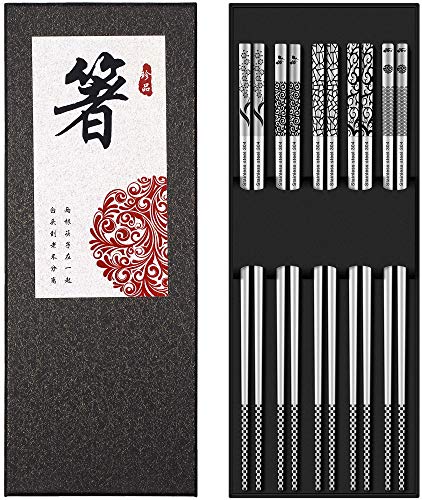
Greatamzor 18/8 Stainless Steel Chopsticks, 5 Pairs
Badge: Best Overall for Daily Carry
Strengths
- Five pairs is the magic number for stationing: desk, bag, car, home drawer, and one in the wash.
- 18/8 stainless steel with laser engraving shrugs off bag life, sink washing and daily dishwashing alike.
- At 9 1/4 inches it eats like a real table pair, because it is one — no miniature compromises.
Trade-offs
- Full length means it needs a pouch or a long lunch-bag pocket; it will not hide in a wallet-sized kit.
- All five pairs look alike, so a shared office needs a marking habit to keep yours yours.
- The engraved pattern is a fixed design — pretty, but not personalized.
Mini spec box
- Material: 18/8 stainless steel
- Set size: 5 pairs
- Length: 9 1/4 inches (per listing)
- Design: laser engraved, non-slip
- Care: dishwasher safe; reusable
The daily-carry philosophy in one product: do not carry one precious object everywhere — distribute good-enough objects everywhere you eat. Five pairs of honest 18/8 steel let you build that system in a single purchase. One pair lives in the desk drawer at work, one rides in the lunch bag, one waits in the car for drive-through surprises, and two rotate at home. Whichever meal ambushes you, a real pair is already there.
The pair itself suits the mission. Laser engraving gives oily takeout noodles something to hold onto, the steel tolerates whatever washing facilities the day offers — office sink, home dishwasher, a rinse and a cloth — and the standard length means your carried pair eats exactly like your home pair, so there is no “travel technique” to relearn. Consistency is an underrated carry feature: your hands already know this tool.
The limitation is the format itself. Nine and a quarter inches of steel is a lunch-bag item, not a pocket item, and the set includes no case. Budget a moment to choose a pouch you like, because the pouch is what turns five loose pairs into a carry system.
Best for: desk workers and commuters building a station-everywhere system / Not suited for: minimalists who need a folding pocket format

NEWDRIP 18/8 Stainless Steel Chopsticks, 8 Pairs
Badge: Best for Stocking Up
Strengths
- Eight pairs equip a whole household’s carry rotation — school bags, work bags and the home drawer in one buy.
- 18/8 steel, laser engraved and non-slip, listed for cooking and eating, so the same stock serves at home too.
- Deep bench strength forgives the inevitable: a pair left at a friend’s place is an inconvenience, not a crisis.
Trade-offs
- Uniform pairs make ownership disputes possible in shared spaces; assign by storage spot.
- Eight pairs is more steel than a solo carrier needs — solo buyers should take a five-pair set.
- Standard 9.25 inch length, with the same pouch requirement as every full-size set here.
Mini spec box
- Material: 18/8 stainless steel
- Set size: 8 pairs
- Length: 9.25 inches (per listing)
- Design: laser engraved, non-slip
- Care: dishwasher safe; reusable
Some households do not need a better chopstick; they need more chopsticks, in more places. The NEWDRIP eight-pair set is the stock-up answer: every family member’s bag gets a pair, the kitchen gets its cooking-and-eating stock from the same box, and the household’s disposable-utensil era ends in one delivery. Because the listing covers cooking as well as eating, these pairs also cover prep and stove duty at home — one inventory for every job.
For carry specifically, abundance changes behavior. People protect scarce objects and use abundant ones. A pair from an eight-pack goes to the picnic, the office party and the road trip without a risk calculation, and if one is genuinely lost, the system absorbs it. That carefree quality is, paradoxically, what makes a daily-carry habit stick: the tool is always present because replacing it was never a worry.
Manage the one real downside — sameness — with geography. Pairs live in assigned places and return to them; a pair found in the wrong bag gets repatriated at the next wash. It is a thirty-second system that keeps eight identical pairs feeling like eight personal ones.
Best for: families and shared households standardizing on one pair everywhere / Not suited for: solo carriers who want a single distinctive pair

Zliutob Stainless Steel Chopsticks, 5 Pairs
Badge: Best Grip on the Go
Strengths
- Textured tips deliver the surest grip in this pool — valuable when you are eating quickly, in a car, or over a keyboard.
- The square grip profile will not roll off a cafeteria tray or a desk, a small mercy that matters daily.
- Built for sushi, ramen and daily meals: exactly the foods that dominate carried lunches.
Trade-offs
- The listing states no length, so bag-fit planning needs a check of the product page.
- Textured tips deserve a prompt rinse after sticky sauces; texture holds residue if a pair sits unwashed in a bag.
- Five identical pairs, so shared-space identification is on you.
Mini spec box
- Material: stainless steel
- Set size: 5 pairs
- Grip: square profile, textured tips
- Care: dishwasher safe, reusable
- Listing highlights: sushi, ramen and daily meals
Carried meals are eaten under worse conditions than home meals: trays instead of tables, time pressure instead of leisure, one hand occasionally on a phone. Grip is the feature that survives those conditions, and the Zliutob set is the grip specialist of this pool. Textured tips hold the last slippery noodle; the square shaft stays put on a tray edge instead of rolling into your lap or onto the floor of a food court.
The foods its listing names — sushi, ramen, daily meals — read like a census of packed lunches and takeout orders, which makes this set feel purpose-built for the carry life even though it is a standard table set. Five pairs support the station system: desk, bag, home, and rotation. Steel construction means the pair that spends the afternoon in a warm bag comes home, goes through the dishwasher, and is indistinguishable from new.
Build one habit around it: rinse the textured tips before the pair goes back in its pouch. Thirty seconds at the office sink prevents the only maintenance issue texture can create, and your bag stays as clean as your conscience.
Best for: takeout-heavy routines, desk lunches, anyone eating in imperfect conditions / Not suited for: buyers who need a stated length before ordering

LIXTONGR Dragon & Phoenix Black Stainless Steel Chopsticks, 2 Pairs
Badge: Best Travel-Ready Set
Strengths
- The listing itself names travel among its uses, and the gift box doubles as a rigid carry container that protects the pair in a bag.
- 18/10 stainless steel at 9 inches: a slightly shorter, more packable length with a premium finish.
- The Dragon & Phoenix design makes your pair unmistakable in any shared kitchen.
Trade-offs
- Two pairs cannot run a station-everywhere system; this is one person’s special pair.
- The gift box is bulkier than a slim pouch, even if it does protect well.
- Black finishes show water spots if a washed pair is sealed away damp — dry before boxing.
Mini spec box
- Material: 18/10 stainless steel
- Set size: 2 pairs
- Length: 9 inches (per listing)
- Design: Dragon & Phoenix, black finish, non-slip grip
- Packaging: gift box; listing includes travel among uses; dishwasher safe
Every other set in this guide asks you to supply the case. This one arrives with packaging sturdy enough to serve as it. The LIXTONGR gift box keeps the pair together, protected and presentable in a suitcase or work bag, and the maker explicitly lists travel among the set’s occasions — the only pick in the pool that claims the carry job in its own words. For the business traveler or the commuter who wants one beautiful personal pair rather than a distributed system, that is a complete answer.
The pair itself justifies the ceremony: 18/10 steel, a black finish with the traditional Dragon & Phoenix motif, a non-slip grip, and a 9-inch length that is marginally easier to pack than the 9.25-inch standard. It also solves identification absolutely — nobody at the office mistakes the black dragon pair for theirs.
Its boundary is arithmetic and temperament. Two pairs is a personal kit, not a household system, and a boxed special pair asks for the small ritual of drying before storage. Carriers who want zero rituals should take a multipack; carriers who enjoy a personal object with presence will understand this set immediately. If a distinctive personal pair appeals, the Best Designed Chopsticks guide compares this motif against the pool’s other decorated options.
Best for: travelers and commuters who carry one personal pair / Not suited for: station-everywhere systems or zero-maintenance routines
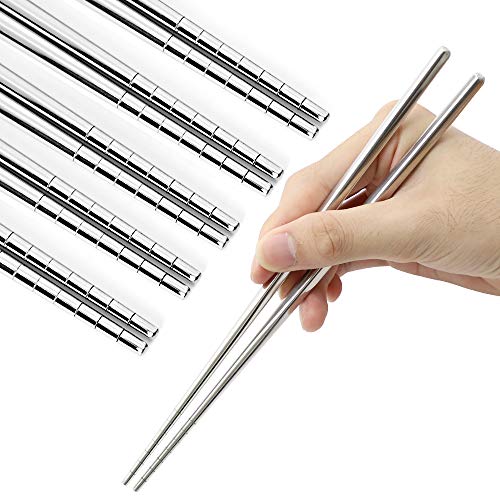
MUYOS Stainless Steel Chopsticks, 5 Pairs, Silver
Badge: Best Lightweight
Strengths
- Hollow-core construction makes this the lightest carry in the guide — the pair you forget is in the bag until lunch.
- Non-slip tips keep control despite the low weight, so eating quality does not drop with the grams.
- Plain silver finish draws no attention in professional settings and matches any lunch kit.
Trade-offs
- Featherweight pairs feel less substantial to diners who like heft; it is a preference, honestly stated.
- No length or steel grade in the listing, so spec-checkers must visit the product page.
- Five identical silver pairs are the easiest in the guide to lose to a shared kitchen.
Mini spec box
- Material: stainless steel, hollow-core lightweight design
- Set size: 5 pairs
- Finish: silver
- Tips: non-slip
- Care: dishwasher safe, reusable for daily meals
Weight is the silent killer of carry habits. Every gram in a daily bag argues, a little, for leaving the item home — and the items left home are the ones that fail you at lunch. MUYOS engineered that argument away: the hollow core keeps steel’s durability and dishwasher-safe ease while trimming the heft that makes a pair feel like cargo. Slipped into a lunch bag or a jacket-adjacent tote, this is the pair most likely to still be with you in month six, which is the only carry metric that matters.
At the meal, the non-slip tips preserve the eating experience; lightweight never has to mean slippery, and here it does not. The plain silver finish is also a deliberate professional choice — in a client-facing lunch or a shared office kitchen, an unadorned pair reads as a tool, not a statement.
The trade-off is purely tactile. Some eaters love the authority of a heavier pair and find hollow-core lightness unsatisfying in the hand. You know which eater you are. If you are the other kind — the kind whose bag is already heavy with a laptop and a water bottle — this set was designed for your exact complaint.
Best for: weight-sensitive commuters, laptop-bag carriers, minimalists / Not suited for: diners who equate heft with quality

Greatamzor Multicolor Stainless Steel Chopsticks, 5 Pairs
Badge: Best for Shared Spaces
Strengths
- Five colors end ownership confusion in shared kitchens, dorms and family lunch-packing lines.
- The laser-engraved copper coin pattern adds grip and makes each pair easy to spot in a crowded utensil drawer.
- Square profile, 9 1/4 inch length: a full-size eating experience, not a travel compromise.
Trade-offs
- Bright colors may not suit formal workplaces or anyone curating a monochrome kit.
- Color finishes keep their looks longest with top-rack dishwashing.
- Like all full-length sets here, it needs a pouch for tidy bag carry.
Mini spec box
- Material: stainless steel
- Set size: 5 pairs, multicolor
- Length: 9 1/4 inches (per listing)
- Design: laser-engraved copper coin pattern, square, non-slip
- Care: dishwasher safe; gift set
Ask anyone who has kept utensils in a shared kitchen how their last set ended, and the answer is rarely “it wore out.” It wandered. Identical steel pairs are functionally anonymous, and anonymous property migrates. The multicolor Greatamzor set is the anti-wandering design: your pair is the green one, it has always been the green one, and everyone in the building knows it. In dorms, shared flats and family lunch production lines, color is not decoration — it is a property-rights system.
The carry mechanics are otherwise the guide’s standard virtues: engraved grip for takeout food, square profile that stays on tray edges, full 9 1/4 inch length for a real meal, and dishwasher-safe steel for the nightly reset. Assign colors to places as well as people — blue lives at the office, red in the gym bag — and a five-pair set covers a surprisingly complex week.
The honest costs are aesthetic and trivial. Multicolor is cheerful, and cheerful is not every workplace’s dialect; and colored finishes, like all coated utensils, prefer the dishwasher’s top rack. Neither point will trouble the shared-space carriers this set is built for.
Best for: dorms, shared kitchens, families packing multiple lunches / Not suited for: formal monochrome kits
Comparison Table
| Pick | Pairs | Length (listing) | Carry character | Link |
|---|---|---|---|---|
| Greatamzor 18/8 | 5 | 9 1/4 inch | Station-everywhere all-rounder | Check on Amazon |
| NEWDRIP 18/8 | 8 | 9.25 inch | Household stock-up | Check on Amazon |
| Zliutob | 5 | Not stated | Grip specialist, no-roll square body | Check on Amazon |
| LIXTONGR Dragon & Phoenix | 2 | 9 inch | Boxed personal travel pair | Check on Amazon |
| MUYOS | 5 | Not stated | Hollow-core lightweight | Check on Amazon |
| Greatamzor Multicolor | 5 | 9 1/4 inch | Color-coded ownership | Check on Amazon |
Every row is the same material promise — reusable steel, dishwasher safe — wearing a different carry strategy. Choose the strategy that matches your routine and the table does the rest.
How to Choose Chopsticks for Daily Carry
Decide your system first: one pair or many stations? The single-pair carrier travels light and keeps rituals — the LIXTONGR boxed set exists for them. The station carrier buys a multipack and never thinks about transport again, because the pair is already wherever lunch happens. Neither is superior; they suit different temperaments. Be honest about which person you are, because a system that fights your temperament lasts a week.
Weight is a carry feature, not a spec-sheet footnote. A pair rides with everything else you haul. Hollow-core construction like the MUYOS set’s is the difference between a tool that lives in the bag and a tool that gets edited out of the bag during a busy month. If your commute is long or your bag is already dense, weight should outrank almost everything else on your list.
Identification prevents the most common carry failure. Pairs are rarely broken; they are absorbed — by shared drawers, communal kitchens and well-meaning colleagues. Color-coding, a distinctive motif, or even a wrap of tape on your home pairs is a legitimate feature. The Best Designed Chopsticks guide is worth a look if you want identification and aesthetics in the same object.
Plan the wash loop. A carried pair gets dirty at lunch and needs to be clean by tomorrow. Steel’s dishwasher-safe nature — confirmed in every listing here — makes the loop effortless at home, but think about the midday half: a quick rinse and dry before the pair goes back in its pouch keeps the pouch fresh indefinitely. If your workplace has no sink access at all, station two pairs and rotate them home for washing; multipacks make that trivial. The Best Dishwasher Safe Chopsticks guide goes deeper on wash performance if cleanup is your deciding factor.
Be realistic about length. Full-length pairs eat best and pack worst; that is the trade at the heart of this guide. A 9 to 9.25 inch pair fits most lunch bags diagonally and all desk drawers easily. If your bag is genuinely tiny, no full-length set will serve you, and a collapsible format is the honest answer — better a frank redirect than a purchase that annoys you daily.
The First Week: Building the Carry Habit
Systems fail in the first week or not at all, so it is worth scripting those days. On day one, place the pairs before you need them: desk, bag, car, home. Placement is the whole game — a pair installed on Sunday is a habit by Friday, while a pair that must be remembered on Monday morning is a resolution, and resolutions have the survival rate everyone knows.
During the first days, notice the moments the system saves you: the forgotten takeout utensils, the snapped disposable, the cafeteria’s empty utensil bin. Those small rescues are the reinforcement that cements the routine. Also notice the friction honestly — a pouch that is annoying to open will be left behind, and a station placed in the wrong drawer will be forgotten. Adjust the physical details in week one without mercy; the system should fit your actual movements, not an idealized version of them.
By the second week, add the wash rotation if you have not already: station pairs come home in the lunch bag on Friday, run through the dishwasher with the weekend loads, and return on Monday. It takes ninety seconds and it closes the loop that keeps every station fresh. Carriers who reach week three with stations stocked almost never go back — the disposable drawer at the office starts to look like what it always was: a supply of other people’s compromises.
One encouragement for the skeptical: you do not need to carry a pair to be a good person, and this guide is not a sermon. It is a logistics upgrade for people who eat away from home often and are tired of eating those meals badly. Judge it the way you would judge any tool purchase — by whether lunch got better. And judge it after a fair trial: two full work weeks with the stations placed, not two days of carrying a loose pair in a coat pocket and wondering why the idea feels clumsy. The format is proven; only the fitting is personal, and fitting is what the first fortnight is for. Give the stations a fair chance to become invisible, because invisible is the end state of every good carry system: the pair stops being a decision and becomes part of the furniture of your day, noticed only on the rare occasion it is missing — which, if the map above did its work, will be rarer than you expect.
How to Carry, Store and Clean a Daily Pair
- Choose a container. A slim fabric pouch, a utensil roll, a pencil-case-style tube or the LIXTONGR gift box all work. The container’s jobs are hygiene (tips protected from bag debris), silence (no rattling), and containment (the pair stays a pair).
- Carry tips-in. Load the pair tip-first into the pouch so the eating ends stay covered and the blunt ends meet the opening.
- Rinse before you stow. After the meal, a twenty-second rinse and a wipe with a napkin keeps residue — and odors — out of the pouch. Sauce left sealed in a warm bag is the one genuinely unpleasant failure mode of daily carry.
- Run the home loop. At home, the pair goes in the dishwasher (every set here is listed dishwasher safe) and a clean stationed pair takes its place. Rotation means no single pair carries the whole week’s wear.
- Audit monthly. Once a month, gather the stations: check tips are aligned, finishes are clean, and every station still has its pair. Replace losses from the multipack bench before a station goes empty and the disposable habit creeps back.
Troubleshooting.
- Problem: your pair keeps disappearing at work → it looks like everyone else’s; switch to a color-coded or motif pair, or store it inside your own lunch container rather than the communal drawer.
- Problem: the pouch smells stale → the pair went in wet or unrinsed; wash the pouch, and rebuild the rinse-and-dry habit — steel itself holds no odor once washed.
- Problem: you keep forgetting the pair at home → the system has one station too few; move a pair permanently into the bag instead of transferring one daily.
Daily Carry Versus Disposable: The Honest Ledger
The case for carrying your own pair is usually made in environmental terms, and those terms are real — a weekday takeout habit consumes disposable utensils at a pace that surprises people when they count. But the argument that actually converts people is selfish, and there is nothing wrong with that: your own pair works better. It does not snap, splinter, bend or taste faintly of its packaging. It grips the noodle the disposable pair drops.
There are still places disposables win, and a fair guide should name them. Truly chaotic settings — festivals, travel days with no washing access, meals eaten standing in the rain — forgive single-use tools, and the Best Disposable Chopsticks guide covers choosing them well. Daily carry is for the other ninety percent of away-from-home meals: the desk, the cafeteria, the regular takeout spot, where a sink exists and a routine can form.
Between those poles sits the food-service world, where volume changes every calculation; readers curious about that end of the spectrum can browse the Best Food Services Chopsticks guide. For the individual carrier, the math is simpler: one multipack, stationed well, outperforms a year of disposable improvisation on cost, quality and conscience simultaneously — a rare case of all three ledgers agreeing.
Where Daily Pairs Actually Live: A Station Map
The station system deserves a concrete map, because “keep a pair everywhere” is easy to say and vague to do. Here is how experienced carriers distribute a five-pair set across an ordinary life.
Station one: the desk. The highest-value station, because desk lunches are the most frequent away-from-home meal for office workers. The pair lives inside your lunch container or a desk-drawer organizer — not the communal kitchen, which is where pairs go to be adopted. If your office has a shared drawer culture, this is where a color-coded or motif pair earns its price in a month.
Station two: the bag. The bag pair is insurance against the unplanned meal — the team lunch, the delayed train, the takeout stop on the way home. It lives in its pouch in a fixed pocket, and it is the pair most likely to benefit from lightweight construction, since it travels daily whether it is used or not.
Station three: the car or locker. Drive-through meals, gym-bag lunches and site-visit days all produce utensil emergencies. A pair in the glove box or locker, in its pouch, converts those meals from improvisation to routine. Steel is ideal here precisely because heat and cold do not trouble it — a summer car interior that would warp lesser materials leaves steel unchanged.
Stations four and five: home, in rotation. The home pairs are the bench — one in the dishwasher while the week’s stations come home for washing, one ready to deploy when a station pair is lost, lent or left behind. Rotation also equalizes wear: no single pair absorbs every meal, so finishes stay even and tips stay aligned across the whole set.
Notice what the map does not include: a pair that travels back and forth daily in a pocket, washed nightly by willpower. That romantic single-pair system works for a minority of very disciplined carriers — the LIXTONGR boxed-set buyer — and the station map exists for everyone else. Design your system for the person you are on your worst week, not your best.
Parents running a lunch-packing line will recognize a second use for the same map: children lose utensils at a rate that would bankrupt a single-pair strategy, and the station logic — cheap redundancy, assigned colors, a home bench — is exactly how school lunch systems survive the year. The sets sized for that mission are the multipacks, and the color-coded one most of all.
Carry Formats, Honestly Compared
Because this guide recommends full-length pairs for a carry keyword, it owes you the comparison against the formats it is not selling.
Full-length fixed pairs (this guide). The best eating experience and the simplest hygiene — one piece, no joints, nothing to trap residue. The cost is length: they need a bag or a drawer, not a pocket. For destination-based carry, which is most real carry, that cost is near zero.
Collapsible and telescopic pairs. Genuinely pocketable and genuinely clever, with two honest costs: the joint is a cleaning challenge after oily food, and the collapsed mechanism is a failure point a one-piece pair does not have. If your carry truly lives in a pocket, this is your format and you should buy it from a guide that pools those products.
Two-piece screw-together pairs. The camper’s compromise: full length when assembled, half length when packed. They share the joint-cleaning issue in milder form and add the risk of losing half a pair. For backpacking they make sense; for desk-and-bag life they solve a problem you do not have.
Short “bento” pairs. Sized for lunch boxes, these trade eating comfort for fit. Small-handed eaters and children often prefer them; most adults find them cramped for noodle work. If your lunch box has a dedicated utensil channel, measure it before assuming a standard pair fits — the 9-inch LIXTONGR is the shortest pair in this guide and still exceeds many bento channels.
The pattern across formats: every gain in packability is paid for in joints, length or eating quality. Daily carriers who eat at desks and tables — the majority — get the best trade from the unglamorous full-length pair, which is why six of them are recommended above.
Common Buying Mistakes
- Buying one pair and calling it a system. A single pair must be remembered, washed and transported daily. Multipacks forgive human nature; single pairs punish it.
- Ignoring weight. The pair you stop carrying helps no one. If your bag is heavy, choose hollow-core lightness on purpose.
- Skipping the container. A loose pair in a bag picks up debris, rattles, separates and eventually gets left behind in annoyance. The pouch is half the product.
- Choosing anonymous pairs for shared spaces. Identical steel in a communal drawer is a donation, not a purchase. Color or motif is a feature.
- Stowing a dirty pair “just this once.” Sealed residue in a warm bag is how pouches get retired. The twenty-second rinse is the whole maintenance contract.
- Expecting full-length pairs to fit a pocket kit. Nine inches is nine inches. Match the format to the bag honestly, or choose a folding format instead.
Final Recommendation
Build the station system with the Greatamzor 18/8 five-pair set: it is the balanced default — real length, engraved grip, dishwasher-safe steel, and enough pairs to put one everywhere you eat. Households should scale the same idea with the NEWDRIP eight-pair set, and grip-first eaters in messy real-world conditions should take the Zliutob set for its textured tips and no-roll square body. If your carry is one elegant personal pair, the boxed LIXTONGR set is the connoisseur’s answer; if your bag is already a workout, the MUYOS hollow-core set is the one that will still be with you in six months. Whichever route you take, you are replacing a year of disposable improvisation with a tool that is simply there — and readers who want the geekier end of everyday carry culture can continue to the Best Geek Chopsticks guide for the novelty side of the drawer.
Related guides
Frequently Asked Questions
Do I really need a case for carrying chopsticks?
Need is strong, but a container of some kind is what separates a system from a loose utensil in a bag. It protects the tips from bag debris, keeps the pair together, and keeps a rinsed pair from touching everything else you carry. A pouch, roll, tube or the LIXTONGR gift box all satisfy the requirement inexpensively.
Are full-length chopsticks practical to carry every day?
For desk drawers and lunch bags, yes — 9 to 9.25 inches fits both easily, and you keep a full-size eating experience. For pocket carry or very small bags, no honest guide would recommend them; that is the collapsible format’s job. Most daily carriers discover their pair actually lives at the destination, not on their person, which makes full length entirely practical.
How do I keep a carried pair hygienic?
Rinse and dry it right after the meal, stow it in its container, and run it through the dishwasher at home — every set here is listed dishwasher safe. Steel is non-porous and holds neither flavors nor odors once washed, which is precisely why it beats wood for a tool that spends time in bags.
How many pairs should one person own for daily carry?
Three is a comfortable minimum: one in use, one in the wash loop, one stationed as backup. Five-pair sets cover that with margin, which is why they anchor this guide. Solo minimalists who carry a single personal pair can manage with two — one carried, one home — if their routine is disciplined.
Will stainless steel chopsticks set off any issues when traveling?
Chopsticks are ordinary eating utensils and travel in checked or carry-on bags without the restrictions that apply to blades; the boxed LIXTONGR set is even positioned by its maker for travel. As with any metal item, expect it to be visible on scanners and unremarkable on inspection. Keep the pair in its case so it presents as what it is: lunch equipment.
Is it rude to bring my own chopsticks to a restaurant?
No. Regulars at sushi bars have carried personal pairs for generations, and staff generally read it as enthusiasm rather than criticism. Keep the pair discreet, use it without commentary about the house utensils, and nobody’s evening is diminished. At very formal traditional settings, accept the house pair graciously — social reading is also a carry skill.
What is the advantage over just using disposable pairs at work?
Grip, strength and consistency. A reusable steel pair with engraved or textured tips handles noodles and dumplings that defeat flimsy disposables, never snaps mid-meal, and feels identical every day. The environmental savings are a bonus on top of a simply better lunch — and over a year of workdays, the multipack’s cost works out in the carrier’s favor as well.