Disclosure: topratedkitchenware.com is reader-supported. When you buy through links on our site, we may earn an affiliate commission from Amazon and other retailers, at no extra cost to you.
Where to buy
Hashi is simply the Japanese word for chopsticks, so the best hashi chopsticks are Japanese-style pairs: comparatively short, fine at the tip, made for individual bowls and precise work with fish and small dishes. This guide applies a strict rule — a pick is only linked if its listing actually names Japanese styling. Two sets pass that test and carry links and images; four more from the verified pool are reviewed in full as prose-only picks, because they are relevant to the search but their listings never claim the Japanese designation.
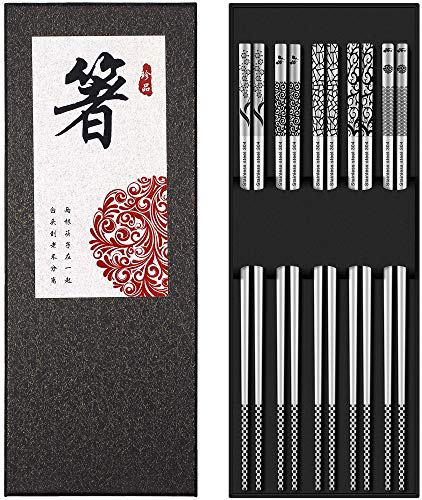
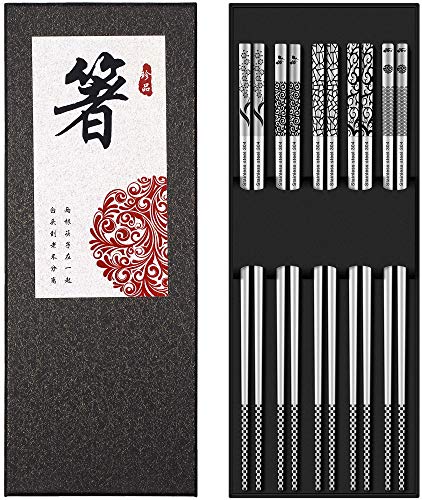
- Greatamzor 18/8 Stainless Steel Chopsticks, 5 Pairs — Best Overall Hashi. Listing names Japanese styling; 18/8 grade, five pairs.
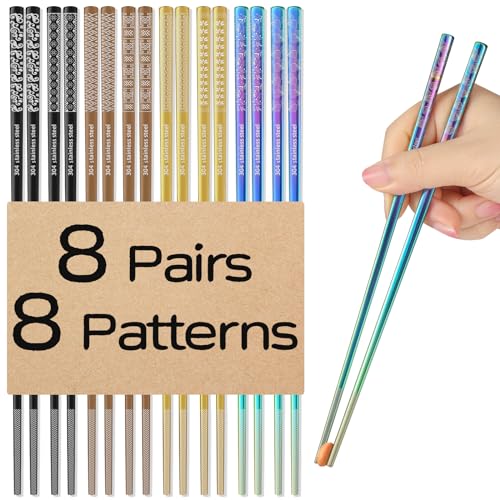
- NEWDRIP 18/8 Stainless Steel Chopsticks, 8 Pairs — Best for a Full Table. Listing names Japanese styling among three styles; eight pairs.
- Zliutob Stainless Steel Chopsticks, 5 Pairs — Best Sushi-Night Geometry (Prose-Only) (reviewed below as a prose-only pick: no purchase link, for the reason explained in its review). Listing names sushi and ramen use but not Japanese styling — prose-only.
- LIXTONGR Dragon & Phoenix Black Stainless Steel Chopsticks, 2 Pairs — Best Occasion Pair (Prose-Only) (reviewed below as a prose-only pick: no purchase link, for the reason explained in its review). Themed occasion pair; no regional style named — prose-only.
- MUYOS Stainless Steel Chopsticks, 5 Pairs — Best Lightweight Pair (Prose-Only) (reviewed below as a prose-only pick: no purchase link, for the reason explained in its review). Hollow-core daily pair; no regional style named — prose-only.
- Greatamzor Multicolor Stainless Steel Chopsticks, 5 Pairs — Best Patterned Pair (Prose-Only) (reviewed below as a prose-only pick: no purchase link, for the reason explained in its review). Copper coin pattern pair; no regional style named — prose-only.
Read the full guide ↓ for the detailed review of every pick, the comparison table, the buying guide and the how-to section.
Words matter in this search. Hashi (箸) is the everyday Japanese word for chopsticks, and someone typing best hashi chopsticks usually wants the Japanese form specifically: a shorter pair than the Chinese table standard, a finer tip for separating fish and picking small items from individual dishes, and a place in a cuisine where each diner eats from their own bowls rather than reaching across a shared spread. This guide honours that specificity instead of treating “hashi” as a decorative synonym for any chopstick.
So the linking rule here is strict, and it is worth stating in the open: only sets whose listings name Japanese styling are linked. Two of the six verified picks pass — both engraved stainless sets whose titles say “Japanese” outright. The other four are reviewed completely, with strengths, trade-offs and verdicts, but as prose-only entries without links or product images, because their listings claim sushi use, occasions, lightness or pattern — everything except the Japanese designation this keyword asks for. You lose nothing as a reader: the full comparison is here, and the links only endorse what the keyword actually specifies. For the broader, unfiltered view of this pool, see Best Japanese Chopsticks, and for the typo-variant search many people land on first, Best Japanede Chopsticks.
One more honesty note: every pick in the verified pool is stainless steel. Traditional hashi are often wood or bamboo, and the tradition section below gives that heritage its due — but this guide reviews the pool as verified, and steel hashi-style pairs are a real and growing category for daily Japanese home cooking, precisely because they survive the dishwasher next to the rice bowls.
Key Takeaways
- Hashi is the Japanese word for chopsticks — this keyword means Japanese-style pairs specifically: shorter, finer-tipped, bowl-oriented.
- Only two of the six verified listings name Japanese styling; those two are linked, the other four are reviewed prose-only.
- Both linked sets are engraved stainless at 9 1/4 to 9.25 inches — the modern steel interpretation of the hashi form.
- Grip texture matters doubly with hashi, because the Japanese repertoire is full of delicate, slippery items: fish, tofu, pickles.
- Prose-only picks are still fully reviewed — a missing label is not a bad product, it is a different product.
- Traditional wooden hashi are honoured in the tradition section, but the verified pool here is steel, and the guide says so.
In this guide
Quick Picks: Best hashi chopsticks
| Pick | Badge | Who it suits | Link |
|---|---|---|---|
| Greatamzor 18/8 Stainless Steel Chopsticks, 5 Pairs | Best Overall Hashi | Buyers who want a listing that names Japanese styling, in a five-pair set | Check on Amazon |
| NEWDRIP 18/8 Stainless Steel Chopsticks, 8 Pairs | Best for a Full Table | Households seating eight who still want Japanese named in the listing | Check on Amazon |
| Zliutob Stainless Steel Chopsticks, 5 Pairs | Best Sushi-Night Geometry (Prose-Only) | Sushi and ramen eaters who care about tip geometry over labels | Prose-only pick — no link |
| LIXTONGR Dragon & Phoenix Black Stainless Steel Chopsticks, 2 Pairs | Best Occasion Pair (Prose-Only) | Occasion diners who want a themed black pair | Prose-only pick — no link |
| MUYOS Stainless Steel Chopsticks, 5 Pairs | Best Lightweight Pair (Prose-Only) | Daily users who find solid steel heavy | Prose-only pick — no link |
| Greatamzor Multicolor Stainless Steel Chopsticks, 5 Pairs | Best Patterned Pair (Prose-Only) | Colour-coding households that like a traditional motif | Prose-only pick — no link |
The badge column tells the linking story at a glance: two linked picks carry the Japanese designation in their listings, and four prose-only picks are marked as such. If your loyalty is to the designation, buy from the first two rows. If your loyalty is to a feature — textured tips, light weight, a themed pair — the prose-only reviews give you the full picture without a purchase link.
How These Picks Were Chosen
The six products come from the verified chopsticks pool, cross-checked against marketplace data for title, set size and stated specifications. We then applied this keyword’s filter: a pick earns a link only when its own listing names Japanese styling. That rule linked the two engraved sets whose titles say Japanese, and left four sets prose-only — not as a punishment, but because a guide about hashi that links products never claiming the style would be mislabelling its own recommendations.
The method is research-led. We do not claim hands-on testing, and we do not import specifications the listings omit: where a set publishes no length or grade, the review records the silence. Japanese styling in these listings is a positioning claim by the seller, not a certification — no standards body stamps chopsticks — and we present it as exactly that: the listing’s own words, weighed by you.
Prices are not printed, as house policy; check current figures through the two linked listings. Readers who want the same pool without the style filter — for a mixed household, say — will find all six linked in the general reading at Best General Purpose Chopsticks.
The 6 Best Options: Best hashi chopsticks in Detail
The two linked reviews come first, in the order we would buy them. The four prose-only reviews follow, each with a note on exactly which claim its listing makes instead of the Japanese one.
Greatamzor 18/8 Stainless Steel Chopsticks, 5 Pairs
Badge: Best Overall Hashi
Strengths
- 18/8 stainless grade is stated plainly in the listing, so you know the alloy family before you buy
- Laser engraving doubles as a grip aid along the shaft, not just decoration
- A five-pair multipack covers a small household or a full place-setting run in one purchase
Trade-offs
- Metal conducts heat, so resting the tips in a hot pan or broth is a poor idea
- The engraved pattern is a fixed design — you cannot choose a plainer finish in this set
- At 9 1/4 inches it sits in the middle of the length range, which long-noodle cooks may find short
Mini spec box (from the listing only)
- Material: 18/8 stainless steel (as listed)
- Length: 9 1/4 inches (as listed)
- Set size: 5 pairs
- Finish detail: laser engraved pattern
- Grip: non-slip design
- Care: dishwasher safe
- Styles named in the listing: Japanese, Korean
This Greatamzor set is built around a straightforward promise: a mid-length stainless pair with a laser-engraved shaft, sold five pairs at a time. The 18/8 grade named in the listing is the alloy family most buyers will recognise from flatware, and the engraving matters more than it looks — a smooth polished shaft is exactly where metal chopsticks earn their slippery reputation, and a cut pattern gives fingertips and food something to hold on to. The listing names both Japanese and Korean styling, which fits the 9 1/4 inch length: shorter and more pointed in spirit than a long Chinese cooking pair, but not as short as a dedicated lunch pair.
For hashi purposes, this set’s credentials are its listing’s own words: Japanese styling named, a 9 1/4 inch length that sits at the longer, more versatile end of the Japanese table range, and engraving that gives the fine work — separating a fish fillet, lifting a pickle — the friction it needs. Five pairs matches the Japanese household rhythm of individual settings. It is the most complete hashi answer the pool offers, and it is linked accordingly.
Best for: hashi buyers who want the designation and a five-pair set / Not suited for: purists who want wood or bamboo hashi

NEWDRIP 18/8 Stainless Steel Chopsticks, 8 Pairs
Badge: Best for a Full Table
Strengths
- Eight pairs is the largest count in this guide alongside the ten-pair set, which suits bigger households
- The listing names Japanese, Korean and Chinese styling, the broadest style claim in the pool
- Engraving plus a non-slip claim addresses the two classic metal-chopstick complaints
Trade-offs
- Eight matching pairs means eight pairs to store — drawer space is a real consideration
- The engraved design is the same across the set, so telling pairs apart at the table is not possible by pattern
- Metal tips can click and scrape on ceramic bowls more than wood or bamboo would
Mini spec box (from the listing only)
- Material: 18/8 stainless steel (as listed)
- Length: 9.25 inches (as listed)
- Set size: 8 pairs
- Finish detail: laser engraved pattern
- Grip: non-slip design
- Care: dishwasher safe
- Styles named in the listing: Japanese, Korean, Chinese
NEWDRIP takes the same basic formula as the five-pair engraved sets — 18/8 stainless, laser engraving, non-slip positioning — and scales it to eight pairs at 9.25 inches. The listing is also the most style-inclusive in this pool, naming Japanese, Korean and Chinese use in one breath, which is a fair reflection of the length: 9.25 inches is a genuine all-rounder span that works at a ramen bowl, a hotpot spread or a plate of dumplings without feeling specialised in any direction. For a household that seats six to eight, one set replaces the usual drawer of mismatched pairs.
This listing names Japanese styling alongside Korean and Chinese — a breadth that purists may read either as versatility or as hedging. The hashi reading: at 9.25 inches with engraving and eight pairs, it is the set for a household that eats Japanese food most nights and seats many people when it does. The designation is present, so the link is earned; the triple naming is disclosed here so you can weigh it yourself.
Best for: Japanese-food households seating up to eight / Not suited for: purists who dislike multi-style listings
Zliutob Stainless Steel Chopsticks, 5 Pairs
Badge: Best Sushi-Night Geometry (Prose-Only)
Strengths
- Textured tips are the most direct answer to slippery food — the texture is where the food actually sits
- A square grip section resists rolling on the table and twisting in the hand
- The listing is honest about scope: sushi, ramen and daily meals, no inflated claims
Trade-offs
- The listing does not state a length or a steel grade, so spec-by-spec comparison is limited
- A square profile feels different from round sticks and takes a meal or two to get used to
- Textured tips need a rinse soon after sticky sauces, which dry into the texture
Mini spec box (from the listing only)
- Material: stainless steel (grade not stated in the listing)
- Set size: 5 pairs
- Grip: textured tips and square grip section
- Care: dishwasher safe
- Named uses in the listing: sushi, ramen and daily meals
The Zliutob set puts its effort exactly where metal chopsticks usually fail: the last inch. Its listing describes textured tips and a square grip, a combination aimed at the two moments a pair lets you down — food sliding off the tip, and the shaft twisting between your fingers mid-lift. The listing names sushi, ramen and daily meals as its territory and does not publish a length or a specific steel grade, which is worth knowing before you buy: you are choosing this set for its tip and grip geometry, not for a spec sheet. Five pairs is a standard household count.
Here is the guide’s most interesting tension. This set’s listing names sushi and ramen — Japanese dishes, plainly — and its textured tips and square grip are arguably the best hashi geometry in the pool. But its title never claims Japanese styling, and this keyword’s rule links designations, not inferences. It is therefore reviewed in full, praised where praise is due, and left prose-only: an excellent sushi-night pair that its own listing does not call hashi.
Best for: sushi and ramen specialists who buy geometry, not labels / Not suited for: buyers who require the Japanese designation in writing
Prose-only pick: this set is reviewed in full because it is relevant to the search, but it carries no purchase link and no product image here — see the note in the sources file for the title-based reason.
LIXTONGR Dragon & Phoenix Black Stainless Steel Chopsticks, 2 Pairs
Badge: Best Occasion Pair (Prose-Only)
Strengths
- 18/10 is the highest alloy grade stated anywhere in this pool
- The black Dragon & Phoenix design is the only themed artwork in the pool — it looks like an occasion piece, not a drawer staple
- It is the only set here whose listing explicitly promises a gift box
Trade-offs
- Two pairs is a place-setting purchase, not a household stock-up
- At 9 inches it is the shortest pair in the pool, which hotpot and shared-dish cooks may notice
- A black finish shows water spots and dishwasher film more readily than plain silver
Mini spec box (from the listing only)
- Material: 18/10 stainless steel (as listed)
- Length: 9 inches (as listed)
- Set size: 2 pairs
- Colour: black, Dragon & Phoenix design
- Grip: non-slip grip
- Care: dishwasher safe
- Packaging: gift box (as listed)
- Occasions named in the listing: dining, travel, housewarming, wedding
Everything about the LIXTONGR set is deliberate: black 18/10 stainless, a Dragon & Phoenix motif, a stated gift box, and a listing that names dining, travel, housewarming and weddings as its occasions. The 18/10 grade is the richest alloy claim in this pool, and the 9 inch length is the shortest here — a table pair, meant for a place setting rather than a stockpot. With only two pairs in the box, this is the set you buy for a couple, a celebration table, or your own favourite bowl, not the set you buy to fill a drawer before a dinner party.
The Dragon & Phoenix pair belongs to a different celebration tradition and its listing knows it — the named occasions are dining, travel, housewarming and wedding, with no regional style claimed. At 9 inches it is dimensionally the closest to a classic short hashi, which makes it a tempting near-miss; but a motif and a length do not make a designation, so it stands prose-only as the occasion pair of the six.
Best for: occasion tables wanting a short themed pair / Not suited for: households needing more than two pairs
Prose-only pick: this set is reviewed in full because it is relevant to the search, but it carries no purchase link and no product image here — see the note in the sources file for the title-based reason.
MUYOS Stainless Steel Chopsticks, 5 Pairs
Badge: Best Lightweight Pair (Prose-Only)
Strengths
- Hollow-core construction is the one genuine engineering difference in this pool — it cuts the weight metal is criticised for
- Non-slip tips target grip where it matters while the shaft stays plain
- A plain silver finish matches ordinary flatware instead of announcing itself
Trade-offs
- The listing states neither a length nor a steel grade, so you are buying on design rather than numbers
- A hollow core can feel less substantial to anyone who likes a heavy pair
- No engraving on the shaft, so mid-shaft grip relies on the tip texture alone
Mini spec box (from the listing only)
- Material: stainless steel (grade not stated in the listing)
- Set size: 5 pairs
- Construction: hollow-core lightweight design
- Colour: silver
- Grip: non-slip tips
- Care: dishwasher safe
- Named use in the listing: daily meals
MUYOS makes the most practical argument in this pool: the reason many people abandon metal chopsticks is weight and hand fatigue, so this pair is built hollow-core to stay light. The listing keeps the rest simple — silver finish, non-slip tips, five pairs, dishwasher safe, aimed squarely at daily meals. It does not state a length or a steel grade, and that gap is worth noting; what you are really choosing here is the construction. For long noodle sessions, dumpling nights and anyone whose hand tires with a solid steel pair, a lighter stick changes the whole meal.
MUYOS claims the daily-meals territory and a hollow-core build, and claims no regional style at all. As a hashi candidate it is the comfort pick — light in the hand across a long, multi-dish Japanese meal — but comfort is not a style designation, and the rule is the rule. Prose-only, fully reviewed, and genuinely recommendable to anyone whose brief is “light pair for Japanese food” rather than “hashi” in the strict sense.
Best for: long Japanese meals where hand fatigue is the enemy / Not suited for: buyers shopping by published length and grade
Prose-only pick: this set is reviewed in full because it is relevant to the search, but it carries no purchase link and no product image here — see the note in the sources file for the title-based reason.
Greatamzor Multicolor Stainless Steel Chopsticks, 5 Pairs
Badge: Best Patterned Pair (Prose-Only)
Strengths
- Different colours per pair end the whose-pair-is-whose argument at family tables
- The copper coin engraving gives the square shaft a traditional motif with real grip texture
- Square profile will not roll off the table edge or a bowl rim
Trade-offs
- The listing does not state a steel grade for this multicolor version
- Coloured finishes are the ones most likely to show wear first at the tips over years of washing
- A busy pattern is not for minimalists — this set is meant to be seen
Mini spec box (from the listing only)
- Material: stainless steel (grade not stated in the listing)
- Length: 9 1/4 inches (as listed)
- Set size: 5 pairs
- Finish: multicolor, laser engraved copper coin pattern
- Profile: square, non-slip
- Care: dishwasher safe
This Greatamzor set is the extrovert of the pool: multicolor pairs, a laser-engraved copper coin pattern and a square non-slip profile at 9 1/4 inches. The colour coding is more useful than it first appears — in a household, coloured pairs quietly become assigned pairs, and at a shared table nobody picks up the wrong set by mistake. The copper coin motif is a traditional symbol worked into the engraving, and because the pattern is engraved rather than printed, it contributes texture to the grip instead of sitting on the surface waiting to wear away.
The copper coin engraving is a Chinese traditional motif, and the listing names no regional style — the honest reading is that this is a patterned, colour-coded household set with an East Asian design accent, not a hashi set. It earns a full prose-only review because pattern-loving households land on this keyword too, and they deserve the facts: square profile, engraved grip, five colours, no Japanese claim.
Best for: colour-coding households that like traditional motifs / Not suited for: buyers who need a listing that names Japanese styling
Prose-only pick: this set is reviewed in full because it is relevant to the search, but it carries no purchase link and no product image here — see the note in the sources file for the title-based reason.
Comparison Table
| Pick | Pairs | Length as listed | Steel as listed | Grip approach | Link |
|---|---|---|---|---|---|
| Greatamzor 18/8 Stainless Steel Chopsticks, 5 Pairs | 5 pairs | 9 1/4 in | 18/8 stainless | Laser engraving + non-slip claim | Check on Amazon |
| NEWDRIP 18/8 Stainless Steel Chopsticks, 8 Pairs | 8 pairs | 9.25 in | 18/8 stainless | Laser engraving + non-slip claim | Check on Amazon |
| Zliutob Stainless Steel Chopsticks, 5 Pairs | 5 pairs | Not stated | Stainless, grade not stated | Textured tips + square grip | — |
| LIXTONGR Dragon & Phoenix Black Stainless Steel Chopsticks, 2 Pairs | 2 pairs | 9 in | 18/10 stainless | Non-slip grip | — |
| MUYOS Stainless Steel Chopsticks, 5 Pairs | 5 pairs | Not stated | Stainless, grade not stated | Non-slip tips, hollow-core | — |
| Greatamzor Multicolor Stainless Steel Chopsticks, 5 Pairs | 5 pairs | 9 1/4 in | Stainless, grade not stated | Engraved copper coin pattern, square | — |
The comparison table keeps the prose-only picks visible, because comparison is information, not endorsement. The link column is the filter made visible: two links where listings name Japanese styling, dashes where they do not. Everything else — pairs, length, grade, grip — is compared on equal terms.
How to Choose: How to Choose best hashi chopsticks: Length, Tip and Designation
Understand the form you are asking for. Japanese hashi evolved around individual servings: rice bowls, miso soup, grilled fish, small side dishes. The pair is therefore shorter than the Chinese shared-dish standard and finer at the tip, because the signature tasks are precision tasks — lifting a flake of fish cleanly, picking a single pickle, separating food rather than spearing across a table. When you shop this keyword, you are shopping that geometry and that dining logic.
Length: the stated figures here are modern-middle. The two linked sets state 9 1/4 and 9.25 inches — longer than a traditional short hashi, shorter than cooking lengths, and practical for contemporary bowls and plates. If your hand is small or your tableware is small and deep, shorter is friendlier; the prose-only LIXTONGR set, at a stated 9 inches, is the pool’s shortest. Buy the length your bowls ask for, not the length a label implies.
Tip fineness and texture decide delicate work. A fine tip is only useful if food stays on it. Engraving on the linked sets adds friction along the shaft and toward the tip; the prose-only Zliutob set goes further with explicitly textured tips. For tofu, fish and glossy noodles, texture is not a detail — it is the difference between serving the food and chasing it. The sushi-specific discussion in Best Japanese Lunch Chopsticks continues this point for packed meals.
Designation is a claim; weigh it like one. No authority certifies “Japanese style” on a marketplace listing. The designation tells you the seller designed and positioned the pair for that tradition — its length band, its marketing, its intended table. This guide links designations and discloses multi-style listings (the eight-pair NEWDRIP names three styles) so the claim’s strength is yours to judge.
Material realism. The verified pool is steel. Steel hashi-style pairs trade the warmth and lightness of wood for dishwasher survival and permanence — a trade most daily cooks accept happily and traditionalists may not. If your heart is set on wood, this pool cannot help you, and the guide would rather say so than dress steel in wooden language.
How to Use Hashi Properly: Grip, Etiquette and Care
Grip. The classic hold: lower stick rests at the base of the thumb and on the ring finger, held still; upper stick is pinched like a pencil and does the moving. Keep the tips even — uneven tips are the beginner’s real enemy, not hand position. Engraved shafts help while the muscle memory forms, because the stick stops rotating in the fingers.
Etiquette worth knowing. Japanese table manners around hashi are specific: never stick them upright in rice (it evokes funeral offerings), never pass food from your hashi to someone else’s, do not point with them, and rest them on a hashi-oki (rest) rather than across the bowl when pausing. None of this is difficult, and all of it is noticed and appreciated at a Japanese table.
Serving. Use the clean, thick ends of your hashi — or dedicated serving pairs — when taking from shared dishes, a hygiene habit built into the culture of individual settings. With individual trays and bowls, your pair mostly travels between your dishes and your mouth, which is precisely what the shorter form is designed for.
Care. All six sets here are listed dishwasher safe; rinse fine tips promptly after miso and oily fish, and dry before storing to keep finishes bright. Troubleshooting. Problem: fish flakes crumble on lifting → support from below with both tips spread slightly, rather than pinching harder. Problem: tips keep crossing → slow down and re-even them against the bowl rim; crossing is a grip-drift issue, solved in days. Problem: pickles escape → texture is the fix; this is the exact failure engraved and textured tips exist to prevent.
Hashi, Kuàizi, Jeotgarak: Why the Regional Forms Differ
The three great chopstick traditions differ because the cuisines differ. Chinese kuàizi are the longest of the three, built for reaching into shared dishes and hot woks. Korean jeotgarak are mid-length and famously metal, shaped for kimchi, soups and barbecue. Japanese hashi are the shortest and finest-tipped, built around individual bowls and a fish-centred cuisine where bones must be separated delicately at the table.
That is why this keyword gets its own strict guide instead of a paragraph in a general one: the form is functional, not decorative. A set can be excellent and still not be hashi — several prose-only picks here are exactly that case. Shoppers whose tables mix traditions happily may prefer the unfiltered pool in Best Home Chopsticks; shoppers who came for the Japanese form now know precisely which two listings claim it.
The Wooden Hashi Tradition — and Why This Pool Is Steel
Classic hashi are wood or bamboo: light, quiet, warm, often lacquered, sometimes beautifully plain. They are also consumables by the standards of a steel pair — lacquer wears, tips fray, and enthusiastic dishwashing shortens their lives. Japanese households have used and replaced them for centuries without finding that tragic; the material’s gentleness on fine ceramics is part of the tradition.
The verified pool behind this guide contains steel interpretations only, and the honest framing is that steel hashi-style pairs serve the modern daily table — dishwasher, family volume, permanence — while borrowing the form: shorter lengths, fine tips, individual settings. If the tradition itself is your purchase, shop wood with the care guidance it deserves; the material debate is laid out in Best Hardwood For Chopsticks. If the form is your purchase and steel’s practicality appeals, the two linked sets above are your shortlist.
Sizing Hashi to the Hand: The Traditional Measure
Traditional hashi sizing starts from the diner’s own hand: a common rule of thumb takes the span from thumb tip to index fingertip and scales it, which is why Japanese shops stock several lengths and why children’s hashi are genuinely shorter rather than merely decorated differently. The principle underneath the rule matters more than the formula — the pair should let the tips meet precisely without the butt ends splaying wide in the palm, and shorter hands cramp on long pairs exactly as longer hands feel cramped by short ones.
The sets in this guide sit in the modern-middle band where lengths are stated, 9 1/4 to 9.25 inches for the linked pair of sets, which suits average adult hands and contemporary bowls. A household buying one set for several adults is making the standard compromise; a household buying for one devoted diner can afford to be fussier, favouring the shorter stated options in the wider pool and the finest tips available.
Children deserve a direct word: adult-length pairs frustrate small hands and teach compensating grips that must later be unlearned. If hashi are a family practice in your home, buy children their own shorter training pairs as a separate, deliberate purchase, and let the sets in this guide be what they graduate to. The tradition itself is sized per person; honouring that is part of buying hashi rather than merely buying chopsticks.
The Sound and Feel of the Table: Why Material Still Matters to Purists
Listen to a Japanese meal eaten with wooden hashi and then with steel: the wooden table is quieter. Tips tap softly against lacquer and ceramic; steel announces itself. Purists are not being precious when they cite sound and warmth — a meal’s sensory texture is part of its cuisine, and the traditional materials genuinely serve it. Steel also carries temperature: a pair rested against a hot bowl tells your fingers about it, where wood stays neutral.
The steel interpretation’s defence is equally genuine: permanence, hygiene and indifference to the dishwasher, in households whose reality is volume and speed. Neither side is performing. They are optimising different variables of the same meal, and this guide’s role is to keep both honest — steel sets described as steel, with their acoustic and thermal character stated, and the wooden tradition described as a living option rather than a museum piece.
Practically, many households land on the hybrid: steel for the daily rotation, one wooden pair kept for the meals where the table itself is the occasion. If that is your landing spot, the linked sets here cover the daily half with their designation intact, and the tradition section above points you toward the other half with your eyes open.
Building the Hashi Setting: Trays, Bowls and the Order of a Meal
A hashi setting is a small composition, and understanding it explains the pair’s design better than any spec sheet. The tray or table holds the rice bowl to the left, the soup bowl to the right, the main dish beyond them, small dishes for pickles and sides, and the hashi resting horizontally in front, tips on the hashi-oki, pointing left for a right-handed diner. Everything is within the short pair’s easy reach — the setting and the stick were designed together, each explaining the other.
The meal’s order uses the same logic. Soup and rice anchor; the pair travels short distances between personal dishes; shared plates, when they appear, are the exception that serving pairs exist for. A diner eating this way for the first time on a mid-length steel pair discovers the form’s kindness: nothing is far, nothing is heavy, and the meal’s pace is set by small, exact movements rather than by reaching and hauling.
Homes outside Japan can adopt the composition without buying a new kitchen. Bowls you already own, a small dish or two, rests for the pair, and the discipline of plating individually rather than family-style for one meal a week — that is enough to feel what the form is for. Many households find the experiment habit-forming, because the individual setting slows a meal down in the best way: each person’s tray is complete, and the table’s centre stays calm.
Complete the picture with the pair this guide links: designation named, engraved or textured for the cuisine’s slippery precision work, sized to the modern-middle band that suits contemporary bowls. The setting teaches the grip; the grip teaches the appreciation; and the word hashi stops being a search term and becomes the name of a practice your table now has.
Hashi for One: The Pleasure of the Solo Setting
Hashi culture is often pictured at family tables, but its most devoted modern practitioner may be the solo diner. The individual setting — tray, bowls, pair on its rest — turns a single person’s dinner into a composed event rather than a refuelling, and the short, precise pair is the instrument of that composition. A linked set’s five pairs give the solo household a rotation: one in use, one in the wash, spares for the guest who occasionally turns one setting into two.
There is a practical poetry in it that the tradition understood early: eating alone with the same care as eating in company is a form of self-respect with tableware. The steel interpretations in this guide serve that practice without ceremony or maintenance — permanence for a ritual that deserves it.
Common Buying Mistakes
- Treating “hashi” as a fancy word for any chopstick. It names the Japanese form and tradition; this guide links only listings that claim that styling.
- Assuming a sushi mention equals a Japanese designation. The Zliutob listing names sushi and ramen as uses but never claims Japanese styling — hence its prose-only status here.
- Buying long pairs for a Japanese table. Reach is a Chinese-table virtue; hashi work is close and precise, and length works against it.
- Sticking hashi upright in rice. It mirrors a funeral rite and is the one etiquette error every Japanese diner will notice.
- Expecting wooden tradition from a steel pool. These are steel interpretations of the form — buy them for permanence and washing, not for lacquered warmth.
- Skipping the rests. A hashi-oki keeps tips off the table, stops rolling and completes the setting; it is the cheapest upgrade in this whole guide.
Final Recommendation
The Greatamzor 18/8 set (B08L797W7X) is the hashi recommendation: Japanese styling named in its listing, a stated 18/8 grade, engraved grip for delicate work, and five pairs sized to a household’s individual settings. It is the pool’s most complete answer to the keyword as the keyword is actually meant.
If you want a fast answer, start with one of these and read its detailed review above: Greatamzor 18/8 Stainless Steel Chopsticks, 5 Pairs, NEWDRIP 18/8 Stainless Steel Chopsticks, 8 Pairs.
Seat more people and the eight-pair NEWDRIP set is the linked alternative, with its multi-style naming disclosed. And if a prose-only pick’s feature — textured tips, hollow-core lightness, a themed occasion pair — matches your real brief better than the designation does, you have read its full review above and can hunt it down by name with open eyes. That is what the best hashi chopsticks guide owes you: the tradition, the filter, and the facts.
Frequently Asked Questions
What does hashi mean?
Hashi (箸) is the Japanese word for chopsticks. As a search term it signals the Japanese form: comparatively short pairs with fine tips, designed for individual bowls and dishes rather than shared platters, in a dining culture built around personal settings.
Why are only two of the six picks linked in this guide?
Because this keyword asks for Japanese styling specifically, and only two listings in the verified pool name Japanese styling in their titles. The other four are reviewed in full as prose-only picks — their listings claim other virtues (sushi use, occasions, lightness, pattern) but not the designation this keyword specifies.
Are metal hashi traditional?
The form is traditional; the material here is modern. Classic hashi are wood or bamboo. Steel pairs in the Japanese length band are a contemporary interpretation valued for dishwasher safety and permanence. This guide describes them as exactly that, rather than dressing steel in traditional language.
What length should hashi be?
Traditionally shorter than Chinese pairs, sized to the diner’s hand and to individual bowls. The linked sets here state 9 1/4 and 9.25 inches, the modern-middle interpretation; the shortest set in the six states 9 inches. Smaller hands and smaller, deeper bowls favour the shorter end.
What is a hashi-oki and do I need one?
A hashi-oki is a small rest that keeps the tips off the table between bites. It is inexpensive, traditional, prevents rolling, and completes a Japanese setting. Of all the accessories in the chopstick world, it is the one this guide recommends without hesitation.
Which prose-only pick is best for sushi specifically?
The Zliutob set: its listing names sushi directly, and its textured tips and square grip are the strongest geometry here for glossy fish and rice work. It is prose-only in this guide solely because its listing does not claim Japanese styling — the review above gives its full case.
How do I avoid the upright-in-rice mistake and other etiquette errors?
Rest hashi on a rest or flat across a small dish, never upright in rice; do not pass food stick-to-stick; take from shared dishes with serving pairs or the clean ends of your own. The how-to section above covers the essentials in a few lines.