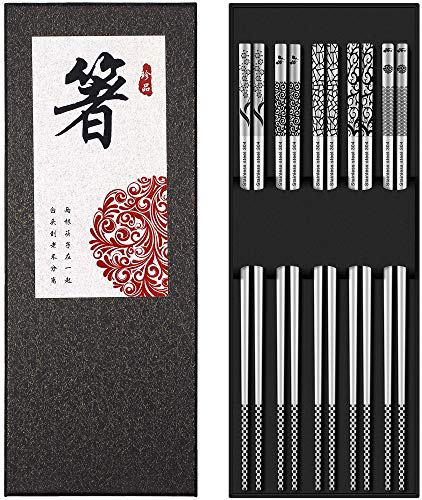
Disclosure: topratedkitchenware.com is reader-supported. When you buy through links on our site, we may earn an affiliate commission from Amazon and other retailers, at no extra cost to you.
Where to buy
The best japanese chopsticks, judged strictly, are pairs whose listings actually claim Japanese styling — so that is the linking rule in this guide. Five of the six verified picks name Japanese style in their titles and carry links and images; one excellent bulk set makes no regional claim at all and is reviewed in full as a prose-only pick. All six are stainless steel: the modern, dishwasher-safe reading of a form that is traditionally shorter, finer-tipped and built for individual bowls.
- Greatamzor Titanium-Plated Stainless Steel Chopsticks, 2 Pairs — Best Premium. Japanese named; titanium-plated black and silver, two pairs.
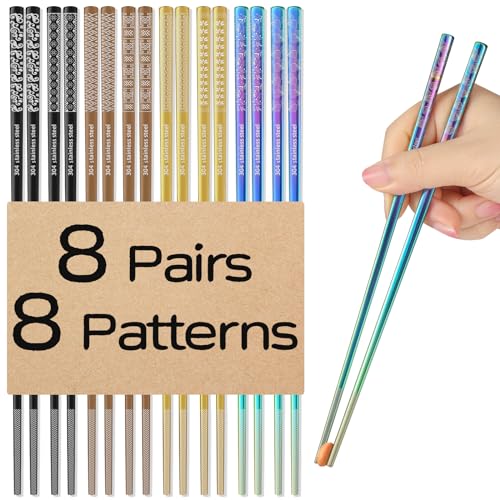
- NEWDRIP Multicolor Stainless Steel Chopsticks, 8 Pairs — Best for Groups. Japanese named among three styles; eight colour-coded pairs.
- Lazycorner 304 Stainless Steel Chopsticks, 10 Pairs — Best Bulk Buy (Prose-Only) (reviewed below as a prose-only pick: no purchase link, for the reason explained in its review). Ten plain pairs; no regional style named — prose-only.
- IQCWOOD 304 Stainless Steel Chopsticks, 5 Pairs — Best Documented Specs. Japanese style named; 304 grade and 9.25 inches stated.
- Greatamzor 18/8 Stainless Steel Chopsticks, 5 Pairs — Best Overall. Japanese named; 18/8 grade, five engraved pairs.
- NEWDRIP 18/8 Stainless Steel Chopsticks, 8 Pairs — Best Celebration Set. Japanese named among three styles; eight engraved pairs.
Read the full guide ↓ for the detailed review of every pick, the comparison table, the buying guide and the how-to section.
Japanese chopsticks are a distinct form, not a marketing adjective: shorter than the Chinese shared-dish standard, finer at the tip, and designed around a meal served as individual bowls and small dishes — rice, soup, grilled fish, pickles — where the work is precision rather than reach. The best japanese chopsticks honour that form. This guide therefore links only the sets whose listings name Japanese styling, and it is pleased to report that five of the six verified picks do exactly that, giving this keyword the deepest honest shortlist in the whole chopsticks cluster.
The five linked sets still manage to be five different answers. There is a premium titanium-plated pair for the deliberate diner, two eight-pair sets (one colour-coded, one engraved) for households and celebrations, a plainly documented five-pair set that states style, grade and length in one breath, and an engraved 18/8 five-pair set that takes our overall recommendation. The sixth pick — a ten-pair bulk set whose listing names no regional style — is reviewed in full as a prose-only entry, because bulk value is real even when a designation is absent. Readers arriving from the misspelled version of this search will find the same standard applied at Best Japanede Chopsticks; readers who want the Japanese word itself unpacked should start with Best Hashi Chopsticks.
One material note, stated once and plainly: the verified pool is stainless steel throughout. These are contemporary interpretations of the Japanese form — permanent, dishwasher safe, family-proof — rather than lacquered wood. The tradition is discussed with respect in the sections below; the products are described as what they are.
Key Takeaways
- Five of six verified listings name Japanese styling — this keyword has the deepest linked shortlist in the cluster.
- The one prose-only pick (a ten-pair bulk set) names no regional style; it is fully reviewed, just not linked.
- Linked sets span two to eight pairs: premium pair, household staples and celebration sets.
- Stated lengths cluster at 9.25 inches — the modern-middle interpretation of the Japanese form.
- Grip texture (engraving, treated tips) is the functional core for a cuisine of fish, tofu and noodles.
- The IQCWOOD and Greatamzor 18/8 sets document their claims best: style plus grade plus, in one case, length.
In this guide
Quick Picks: Best japanese chopsticks
| Pick | Badge | Who it suits | Link |
|---|---|---|---|
| Greatamzor Titanium-Plated Stainless Steel Chopsticks, 2 Pairs | Best Premium | One or two diners who want a premium Japanese-named pair | Check on Amazon |
| NEWDRIP Multicolor Stainless Steel Chopsticks, 8 Pairs | Best for Groups | Households and groups wanting Japanese named across eight pairs | Check on Amazon |
| Lazycorner 304 Stainless Steel Chopsticks, 10 Pairs | Best Bulk Buy (Prose-Only) | Bulk buyers who do not need a style designation | Prose-only pick — no link |
| IQCWOOD 304 Stainless Steel Chopsticks, 5 Pairs | Best Documented Specs | Buyers who want style, grade and length all stated | Check on Amazon |
| Greatamzor 18/8 Stainless Steel Chopsticks, 5 Pairs | Best Overall | Most households: designation, grade and five pairs | Check on Amazon |
| NEWDRIP 18/8 Stainless Steel Chopsticks, 8 Pairs | Best Celebration Set | Celebration tables needing eight engraved pairs | Check on Amazon |
For most buyers the decision is between the two five-pair linked sets: the documented IQCWOOD and the engraved Greatamzor 18/8, which takes the overall badge for its balance of designation, grade and grip. Scale up with either eight-pair set; scale down to the titanium-plated pair for a premium personal set.
How These Picks Were Chosen
Products come from the verified chopsticks pool, cross-checked against marketplace data for title, set size and stated specifications. The keyword’s filter was then applied: links only where a listing’s own title names Japanese styling. Five titles pass — including two that name Japanese alongside Korean and Chinese, a breadth disclosed in their reviews. One title names no style and its set is prose-only.
The work is research-led, not hands-on testing, and the guide keeps that boundary visible: specifications are quoted as “the listing states”, gaps are recorded as gaps (the premium set, notably, publishes no length), and no prices or popularity figures are printed or invented. “Japanese style” in a title is a seller’s positioning claim; our contribution is to check what documentation travels with the claim and to rank accordingly.
If your household eats across traditions and the designation is not your priority, the same pool is linked in full — all six sets — in the unfiltered guide at Best General Purpose Chopsticks. If your priority is the packed-lunch variant of the form, Best Japanese Lunch Chopsticks narrows the lens further.
The 6 Best Options: Best japanese chopsticks in Detail
Reviews run from the premium pair through the group and bulk options to the two five-pair staples, ending with the celebration set. The prose-only review sits in its pool position, clearly marked.

Greatamzor Titanium-Plated Stainless Steel Chopsticks, 2 Pairs
Badge: Best Premium
Strengths
- Titanium plating in black and silver is the most premium finish story in this pool
- Two different colours in one box make an easy his-and-hers or host-and-guest split
- Laser engraving keeps the grip honest despite the smooth plated finish
Trade-offs
- Only two pairs — the smallest count in the pool alongside the LIXTONGR set
- A plated finish is a surface treatment, so harsh scouring is off the table
- The listing does not state a length, so size comparison rests on style positioning
Mini spec box (from the listing only)
- Material: stainless steel, titanium plated (as listed)
- Set size: 2 pairs
- Colours: black and silver (as listed)
- Finish detail: laser engraved pattern
- Grip: non-slip design
- Care: dishwasher safe
- Styles named in the listing: Japanese, Korean
Greatamzor’s titanium-plated set is positioned as the premium option: stainless steel under a titanium-plated finish, one pair in black and one in silver, laser engraved, and sold as a two-pair gift set. The listing names Japanese and Korean styling and does not publish a length, so treat this as a finish-and-feel purchase. Plating gives metal a warmer, less clinical look on the table, and the two-tone pairing makes the set read as intentional — the kind of pair you hand to a guest without apologising for your drawer of mismatched sticks.
The connoisseur’s option among the linked five: Japanese styling named, titanium plating in black and silver, engraving for grip, and a two-pair gift-set format that suits a single devoted diner or a couple. It treats the pair as an instrument — the object you keep in a case or a dedicated slot, not the drawer’s workhorse. Its one documentary gap is length, which the listing never states; buy it for finish and designation, not dimensions.
Best for: premium personal pairs for one or two diners / Not suited for: households needing several pairs

NEWDRIP Multicolor Stainless Steel Chopsticks, 8 Pairs
Badge: Best for Groups
Strengths
- Eight pairs in different colours is the strongest big-table colour-coding option here
- The listing names Japanese, Korean and Chinese styling — the widest style claim in the pool
- Engraving gives each coloured pair the same non-slip behaviour, so colour choice costs no grip
Trade-offs
- The listing does not state a steel grade for the multicolor version
- Eight pairs is a lot of drawer or crock space for a small household
- Coloured finishes need gentler washing if you want the colours even over the years
Mini spec box (from the listing only)
- Material: stainless steel (grade not stated in the listing)
- Length: 9.25 inches (as listed)
- Set size: 8 pairs
- Finish: multicolor, laser engraved
- Grip: non-slip design
- Care: dishwasher safe
- Styles named in the listing: Japanese, Korean, Chinese
NEWDRIP’s multicolor set combines the two most practical ideas in this pool: eight pairs, and a different colour for each. At 9.25 inches with laser engraving and a non-slip claim, the underlying stick is the pool’s familiar all-rounder; the colours are what change daily life. Households can assign colours, hosts can match pairs to settings, and a dropped pair is easy to spot in the dishwasher rack. The listing names Japanese, Korean and Chinese styling, which matches the mid-range length — one set that can cover sushi night and hotpot night without pretending to be a specialist at either.
Japanese styling named at group scale: eight pairs, colour-coded, engraved, at a stated 9.25 inches. The listing also names Korean and Chinese styling — breadth that suits a household whose cooking crosses borders nightly, and which purists can weigh with the disclosure in front of them. For a family that eats Japanese food together several nights a week, this is the designation with headcount.
Best for: families and groups eating Japanese food together / Not suited for: formal tables wanting uniform plain silver
Lazycorner 304 Stainless Steel Chopsticks, 10 Pairs
Badge: Best Bulk Buy (Prose-Only)
Strengths
- Ten pairs is the biggest count in the pool — one purchase covers a full dinner party
- 304 food-grade stainless is stated plainly, the same alloy family as most kitchen steel
- A lightweight build in a bulk set keeps the per-pair feel from turning clumsy
Trade-offs
- The listing does not state a length, so table fit has to be judged on arrival
- A plain silver bulk set has no colour coding — pairs are interchangeable by design
- Ten pairs of anything needs a storage plan: a crock or a wide drawer divider
Mini spec box (from the listing only)
- Material: 304 stainless steel, food grade (as listed)
- Set size: 10 pairs — the largest count in this pool
- Colour: silver
- Design notes in the listing: non-slip, lightweight
- Care: dishwasher safe
- Named uses in the listing: daily meals and gifts
The Lazycorner set is the volume play: ten pairs of 304 food-grade stainless in a plain silver finish, described as non-slip and lightweight, and aimed at daily meals and gifts. Ten pairs changes the maths of a household — a full table of eight still leaves spares in the drawer, and a pair lost to the sofa cushions or a lunch bag is an annoyance rather than a shopping trip. The listing does not state a length, which is the honest gap to note; everything else about the set is deliberately plain, and plain is the point for buyers who want one uniform stack of pairs.
The prose-only pick, and a useful lesson in what this keyword’s filter does: ten pairs of food-grade 304 steel is the best bulk value in the six, but the listing names no regional style, so under a Japanese-style keyword it earns a full review and no link. If your real brief is “stock the house”, this review may be the most valuable one here — shop it by name, with its unstated length noted.
Best for: bulk stocking without a style requirement / Not suited for: buyers who require the Japanese designation
Prose-only pick: this set is reviewed in full because it is relevant to the search, but it carries no purchase link and no product image here — see the note in the sources file for the title-based reason.

IQCWOOD 304 Stainless Steel Chopsticks, 5 Pairs
Badge: Best Documented Specs
Strengths
- One of the few sets here that states both its grade (304) and its length (9.25 inches) up front
- Lightweight positioning plus non-slip tips is the beginner-friendly combination in this pool
- The listing names Korean and Japanese styling, matching the mid-short length
Trade-offs
- Five pairs is a household set, not a party set
- Plain silver only — no colour coding or pattern to tell pairs apart
- No engraving is mentioned, so grip depends on the treated tips alone
Mini spec box (from the listing only)
- Material: 304 stainless steel (as listed)
- Length: 9.25 inches (as listed)
- Set size: 5 pairs
- Colour: silver
- Design notes in the listing: lightweight, non-slip tips
- Care: dishwasher safe
- Styles named in the listing: Korean, Japanese style
IQCWOOD’s set is the spec-sheet favourite: 304 stainless, 9.25 inches, five pairs, lightweight with non-slip tips, and a listing that names Korean and Japanese styling. That combination — a stated grade, a stated length and a mid-short span — makes it the easiest set in the pool to buy with confidence on paper, because there is very little you have to guess. The plain silver finish keeps it neutral at the table. If your shortlist method is to compare numbers first and stories second, this is the pair that gives you the most numbers to compare.
The documented staple: Japanese style named, 304 grade stated, 9.25 inch length stated, lightweight build and non-slip tips, five plain silver pairs. In a category where claims often travel alone, this listing’s paperwork is complete, and for a buyer who trusts documents over adjectives it is the easiest linked purchase in the guide. Its plainness is the only thing it does not offer relief from.
Best for: document-driven buyers / Not suited for: buyers wanting colour, pattern or plating
Greatamzor 18/8 Stainless Steel Chopsticks, 5 Pairs
Badge: Best Overall
Strengths
- 18/8 stainless grade is stated plainly in the listing, so you know the alloy family before you buy
- Laser engraving doubles as a grip aid along the shaft, not just decoration
- A five-pair multipack covers a small household or a full place-setting run in one purchase
Trade-offs
- Metal conducts heat, so resting the tips in a hot pan or broth is a poor idea
- The engraved pattern is a fixed design — you cannot choose a plainer finish in this set
- At 9 1/4 inches it sits in the middle of the length range, which long-noodle cooks may find short
Mini spec box (from the listing only)
- Material: 18/8 stainless steel (as listed)
- Length: 9 1/4 inches (as listed)
- Set size: 5 pairs
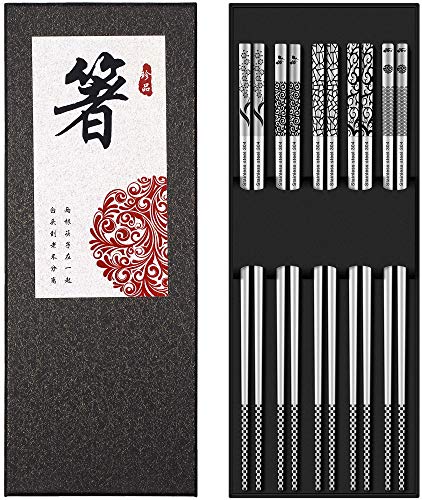
- Finish detail: laser engraved pattern
- Grip: non-slip design
- Care: dishwasher safe
- Styles named in the listing: Japanese, Korean
This Greatamzor set is built around a straightforward promise: a mid-length stainless pair with a laser-engraved shaft, sold five pairs at a time. The 18/8 grade named in the listing is the alloy family most buyers will recognise from flatware, and the engraving matters more than it looks — a smooth polished shaft is exactly where metal chopsticks earn their slippery reputation, and a cut pattern gives fingertips and food something to hold on to. The listing names both Japanese and Korean styling, which fits the 9 1/4 inch length: shorter and more pointed in spirit than a long Chinese cooking pair, but not as short as a dedicated lunch pair.
The overall recommendation earns it on accumulation: Japanese styling named, an 18/8 grade stated, engraving that serves the cuisine’s slippery precision work, five pairs for a household’s individual settings, and a 9 1/4 inch length at the versatile end of the form. Nothing about it is exotic; everything about it is answered. For a first serious Japanese-style set, this is where the guide points.
Best for: most households buying a first serious set / Not suited for: purists committed to wooden hashi

NEWDRIP 18/8 Stainless Steel Chopsticks, 8 Pairs
Badge: Best Celebration Set
Strengths
- Eight pairs is the largest count in this guide alongside the ten-pair set, which suits bigger households
- The listing names Japanese, Korean and Chinese styling, the broadest style claim in the pool
- Engraving plus a non-slip claim addresses the two classic metal-chopstick complaints
Trade-offs
- Eight matching pairs means eight pairs to store — drawer space is a real consideration
- The engraved design is the same across the set, so telling pairs apart at the table is not possible by pattern
- Metal tips can click and scrape on ceramic bowls more than wood or bamboo would
Mini spec box (from the listing only)
- Material: 18/8 stainless steel (as listed)
- Length: 9.25 inches (as listed)
- Set size: 8 pairs
- Finish detail: laser engraved pattern
- Grip: non-slip design
- Care: dishwasher safe
- Styles named in the listing: Japanese, Korean, Chinese
NEWDRIP takes the same basic formula as the five-pair engraved sets — 18/8 stainless, laser engraving, non-slip positioning — and scales it to eight pairs at 9.25 inches. The listing is also the most style-inclusive in this pool, naming Japanese, Korean and Chinese use in one breath, which is a fair reflection of the length: 9.25 inches is a genuine all-rounder span that works at a ramen bowl, a hotpot spread or a plate of dumplings without feeling specialised in any direction. For a household that seats six to eight, one set replaces the usual drawer of mismatched pairs.
The celebration set among the linked five: eight engraved pairs, a stated 18/8 grade, and Japanese styling named (with Korean and Chinese, disclosed as ever). Where the NEWDRIP multicolor set organises a household by colour, this set dresses a table uniformly — festival dinners, family gatherings, the meals where matching pairs are part of the respect shown to guests.
Best for: celebrations and uniform family tables / Not suited for: solo diners and small drawers
Comparison Table
| Pick | Pairs | Length as listed | Steel as listed | Grip approach | Link |
|---|---|---|---|---|---|
| Greatamzor Titanium-Plated Stainless Steel Chopsticks, 2 Pairs | 2 pairs | Not stated | Stainless, titanium plated | Laser engraving + non-slip claim | Check on Amazon |
| NEWDRIP Multicolor Stainless Steel Chopsticks, 8 Pairs | 8 pairs | 9.25 in | Stainless, grade not stated | Laser engraving + non-slip claim | Check on Amazon |
| Lazycorner 304 Stainless Steel Chopsticks, 10 Pairs | 10 pairs | Not stated | 304 stainless, food grade | Non-slip, lightweight design | — |
| IQCWOOD 304 Stainless Steel Chopsticks, 5 Pairs | 5 pairs | 9.25 in | 304 stainless | Non-slip tips, lightweight design | Check on Amazon |
| Greatamzor 18/8 Stainless Steel Chopsticks, 5 Pairs | 5 pairs | 9 1/4 in | 18/8 stainless | Laser engraving + non-slip claim | Check on Amazon |
| NEWDRIP 18/8 Stainless Steel Chopsticks, 8 Pairs | 8 pairs | 9.25 in | 18/8 stainless | Laser engraving + non-slip claim | Check on Amazon |
Compare the linked five on documentation as much as on features: which listings state a grade, which state a length, which state both. In this category, the completeness of a listing’s paperwork is the best available proxy for a maker’s care — and it costs you nothing to prefer the documented set.
How to Choose: How to Choose best japanese chopsticks: Form, Documentation and Grip
Buy the form first. Japanese dining is individual: your bowls, your small dishes, your pair. The form that serves it is comparatively short with a fine tip, because the signature moves are delicate — separating fish along its flake, lifting tofu without breaking it, picking one pickle from a small dish. Any linked set here sits in that form’s modern band; the differences that matter are documentation, grip and count, in that order.
Documentation is the tiebreaker. Among the linked five, prefer the listings that state the most: the IQCWOOD set states style, grade and length; the Greatamzor 18/8 set states style, grade and length as well (9 1/4 inches); the eight-pair sets state style and length; the premium plated set states style alone. When two sets are otherwise equal, the one whose maker published numbers is the one whose reorder will match.
Grip texture is functional, not decorative. The Japanese repertoire is a catalogue of slippery things. Engraving on four of the linked sets and treated tips on the IQCWOOD set are there because fish skin, noodle broth and sauce glazes defeat polished steel. If your cooking leans to grilled fish and noodle soups, weight texture as heavily as the designation itself — a point the community discussion in Best Japanese Chopsticks Reddit returns to constantly.
Count for your table’s real shape. Two pairs serve a devoted solo diner or couple; five pairs serve a household’s individual settings; eight pairs serve the celebration table. Japanese meals multiply small dishes, not diners — so count people, not courses, and add the guest pair.
Material, honestly. Steel interpretations trade lacquered warmth for permanence. They will not be damaged by your dishwasher, your children or your wasabi. If the wooden tradition is the substance of your search rather than its style, the honest path is a wooden shortlist — this pool cannot provide it, and its steel sets are best chosen by people who want the form with modern practicality.
How to Use Japanese Chopsticks: Precision Grip and Table Manners
The precision grip. Lower stick anchored at the thumb’s base, resting on the ring finger, essentially still. Upper stick between thumb, index and middle finger, moving like a pencil. Keep the tips meeting evenly — with hashi-style work, even tips matter more than grip strength, because the food is delicate and the margin for error is a flake of fish.
Signature techniques. Fish: slide both tips under a section and lift, supporting rather than squeezing. Tofu: pinch low, lift from beneath, move slowly — soft tofu forgives support and punishes pressure. Noodles: gather a small bundle, twirl minimally against the bowl, and lift; smaller bundles are manners and mechanics at once. Pickles and small items: the fine tip’s home ground — one piece, cleanly, without disturbing the dish.
Manners. Rest the pair on a hashi-oki or tray edge between bites; never upright in rice; never pass food stick-to-stick; use serving pairs for shared dishes. Lift your rice bowl — it is correct form, and it shortens the pair’s journey, which is the whole design.
Care. All six sets are listed dishwasher safe. Rinse after oily fish; dry before storing; keep plated finishes from abrasive pads. Troubleshooting. Problem: tips cross constantly → re-even them on the bowl rim and slow the upper stick; crossing is drift, not fate. Problem: fish crumbles → you are pinching; switch to supporting from below. Problem: noodles escape at the last inch → gather smaller bundles and let the engraved texture work closer to the tip.
Lengths Compared: Japanese Form vs Chinese Reach vs Korean Middle
The three traditions size their pairs to their tables. Chinese pairs run longest, for shared dishes and wok work. Korean pairs sit in the middle, in metal, for soups, kimchi and barbecue. Japanese pairs are the shortest of the three, for individual settings and fish. The stated lengths in this guide’s linked sets — 9 1/4 and 9.25 inches — are modern interpretations: a touch longer than classic hashi, which suits contemporary homes where a Japanese-style pair must also survive a pasta night.
Purists shopping the classic short form should note the wider pool’s shortest stated length is 9 inches, and that traditional wooden hashi sized by hand remain a separate, specialised purchase. Everyone else can buy the modern band with confidence: it is the form’s working compromise, not a betrayal of it. Style variants within the band are compared further in Best Japanese Style Chopsticks.
What “Japanese Style” Means in a Marketplace Listing
It means the seller designed and positioned the pair for the Japanese tradition — its length band, its tip, its marketing — and it is a claim, not a certification. No registry stamps chopsticks. The mature way to shop the claim is to ask what travels with it: a stated length in the form’s band, a grip suited to the cuisine, a grade the maker is willing to publish. The linked sets here carry those companions to different degrees, and the reviews grade the paperwork as carefully as the products.
Multi-style listings deserve their own note: two linked sets name Japanese alongside Korean and Chinese. That breadth suits real households, whose cooking rarely respects borders, and it is disclosed wherever it occurs. A buyer who wants a single-tradition claim should choose the listings that name Japanese with the fewest companions — the IQCWOOD and the 18/8 Greatamzor sets are the focused claims in this guide.
A Short History of the Japanese Pair, From Court to Convenience
Chopsticks reached Japan from the continent centuries ago and were reshaped by the islands’ own table: where the source traditions built length for shared dishes and communal pots, Japan’s meal settled into individual trays and bowls, and the pair shortened and refined to match. Bamboo came first for most people, wood for those who could choose, lacquer for ceremony — a material ladder that still echoes in how the category is sold today.
The fish-centred cuisine did the rest of the design work. A diet of whole grilled fish at individual settings rewards a fine tip and a precise, close grip; a rice bowl lifted in one hand rewards a pair that never needs to travel far. Even the etiquette — the rests, the prohibitions, the horror of the upright pair in rice — grew from this settled, personal geometry of eating.
Steel is the newest chapter, not a rupture: post-war material abundance plus the dishwasher plus small urban kitchens produced a pair that keeps the form and drops the maintenance. The sets in this guide are that chapter’s current edition. Reading them with the history in mind clarifies what to judge: not whether they are wooden — they are not, and say so — but whether their lengths, tips and grips still serve the meal the form was designed for. On that test, the documented, textured, mid-short sets here acquit themselves well.
Pairing the Pair: Bowls, Rests and Tableware That Complete the Form
A Japanese-style pair performs best inside its native ecosystem. The rice bowl it expects is small enough to lift; the soup bowl has a foot that keeps it steady; the fish plate is long rather than round. None of this requires a shopping spree — it requires noticing that a short, fine pair on a wide Western dinner plate is a tool outside its context, working harder than it should. Serve the same food in bowls and the same pair suddenly feels designed, because it was.
The rest — hashi-oki — is the ecosystem’s smallest and most transformative piece. It keeps tips clean and off the table, stops rolling, and gives the meal its rhythm of pauses. Ceramic, wood or folded paper in a pinch: the material matters less than the habit. Hosts serving Japanese food to guests new to it will find rests do quiet instructional work, showing visitors where the pair lives between bites without a word of correction.
Finally, serving pairs complete the set’s manners: one longer or distinct pair for shared dishes keeps personal pairs personal. Several households use a prose-only bulk set from this very guide as their serving stock — a neat division of labour in which the linked sets keep the individual settings and the bulk pairs do the communal work. Form, after all, is a system; the pair is just its most personal component.
Learning on Steel: A Two-Week Plan for New Japanese-Style Users
Week one is about the grip, and it should be fed well. Days one and two: rice and stir-fries, the forgiving foods, with the single goal of keeping tips even. Days three and four: dumplings and grilled items, where the pair starts doing real work and the engraved or treated-tip sets quietly cover for beginner errors. Days five to seven: noodles, in broth, at full meal length — the session where most learners discover whether their pair’s weight suits them, and where the lightweight-documented sets earn their positioning.
Week two is about the cuisine’s examinations. Fish early in the week, with the supporting lift replacing the pinch. Tofu midweek, slowly, over the bowl. A full multi-dish meal to close — rice, soup, main, pickles — eaten at conversation pace with rests used properly. Learners who reach day fourteen on this plan do not describe themselves as learning any more; the pair has become transparent, which is the skill’s real name.
Two plan-level truths deserve emphasis. First, soreness and clumsiness in week one are information about practice, not verdicts about the product — unless the pair is genuinely too heavy or too long for your hand, in which case the plan has done its diagnostic job early and cheaply. Second, children should run a parallel plan on shorter training pairs, not a scaled-down version of this one; small hands deserve their own equipment and their own two weeks.
At the plan’s end, do the small ceremony the tradition suggests: wash the pair, set it on its rest at a properly composed place, and eat something you love. You now own the form — its grip, its manners, its logic — and the sets in this guide stop being products and start being the tools of a practice. That transition is the best outcome any buying guide can honestly promise.
Serving and Sharing: The Second Pair Every Japanese Table Needs
Personal pairs get the attention, but Japanese tables run on a second, quieter instrument: the serving pair. Shared dishes — a platter of sashimi, a simmered pot’s vegetables, a plate of gyoza — are served with dedicated pairs, or with the clean reversed ends of personal ones, so that the hygiene of individual settings survives contact with communal food. Households adopting the form often miss this half of the system and wonder why the manners feel incomplete.
Sizing a serving pair is simpler than sizing a personal one: it can run slightly longer, since reach is its job, and it should be visually distinct so it never migrates into a place setting. Many households press a bulk set into this service — the prose-only ten-pair set in this guide is a natural serving stock, plainly made and endlessly replaceable — while the linked, documented sets keep the personal settings. The division flatters both: the bulk pairs absorb the communal wear, and the personal pairs stay personal.
Hosts serving guests unfamiliar with the custom should simply model it: take from the shared plate with the serving pair, set it back on its rest, and let the table learn by watching. No lecture is required, and none should be given. The system’s elegance is that it is visible — a small, repeatable courtesy that guests carry home with them, which is how table traditions have always travelled.
Care in Brief: Keeping a Japanese-Style Steel Set Bright for Years
The whole care doctrine for these sets fits in one breath, and it is worth printing plainly at the end of a long guide. Wash before first use. Load tip-down. Rinse textures after sticky and oily food. Dry before storing if the finish is black, coloured or plated. Keep abrasives away from anything that is not plain steel. Save the listing title — grade, length and all — somewhere your future self can find it.
Do those six things and a steel Japanese-style set has no scheduled end: no lacquer to renew, no grain to split, no seasoning to maintain. The tradition asked more of its keepers, and gave warmth in return; the modern pair asks almost nothing, and gives permanence. Choose knowingly, keep lightly, and the set will be serving fish long after the search that found it is forgotten.
Common Buying Mistakes
- Buying reach for a precision cuisine. Long pairs are for shared dishes and woks; Japanese work is close, individual and delicate.
- Treating the style claim as a certification. It is the seller’s positioning — prefer the listings whose stated specs document the claim.
- Pinching tofu and fish harder when they slip. Support from below; pressure is what breaks delicate food. Texture helps; technique decides.
- Skipping the rest. A hashi-oki completes the setting, prevents rolling and keeps tips off the table — the cheapest correctness in the category.
- Expecting lacquered tradition from steel sets. These are modern interpretations: buy them for permanence and washing, with the form intact.
- Underbuying for celebration tables. Japanese meals multiply dishes, and festivals multiply people; the eight-pair sets exist for the second fact.
Final Recommendation
The Greatamzor 18/8 set (B08L797W7X) is the recommendation for most buyers: Japanese styling named, grade stated, engraved grip suited to the cuisine, five pairs for a household’s settings, and a versatile 9 1/4 inch length. It is the most completely answered option in a guide that prizes answered questions.
If you want a fast answer, start with one of these and read its detailed review above: Greatamzor Titanium-Plated Stainless Steel Chopsticks, 2 Pairs, NEWDRIP Multicolor Stainless Steel Chopsticks, 8 Pairs.
Take the IQCWOOD set if documentation is your religion, either eight-pair NEWDRIP set if your table is large — colour-coded for the household system, engraved-uniform for celebrations — and the titanium-plated pair if the purchase is a personal instrument for one or two. The best japanese chopsticks are the ones whose claims you have read, whose specs you have seen, and whose grip suits your dinner.
Related guides
Frequently Asked Questions
What makes chopsticks “Japanese” as opposed to Chinese or Korean?
The form follows the cuisine: Japanese pairs are the shortest and finest-tipped of the three traditions, built for individual bowls and delicate work with fish and small dishes. Chinese pairs are longer for shared dishes; Korean pairs are mid-length and traditionally metal. In marketplace listings, “Japanese style” is the seller’s claim of that form — this guide links only listings that make it.
Why is one pick in this guide not linked?
The ten-pair Lazycorner set’s listing names no regional style at all. It is a good bulk set, fully reviewed, but a Japanese-style keyword should only link products that claim the style. The other five listings name Japanese styling and are linked.
Are metal Japanese chopsticks authentic?
The form is authentic to the tradition; the material is the modern interpretation. Traditional hashi are wood or bamboo. Steel pairs in the Japanese length band offer dishwasher safety and permanence, and are common in contemporary Japanese homes. This guide describes them as interpretations, not as antiques.
Which set has the most completely documented listing?
The IQCWOOD set states its Japanese style, its 304 grade and its 9.25 inch length together. The Greatamzor 18/8 set is close behind with style, grade and a 9 1/4 inch length. The premium titanium-plated set states its style and finish but no length — the one gap in its paperwork.
Two listings name three styles. Should that put me off?
Only if single-tradition focus is your priority. The NEWDRIP sets name Japanese, Korean and Chinese styling — breadth that matches how many households actually cook. The Japanese claim is present and linked; the companions are disclosed in the reviews so the choice is yours.
What length should I buy for small, deep bowls?
The shorter end of the modern band. Stated lengths among the linked sets are 9 1/4 to 9.25 inches; the wider pool’s shortest stated set is 9 inches. If your bowls are small and deep and your hands are small, favour shorter stated lengths and fine tips.
How do I stop fish and tofu breaking when I lift them?
Support rather than pinch: slide both tips beneath the piece and lift it on the pair, keeping tips even. Engraved and tip-treated pairs help by adding friction, but the technique change — from squeezing to supporting — is what actually saves the flake.