Disclosure: topratedkitchenware.com is reader-supported. When you buy through links on our site, we may earn an affiliate commission from Amazon and other retailers, at no extra cost to you.
Where to buy
Comparing the best japanese style chopsticks and want the verdict first? Three of the six sets below are presented by their own listings as Japanese or Japanese Korean style, and those three carry purchase links. The other three are capable stainless steel sets whose listings make no Japanese style claim at all, so they are reviewed in full but without links — in a guide about a specific style, the label has to be earned in the listing, not implied by a photograph of sushi.
- MUYOS Stainless Steel Chopsticks, 5 Pairs, Silver — Best Lightweight All-Rounder (reviewed below, no purchase link)
- Greatamzor Multicolor Stainless Steel Chopsticks, 5 Pairs — Best for Family Tables (reviewed below, no purchase link)
- Greatamzor Titanium Plated Stainless Steel Chopsticks, 2 Pairs — Best True Japanese Style
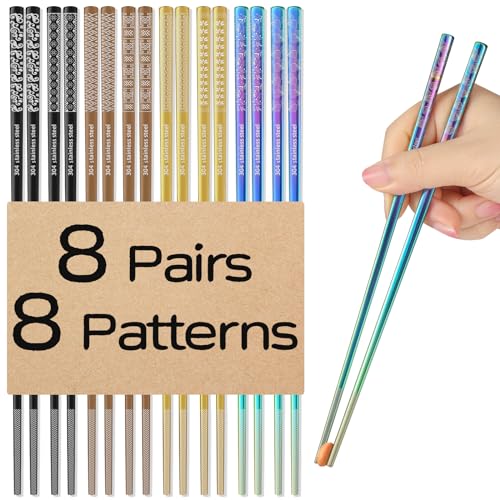
- NEWDRIP Multicolor Metal Chopsticks, 8 Pairs — Best Japanese Style for a Crowd
- Lazycorner 304 Stainless Steel Chopsticks, 10 Pairs — Best Bulk Buy (reviewed below, no purchase link)
- IQCWOOD 304 Stainless Steel Chopsticks, 5 Pairs — Best Declared Japanese Style Value
Read the full guide ↓ for what “Japanese style” actually means in geometry — length, tip and profile — how each set measures up, and how to spot a genuinely Japanese-shaped pair in a sea of generic steel.
Style, with chopsticks, is not decoration. It is geometry that a cuisine built over centuries. Japanese style means a comparatively short pair, because the meal arrives in front of one diner rather than in the middle of a table; a fine, pointed tip, because the cuisine asks you to separate fish from bone and lift single, delicate items; and a light, balanced shaft, because the grip is a precision grip rather than a power grip. Change any one of those three and the pair still works — chopsticks are forgiving tools — but it stops eating like a Japanese pair, and over a whole meal of small, precise bites you feel the difference in your hand and on the plate. Shoppers looking for the best japanese style chopsticks are, whether they know it or not, shopping for that geometry.
This guide judges six stainless steel sets against that geometry using only what their verified listings state: the style claim itself, the length where given, the tip and grip treatment, the steel and the count. Three sets claim the style and are linked. Three do not — a hollow-core lightweight set, a color-coded family set and a ten-pair bulk set — and they are reviewed honestly as what they are, because each is a good answer to a different question. Along the way we explain how Japanese geometry differs from Korean and Chinese, how to choose within the style, and how to hold and care for a pointed steel pair so the tips stay precise.
Key Takeaways
- Japanese style is geometry: shorter length, a fine pointed tip and a light precision balance — not a pattern, a color or a sushi photograph.
- Three sets here claim the style in their listings and are linked: the Greatamzor titanium-plated two-pair set, the NEWDRIP eight-pair set and the IQCWOOD five-pair set, the last of which names the Korean Japanese style outright.
- Stated lengths cluster at 9.25 inches for the linked multipacks — the long end of the traditional hashi band, but within it.
- On steel, a pointed tip needs texture to work: engraving and non-slip tip treatments are what keep the Japanese point from becoming a skating rink.
- The three prose-only sets fail on labeling, not quality: none of their listings claims Japanese style, and two do not even state a length.
- If you cook Korean as often as Japanese, the hybrid Japanese Korean listings here are a feature, not a compromise — the two styles are close cousins in length.
In this guide
Quick Picks
| Pick | Badge | Pairs | Length | Style as listed | Link |
|---|---|---|---|---|---|
| MUYOS Stainless Steel Chopsticks | Best Lightweight All-Rounder | 5 pairs | Not stated in listing | Not stated | See review below |
| Greatamzor Multicolor Stainless Steel Chopsticks | Best for Family Tables | 5 pairs | 9 1/4 inches | Not stated | See review below |
| Greatamzor Titanium Plated Stainless Steel Chopsticks | Best True Japanese Style | 2 pairs | Not stated in listing | Japanese Korean | Check on Amazon |
| NEWDRIP Multicolor Metal Chopsticks | Best Japanese Style for a Crowd | 8 pairs | 9.25 inches | Japanese Korean Chinese | Check on Amazon |
| Lazycorner 304 Stainless Steel Chopsticks | Best Bulk Buy | 10 pairs | Not stated in listing | Not stated | See review below |
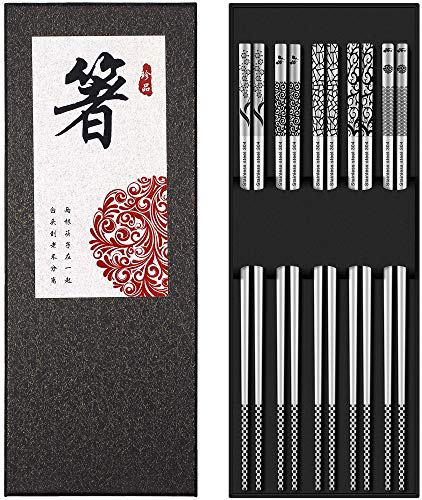
| IQCWOOD 304 Stainless Steel Chopsticks | Best Declared Japanese Style Value | 5 pairs | 9.25 inches | Korean Japanese style | Check on Amazon |
Notice what the style column does to this table: it splits six similar-looking steel sets into two honest groups. The linked three are the ones a buyer can choose on style evidence — a stated claim, and for two of them a stated length to back it. The prose-only three ask you to trust a photograph instead. For readers still deciding whether Japanese geometry is even the right geometry for their cooking, the explainer on the Best Kind Of Chopsticks works through all three regional styles before you spend anything.
How These Picks Were Chosen
We verified every set against its listing record first — exact title, pair count, steel, stated features — and allowed nothing into the spec boxes that the listing does not state. Then, for this style-focused guide, we applied the labeling rule strictly: a set is linked only when its own listing claims Japanese or Japanese Korean style. Three sets pass. The Greatamzor titanium-plated set lists Japanese Korean in its title; the NEWDRIP eight-pair set lists Japanese Korean Chinese; and the IQCWOOD set goes furthest, naming a Korean Japanese style outright alongside its 9.25 inch length. Three sets do not pass: the MUYOS, the multicolor Greatamzor and the Lazycorner listings describe general reusable steel chopsticks for daily meals, with no style claim — and in the MUYOS and Lazycorner cases, no stated length either.
Those three are still reviewed in full, as prose-only entries without links or product images, because a style guide that hid them would leave readers unable to judge the alternatives they will inevitably meet while shopping. Each prose-only review names exactly what is missing — the claim, the length, or both — so you can weigh the set’s real virtues, like the MUYOS hollow-core lightness or the Lazycorner ten-pair value, against the absence of style evidence.
As with every guide on this site, the work is research-led: verified specifications compared carefully, owner-feedback themes weighed qualitatively, and no invented hands-on claims. We print no star ratings and no review counts, because those figures drift constantly and would date the guide, and we print no prices — the Check on Amazon links show the current figure on the day you shop. One scope note: every set here is stainless steel, so this is a guide to Japanese style in steel. If you already know steel is your material and want the metal-only ranking, the companion shortlist for Best Japanese Style Chopsticks Stainless Steel narrows the field further.
The 6 Best Japanese Style Chopsticks, Reviewed in Detail
MUYOS Stainless Steel Chopsticks, 5 Pairs, Silver
Badge: Best Lightweight All-Rounder
Strengths
- Hollow-core design keeps the pair light, which suits the light precision grip Japanese style assumes.
- Non-slip tips give the pointed end something to hold on to.
- Plain silver finish and five pairs make it an easy, matches-everything household set.
Trade-offs
- No Japanese style claim in the listing — reviewed here without a purchase link.
- No stated length, so the defining measurement of the style cannot be checked from the listing.
- The featherweight feel divides users; some find it insubstantial for heavier items.
Spec box: Material: stainless steel, hollow-core design · Pairs: 5 · Length: not stated in listing · Finish detail: non-slip tips · Care: dishwasher safe · Finish color: silver
The MUYOS set is a study in almost. Its hollow-core lightness genuinely suits Japanese eating — hashi are meant to disappear into a precision grip, and a light pair tires the hand least across a long meal of small bites — and its non-slip tips address the pointed tip’s natural weakness on steel. If you handled it blind, you might guess it was designed with this style in mind. But a style guide runs on evidence, and this listing offers none: no Japanese claim, and no length, which is the one number that could have made the case on its own. We therefore review it as what it verifiably is — a well-conceived lightweight all-rounder for daily meals — and leave the link off.
The honest limitation is the same gap viewed from the buyer’s side: without a stated length, you cannot know whether you are getting hashi proportions or a longer general-purpose pair, and those eat very differently at a sushi plate. Readers who love the hollow-core idea and do not mind verifying dimensions independently will find a comfortable, dishwasher-safe set here. Readers who want the style confirmed before money changes hands should choose among the three linked sets below, where the claim — and usually the length — is in writing.
Best for: diners who prize a light pair and are relaxed about formal style labeling / Not suited for: buyers who want the Japanese style and its length confirmed in the listing
Greatamzor Multicolor Stainless Steel Chopsticks, 5 Pairs
Badge: Best for Family Tables
Strengths
- At a stated 9 1/4 inches, its length sits inside the traditional hashi band.
- Square non-slip shaft with laser-engraved texture — the profile cannot roll and the grip is secure.
- Five colors let each family member keep a personal pair, a genuinely Japanese household habit.
Trade-offs
- No Japanese style claim in the listing — reviewed here without a purchase link.
- Its signature copper coin pattern is a Chinese motif, not a Japanese one.
- The bright finish suits family tables better than formal Japanese settings.
Spec box: Material: stainless steel, multicolor finish · Pairs: 5 · Length: 9 1/4 inches · Finish detail: laser-engraved copper coin pattern, square non-slip shaft · Care: dishwasher safe
Geometry says this set could pass as Japanese style: 9 1/4 inches is hashi length, the square shaft is stable and grippy, and the engraved texture gives the tips purchase on fish and noodles. Even its color-coding echoes a real Japanese custom — in many households each person has their own pair, recognized at a glance. What it does not have is the claim. The listing presents a multicolor gift set decorated with a copper coin pattern, a motif from Chinese tradition, and says nothing about Japanese style at all. In a guide whose entire promise is the style, that absence is decisive, so the set is reviewed in full and linked nowhere.
None of that diminishes it as a family set — for a mixed-cuisine household it may be the most practical entry in this whole guide, and its maker is the same one behind two of the linked picks. The honest limitation is presentational coherence: on a carefully set Japanese table, rainbow steel with coin engraving looks like what it is, a cheerful generalist set visiting a formal occasion. Buy it independently for family life if you like; buy one of the linked sets when the style itself is the occasion.
Best for: families who want color-coded personal pairs at hashi length / Not suited for: formal Japanese table settings or buyers who need the style claim in the listing

Greatamzor Titanium Plated Stainless Steel Chopsticks, 2 Pairs
Badge: Best True Japanese Style
Strengths
- Listed explicitly as a Japanese Korean chopstick — the style claim is in the title, not the photography.
- Titanium-plated finish in black and silver gives a personal, giftable two-pair set a distinctive look.
- Laser-engraved non-slip texture keeps the fine tip useful on sashimi and noodles.
Trade-offs
- Only two pairs — a personal or couple’s set, not a household solution.
- The listing does not state a length, so hashi proportions rest on the style claim rather than a measurement.
- A plated finish prefers gentle washing to stay pristine.
Spec box: Material: stainless steel, titanium plated · Pairs: 2 · Length: not stated in listing · Finish detail: laser engraved, non-slip · Colors as listed: black, silver · Style as listed: Japanese Korean · Presentation: gift set
This is the connoisseur’s pick of the six: a two-pair gift set whose listing actually commits to the Japanese Korean style, finished in titanium plating that gives the black pair a deep, almost ceramic darkness and the silver pair a soft luster plain steel does not have. The engraving is not decoration pasted onto the concept — it is the grip system, and on a style of chopstick whose whole point is a fine tip doing precise work, a textured tip is what separates a usable pair from a slippery sculpture. As a personal set for one diner or a couple who eat Japanese food often and carefully, it is the most style-faithful object in this guide.
The limitations are count and confirmation. Two pairs means the set is a jewel, not infrastructure — guests and families need one of the multipacks. And while the style is claimed, the length is not stated, so the meticulous buyer must take the proportions partly on the maker’s word; the listing’s Japanese Korean designation is a promise about exactly that geometry, which is why we accept it here, but we note the missing measurement because this guide notes it everywhere. If you want the same maker’s approach with the length in writing, the multipack below provides it; if you want the most deliberate, personal expression of the style, this is the set — and households shopping for younger diners should remember that all six sets here are adult pairs, with the Best Kids Chopsticks guide covering shorter training designs instead.
Best for: individuals and couples who want the style claimed, finished beautifully and used personally / Not suited for: families, guests or anyone who needs more than two pairs

NEWDRIP Multicolor Metal Chopsticks, 8 Pairs
Badge: Best Japanese Style for a Crowd
Strengths
- Eight pairs with the Japanese style claimed in the listing and a stated 9.25 inch length.
- Multicolor finish preserves the personal-pair custom even at family scale.
- Laser-engraved non-slip texture and dishwasher-safe steel throughout.
Trade-offs
- The listing claims Japanese, Korean and Chinese styles at once, which dilutes the purity purists want.
- Eight pairs is a lot of storage for small kitchens.
- Multicolor finishes read casual next to lacquered or plain-steel formal sets.
Spec box: Material: stainless steel, multicolor finish · Pairs: 8 · Length: 9.25 inches · Finish detail: laser engraved, non-slip · Care: dishwasher safe · Style as listed: Japanese Korean Chinese
The NEWDRIP set is the crowd-pleaser: eight pairs, colors to go around, the Japanese style claimed in writing and a 9.25 inch length that keeps the claim geometrically honest. That combination — claim plus measurement plus count — is rarer than it should be, and it makes this the easiest recommendation in the guide for a household that eats Japanese food weekly and hosts for it monthly. The engraved texture does the same grip work as on the other linked sets, and the multicolor finish turns the eight-pair count from a storage problem into a system: each regular diner claims a color, guests take what remains, and the dishwasher rotation never leaves the drawer empty.
The honest limitation is the triple claim. A listing that promises Japanese, Korean and Chinese styles in one breath is describing a versatile mid-length pair, not a specialist instrument — the three styles differ, and no single geometry is the purest form of all three. For most households that versatility is the point; for a diner building a strictly traditional Japanese setting, the two-pair Greatamzor above makes the narrower promise. Either way, the claim is stated and the length is stated, so the buyer knows exactly what is being promised — the standard this guide asks of every set. Shoppers whose tables lean Korean on other nights will find the same set discussed from that angle in the Best Korean Chopsticks roundup.
Best for: families and hosts who want the Japanese style claimed, measured and multiplied by eight / Not suited for: purists who want a single-style specialist pair
Lazycorner 304 Stainless Steel Chopsticks, 10 Pairs
Badge: Best Bulk Buy
Strengths
- Ten pairs — the largest count here, enough for big families, parties and spares everywhere.
- 304 stainless steel, food grade and dishwasher safe, in a plain silver finish.
- Lightweight, non-slip design brief suits high-turnover everyday use.
Trade-offs
- No Japanese style claim in the listing — reviewed here without a purchase link.
- No stated length, so there is no way to verify hashi proportions from the listing.
- Bulk plain sets prioritize count over finish and tip refinement.
Spec box: Material: 304 stainless steel · Pairs: 10 · Length: not stated in listing · Finish detail: non-slip, lightweight · Care: dishwasher safe · Finish color: silver
Ten pairs is a statement of priorities: never run out. For a large family, a share house, a small restaurant-minded home cook or anyone who has ever served noodle soup to six people with four pairs in the drawer, the Lazycorner set solves the only problem that matters at that moment. The specification is honest basics — 304 food-grade steel, non-slip treatment, dishwasher safety, a plain silver finish that matches everything and shows nothing. As bulk infrastructure, it is the strongest offer in this guide.
As Japanese style, it offers no evidence at all: the listing claims no style and states no length, so under this guide’s rule it is prose-only. The honest limitation is refinement — bulk sets are built to a count and a price tier, and the tip finish and balance that a style-focused buyer is shopping for are exactly where such sets economize, even when the listing does not say so. Our advice is to treat this set as the foundation layer of a chopstick drawer — the everyday and overflow pairs — and to add one of the linked style-claimed sets as the pair you actually reach for when the meal is Japanese and the details matter.
Best for: large households and hosts who need count above all / Not suited for: style-led buyers who want the Japanese claim and length verified

IQCWOOD 304 Stainless Steel Chopsticks, 5 Pairs
Badge: Best Declared Japanese Style Value
Strengths
- The clearest style statement here: the listing names a Korean Japanese style outright.
- Stated 9.25 inch length backs the claim with the measurement that defines the style.
- Five pairs in 304 stainless steel with non-slip tips — the complete everyday package.
Trade-offs
- 304 is the general-purpose grade; the 18/8 sets elsewhere in this program carry a richer alloy recipe.
- The hybrid Korean Japanese billing will not satisfy a buyer seeking a single-tradition pair.
- Plain silver finish is functional rather than giftable.
Spec box: Material: 304 stainless steel · Pairs: 5 · Length: 9.25 inches · Finish detail: non-slip tips, lightweight · Care: dishwasher safe · Style as listed: Korean Japanese style
If the titanium-plated Greatamzor is the connoisseur’s pick, the IQCWOOD is the evidence-lover’s. Its listing does the two things this guide keeps asking for: it names the style — Korean Japanese, in so many words — and it states the length, 9.25 inches, so the claim can be checked against the geometry instead of taken on faith. Five pairs is the right count for a couple or small family, 304 steel is the dependable general-purpose grade, and the non-slip tips complete a specification with no obvious hole in it. For a buyer who wants Japanese style in steel, verified on paper, at an everyday count, this is the most straightforward purchase in the guide.
The limitations are matters of tier and taste. The 304 grade is a step below the 18/8 and 18/10 alloys in nickel content — a difference that shows up over years of finish, not in a single meal — and the plain silver presentation is a workhorse look rather than a gift look. The hybrid billing deserves a word too: Korean and Japanese lengths genuinely overlap, so a Korean Japanese pair is a coherent product, but a diner who wants the shortest, most pointed expression of hashi should compare it with the two-pair set above. For the steel-specific ranking of sets like this one, our Best Korean Stainless Stell Chopsticks guide — which keeps that keyword’s original spelling — covers the same hybrid territory from the Korean side.
Best for: buyers who want the style named and the length stated, in a five-pair everyday set / Not suited for: gift buyers or single-tradition purists
Comparison Table
| Pick | Pairs | Length | Steel | Style claim | Link status |
|---|---|---|---|---|---|
| MUYOS | 5 | Not stated | Stainless, hollow-core | None | Prose-only — no style claim |
| Greatamzor Multicolor | 5 | 9 1/4 in | Stainless | None | Prose-only — no style claim |
| Greatamzor Titanium Plated | 2 | Not stated | Stainless, titanium plated | Japanese Korean | Check on Amazon |
| NEWDRIP Multicolor | 8 | 9.25 in | Stainless | Japanese Korean Chinese | Check on Amazon |
| Lazycorner | 10 | Not stated | 304 stainless | None | Prose-only — no style claim |
| IQCWOOD | 5 | 9.25 in | 304 stainless | Korean Japanese style | Check on Amazon |
The style claim column tells the story of this whole guide at a glance. Three listings make the claim; two of those back it with a stated length; one — the IQCWOOD — does both most explicitly. The three unclaimed sets are not bad chopsticks; they are uncommitted ones, and the comparison a careful buyer makes is between commitment and count, finish and flexibility.
How to Choose Japanese Style Chopsticks
Learn the three measurements of the style. Length first: Japanese pairs live in the shorter band, roughly 8.5 to 9.5 inches for adults, because the food comes to the diner. Tip second: look for a genuine taper to a fine point, the feature that makes fish work and garnish placement possible. Profile third: Japanese pairs are usually round or lightly squared and slender, held in a pencil-like precision grip. A listing that states the style and the length lets you verify two of the three before buying; the tip you judge from the grip treatment the listing describes — engraving or non-slip texture near the point is the steel proxy for a well-finished tip.
Understand what the hybrid labels mean. Japanese Korean is a coherent hybrid because the two styles are neighbors: Korean pairs run slightly longer and flatter, Japanese pairs slightly shorter and pointier, and a hybrid sits between them, versatile across both cuisines. Japanese Korean Chinese, claimed by the NEWDRIP set, stretches the promise further — Chinese lengths are meaningfully longer — so read a triple claim as versatility, not specialization. None of this is dishonest; it is a spectrum, and where you want to sit on it depends on how many cuisines your table actually serves. The full spectrum is mapped in our guide to the Best Kind Of Chopsticks To Buy, which is the right read before a first purchase.
Match material expectations to steel. This guide covers Japanese style in stainless steel, which buys you dishwasher safety, odor resistance and a decades-long service life. What steel cannot reproduce is the warm, naturally grippy feel of bamboo or the featherweight of good wood — the traditional materials. If your heart is set on the traditional hand-feel, buy the style in bamboo and accept the hand-washing; if your priority is a pair that eats precisely and washes without thought, steel in the right geometry is the modern answer, and the grip treatments in these listings close most of the feel gap.
Count and finish come last. Decide the count by household — two pairs for a personal set, five for a couple or small family, eight to ten for hosts — and the finish by setting: plated and black finishes for deliberate, personal tables; plain silver for invisibility; colors for family systems. Buyers furnishing a table for children as well as adults should source the children’s pairs separately, in the shorter training formats covered by the kids guide linked earlier, rather than handing a small diner a full-size steel pair and hoping for the best.
How to Hold, Use and Care for Pointed Steel Chopsticks
Japanese style assumes technique, and a pointed steel pair rewards learning it properly:
- Seat the lower stick in the web of the thumb, resting on the ring finger, and keep it still — it is the platform, not a pincer.
- Hold the upper stick as you would a pencil, with thumb, index and middle finger, and let it do all the moving.
- Grip in the upper third. A pointed pair gripped too low becomes twitchy; gripped at the very end, the fine tip loses its precision.
- Align the tips before the first bite by tapping them gently, tips together, on the plate edge — aligned tips are the difference between picking up a bean and chasing it.
- Use the points as the cuisine intends: slide under a section of fish, lift along the bone line, and place — do not spear — small items.
- Rest the pair on a rest or across the bowl between bites, and set them down together, parallel, when you finish.
Care for steel is brief by design. Dishwasher washing is fine for every set here; hand-wash plated finishes if you want them pristine. Dry before storing to prevent water spots, and store pairs together — a drawer organizer or a jar, tips up — so the fine points are not dulled or bent by heavier cutlery. Inspect tips occasionally: a pointed steel tip that has been bent by a fall can usually be eased back by hand, and catching it early keeps the pair’s precision intact.
Troubleshooting. Problem: the tips cross or scissor instead of meeting → what to do: your upper-stick grip is too tight or too low; relax the hand, move the grip up, and practice opening and closing slowly over a bowl of beans. Problem: sashimi and smooth items slide off the point → what to do: approach from a shallow angle so the textured zone, not just the polished point, contacts the food, and lift smaller pieces. Problem: hand fatigue during long meals → what to do: check that you are not squeezing; a precision grip should feel like holding a pen loosely, and a lighter pair such as a hollow-core design can help while technique develops.
Japanese Style Versus Korean and Chinese Geometry
Because three of these listings claim more than one style, it is worth being precise about the differences. Japanese pairs are the shortest and the pointiest, built for individual servings and fish. Korean pairs are a touch longer, most often metal, and frequently flat-sided — a profile that grips slippery fermented and pickled foods and survives the heat of stews and tabletop grills. Chinese pairs are the longest, shaped to reach across shared platters and into hot pots while keeping fingers away from steam and oil. A household that cooks across all three cuisines can honestly be served by one mid-length hybrid pair, which is what several listings here offer. A household that cooks one cuisine deeply will feel the specialist geometry every meal. Neither choice is wrong; confusing the two — buying a hybrid while expecting a specialist — is the only real mistake, and it is the mistake this guide’s linking rule exists to prevent.
Why the Label Matters More Than the Photograph
Chopstick listings are photographed beautifully and labeled loosely, and the gap between the two is where buyers get misled. A generic steel pair photographed on a sushi board is still a generic steel pair when it arrives; the photograph describes the food, not the tool. The listing title, by contrast, is the maker’s own specification — the place where length, material and style are either committed to or quietly omitted. This guide’s insistence on the title over the image is not pedantry: it is the only standard a reader can reproduce when shopping alone. Apply it everywhere. When a listing claims the style and states the length, you are buying evidence. When it offers only a mood, you are buying a hope — sometimes a fine hope, as the prose-only sets here show, but a hope priced and described as one.
There is also a fairness point in the makers’ favor that this standard reveals. The three prose-only makers here did not claim a style they could not support, and their listings are, in their own terms, accurate descriptions of good general products. The two Greatamzor product lines show the contrast within a single brand: the same company writes “Japanese Korean” into one title and leaves it out of another, which suggests the words are being used deliberately, as specifications rather than decoration. When makers use style words carefully, buyers can use them confidently — and rewarding that care, by linking the sets that claim accurately and describing the rest without penalty beyond the missing link, is how a guide keeps the whole market honest rather than merely policing it.
Reading a Chopstick Listing Like a Spec Sheet
Since this guide keeps returning to what listings do and do not say, it is worth setting out the reading method itself, because it transfers to every chopstick purchase you will ever make. Read a listing in four passes. First pass, identity: what does the title claim the product is — which styles, which material, how many pairs? A title that names a style is making a testable promise; a title that names only foods is making none. Second pass, dimensions: find the length, and treat its absence as information. Makers state the dimensions that flatter the product; a missing length on a style-led product usually means the length is unremarkable for that style, which is itself a reason to look at a set that states it. Third pass, mechanism: how does the pair solve grip? Engraving, texture, square profiles and tip treatments are all real answers with different feels; a listing that says only “non-slip” without naming the mechanism is asking you to trust the adjective. Fourth pass, care and construction: dishwasher safety, steel grade, solid or hollow construction. Those four passes take under a minute, and they convert a page of marketing into a small spec sheet you can compare across brands — exactly the comparison the table in this guide models.
Apply the method to this guide’s own six and the pattern sharpens. The IQCWOOD listing survives all four passes: style named, length stated, tip mechanism named, grade and care stated. The titanium-plated Greatamzor survives three and a half — the length pass comes back blank. The NEWDRIP survives all four but spends its identity pass on three styles at once, which the method teaches you to read as breadth rather than depth. The MUYOS and Lazycorner listings fail the first two passes while passing care and construction comfortably, which is the signature of a good general product wearing no style ambitions. And the multicolor Greatamzor passes dimensions and mechanism with ease while its identity belongs to another tradition entirely. None of these judgments required handling a single pair — only reading carefully — and that is the point: in a category sold almost entirely online, careful reading is the hands-on test available to you, and it is more reliable than the photography that usually replaces it.
One more habit completes the method: check the claim against the cuisine you cook. A stated Japanese style matters most if your table is Japanese most nights; it matters little if the pair will spend its life in noodle soup, fried rice and takeout dumplings, where a hybrid or general pair is honestly the better tool. The goal of reading listings this way is not to become a purist. It is to make the product’s promises and your actual habits meet in the middle, on paper, before the box arrives — which is the only moment when changing your mind is free.
Common Buying Mistakes
- Judging style by the food in the photo. Sushi in the picture says nothing about the pair. Read the title for the style claim and the length.
- Treating a triple-style claim as a specialist promise. Japanese Korean Chinese means versatile mid-length. Buy it for versatility, not purity.
- Ignoring the unstated length. Length is the style’s defining number. A listing that omits it asks for trust it has not earned.
- Buying pointed steel with no tip texture. A polished point on wet fish is a lesson in frustration. Engraving or non-slip treatment is functional, not decorative.
- Confusing count with quality. Ten pairs of an unclaimed, unstated set do not add up to one verified Japanese-style pair.
- Handing adult steel pairs to small children. The style includes shorter training formats for young diners; use them, and keep adult pairs for adult hands.
Final Recommendation
Choose by the strength of the promise you need. For the most complete everyday evidence — style named, length stated, five pairs, honest steel — the IQCWOOD 304 set is this guide’s default recommendation. For a household at scale, the NEWDRIP eight-pair set keeps the claim and the measurement while multiplying the count. For a personal pair with the most deliberate finish, the titanium-plated Greatamzor two-pair set is the connoisseur’s choice. The three prose-only sets remain sensible purchases for lightness, color-coding and bulk respectively — once you understand that what they are selling is utility, not a verified Japanese style.
Frequently Asked Questions
What defines Japanese style in chopsticks?
Three geometric traits: a shorter length suited to individual place settings, a fine pointed tip for precise work such as separating fish from bone, and a light, slender profile held in a precision grip. Decoration, color and the food in the product photo are not part of the definition — which is why this guide judges listings by their stated style and length.
Can one pair really be Japanese, Korean and Chinese style at once?
It can be a versatile mid-length pair that serves all three cuisines acceptably, which is what a triple claim honestly means. It cannot be the purest form of each, because the styles differ in length and profile by design. Buy triple-claimed sets for mixed-cuisine flexibility, and single-style sets when one cuisine dominates your table.
Why do some listings here have no purchase link?
Because their listings do not claim Japanese style. This guide links only sets whose own listing makes the claim — three of the six — and reviews the rest in full without links, naming what each does well and what evidence it lacks. It is the same standard you can apply yourself: claim plus stated length beats photography.
Is 9.25 inches the right length for Japanese style?
It sits at the long end of the traditional adult hashi band, which runs roughly from 8.5 to 9.5 inches, so yes — it is within the style, and it suits larger hands and diners who also eat Korean dishes. Smaller hands often prefer a pair nearer 9 inches. What matters is that the length is stated, so the choice is yours rather than the listing’s secret.
Are pointed tips harder for beginners?
Slightly, at first — a fine point is less forgiving of a loose grip than a blunt tip. The learning curve is short, and texture near the tip helps considerably. Beginners who struggle can start with textured, square-profile pairs and progress to finer points; children should start with the shorter training designs made for them rather than adult pointed pairs.
Does the steel grade change the style?
No — grade changes durability and finish, not geometry. 304, 18/8 and 18/10 can all be made into a correct Japanese shape. Choose the shape on style evidence first, then let grade and finish decide between otherwise equal sets, keeping in mind that richer alloys hold their finish longer under daily dishwashing.