Disclosure: topratedkitchenware.com is reader-supported. When you buy through links on our site, we may earn an affiliate commission from Amazon and other retailers, at no extra cost to you.
Where to buy
Looking for the best japanese style chopsticks stainless steel can offer, without wading through the whole guide? Five of the six sets below satisfy both halves of that phrase in their own listings — a Japanese style claim and stainless steel construction — and those five carry purchase links. One set, a ten-pair bulk buy in honest 304 steel, makes no Japanese claim at all, so it is reviewed in full but without a link: steel alone does not make a pair Japanese, any more than the Japanese label alone would excuse the wrong material for this keyword.
- Greatamzor Titanium Plated Stainless Steel Chopsticks, 2 Pairs — Best Overall in Japanese Steel
- NEWDRIP Multicolor Metal Chopsticks, 8 Pairs — Best for Families and Guests
- Lazycorner 304 Stainless Steel Chopsticks, 10 Pairs — Best Bulk Steel (reviewed below, no purchase link)
- IQCWOOD 304 Stainless Steel Chopsticks, 5 Pairs — Clearest Style Claim in Steel
- Greatamzor 18/8 Stainless Steel Chopsticks, 5 Pairs — Best 18/8 Five-Pair Set
- NEWDRIP 18/8 Stainless Steel Chopsticks, 8 Pairs — Best 18/8 Eight-Pair Set
Read the full guide ↓ for how the steel grades differ, what steel does to the Japanese shape, and which of these five linked sets fits your household’s size and style.
Pairing Japanese style with stainless steel is a deliberate modern compromise, and it helps to understand both sides of it before choosing a set. The style contributes the geometry: a shorter pair, a fine pointed tip, a light precision balance shaped by individual servings and a fish-centered cuisine. The steel contributes the ownership experience: no warping, no staining, no odor retention, dishwasher safety and a service life measured in decades rather than seasons. What steel takes away is the natural grip and warmth of bamboo — which is why every serious steel set in this guide replaces that lost grip artificially, with laser engraving, textured tips or non-slip treatments, and why judging a steel hashi is mostly a matter of judging how well its maker solved the smoothness problem. The best japanese style chopsticks stainless steel makers produce are the ones that solve it without blunting the point that defines the style.
This guide verifies both halves of the keyword for every set. All six are stainless steel — that much the whole group shares, in grades running from 304 through 18/8 to a titanium-plated finish. The Japanese half is where they separate: five listings claim Japanese or Japanese Korean style, and one, the Lazycorner bulk set, claims no style at all and states no length. That set is reviewed honestly as bulk steel infrastructure and left unlinked, while the five that satisfy the full keyword are linked and ranked. What follows is the detailed comparison, a steel-first buying guide, care instructions specific to steel, and the grade-by-grade explanation readers ask for most.
Key Takeaways
- This keyword has two tests — Japanese style and stainless steel — and a set must pass both in its listing to be linked. Five of the six sets do; the Lazycorner ten-pair set is steel without a style claim.
- The linked five span three finishes of steel ownership: titanium-plated (Greatamzor two-pair), 304 (IQCWOOD) and 18/8 (the Greatamzor five-pair and both NEWDRIP sets).
- On steel, the Japanese point only works with texture: every linked set uses engraving or non-slip tips to replace the grip bamboo provides naturally.
- Stated lengths for the linked sets are 9.25 inches where given — the long end of the hashi band — with the two-pair Greatamzor resting on its style claim rather than a stated measurement.
- Grade differences (304 versus 18/8) show up over years of finish and corrosion resistance, not in a single meal; tip texture and length matter more day to day.
- Steel’s honest costs are heat conduction and a cooler, heavier hand-feel than bamboo — manageable, and worth it for dishwasher life, but real.
In this guide
Quick Picks
| Pick | Badge | Pairs | Length | Steel | Link |
|---|---|---|---|---|---|
| Greatamzor Titanium Plated Stainless Steel Chopsticks | Best Overall in Japanese Steel | 2 pairs | Not stated in listing | Stainless steel, titanium plated | Check on Amazon |
| NEWDRIP Multicolor Metal Chopsticks | Best for Families and Guests | 8 pairs | 9.25 inches | Stainless steel | Check on Amazon |
| Lazycorner 304 Stainless Steel Chopsticks | Best Bulk Steel | 10 pairs | Not stated in listing | 304 stainless steel | See review below |
| IQCWOOD 304 Stainless Steel Chopsticks | Clearest Style Claim in Steel | 5 pairs | 9.25 inches | 304 stainless steel | Check on Amazon |
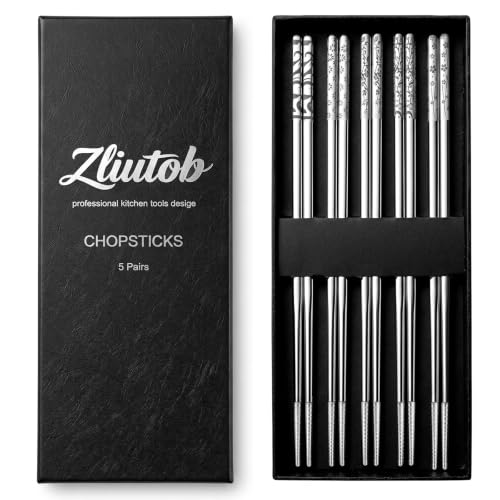
| Greatamzor 18/8 Stainless Steel Chopsticks | Best 18/8 Five-Pair Set | 5 pairs | 9 1/4 inches | 18/8 stainless steel | Check on Amazon |
| NEWDRIP 18/8 Stainless Steel Chopsticks | Best 18/8 Eight-Pair Set | 8 pairs | 9.25 inches | 18/8 stainless steel | Check on Amazon |
Read this table as a two-key sort. The steel column tells you what ownership will feel like in five years; the style evidence, detailed in each review, tells you what dinner will feel like tonight. The single prose-only row is not a punishment — it is the only set whose maker declined to claim the style, and its ten-pair value is real for the buyers who need count more than geometry. If your household has not yet settled the prior question of material at all, the overview of the Best Kind Of Chopsticks compares steel with bamboo, wood and fiberglass before you commit.
How These Picks Were Chosen
Each set was first verified against its listing record — exact title, brand, pair count, steel description, stated length and stated features — and only listing-stated facts appear in the spec boxes. The linking rule for this keyword is a conjunction: the listing must present the set as stainless steel and as Japanese or Japanese Korean style. Five sets pass both halves. The Greatamzor titanium-plated set claims Japanese Korean; the NEWDRIP multicolor set claims Japanese Korean Chinese; the IQCWOOD names a Korean Japanese style; and the two 18/8 sets — Greatamzor’s five-pair and NEWDRIP’s eight-pair — both claim Japanese Korean in their titles. The Lazycorner set passes the steel half completely and the style half not at all: no style claim, no stated length. It is therefore reviewed in full as a prose-only entry, with no link and no product image, and its review explains the bulk role it genuinely fills.
Within the linked five, ranking weighed the things steel buyers can actually verify: whether the length is stated, how the grip is engineered, the steel grade or finish, and the count’s fit to real households. We did not reward any set for photography, and we did not penalize the hybrid Japanese Korean listings — the two styles are close in length, and a hybrid claim honestly stated is worth more than a pure claim a listing cannot support.
The guide is research-led throughout. Specifications come from the verified listings; judgments draw on the recurring patterns in owner feedback about steel chopsticks — tip slipperiness, finish wear, weight — weighed qualitatively. We print no prices and no fixed ratings or review counts, because both change too quickly to belong in a guide meant to stay useful; the Check on Amazon links carry the live figures. A scope note for younger households: every set here is an adult full-size pair, and the separate guide to Best Kids Chopsticks covers the shorter training formats designed for children.
The 6 Best Japanese Style Stainless Steel Chopsticks, Reviewed in Detail

Greatamzor Titanium Plated Stainless Steel Chopsticks, 2 Pairs
Badge: Best Overall in Japanese Steel
Strengths
- Japanese Korean style claimed in the title, in a titanium-plated finish no other set here offers.
- Laser-engraved non-slip texture — the grip solution is built into the surface, not added on.
- Two pairs in black and silver make a deliberate personal set with a spare.
Trade-offs
- Two pairs only; households and hosts need a multipack alongside.
- Length is not stated, so proportions rest on the style claim.
- Plated finishes reward gentle washing if you want them flawless for years.
Spec box: Material: stainless steel, titanium plated · Pairs: 2 · Length: not stated in listing · Finish detail: laser engraved, non-slip · Colors as listed: black, silver · Style as listed: Japanese Korean · Presentation: gift set
Start with the finish, because it is doing more than looking handsome. Titanium plating gives stainless steel a harder-wearing colored surface than paint or lacquer, and in the black version it produces the deep, matte darkness that makes this pair read almost like lacquered wood from across the table — a small aesthetic bridge between the traditional material and the modern one. Under the finish, the specification is the complete steel-hashi argument: Japanese Korean style claimed outright, engraved texture where the fingers and the food meet, and a two-pair gift format that frames the set as personal equipment rather than kitchen stock. For one diner or a couple, it is the most considered object in this guide.
The limitations are the ones its format guarantees. Two pairs cannot serve a family or a dinner party, and a household that loves this set will end up buying a multipack for everyone else anyway. The unstated length is the second caveat: the style claim implies hashi proportions, and we accept the maker’s word as the listing’s evidence, but the measurement itself is not published — a gap the IQCWOOD set below does not have. Finally, treat the plating kindly: it is listed for ordinary use and the set is a gift-grade product, but abrasive pads are not its friends. None of this dethrones it as the best single expression of Japanese style in steel here; it simply defines the buyer — someone choosing a personal pair, carefully.
Best for: individuals and couples who want the finest finish and a claimed Japanese style in a personal set / Not suited for: families, hosts or buyers who want the length printed in the listing

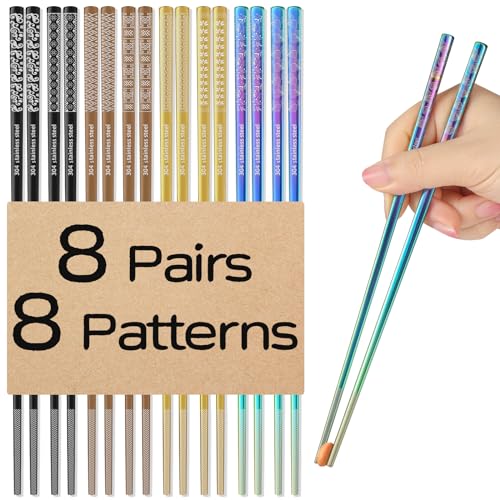
NEWDRIP Multicolor Metal Chopsticks, 8 Pairs
Badge: Best for Families and Guests
Strengths
- Eight pairs with Japanese style claimed and a stated 9.25 inch length in stainless steel.
- Multicolor finish keeps personal pairs identifiable at family scale.
- Laser-engraved grip and dishwasher safety across the whole set.
Trade-offs
- The triple style claim (Japanese Korean Chinese) signals versatility over specialization.
- The listing describes the steel generically, without a grade such as 304 or 18/8.
- Eight pairs need real drawer space and an organizer to stay tidy.
Spec box: Material: stainless steel, multicolor finish · Pairs: 8 · Length: 9.25 inches · Finish detail: laser engraved, non-slip · Care: dishwasher safe · Style as listed: Japanese Korean Chinese
This is the set that turns Japanese steel from a personal choice into household infrastructure. Eight pairs mean the style survives contact with real family life: pairs in the dishwasher, pairs in lunch bags, pairs claimed by color at the table, and still a clean pair in the drawer. The evidence is in order — the style is claimed, the 9.25 inch length is stated, the engraved grip is specified — so a buyer is not asked to trust anything that is not written down. For a household that eats Japanese food weekly and feeds guests monthly, no other set in this guide removes as much friction per purchase.
Two honest notes keep the review balanced. The listing claims three styles at once, which the experienced reader now knows means a versatile mid-length geometry rather than a purist instrument; families cooking across Asia will call that a feature, and traditionalists will reach for the two-pair set above instead. And the steel is described without a grade — it is stainless steel, dishwasher safe and engraved, but a buyer who cares about the difference between generic stainless and a named 18/8 alloy should look at the two 18/8 sets that close this guide, where the alloy is part of the promise. Within its own terms — count, color system, claimed style, stated length — this set is complete.
Best for: families and hosts who want claimed Japanese style in steel, eight pairs deep / Not suited for: alloy-focused buyers or single-style purists
Lazycorner 304 Stainless Steel Chopsticks, 10 Pairs
Badge: Best Bulk Steel
Strengths
- Ten pairs of food-grade 304 stainless steel — the deepest stock in this guide.
- Lightweight, non-slip design brief suits everyday high-turnover use.
- Plain silver finish, dishwasher safe, matches any existing flatware.
Trade-offs
- No Japanese style claim in the listing — reviewed here without a purchase link.
- No stated length, so hashi proportions cannot be verified from the listing.
- Bulk sets prioritize count; tip refinement is not their selling point.
Spec box: Material: 304 stainless steel · Pairs: 10 · Length: not stated in listing · Finish detail: non-slip, lightweight · Care: dishwasher safe · Finish color: silver
Every chopstick drawer needs a foundation layer, and this is the foundation layer in its purest form: ten pairs of 304 steel, plainly finished, built to be used, lost, replaced from the same box and never worried about. Large families, share houses, party hosts and anyone who has ever counted pairs at the door of a noodle night will recognize the value instantly. The 304 grade is the honest general-purpose alloy — the same family of steel as most kitchen sinks and cookware — and for bulk everyday pairs it is entirely fit for purpose.
It is prose-only in this guide for a clean, single reason: the keyword asks for Japanese style and stainless steel, and this listing delivers only the steel. No style is claimed and no length is stated, so there is no evidence on which to link it as a Japanese product, and we do not manufacture evidence. The honest limitation follows from its design brief — a set engineered to a count will not lavish attention on tip finish, and the diner who cares about the fine point that defines hashi should buy one of the linked sets for the meals that matter and let this set carry the everyday load. Used that way, as infrastructure beneath a style-led pair or two, it may be the most sensible purchase in the entire roundup.
Best for: large households, hosts and anyone building a deep, worry-free stock of steel pairs / Not suited for: buyers who need the Japanese style claimed and measured

IQCWOOD 304 Stainless Steel Chopsticks, 5 Pairs
Badge: Clearest Style Claim in Steel
Strengths
- Names the Korean Japanese style outright and states the 9.25 inch length — claim and measurement together.
- Five pairs of 304 stainless steel with non-slip tips: the complete everyday specification.
- Lightweight build keeps the precision grip comfortable over long meals.
Trade-offs
- 304 is the general-purpose grade, a step below 18/8 in nickel content.
- The hybrid Korean Japanese billing is versatile rather than single-tradition.
- Plain silver finish is a workhorse look, not a gift look.
Spec box: Material: 304 stainless steel · Pairs: 5 · Length: 9.25 inches · Finish detail: non-slip tips, lightweight · Care: dishwasher safe · Style as listed: Korean Japanese style
The IQCWOOD set is the evidence champion of this guide. Its title performs the two acts of honesty this keyword requires in a single breath: it names the style — Korean Japanese style, stated as a style rather than sprinkled as a keyword — and it states the length, 9.25 inches, so the geometry behind the claim can be checked. Around that core, the rest of the specification is sensibly complete: five pairs, 304 steel, non-slip tips, lightweight construction, dishwasher safety. A buyer who reads listings the way this site teaches — claim, dimensions, mechanism, care — will find every box ticked here, which cannot be said of any other set in the roundup at this count.
Its limitations are tier, not truth. The 304 alloy is the general-purpose grade, and the two 18/8 sets below carry a richer recipe that will hold a finish longer across years of dishwashing; whether that difference is worth choosing on depends on how long you keep chopsticks, and for most households the honest answer is that tip texture matters more. The hybrid billing, again, is versatility stated plainly. If your table is Japanese most nights and Korean some, this set is arguably the most rational purchase in the guide; the full Korean-side treatment of hybrid steel pairs lives in our Best Korean Chopsticks roundup for readers who want the comparison from that direction.
Best for: buyers who want style and length both in writing, in a five-pair everyday steel set / Not suited for: alloy-first buyers or those seeking a gift presentation
Greatamzor 18/8 Stainless Steel Chopsticks, 5 Pairs
Badge: Best 18/8 Five-Pair Set
Strengths
- 18/8 stainless steel with the Japanese Korean style claimed and a 9 1/4 inch length stated.
- Laser-engraved non-slip pattern — grip engineered into the surface.
- Five pairs in a gift-ready set from the maker of this guide’s top pick.
Trade-offs
- The engraved pattern is decorative as well as functional; minimalists may prefer plain steel.
- Five pairs is a couple-scale count; larger households should look at the eight-pair sets.
- Steel’s heat conduction still applies — this is an eating set, not a cooking tool.
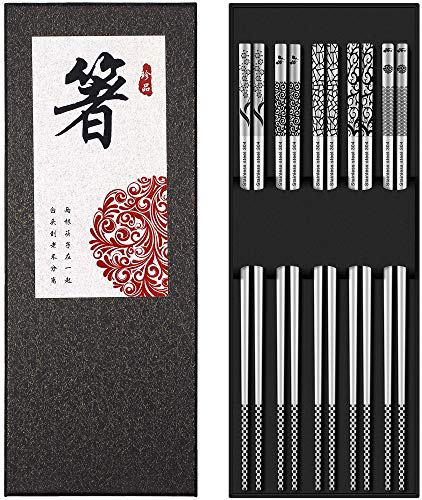
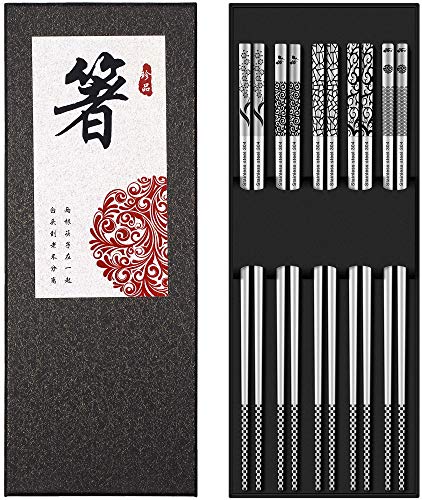
Spec box: Material: 18/8 stainless steel · Pairs: 5 · Length: 9 1/4 inches · Finish detail: laser engraved, non-slip · Care: dishwasher safe · Style as listed: Japanese Korean
If the IQCWOOD wins on paperwork, this Greatamzor set wins on alloy. 18/8 is the grade quality flatware is made from — chromium for stain resistance, a full measure of nickel for corrosion resistance and finish — and in a product that will be dishwashed hundreds of times, that recipe is the difference between a set that looks new in year three and one that looks tired. The rest of the evidence is equally complete: Japanese Korean style claimed, 9 1/4 inches stated, laser engraving doing the grip work, five pairs in a gift-ready box. It is, specification for specification, the most conventionally excellent set in this guide — the one with no asterisk anywhere.
What keeps it from the top badge is emphasis rather than any flaw: the titanium-plated set is the more distinctive personal object, and the NEWDRIP sets serve crowds better. The honest limitations are small and shared — engraving that reads as decoration to some eyes, a five-pair ceiling for hosting, and steel’s universal heat conduction at the table. For a couple or small family who want the alloy, the claim and the length in one purchase, this is the set we would buy with our own money, and readers assembling a first full collection can see where it sits in the wider market in the Best Kind Of Chopsticks To Buy guide.
Best for: couples and small families who want the 18/8 alloy with style and length both stated / Not suited for: large households or buyers who dislike engraved decoration

NEWDRIP 18/8 Stainless Steel Chopsticks, 8 Pairs
Badge: Best 18/8 Eight-Pair Set
Strengths
- Eight pairs in named 18/8 stainless steel — the alloy and the count together.
- Japanese style claimed, 9.25 inch length stated, laser-engraved non-slip grip.
- Uniform design keeps a big table looking consistent, course after course.
Trade-offs
- Uniform pairs mean no personal color or design per diner.
- The listing’s three-style claim reads as versatility rather than specialization.
- A working set’s plain presentation will not double as a gift.
Spec box: Material: 18/8 stainless steel · Pairs: 8 · Length: 9.25 inches · Finish detail: laser engraved, non-slip · Care: dishwasher safe · Style as listed: Japanese Korean Chinese
Close the guide with the set that combines the two virtues the others split between them: the 18/8 alloy of the Greatamzor five-pair set and the eight-pair depth of the NEWDRIP multicolor set — here in a single uniform design. For a household that has decided on Japanese style in steel and simply wants the drawer solved, this is the one-box answer: claimed style, stated length, engraved grip, named alloy, and enough pairs that the dishwasher’s schedule stops dictating the menu. Uniformity, often listed as a drawback, has a real table virtue too — a set table of eight identical pairs looks intentional in a way a rainbow of colors does not, which matters at the dinner parties this count is bought for.
The honest limitations mirror its siblings’: the three-style claim is breadth, not depth; there is no personal-pair system unless you add rings or a second design; and eight pairs is more steel than a solo diner will ever need. None of that obscures what the set is — the most complete household specification in this guide, and the natural upgrade path for a couple who started with the five-pair 18/8 set and found themselves washing pairs between courses. Buyers tempted by novelty finishes instead might glance at the Best Lightsaber Chopsticks category for the light-up end of the chopstick world — a reminder that this guide’s steel sets are the serious end of the market, chosen for decades of dinners rather than a single themed evening.
Best for: households and hosts who want 18/8 steel, claimed style and eight-pair depth in one box / Not suited for: solo diners or households built around personal, distinguishable pairs
Comparison Table
| Pick | Pairs | Length | Steel | Style claim | Link status |
|---|---|---|---|---|---|
| Greatamzor Titanium Plated | 2 | Not stated | Stainless, titanium plated | Japanese Korean | Check on Amazon |
| NEWDRIP Multicolor | 8 | 9.25 in | Stainless | Japanese Korean Chinese | Check on Amazon |
| Lazycorner | 10 | Not stated | 304 stainless | None | Prose-only — steel only, no style claim |
| IQCWOOD | 5 | 9.25 in | 304 stainless | Korean Japanese style | Check on Amazon |
| Greatamzor 18/8 | 5 | 9 1/4 in | 18/8 stainless | Japanese Korean | Check on Amazon |
| NEWDRIP 18/8 | 8 | 9.25 in | 18/8 stainless | Japanese Korean Chinese | Check on Amazon |
Two sorts explain this table. Sort by evidence and the IQCWOOD and the two 18/8 sets lead — claim, length and alloy all in writing. Sort by role and the picture rearranges: the titanium set is the personal jewel, the eight-pair sets are the household engines, the Lazycorner is the foundation layer. A well-built drawer often contains two rows of this table, not one.
How to Choose Japanese Style Chopsticks in Stainless Steel
Verify both halves of the keyword. Japanese style means the listing claims it and, ideally, states a length in the 9 to 9.25 inch region where these sets cluster. Stainless steel means the listing says so — and the better listings name the grade or finish. A set missing either half is a different product wearing this keyword’s clothes; this guide links only the five that state both.
Read the grades without superstition. 304 is the general-purpose food grade: chromium-rich, rust-resistant, entirely adequate. 18/8 adds a fuller nickel share, which buys better corrosion resistance and a finish that survives years of dishwashing with more of its shine. 18/10, seen elsewhere in this program, adds a touch more nickel again. Titanium plating is a surface treatment rather than an alloy — it hardens and colors the exterior of a steel core. In a single meal, you cannot feel the difference between these. Across five years of daily washing, you can see it. Choose the grade for your time horizon, and never let it outrank length and tip texture, which you feel at every bite.
Judge the grip mechanism, not the grip adjective. Every listing here says non-slip; the useful question is how. Laser engraving cuts a permanent texture into the surface — it cannot wear off, because it is the surface. Textured or treated tips concentrate grip where the food is held. Square profiles stop rolling and brace the fingers. On a pointed Japanese tip, at least one of these mechanisms is the difference between a precise tool and a pair of knitting needles at a sushi plate, so treat a listing with no named mechanism as an unproven claim.
Then count, finish and forget. Two pairs for a personal set, five for a couple or small family, eight to ten for hosts and big households. Black and plated finishes for deliberate tables, plain silver for invisibility, colors for family systems. Once those decisions are made, steel asks nothing more of you — which is, in the end, the entire argument for it. The Korean-steel mirror of this guide, Best Korean Stainless Stell Chopsticks, applies the same two-test method to the flatter Korean profile, typo and all, for readers whose tables run that way.
How to Use and Care for Stainless Steel Hashi
Steel changes the care routine more than the eating technique, but both deserve a clear pass:
- Grip in the upper third, lower stick still on the ring finger, upper stick moving like a pencil — steel’s weight makes a low, tight grip tiring faster than bamboo does.
- Let the textured zone do the work on slippery foods: contact the food with the engraved or treated section, not only the polished point.
- Never leave a steel pair soaking in hot broth or resting across a hot pan; the shafts conduct heat to your fingers within moments.
- Wash in the dishwasher freely for plain and engraved steel; hand-wash plated and black finishes if keeping them pristine matters to you.
- Dry before storing — steel does not rust in normal use, but standing water leaves spots that make a good set look neglected.
- Store pairs together, tips protected, and check tips seasonally for bends from drops or drawer jams; a gentle hand-straightening restores most.
The deeper care truth about steel is that neglect shows slowly and recovers well. A water-spotted pair polishes back with a soft cloth and a drop of vinegar. A pair that has lived in a cutlery drawer for a year needs nothing but a wash. Compare that with lacquered wood, where one dishwasher cycle can end the finish permanently, and the steel bargain explains itself — you trade a little warmth at the table for a tool that forgives almost everything you do to it afterward.
Troubleshooting. Problem: white spots or a rainbow film after dishwashing → what to do: it is mineral deposit, not damage; wipe with a cloth dampened with vinegar and dry by hand. Problem: food slips despite the engraving → what to do: your contact point has drifted to the polished section above the texture; choke the grip slightly so the textured zone meets the food. Problem: the pair feels too heavy by the end of long meals → what to do: loosen the grip first — most fatigue is tension, not weight — and consider a hollow-core or lightweight set for marathon dinners.
Steel Grades, Explained at the Table
Readers ask about the numbers constantly, so here is the whole story in one place. Stainless steel resists rust because chromium in the alloy forms an invisible protective layer on the surface. Nickel, the second number in grades like 18/8 and 18/10, deepens that resistance and gives the metal its warm, slightly rich shine; the first number is the chromium share. 304 is the same family expressed in the AISI numbering system rather than the ratio system, sitting close to 18/8 in spirit and slightly leaner in nickel as commonly produced. For chopsticks — which meet food, water and detergent, but no acids stronger than vinegar and no heat beyond a dishwasher — all of these grades are comfortably sufficient, and the practical ranking is about finish longevity: richer alloys spot less and shine longer. Titanium plating plays a different role, armoring and coloring the surface of the steel beneath it. Buy the geometry first, the grip second and the grade third, and the numbers will never mislead you again.
What Steel Does to the Japanese Point
The defining feature of the Japanese style is its fine point, and steel changes what that point can be. In bamboo or wood, a point is carved and then, inevitably, softens: fibers compress, edges round, and after a year of washing the tip that once separated fish cleanly has become a blunt instrument. In steel, the point is machined or formed once and holds its geometry essentially forever, which is why a steel hashi can stay precise across a decade of dinners. That permanence cuts both ways. A well-finished steel point is a precision tool for the life of the set; a poorly finished one — roughly ground, slightly asymmetric, or polished so smooth it cannot hold food — will stay exactly that disappointing for just as long. There is no breaking-in period that rescues it. This is the deepest reason the grip mechanism matters so much in this category: the texture near the tip is not an accessory to the point, it is the other half of it, supplying the friction the material removed.
Weight tells a similar story. A solid steel pair carries its mass along the whole shaft, which steadies the tips for experienced users — the pair feels planted, deliberate — and tires beginners, whose grip is usually tighter than it needs to be. Makers answer with thinner profiles and, in the wider market, hollow-core construction that strips the weight while keeping the silhouette. None of the five linked sets here claims a hollow core, so expect the honest, planted feel of solid steel and judge whether your household’s hands will enjoy it across a long meal. Diners transitioning from bamboo should give steel a week of dinners before judging: the first two meals feel foreign, the next five recalibrate the hand, and by the end of the week most users report that the precision of the unchanging point has quietly won them over — provided the texture is there. A smooth, heavy, pointed steel pair with no grip treatment is the one combination this guide advises against in any grade, at any count, from any maker.
Finally, steel changes the sound and ceremony of the table in ways worth acknowledging. Steel on ceramic rings where bamboo whispers; steel in a metal sink clatters where wood is silent. None of this affects a single bite, but meals are atmospheres as well as nutrition, and households that love the quiet of a traditional setting sometimes keep one wooden pair for the most deliberate dinners and let steel carry the other three hundred nights a year. That hybrid drawer — steel for life, wood for ceremony — is not indecision. It is the mature form of the choice this keyword poses, and several of the sets above, the giftable two-pair set especially, seem designed by people who understood exactly that.
One last ownership note separates steel from every traditional material: steel pairs are effectively immune to the two accidents that kill wooden sets — the dishwasher cycle run by a helpful guest and the overnight soak in a sink of cooling water. Bamboo swells, lacquer blisters, wood warps; steel emerges from both merely wet. For households where utensils are shared, borrowed and occasionally mistreated by people who did not choose them, that immunity has a real cash value that never appears in a listing: the set you buy is the set you still own in five years. It is also why steel has become the default material for the Japanese-style sets sold to Western households, whose kitchens run on dishwashers in a way the style’s homeland historically did not. The five linked sets in this guide all assume that life — daily machine washing, shared drawers, the occasional drop — and are specified accordingly, with engraved or treated surfaces that survive it and alloys chosen to come out of it still shining.
Common Buying Mistakes
- Passing the steel test and skipping the style test. A ten-pair steel set with no style claim is not a Japanese set at any count. Check both halves of the keyword.
- Paying for a grade and ignoring the tip. You feel texture at every bite and grade at no bite. Engraving and tip treatment outrank alloy in daily use.
- Assuming non-slip is non-slip. The word is universal; the mechanisms are not. Prefer listings that name engraving, texture or profile.
- Cooking with eating pairs. Steel conducts heat and 9.25 inches is too short for wok work. Keep a separate long cooking pair at the stove.
- Scouring plated finishes. Abrasive pads will dull black and titanium-plated surfaces. Soft sponge, ordinary detergent, done.
- Buying one format for every job. A two-pair jewel and an eight-pair workhorse are different tools. Most satisfied households own one of each type.
Final Recommendation
For a personal pair, choose the finish and the claim together in the Greatamzor titanium-plated set. For a household, choose depth with the alloy named in the NEWDRIP 18/8 eight-pair set. Between those poles, the IQCWOOD offers the cleanest paperwork, the Greatamzor 18/8 five-pair set the most conventional excellence, and the NEWDRIP multicolor set the friendliest family system. The Lazycorner ten-pair set remains the right foundation buy once a style-led pair exists in the drawer. Every linked set here states both halves of the keyword — Japanese style, stainless steel — and that, more than any single badge, is what makes them the safe recommendations.
Frequently Asked Questions
What is the difference between 304 and 18/8 stainless steel?
They are close relatives described in different numbering systems. 304 is the general-purpose food grade; 18/8 names its recipe directly — about 18 percent chromium and 8 percent nickel — and typically carries a richer nickel share, which improves corrosion resistance and long-term finish. For chopsticks both are dishwasher safe and durable; 18/8 holds its looks longer under heavy use.
Does stainless steel change how Japanese chopsticks feel?
Yes, in three ways: steel is cooler to the touch, generally a little heavier than bamboo, and smoother — which is why steel sets add engraving or textured tips to recover grip. The geometry is unchanged, so a steel pair at hashi length with a fine, textured tip still eats like a Japanese chopstick; it simply feels like a modern one.
Why is one set in this guide not linked?
The Lazycorner ten-pair set is stainless steel but its listing claims no Japanese style and states no length, so it fails the style half of this keyword. It is reviewed in full as a bulk foundation set — a genuinely useful product — but linking it as a Japanese style product would claim evidence its maker never provided.
Are Japanese Korean hybrid sets a compromise?
Only if your table is strictly one cuisine. The two styles are close in length, so a hybrid pair serves both honestly, and every hybrid in this guide states the pairing openly. Purists building a single-tradition table should choose the narrowest claim; mixed-cuisine households are usually better served by the hybrid.
Can stainless steel chopsticks go in the dishwasher every day?
Yes — that is one of steel’s defining advantages, and every set here is listed as dishwasher safe. Plain and engraved finishes tolerate daily cycles indefinitely. Plated and black finishes are also listed as dishwasher safe, but hand-washing keeps decorative surfaces pristine longest; dry pairs after washing in hard-water homes to prevent spots.
Should my first Japanese-style set be steel or bamboo?
Choose steel if your kitchen runs on a dishwasher and you want one purchase to settle the question for years; choose bamboo if you are learning the cuisine’s table manners and want the traditional weight and grip while you do. Many households end up owning both — steel for the week, bamboo for the deliberate weekend meal — and the five linked sets in this guide are priced and counted as everyday equipment, which makes them the natural first half of that pairing whichever order you buy them in.
How long will a stainless steel set last?
Far longer than the household usually keeps track of. There is nothing to warp, splinter or wear through in normal use; the realistic end-of-life events are loss, a bent tip from a hard drop, or a decorative finish slowly dulling. It is common for a good steel set to outlast the kitchen it was bought in, which is why buying the right geometry once matters more than buying cheaply twice.