Disclosure: topratedkitchenware.com is reader-supported. When you buy through links on our site, we may earn an affiliate commission from Amazon and other retailers, at no extra cost to you.
Where to buy
The word guide in this keyword changes the job. A ranking tells you what to buy; the best reusable chopsticks guide should teach you how the buying is done, so that this purchase — and the next one, and the one you advise a friend through — is made well. The six sets below are therefore presented as worked examples of a method: each review names the decision the set represents, the evidence its listing provides, and the buyer for whom that evidence is decisive. All six are reusable stainless steel sets, verified through the Creators API on 2026-11-20, and all six are linked — five state reusable in their titles outright, and the LIXTONGR set is a solid 18/10 steel dining set listed as dishwasher safe, reusable by construction. Follow the method in order the first time; after that, it runs in about ninety seconds per listing, for life. Readers who want community field reports to cross-check the method will find them surveyed in Best Reusable Chopsticks Reddit.
- Zliutob Stainless Steel Chopsticks, 5 Pairs — the worked example for grip-first decisions.
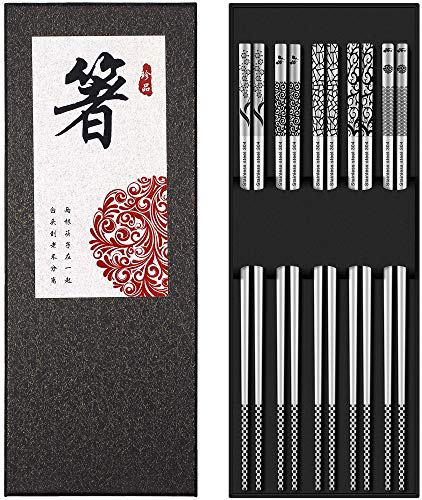
- LIXTONGR Dragon & Phoenix Black Stainless Steel Chopsticks, 2 Pairs — the worked example for documented-grade, gift-grade decisions.
- MUYOS Stainless Steel Chopsticks, 5 Pairs — the worked example for weight-and-comfort decisions.
- Greatamzor Multicolor Stainless Steel Chopsticks, 5 Pairs — the worked example for shared-household system decisions.
- Greatamzor Titanium Plated Stainless Steel Chopsticks, 2 Pairs — the worked example for finish-and-occasion decisions.
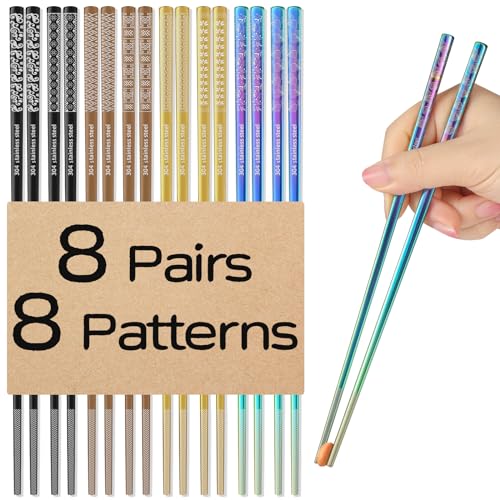
- NEWDRIP Multicolor Metal Chopsticks, 8 Pairs — the worked example for depth-and-consistency decisions.
Read the full guide ↓ for the five-step decision method itself, a complete how-to for using and keeping reusable chopsticks, and the worked reasoning behind every pick.
Most buying guides in this category are lists wearing a guide’s clothing. They rank six products, attach adjectives, and leave the reader exactly as equipped as before — dependent on the list, unable to judge the seventh product, the one that appears next season. This guide refuses that bargain. The six sets are here, reviewed fully and linked honestly, but they are organized as lessons: one set teaches you to read grip claims, another teaches you to read grade claims, another teaches the arithmetic of pair counts, another the logic of finishes. Learn the six lessons and the category is yours — you will be able to walk into any listing, in any future pool, and know within two minutes whether the product deserves your money and why.
The evidence base is the same disciplined one used across this cluster: listings verified through the Creators API on 2026-11-20, specifications quoted only from verified titles, gaps flagged in the open. Two of these six listings state no length. Several state no steel grade beyond the family name. In a ranking, those are embarrassments to step around; in a guide, they are teaching material — the absence of a claim is a claim about the maker’s priorities, and learning to price an absence is the most transferable skill in this entire article.
How to use what follows: read the method section first if you are new to the category, then the reviews as worked examples, then the how-to layer for the using and keeping of whatever you buy. If you are experienced, go straight to the reviews and audit our reasoning — a guide should survive being argued with, and this one is written to be argued with. Either way, by the final recommendation you will hold both a product choice and the method that produced it, and the method is the part that keeps working after the box is recycled.
Key Takeaways
- The method, in one line: document the material, interrogate the grip, check the dimensions, run the pair arithmetic, match the finish to the life.
- Each pick teaches one step: Zliutob teaches grip, LIXTONGR teaches documentation, MUYOS teaches weight, the multicolor Greatamzor teaches household systems, the plated Greatamzor teaches finishes, the NEWDRIP teaches depth.
- All six sets are reusable, steel, and dishwasher safe; the guide links all six and differentiates by the quality of each listing’s evidence.
- Absences are evidence: no stated length and no designated grade are priced into every review below.
- The how-to layer is part of the purchase: grip technique, washing routine, and storage decide whether a good set stays good.
- Apply the five steps to any future listing in about ninety seconds; that skill is this guide’s real product.
In this guide
Quick Picks
| Pick | Badge | The lesson it teaches | Link |
|---|---|---|---|
| Zliutob, 5 Pairs | Best for Learning Grip | Textured tips plus square grip: how to read a two-interface grip claim. | Check on Amazon |
| LIXTONGR Dragon & Phoenix, 2 Pairs | Best for Learning Documentation | 18/10 designated, length stated, box included: the complete evidence file. | Check on Amazon |
| MUYOS, 5 Pairs | Best for Learning Weight | Hollow-core construction: how a build decision becomes a comfort claim. | Check on Amazon |
| Greatamzor Multicolor, 5 Pairs | Best for Learning Systems | Color as ownership: how a finish can be a household management tool. | Check on Amazon |
| Greatamzor Titanium Plated, 2 Pairs | Best for Learning Finishes | Plating over steel: how to price a surface decision honestly. | Check on Amazon |
| NEWDRIP Multicolor, 8 Pairs | Best for Learning Depth | Eight engraved pairs: how consistency is manufactured and checked. | Check on Amazon |
How These Picks Were Chosen
The pool is this site’s verified chopsticks pool, confirmed through the Creators API on 2026-11-20, and the six sets assigned to the guide cluster happen to span the category’s decision space almost perfectly — which is why they were kept in assignment order and taught in that order. The linking rule matches the flagship’s: every genuine reusable set is linked. Five titles state reusable verbatim; the LIXTONGR title states 18/10 stainless steel, dishwasher safety, and a dining gift-box format, which is reusability by construction, and we say so openly wherever it matters, including the sources file.
The assessment method is the article: five steps, applied uniformly, with the results shown rather than summarized away. Step one, material documentation. Step two, grip engineering. Step three, dimensions. Step four, pair arithmetic against a household’s wash cycle. Step five, finish matched to intended life. A set can fail a step and still be recommended — the Zliutob fails documentation and leads the guide — because the steps are weighted by the buyer’s own priorities, and teaching that weighting is the guide’s purpose. This is research-led work: no hands-on testing is claimed, long-term behavior is reasoned from named materials and finishes, and every number in the article comes from a verified listing.
The 6 Best Reusable Chopsticks, Guided

1. Zliutob Stainless Steel Chopsticks, 5 Pairs — Lesson: Read the Grip
Badge: Best for Learning Grip
Strengths
- Textured tips address the food interface; a square grip section addresses the hand interface — both, in one listing sentence.
- The brief names sushi, ramen, and daily meals: the grip claim is aimed at the foods that test grip hardest.
- Five pairs, dishwasher safe, reusable — the supporting specifications are complete.
Trade-offs
- Step one fails softly: stainless steel is named, no grade is designated.
- Step three fails outright: no length is stated anywhere in the listing.
- No presentation format; the lesson is engineering, not ceremony.
Spec box (from the verified listing): Material: stainless steel (grade not designated in listing), stated reusable · Pairs: 5 · Length: not stated · Tips: textured · Grip section: square · Care: dishwasher safe · Use notes: sushi, ramen, daily meals
Here is how a guided review works. The listing’s central sentence describes textured tips and a square grip, and the method asks: friction at which interface? Tips touch food, so textured tips are a food-interface claim — they promise the pair will close on a wet noodle and hold it. A square section sits under the fingers, so it is a hand-interface claim — flat planes that keep the pair oriented without constant correction. Two interfaces, two mechanisms, both permanent because both are geometry rather than coating. That is what a strong grip claim looks like, and you can now recognize one anywhere: it names a mechanism, at a location, for a reason.
The same method, honestly applied, prices this set’s gaps. No grade designation means step one rests on the family name; no stated length means step three is a blank the buyer must accept or reject. We lead the guide with this set precisely because it teaches both halves of the skill — recognizing strong evidence and pricing missing evidence — in a single product. Buyers whose hands struggle will forgive the paperwork; buyers who cannot, have learned something equally valuable about their own priorities.
Best for: learners, noodle and sushi eaters, grip-first buyers / Not suited for: documentation-first buyers

2. LIXTONGR Dragon & Phoenix Black Stainless Steel Chopsticks, 2 Pairs — Lesson: Read the Documentation
Badge: Best for Learning Documentation
Strengths
- 18/10 stainless steel: the pool’s top grade designation, stated plainly.
- Length stated at 9 inches; non-slip grip; dishwasher safe; gift box — the evidence file is complete.
- Listed uses span dining, travel, housewarming, and wedding: the intended life is declared.
Trade-offs
- Step four is the constraint: two pairs serve a couple or a gift, not a family rotation.
- The decorated black finish is step five’s question — beautiful, and a commitment.
- The title does not print the word reusable; construction and care claims carry that step, as our method section discloses.
Spec box (from the verified listing): Material: 18/10 stainless steel · Pairs: 2 · Length: 9 inches · Grip: non-slip · Finish: black, dragon and phoenix motif · Care: dishwasher safe · Format: gift box · Listed uses: dining, travel, housewarming, wedding
Place this listing beside the Zliutob’s and the documentation lesson teaches itself. Where the first set offered mechanisms without paperwork, this one offers paperwork without elaborate mechanisms: a top designation, a published dimension, a declared use range, a protective format. The method’s point is not that paperwork beats engineering — the ranking of real purchases depends on the buyer’s weights — but that you should be able to see, at a glance, which kind of strength a set is selling. This set sells verifiability. Every claim it makes can be checked against a standard, a ruler, or a box.
Its teaching value includes its one nuance: the absent word. A guided buyer notices that reusable never appears in the title and asks the right follow-up — what in the listing establishes reusability? — and finds the answer in the construction: solid steel, dishwasher safe, a dining set in a storage box. Claims can be established by construction as well as by adjective, and knowing the difference makes you a sharper reader of every listing in every category, not just this one.
Best for: gift-givers, couples, verification-minded buyers / Not suited for: families needing rotation depth
3. MUYOS Stainless Steel Chopsticks, 5 Pairs, Silver — Lesson: Read the Weight
Badge: Best for Learning Weight
Strengths
- Hollow-core lightweight design: a build claim with a clear mechanism and a clear beneficiary — the daily hand.
- Non-slip tips answer the obvious objection to lightness, showing the design was thought through.
- Plain silver, daily-meals brief, dishwasher safe: the supporting claims are coherent.
Trade-offs
- Steps one and three are undocumented: no grade designation, no stated length.
- Lightness is a preference, not a universal good; heft-lovers will read the same claim as a warning.
- No identity system, no presentation — the lesson is purely about build.
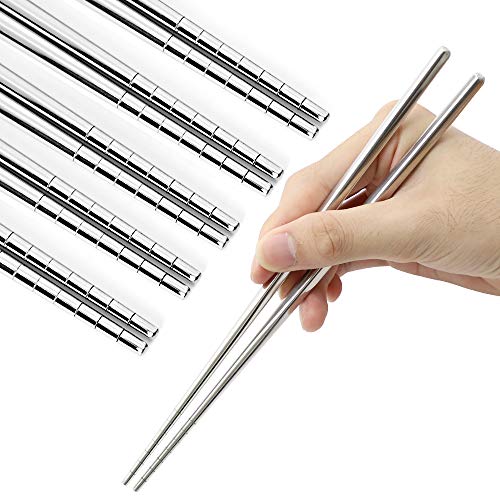
Spec box (from the verified listing): Material: stainless steel (grade not designated in listing), stated reusable · Pairs: 5 · Length: not stated · Build: hollow-core lightweight · Tips: non-slip · Finish: silver · Care: dishwasher safe · Use notes: daily meals
Weight claims are where guided reading earns its keep, because “lightweight” is an adjective until you find the mechanism — and here the mechanism is named: a hollow core. That single phrase converts marketing into engineering. It tells you how the weight was removed (structure, not thinner walls everywhere), what was kept (the steel surface and its dishwasher indifference), and what to expect in the hand (a pair that asks less of your grip across a long meal). The accompanying non-slip tips complete the reasoning chain: the maker anticipated that a lighter pair could feel less planted and engineered the contact points accordingly.
The lesson generalizes: for every comfort claim in any listing, demand the mechanism. Balanced, ergonomic, featherlight — adjectives all — become trustworthy exactly when a construction word stands behind them. This set also teaches the weighting step honestly: its documentation gaps are real, and a buyer who ranks paperwork first will rank it last. A guide does not hide that fork; it marks it, which we have now done twice, from both directions.
Best for: daily eaters, tired hands, mechanism-minded readers / Not suited for: heft-lovers and documentation-first buyers

4. Greatamzor Multicolor Stainless Steel Chopsticks, 5 Pairs — Lesson: Read the System
Badge: Best for Learning Systems
Strengths
- Multicolor finish across five pairs: an ownership system disguised as decoration.
- Laser engraved copper coin pattern on a square non-slip profile — grip by permanent mechanism.
- Length stated at 9 1/4 inches: step three satisfied.
Trade-offs
- Step one is family-level: stainless steel, no grade designated.
- The palette is a whole-table aesthetic decision that not every household wants.
- Five pairs is mid-depth; the system governs identity, not abundance.
Spec box (from the verified listing): Material: stainless steel (grade not designated in listing), stated reusable · Pairs: 5 · Length: 9 1/4 inches · Profile: square, non-slip · Pattern: laser engraved copper coin · Finish: multicolor · Care: dishwasher safe · Format: gift set
Beginners read finishes as decoration. Guided buyers ask what a finish does. This set’s colors do something specific and valuable: they assign. In any household where more than one person eats, an unmarked shared set creates a standing ambiguity about whose pair is whose and which pairs are clean; a color per person dissolves the ambiguity permanently, at zero ongoing effort. That is a system property, and it is worth more in a shared home than a grade designation — a sentence that would be heresy in a ranking and is simply true in a guide, because guides price features against lives, not against other features.
The supporting evidence is solid where it matters for the lesson: engraving supplies the permanent grip mechanism, the square profile supplies orientation and drawer behavior, the length is published. Step one’s family-level steel claim is the priced gap, noted as always. If your household is solo, this lesson is trivia and the set is merely pretty; if your household is plural, this may be the most useful five pairs in the article — and recognizing which of those readers you are is, itself, the skill being taught.
Best for: shared households, roommates, families with older children / Not suited for: solo minimalists and grade-first buyers

5. Greatamzor Titanium Plated Stainless Steel Chopsticks, 2 Pairs — Lesson: Read the Finish
Badge: Best for Learning Finishes
Strengths
- Titanium plated surface in black and silver: the finish is declared as a construction, not hinted as a color.
- Laser engraved non-slip detailing in a premium Japanese Korean style, gift set format.
- Dishwasher safe per the listing — the care claim is explicit even for a premium surface.
Trade-offs
- A plated finish is a surface: its long-term cosmetics depend on care in a way through-steel never asks.
- Steps one and three are thin: stainless named without a grade number, no length stated.
- Two pairs: an occasion instrument, not a rotation.
Spec box (from the verified listing): Material: stainless steel, titanium plated, stated reusable · Pairs: 2 · Length: not stated · Surface: laser engraved, non-slip · Colors: black, silver · Style notes: premium Japanese Korean · Care: dishwasher safe · Format: gift set
Finishes are where guided reading most often saves a buyer from a mismatched purchase, because finish language is where listings are most tempted to blur. The discipline is one question: is this surface the material, or on the material? Bare steel is the first kind — what you see is what the pair is, all the way through, and wear is a non-event. Plating is the second kind — a deliberate layer with its own virtues, color chief among them, and its own care logic. This listing, to its credit, declares the second kind in plain words: titanium plated, over stainless steel, in two colors. A guided buyer thanks it for the clarity and then prices the clarity: this is an occasion surface, bought for how it presents, kept with a softer sponge, and not mistaken for a through-material workhorse.
Notice what the method does not do: it does not call the plated set worse. It calls it categorized. In the right life — a gift, a celebration table, a couple’s Friday ritual — this is the correct purchase, and the guide that steered a gift-buyer away from it toward a ten-pack would have failed at guidance. The lesson is matching, and the matching variable is the life the pair will lead.
Best for: gifts and occasion tables, finish-led buyers / Not suited for: through-material purists and family rotations

6. NEWDRIP Multicolor Metal Chopsticks, 8 Pairs — Lesson: Read the Depth
Badge: Best for Learning Depth
Strengths
- Eight pairs: depth that runs a family wash cycle without a clean-pair crisis.
- Laser engraved non-slip surfaces — a machine-consistent grip treatment, repeatable across the set.
- Length stated at 9.25 inches; brief covers cooking and eating across Japanese Korean Chinese styles.
Trade-offs
- Step one is family-level stainless, undesignated.
- Depth multiplies the arrival check: eight pairs must be compared, not assumed consistent.
- Multicolor at eight pairs is the loudest table statement in the guide.
Spec box (from the verified listing): Material: stainless steel (grade not designated in listing), stated reusable · Pairs: 8 · Length: 9.25 inches · Surface: laser engraved, non-slip · Finish: multicolor · Style notes: Japanese Korean Chinese · Use notes: cooking and eating · Care: dishwasher safe · Format: gift set
The final lesson is arithmetic wearing a product’s clothes. Depth is a quality because availability is a quality: a reusable set that cannot produce a clean pair at the busiest moment has failed its only job, whatever its steel. Eight pairs is this guide’s deepest answer, and the manufacturing detail that makes depth trustworthy is the finish process — laser engraving is machine work, identical from pair to pair in a way hand-applied finishes struggle to match. The guided buyer therefore reads “eight pairs, laser engraved” as a consistency claim, and then verifies it with the two-minute arrival comparison the how-to section teaches.
Depth also has a donor function the other lessons hinted at: a deep set seeds the rest of a reusable life — a pair for the work drawer, a pair for the travel wrap, spares for guests — without new purchases. Priced against that system role, the undesignated steel and the bright palette are reasonable trades for the household this set is for. And with that, the six lessons close: grip, documentation, weight, system, finish, depth. Every listing you ever read in this category is some mixture of those six, and you now have a price for each.
Best for: families, hosts, and households seeding multiple locations / Not suited for: solo buyers and subdued tables
Comparison Table
| Pick | Lesson | Strongest step | Weakest step | Pairs | Link |
|---|---|---|---|---|---|
| Zliutob | Grip | Grip engineering | Documentation, dimensions | 5 | Check on Amazon |
| LIXTONGR | Documentation | Material evidence | Depth | 2 | Check on Amazon |
| MUYOS | Weight | Build mechanism | Documentation, dimensions | 5 | Check on Amazon |
| Greatamzor Multicolor | System | Household logic | Documentation | 5 | Check on Amazon |
| Greatamzor Titanium Plated | Finish | Declared surface | Dimensions, depth | 2 | Check on Amazon |
| NEWDRIP Multicolor | Depth | Consistency at scale | Documentation | 8 | Check on Amazon |
How to Choose: The Five Steps, In Order
Step one — document the material. Find the steel sentence. A designated grade or a numbered standard outranks a family name; a family name outranks silence. Write down which you found, because later steps are priced against it. Step two — interrogate the grip. Find the mechanism and its location: tips for food, sections for fingers, engraving for both. No mechanism named means your technique supplies the friction. Step three — check the dimensions. A stated length lets you match hand, bowl, and storage; an unstated one is a small, deliberate risk. Step four — run the arithmetic. Eaters times meals, divided by your washing rhythm, plus a margin; the answer is a pair count, and it outranks aesthetics. Step five — match the finish to the life. Through-material for the workhorse, plated or decorated for the occasion, color for the shared system. Then, and only then, compare prices and photographs — in a guide’s order, those come last, because they are the two things that cannot tell you how the pair will eat.
Two worked cautions close the method. First, steps are weighted, not averaged: a family that weights step four at half the decision will land on the NEWDRIP, a couple weighting step one will land on the LIXTONGR, and both are correct — the method’s job is to make the weighting conscious. Second, evidence ages: listings change, pools refresh, and the companion analyses in this cluster — including the safety-wording examination in Best Reusable Chopsticks Safe and the material contrast in Best Reusable Chopsticks Wood — should be read as of their check dates, exactly as this guide’s are.
How to Use and Keep Reusable Chopsticks: The Complete How-To
Grip, step by step. One: rest the lower stick across the base of your thumb and the ring finger; it stays still for the whole meal. Two: hold the upper stick like a pencil, between thumb, index, and middle finger. Three: move only the upper stick, opening and closing the tips like a hinge. Four: practice the close on something forgiving — a piece of bread, a large vegetable — until the tips meet at the same point every time. Five: graduate to the slippery test foods, noodles first, and let textured or engraved pairs teach your fingers what correct pressure feels like.
Eating. Take smaller loads than pride suggests; a reusable pair’s control rewards moderation. Rest the pair on a rest or the bowl rim between bites — never across the top of another diner’s bowl, never standing upright in rice, which carries funereal connotations in several of the traditions these styles come from. Serve from shared dishes with the serving end, or with a dedicated serving pair, if your household keeps that courtesy.
Washing and keeping. Rinse at the meal’s end; machine-wash freely, since all six sets here are listed as dishwasher safe; dry before the drawer. Weekly, brush engraved and textured zones. Monthly, lay the set out and compare pairs — the consistency audit that catches a bent or wandering pair early. Problem: tips no longer meet → the pair has likely been bent by drawer pressure; compare it against a sibling pair and retire or straighten your expectations accordingly. Problem: grip feels diminished → residue in the texture; soak hot, brush along the pattern. Problem: a finish looks tired → review the care match; plated surfaces want the soft sponge that through-steel never demands.
Worked Example: Guiding a Friend Through a Purchase
Imagine the message every experienced buyer eventually receives: “Which reusable chopsticks should I get?” The unguided answer is a product name. The guided answer is five questions. How many eaters, and how often? — that sets the depth step. What do you mostly eat? — noodles and sushi push grip to the top; varied family meals push depth. Do your hands tire? — a yes promotes the hollow-core lesson. Do you read labels? — a yes promotes documentation; a no promotes mechanisms you can feel. Is this for every day, or is there a gift or an occasion inside the purchase? — that settles the finish step. Five answers, and the six sets in this guide sort themselves: the family noodle house lands on depth plus engraving, the label-reading couple lands on the documented two pairs plus a workhorse five, the tired-handed solo eater lands on the light build without a moment’s regret.
Notice that the method never asked what the friend’s budget was, because within a product class like this one, fit failures cost more than price differences: a wrong set is re-bought, a right set is bought once. That is the deepest sense in which this is a guide rather than a ranking — it optimizes for the purchase you keep. Readers arriving from the typo’d variants of this search will find the same pool discussed in Best Reuzable Chopsticks, and the tradition-specific reading in Best Reusable Japanese Chopsticks rewards anyone whose five answers point toward Japanese-style dining.
Practice: The Method Applied to Three Hypothetical Listings
A method is only yours when you have used it on material you have never seen, so here are three invented listings — composites, not real products — to practice on before you shop. Listing A reads, in full: “Premium Chopsticks, Elegant Design, Perfect for Sushi Lovers, Great Gift.” Run the steps. Material: unnamed — fail. Grip: no mechanism — fail. Dimensions: absent — fail. Depth: unstated — fail. Finish: “elegant” is not a finish. Five fails in eleven words; the listing is a photograph with a price attached, and the guided buyer closes the tab without a flicker of doubt, however beautiful the photograph is. That speed is what the method buys you.
Listing B reads: “Bamboo Chopsticks, 6 Pairs, 9 Inches, Twisted Grip Design, Hand Wash Recommended.” Material: named, with a care consequence stated honestly. Grip: a mechanism, twisted geometry, at the hand interface. Dimensions: stated. Depth: stated, and the arithmetic is yours to run. Finish: the material is the finish, through and through. This listing passes the method in a different material than this guide’s pool — which is exactly the point. The steps did not ask whether the product resembled our six picks; they asked whether its evidence was complete, and it was. A guided buyer can buy outside the pool with confidence, because the method, not the pool, is doing the work.
Listing C is the interesting one: “Stainless Steel Chopsticks, 4 Pairs, Textured Tips, Dishwasher Safe, Restaurant Quality.” Material: family-level. Grip: one mechanism, at the food interface only. Dimensions: absent. Depth: four pairs — a solo or couple arithmetic. Finish: unaddressed. And one phrase, “restaurant quality,” that the method teaches you to translate: it means nothing checkable, so it earns nothing, and the set must stand on its textured tips and its care claim alone. Verdict: a legitimate small-household candidate with two priced gaps. Notice that the method produced neither love nor dismissal — it produced a profile, and profiles are what good decisions are actually made from.
After the Purchase: The Owner’s Half of the Guide
Guides usually end at the buy button, which is a pity, because half of what makes a set the best reusable chopsticks happens in your kitchen afterward. The owner’s half has four chapters. The first is placement: a set with an address — a drawer section, a holder, a wrap in the work bag — survives; a set without one dissolves into the general utensil population and is effectively lost while still in the house. The second is the wash loop, already taught above, whose entire virtue is brevity: rinse, machine, dry, home. The third is rotation discipline in deep sets: use the pairs in turn, because a set where two pairs do all the work ages unevenly and teaches you false lessons about its own consistency.
The fourth chapter is the annual review, and it takes ninety seconds once a year — the same ninety seconds as the listing method, which is a pleasing symmetry. Lay the set out. Count it: loss is data about your household’s real consumption rate, and next purchase’s arithmetic should use it. Inspect tips and textures in good light. Ask the only question that matters: is every pair here still one I would hand to a guest? Pairs that fail graduate to cooking duty, camping kits, or the work drawer, and the drawer stays honest. A reusable set maintained at that standard does not really wear out; it is curated, and the distinction is why some households are on their second set in a decade while others are on their ninth — with the same products available to both.
The Guide in One Page: A Checklist to Keep
For readers who keep checklists, here is the entire method stripped to its skeleton, suitable for a note on your phone. Material: designated or numbered beats family, family beats silent. Grip: a named mechanism at the tips, at the fingers, or both — count the interfaces covered. Dimensions: stated is a point in the maker’s favor before you even read the number. Depth: eaters times meals per wash cycle, plus margin, rounded up to a real set size. Finish: through-material for workhorses, declared surfaces for occasions, color where a household needs governing. Care: dishwasher safe is the class baseline; anything fussier must argue for itself. Arrival: two minutes, side by side, tips pinched, sticks rolled, surfaces felt. Ownership: an address, a short loop, an even rotation, an annual ninety-second review.
And one meta-rule that governs all the others: believe the listing’s facts, price its silences, and ignore its adjectives. Facts are the maker’s commitments. Silences are the maker’s choices. Adjectives are the maker’s hopes. A buyer who sorts every sentence of every listing into those three piles will rarely buy badly again — in this category, or, honestly, in most others where simple physical products are sold with complicated words.
Common Buying Mistakes
- Reading adjectives instead of mechanisms. Premium is not a mechanism; hollow-core is. Buy the second kind of word.
- Averaging the steps. A set that is average at everything serves a life that is specific. Weight your own steps.
- Skipping step four. Pair arithmetic is the step buyers skip and the one that decides whether the set works on a busy Tuesday.
- Buying a finish against its life. Plated glamour in a family rotation, or a ten-pack as a wedding gift — category errors, both.
- Never running the arrival audit. Two minutes of comparison converts claims into facts while returns are free.
- Treating the guide as a verdict. If your weighting differs from ours, your answer should too. That is the method working, not failing.
A Note on Evidence and Dates
Every product claim in this guide traces to a listing verified on 2026-11-20, and the guide should be read with that date attached. Listings are living documents: makers revise titles, clarify dimensions, and occasionally answer exactly the criticisms a guide like this one prints — a set that states no length today may state one next season, and the method will credit it the moment it does. That is why the guide teaches steps rather than freezing verdicts. The verdicts above are the steps’ honest output for this pool on this date; the steps themselves are the durable part, and they will re-derive the right answer from whatever evidence the next pool presents.
Final Recommendation
If you read nothing else, run the five steps on the Zliutob set and the LIXTONGR set side by side — grip’s champion and documentation’s champion — and notice which one’s evidence moves you. That reaction is your weighting, made visible, and it will choose correctly among the rest: the MUYOS if your hands spoke up, the deep NEWDRIP if your household did.
Our own weighting, for the record, lands where the flagship’s does: a documented, grippy, mid-depth set for the general household, with specialists routed to their lessons. But the guide’s honest closing is that the method is the recommendation. Products rotate; pools refresh; the five steps will still be standing, ready for the next listing you ever read.
Frequently Asked Questions
What is the first thing to check in a reusable chopsticks listing?
The material sentence. A designated grade or numbered standard is the strongest claim, a family name is serviceable, and silence is a stop sign. Everything else in the listing is priced against that first finding.
How do I know if a grip claim is real?
Look for a mechanism at a location: textured tips, a square grip section, engraving across the shaft. Adjectives without mechanisms — comfortable, easy, premium — are decoration, and should be priced as such.
Does a guide’s ranking matter more than my own priorities?
No. A guide’s job is to make your priorities operational. If your weighting of depth, documentation, weight, or finish differs from ours, your correct answer differs too — the five steps make that difference deliberate instead of accidental.
What if a listing does not state a length?
Price the absence: it is a small risk on fit that you can retire on arrival by measuring, while returns are easy. Two sets in this guide carry that gap, and we flagged both rather than guessing.
How many pairs does the guide’s arithmetic usually produce?
For a couple washing often, five pairs. For a family eating daily, eight to ten. The formula matters more than the figures: eaters times meals per wash cycle, plus a margin for guests, loss, and life.
Can I use this method for wooden or plastic chopsticks?
Yes — the steps are material-neutral. Documentation becomes species and finish claims for wood, heat tolerance for composites; grip, dimensions, arithmetic, and finish-matching work identically. Only the evidence vocabulary changes.
Where can I see this method argued with?
In the community discussions surveyed elsewhere in this cluster, where owners stress-test exactly these steps against years of daily use — which grips survived, which finishes disappointed, which documentation matched the object that arrived. A method that cannot survive field reports is a theory; this one was built to be checked against them.
Is this guide’s method useful for a single quick purchase?
Yes — that is its native habitat. The full article teaches the reasoning once; the checklist version then runs in about ninety seconds at the moment of any purchase, including a hurried one. Buyers who internalize only one habit should take this one: sort every sentence in the listing into fact, silence, or adjective, and spend in proportion to the facts.
How long should a careful buyer spend on the five steps?
About ninety seconds once the habit forms: fifteen seconds per step, plus fifteen to total the picture. The first few listings take longer, which is tuition, not inefficiency — the practice listings in this guide exist so that your first slow runs happen here, on composites, rather than at the moment of purchase. Speed is not the goal in itself; the goal is that no step gets skipped when a beautiful photograph is arguing for skipping.
What should I do when two steps point to different sets?
Follow your weighting, and make it consciously. If documentation says one set and grip says another, ask which failure you would rather live with daily — a thinner claim you read once, or a weaker grip you feel at every meal. Most buyers, asked that way, discover their true priority in seconds. The method’s job is to stage that question clearly, not to answer it for you.
Why does this guide link a set whose title omits the word reusable?
Because the LIXTONGR listing establishes reusability by construction — solid 18/10 steel, dishwasher safe, a dining set in a storage box — and a guide should teach the difference between a claim stated as an adjective and one established by the facts around it.