Disclosure: topratedkitchenware.com is reader-supported. When you buy through links on our site, we may earn an affiliate commission from Amazon and other retailers, at no extra cost to you.
Where to buy
If you are shopping for the best food processors for nutbutter, the six picks below are the shortlist this guide is built around. Nut butter is the hardest everyday job you can give a food processor: ten-plus minutes of continuous work against a thick, oily mass that climbs the bowl walls. The six machines below are the ones worth considering for that job, ordered by how honestly they handle it. One of them is reviewed prose-only, because its listing does not support the power this task demands.
- Cuisinart 14-Cup Food Processor — Best Overall · Check on Amazon
- Cuisinart FP-1400 14-Cup Food Processor — Best for Large Batches
- Cuisinart Pro Custom 11 Food Processor — Best Classic Design
- Ninja Professional Plus Food Processor BN601 — Most Powerful Listing
- Cuisinart Mini Food Processor 3-Cup — Best for Tiny Test Batches (Prose-Only) (reviewed below as a prose-only pick; see the notes in its review)
- Hamilton Beach 10-Cup Food Processor — Best Value Full-Size
Read the full guide ↓
If you are shopping for the best food processors for nutbutter, forget chopping speed for a moment. Nut butter is not a burst job. Whole nuts become crumbs, crumbs become a dry powder, the powder clumps into a stubborn ball, and only after several more minutes of scraping and running does that ball relax into a glossy, pourable butter. A machine that is brilliant for thirty seconds of salsa can fail completely at minute eight of almond butter, when the load is at its thickest and the motor has no rest.
That long, grinding middle stage is what separates the picks in this guide. Bowl size decides how much you can make at once, because a batch that is too small never forms the circulating mass the blade needs, and a batch that is too large stalls it. Motor strength, as stated in each listing, decides whether the machine keeps turning when the mixture is at its driest. Blade geometry and bowl shape decide how often you stop to scrape. None of this shows up in a quick dice test, which is why this guide judges every machine against the nut-butter sequence itself.
You will also find one honest demotion below. A small mini chopper appears in this roundup because readers ask about it for nut butter constantly, but its listing describes a reversible blade for chopping and grinding small quantities, with no power figure that supports sustained nut-butter work. It is reviewed in full, without a purchase link or photo, so you can see exactly where its ceiling sits. Readers building a broader whole-food kitchen may also want our companion guide to Best Food Processors For Paleo, which weights these same machines for sauces, shredding and batch prep instead.
Key Takeaways
- Nut butter needs sustained power, not burst speed: the dry, clumping middle stage is where weak motors stall.
- Match batch size to bowl size. Too little mixture never circulates; too much overwhelms the blade.
- A 720-watt or 1000PW-class listing is the safer signal for regular almond or mixed-nut batches.
- Roasted nuts release their oils far more willingly than raw nuts and shorten the grinding stage.
- Plan on scraping the bowl walls several times per batch; a bowl scraper accessory genuinely helps.
- Mini choppers suit a few spoonfuls of test batch at most, not a full jar, and one pick here is prose-only for exactly that reason.
In this guide
Quick Picks
The top of this list is all full-size bowls with the power listings to match. The mini chopper near the end is included for honesty about small test batches, and it is the one prose-only pick in this guide.
| Product | Badge | Why it is here | Amazon |
|---|---|---|---|
| Cuisinart 14-Cup Food Processor | Best Overall | 720-watt listing and a 14-cup bowl: the complete nut-butter package. | Check on Amazon |
| Cuisinart FP-1400 14-Cup Food Processor | Best for Large Batches | Newer 14-cup design with a sealed lid for the liquid final stage. | Check on Amazon |
| Cuisinart Pro Custom 11 Food Processor | Best Classic Design | The long-running 11-cup design, sized for one generous jar. | Check on Amazon |
| Ninja Professional Plus Food Processor BN601 | Most Powerful Listing | 1000PW listing with a puree preset and three blades. | Check on Amazon |
| Cuisinart Mini Food Processor 3-Cup | Best for Tiny Test Batches (Prose-Only) | Prose-only: a mini chopper with no stated power; test batches only. | Prose-only pick |
| Hamilton Beach 10-Cup Food Processor | Best Value Full-Size | 10-cup bowl, puree named in the listing, and a bowl scraper included. | Check on Amazon |
How These Picks Were Chosen
These picks were chosen by comparing verified listings for the qualities nut butter actually tests: stated motor power, bowl capacity, blade design, and whether the listing names puree or dough work, which signals a drivetrain built for thick loads. Every product name, capacity and power figure in this guide comes from the listing itself, checked on 2026-11-20. Where a listing gave no power figure and described a small chopper, the machine was not promoted on guesswork.
This is a research-led guide, not a hands-on lab report. No test kitchen claims are made here. Instead, each review reasons from the listed specifications and from the well-understood physics of the nut-butter process: oils release under sustained friction and warmth, the mass must keep folding over the blade, and any machine that cannot maintain circulation will leave you with nut powder and a hot motor housing.
Six machines are reviewed. Five carry Amazon links and listing photos. The Cuisinart Mini 3-Cup is prose-only: its listing describes chop and grind modes for a 24 oz bowl and states no motor power, so presenting it as a linked nut-butter recommendation would mislead. It still gets a full review, because for a two-tablespoon test batch of a new flavor idea, it has a narrow and legitimate use.
The 6 Best Food Processors for Nutbutter
Every review below judges its machine against the same sequence: whole nuts, crumbs, powder, the clumping ball stage, and the final glossy release. Batch size advice assumes roasted nuts, which behave far better than raw in every bowl.

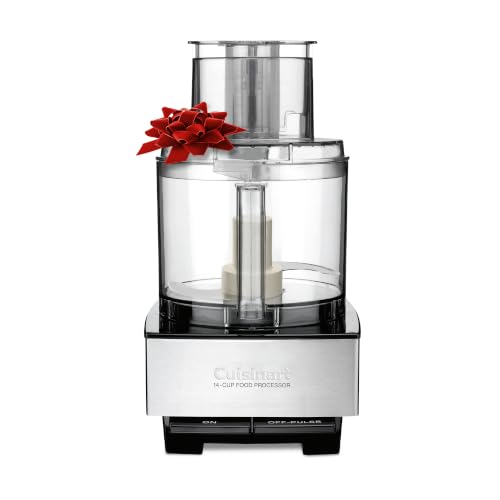
Cuisinart 14-Cup Food Processor
Badge: Best Overall
Strengths
- 720-watt motor stated in the listing, the clearest power signal in this roundup
- 14-cup bowl gives nut masses room to circulate instead of packing down
- Listing explicitly names puree and kneading dough, both thick-load jobs
Trade-offs
- Large footprint for a single-purpose nut-butter habit
- Big bowl means very small batches rattle around without forming a mass
- Stainless build is heavier to move on and off the counter
Key specs (from the listing)
- Capacity: 14-cup work bowl
- Motor: 720-watt
- Functions named in the listing: mincing, dicing, shredding, puree and kneading dough
- Finish: stainless steel
- Model: DFP-14BCNY
The Cuisinart DFP-14BCNY pairs a 14-cup bowl with a 720-watt motor, and that combination is the classic nut-butter formula: enough room for a family-size batch and enough stated power to keep the blade moving when the mixture turns to a dry, clumping ball. The listing names mincing, dicing, shredding, puree and kneading dough, and the last two matter here, because both are sustained thick-load tasks rather than quick bursts. In a bowl this size, a batch built from several cups of roasted almonds or peanuts has the depth to fold over the blade instead of smearing up the walls.
For nut butter specifically, the generous bowl is a double-edged advantage. It rewards cooks who make a full jar at a time and freeze or gift the surplus, and it punishes anyone hoping to test a quarter-cup of a new spiced blend, which will simply ride around the perimeter. Run this machine in the rhythm nut butter wants: continuous running through the powder stage, brief pauses to scrape the walls down, then patience while the oils release. Warm roasted nuts straight from a low oven shorten the ball stage noticeably in a large bowl.
Ownership details suit the job too. The wide bowl gives the finished butter somewhere to settle away from the blade when you stop, so the last scrape gathers nearly everything into the jar instead of leaving a ring behind. If you make nut butter for a household with mixed tastes, this is also the bowl in which to run a plain base batch and divide it: one jar plain, one jar with cocoa, one with warming spices, each finished with a few pulses rather than a second full process.
Best for: households making full jars of peanut, almond or mixed-nut butter weekly / Not suited for: small test batches under a cup, which never form a circulating mass


Cuisinart FP-1400 14-Cup Food Processor
Badge: Best for Large Batches
Strengths
- 14-cup large capacity for double batches and nut-butter gifts
- Leak-proof SealTight lid suits the final liquid stage of a run
- Dishwasher-safe parts and in-bowl storage simplify a greasy cleanup
Trade-offs
- Listing states no wattage, so power must be judged by class, not a number
- SealTight lid has more surfaces to wash after oily batches
- Full-size footprint, like the other 14-cup option here
Key specs (from the listing)
- Capacity: 14-cup large work bowl
- Lid: leak-proof SealTight design
- Slicing range named in the listing: 1 to 7 mm, plus shredding
- Also named: kneads dough
- Parts: dishwasher-safe, with in-bowl storage
- Model: FP-1400
The Cuisinart FP-1400 is the newer 14-cup design in this roundup, with a leak-proof SealTight lid, slicing from 1 to 7 mm, shredding, and dough kneading among its listed jobs. The listing does not state a wattage, so this guide will not invent one; what can be said is that it sits in the same full-size class as the 720-watt model above and is specced for dough, another sustained-load task. The sealed lid is a genuine nut-butter plus, because finished butter is a liquid and a long run throws oily spray at the lid seam.
Choose this one if your nut-butter habit is really a small production run: a double batch for the week, jars for family, or a base batch you split and flavor three ways. In-bowl storage keeps the blade and discs nested inside the bowl, which matters when a greasy processor otherwise colonizes a whole cabinet shelf. Work in one full batch rather than two half batches, scrape at the powder stage and again at the ball stage, and let the sealed lid contain the messy final minutes.
One practical note on the sealed lid: nut butter’s final stage throws a fine, oily mist, and in unsealed designs that mist migrates into lid seams and the pusher channel, where it is tedious to chase. A leak-proof lid keeps the mess in the bowl, where hot soapy water deals with it in one short processing rinse. For cooks who batch on a schedule, that difference in cleanup is the difference between a weekly habit and a monthly chore.
Best for: batch makers who process several cups of nuts at once / Not suited for: tiny single servings, where the big bowl cannot build a working mass

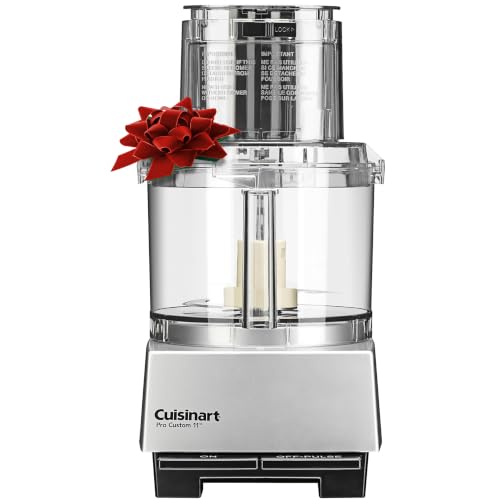
Cuisinart Pro Custom 11 Food Processor
Badge: Best Classic Design
Strengths
- 11-cup bowl is a sweet spot for one generous jar per batch
- Includes slicing and shredding discs for the rest of the week’s cooking
- Dishwasher-safe parts after an oily, stubborn cleanup
Trade-offs
- Listing states no wattage figure
- 11 cups fills up fast if you double a recipe
- Chrome finish shows oily fingerprints readily
Key specs (from the listing)
- Capacity: 11-cup work bowl
- Discs named in the listing: slicing disc and shredding disc
- Parts: dishwasher-safe
- Finish: stainless steel and chrome
- Model: DLC-8SBCYP1
The Cuisinart Pro Custom 11 has been a reference design in home kitchens for years: an 11-cup bowl, slicing and shredding discs in the listing, dishwasher-safe parts and a stainless and chrome finish. Eleven cups turns out to be a very natural nut-butter size. A batch of roughly three to four cups of roasted nuts sits deep enough to circulate, finishes as about a jar and a half of butter, and does not ask the machine to work at the ragged edge of its bowl. The listing states no wattage, so treat its power as class-typical rather than proven by a number.
This is the pick for the cook who wants one respected machine rather than the biggest machine. Its nut-butter manners are predictable: steady through the crumb stage, a ball stage that needs two or three scrapes, and a clean release once the oils come out. Because the discs handle cheese, potatoes and slaw the rest of the week, the processor earns its counter space beyond nut butter. If your batches keep growing, step up to a 14-cup bowl instead of overfilling this one, which only lengthens the scrape-and-run cycle.
There is also a confidence that comes with a long-running design: the loading habits are well understood. Fill it about halfway with roasted nuts for the smoothest run, expect the ball stage to need patience rather than intervention, and resist the urge to keep adding nuts once the butter has released, which restarts the whole cycle. Batches made this way come out consistent from jar to jar, which is what turns a recipe into a routine.
Best for: one-jar-at-a-time makers who also want discs for everyday prep / Not suited for: double batches, which crowd the 11-cup bowl


Ninja Professional Plus Food Processor BN601
Badge: Most Powerful Listing
Strengths
- 1000PW power figure is the highest stated in this roundup
- Auto-iQ presets include puree, a useful starting program for nut masses
- Three blade options and a 9-cup bowl suit varied batch styles
Trade-offs
- 9-cup bowl is smaller than the 14-cup options for big batches
- Preset programs still need manual scraping pauses
- Peak-power figures are not directly comparable with continuous wattage
Key specs (from the listing)
- Capacity: 9-cup bowl
- Power named in the listing: 1000PW
- Programs: Auto-iQ presets for chop, slice, puree and mixing dough
- Blades: 3 blade options named in the listing
- Feed chute and pusher included
- Parts: dishwasher-safe
- Model: BN601
The Ninja Professional Plus BN601 lists 1000PW of power, a 9-cup bowl, three blades, a feed chute with pusher, and Auto-iQ presets that chop, slice, puree and mix dough. A note on honesty: a peak-power figure is not the same measurement as a continuous wattage rating, so this guide does not claim the Ninja is simply stronger than the 720-watt Cuisinart. What the listing does establish is a machine specced and programmed for thick work, and the puree preset gives nut butter a sensible starting point before you take manual control of the scrape-and-run rhythm.
For nut butter, treat the presets as a first act, not the whole play. Start a batch on the puree program to get through crumbs and powder, then switch to manual runs with scraping pauses once the mass balls up, because no preset knows when the walls need attention. The 9-cup bowl concentrates a medium batch nicely, and the mass circulates with less dead space than in a 14-cup bowl. Households that also blend doughs and slice will feel the versatility; pure nut-butter devotees making huge batches should look at the larger bowls.
The three-blade set deserves a word of expectation-setting: for nut butter you will live on the main processing blade, and the additional blades serve the machine’s other jobs across the week. That is not a weakness. A processor bought for nut butter that also slices and mixes dough earns its storage space, and the BN601’s feed chute and pusher make it a genuine everyday machine rather than a single-task appliance that gathers dust between jars.
Best for: medium batches and cooks who like preset programs to start the process / Not suited for: the largest double batches, where 9 cups runs out of headroom
Cuisinart Mini Food Processor 3-Cup
Badge: Best for Tiny Test Batches (Prose-Only)
Strengths
- Reversible auto-reversing blade offers distinct chop and grind modes
- 24 oz bowl is the right size for a few spoonfuls of a new blend
- Brushed chrome mini footprint stores almost anywhere
Trade-offs
- Listing states no motor power for a job defined by sustained power
- 3-cup bowl cannot hold a jar-size batch of nuts
- Grind mode suits dry crumbs, not the long oily release stage
Key specs (from the listing)
- Capacity: 3-cup (24 oz)
- Blade: reversible, auto-reversing SmartPower blade
- Modes named in the listing: chop and grind
- Finish: brushed chrome
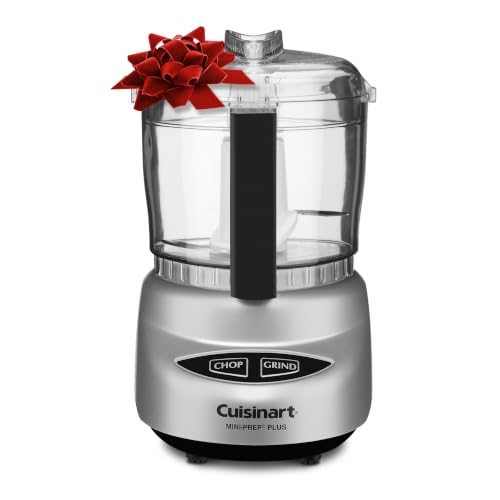
The Cuisinart Mini Food Processor is a 3-cup, 24 oz mini chopper with a reversible SmartPower blade that runs one way to chop and the other to grind, in a brushed chrome housing. It is a well-liked little machine for garlic, herbs, breadcrumbs and spice-scale jobs. It is included in this guide prose-only, with no purchase link, because its listing makes no power claim at all, and nut butter is precisely the job where an unstated, small-chopper motor is most likely to be overmatched. Presenting it as a linked recommendation would be a disservice.
Here is the narrow honest use: a test batch. If you want to know whether smoked paprika and a pinch of cinnamon belong in your next full jar of almond butter, a few tablespoons of nuts in this mini will tell you, ground in short bursts with rests between them. What it should not do is a full jar. The mass has nowhere to circulate, the run stretches far beyond a mini motor’s comfort, and the result is usually warm nut powder rather than butter. Treat it as a flavor laboratory, and let a full-size machine do the production work.
To be fair to this little machine, its grind mode produces excellent small quantities of nut meal and spice-nut blends for baking, and its chop mode handles a handful of nuts for a salad topping in seconds. Those are real virtues in a small kitchen. They simply are not nut butter production, and the distinction is the entire reason it appears here without a link: a guide that blurs that line sends readers home with the wrong tool for the job they described.
Best for: spoonful-size flavor experiments before committing to a full batch / Not suited for: any jar-size batch of nut butter

Hamilton Beach 10-Cup Food Processor
Badge: Best Value Full-Size
Strengths
- 10-cup capacity covers a standard jar batch comfortably
- Listing names puree among its core functions
- Included bowl scraper is genuinely useful mid-batch
Trade-offs
- Listing states no wattage figure
- Bowl scraper helps, but the ball stage still needs pauses
- Stainless finish is a styling layer over a value-focused build
Key specs (from the listing)
- Capacity: 10 cups
- Functions named in the listing: slicing, shredding, mincing and puree
- Accessory named in the listing: easy-clean bowl scraper
- Finish: stainless steel
- Model: 70730
The Hamilton Beach 70730 is a 10-cup processor whose listing names slicing, shredding, mincing and puree, with an easy-clean bowl scraper included and a stainless steel finish. Ten cups is enough bowl for a standard batch of peanut or almond butter, and the named puree function signals the blade work nut butter needs. Like several picks here, the listing states no wattage, so this guide positions it by class and function rather than by a number. Its standout detail is humble: that bowl scraper, purpose-shaped for exactly the wall-clinging stage nut butter is famous for.
Nut butter in this machine is a tidy, manageable process if you respect the scrape rhythm. The scraper clears the walls faster and more completely than a spatula improvised at an angle, which shortens the total run and leaves less butter stranded above the blade line. Peanuts, the most forgiving nut, are the natural starting point here; save the driest almonds for a day when you have patience for extra pauses. For cooks watching their budget qualitatively, this is the full-size option in this roundup positioned at the accessible end of the range. Readers comparing it with the wider whole-food picture may also check Best Food Processors For Pureeing, since a smooth puree and a smooth nut butter reward the same circulation habits.
A final practical strength: ten cups is large enough that a standard batch leaves headroom for the mass to tumble, and tumbling is what exposes new surfaces to the blade. In bowls filled to the brim, the top layer can ride untouched for minutes. Here, a normal jar batch circulates freely, which shows up in the finished jar as an even texture from top to bottom rather than a smooth layer over a gritty base.
Best for: first-time nut-butter makers who want a full-size bowl and a scraper included / Not suited for: power shoppers who want a stated wattage figure to compare
Comparison Table
Compare these six by batch habit first and specifications second. The right bowl for your usual batch will make you happier than any single feature, and the prose-only mini is included so its limits are visible in the same table as the real contenders.
| Product | Capacity | Standout for this job | Amazon |
|---|---|---|---|
| Cuisinart 14-Cup Food Processor | 14-cup work bowl | Strongest all-round power and capacity pairing | Check on Amazon |
| Cuisinart FP-1400 14-Cup Food Processor | 14-cup large work bowl | Sealed lid and in-bowl storage for batch makers | Check on Amazon |
| Cuisinart Pro Custom 11 Food Processor | 11-cup work bowl | Balanced bowl size with discs included | Check on Amazon |
| Ninja Professional Plus Food Processor BN601 | 9-cup bowl | Preset programs plus the highest stated power figure | Check on Amazon |
| Cuisinart Mini Food Processor 3-Cup | 3-cup (24 oz) | Prose-only: mini format, no power figure in listing | Prose-only pick |
| Hamilton Beach 10-Cup Food Processor | 10 cups | Bowl scraper included; accessible full-size option | Check on Amazon |
How to Choose a Food Processor for Nutbutter
Start with the motor, and read listings honestly
Nut butter asks for torque sustained over many minutes, so the motor line of a listing matters more here than in almost any other processor purchase. A stated figure such as 720 watts, or a peak figure such as 1000PW, tells you the machine was designed with heavy work in mind. No figure at all, on a small chopper, tells you the opposite. Peak and continuous figures are measured differently, so compare them as signals of class rather than as a precise league table.
Also weigh the jobs a listing chooses to name. A processor that lists kneading dough and puree among its headline functions is describing a drivetrain expected to push through resistance. A chopper that lists only chopping and grinding is describing quick, light work. Believe the listing’s own framing; it is usually the most honest sentence on the page.
Size the bowl to your batch, not your ambition
Nut butter shrinks as it processes: whole nuts occupy far more volume than the finished butter. As a working rule, a batch should fill roughly a third to a half of the bowl with whole nuts. That gives the mass depth to circulate without climbing out of reach of the blade. In a 14-cup bowl that means generous multi-cup batches; in a 9 or 10-cup bowl, a comfortable single jar; in a 3-cup mini, a few spoonfuls, which is why the mini in this guide is a test-batch tool only.
Underfilling is the quieter failure. Too little mixture in a big bowl never forms the cohesive ball that eventually releases its oils, and you end up chasing crumbs around the perimeter with a spatula. If you mostly make small amounts, a mid-size bowl will serve you better than the flagship, however tempting the flagship looks.
Blade, bowl shape and the scrape factor
Every full-size pick here uses an S-shaped blade low in the bowl, and what differs is how the bowl walls guide food back into its path. Straight walls with a scraper, like the Hamilton Beach design, clear efficiently. Whatever you choose, budget your attention: plan to stop and scrape at the powder stage, at the ball stage, and once more before the final run. A machine that opens easily and whose blade lifts out safely makes that rhythm pleasant rather than annoying.
Lid design matters at the end of the run, when the butter is liquid and the machine throws spray. A well-sealed lid, such as the SealTight design on the FP-1400, keeps the last messy minutes contained. It is a small detail that looms large when you are cleaning oil off a ceiling of lid crevices.
Where nut butter fits in a wider kitchen
Few people buy a processor for nut butter alone, so weigh the rest of the week honestly. Discs for slicing and shredding turn the same base into a slaw, gratin and cheese machine, and the guide to Best Food Processors For Potatoes shows how the disc-equipped picks here perform at the slicing jobs. If nut butter is part of a grain-free baking habit, the overlap with Best Food Processors For Paleo is considerable, since nut flours, sauces and butters all come from the same bowl.
How to Make Nut Butter in a Food Processor
Homemade nut butter is a lesson in trusting a process that looks broken for most of its duration. The method below works in any full-size pick in this guide. Roast the nuts first unless a recipe says otherwise: roasting deepens flavor and, more importantly, loosens the oils so the final release happens sooner and more completely.
- Roast the nuts on a sheet pan in a low oven until fragrant and slightly darkened, then let them cool only until warm, not cold.
- Add the warm nuts to the bowl, filling it roughly a third to a half full, and fit the lid securely.
- Run the machine continuously through the crumb stage and into the dry powder stage, about two to three minutes.
- Stop, scrape the walls and corners down into the center, and run again as the powder clumps into a stiff ball.
- Keep scraping and running through the ball stage without adding oil; the ball will look hopelessly dry before it suddenly relaxes.
- When the mass turns glossy and pourable, run one final minute for smoothness.
- Add salt and any flavorings only at the end, pulsing briefly to combine, since early additions can seize the mixture.
- Transfer to a clean jar, cool completely, and store in the refrigerator for the longest keeping quality.
Expect the whole process to take somewhere in the range of ten to fifteen minutes of combined running and scraping for almonds, and noticeably less for peanuts, which give up their oils generously. If your machine’s housing grows hot, rest it for a few minutes at the ball stage; the nuts will wait patiently, and the pause protects the motor. Never walk away and leave a straining machine running unattended.
Cleanup is easiest immediately: hot soapy water in the bowl, run for a few seconds, then wash normally. Nut oils left to dry become a stubborn film, and several picks here offer dishwasher-safe parts for exactly this reason. Dry the blade carefully before storage, since a nicked or rusty blade edge will slow every future batch.
Troubleshooting
Problem: The mixture stays a dry powder and never balls up → Keep running and scraping; the powder stage is the longest. If ten minutes pass with no change, the batch is probably too small for the bowl, so add another handful of warm roasted nuts to build a working mass.
Problem: The ball rides around intact without breaking down → Stop, break the ball apart with a spatula, push the pieces toward the blade, and restart. A broken ball re-forms and releases its oils far faster than an intact one spinning as a unit.
Problem: The finished butter is gritty rather than silky → Run it longer in the final stage and make sure the nuts were roasted; raw and under-roasted nuts resist a smooth finish. A gritty batch still works beautifully in sauces and baking.
Raw vs Roasted Nuts: What Changes in the Bowl
Roasting is the single biggest variable in nut-butter making, larger than the difference between any two machines in this guide. Heat loosens the nut’s internal oils and makes its structure more brittle, so roasted nuts move through the powder and ball stages quickly and finish glossy. Raw nuts hold their oils tightly, stretch the grinding stage, warm the motor, and often finish thicker and paler, with a green, tannic flavor in the case of walnuts or almonds with skins.
There are honest reasons to choose raw: some eaters prefer the flavor, and raw preparations belong to certain dietary patterns. If raw is your goal, compensate with technique. Use the largest, strongest machine you have, work with slightly smaller batches to reduce load, rest the motor at the ball stage, and accept a longer run. A teaspoon of a neutral oil added at the very end, after the release, is a legitimate finishing aid; added at the powder stage, the same oil can turn the mass soupy at the edges while the center stays dry.
Nut choice matters as much as roast. Peanuts and cashews are the forgiving beginners, almonds are the mainstream test, and walnuts and hazelnuts sit between. Brazil nuts are so oily they can turn almost liquid, while pumpkin and sunflower seeds behave like nuts for this purpose and make excellent butters for nut-free households, with the same scrape-and-run rhythm.
Sweet, Savory and Everything After Plain
Your first successful jar should be plain: nuts, patience, and a pinch of salt at the end. Once the base technique is reliable, the processor becomes a flavor workshop. Cocoa and a little honey folded in at the end make a chocolate spread; cinnamon, vanilla and a touch of maple sugar make a breakfast butter; smoked paprika, cumin and lime zest make a savory almond butter that belongs on roasted vegetables and grain bowls.
The discipline is timing. Dry spices and cocoa can go in during the last minute of running. Liquid sweeteners should be drizzled in slowly at the very end, because a sudden addition can seize a nut butter into a stiff, grainy mass. Crunchy style is easiest of all: reserve a handful of chopped nuts from the start and stir them through the finished smooth batch by hand. If fillings and spreads are your wider interest, the technique overlaps with Best Food Processors For Pasta Filling, where the same bowls turn ricotta, herbs and greens into smooth, pipeable mixtures.
Storage, Separation and the Life of a Homemade Jar
Homemade nut butter separates. That is not a flaw in your technique; it is the physics of ground nuts and their own oil, with nothing added to hold the emulsion. The oil rises slowly in the jar, fastest in the first days and in warm rooms. The fix is mechanical, not chemical: stir the jar thoroughly once, right down to the corners, then store it upside down in the refrigerator so the oil redistributes through the butter as it settles, and flip it back when you open it.
Refrigeration also governs texture and keeping quality. Cold nut butter spreads stiffly, which suits toast that will warm it, and softens within minutes at room temperature for dipping and drizzling. A refrigerated jar keeps its fresh flavor for weeks; a pantry jar should be treated as a shorter-lived food, especially in summer. Label the jar with the nut and the date you made it, because a shelf of identical amber jars becomes a guessing game by week two.
Finally, judge a batch by the second day, not the first spoonful. Fresh nut butter tastes warm, loose and intensely roasted straight from the bowl, then firms and mellows as it cools and the flavors marry. Many batches that seemed under-salted warm are perfectly seasoned cold. Adjust the next batch, not the finished jar, and your recipe will converge on exactly the butter your household wants.
Common Buying Mistakes
Buying a mini chopper for jar-size batches. The most common nut-butter disappointment is a small machine asked to do a long job. A mini has its place for test batches, as the prose-only review above explains, but a full jar needs a full-size bowl and a motor specced for sustained work.
Adding oil during the powder stage. Oil added early coats dry particles and delays the natural release, and it can leave the finished butter loose and separated. Patience first; a finishing drizzle at the end, only if the texture truly needs it.
Underfilling a large bowl. A handful of nuts in a 14-cup bowl never forms a working mass. Match the batch to the bowl, or choose a mid-size machine for a small-batch habit.
Walking away from a straining motor. The ball stage is the hardest work the machine will ever do. Stay nearby, rest the motor if the housing gets hot, and never leave a loaded processor running unattended.
Flavoring too early. Salt, spices and sweeteners change how the mass behaves. Everything goes in at the end, when the butter is already glossy, and gets pulsed in briefly.
Final Recommendation
For most households, the answer is the Cuisinart 14-Cup DFP-14BCNY: a stated 720-watt motor, a bowl sized for real batches, and a listing that names the thick-load jobs nut butter resembles. It is the least compromising route to a weekly jar.
Start with the Cuisinart 14-Cup Food Processor if it matches your kitchen, or the Cuisinart FP-1400 14-Cup Food Processor as the closest alternative — check the latest price on Amazon for either before you decide.
Choose the FP-1400 instead if you make double batches and value the sealed lid and in-bowl storage. Choose the Ninja BN601 if you like presets to start the process and mostly make medium batches. The Hamilton Beach is the sensible accessible full-size option, and the Pro Custom 11 remains the classic one-jar choice. Keep the little Cuisinart Mini for what it is honestly good at: spoonful-size experiments, not production.
Frequently Asked Questions
How long does it take to make nut butter in a food processor?
Plan on roughly ten to fifteen minutes of running and scraping for almonds in a full-size machine, and less for peanuts. Most of that time is the powder and ball stages, which look unpromising and are completely normal. Roasted, still-warm nuts shorten the process noticeably.
Do I need to add oil to make nut butter?
Usually not. Nuts carry enough oil of their own, released by sustained processing. Adding oil early can actually slow the release and loosen the final texture. If a finished batch feels too stiff, a small drizzle at the end is a reasonable adjustment.
Which nuts are easiest and hardest in a food processor?
Peanuts and cashews are the most forgiving, almonds are the standard test, and raw nuts of any kind are harder work than roasted. Very dry nuts and small batches in oversized bowls are the combinations most likely to stall out as powder.
Why does my nut butter ride up the walls and stop progressing?
The mass is being thrown outward faster than it falls back to the blade, which is normal at the powder and ball stages. Stop, scrape everything into the center, break up any solid ball, and restart. A bowl scraper accessory makes this rhythm quicker.
Can a mini chopper really make nut butter?
Only in the narrowest sense: a few spoonfuls, in short bursts with rests, as a flavor test. The listing for the mini in this guide states no motor power, which is why it appears prose-only. A jar-size batch belongs in a full-size machine.
How should I store homemade nut butter?
In a clean, sealed jar in the refrigerator, where it keeps for weeks. Oil separation is natural in a preservative-free butter; stir it back in before use. For a softer spreading texture, let the jar sit at room temperature briefly before serving. Smooth, well-processed batches, like those discussed in Best Food Processors For Riced Veggies for vegetable prep, reward the same patience with texture.
Why did my nut butter separate in the jar?
Because it is simply nuts and their own oil, with nothing added to hold them together. Separation is expected and harmless. Stir the jar thoroughly, store it refrigerated and upside down so the oil works back through the butter, and it will spread evenly again.