Disclosure: topratedkitchenware.com is reader-supported. When you buy through links on our site, we may earn an affiliate commission from Amazon and other retailers, at no extra cost to you.
Where to buy
All of the linked pots below are sold through Amazon, and each link goes to the product page where you can confirm the maker’s stovetop rating for yourself before ordering — that rating is the whole subject of this guide, so verify it firsthand. Two pots in the pool, the DOPUDO and the Enchanti, are reviewed in full but carry no purchase link: their maker listings do not claim stovetop safety, and a guide about stovetop-safe pots should not sell you one that makes no such claim. Read the full guide below for how stovetop ratings work, which burners suit glass, and how to heat a glass pot without cracking it.
- Ehugos Glass Teapot with Removable Infuser, 1500 ml / 50 oz — Check on Amazon
- Teabloom Stovetop & Microwave Safe Glass Teapot, 40 oz
- DOPUDO Small Glass Teapot with Infuser, 18 oz (covered prose-only below — no stovetop claim in its listing)
- STNTUS Glass Teapot, 40 oz / 1200 ml, Stovetop Safe
- Enchanti Tea Pot, One Touch Glass Teapot with Infuser, 27 oz (covered prose-only below — no stovetop claim in its listing)
- Teabloom Celebration Glass Teapot & Kettle, 27 oz
Read the full guide ↓
A note on how this guide is organized: the four linked pots are the ones whose makers claim stovetop safety in writing, and they are the only ones we will sell you from a page with this title. The two prose-only reviews are placed in their pool positions so the reasoning is fully visible — you can see the whole set of candidates we were given, what each listing does and does not claim, and exactly where the line was drawn. If a future listing revision adds a stovetop claim to either prose-only pot, it would move into the linked group on its merits; until then, the line stays where the makers drew it.
The best stovetop safe glass teapots collapse two appliances into one: the vessel that heats your water is the vessel that steeps your tea. That sounds like a small convenience until you have lived with a crowded counter, a dorm hot plate, or a camper stove, where every eliminated kettle is space and washing-up returned to you. But glass on a burner is also where teapot marketing gets careless, so this guide is strict about evidence. Every linked pick below is described as stovetop safe — or stovetop and microwave safe — in its own maker listing. Two well-made pots from the same pool are covered without links because their listings make no stovetop claim at all. Inside, we explain what the rating does and does not promise, how burner type changes the risk, and the heating routine that keeps a glass pot alive for years. If you are comparing heating and steeping vessels more broadly, our research on Best Tea Kettles And Teapots covers the wider category, while this page stays focused on glass that is rated to meet the flame.
Key Takeaways
- The Ehugos 50 oz glass teapot is the strongest all-round stovetop pick: maker-rated stovetop safe, a large 1500 ml capacity, and a removable stainless infuser.
- “Stovetop safe” is a maker claim, not a universal property of glass. Two pots in this very pool make no such claim and are covered prose-only for exactly that reason.
- Burner fit matters as much as the rating: a base matched to the burner, moderate heat, and no cold surfaces for a hot pot are the habits that prevent cracks.
- Glass teapots do not work on induction burners by themselves, because glass is not magnetic; induction owners need an interface disc or a different pot.
- Teabloom offers the most flexible heating story here, with two pots rated for both stovetop and microwave use.
- Capacity in this pool runs from a compact 27 oz to a household-scale 50 oz, and every linked pick carries a removable infuser — the heating claim gets the water hot, but the infuser is what makes it tea.
In this guide
Quick Picks
| Pick | Badge | Capacity (from maker listing) | Heating claim (from maker listing) | Link |
|---|---|---|---|---|
| Ehugos Glass Teapot | Best Overall | 1500 ml / 50 oz | Stovetop safe | Check on Amazon |
| Teabloom Glass Teapot | Best for Blooming Tea | 40 oz | Stovetop & microwave safe | Check on Amazon |
| DOPUDO Small Glass Teapot | Best Solo Pot (Prose-Only) | 18 oz / 530 ml | No stovetop claim in listing | Prose-only — see review |
| STNTUS Glass Teapot | Best for Groups | 40 oz / 1200 ml | Stovetop safe | Check on Amazon |
| Enchanti One Touch Tea Pot | Best One-Touch Brewer (Prose-Only) | 27 oz / 800 ml | No stovetop claim in listing | Prose-only — see review |
| Teabloom Celebration | Best Compact Stovetop Pot | 27 oz | Stovetop & microwave safe | Check on Amazon |
How These Picks Were Chosen
The selection rule for this guide was a single sentence: the maker’s own listing must claim stovetop safety. We checked every pot in the assigned pool against its listing title and sorted them into two groups. Four pots state the claim directly — the Ehugos and STNTUS say “stovetop safe,” and both Teabloom pots say “stovetop and microwave safe.” Two pots, the DOPUDO and the Enchanti, are good glass teapots whose listings describe infusers, capacities, and brewing styles but never claim stovetop use; they are reviewed honestly as kettle-filled brewers and carry no purchase links, because linking them from a stovetop guide would mislead exactly the readers this page exists to protect. Beyond the heating claim, we compared capacity, infuser type, and the teas each pot is positioned for, using only what the maker listings state — no invented specifications, no assumed ratings. This is a research-led guide with no hands-on testing claims; where a listing is silent, we say so. For the broader landscape of heating and steeping vessels, see Best Teapots alongside this focused shortlist.
The 6 Best Stovetop Safe Glass Teapots

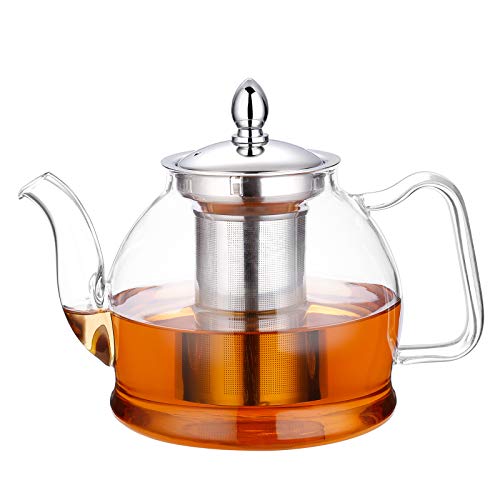
Ehugos Glass Teapot with Removable Infuser, 1500 ml (50 oz)
Badge: Best Overall
Strengths
- Maker-rated stovetop safe with the largest capacity in this guide — 1500 ml / 50 oz heats and brews for a table in one vessel.
- Removable stainless infuser gives fine filtration that glass infusers usually cannot match.
- Hand-crafted large format suits blooming and loose leaf teas that need room to open.
Trade-offs
- A full 50 oz glass pot is heavy; pouring with one hand takes care, especially for smaller hands.
- Large glass on a burner needs a wide, well-matched burner to heat evenly.
- Oversized for solo drinkers, who will heat more water than they drink.
Mini spec box: Capacity 1500 ml / 50 oz · Body: glass · Infuser: removable, stainless · Heating: stovetop safe per maker listing · Positioning: large pot for blooming and loose leaf tea (per maker listing).
The Ehugos is what this category looks like when it is done at full scale. Its listing is explicit — a 1500 ml glass teapot, stovetop safe, with a removable infuser described as stainless — and each of those three facts answers a different buyer’s question. Stovetop safe means the kettle can leave the counter. The stainless infuser means fine-cut teas are filtered properly, which is not true of every glass pot in this guide. And 50 oz means one heating cycle serves a family breakfast or a table of guests, which is precisely the scenario where a combined heat-and-brew vessel saves the most effort. In use, the routine is simple: fill, set over moderate heat on a burner that matches the base, watch for the boil through the glass, drop the infuser, steep, pour. The honest limitations are physical. Glass at this size full of water is a two-hand pour for many people, and a large base on a small burner heats unevenly, which stresses the glass and slows the boil. Match the burner to the pot and the Ehugos is the most complete stovetop glass teapot in this pool — the pick we would hand a household that wants one vessel to do everything. Households comparing it against separate kettles and pots can weigh the trade-offs in Best Tea Kettles And Teapots.
Best for: families and hosts who want one large vessel to heat and brew / Not suited for: solo drinkers or anyone with a single small burner.

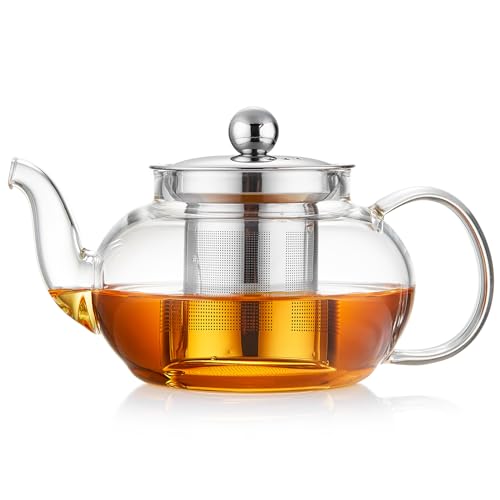
Teabloom Stovetop & Microwave Safe Glass Teapot, 40 oz
Badge: Best for Blooming Tea
Strengths
- Rated for both stovetop and microwave heating — the most flexible heating claim in this guide.
- Ships with 2 blooming teas and a removable glass infuser, so the flowering-tea experience works out of the box.
- Positioned by its maker as a 2-in-1 tea kettle and tea maker at a versatile 40 oz.
Trade-offs
- A glass infuser filters less finely than steel mesh; fine-cut teas can shed particles.
- 40 oz is a middle size — generous for one, modest for a crowd.
- Microwave heating gives you less temperature control than a stovetop for delicate teas.
Mini spec box: Capacity 40 oz · Body: glass · Infuser: removable glass · Heating: stovetop and microwave safe per maker listing · Includes: 2 blooming teas · Positioning: 2-in-1 kettle and tea maker (per maker listing).
Teabloom’s flagship pot is the connoisseur’s entry in this guide — the maker literally positions it as the tea purist’s choice — and its heating credentials are the broadest here: stovetop and microwave safe, in a 40 oz glass body with a removable glass infuser and two blooming teas included. The glass infuser is a deliberate aesthetic decision. Blooming tea is a visual product, and a steel basket would hide the flower at the exact moment it performs; a clear infuser keeps the whole chamber transparent, so the pot on the stove and then on the table is a single continuous show. The microwave rating is more practical than it sounds: in an office or a small apartment, heating water in the same pot you steep in, without a burner at all, is a genuinely simpler routine. The trade-offs mirror the Ehugos comparison in reverse — where the Ehugos filters finely with steel, this pot shows beautifully with glass, and fine-leaf drinkers will notice particles that a mesh basket would have caught. Choose the Teabloom if blooming and whole-leaf teas are your center of gravity and you want heating freedom; choose the Ehugos if filtration and capacity matter more.
Best for: blooming-tea and whole-leaf drinkers who want stovetop or microwave freedom / Not suited for: drinkers of fine-cut teas who want the cleanest possible cup.

DOPUDO Small Glass Teapot with Infuser, 18 oz
Badge: Best Solo Pot (Prose-Only)
Strengths
- Excellent solo brewer: 18 oz / 530 ml of borosilicate glass with a removable 18/8 steel infuser.
- Fine steel filtration in the smallest body in this pool.
- Compact footprint suits desks and small kitchens.
Trade-offs
- Its maker listing makes no stovetop claim, so it cannot be recommended for burner use — the reason it is prose-only here.
- Requires a separate kettle or other hot-water source.
- Strictly a one-drinker pot.
Mini spec box: Capacity 18 oz / 530 ml · Body: borosilicate glass · Infuser: removable 18/8 steel · Heating: no stovetop claim in maker listing — fill with heated water · Positioning: individual loose-leaf brewing (per maker listing).
We want to be plain about this review: the DOPUDO is a very good small teapot that does not belong on a stove, and it appears in this guide so that its absence of a claim is visible rather than silent. Its listing describes a compact borosilicate pot with a removable 18/8 steel infuser for individual loose-leaf brewing — and says nothing about stovetop use. That silence is the information. Buyers who assume “glass teapot” implies “stovetop safe” crack pots; the DOPUDO’s maker never promised burner safety, so the honest way to use it is the way it was designed: water heated elsewhere, poured over leaf, steeped, and served from a pot sized exactly for one mug. Judged as a brewer rather than a kettle, it is arguably the finest-filtering small pot in this entire pool. If your kitchen already has a kettle you like, it deserves your consideration through the small-pot coverage elsewhere on this site. If you came to this page specifically to heat water in the pot, keep reading — the remaining picks are the ones rated for your burner.
Best for: solo drinkers with a kettle who want fine steel filtration / Not suited for: anyone who needs to heat water in the pot itself.

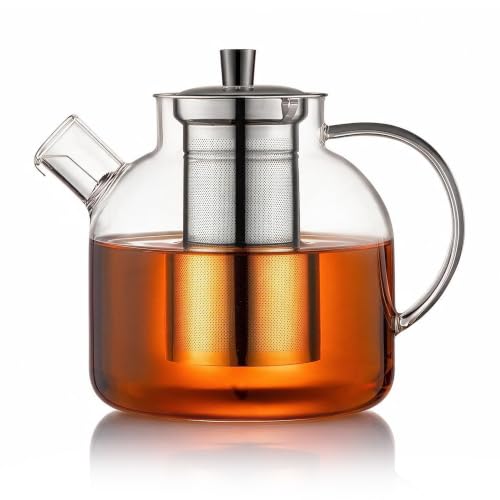
STNTUS Glass Teapot, 40 oz / 1200 ml
Badge: Best for Groups
Strengths
- Maker-rated stovetop safe at a group-friendly 40 oz / 1200 ml, positioned for 4–6 cups.
- Infuser plus a stainless steel strainer — two stages of leaf control for pots that get poured repeatedly.
- Same capacity class as the Teabloom with a steel-based filtration story instead of glass.
Trade-offs
- Less presentation-focused than the Teabloom; no included blooming teas.
- 40 oz of glass and water is a committed pour for one person serving a group.
- Solo drinkers will find it more pot than they need.
Mini spec box: Capacity 40 oz / 1200 ml · Body: glass · Infuser: included, with stainless steel strainer · Heating: stovetop safe per maker listing · Yield: 4–6 cups per maker listing.
The STNTUS is the workhorse answer to the Teabloom’s showpiece. Same 40 oz class, same stovetop-safe rating in the maker listing, but the filtration story is steel rather than glass: an infuser paired with a stainless steel strainer, which suits a pot that will be poured, topped up, and poured again across a long breakfast or an afternoon of guests. That double control keeps later cups cleaner, and it makes the STNTUS the better choice for mixed groups drinking ordinary loose leaf rather than watching a bloom open. The maker’s 4–6 cup positioning is realistic for 1200 ml, and heating that volume in the pot itself — rather than in a kettle and then transferring — is the entire convenience argument of this category in one product. The limitations are the category’s limitations: a full glass pot is heavy, a big base wants a matched burner, and one person drinking alone should buy smaller. For households whose tea is a group activity, the STNTUS is the most straightforward stovetop glass pot in this guide, and a natural comparison point in Best Teapots And Brewers.
Best for: households and hosts brewing ordinary loose leaf for several people / Not suited for: solo drinkers and blooming-tea presentation.
Enchanti Tea Pot, One Touch Glass Teapot with Infuser, 27 oz
Badge: Best One-Touch Brewer (Prose-Only)
Strengths
- One-touch brewing design makes the steep-and-release routine simple for beginners.
- Flexible 27 oz / 800 ml size, sold as a gift-ready set.
- Glass body keeps the brew visible.
Trade-offs
- No stovetop claim in its maker listing — prose-only in this guide for that reason.
- Needs a separate kettle, which removes the one-vessel advantage this page is about.
- Mechanism adds parts to rinse versus a simple basket infuser.
Mini spec box: Capacity 27 oz / 800 ml · Body: glass · Infuser: included, one-touch design · Heating: no stovetop claim in maker listing — fill with heated water · Positioning: loose-leaf tea maker and gift set (per maker listing).
The Enchanti is the second honest exclusion in this guide, and its story mirrors the DOPUDO’s: a well-conceived glass brewer — one-touch steeping, a flexible 27 oz size, gift-set presentation — whose listing simply never claims stovetop safety. That is not a defect in the pot; it is a boundary on its use. One-touch brewers earn their keep at the desk and the breakfast table, where the water arrives from a kettle and the mechanism turns steeping into a single gesture a beginner cannot get wrong. What the Enchanti must never do is sit on a burner on the assumption that glass is glass. If your routine is kettle-first, it is a charming and practical pot, and it is covered in depth in our small-pot and general teapot guides. If your routine is the one this page exists for — water heated in the vessel on the stove — the linked picks above and below are your list, and this review exists so you can see exactly why the Enchanti is not on it.
Best for: beginners and gift buyers with a kettle-based routine / Not suited for: stovetop heating of any kind.
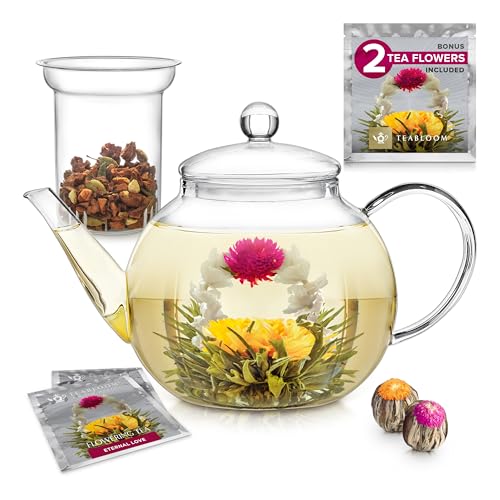
Teabloom Celebration Glass Teapot & Kettle, 27 oz
Badge: Best Compact Stovetop Pot
Strengths
- Stovetop and microwave safe in a compact 27 oz body — the smallest fully rated pot in this guide.
- Heat-resistant glass with a removable glass infuser and 2 blooming teas included.
- Handles loose leaf, bagged, and blooming tea per the maker, so one pot covers a mixed household.
Trade-offs
- Glass infuser filtration is coarser than steel mesh for fine-cut leaf.
- 27 oz serves one or two; groups should step up to the 40–50 oz picks.
- Small base on a large burner wastes heat around the pot; match the burner size.
Mini spec box: Capacity 27 oz · Body: heat-resistant glass · Infuser: removable glass · Heating: stovetop and microwave safe per maker listing · Includes: 2 blooming teas · Teas: loose leaf, bagged, and blooming per maker listing.
The Celebration is the pick for readers who want everything this category promises at the smallest sensible scale. Twenty-seven ounces of heat-resistant glass, rated by its maker for both stovetop and microwave, with a removable glass infuser and blooming teas in the box: that is the one-vessel routine for one or two drinkers, with nothing extra to store. The compact size is also a safety advantage in disguise — a smaller base is easier to match to a burner, a lighter full pot is easier to pour, and a smaller volume heats faster, which means less time at the stove and less temptation to crank the heat. Its maker’s positioning across loose leaf, bagged, and blooming tea makes it the most flexible brewer here for households whose tea habits vary by person and by day. The cautions are the familiar glass-infuser one — fine-cut teas will shed some particles — and a sizing one: do not ask 27 oz to serve a table. Within its scale, though, this is the most complete small stovetop glass teapot in the pool, and the natural first recommendation for couples. Readers weighing it against larger pots can compare the full range in Best Teapots.
Best for: one or two drinkers who want a compact, fully rated heat-and-brew pot / Not suited for: groups, or fine-cut tea drinkers who need steel-mesh filtration.
Comparison Table
| Pick | Capacity | Stovetop claim (maker) | Infuser | Best role | Link |
|---|---|---|---|---|---|
| Ehugos Glass Teapot | 1500 ml / 50 oz | Yes — stovetop safe | Removable stainless | Large households | Check on Amazon |
| Teabloom Glass Teapot | 40 oz | Yes — stovetop & microwave | Removable glass | Blooming tea | Check on Amazon |
| DOPUDO Small Glass Teapot | 18 oz / 530 ml | No claim in listing | Removable 18/8 steel | Solo brewing (kettle-filled) | Prose-only |
| STNTUS Glass Teapot | 40 oz / 1200 ml | Yes — stovetop safe | Infuser + steel strainer | Groups | Check on Amazon |
| Enchanti One Touch | 27 oz / 800 ml | No claim in listing | One-touch infuser | Beginners (kettle-filled) | Prose-only |
| Teabloom Celebration | 27 oz | Yes — stovetop & microwave | Removable glass | Compact one-vessel brewing | Check on Amazon |
How to Choose a Stovetop Safe Glass Teapot
Rule one is the rule this whole guide is built on: the claim must come from the maker. “Stovetop safe” printed in a listing is a design statement — the glass composition, wall thickness, and base shape were chosen for direct heat. Its absence is not a technicality; it means the maker has not made that promise, and no review site can make it for them. When you shop beyond this guide, search the listing for the exact claim before anything else, and treat pots without it as kettle-filled brewers, however sturdy they look.
Rule two is burner fit. A glass pot heats safely when the flame or element matches its base: too small a burner concentrates heat in one ring of glass, and too large a burner wastes energy around the sides and heats the handle. Electric coil and smooth-top burners suit glass well because contact is even. Gas works with a moderate flame kept under the base. Induction is the exception that catches buyers out — glass is not magnetic, so a glass pot will not heat on an induction hob without an interface disc, and if induction is your only stove, a stovetop glass pot is the wrong purchase no matter how it is rated. Rule three is size: buy the capacity you will actually heat. A 50 oz pot like the Ehugos earns its place in a household; the same pot in a solo kitchen means heating a litre of water to drink a mug, slowly, every day. The 27 oz Celebration exists precisely for the smaller routine. Finally, weigh the infuser: steel for fine teas and clean cups, glass for blooming and whole-leaf display. Heating gets the water ready; the infuser decides what the cup tastes like.
One accessory question follows from the burner discussion: the heat diffuser. A diffuser is a flat metal plate that sits between burner and pot, spreading a small or uneven heat source across a wider base. For a large glass pot on a small gas burner, or on an old coil that no longer sits flat, a diffuser genuinely reduces the concentrated ring of heat that stresses glass, and it costs little. It is not a license to use maximum heat, and it does not make an unrated pot stovetop safe — nothing retrofits that promise — but as insurance for a rated pot on an imperfect stove, it is the one accessory this guide endorses without reservation. Pair it with a trivet that lives permanently beside the stove, and you have removed the two most common mechanical causes of glass-pot failure: uneven heat going in, and a cold landing coming off.
How to Heat a Glass Teapot on the Stove Safely
- Start with the pot at room temperature and the water in it before heat is applied — never set an empty glass pot on a hot burner, and never pour boiling water into a pot sitting on a cold surface shock.
- Choose the burner closest to the pot’s base diameter, and set moderate heat. Glass rewards patience: a slightly slower boil is a longer-lived pot.
- Keep the flame under the base on gas stoves; flames licking up the sides heat the walls unevenly and can damage handles.
- Watch the water, not the clock. Glass shows you the first lazy bubbles and the rolling boil, so you can pull delicate-tea water early and fully boil for black tea.
- Remove the pot with a dry mitt or handle cover, and set it on a trivet or wooden board — never on a cold stone counter or a wet surface, which is the classic thermal-shock crack.
- Add the infuser and leaf, steep off the heat, and pour. Let the pot cool before rinsing; a warm rinse cleans glass easily and safely.
Troubleshooting. Problem: the pot makes ticking or pinging sounds on the burner → heat is concentrated unevenly; move to a better-matched burner and lower the heat. Problem: water takes forever to boil → the burner is much smaller than the base, or the pot is overfilled for its size; match the burner and heat only what you will drink. Problem: a faint white film builds up inside → mineral deposits from hard water; a warm soak with a little baking soda dissolved in the water lifts it without scrubbing the glass.
What “Stovetop Safe” Does Not Promise
Understanding the limits of the rating prevents the two most common disappointments. First, stovetop safe does not mean unbreakable: a rated pot survives correct heating, not drops, knocks, or a dry boil. Boiling a glass pot dry is the fastest way to destroy any pot in this guide, rated or not — set a timer or stay in the kitchen. Second, the rating does not transfer across heating methods the maker did not name. A pot rated for the stovetop is not thereby rated for a campfire, a wood stove’s hot spot, or direct contact with a glowing coil at maximum setting; the Teabloom pots name the microwave explicitly, which is why we can say it about them and not about the Ehugos or STNTUS. Third, the rating describes the pot, not your stove: an old, warped, or badly matched burner can mistreat a well-made pot. Read the rating as “designed for careful stovetop use,” adopt the routine in the how-to section above, and a glass pot will give you years of one-vessel brewing. Readers building a full tea setup can also weigh the separate-kettle approach in Best Teapots And Brewers, which suits some kitchens better than any combined vessel.
Glass on Different Stovetops: Gas, Electric, Ceramic, and Induction
Not all burners treat glass equally, and the stove you own should influence which pot you buy — or whether you buy one at all. Gas stoves are the traditional partner for stovetop glass: the flame is visible, adjustable in fine increments, and easy to keep licking only the base. The watch-out is flame spread at high settings, where heat climbs the walls and stresses the handle joint; moderate flame is both safer and, counterintuitively, barely slower. Electric coil burners heat by contact, which glass likes, provided the coil is flat and the pot sits level; a warped coil creates a hot stripe across the base. Smooth ceramic and radiant glass tops are the gentlest of all — broad, even contact with no flame — and the main discipline there is not sliding the pot, which can scratch the cooktop and the pot alike.
Induction is the hard boundary already flagged in this guide: without a magnetic base, a glass pot simply does not heat. Interface discs exist and do work, but they add a layer of metal between burner and glass that heats unevenly and removes the watch-the-water advantage of a clear pot; most induction owners are happier with a metal stovetop kettle for water and a glass pot for steeping, which is a legitimate two-vessel answer to a one-vessel question. Portable butane burners and camping stoves concentrate intense heat in a small circle and are poor matches for larger glass bases like the Ehugos; if camp brewing is your goal, heat water in a metal camp kettle and steep in the pot off the flame. The pattern across all of these cases is the same one this guide keeps returning to: glass rewards even, moderate, matched heat, and punishes concentrated extremes. Choose the pot your stove can treat kindly.
Stovetop Glass Pot or Separate Kettle? An Honest Comparison
The combined vessel is not automatically the better system, and readers deserve the comparison stated plainly. The stovetop glass pot wins on simplicity: one vessel to fill, heat, steep, pour, and wash; one item to store; no transfer of boiling water from kettle to pot, which is the step where scalds happen and heat is lost. It wins doubly in small spaces — dorms, studios, offices, campers — where the kettle it replaces might not fit at all. It also wins on temperature visibility, because you watch the water itself approach the boil rather than listening for a kettle’s click.
The separate kettle wins on speed and specialization. A good electric kettle heats faster than any pot on a burner, holds temperature settings for delicate teas that a stovetop cannot match, and keeps the teapot free to be any material — including the unrated glass brewers covered prose-only in this guide, the DOPUDO and the Enchanti, which become fully sensible purchases the moment a kettle enters the picture. A kettle also scales independently: a household can own a large kettle and a small pot, heating group volumes of water while steeping solo volumes of tea. The honest summary is that the stovetop pot is the better system for small households with simple routines and limited space, and the kettle is the better system for temperature-sensitive teas, larger households, and induction kitchens. Many readers will land on the hybrid — a rated glass pot for daily one-vessel brewing and a kettle for everything else — and this guide’s picks support that: start with the Celebration or Ehugos as your daily driver, and let a future kettle purchase be about speed rather than necessity. The wider category context lives in Best Tea Kettles And Teapots, where both halves of the system are covered together.
A Daily Routine With a Stovetop Glass Teapot
It helps to picture the ordinary Tuesday version of owning one of these pots, because that — not the first impressive brew — is what you are buying. Morning: the pot lives on or beside the stove, so the routine starts with a fill at the sink, a burner matched to the base, and moderate heat while you do something else in the kitchen. Because the pot is glass, the water tells you when it is ready; there is no kettle to listen for and no transfer to make. Leaf goes in the infuser, the pot comes off the heat onto its trivet, and breakfast tea steeps on the counter where everyone can see it. Pouring is the whole pot’s job, and the wash is a warm rinse — glass releases the morning’s tea without scrubbing, and the infuser empties with a tap over the bin.
Evening: the same pot handles a smaller, slower brew. This is where the compact Celebration earns its keep for one or two people, and where the big Ehugos mostly rests unless guests are over — which is exactly the right division of labor, and why this guide recommends sizing to your routine rather than your largest gathering. Across a week, the maintenance is a baking-soda soak if your water is hard, a check that the infuser is dry before it goes back in, and nothing else. Compare that with the two-vessel routine — kettle descaling, pot washing, two items stored, one transfer of boiling water per brew — and the appeal of the combined vessel stops being about novelty. It is about a routine with fewer steps, repeated hundreds of times a year. That repetition is also why the safety habits in this guide matter: moderate heat, matched burner, trivet every time. Build them into the routine from the first week and they cost you nothing; skip them and the pot eventually collects the debt.
Common Buying Mistakes
- Assuming all glass teapots are stovetop safe. Two of the six pots in this pool are not rated for it. The claim must be the maker’s, in writing.
- Buying for an induction stove. Glass does not heat on induction without an interface disc. Check your hob before you check out.
- Using maximum heat to save time. A rolling boil a minute sooner is not worth thermal stress on the base. Moderate heat is the routine.
- Setting a hot pot on a cold or wet counter. The classic crack. Use a trivet every time until it is a reflex.
- Boiling the pot dry. No rating covers it. Stay nearby or set a timer.
- Ignoring the infuser while shopping the rating. Heating is half the product; a glass infuser that sheds your fine-cut tea into the cup will annoy you daily.
Final Recommendation
For most households, buy the Ehugos 50 oz glass teapot: maker-rated stovetop safe, the largest capacity here, and a stainless infuser that filters the way most drinkers expect. Choose the Teabloom 40 oz instead if blooming tea and microwave flexibility matter more than filtration, the STNTUS if you brew ordinary loose leaf for a group and want steel straining, and the Teabloom Celebration if your routine is one or two cups and you want the whole stovetop promise in a compact pot. And take the guide’s central lesson with you beyond these picks: the DOPUDO and Enchanti are good teapots that simply never claimed this job — buy the claim, not the assumption.
Frequently Asked Questions
Can any glass teapot go on the stove?
No. Only pots whose makers rate them stovetop safe should meet a burner. In this guide’s pool, the Ehugos, STNTUS, and both Teabloom pots carry that claim in their listings; the DOPUDO and Enchanti do not, which is why they are covered without purchase links.
Do stovetop glass teapots work on induction?
Not by themselves. Induction heats magnetic materials, and glass is not magnetic, so the pot stays cold. An induction interface disc can bridge the gap, but if induction is your only hob, a metal kettle-and-pot setup is usually the better purchase.
Is it safe to boil water in a glass teapot?
In a maker-rated pot, yes, with the standard routine: water in before heat, a burner matched to the base, moderate heat, and a trivet — never a cold or wet surface — when you take it off. The dangerous habits are boiling dry, maximum heat, and thermal shock, and all three are avoidable.
What is the difference between stovetop safe and microwave safe?
They are separate maker claims about separate stresses. Some pots carry one, some carry both — both Teabloom pots in this guide claim stovetop and microwave use, while the Ehugos and STNTUS claim stovetop use. Never assume one rating implies the other.
How do I stop a glass teapot from cracking?
Prevent thermal shock: avoid sudden temperature changes in both directions, keep heat moderate and evenly spread under the base, never boil the pot dry, and let it cool before washing. Warm water and a soft sponge clean glass without the scrubbing that creates micro-scratches.
Which size stovetop glass teapot should I buy?
Match capacity to drinkers: 27 oz for one or two people, 40 oz for a small group, and 50 oz for a household that brews a full pot at breakfast. Heating more water than you drink wastes time every single day, so the smallest pot that covers your routine is the right one. Budget-focused comparisons across the category appear in Best Teapots For All Budgets.
How long does a stovetop glass teapot last?
With the routine in this guide — moderate heat, a matched burner, no dry boils, no cold counters under a hot pot — a rated glass teapot lasts for years of daily use. Its lifespan is decided almost entirely by handling rather than by the glass itself: the failures are nearly always thermal shock or a knock, both of which are habits, not fate. Store the pot where it will not be clipped by passing pans, keep its infuser with it, and descale gently when mineral film appears. A pot treated that way usually outlasts the kettle it replaced.
Can I brew coffee or other drinks in a stovetop glass teapot?
You can heat water in it for anything, and the clear body makes it a pleasant server for mulled drinks and herbal infusions that are not, strictly, tea. What we would not do is treat it as a coffee brewer: coffee oils cling even to glass and will flavor later teas until the pot is thoroughly cleaned, and the infusers in these pots are designed for leaf, not grounds. Keep the teapot for tea and tea-like infusions, heat plain water in it whenever you like, and your daily cup stays clean-tasting.
What should I check when a stovetop glass teapot arrives?
Inspect the base and walls against a bright light for chips, bubbles with cracks radiating from them, or a base that rocks on a flat counter — a pot that does not sit flat will not heat evenly. Fill it with cold water and check the pour and the lid fit before the first heating, then make the first boil a supervised one at moderate heat while you confirm your burner match. Five calm minutes on day one is the cheapest insurance in this entire category.