Disclosure: topratedkitchenware.com is reader-supported. When you buy through links on our site, we may earn an affiliate commission from Amazon and other retailers, at no extra cost to you.
Where to buy
The six glass teapots below were chosen as the best teapots for all tea drinkers on one quality above all: range. Between them they handle loose leaf and bagged tea, delicate greens and robust black blends, herbal infusions and blooming teas, for one drinker or a table. All are sold through Amazon; check each listing for the current delivery details and confirm the infuser style matches the teas you drink most before ordering.
- Enchanti One Touch Glass Teapot with Infuser, 27 oz / 800ml — Check on Amazon
- Teabloom Celebration Glass Teapot & Kettle, 27 oz
- CNGLASS Glass Teapot Stovetop Safe with Removable Infuser, 20.3 oz
- DRNKNSTX Enchanted Tea Pot with Tea Infuser, 20 oz
- HIWARE 1000ml Glass Teapot with Removable Infuser
- PARACITY Glass Teapot Stovetop 18.6 oz (550ml)
Read the full guide ↓
The search for the best teapots for all tea starts with an honest observation: tea is not one drink. A pot that flatters a malty breakfast blend at a rolling boil can ruin a delicate green tea that wants cooler water and a short steep. A basket that contains fine rooibos needles beautifully may cramp a rolled oolong that needs room to unfurl. Blooming teas demand a clear stage; bagged teas demand nothing but hot water and somewhere to rest. The best teapots for all tea are the ones that respect those differences — neutral in flavour, flexible in format, and honest about the one or two compromises every vessel makes.
Glass earns its place at the centre of this guide for a simple reason: it is the only common teapot material that adds nothing. Ceramic can carry the ghost of a strongly spiced chai into the next pot of white tea; seasoned clay is prized precisely because it remembers. Glass forgets everything between washes, so the pot you use for a smoky lapsang on Monday brews a pristine jasmine green on Tuesday. Add a removable infuser — the feature all six of these pots share in some form — and you control the second great variable, contact time, by lifting the leaves out the moment the steep is right. Temperature, the third variable, is managed by your kettle and your patience rather than by the pot, which is why technique sections matter as much as product sections in a guide like this.
What follows compares six glass teapots as all-tea instruments: which infusers suit which leaf sizes, which capacities suit which households, and which pots carry a stovetop rating for drinkers who like to heat and brew in one vessel. If your interest is narrower — a single tea brewed perfectly — the principles here still apply, and our companion guide to the Best Teapots For Green Tea takes the delicate end of the spectrum deeper. For everyone whose tea shelf holds four tins and a box of bags, this is the shortlist.
Key Takeaways
- Glass is flavour-neutral and washes completely clean, so one pot can serve every tea family without carrying flavours between brews.
- The Teabloom Celebration is the most explicitly versatile pick: its maker names loose leaf, bagged, and blooming tea, and it is stovetop and microwave safe.
- Fine stainless infusers (PARACITY) suit small and broken leaves; glass infusers (Celebration) suit large leaves and blooming teas.
- The HIWARE 1000ml is the family all-rounder: stovetop safe, one litre, equally happy with bags or loose leaf.
- Temperature discipline matters more than the pot: cool the water for greens and whites, use a full boil for black tea and herbals.
- One-touch and steeper designs (Enchanti, DRNKNSTX) forgive beginners by separating leaves from liquor for you.
In this guide
Quick Picks
| Pick | Badge | Capacity | Infuser | Link |
|---|---|---|---|---|
| Enchanti Tea Pot | Best for Beginners Across Teas | 27 oz / 800ml | Infuser, one-touch design | Check on Amazon |
| Teabloom Celebration Teapot | Most Versatile Overall | 27 oz | Removable glass infuser | Check on Amazon |
| CNGLASS Glass Teapot | Best Compact Stovetop All-Rounder | 20.3 oz | Removable infuser | Check on Amazon |
| DRNKNSTX Enchanted Tea Pot | Best for Herbal & Dessert Tea Rituals | 20 oz | Tea infuser / steeper design | Check on Amazon |
| HIWARE Glass Teapot | Best Family All-Rounder | 1000ml | Removable infuser | Check on Amazon |
| PARACITY Glass Teapot | Best for Fine & Delicate Teas | 18.6 oz / 550ml | Removable 18/8 stainless steel infuser | Check on Amazon |
How These Picks Were Chosen
We chose these six pots by testing their verified specifications — capacity, infuser construction, heating ratings, and the tea formats each maker names, all checked against listing data on 2026-11-20 — against the demands of the major tea families. A pot scored for range when its infuser could plausibly contain the leaves it would meet, its size suited real sessions of that tea, and its material imposed no flavour memory. Pots whose listings named multiple tea formats explicitly, like the Celebration’s loose leaf, bagged, and blooming, anchor the list; pots with a narrower stated purpose earned their place by excelling at the end of the spectrum the others serve least well, such as the PARACITY’s fine steel mesh for small leaves.
This is a research-led comparison, not a claim of laboratory testing across every tea type. We did not brew our way through a tasting panel for this guide. What specification analysis does reliably is match mechanics to teas: mesh fineness against leaf size, capacity against session style, heating ratings against workflow. The brewing guidance that follows — temperatures, steep times, leaf handling — reflects established practice for each tea family rather than any maker’s marketing, and it applies to any glass pot you already own as much as to the six below.
One more selection principle: honesty about limits. No single pot is literally best for all tea — a competition-grade green tea ritual and a builders’ breakfast brew are different sports. The pots here are the ones whose compromises fall where most households can live with them, and each review names the tea that pot serves least well, so you can choose with your eyes open. The heating-focused companion guide to the Best Teapots For Boiling Water covers the stovetop side of versatility for readers whose range question is really about the stove.
The 6 Best Teapots for All Tea Types

Enchanti One Touch Glass Teapot with Infuser, 27 oz / 800ml
Badge: Best for Beginners Across Teas
Strengths
- One-touch design separates leaves from liquor mechanically, removing the most common beginner error — the forgotten steep — across every tea type.
- 800ml serves a full solo session or two drinkers, the most common real-world pattern for mixed tea shelves.
- Gift-set presentation makes it an easy route into loose leaf for someone else.
Trade-offs
- No stovetop rating in the listing; water is heated separately.
- The mechanism needs a prompt rinse; dried residue in moving parts dulls the convenience.
- Very fine teas may still shed a little sediment, as with most non-paper infusers.
Spec box
- Capacity: 27 oz / 800ml
- Infuser: Infuser included, one-touch design
- Format: Glass teapot and tea maker for loose leaf tea
- Packaging: Tea gift set per maker
- Stovetop: Not stated in the maker listing — treat as pour-over only
The Enchanti is the pot we would hand to someone whose tea shelf is expanding faster than their technique. Exploring all tea means making mistakes in sequence: the green steeped in boiling water, the black tea forgotten for ten minutes, the oolong drowned in too small a basket. A one-touch design forgives the most damaging of those errors — over-extraction — by separating leaves and liquor on command, so a distracted new brewer still pours a clean cup. At 800ml it also matches the exploratory pattern: enough for a proper session of one tea, small enough that brewing a second, different tea an hour later is no chore. For households where one person drinks everything and the other is just starting, it bridges the skill gap better than any other pot here.
Its ceiling is control. Experienced brewers who time steeps to the half-minute and pour in stages will find the mechanism a simplification they do not need, and the absence of a stovetop rating keeps it kettle-dependent. As a learning instrument and a daily all-rounder for the curious, though, it is the friendliest starting point in the group.
Best for: Beginners exploring multiple teas, gift buyers / Not suited for: Precision brewers or stovetop workflows
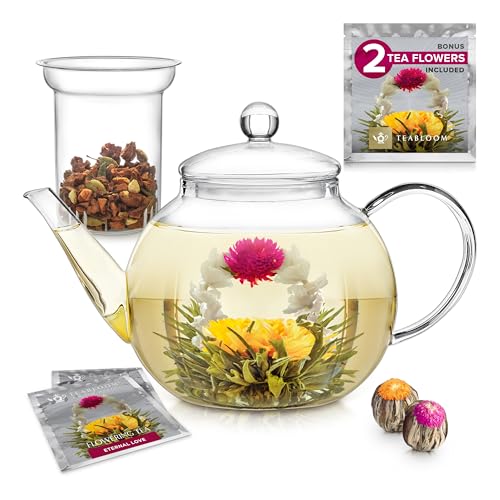
Teabloom Celebration Glass Teapot & Kettle, 27 oz
Badge: Most Versatile Overall
Strengths
- The only listing here that names all three formats — loose leaf, bagged, and blooming tea — backed by a removable glass infuser.
- Stovetop and microwave safe in heat-resistant glass, so it heats water as well as brewing, in almost any kitchen.
- Two blooming teas included, so its most theatrical format works from day one.
Trade-offs
- Glass infuser slots are wide; very fine leaves and rooibos needles can slip through.
- The glass infuser is delicate and asks for careful washing.
- 27 oz serves one to two; it is not a family pot.
Spec box
- Capacity: 27 oz
- Infuser: Removable glass infuser
- Stovetop: Stovetop and microwave safe per maker
- Material: Heat-resistant glass
- Included: 2 blooming teas
- Tea types named by maker: Loose leaf, bagged, and blooming
If the brief is literally one pot for all tea, the Celebration has the strongest paperwork in this guide: its maker names loose leaf, bagged, and blooming tea in a single specification, and the pot’s hardware backs the claim. The glass infuser gives large leaves and blooming balls an unobstructed stage; bags can simply rest in the pot with the infuser removed; and the stovetop-plus-microwave rating means the water side of every tea ritual is covered wherever you live. The clear body is more than decoration for mixed drinkers — liquor colour is the most reliable cross-tea gauge of strength, and glass lets a green, a gold oolong, and an amber black each announce themselves honestly.
The compromise sits in the infuser’s slots. Glass infusers cannot be made as fine as steel mesh, so the finest teas — rooibos, broken fannings, some Japanese greens — will shed sediment into the cup. Drinkers whose shelf leans fine should pair this pot with the PARACITY’s steel mesh approach, or accept a gentle pour and a little sediment as the price of the Celebration’s range.
Best for: Mixed-format households wanting one pot / Not suited for: Drinkers of very fine teas who hate sediment

CNGLASS Glass Teapot Stovetop Safe with Removable Infuser, 20.3 oz
Badge: Best Compact Stovetop All-Rounder
Strengths
- Stovetop-safe rating in a compact 20.3 oz body: heat and brew in one vessel across tea types.
- Removable infuser with loose leaf and blooming tea named by the maker.
- Simple construction with nothing to jam, clog, or misplace.
Trade-offs
- 20.3 oz limits it to one or two drinkers per brew.
- Single infuser system; no separate strainer for free-leaf brewing.
- No included extras or gift presentation.
Spec box
- Capacity: 20.3 oz
- Infuser: Removable infuser
- Stovetop: Described as stovetop safe by the maker
- Tea types named by maker: Loose leaf and blooming tea
The CNGLASS is the minimalist’s answer to the all-tea question. Rather than adding mechanisms or second strainers, it offers the two fundamentals in their most portable form: glass that flavours nothing, and a stovetop rating that lets the pot make its own hot water. That second point matters for range more than it first appears, because different teas want different water — a rolling boil for black tea, a gentler heat for greens — and a pot that lives on the stove lets you catch water at the moment it suits the leaf, then brew in the same vessel. Small households, caravanners, and desk brewers with a hotplate all get a complete tea station in one 20.3 oz object.
Its range limit is the calendar, not the tea shelf: at this size, a household of four tea drinkers means brewing twice, and a long afternoon of varied teas means washing between each. Buyers whose all-tea life is social should step up to the HIWARE’s litre; buyers whose all-tea life is personal will find this pot covers the whole shelf without excess.
Best for: Solo and couple all-tea drinkers, stove-first kitchens / Not suited for: Family service

DRNKNSTX Enchanted Tea Pot with Tea Infuser, 20 oz
Badge: Best for Herbal & Dessert Tea Rituals
Strengths
- Steeper-style design suits the long, forgiving infusions that herbal and dessert teas enjoy.
- 20 oz personal size matches the evening-cup ritual it is designed for.
- Gift-oriented, characterful presentation encourages the loose-leaf habit in new drinkers.
Trade-offs
- No stovetop rating in the listing; kettle water only.
- Steeper formats are built for prompt serving, not for keeping tea warm through an evening.
- Precision teas like competition greens are better served by the PARACITY or Celebration.
Spec box
- Capacity: 20 oz
- Infuser: Tea infuser / steeper design for loose leaf
- Format: Glass tea maker and steeper, gift-oriented presentation
- Stovetop: Not stated in the maker listing — treat as pour-over only
Herbal infusions are the forgiving end of the tea world — chamomile, peppermint, rooibos, and blended dessert teas tolerate long steeps, wide temperature ranges, and leisurely serving — and the DRNKNSTX is shaped for exactly that temperament. Its steeper format and gift-book presentation turn an evening tisane into a small ritual, which is how herbal teas are actually enjoyed: slowly, often while doing something else, with the pot as part of the mood. Within an all-tea household, this is the pot that covers the caffeine-free hours, and its glass body keeps even a deep-red rooibos looking like what it is — a pleasure rather than a compromise.
Be clear about its lane. Delicate teas that punish imprecision are not its strength, and it will not heat its own water. As the herbal-and-evening specialist in a two-pot household, or as the gift that starts someone’s loose-leaf shelf, it earns its place; as a household’s only pot, the Celebration or HIWARE covers more ground.
Best for: Herbal and dessert tea drinkers, gifts / Not suited for: Precision brewing or stovetop use
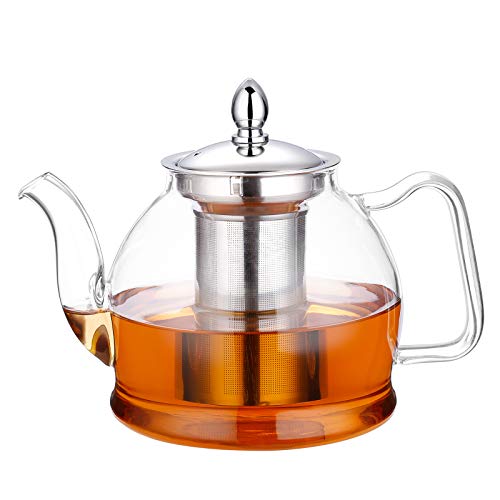
HIWARE 1000ml Glass Teapot with Removable Infuser
Badge: Best Family All-Rounder
Strengths
- A full litre of capacity serves mixed households where one pot must satisfy several tea drinkers at once.
- Stovetop safe, so the family kettle-and-pot shuffle collapses into one vessel.
- Maker names blooming and loose leaf; bags work with the infuser removed, making it a genuine three-format pot.
Trade-offs
- Half-filled for a solo brew, it steeps and holds heat less well; it wants to be used at family scale.
- Glass loses heat over a long table session; a cosy helps for slow breakfasts.
- The infuser, while versatile, is a generalist — fine-leaf specialists may prefer the PARACITY’s mesh.
Spec box
- Capacity: 1000ml
- Material: Glass (per manufacturer listing)
- Infuser: Removable infuser included
- Stovetop: Described as stovetop safe by the maker
- Tea types named by maker: Blooming and loose leaf
Families are where the all-tea question gets practical. One household can contain a breakfast-blend loyalist, a green-tea drinker, a teenager on herbal infusions, and a grandparent who takes bags — and the HIWARE is the pot that serves that table without a cupboard of specialists. A litre brews a round for everyone; the removable infuser contains loose leaf for those who want it and lifts out for those brewing bags; the stovetop rating means the water heats where the tea brews. Glass neutrality does the quiet work: rinse between the morning’s black tea and the afternoon’s green, and no flavour crosses over. For mixed households comparing service formats, our look at the Best Teapots For Cafe Use applies the same one-pot-many-drinkers logic at commercial scale.
The honest limitation is the solo case. A litre pot used daily by one person is the wrong tool — it will be under-filled, cool quickly, and encourage over-steeping the dregs. Households of one or two should take the Celebration or CNGLASS and leave the HIWARE to the tables it was sized for.
Best for: Mixed-tea families and shared tables / Not suited for: Solo daily brewing

PARACITY Glass Teapot Stovetop 18.6 oz (550ml)
Badge: Best for Fine & Delicate Teas
Strengths
- Removable 18/8 stainless steel infuser — the finest straining in this group, suited to small, broken, and needle-like leaves.
- Borosilicate glass in a compact 550ml size that heats quickly and suits short, careful steeps.
- Stovetop-listed, and positioned by its maker for travel and camping as well as home use.
Trade-offs
- 550ml is a personal pot; it will not serve a table.
- Small volumes cool fast, so very long steeps need a warm room or a cosy.
- Rolled oolongs that need maximum room to unfurl are happier in a wider basket.
Spec box
- Capacity: 18.6 oz / 550ml
- Material: Borosilicate glass
- Infuser: Removable 18/8 stainless steel infuser
- Stovetop: Listed as a stovetop teapot by the maker
- Use cases named by maker: Camping, travel, home brewing
Every all-tea lineup needs a pot for the fine end of the shelf, and the PARACITY is it. Fine leaves — rooibos needles, broken-leaf blends, small-leaf greens — defeat wide-slot infusers and turn cups gritty; the PARACITY’s stainless mesh is the finest strainer here and keeps the liquor clean. Its small size is a feature for delicate teas, not a limitation: green and white teas are brewed in modest volumes, tasted, and re-steeped, and a 550ml pot matches that rhythm while wasting nothing. The borosilicate body and stovetop listing complete a pot that a travelling tea drinker can take anywhere and brew almost anything in, which is why campers and caravan owners appear in its maker’s own description.
Respect the two edges of its range. It cannot serve a group, and tightly rolled oolongs that expand dramatically will feel cramped in any small basket. Within its lane — fine, delicate, personal — it is the most capable pot in this guide.
Best for: Fine-leaf and delicate tea drinkers, travellers / Not suited for: Group service or maximum-expansion oolongs
Comparison Table
| Teapot | Capacity | Infuser | Heating | Strongest tea territory | Link |
|---|---|---|---|---|---|
| Enchanti | 800ml | One-touch infuser | Pour-over | Beginners across all types | Check on Amazon |
| Teabloom Celebration | 27 oz | Glass infuser | Stovetop + microwave | Loose leaf, bagged, blooming | Check on Amazon |
| CNGLASS | 20.3 oz | Removable infuser | Stovetop safe | Compact all-round brewing | Check on Amazon |
| DRNKNSTX | 20 oz | Steeper / infuser | Pour-over | Herbal and dessert teas | Check on Amazon |
| HIWARE | 1000ml | Removable infuser | Stovetop safe | Mixed family tables | Check on Amazon |
| PARACITY | 550ml | 18/8 steel infuser | Stovetop listed | Fine and delicate leaves | Check on Amazon |
How to Choose a Teapot That Really Handles All Tea
Start with your finest leaf, not your favourite. Infuser choice is the one specification that can genuinely exclude a tea. If your shelf includes rooibos, fine greens, or broken blends, you need fine steel mesh — here, the PARACITY — or you accept sediment. If your shelf is large-leaf and blooming teas, glass infusers and wide baskets serve beautifully and show the leaf off. Most mixed shelves lean fine more often than they admit, which is why mesh is the safer default for a one-pot household.
Size for the session, not the shelf. Different teas imply different sessions: black tea is brewed by the potful for a table; green tea by the small pot, re-steeped; herbal by the evening mug or two. A household that drinks all three should choose the size of its most social tea — usually the breakfast black — and let the small teas brew in a partially filled pot or a second small vessel, rather than buying a small pot and failing the breakfast table. That logic makes the HIWARE the family default and the mid-size pots the couple’s default.
Decide how your water gets hot. A stovetop-rated pot catches water at the temperature each tea wants, which is a real versatility advantage for drinkers who move between boiling-water blacks and cooler-water greens in the same morning. Kettle households with temperature control already own that advantage; kettle households without it can rest boiled water for greens. Either workflow works with all six pots, but the stovetop models — Celebration, CNGLASS, HIWARE, PARACITY — keep the option open, and our guide to the Best Teapots For Electric Stove details how glass behaves on modern electric elements for readers weighing that route.
Value flavour neutrality. The more teas you drink, the more a remembering material costs you. Glass, and glass alone in this category, rinses to a blank slate in seconds. If your household truly drinks everything, that neutrality is worth more than heat retention, durability, or any single feature — it is the property that makes one pot possible at all.
Plan for heat honestly. Glass sheds heat faster than ceramic or iron, and the teas differ in how much they care. Black tea brewed for immediate table service barely notices; a white tea sipped slowly over an hour of reading notices a great deal. The mitigations are old and cheap: warm the pot before brewing, keep the lid on, brew the volume you will drink within the half hour, and use a simple cosy for the slow sessions. A pot chosen for range should not be rejected for physics that a cosy solves — but a buyer who drinks slowly and hates cosies should know the trade before choosing glass, because no infuser design changes the thermal character of the vessel itself.
How to Brew Every Tea in a Glass Pot: The Working Method
The universal sequence. Warm the pot with hot water and discard it. Add leaf to the infuser — roughly a teaspoon per 250ml as a baseline. Pour water at the family’s temperature. Steep for the family’s time, lid on. Remove the infuser completely; do not leave it hovering in the liquor. Serve, and re-steep the teas that reward it. Every variable below plugs into that same sequence, which is why one pot can serve all tea: the method flexes, the vessel stays constant.
Black tea. Water at a full, rolling boil; three to five minutes. Black tea is the most forgiving family and the one glass pots serve at breakfast tables everywhere. Milk drinkers should brew a touch stronger, since milk softens the liquor.
Green tea. Water rested two to three minutes off the boil — roughly 75–85°C — and a short steep of two to three minutes. Boiling water scalds green leaves into bitterness; this single correction transforms more cups than any equipment purchase. Re-steep once or twice, adding half a minute each round.
White tea. Similar temperatures to green, slightly longer steeps, and patience: white teas open slowly and reward a second steeping that is often better than the first. The clear pot earns its keep here, because the liquor’s pale gold is the surest readiness signal.
Oolong. Hot water, short repeated steeps, and room to unfurl — fill the infuser no more than a third full for rolled oolongs, and expect the leaves to thank you across four or more infusions. Wide baskets and glass infusers suit oolongs best.
Herbal infusions and rooibos. Boiling water and a long, relaxed steep of five minutes or more; these are tisanes rather than true teas and are nearly impossible to ruin. Fine rooibos needles are the exception that tests infusers — use the finest mesh you have, here the PARACITY’s steel, or accept a little sediment in the last sip.
Blooming tea. One ball, water just off the boil, a wide clear pot — the Celebration or HIWARE — and several unhurried minutes while the flower opens. Pour gently to keep the bloom intact, and re-steep twice more as the flavour softens.
Care between teas. The all-tea pot lives by its rinsing discipline: empty the infuser immediately, rinse pot and infuser with hot water, and wash properly after strong or spiced teas before brewing a delicate one. Descale with a citric-acid soak when film appears. A pot that is rinsed in the moment never carries yesterday’s chai into today’s sencha.
Troubleshooting.
- Problem: Green tea tastes bitter and harsh → what to do: the water was too hot or the steep too long. Rest boiled water for two to three minutes and cut the steep to two minutes before changing anything else.
- Problem: Sediment in the cup from fine teas → what to do: pour slowly and completely, use the finest-mesh pot you own for those teas, and let the last centimetre of liquor stay in the pot.
- Problem: A delicate tea tastes of the previous brew → what to do: wash the infuser separately with hot soapy water and dry the pot with the lid off; steel mesh and lids hold scent longer than glass.
- Problem: Rolled oolong tastes thin → what to do: the leaves had no room. Halve the dose’s crowding by filling the infuser a third full at most, and add a steep rather than more leaf.
One Pot or Two? The Honest Versatility Verdict
After all the matching above, a fair question remains: should a mixed-tea household actually buy two pots? The case for one is strong — glass neutrality means no flavour penalty, and a mid-size infuser pot covers perhaps ninety percent of home brewing well. The case for two rests on the edges: a fine-mesh small pot for delicate and fine teas, and a large pot for the social table, each used at its proper fill. Households that drink green tea daily and host monthly will feel that split as a genuine improvement; households that drink three teas a week will feel it as clutter. Our recommendation follows the drinking, not the shelf: start with one versatile pot — the Celebration for one or two drinkers, the HIWARE for families — and let a year of actual brewing tell you whether a second, specialised pot has earned its place. Versatility is not owning every tool; it is never being stopped by the tool you own.
Matching Infusers to Leaf Size: A Closer Look
Leaf size is the physical fact that decides whether a cup is clean or gritty, and it varies more than new drinkers expect. At the large end sit whole-leaf whites, blooming balls, and rolled oolongs that can triple in volume as they hydrate; these need baskets with room and openings wide enough to let water circulate — the glass infusers of the Teabloom Celebration and the generous baskets of the HIWARE serve them best, and cramping them is the surest route to a thin, under-extracted cup. In the middle sit standard loose-leaf blacks and greens, which almost any infuser in this guide handles without drama. At the fine end sit rooibos needles, fannings and dust grades, and finely milled Japanese teas; these pass through wide slots as if the infuser were not there, and only fine steel mesh — the PARACITY’s 18/8 stainless infuser is the tightest here — keeps them in the pot. A household that drinks across all three bands has three honest options: own the fine-mesh pot and accept that rolled oolongs will be slightly cramped, own the wide-basket pot and pour fine teas gently through the last-centimetre trick, or own one of each at different sizes, which is the two-pot answer the previous section weighed. What does not work is ignoring the question: the wrong infuser taxes every single cup of the tea it mismatches, for the life of the pot.
A Week of Teas: One Pot Through Its Paces
It may help to watch a single versatile pot work a realistic week. Monday opens with a breakfast blend at a full boil, brewed strong for milk — the pot at family scale, infuser working conventionally. Tuesday’s lunch is a green tea, water rested, steep kept short, leaves re-steeped in the afternoon with a touch more time. Wednesday brings a colleague and a blooming tea, where the pot stops being equipment and becomes the meeting’s centrepiece. Thursday is a rolled oolong across the evening, four short steeps from the same leaves, the infuser filled only a third so the leaves can open. Friday ends with a rooibos before bed — boiling water, long steep, no caffeine, and a reminder to pour the last cup gently if the mesh is wide. The weekend adds a spiced chai on Saturday, washed out thoroughly, and a white tea on Sunday that tastes of nothing but itself, because the glass kept no memory of the chai. That week — seven teas, one pot, zero flavour collisions — is the practical meaning of the phrase best teapots for all tea, and every pot in this guide can run some version of it, with the differences lying in capacity and infuser rather than in possibility. Notice what the week never required: a second material, a flavoured-memory vessel, or any equipment beyond a kettle, a timer, and the discipline to lift the infuser when it rings. The pot’s contribution was to stay neutral and visible throughout — which is precisely the contribution glass makes better than any other material in the category.
Water: The Ingredient Every Tea Shares
All tea is mostly water, and the water you brew with shapes every family in this guide more than any pot can. Very hard water mutes delicate teas and scales glass quickly; heavily chlorinated water can flatten a white tea entirely; water that has been boiled repeatedly loses freshness and brews dull. The practical habits are simple: brew with fresh, cold-drawn water brought to temperature once; if your tap water is strongly treated, let it stand in an open jug for a while before brewing the delicate end of your shelf; and descale the pot on schedule so yesterday’s minerals do not season today’s cup. None of this requires equipment beyond the pots above — it requires noticing that the pot is the stage, the leaf is the performer, and the water is the theatre itself. Drinkers who fix their water after fixing their pot routinely report the larger improvement came second.
Common Buying Mistakes
- Choosing an infuser that excludes your finest tea. Wide glass slots and rooibos needles do not mix; check mesh against your shelf’s smallest leaf.
- Using one temperature for every tea. Boiling water on green tea is the most common all-tea error, and no pot can protect a leaf from it.
- Leaving the infuser in between cups. Contact time is a variable, not a storage method; lift the leaves out when the steep ends.
- Buying a flavoured-memory material for a mixed shelf. Seasoned and porous materials are wonderful for one tea and a liability for six.
- Judging a pot by one tea. Test a new pot across your shelf over a week before deciding it disappoints; each family exposes a different strength.
Final Recommendation
For one or two drinkers who genuinely drink everything, the Teabloom Celebration is the most complete answer: loose leaf, bagged, and blooming named by its maker, a glass infuser, and stovetop-plus-microwave heating in a single 27 oz pot. Families should take the HIWARE 1000ml and its litre of neutral, stovetop-safe capacity. Fine-leaf drinkers will be happiest with the PARACITY’s steel mesh, beginners with the Enchanti’s forgiving one-touch design, stove-first minimalists with the CNGLASS, and evening herbal drinkers with the DRNKNSTX. Whichever you choose, run the universal sequence — warm pot, right temperature, timed steep, leaves out — and the pot will serve every tea you own. Start with the pot that matches your household size and your finest leaf, give it a month across your whole shelf before judging it, and you will very likely find that the limiting factor in your tea was never the vessel at all — it was temperature, timing, and the leaves themselves, all of which are now in your hands.
Frequently Asked Questions
Can one teapot really be used for all types of tea?
Yes, if it is glass with a removable infuser. Glass carries no flavour between brews, and the infuser lets you control contact time for each family. The compromises are at the edges: very fine teas prefer the finest mesh, and very social brewing prefers the largest pot — but a well-chosen mid-size glass pot covers the great majority of home tea drinking well.
What water temperature should I use for each tea?
Use a full boil for black tea and herbal infusions, water rested a few minutes off the boil — around 75–85°C — for green and white teas, and hot but not violent water for oolongs, with short repeated steeps. Blooming teas like water just off the boil. When in doubt, err cooler for anything green or white; bitterness from heat is the hardest fault to undo.
Do tea bags work in these infuser teapots?
Perfectly. Remove the infuser if you like, place the bags in the pot, steep, and lift them out with a spoon at the end of the time. One of the pots here, the Teabloom Celebration, names bagged tea in its own specification. Bags and loose leaf can share the same pot across a day with a rinse between.
How do I stop flavours crossing between different teas?
Rinse the pot and infuser with hot water immediately after each brew, wash with soap after strong, smoky, or spiced teas, and dry with the lid off. Glass itself holds almost no scent; the infuser and lid are where flavours linger, so they deserve the attention.
Which of these pots is best for blooming teas?
The Teabloom Celebration and the HIWARE: both give a bloom room to open in full view, and the Celebration includes two blooming teas in the box. The CNGLASS also names blooming tea in its listing for smaller presentations. Use water just off the boil and pour gently to keep the flower intact.
Can I re-steep leaves in these pots?
Yes — green, white, and oolong teas are traditionally re-steeped, often improving on the second infusion. Keep the leaves in the infuser between rounds, use water at the same temperature, and add a little time to each subsequent steep. Black teas and herbals are usually brewed once, though rooibos tolerates a second steep gracefully.
Which teas are hardest for a single pot to cover?
Two ends of the spectrum test any one pot: very fine teas like rooibos, which challenge infuser mesh, and large rolled oolongs, which challenge infuser volume. A pot with fine steel mesh and a reasonably roomy basket — or a household willing to pour fine teas gently — covers both acceptably. Competition-level brewing in either direction is where a second, specialised pot stops being a luxury.
How should I clean the pot between a strong tea and a delicate one?
Rinse pot and infuser with hot water immediately, then wash the infuser with a little dish soap and rinse it thoroughly — mesh holds scent longer than glass. Brew a small amount of plain hot water and discard it if a smoky or spiced tea preceded a white or green; that rinse cycle clears the last traces and warms the pot for the delicate brew at the same time.
Is glass better than ceramic for mixed tea drinking?
For a mixed shelf, yes: glass is flavour-neutral and shows the liquor, both of which matter more as the variety grows. Ceramic holds heat better and suits a household devoted to one or two teas. The deciding question is variety — the more teas you rotate, the stronger the case for glass. Many households end up owning both across time: a ceramic pot for the daily favourite and a glass pot for everything else, which is a perfectly sensible end state rather than a failure of commitment to either material.