Disclosure: topratedkitchenware.com is reader-supported. When you buy through links on our site, we may earn an affiliate commission from Amazon and other retailers, at no extra cost to you.
Where to buy
The six glass teapots below were chosen as the best teapots for brewing tea on the quality of the brew they make possible: removable infusers for steep control, capacities matched to real sessions, and clear walls that let you judge extraction by eye. All are sold through Amazon. Check the listing for each pot’s stated capacity and infuser type before ordering, and match the size to the sessions you actually brew.
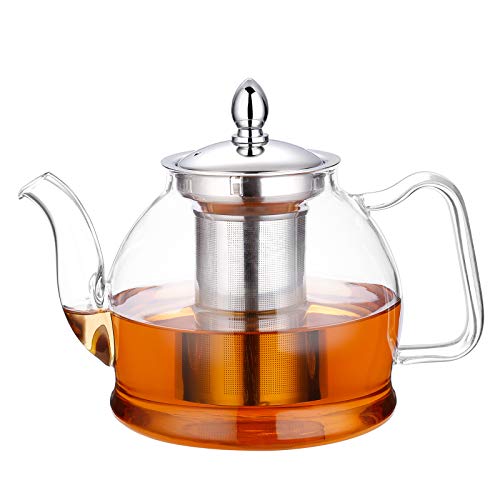
- HIWARE 1000ml Glass Teapot with Removable Infuser — Check on Amazon
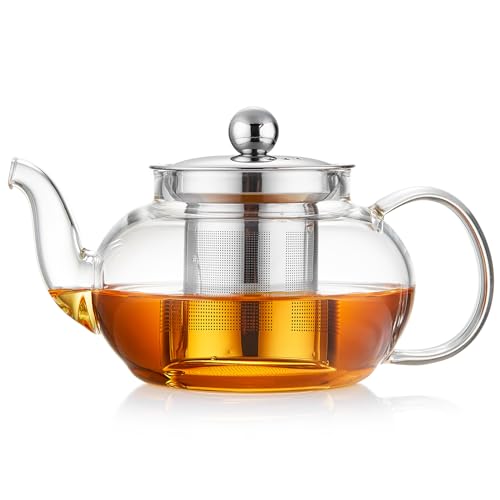
- PARACITY Glass Teapot Stovetop 18.6 oz (550ml)
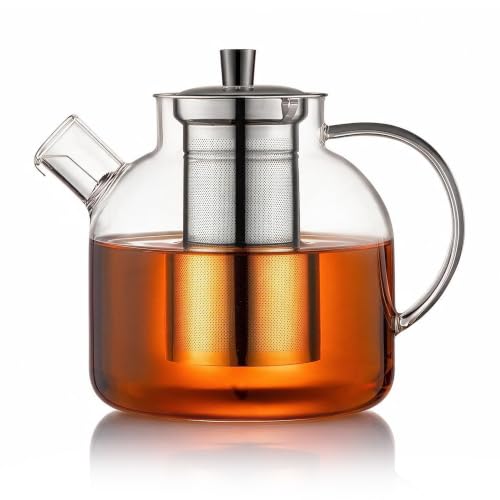
- Ehugos 1500ml (50 oz) Glass Teapot with Removable Infuser
- Teabloom Stovetop & Microwave Safe Glass Teapot (40 oz)
- DOPUDO Small Glass Teapot with Infuser, 18 oz (530ml)
- STNTUS Glass Teapot, 40 oz / 1200ml, 4–6 Cups
Read the full guide ↓
The best teapots for brewing tea are not the prettiest pots or the most expensive ones. They are the pots that give the brewer control over the four variables that decide every cup: leaf dose, water temperature, steep time, and the moment extraction stops. A removable infuser is the mechanism of that control — it lets you separate leaves from liquor at the exact second the brew is right, rather than watching a good pot of tea stew into bitterness while the first cup is poured. Glass is the material of that control, because it shows you the liquor deepening in real time, turning steeping from guesswork into observation. The six pots in this guide were chosen as brewing instruments first and ornaments second.
Every pick here is a glass teapot with a removable infuser, verified against manufacturer listing data on 2026-11-20, and they divide the brewing world sensibly. Two are personal instruments — the DOPUDO at 530ml and the PARACITY at 550ml — built for the short, attentive steeps of solo sessions and re-steeping. Two are household instruments — the HIWARE at a litre and the STNTUS at 1200ml with its dual straining — built for tables where one brew must satisfy several drinkers. One, the Ehugos at 1500ml, is the group instrument. And the Teabloom, with its glass infuser and included blooming teas, is the visual instrument, for the teas whose brewing is half the pleasure. Technique threads through the whole guide: if you take one idea away, let it be that the pot’s job is to make the variables manageable, and yours is to manage them.
A note on the brewing itself before the products: none of these pots will rescue boiling water poured on green tea, or leaves left steeping through a phone call. What they will do — the good ones, used as directed — is make correct brewing the path of least resistance. The method sections after the reviews lay out the full working technique, from warming the pot to the second steep. Readers whose brewing leans delicate will also find our companion guide to the Best Teapots For Green Tea worth their time; it narrows this guide’s principles to the least forgiving tea family of all.
Key Takeaways
- Brewing quality is control: dose, temperature, time, and a clean stop — and a removable infuser is what makes the stop possible.
- The HIWARE 1000ml is the best all-round brewing pot: stovetop safe, one litre, infuser-equipped.
- The PARACITY’s fine 18/8 steel infuser suits small leaves and short, precise solo steeps.
- The STNTUS offers two brewing methods — basket infusion or free-leaf with a spout strainer — in one 1200ml pot.
- The DOPUDO brews the freshest solo cup because its 530ml size is used at full capacity every time.
- Glass lets you judge the steep by colour, the most reliable in-the-moment gauge a brewer has.
In this guide
Quick Picks
| Pick | Badge | Capacity | Infuser | Link |
|---|---|---|---|---|
| HIWARE Glass Teapot | Best Overall Brewer | 1000ml | Removable infuser | Check on Amazon |
| PARACITY Glass Teapot | Best for Small-Batch Precision | 18.6 oz / 550ml | Removable 18/8 stainless steel infuser | Check on Amazon |
| Ehugos Glass Teapot | Best for Group Brewing | 1500ml / 50 oz | Removable stainless infuser | Check on Amazon |
| Teabloom Glass Teapot | Best for Blooming & Visual Brewing | 40 oz | Removable glass infuser | Check on Amazon |
| DOPUDO Small Glass Teapot | Best Solo Brewer | 18 oz / 530ml | Removable 18/8 steel infuser | Check on Amazon |
| STNTUS Glass Teapot | Best for Mixed Brewing Methods | 40 oz / 1200ml, 4–6 cups | Infuser with stainless steel strainer | Check on Amazon |
How These Picks Were Chosen
We evaluated these pots as brewing equipment. From each manufacturer’s verified listing — checked on 2026-11-20 — we recorded the capacity, the infuser’s construction and removability, any stovetop or microwave rating, and the tea formats the maker names. We then matched those mechanics to brewing demands: Does the infuser lift fully clear so extraction stops dead? Is the capacity honest for the sessions it will serve? Does the pot’s size encourage brewing at the fill level where circulation works properly? Pots that answered those questions well, at their scale, made the list.
This guide is research-led. We did not run a tasting panel or time these pots against each other, and we print no invented scores. The brewing science we rely on is the established kind: extraction accelerates with temperature and leaf surface area, bitterness compounds extract later than sweetness, and removing the leaves is the only reliable brake. Where a pot’s design interacts with that science — a fine mesh for small leaves, a wide body for blooming teas, a strainer for free-leaf brewing — the reviews say so specifically rather than praising in generalities.
We also favoured pots that forgive. Most home brewing is done by people who are simultaneously making toast, answering messages, and finding cups. A pot whose infuser lifts out in one motion, whose size matches the household so it is used full, and whose glass shows the brew’s progress at a glance will produce better real-world tea than a technically finer pot that demands ceremony. That philosophy — control made easy — runs through every badge below, and through our service-oriented companion on the Best Teapots For Cafe Use, where the same forgiveness is what separates a workable café pot from a beautiful liability.
The 6 Best Teapots for Brewing Tea
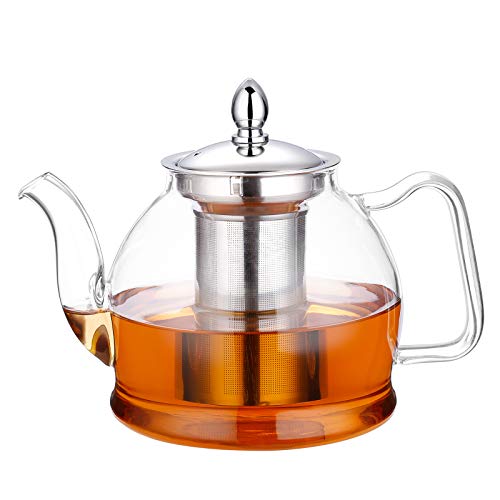
HIWARE 1000ml Glass Teapot with Removable Infuser
Badge: Best Overall Brewer
Strengths
- One litre is the most useful brewing volume in the category: a full family round or a solo drinker’s day of re-steeps, always at a proper fill.
- Removable infuser gives a clean extraction stop for the blooming and loose leaf teas its maker names.
- Stovetop safe, so brew water can be heated in the pot and caught at the right moment for the leaf.
Trade-offs
- Half-filled for a single mug, it brews less evenly; it wants to work at scale.
- Glass loses heat across a long session, so slow drinkers should decant or use a cosy.
- The infuser is a generalist; the finest leaves are better contained by the PARACITY’s mesh.
Spec box
- Capacity: 1000ml
- Material: Glass (per manufacturer listing)
- Infuser: Removable infuser included
- Stovetop: Described as stovetop safe by the maker
- Tea types named by maker: Blooming and loose leaf
The HIWARE earns the top brewing spot because a litre, brewed properly, is where all the variables are easiest to manage. There is enough water for stable temperature, enough room in the pot for leaves to circulate rather than clump, and enough liquor that pulling the infuser at the right moment rewards you with four consistent cups instead of one good cup and three stewed ones. The stovetop rating adds a brewer’s refinement: water heated in the pot can be taken off the heat at the first sign of the temperature your leaf wants, then the leaves go in without a transfer that sheds degrees and momentum. For the mixed household — black tea at breakfast, something greener later — it is the single most capable instrument here.
Its weakness is the mirror of its strength. This is a pot that brews at scale, and a solitary mug brewed in its shallows will be thinner and cooler than the same mug from the DOPUDO. Buy it for the sessions it was sized for and it will not disappoint a single one.
Best for: Households brewing daily for two to four / Not suited for: Strictly solo mug brewing
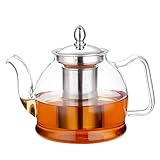

PARACITY Glass Teapot Stovetop 18.6 oz (550ml)
Badge: Best for Small-Batch Precision
Strengths
- Fine 18/8 stainless steel infuser contains small and broken leaves that escape coarser baskets, keeping the liquor clean.
- 550ml brews at full capacity for one or two, which is where extraction is most consistent.
- Borosilicate body, stovetop listed — small volumes of water reach temperature quickly for short steeps.
Trade-offs
- No group capacity; a table of guests means serial brewing.
- Small volumes cool quickly, so plan steeps in minutes, not quarter-hours.
- Tightly rolled leaves have less room to unfurl than in a wide basket.
Spec box
- Capacity: 18.6 oz / 550ml
- Material: Borosilicate glass
- Infuser: Removable 18/8 stainless steel infuser
- Stovetop: Listed as a stovetop teapot by the maker
- Use cases named by maker: Camping, travel, home brewing
Precision brewing is small-batch brewing. When the whole session is 550ml, every variable is within reach: the water temperature is uniform, the leaf-to-water ratio is easy to repeat, the steep can be watched second by second through the glass, and the infuser lifts the instant the colour is right. The PARACITY is built for that discipline, and its fine steel mesh extends the discipline to the leaves that defeat other pots — the small, the broken, the needle-like. A solo drinker working through a quality green or a fine blend will extract more from the leaf in this pot than in any larger vessel, because nothing about the session is approximate. Its maker’s camping and travel positioning is a bonus: precision that packs.
The boundary is social. This pot brews for the brewer and perhaps one guest; beyond that it becomes a kettle-side relay. Households whose tea is an event should look up the list to the HIWARE and beyond.
Best for: Solo precision brewers and fine-leaf drinkers / Not suited for: Entertaining

Ehugos 1500ml (50 oz) Glass Teapot with Removable Infuser
Badge: Best for Group Brewing
Strengths
- 1500ml brews a full round for a group in a single extraction, so every cup tastes like the first.
- Stovetop safe with a removable stainless infuser — heat, steep, stop, serve, all in one vessel.
- Wide hand-crafted body gives blooming teas and large leaves maximum room.
Trade-offs
- Group scale demands group discipline: a forgotten infuser ruins six cups at once, not one.
- Heavy when full; pouring for a table needs a steady, two-handed technique.
- Wasteful for solo sessions, where most of the pot would cool or stew.
Spec box
- Capacity: 1500ml / 50 oz
- Material: Glass, hand crafted
- Infuser: Removable stainless infuser
- Stovetop: Described as stovetop safe by the maker
- Tea types named by maker: Blooming and loose leaf
Group brewing has a quiet enemy: the second pot. Brew one pot for the first four cups and a second for the next two, and the table drinks two different teas wearing the same name. The Ehugos abolishes that with a single 1500ml extraction — one dose, one temperature, one steep, six consistent cups. Its stovetop rating keeps the workflow in one vessel from cold water to poured round, and the wide body is the best stage in this guide for the large-leaf and blooming teas that need expansion room. For study groups, family breakfasts, and hosts who brew for a room, it is the only pot here sized honestly for the job.
The responsibility scales with the volume. At 1500ml, the brewer’s timer matters six times over, and the pour is a genuine lift. Groups that brew casually and wander off mid-steep will produce large quantities of stewed tea; groups with one appointed brewer will produce the best rounds in this guide.
Best for: Groups, families, and hosts / Not suited for: Solo brewing

Teabloom Stovetop & Microwave Safe Glass Teapot (40 oz)
Badge: Best for Blooming & Visual Brewing
Strengths
- Designed around blooming teas, with two included, and a glass infuser that never blocks the view.
- Stovetop and microwave safe, and works as a 2-in-1 kettle and tea maker.
- 40 oz is a comfortable two-to-four cup brewing volume for unhurried sessions.
Trade-offs
- The glass infuser’s wider slots let fine leaves slip; it is a large-leaf instrument.
- Glass infuser fragility demands the gentlest washing in this group.
- Mid-size capacity suits neither the solo mug nor the full table perfectly.
Spec box
- Capacity: 40 oz
- Infuser: Removable loose tea glass infuser
- Stovetop: Stovetop and microwave safe per maker
- Included: 2 blooming teas
- Format: 2-in-1 tea kettle and tea maker
Some brewing is theatre, and the Teabloom is the theatre’s pot. A blooming tea is brewed to be watched — the ball sinking, softening, and opening into a flower while the liquor goldens around it — and every element of this pot serves the watching: clear walls, a glass infuser that adds no visual noise, a size that frames one bloom properly. The included teas mean the performance starts on arrival. But it would be a mistake to file the Teabloom as decoration only. As a brewer it is fully competent for loose leaf at the two-to-four cup scale, its dual heating ratings make it the most flexible water-handler here, and the visual feedback it specialises in — colour as the steep’s progress bar — is the same feedback every brewer in this guide relies on, simply presented at its most beautiful.
Know its infuser’s limits. Fine teas belong in the steel-mesh pots; the Teabloom’s glass slots are for leaves with presence. Treat it as the large-leaf and blooming specialist and it is superb.
Best for: Blooming tea and visual brewers, gifts / Not suited for: Fine-leaf teas or rough handling


DOPUDO Small Glass Teapot with Infuser, 18 oz (530ml)
Badge: Best Solo Brewer
Strengths
- 530ml of borosilicate glass purpose-built for individual loose-leaf brewing — used full every time, so extraction stays consistent.
- Removable 18/8 steel infuser: fine straining, fast rinsing, durable in daily service.
- The smallest footprint here; it lives on a desk or a crowded bench without negotiation.
Trade-offs
- No stovetop claim in its listing — it brews from kettle water.
- One person’s pot, strictly; guests need a second vessel.
- Small thermal mass means the brew is for now, not for an hour from now.
Spec box
- Capacity: 18 oz / 530ml
- Material: Borosilicate glass
- Infuser: Removable 18/8 steel infuser
- Format: Compact teapot for individual loose-leaf brewing
- Stovetop: Not stated in the maker listing — treat as pour-over only
The DOPUDO makes a brewer’s argument that bigger pots cannot: the freshest cup is the one brewed at exactly drinking scale, minutes before it is drunk. A solo drinker with a litre pot faces a daily choice between a half-filled, unevenly steeped brew and a full pot that stews or cools before it is finished. The DOPUDO removes the choice. Its 530ml is one generous session, brewed full, steeped under observation, infuser lifted at the peak, and finished while it is still itself. The steel infuser handles the fine end of a solo drinker’s shelf, the borosilicate rinses clean between a morning black and an evening green, and the whole ritual takes a corner of a desk. For the way most committed solo brewers actually drink, this is the most honest pot in the guide.
Its limit is written on its spec sheet: 18 ounces is a boundary, not a suggestion. Buy it as a personal instrument and it excels; buy it hoping to host and it will frustrate you weekly.
Best for: Solo daily brewers, desks, small kitchens / Not suited for: Any form of entertaining

STNTUS Glass Teapot, 40 oz / 1200ml, 4–6 Cups
Badge: Best for Mixed Brewing Methods
Strengths
- Two complete brewing methods in one pot: contained basket infusion, or free-leaf brewing caught by the stainless steel strainer.
- 1200ml capacity sized by the maker for four to six cups — the family and small-group standard.
- Stovetop safe, so both methods can start from water heated in the pot.
Trade-offs
- Two components to wash and store together.
- Free-leaf brewing demands a steady pour to let the strainer work.
- More pot than a couple needs for a morning mug each.
Spec box
- Capacity: 40 oz / 1200ml
- Cup guide: Four to six cups per maker
- Infuser: Infuser basket plus stainless steel strainer
- Stovetop: Described as stovetop safe by the maker
- Tea types named by maker: Loose tea
Brewing schools divide over a genuine question: should leaves steep contained in a basket, for control and cleanliness, or free in the pot, for maximum circulation and a fuller extraction that a strainer then catches? The STNTUS is the only pot here that refuses to choose. Basket on weekdays, when the routine is clockwork; free-leaf on weekends, when a robust blend deserves the traditional treatment and the pour is unhurried. That duality makes it the best teaching pot in the group — a new brewer can run the same tea both ways and taste the difference the method makes, which is the fastest education in the craft. At 1200ml it also sits at the family size where a single extraction still serves the table, and its stovetop rating keeps both methods on a single vessel.
The cost is the second component and the care it asks: a strainer separated from its pot in a busy drawer is a method lost. Households that know they will only ever brew one way can simplify with the HIWARE; households that brew both ways, or want to learn, have found their pot.
Best for: Families and method-curious brewers / Not suited for: Minimalist one-part kitchens
Comparison Table
| Teapot | Capacity | Infuser | Heating | Brewing strength | Link |
|---|---|---|---|---|---|
| HIWARE | 1000ml | Removable infuser | Stovetop safe | All-round daily brewing | Check on Amazon |
| PARACITY | 550ml | 18/8 steel infuser | Stovetop listed | Small-batch precision, fine leaves | Check on Amazon |
| Ehugos | 1500ml | Stainless infuser | Stovetop safe | Single-extraction group rounds | Check on Amazon |
| Teabloom | 40 oz | Glass infuser | Stovetop + microwave | Blooming and visual brewing | Check on Amazon |
| DOPUDO | 530ml | 18/8 steel infuser | Pour-over | Fresh solo sessions | Check on Amazon |
| STNTUS | 1200ml | Infuser + strainer | Stovetop safe | Two brewing methods | Check on Amazon |
How to Choose a Teapot for Brewing: The Variables That Matter
Infuser first. The infuser is the brewer’s brake pedal, and its quality decides how precisely you can stop extraction. It must lift fully clear of the liquor in one motion, hold the finest leaf you drink, and rinse clean without trapping residue. Fine steel mesh — PARACITY, DOPUDO — suits small leaves and daily abuse. Glass infusers — Teabloom — suit large leaves and visual brewing. A basket-plus-strainer system — STNTUS — suits households split between brewing methods. Choose the infuser for your finest tea and your preferred method, and the pot around it will follow.
Capacity matched to the session. Extraction is most consistent when the pot is used near its intended fill: leaves circulate, temperature holds, and the dose arithmetic stays honest. Map your sessions before you shop. Solo drinkers brew best in 500–600ml. Couples and small families in 800ml–1200ml. Groups in 1500ml. The wrong size is not a minor inconvenience; it is a daily tax on every variable at once, paid in thin, cool, or stewed cups.
Heating that fits the brewing. A stovetop-rated pot lets the brewer catch water at the exact temperature moment — essential for households moving between boiling-water blacks and cooler greens in one morning. Kettle households already own that control if the kettle allows it; otherwise, rest boiled water before delicate steeps. Five of these six pots carry a stovetop claim; the DOPUDO is the pour-over exception, and its solo focus makes that a fair trade. Burner-specific guidance lives in our companions on the Best Teapots For Electric Stove and gas models for readers who want the heating layer in depth.
Visibility as an instrument. Treat the glass as a gauge, not a decoration. Liquor colour integrates dose, temperature, and time into a single readable signal, and brewers who watch it learn their teas faster than brewers who rely on timers alone. In a mixed household, colour is also diplomacy: the person pouring can see the strength and adjust the next steep without a debate.
How to Brew Tea Properly: The Complete Working Method
Step one — warm the pot. Swirl a cup of hot water through the empty pot and discard it. A cold pot steals the first heat from the brew, dropping the temperature into the range where extraction turns thin and uneven, and the temperature shock is unkind to glass. Thirty seconds of warming is the cheapest quality improvement in all of tea-making.
Step two — dose the leaf. Start from a teaspoon of loose leaf per 250ml of water, then adjust by leaf type: fluffy whites and large-leaf teas need a more generous hand because a teaspoon of them weighs less; dense, broken teas need a level measure or they will dominate. Consistency matters more than the exact figure — use the same spoon, the same pot, and change one thing at a time until the cup is yours.
Step three — water at the right temperature. Black tea and herbal infusions take a full boil. Green and white teas want water rested off the boil — roughly 75–85°C — because boiling water scalds their leaves into bitterness. Oolongs sit between, hot and forgiving across repeated steeps. Rooibos and other fine infusions, covered in our guide to the Best Teapots For Infusion Tea Like Rooibos, take boiling water and a long steep happily. If you take one habit from this guide, take this one: the pause between kettle and pot for anything green.
Step four — steep with the lid on, on a timer. Two to three minutes for greens, three to five for blacks, longer for herbals, short and repeated for oolongs. The lid keeps the aromatics and the heat in the pot where they belong. Use a timer you trust; memory is not a timer, and the difference between a four-minute and a seven-minute black tea is the difference between breakfast and regret.
Step five — stop the extraction. Lift the infuser out completely and set it on a small dish. In the STNTUS’s free-leaf mode, the equivalent is decanting the whole brew through the strainer into cups or a serving vessel. Then pour in a slow circle so the first and last cups match. Leaves left in liquor keep working; a stopped brew stays where you put it.
Step six — re-steep what rewards it. Greens, whites, and oolongs give a second and third infusion, each a little longer than the last. Keep the leaves in the infuser, covered, between rounds. Black teas and most herbals are single-steep citizens; make them fresh and make them at the right size instead.
Care between brews. Empty the infuser immediately, rinse pot and basket in hot water, and wash fully after strong or spiced teas. Descale with a citric-acid soak when film appears. A clean pot is a brewing variable too — yesterday’s residue is today’s off-note.
Troubleshooting.
- Problem: Tea tastes bitter → what to do: shorten the steep, lower the water temperature for greens and whites, and confirm the infuser actually came out at the end. Bitterness is almost always time plus temperature, in that order.
- Problem: Tea tastes thin and watery → what to do: increase the leaf dose slightly, check that the water was hot enough for the family, and brew at the pot’s proper fill so the leaves circulate instead of huddling.
- Problem: The first cup is perfect and the last is stewed → what to do: the brew was never stopped. Decant the full pot into cups or a warmed serving vessel at the end of the steep, especially in the large pots.
- Problem: Leaves in the cup → what to do: seat the infuser fully, pour slowly, and match fine teas to the finest mesh you own; in free-leaf mode, let the strainer do its work with a gentle, unhurried pour.
The Four Variables, Taken One at a Time
Dose is the variable beginners underuse, because adding leaf feels extravagant. It is not: a properly dosed short steep beats an under-dosed long one at every level, delivering flavour before the bitter compounds arrive. Temperature is the variable with the sharpest cliff — five degrees too hot will not ruin a black tea, but boiling water on a delicate green is a cliff edge, which is why the rested-kettle habit matters. Time is the variable the infuser exists to govern, and the one most often surrendered to distraction; timers and one-motion infuser removal are the countermeasures. Leaf quality is the variable no pot can fix, and the honest brewer budgets for it: every pot in this guide will faithfully express the difference between a fresh, well-stored leaf and a tired one, which is an argument for buying tea in quantities you will finish while it is still itself. Master the order — dose, temperature, time, leaf — and the choice between these six pots becomes what it should be: a matter of household size and habit, not a search for a vessel that brews by itself. None does. That is the brewer’s job, and it is the enjoyable part.
There is a fifth, unofficial variable worth naming because it decides whether the other four get practised at all: friction. A pot that is pleasant to fill, easy to watch, simple to empty, and quick to rinse will be used on the tired Tuesday evenings when technique usually collapses — and a technique practised on Tuesdays is worth more than a perfect technique reserved for Sundays. Every design choice praised in this guide, from one-motion infusers to right-sized capacities, is ultimately a friction choice. When you stand between two finalists, choose the one you can picture yourself using half-asleep at seven in the morning. That pot is your brewing pot; the other one is a display piece with a spout.
Brewing for a Table: Service Technique at Scale
Brewing for several drinkers is the same method with the margins removed, and it rewards a small amount of stage management. Warm the largest pot — the Ehugos or STNTUS at a gathering — and warm the cups too if the room is cold, because a litre of tea poured into cold cups loses its first impression instantly. Dose for the full volume and steep with the lid on and the timer visible; at group scale, appoint the brewer, because a pot that belongs to everyone gets watched by no one. When the timer ends, remove the infuser before the first pour, not after it: the single most common service error is pouring two cups, chatting, and returning to a pot that has been steeping the whole time. Pour in a circle, a little into each cup in turn, so strength equalises across the table rather than running from light to dark. If a second round is coming, start the water as the first round is poured, and consider whether the leaves have a second steep in them — oolongs and greens do, breakfast blends generally do not. Hosts who run that sequence find that a glass pot at the table is not a compromise but a centrepiece: guests watch the colour, ask about the tea, and remember the afternoon. That social dividend is built into every large glass pot in this guide, and it is free.
Re-Steeping: Getting the Second and Third Cup Right
Re-steeping is where good leaves repay their cost, and where brewing technique shows most clearly. The principle is simple: quality leaves are not exhausted by one infusion, because the first steep opens them as much as it extracts from them. Greens often peak on the second steep, whites on the second or third, and oolongs can run four or more rounds with evolving character. The method asks for three habits. Keep the leaves in the infuser between rounds, drained but not dried out — set the basket across the pot’s mouth or on its dish, covered if the kitchen is busy. Use water at the same temperature as the first steep; cooling the water for later steeps flattens them. Add time progressively — roughly half a minute per round for greens, more for oolongs — because the leaf gives up its flavour more slowly as it opens. Know when to stop: when a steep comes out thin despite extra time, the leaf is done, and composting it promptly keeps the pot ready for the next tea. Small pots serve re-steeping best, because each round is drunk fresh; the PARACITY and DOPUDO are the natural instruments, and a solo drinker who masters re-steeping will find a modest bag of fine leaves lasting the week — the most economical luxury in tea.
Storing Leaf and Pot: The Unglamorous Half of Brewing
Brewing quality is decided partly before the water boils. Loose leaf deteriorates in light, air, heat, and scent, so it belongs in a sealed, opaque container away from the stove and the spice rack — a lesson glass teaches by contrast, since the pot itself is transparent and the leaf tin must not be. Measure from the tin, reseal it immediately, and buy in quantities your household finishes while the leaf is still lively; a modest amount of fresh tea brewed well beats a treasure chest of stale tea brewed perfectly. The pot has its own storage logic: keep it with its infuser inside and its lid seated, on a shelf at hand height, out of the traffic lane of the kitchen. A pot stored assembled is a pot whose parts are never lost, and a pot stored safely is a pot that survives to brew the next bag of leaves. None of this is technique in the glamorous sense, but brewers who manage storage find their cups improve without changing anything at the stove — because the variables they control at brewing time were protected all week.
Common Buying Mistakes
- Buying the pot for the tea you admire, not the tea you drink. A blooming-tea stage is wasted on a breakfast-blend household; match the instrument to the actual shelf.
- Ignoring fill level. A pot used half-empty brews unevenly every day; size is a brewing specification, not a storage one.
- Choosing a coarse infuser for fine teas. Sediment in every cup is a specification error made at purchase, not a brewing failure.
- Skipping the timer habit. No pot corrects a forgotten steep; buy the pot that makes stopping easiest for your routine.
- Judging by the first brew. Every pot has a learning curve of two or three sessions per tea; judge it after the curve, not during it.
Final Recommendation
For most brewing households, the HIWARE 1000ml is the instrument to build a routine around: honest capacity, clean extraction control, and stovetop flexibility in one pot. Solo brewers should take the DOPUDO for freshness or the PARACITY for fine-leaf precision; groups, the Ehugos; method explorers and families, the STNTUS with its two ways to brew; and visual brewers, the Teabloom. Then do the part no purchase can do for you: warm the pot, dose honestly, mind the temperature, set the timer, and lift the leaves when it rings. That is brewing, and any of these six pots will honour it. Give a new pot a fortnight of honest sessions before you judge it, keep a note of the ratios that worked for your favourite leaves, and you will find the ritual shortening and the cups improving at the same time — the surest sign that the instrument and the brewer have learned each other.
Frequently Asked Questions
What makes a teapot good for brewing, specifically?
Control. A brewing teapot must let you dose the leaf, hold the temperature, time the steep, and stop the extraction cleanly — which is why every pot here has a removable infuser, and why glass, which shows the liquor’s progress, outperforms opaque materials for learning and consistency. Size matched to your sessions completes the picture.
How much loose leaf should I use per pot?
Start with a teaspoon per 250ml of water and adjust: more for fluffy, large-leaf teas, a level measure for dense broken teas, and small changes — a quarter-teaspoon at a time — until the strength suits you. Write your ratio on the tea tin once you find it; consistency is what turns a good brew into your brew.
Should leaves steep in the infuser or loose in the pot?
Both work, and the STNTUS supports both methods deliberately. The infuser gives a cleaner stop and easier cleanup; free-leaf steeping gives maximum circulation and a fuller extraction for robust teas, with the strainer catching leaves at the pour. New brewers should start with the infuser and experiment once the basics are automatic.
Why does my tea taste different in a bigger pot?
Because the variables move: a larger volume holds temperature longer, leaves circulate differently, and a pot used below its fill steeps unevenly. Dose scales with water volume, not with the pot’s maximum, and a half-filled large pot will always brew a thinner, cooler cup than the same dose in a right-sized pot.
Can I brew tea bags in these pots?
Yes — place bags in the pot with or without the infuser, steep for the usual time, and remove them at the end. The infuser pots here lose nothing when used with bags, and households that mix bags on weekdays with loose leaf on weekends are exactly who these versatile designs serve.
How do I keep the second half of the pot from over-steeping?
Stop the extraction for the whole pot at once: remove the infuser the moment the steep ends, or decant everything into a warmed serving vessel. If the pot will sit, that decant is the difference between a second cup that matches the first and one that punishes you for the conversation in between.
How do I brew iced tea in these pots?
Brew a double-strength hot tea — twice the leaf, the usual time — with the infuser, remove the leaves, let the pot cool somewhat, then pour over ice in glasses or a pitcher. Never plunge a hot glass pot into ice or cold water; the thermal shock rule applies in summer too. Cold-brewing is the gentler alternative: leaves and cold water in the pot, refrigerated for several hours, then strained — glass shows the colour beautifully either way.
What is the best way to learn my new pot?
Brew one familiar tea three ways across a week: your usual method, a slightly shorter steep, and a slightly stronger dose. Taste them side by side in your mind or in a notebook, and keep the version you liked. That small experiment teaches a new pot’s character — its pour, its heat behaviour, its infuser’s fineness — faster than any review, including this one. Brewers who keep the habit of changing one variable at a time rarely stay beginners for long, because every cup becomes a small, drinkable experiment with a result they can taste.
Does the teapot material change the taste of the tea?
Glass is neutral: it adds nothing and, rinsed properly, carries nothing between brews, which is why it anchors this guide. Porous and seasoned materials deliberately contribute character over time — prized by single-tea devotees, a complication for mixed shelves. For brewing control and honesty of flavour, glass is the reference standard.