Disclosure: topratedkitchenware.com is reader-supported. When you buy through links on our site, we may earn an affiliate commission from Amazon and other retailers, at no extra cost to you.
Where to buy
Four of the six teapots below qualify as the best teapots for gas stove kitchens because they carry a stovetop claim from their makers, and those four are linked and recommended for gas stove use. Two — the Enchanti and the DRNKNSTX — make no stovetop claim in their listings, so they are reviewed honestly in prose only, with no purchase link, as kettle companions that must never meet a flame. Linked pots are sold through Amazon; verify the stovetop wording on the listing itself before ordering, because that claim is the licence for everything this guide recommends.
- Enchanti One Touch Glass Teapot with Infuser, 27 oz / 800ml — no stovetop claim; reviewed prose-only below
- Teabloom Celebration Glass Teapot & Kettle, 27 oz — Check on Amazon
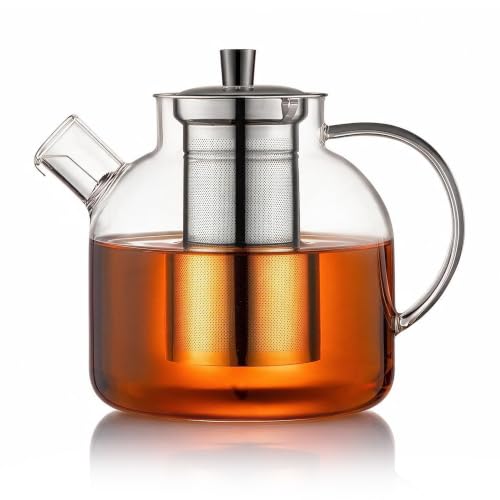
- CNGLASS Glass Teapot Stovetop Safe with Removable Infuser, 20.3 oz
- DRNKNSTX Enchanted Tea Pot with Tea Infuser, 20 oz — no stovetop claim; reviewed prose-only below
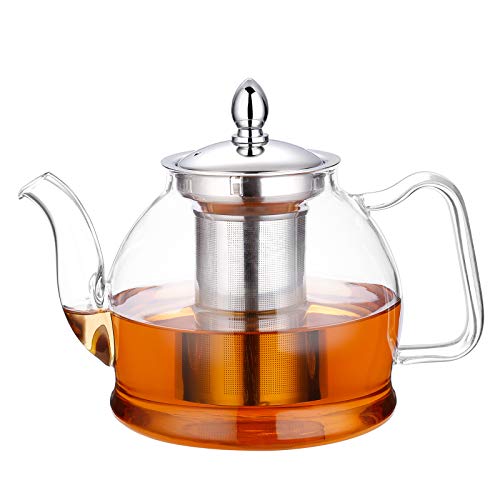
- HIWARE 1000ml Glass Teapot with Removable Infuser
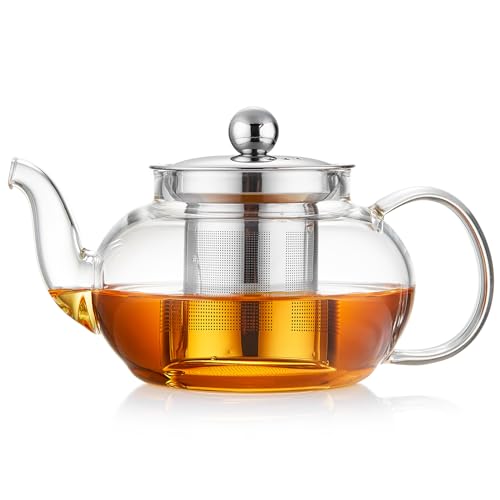
- PARACITY Glass Teapot Stovetop 18.6 oz (550ml)
Read the full guide ↓
The best teapots for gas stove kitchens begin with a licence: the maker’s own statement that the pot is stovetop safe. Gas is the most honest heat in the kitchen — visible, instant, and completely unforgiving of a vessel that was never built for direct flame. A glass pot rated for the stove can live happily over a burner for years; an unrated one can fail on its first boil, because open flame concentrates heat at the base and climbs the walls in a way no other heat source quite replicates. This guide therefore sorts its six pots by their listings before it says a word about brewing: four carry the claim, verified on 2026-11-20, and two do not, and the two that do not are labelled as kettle companions in plain language rather than quietly dropped or quietly linked.
The four rated pots divide the gas kitchen sensibly. The HIWARE, at a stovetop-safe litre, is the household boiler. The PARACITY, a borosilicate pot its maker lists for the stovetop and aims at camping and travel, is the small-flame specialist — the pot for caravan burners and camp stoves as well as home rings. The CNGLASS brings the rating to a compact 20.3 oz for solo stove-top routines, and the Teabloom Celebration adds a microwave-safe second route and the full loose-leaf, bagged, and blooming repertoire at 27 oz. Between them they cover every gas ring in a normal kitchen, from the smallest simmer burner to the family wok ring turned low. The flame technique that keeps them safe — footprint under the base, moderate heat, no dry boils, no cold shocks — is laid out in full in the method section, because on gas, technique is not a refinement of safety; it is most of it.
A word for the two companions before the reviews. The Enchanti and the DRNKNSTX will appear beside the rated pots in every search a gas-stove shopper runs, and nothing on a results page warns that their listings are silent about stovetop use. They are good brewers — one a beginner-friendly one-touch design, the other a giftable steeper for herbal teas — and a gas kitchen with a kettle can use both happily for years. What they must never do is sit on a grate over a flame. This guide links only what it can recommend for the keyword’s core purpose, and it reviews the rest honestly so the distinction survives contact with a shopping cart.
Key Takeaways
- Only maker-rated stovetop pots belong over a gas flame: here, the Teabloom Celebration, CNGLASS, HIWARE, and PARACITY.
- The Enchanti and DRNKNSTX carry no stovetop claim and are reviewed prose-only as kettle companions.
- The HIWARE 1000ml is the household gas boiler; the PARACITY is the camping and small-burner specialist.
- Flame discipline is the safety system: keep the flame footprint under the base, use moderate heat, never boil dry.
- Gas responds instantly, which makes it the best heat for catching water at a precise stage for delicate teas.
- Borosilicate and heat-resistant glass tolerate the burner within their ratings — gradual changes, filled pot, no cold shocks.
In this guide
Quick Picks
| Pick | Badge | Capacity | Over a gas flame? | Link |
|---|---|---|---|---|
| Enchanti Tea Pot | Kettle Companion (Prose-Only) | 27 oz / 800ml | No — no stovetop claim | Reviewed below, no link |
| Teabloom Celebration Teapot | Best for Flexible Gas Kitchens | 27 oz | Yes — stovetop and microwave safe | Check on Amazon |
| CNGLASS Glass Teapot | Best Compact Gas Boiler | 20.3 oz | Yes — stovetop safe per maker | Check on Amazon |
| DRNKNSTX Enchanted Tea Pot | Kettle Companion (Prose-Only) | 20 oz | No — no stovetop claim | Reviewed below, no link |
| HIWARE Glass Teapot | Best Household Gas Boiler | 1000ml | Yes — stovetop safe per maker | Check on Amazon |
| PARACITY Glass Teapot | Best for Camping & Small Burners | 18.6 oz / 550ml | Yes — stovetop listed by maker | Check on Amazon |
How These Picks Were Chosen
Every pot in this guide was checked against its manufacturer’s own listing on 2026-11-20, and the sorting rule was the listing’s own words. Four pots state stovetop suitability — the HIWARE and CNGLASS are each described as stovetop safe, the PARACITY is listed as a stovetop teapot, and the Teabloom Celebration is described as stovetop and microwave safe — and those four carry the links, images, and gas-stove recommendations. Two pots, the Enchanti and the DRNKNSTX, contain no stovetop claim of any kind; they are reviewed in prose only, without links or images, as brewers for kettle water. In a category where the failure mode is a pot of boiling water, we do not infer ratings from materials, photographs, or brand siblings. Silence is a no.
This is a research-led guide, not a flame test. We did not run these pots over burners to compare heating performance, and we publish no invented timings. The gas technique in the method section is the established practice for rated glass cookware: match the flame to the base, moderate the heat, keep the pot filled and attended, and manage the cool-down as carefully as the heat-up. Where the science matters — why borosilicate tolerates a burner, why a dry boil is the unforgivable sin — we explain it from the material’s known behaviour rather than from marketing copy.
We also weighed the gas kitchen’s real alternatives honestly. A household with a good kettle gains convenience, not capability, from a rated pot; a household that cooks on gas daily and drinks tea twice a day gains a genuinely simpler ritual, and campers gain a vessel that works on the only heat they have. The reviews keep those cases separate, because the best gas-stove teapot for a caravan and the best one for a family range are both in this list — wearing different badges.
The 6 Best Teapots for Gas Stove Kitchens (4 Rated + 2 Kettle Companions)
Enchanti One Touch Glass Teapot with Infuser, 27 oz / 800ml (Prose-Only: Kettle Companion)
Badge: Kettle Companion (Prose-Only)
Strengths
- One-touch design mechanises the steep-stop, forgiving beginners who brew from kettle water.
- 800ml is the most flexible personal size here — a large solo session or a two-person pot.
- Gift-set presentation suits the present-buying half of its audience.
Trade-offs
- No stovetop claim in its listing: it must never sit on a gas grate, full stop.
- Kettle-dependent for all hot water.
- The mechanism needs a prompt rinse after use.
Spec box
- Capacity: 27 oz / 800ml
- Infuser: Infuser included, one-touch design
- Format: Glass teapot and tea maker for loose leaf tea
- Packaging: Tea gift set per maker
- Stovetop: NOT stated by the maker — keep away from all burners
The Enchanti opens this guide as a study in honest labelling. It is a well-conceived brewer — the one-touch separation is genuinely kind to new loose-leaf drinkers, and 800ml is the size experienced solo brewers keep choosing — and its listing simply never claims stovetop use. In a gas kitchen, that makes it a counter pot: the kettle boils on the ring, the Enchanti brews beside it, and the flame never meets the glass. Households that already run a kettle for coffee or cooking will find that workflow costs them nothing, and beginners will find the pot itself one of the friendliest in this entire set. It appears here without a link or image because this guide reserves both for pots it can recommend over a flame; readers who want the Enchanti as a brewer should buy it with clear eyes, as a kettle companion of real quality — and then keep it off the grate for the whole of its long life.
Best for: Kettle households and loose-leaf beginners / Not suited for: Any contact with a gas burner
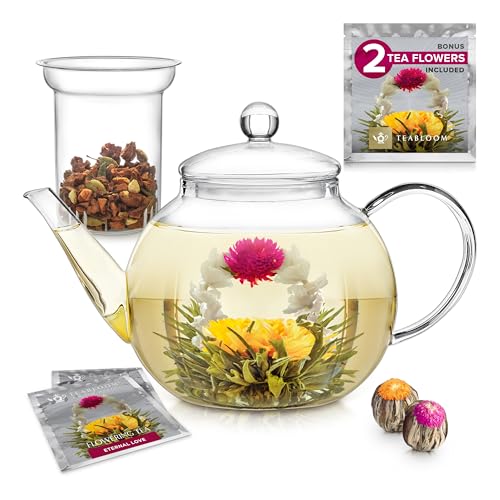
Teabloom Celebration Glass Teapot & Kettle, 27 oz
Badge: Best for Flexible Gas Kitchens
Strengths
- Stovetop and microwave safe per its maker — a rated flame pot with a second, flameless route in reserve.
- Removable glass infuser in heat-resistant glass, handling loose leaf, bagged, and blooming teas per the listing.
- Two blooming teas included, so its most presentable format works immediately.
Trade-offs
- The glass infuser is delicate; a busy gas kitchen’s sink is its natural hazard.
- 27 oz serves one to two — not a family round.
- On wide burners, its modest base needs the smallest ring and a centred seat.
Spec box
- Capacity: 27 oz
- Infuser: Removable glass infuser
- Stovetop: Stovetop and microwave safe per maker
- Material: Heat-resistant glass
- Included: 2 blooming teas
- Tea types named by maker: Loose leaf, bagged, and blooming
The Celebration is the diplomat of this set: rated for the flame when the flame is wanted, rated for the microwave when it is not, and specified for every tea format a household is likely to pour. Over gas it behaves as a proper small boiler — 27 oz on the smallest ring, flame kept under the base, water caught at the stage the leaf wants — and its glass infuser keeps blooming teas and large leaves in an all-glass presentation that suits the ceremony end of the shelf. For renters and small households whose kitchens change faster than their habits, that double rating is insurance: the pot that boils on this year’s gas range microwaves in next year’s bedsit without missing a service.
Handle the infuser like the premium component it is, and centre the pot carefully on small burners — a modest base on a big ring invites flame up the sides, which is heat wasted and a handle warmed for the wrong reason. Observed on both counts, it is the most adaptable rated pot in this guide.
Best for: Small gas kitchens wanting one flexible pot / Not suited for: Family volumes or careless washing

CNGLASS Glass Teapot Stovetop Safe with Removable Infuser, 20.3 oz
Badge: Best Compact Gas Boiler
Strengths
- Stovetop-safe rating in a compact 20.3 oz body that suits the smallest home ring.
- Removable infuser covers the loose leaf and blooming teas its maker names.
- Simple construction with nothing to jam — easy to seat, inspect, and clean over a flame-heated life.
Trade-offs
- One-to-two drinkers per boil; groups will run it twice.
- A small base on a large burner wastes flame up the sides — burner matching matters.
- No microwave rating stated; the flame is its only route.
Spec box
- Capacity: 20.3 oz
- Infuser: Removable infuser
- Stovetop: Described as stovetop safe by the maker
- Tea types named by maker: Loose leaf and blooming tea
The CNGLASS is the solo gas cook’s pot. Its virtue is proportion: a personal volume that comes to the boil quickly over a small flame, in the same glass that then brews, with an infuser that lifts out cleanly when the steep is done. On a home range it replaces the kettle for the one-or-two-cup ritual entirely; in a small flat or a studio with a two-ring hob, it is often the only vessel that earns permanent residence beside the stove. Gas suits it — the instant response of a burner lets the brewer kill the heat the second the water reaches the leaf’s preferred stage, a small precision that electric elements, with their residual heat, cannot quite match.
Its discipline is the burner match. Put this modest base over the largest ring at full tilt and the flame will spend itself on the pot’s sides and the kitchen air; the smallest suitable ring at a moderate setting is faster in practice, safer for the glass, and kinder to the handle. Small pot, small flame, short wait — that is the whole method, and it works every morning.
Best for: Solo gas-stove users and small hobs / Not suited for: Groups
DRNKNSTX Enchanted Tea Pot with Tea Infuser, 20 oz (Prose-Only: Kettle Companion)
Badge: Kettle Companion (Prose-Only)
Strengths
- A characterful glass steeper for loose leaf, at home with herbal and dessert teas brewed from kettle water.
- 20 oz personal format suits a slow evening session.
- Gift-oriented presentation encourages new tea drinkers.
Trade-offs
- Its listing makes no stovetop claim — a gas flame must never come near it.
- Entirely dependent on a kettle or another vessel for hot water.
- Steeper formats serve promptly rather than holding heat.
Spec box
- Capacity: 20 oz
- Infuser: Tea infuser / steeper design for loose leaf
- Format: Glass tea maker and steeper, gift-oriented presentation
- Stovetop: NOT stated by the maker — keep away from all burners
The DRNKNSTX is the second companion, and its story is the same as the Enchanti’s with the emphasis shifted from mechanism to mood. Marketed as an enchanted tea pot and a gift for tea lovers, it is a 20 oz glass steeper whose listing speaks of infusers and loose leaf diffusers and says nothing — anywhere — about stovetop use. In a gas kitchen it therefore belongs on the counter, receiving boiling water from the kettle that the flame heated, and brewing the forgiving teas that are its natural repertoire: herbals, rooibos blends, and dessert infusions that want time rather than technique. Judged in that role it is a pleasant, presentable object that starts conversations. Judged as a gas-stove teapot it is not a candidate at all, which is why it carries no link and no image here. The distinction costs its admirers nothing — the kettle is already on the stove — and it protects the one thing that matters, which is that no reader of this guide ever sets an unrated glass pot over a naked flame on our say-so.
Best for: Kettle owners wanting a giftable herbal steeper / Not suited for: Any contact with a burner
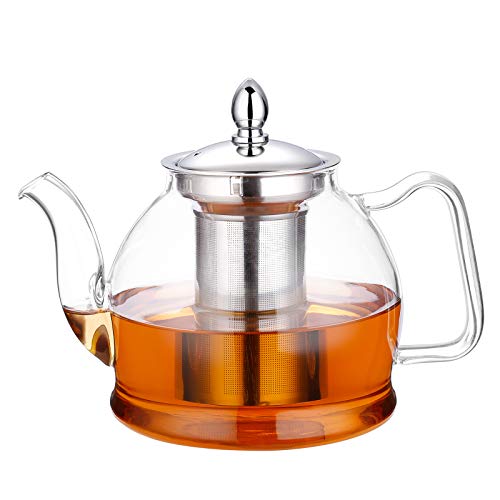
HIWARE 1000ml Glass Teapot with Removable Infuser
Badge: Best Household Gas Boiler
Strengths
- Stovetop safe at a full litre — the household volume, heated and brewed in one vessel.
- Removable infuser for the blooming and loose leaf teas its maker names.
- Its maker describes it as a tea kettle as well as a teapot: the dual role is the design, not a stretch.
Trade-offs
- A litre over a flame takes longer than the compact pots; the morning routine should budget for it.
- Needs a burner matched to its base — too wide a flame wastes heat and warms the handle.
- Full, it is a committed two-hand pour.
Spec box
- Capacity: 1000ml
- Material: Glass (per manufacturer listing)
- Infuser: Removable infuser included
- Stovetop: Described as stovetop safe by the maker
- Tea types named by maker: Blooming and loose leaf
The HIWARE is the gas kitchen’s default for the same reason it leads so many of our teapot guides: a litre, stovetop safe, with an infuser, is the specification of a household system rather than a gadget. On a medium ring at a moderate flame it brings the family’s water up in the pot that will brew it, the infuser waits beside the stove, and the whole breakfast round happens in one vessel with one wash-up. Gas flatters it in a specific way — the flame’s instant cut-off means the water can be taken at the precise moment for the leaf, and a pot that lives on the stove earns that precision daily. Its maker’s own description calls it a tea kettle, which is the honest name for what a stovetop-safe teapot is.
The cautions scale with the volume. A litre of water over a flame deserves attendance, a ring matched to the base, and a pour that respects the weight. Households that mostly brew for one will find the same virtues in the CNGLASS at a third of the commitment; households that brew for a table will find no substitute here.
Best for: Families and daily gas-stove tea routines / Not suited for: Strictly solo brewing

PARACITY Glass Teapot Stovetop 18.6 oz (550ml)
Badge: Best for Camping & Small Burners
Strengths
- Borosilicate glass listed by its maker as a stovetop teapot — the material gas heat respects most.
- Removable 18/8 stainless steel infuser: the finest straining here, and the most travel-durable.
- Its maker positions it for camping and travel, where gas is often the only heat there is.
Trade-offs
- 550ml boils for one or two; a family’s breakfast outgrows it.
- Portable gas stoves run fierce; the lowest stable flame is the correct setting, learned by trial.
- Glass travels in padding or not at all.
Spec box
- Capacity: 18.6 oz / 550ml
- Material: Borosilicate glass
- Infuser: Removable 18/8 stainless steel infuser
- Stovetop: Listed as a stovetop teapot by the maker
- Use cases named by maker: Camping, travel, home brewing
Where gas is portable, the PARACITY is the pot. Camping stoves, caravan hobs, and boat galleys share a condition: flame is the heat, space is short, and every vessel must earn its passage twice. A 550ml borosilicate pot that heats its own water and brews in the same body replaces a kettle and a teapot with one object, and its steel infuser survives the knocks of transit that would end a glass infuser’s career. At home it is equally at ease on the smallest ring, brewing the fine-leaf teas its mesh was made for — the same pot, the same flame discipline, two lives. No other model in this guide is claimed by its maker for the travelling life, and the specification backs the claim at every point.
The travelling caveat is the stove itself. Portable burners vary from a whisper to a roar and concentrate heat unpredictably in wind; start low, shield the flame, and treat the first boil on any new stove as a calibration, not a cup of tea. The pot’s rating assumes a controlled flame, and providing one is the cook’s half of the bargain.
Best for: Campers, caravanners, and small-burner households / Not suited for: Family volumes
Comparison Table
| Teapot | Capacity | Maker’s heating claim | Gas-stove verdict | Link |
|---|---|---|---|---|
| Enchanti | 800ml | None stated | Kettle companion only | No link — prose-only |
| Teabloom Celebration | 27 oz | Stovetop + microwave safe | Rated for the flame | Check on Amazon |
| CNGLASS | 20.3 oz | Stovetop safe | Rated for the flame | Check on Amazon |
| DRNKNSTX | 20 oz | None stated | Kettle companion only | No link — prose-only |
| HIWARE | 1000ml | Stovetop safe | Rated for the flame | Check on Amazon |
| PARACITY | 550ml | Stovetop teapot | Rated for the flame, travel-ready | Check on Amazon |
How to Choose a Teapot for a Gas Stove
Start with the claim, end with the claim. Everything else in this section is refinement; the rating is the decision. The maker’s listing for the exact model must state stovetop suitability. Four pots here do, two do not, and the two that do not are not failed products — they are kettle brewers, reviewed as such. If you are comparing a pot outside this guide, apply the same test and accept no substitutes: not a stove in the product photography, not a claim made for a sibling model, not a reviewer’s confidence.
Match the pot to the ring you actually use. Gas kitchens have a favourite burner, and the pot should fit it: base covered by the flame’s footprint, no more and not much less. The CNGLASS and PARACITY belong on small rings, the Celebration on small-to-medium, the HIWARE on a medium ring turned moderate. A pot habitually used over an oversized flame will show it first at the handle — warmed by licking heat — and eventually at the glass. If your favourite ring is the big one, a trivet that centres and steadies a smaller pot is a legitimate accessory, but the cleaner answer is the ring the pot was sized for.
Weigh borosilicate where it is named. The PARACITY’s listing names borosilicate glass, the low-expansion material that tolerates direct heat best, and where a maker names the material, that transparency is itself a quality signal. Heat-resistant glass claims, as on the Celebration, serve the same purpose. What you are buying in either case is a stated material plus a stated rating — the two together are what make flame use a system rather than a gamble.
Decide whether the kettle stays. A rated pot deletes the kettle from the tea routine, not from the kitchen. Households that drink tea twice a day on a gas range gain the most from integration; households whose kettle already lives on the counter for a dozen jobs gain little, and for them the companions in this guide — used as brewers — are a rational fleet. There is no virtue in owning both systems at half-use. Choose the workflow, then the pot, in that order — and if your teas lean green, note that gas’s instant cut-off is a genuine brewing advantage we explore in the Best Teapots For Green Tea companion.
How to Boil and Brew Over Gas: The Flame Method
Before the flame. Inspect the pot — no chips, no hairlines at the handle or base. Fill it with the water you need; never set an empty or nearly empty glass pot over a burner. Centre it on the grate of a ring matched to its base, handle turned away from other burners and from where sleeves pass.
Light low, build moderately. Bring the pot up on a low-to-medium flame rather than a full blast. The flame’s blue footprint should stay under the base of the pot, never curling up the sides: flame past the base is heat spent on the handle, the air, and the glass above the waterline, which is exactly where thermal stress gathers. A moderate flame costs a minute and buys the pot years. Stay with it — gas is silent and quick, and a pot coming to the boil deserves the same attention as a pan of milk.
Catch the stage, kill the flame. Gas’s gift to the brewer is the instant stop. Watch the water: first lazy bubbles for delicate greens if you are heating with precision, a full rolling boil for black tea and herbals — then the flame goes off and the pot comes off the grate in the same motion, onto a wooden board or trivet, never a cold or wet surface. Add the leaves or the infuser, lid on, timer on, and steep away from the heat entirely. A brewed pot never goes back over even a low flame to keep warm; that road leads to stewed tea and stressed glass by the same turning.
Cool and clean with the same patience. Let the pot cool several minutes before washing, and never run cold water into hot glass or set a hot pot into a sink of water. Descale with a citric-acid soak when film appears — scale on the base slows the boil and tempts the cook toward bigger flames, which is how a maintenance shortcut becomes a safety issue. Wipe the pot’s base dry before its next firing; a wet base on a lit grate steams, spits, and heats unevenly.
Troubleshooting.
- Problem: The handle gets hot during boiling → what to do: the flame is too wide for the pot. Move to a smaller ring or reduce the flame until its footprint sits under the base; a hot handle is information, not an inconvenience.
- Problem: Soot darkens the pot’s base → what to do: the flame is running yellow and fuel-rich, or the burner is dirty. Clean the burner ports, check for a clean blue flame, and wash the base with a bicarbonate paste; persistent yellow flame is a job for a gas technician, not a bigger scrub.
- Problem: The boil takes forever → what to do: check the ring match and the lid — an uncovered pot on a small ring loses heat as fast as the flame delivers it. Descale the base if a film has built up.
- Problem: A crack appears after use over the flame → what to do: retire the pot from all hot liquids. Review the likely cause — dry heat, oversized flame, cold shock — before its replacement meets the same stove, because the stove’s habits, not the pot’s luck, are usually the author.
Gas at Home, Gas on the Road: Two Versions of the Same Craft
The home range and the camp stove ask the same discipline at different scales of forgiveness. At home, the variables are known: the favourite ring, the familiar dial, the trivet in its place. On the road, every variable resets — a borrowed burner, a wind that leans the flame against one wall of the pot, a grate that rocks. The travelling brewer’s answer is procedural humility: the first boil on any unfamiliar stove is water only, at the lowest stable flame, watched from start to finish, and the pot that travels for this life is the one built and claimed for it — here, the borosilicate PARACITY with its steel infuser. Caravan and boat kitchens sit between the two worlds: fixed stoves, known dials, but confined spaces where a full pot’s carry is short and crowded. In all three settings the constants hold — rated pot, matched flame, filled vessel, attended boil, patient cool-down — and a brewer who internalises them will make good tea over any gas flame on earth, which is more than can be said for any other heat source a traveller can carry. Drinkers who brew the fine, fast end of the shelf on the road will also appreciate the guidance in our look at the Best Teapots For Infusion Tea Like Rooibos, whose needle-fine leaves are the sternest test of a travelling infuser.
Gas Brewing for Delicate Teas: Where the Flame Earns Its Keep
The strongest argument for boiling over gas is not speed but control at the delicate end of the shelf. Green teas and the Japanese styles covered in our companion guide to the Best Teapots For Japanese Tea want water noticeably below boiling, and they punish overshoot with bitterness. On an electric element, stored heat keeps pushing the water’s temperature upward after the dial drops; over gas, the heat vanishes the instant the flame dies, so a brewer watching for the first bubble streams can arrest the water within a degree or two of intention. That precision is why so many serious brewers of the Best Teapots For Loose Leaf Tea tradition keep a gas ring even in otherwise electric kitchens: the loose leaf ritual is a sequence of small, exact decisions, and a heat source that obeys instantly makes every one of them easier. The rated small pots in this guide — the CNGLASS and PARACITY above all — are the instruments of that style: little water, watched closely, flame killed at the moment, leaves in without a transfer. A household that drinks delicate teas daily will feel this advantage in the cup within the first week, and it is the honest reason gas survives in tea kitchens long after other appliances have gone electric around it.
Keeping a Gas-Rated Glass Pot Alive for Years
A rated pot’s lifespan is decided less by its glass than by the accumulation of small courtesies. Dry the base before firing, because a wet base steams and heats unevenly. Keep the grate clean, because a pot rocking on a burnt-on spill concentrates stress exactly where the flame arrives. Store the pot off the stove — a pot that lives on a grate gets knocked by pans, preheated by neighbouring burners, and aged by a hundred small insults that have nothing to do with tea. Inspect the base monthly under a good light: the hairline that is retired today is a story told with relief; the one that is ignored becomes a story told with a mop. And keep the maker’s rating honest by staying inside it — moderate flames, filled pots, attended boils — because a rating is a description of tested conditions, not a force field. Owners who practise those courtesies routinely report the same surprise: the fragile glass pot outlasts the sturdy-looking appliances around it, not because glass is secretly tough, but because a rated pot used as directed is a system in balance, and systems in balance endure.
Common Buying Mistakes
- Setting an unrated pot on a grate “just once.” Once is the whole risk. If the listing is silent, the kettle does the boiling — as the Enchanti and DRNKNSTX in this guide are designed to allow.
- Using the biggest ring at full flame for a small pot. Flame up the sides heats the handle, stresses the walls, and boils no faster in any way that matters.
- Boiling dry while the kettle’s on your mind. A dry glass pot over a flame is the category’s one unforgivable accident, and it is always an attention accident.
- Cooling the pot under the tap. The post-boil cold rinse cracks more rated pots than flames ever do.
- Buying the family boiler for a camp stove. Match the pot to the burner it will actually meet, at home or on the road.
Final Recommendation
For the household gas range, the HIWARE 1000ml is the boiler to build the routine on: stovetop safe at the litre size family life uses, with an infuser that keeps the single-vessel workflow clean. Solo gas cooks should take the CNGLASS and its small-ring proportions; travellers and campers, the PARACITY and its borosilicate, travel-claimed build; and small households wanting every format and a microwave in reserve, the Teabloom Celebration. The Enchanti and DRNKNSTX close the guide as what they are — excellent kettle companions that no flame should ever touch. Buy the rating, match the ring, mind the flame, and a glass pot over gas becomes the most responsive tea station a kitchen can offer. Give the new pot its first week at moderate flames while you learn its temper and it learns your stove, keep the kettle companions in this guide for what they genuinely are, and the distinction this article has insisted on — rated over flame, unrated beside it — will quietly become the habit that keeps every boil in your kitchen both safe and worth drinking.
Frequently Asked Questions
Can any glass teapot go on a gas stove?
No. Only teapots whose makers state stovetop safety belong over a flame. Four of the six pots here carry that claim; the Enchanti and DRNKNSTX do not, and they must be filled from a kettle. An unrated pot over gas risks cracking or failing with boiling water inside, which is why this guide links only rated pots for gas use.
Why does the flame need to stay under the base of the pot?
Flame that climbs the sides heats glass above the waterline, where there is no water to absorb and even out the temperature, and it warms the handle and wastes fuel in the process. A flame footprint matched to the base heats the water efficiently and keeps the pot’s temperature gradients gentle — which is what rated glass is designed to tolerate.
Is gas or electric better for a stovetop teapot?
Both work for rated pots, with different virtues. Gas responds instantly — the heat stops the second you turn it off, which brewers love for catching water at a precise stage — and demands flame discipline. Electric heat is slower to respond and lingers after switch-off, demanding residual-heat discipline instead. Choose by the stove you have; the rating matters more than the fuel.
Can I use a stovetop teapot on a camping gas stove?
Yes, if the pot is rated — the PARACITY is positioned by its maker for camping and travel, with borosilicate glass and a steel infuser suited to the life. Start on the lowest stable flame, shield the pot from wind-driven flare, centre it carefully, and treat the first boil on an unfamiliar stove as a calibration run. Note the dial position that produced a calm, centred boil and mark it if the stove is yours; camp stoves reward that small record the next morning, when the light is worse and the need is greater.
What happens if a glass teapot boils dry over gas?
A dry pot over a flame experiences the most extreme thermal stress in this category, and cracking is likely — immediately or as a weakness that fails later. Turn the flame off, let the pot cool completely on the grate, inspect it closely, and retire it at any sign of damage. Prevention is absolute attention: a pot on a burner is never left alone.
Why do some teapots in this guide have no purchase link?
Because their makers’ listings make no stovetop claim, and this guide links only pots it can recommend for the keyword’s purpose — use over a gas flame. The Enchanti and DRNKNSTX are reviewed in full as kettle companions so readers can judge them fairly for the role they can play, without any implication that they belong on a burner.
Can I use a gas-rated teapot on an electric stove instead?
Generally yes: a stovetop-safe rating is about the glass tolerating direct heat, and a rated pot that is safe over a flame is safe on a coil or radiant electric element used with the same discipline — flat contact, moderate setting, no dry heating. The exception is induction, which cannot heat plain glass at all. Always let the maker’s own wording lead; if a listing restricts the pot to one heat type, that restriction governs.
Do I need a trivet or heat diffuser for a glass pot on gas?
Most rated pots sit happily on a standard grate whose ring matches their base, and a diffuser is optional. A diffuser can help on a fierce or uneven burner by spreading the flame’s footprint, and it is close to essential on some camping stoves. If you use one, keep it clean and flat, and remember it slows the boil — the trade is gentleness for time, and on a delicate morning that trade is often worth making. What a diffuser must never do is substitute for a rating: spreading the heat under an unrated pot makes the heat gentler, not the pot safer, and the companions in this guide stay off the grate with or without one.
How do I clean soot or scorch marks from a glass teapot’s base?
Wash first with warm soapy water; for stubborn soot, a paste of bicarbonate of soda on a soft cloth usually lifts it without scratching. Then address the cause: soot means a yellow, fuel-rich flame or dirty burner ports. Clean the burner, confirm a blue flame, and if the flame stays yellow, have the stove serviced — the pot is reporting a stove problem. While the technician is booked, brew with kettle water and any pot in this guide used as a counter brewer; the rated pots lose nothing by a week of pour-over service, and the companions were built for nothing else.