Disclosure: topratedkitchenware.com is reader-supported. When you buy through links on our site, we may earn an affiliate commission from Amazon and other retailers, at no extra cost to you.
Where to buy
All six pots in this guide to the best teapots for steeping tea are sold through Amazon, and every linked pick below goes straight to its product page so you can confirm the current capacity, infuser style, and availability before ordering. Start with the short list, then read the full guide for the timing, temperature, and separation guidance that makes steeping a skill instead of a guess.
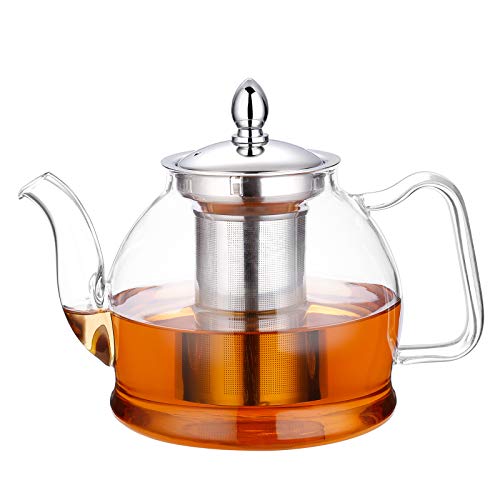
- DOPUDO Small Glass Teapot with Infuser, 18 oz — Check on Amazon
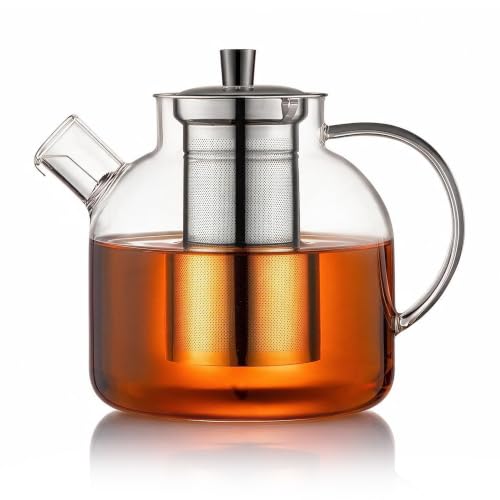
- STNTUS Glass Teapot, 40 oz, with Infuser and Strainer
- Enchanti Tea Pot, One Touch Glass Teapot with Infuser, 27 oz
- Teabloom Celebration Glass Teapot & Kettle, 27 oz
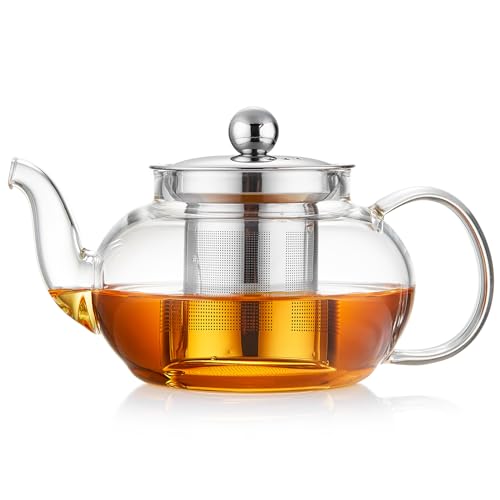
- CNGLASS Glass Teapot Stovetop Safe, 20.3 oz
- DRNKNSTX Enchanted Tea Pot with Tea Infuser, 20 oz
Read the full guide ↓
Steeping is the moment tea is actually made — everything before it is shopping and boiling, and everything after it is drinking. It is also where most cups are lost: thirty seconds too long, water a shade too hot, leaves left sitting in the liquor while the first cup is enjoyed. The best teapots for steeping tea are the ones that give the drinker control over that moment: a removable infuser that separates leaf from water decisively, a size that keeps the leaf-to-water ratio honest, and clear walls that let you watch extraction happen and learn from it. Every pot in this guide is a glass infuser pot for loose leaf tea, chosen because steeping — timed, visible, repeatable — is what its format does best.
This guide treats steeping as a learnable system rather than a talent. There are only three variables — leaf quantity, water temperature, and time — plus one discipline: separation, the act of ending the steep when the timer says so. A pot with a lift-out basket makes separation effortless, and glass makes the other three variables observable, because colour development is extraction made visible. The six picks below run from 18 oz solo pots, where steeping is at its most precise, to a 40 oz group pot, where steeping discipline matters most because the stakes — a whole table’s round — are highest. Readers who want the general equipment picture first will find it in Best Teapots For Loose Leaf Tea; this page is about the craft the equipment serves.
Key Takeaways
- The DOPUDO 18 oz glass teapot is our first choice for steeping: a compact pot with a removable 18/8 steel infuser, sized for precise, repeatable solo steeps.
- Separation is the master skill — every pick here has a lift-out infuser, so the steep ends when you decide, not when you finish pouring.
- Small pots steep most precisely; large pots demand the most discipline because their last cups wait longest.
- Glass turns steeping into a visible process — colour is your extraction gauge.
- Adjust one variable at a time: dose for strength, temperature for harshness, time for fine-tuning.
In this guide
Quick Picks
| Pick | Badge | Capacity from listing | Infuser noted in listing | Link |
|---|---|---|---|---|
| DOPUDO Small Glass Teapot | Best Overall for Steeping | 18 oz / 530ml | Removable 18/8 steel infuser | Check on Amazon |
| STNTUS Glass Teapot | Best for Group Steeping | 40 oz / 1200ml, 4–6 cups | Infuser with stainless steel strainer | Check on Amazon |
| Enchanti Tea Pot, One Touch | Best for Easy Serving | 27 oz / 800ml | Glass teapot with infuser | Check on Amazon |
| Teabloom Celebration | Best for Watching the Steep | 27 oz | Removable glass infuser | Check on Amazon |
| CNGLASS Glass Teapot | Best Stovetop Option | 20.3 oz | Removable infuser | Check on Amazon |
| DRNKNSTX Enchanted Tea Pot | Best for Learning | 20 oz | Tea infuser / steeper | Check on Amazon |
Badges reflect steeping fit — precision, separation, and visibility — because that is this guide’s subject.
How These Picks Were Chosen
This is a research-led guide. We compared the verified listings in this glass teapot group and checked every specification quoted here against the listing title itself. For steeping, the criteria were specific: a removable infuser on every pick, without exception, because separation is the craft’s foundation; sizes weighted toward the small end, where steeping precision is achievable; stated infuser construction where available, since fine teas need fine baskets; and clear glass throughout, because visibility is a steeping tool. Where a listing does not state a detail — the Enchanti listing does not name its infuser material — the review says so and explains the practical consequence.
We also considered the steeping routine as a whole system: how the basket lifts, where it rests, how the pour behaves at the end of a timed steep when seconds matter. A pot that makes separation awkward will be steeped carelessly no matter how good its owner’s intentions are, and a pot that makes it graceful will quietly train its owner into good habits. That ergonomic judgement, applied across hundreds of imagined steeps, is what separates this guide’s order from a simple size ladder. The temperature side of the craft connects closely with our Best Teapots For Japanese Tea guidance, where cooled water and brevity rule.
The 6 Best Teapots for Steeping Tea

DOPUDO Small Glass Teapot with Infuser, 18 oz
Badge: Best Overall for Steeping
Strengths
- Compact 18 oz / 530ml volume makes leaf-to-water ratios precise and repeatable — the foundation of controlled steeping.
- Removable 18/8 steel infuser stated in the listing: clean separation and fine filtration in one component.
- Listing frames it for individual loose-leaf brewing — the solo steeping pattern exactly.
Trade-offs
- One-to-two-person capacity; group steeping needs a bigger vessel.
- No stovetop claim in the listing, so temperature is managed at the kettle — an advantage for precision, a step for convenience.
- Small basket crowds very bulky leaves.
Mini spec box: Capacity 18 oz / 530ml · Borosilicate glass · Removable 18/8 steel infuser · Sized for individual brewing.
Precision loves small numbers. In an 18 oz pot, a teaspoon more or less of leaf is a measurable change, a thirty-second difference in the steep is a tasteable one, and the whole system is small enough to hold in your head across sessions. That is why the DOPUDO leads a steeping guide: its scale turns steeping from approximation into method. The stated steel infuser lifts out cleanly at the timer’s end — no fumbling, no drips buying the leaves extra seconds — and its fine mesh means even small-leaf teas can be steeped with confidence that separation will be complete.
Who it suits: the drinker who wants to actually learn steeping — one tea, varied systematically, notes taken — and every solo drinker who simply wants the same good cup repeated reliably. The honest limitation is hospitality, which it does not pretend to. As a steeping instrument for one, it is the sharpest tool in this guide.
Best for: precise, repeatable solo steeping / Not suited for: serving groups.

STNTUS Glass Teapot, 40 oz, with Infuser and Strainer
Badge: Best for Group Steeping
Strengths
- Infuser plus a stainless steel strainer stated in the listing — separation at the steep and cleanliness at the pour.
- 40 oz / 1200ml listed at 4–6 cups: group steeping with one timed extraction for everyone.
- Stovetop safe per listing, simplifying water management for a crowd.
Trade-offs
- Large volumes steep less forgivingly — dose and timing errors multiply across cups.
- Two filtration parts to rinse.
- The last cup waits longest, so the basket discipline matters most here.
Mini spec box: Capacity 40 oz / 1200ml · 4–6 cups per listing · Infuser with stainless steel strainer · Stovetop safe per listing · For loose tea.
Group steeping is steeping with an audience and a deadline: one extraction must serve everyone at the same strength. The STNTUS is built for that pressure. Its basket handles the timed steep for a full 40 oz, its spout strainer keeps the pours clean even as the round progresses, and the routine it demands — dose generously, time honestly, lift decisively, pour in a full round — is exactly the discipline that separates a good group pot from a bitter one. Through glass, the host can show guests the colour they are aiming for, which turns steeping from backstage work into part of the occasion.
Who it suits: hosts and households steeping for four to six. The honest limitation is precision: no 40 oz pot steeps with a solo pot’s delicacy, and delicate teas for a crowd should be brewed in two small batches rather than one large one when quality matters most. For the robust teas groups usually drink, it is the right instrument.
Best for: one timed steep for a whole table / Not suited for: delicate teas at competition precision.

Enchanti Tea Pot, One Touch Glass Teapot with Infuser, 27 oz
Badge: Best for Easy Serving
Strengths
- 27 oz / 800ml mid-size suits the two-to-three-person steeps most households actually make.
- One-touch serving format in the listing — the pour at the end of a timed steep should be immediate, and this design prioritises it.
- Glass walls keep the steep visible for colour judgement.
Trade-offs
- The listing does not state the infuser material or stovetop safety — check the product page for basket details and use a kettle.
- Mid-size is a compromise for both solo precision and group volume.
- Gift-set presentation is part of the proposition.
Mini spec box: Capacity 27 oz / 800ml · One touch glass teapot with infuser · For loose leaf tea · Sold as a tea gifts set.
The Enchanti’s steeping virtue is what happens at the end of the steep. Timing discipline is wasted if the serving fumbles — a slow, awkward pour is just extra steeping by another name — and a design built around easy, one-touch serving respects the timer all the way into the cup. At 27 oz it covers the household’s commonest steep, two or three mugs from one extraction, with the glass giving the brewer a continuous read on colour.
Who it suits: households steeping for two or three who value a clean finish to the process. The honest limitation is specification certainty about the basket, which the product page must supply. For drinkers whose teas are standard loose leaf, the format’s serving ease will matter more day to day than basket minutiae.
Best for: household steeps with an easy pour / Not suited for: buyers who need the basket fully specified upfront.
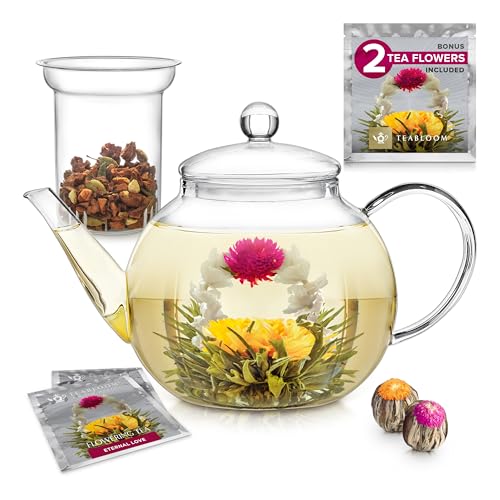
Teabloom Celebration Glass Teapot & Kettle, 27 oz
Badge: Best for Watching the Steep
Strengths
- Removable glass infuser inside clear walls — the steep is visible from leaf to liquor with nothing in between.
- Stovetop and microwave safe per listing, with heat-resistant glass — flexible water management for back-to-back steeps.
- Listing covers loose leaf, bagged, and blooming tea, and includes 2 blooming teas.
Trade-offs
- Glass infuser slots are typically less fine than steel mesh for the smallest particles.
- Glass components need careful handling.
- A generalist’s breadth rather than a specialist’s precision.
Mini spec box: Capacity 27 oz · Removable glass infuser · Stovetop and microwave safe per listing · Heat-Resistant Glass · Includes 2 blooming teas · For loose leaf, bagged, and blooming tea.
Steeping is learned by watching, and no pot in this guide shows more of it than the Celebration. With a glass infuser, you see the leaves give up their colour in real time — the first pale swirls, the deepening body, the moment the liquor reaches the shade your notes say is right. For a drinker calibrating a new tea, that visibility shortens the learning curve from weeks to days. The stated heating flexibility helps the experimental routine too, because successive test steeps need constant small amounts of hot water.
Who it suits: learners, experimenters, and hosts who steep at the table. The honest limitation is fine filtration, as with all glass infusers here — pour gently with the finest teas. For standard loose leaf, it is the most instructive 27 oz in the guide. See also the visibility discussion in Best Teapots For Oolong, where watching leaves is half the craft.
Best for: learning and demonstrating steeping / Not suited for: the finest-cut teas.

CNGLASS Glass Teapot Stovetop Safe, 20.3 oz
Badge: Best Stovetop Option
Strengths
- Listing states stovetop safe — water heats in the pot, so back-to-back steeps and re-steeps need no kettle management.
- 20.3 oz is a precise solo-to-pair steeping size.
- Removable infuser for timed separation, with the listing covering loose leaf and blooming tea.
Trade-offs
- The listing does not state the infuser material.
- Direct heating suits robust teas best; delicate teas still want water cooled before it meets leaf.
- Compact capacity means re-brewing for groups.
Mini spec box: Capacity 20.3 oz · Stovetop safe per listing · Removable infuser · For loose leaf and blooming tea.
The CNGLASS streamlines the steeping station to a single vessel. For the robust teas that make up most daily steeping — black teas, roasted styles, most blends — heating the water in the pot removes the transfer step and keeps the brewer’s attention on the two variables that matter: dose and time. It is also a quietly good re-steeping pot, because the second infusion’s fresh hot water is a burner away rather than a kettle cycle away.
Who it suits: minimalists, small kitchens, and daily steepers of robust teas. The honest limitation is delicate work — a green tea still deserves cooled water, which the stovetop routine must accommodate with a standing-and-cooling pause. Used with that awareness, it is the most frictionless steeping routine in this guide.
Best for: one-vessel steeping of robust teas / Not suited for: group serving.

DRNKNSTX Enchanted Tea Pot with Tea Infuser, 20 oz
Badge: Best for Learning
Strengths
- 20 oz glass steeper format — the mechanics of steeping are visible and obvious to a beginner.
- Listing describes a loose leaf steeper with infuser, made for diffusing loose leaf tea.
- Gift positioning makes it the natural first steeping pot to give or receive.
Trade-offs
- No stovetop or infuser-material claims in the listing; use a kettle.
- Presentation-led design may outgrow a serious daily routine.
- Solo-to-pair capacity only.
Mini spec box: Capacity 20 oz · Tea infuser / loose leaf steeper · Glass tea maker per listing · Gift positioning.
Every steeping journey starts with a first timed cup, and the DRNKNSTX is shaped to make that cup happen. Its steeper format presents the process plainly — leaves in the basket, water over them, colour developing in full view — and its gift-oriented design lowers the psychological barrier that keeps bag drinkers from ever trying. A beginner who watches three steeps of the same tea at three different times in this pot will understand steeping more deeply than a month of reading provides.
Who it suits: beginners and gift buyers. The honest limitation is that a developing drinker will eventually want specification detail the listing does not give, and will graduate toward the DOPUDO pattern. Graduation is success, not failure — this pot’s job is to start the habit, and it does it charmingly.
Best for: first steps into deliberate steeping / Not suited for: advanced specification-led routines.
Comparison Table
| Pick | Capacity | Filtration from listing | Heating noted in listing | Link |
|---|---|---|---|---|
| DOPUDO | 18 oz / 530ml | 18/8 steel infuser | Heat water separately | Check on Amazon |
| STNTUS | 40 oz / 1200ml | Infuser plus steel strainer | Stovetop safe | Check on Amazon |
| Enchanti | 27 oz / 800ml | Infuser (material unstated) | Heat water separately | Check on Amazon |
| Teabloom Celebration | 27 oz | Glass infuser | Stovetop and microwave safe | Check on Amazon |
| CNGLASS | 20.3 oz | Removable infuser | Stovetop safe | Check on Amazon |
| DRNKNSTX | 20 oz | Infuser / steeper | Heat water separately | Check on Amazon |
How to Choose a Teapot for Steeping Tea
Separation is the first specification. Everything in steeping reduces to controlling contact between leaf and water, so the removable infuser is not a feature but the foundation. Judge a candidate pot by the lift-out: it should be quick, clean, and one-handed, with somewhere obvious for the basket to rest. All six picks here meet that bar; pots without a removable infuser were excluded from this guide entirely, however handsome.
Size for precision. Steeping control is easiest in small volumes, where ratios are exact and a whole steep can be poured and drunk at its peak. Solo steepers should stay in the 18–20 oz class; pairs in the 27 oz class; groups accept the 40 oz compromise knowingly, with robust teas that forgive it. The commonest steeping disappointment — chronically bitter or weak tea — is usually a size problem disguised as a technique problem.
Match the basket to your finest tea. Standard loose leaf steeps happily in any basket here. Fine-cut teas need the finest barrier, which in this guide means the stated steel infusers. Glass infusers reward the eye and suit standard leaf; choose them for the watching, not for powder-fine filtration.
Plan your water. Steeping needs water at a chosen temperature, repeatedly. Stovetop-safe listings put the heat source in the pot; kettle routines give finer temperature control for delicate teas; the Celebration’s stated microwave safety is a pragmatic option for small volumes. Choose the arrangement that matches the teas you steep most.
Think in tiers qualitatively. Compact steel-infuser pots sit at the accessible end, versatile mid-size pots in the middle, and presentation or group formats at the premium end. For steeping, spend on the basket and the size first — the timer and the kettle you already own do the rest.
How to Steep Tea: The Complete Method
- Decide the cup before you touch the kettle: which tea, how strong, how many drinkers. Steeping begins as a decision, not an action.
- Heat fresh water to the tea’s zone — freshly boiled for black teas and herbals, cooled below boiling for greens and whites, near-boiling for most oolongs.
- Warm the pot and discard the warming water, so the steep temperature is the one you chose.
- Measure the leaf into the infuser: a teaspoon per mug as the baseline, more for teas you brew concentrated, less for delicate ones you are learning.
- Pour the water over the leaves, start the timer immediately, and watch the colour develop through the glass as your cross-check.
- At time, lift the infuser out in one motion, drain it for a few seconds over the pot, and set it on its dish. The steep is now over — completely.
- Pour the full round at once, so every cup shares one extraction.
- Taste critically: note what you would change — dose, temperature, or time, in that order of likelihood — and adjust exactly one variable next steep.
- If the tea supports re-steeping, return the basket and repeat with fresh water, adding time as the leaves tire.
Troubleshooting. Problem: bitter and harsh → shorten the steep first; if bitterness persists, cool the water — harshness is heat and time working together. Problem: thin and flavourless → increase the dose before increasing time; weak tea is usually under-leafed, not under-steeped. Problem: first cup good, second cup stewed → the basket stayed in the pot; separation after pouring is not optional, it is the method.
Steeping Times and Temperatures by Tea Family
Every family’s numbers are starting points for your own calibration, not laws — leaf grade, dose, and taste all move them. Black teas take freshly boiled water and a few minutes; they are the most forgiving family and the right place to learn the method. Green teas want water cooled meaningfully below boiling and short steeps, often one to two minutes; they punish heat and time quickly, which is why they teach precision fastest. Oolongs split by style: short, repeated infusions, hotter for roasted, gentler for green. White teas prefer cooler water and a patient, longer steep, and reward gentleness with sweetness. Herbal infusions generally want boiling water and a generous steep, and forgive almost everything except being left on their leaves for hours. Keep a notebook for your first weeks with any new tea: dose, temperature approach, time, verdict. Six entries per tea will pin down its preferences in your pot with your water more reliably than any chart — including this one.
The Science in Plain Language: What a Steep Actually Does
A steep is an extraction: hot water dissolves flavour compounds out of leaf, and different compounds dissolve at different rates. The bright, aromatic notes come early; the heavier, more astringent compounds build with time and heat. That single fact explains the whole craft. A short steep tastes vivid but can be thin; a long steep tastes full but risks harshness; hotter water accelerates everything, including the parts you may not want. Dose changes the total material available, which is why adding leaf strengthens a cup more cleanly than adding time. Separation — the lift-out — is how you freeze the balance at the moment it tastes right. Through glass you can watch the visible correlate of all this: colour is extraction you can see, deepening as the dissolved material builds. None of this requires a laboratory; it requires a pot that lets you control the variables and observe the result, which is the entire design brief behind this guide’s picks.
Re-Steeping: Getting the Second and Third Cups Right
Many teas are designed to be steeped more than once, and the technique differs from the first round in three ways. First, keep the drained leaves covered and warm between steeps — a basket left open on a cold counter cools and dries at the edges. Second, use fresh water each time, often a touch hotter for later rounds, because the leaves need more encouragement as their readily extracted compounds deplete. Third, extend the time gradually: each successive steep typically needs a little longer than the one before. Judge readiness by taste and colour rather than by a fixed schedule, and stop when a steep comes out pale despite your adjustments — the leaves are done, and composting them promptly is part of the craft. Oolongs and greens are the great re-steepers; a good black tea gives one strong steep and a lighter second; herbals usually give one. A pot with a clean lift-out and a sensible basket rest — every pick in this guide — makes the multi-steep routine effortless enough to become habit.
Steeping for One Versus Steeping for a Table
The two situations look identical on a specification sheet and behave oppositely in the kitchen. Steeping for one is a precision exercise: small volume, exact ratio, the whole steep drunk at its peak, and immediate feedback for the next adjustment. Steeping for a table is a logistics exercise: the extraction must be right once, for everyone, and then survive the pouring round without the last cup turning. The practical consequences follow. Solo steepers should buy small and precise — the DOPUDO pattern — and can indulge delicate teas that would never survive a group pot. Table steepers should buy capacity with strong separation — the STNTUS pattern — choose robust teas for crowds, and consider brewing two small batches of a delicate tea rather than one large one when the occasion justifies it. Households that do both should own both patterns rather than compromise in the middle; the 27 oz pots in this guide are the honest middle for households that genuinely live between the two.
Cold Steeping: The Overnight Method
Cold steeping — leaves, cold water, time, and a refrigerator — deserves a place in any steeping guide because it inverts every rule above and produces something lovely. Without heat, extraction is slow and selective: sweetness and aroma come forward while bitterness barely develops, which makes cold steeping the most forgiving technique in this entire guide and a fine use for teas you have over-bought. Use the basket as usual, fill with cold water, and refrigerate for several hours or overnight; serve straight from the pot, lifting the basket when the strength suits you. Green teas and light oolongs are the classic subjects, and a glass pot is the ideal vessel because the slow colour development is visible through the fridge door. Drink cold-steeped tea within a couple of days, keep the pot covered, and treat the method as a summer instrument in the steeping toolkit rather than a replacement for the hot craft.
Care and Cleaning for Steeping Pots
Steeping pots live wet, so their care is about freshness. Empty the basket the same day — leaves left overnight in a closed pot will scent it, and the next delicate steep will report the fact. Rinse pot and basket in hot water after use, brush mesh gently when fragments lodge, and dry with the lid off so the interior stays neutral. Tea film builds slowly on glass; a weekly bicarbonate soak lifts it without abrasives. Warm the pot before brewing — already part of the method — and never plunge hot glass into cold water. Kept this way, a glass steeping pot remains a neutral instrument indefinitely, contributing nothing to the cup but control, which is precisely what steeping asks of it.
Building a Steeping Practice: Notes, Ratios, and Repetition
Steeping becomes a skill through a specific, unglamorous loop: brew, taste, note, adjust one variable, brew again. The notebook can be a phone note or a card by the caddy; what matters is that dose, water approach, and time are recorded alongside the verdict, because memory flatters and forgets in equal measure. Within a fortnight, patterns emerge that no general guide can give you — your kettle’s habits, your water’s character, your own palate’s preference for strength. Ratios settle: you will learn that your breakfast blend wants a heaped measure and four unhurried minutes in the big pot, while your green wants a level measure, cooled water, and ninety seconds in the small one. That personal table, earned by repetition, is the real product of buying a good steeping pot. The equipment in this guide was chosen to make the loop easy to run — quick separation, visible extraction, honest sizes — because a practice that is easy to repeat is a practice that happens.
Steeping Beyond Tea: Herbal Infusions in the Same Pots
Everything said here about tea applies, with looser tolerances, to the wider world of infusions that share these pots: rooibos and honeybush, mint and chamomile, hibiscus and ginger blends. Herbal materials generally want boiling water and generous steeps, and their main steeping risk is the opposite of tea’s — under-extraction tastes thin and apologetic, so give them time and dose confidently. Fine-cut herbals share rooibos’s filtration demands, which points back to the stated steel baskets for households that drink them often. The separation discipline still applies, especially to blends containing true tea or strong spices, which can stew even when the base herb forgives. A household that steeps both tea and herbals in one pot should rinse the basket promptly between families and give it a proper wash after anything spiced; glass’s neutrality handles the rest. Our dedicated guide to Best Teapots For Infusion Tea Like Rooibos explores that fine-herbal end in full.
Steeping and Water Quality: The Variable Nobody Sees
Two drinkers can follow identical steeping instructions with identical leaf and produce different cups, and the invisible cause is usually water. Heavily mineralised water extracts differently and can mute delicate flavours, while very soft water can leave a steep tasting hollow. Chlorine, present in many municipal supplies, announces itself most clearly in green and white teas. The remedies are kitchen-level rather than technical: use fresh water rather than repeatedly reboiled water, let a jug of tap water stand so chlorine dissipates, or try filtered water for a week and compare — steeping’s note-taking habit makes the comparison honest. What matters for this guide is the diagnostic order: when a steep disappoints, adjust dose, time, and temperature before concluding anything about the pot, and suspect the water before suspecting the leaf supplier. The glass pot contributes nothing to this variable at all, which is its virtue — it is the one element of the system that never needs troubleshooting.
Steeping at Altitude, in Hard-Water Areas, and Other Real Kitchens
Steeping advice is usually written for a sea-level kitchen with cooperative water, and real kitchens deviate in ways worth naming. At altitude, water boils at a lower temperature, which quietly cools every steep: black teas may need a little more time or leaf to reach the strength a sea-level recipe promises, while delicate greens become paradoxically easier to brew well. In hard-water areas, mineral content flattens some flavours and films glass faster, so the weekly descaling-and-polish routine matters more and a filtered-water experiment is worth running sooner. In very cold kitchens, pots and cups steal more heat, and the warming step — already in the method — stops being optional for small steeps. None of these conditions changes the equipment decision in this guide; they change the calibration. A steeping practice built on notes absorbs local conditions within a fortnight, which is the deepest argument for the practice itself: recipes travel badly, but a method travels anywhere.
Teaching Someone Else to Steep: The Pot as Instructor
Steeping is often learned socially — a parent, a friend, a partner who makes the good cup — and the glass infuser pot is the best teaching instrument the category offers. The teacher can show, not just tell: watch the colour reach this shade; see how the leaves have opened; notice how the second steep pours paler. The learner’s hands learn the lift-out on a pot where the action is visible and forgiving, and their palate gets immediate, explainable feedback. Households that drink tea together do well to standardise on one method and one set of house ratios for the shared teas, written on a card by the caddy, so that anyone’s steep tastes like the household’s tea rather than a lottery. That small institution — the house method — is how good steeping survives busy mornings and different hands, and it begins with a pot whose workings everyone can see.
Steeping Vessels Compared: Why the Basket Pot Wins at Home
It is fair to ask why this guide is built entirely on basket teapots when tea can also be steeped in a gaiwan, a kyusu, a French press, or a plain pot with a strainer. Each alternative has its devotees and its logic. The gaiwan offers unmatched control for small, repeated infusions but asks for practised hands and serves one style of session. The kyusu is sencha’s own instrument, specialised by design. A press plunges rather than lifts, and leaves sit in the liquor’s depths unless the whole brew is decanted. The plain pot plus strainer works but doubles the washing and the dripping. The basket teapot’s claim is not supremacy in any single tradition but competence across all of them with the least friction: dose, pour, time, lift, serve, rinse. For a household steeping several tea families across a week, that frictionless competence is what keeps the practice alive on tired Tuesday evenings — and a practice that survives Tuesdays is worth more than a perfect method reserved for Sundays. Choose a specialist vessel when a single tradition captures you; until then, the basket pot is the honest all-rounder, and this guide’s six are its best current expressions in glass.
One Last Word on Attention
Steeping asks for roughly four minutes of intermittent attention — a kettle watched, a timer glanced at, a basket lifted at the right moment. That small allotment of attention is, for many drinkers, the point of tea itself: a brief, deliberate pause built into the day. The pots in this guide protect that pause by making its mechanics effortless, so the attention can go to the tea rather than to the equipment. Choose the one that fits your sessions, and let the pause do its work.
Common Buying Mistakes
- Buying a pot without a removable infuser. For steeping, separation is the craft; a pot that cannot separate cannot steep with control.
- Steeping everything at one time and temperature. Families differ; learn each tea’s zone and write it down.
- Fixing weak tea with longer steeps. Add leaf for strength. Time adds harshness faster than it adds flavour.
- Leaving the basket in while the pot is drunk. The steep ends when you lift the infuser, not when the pot is empty.
- Judging a pot by one steep of an unfamiliar tea. Assess equipment with a tea you know, across several steeps, before blaming the vessel.
Final Recommendation
For most drinkers learning or refining the craft, start with the DOPUDO 18 oz glass teapot: precise scale, a stated steel infuser, and separation clean enough to make timing honest. Give the craft a month of honest practice before judging either the pot or yourself — a dozen recorded steeps of one familiar tea will teach your hands the lift-out, your eye the colours, and your palate the differences that time and temperature make. Steeping is a small skill with a long reward: every cup for years, made deliberately, in a pot that shows you exactly what you are doing. Choose the CNGLASS for a one-vessel routine with robust teas, the Celebration for watching and teaching the steep, the Enchanti for easy household serving, the STNTUS for a table that must be served from one extraction, and the DRNKNSTX to give a beginner their first timed cup. Then practise: steeping rewards repetition more than equipment, and the right pot is the one that makes repetition pleasant.
Frequently Asked Questions
What does steeping actually mean?
Steeping is soaking tea leaves in hot water so flavour compounds extract into the liquor. It begins when water meets leaf and — this is the part equipment controls — it should end when you separate the two, which a removable infuser does in one motion.
How long should tea steep?
It depends on the family: greens briefly, often one to two minutes; blacks a few minutes; oolongs in short repeated infusions; whites longer and gentler; herbals generously. Treat any figure as a starting point and calibrate by taste, adjusting one variable at a time.
What happens if tea steeps too long?
The heavier, more astringent compounds dominate and the cup turns bitter and stewed. With the leaves removed, brewed tea holds its balance; with the leaves left in, the steep continues whether you are drinking or not. Lift the infuser out when the time is up.
Is a glass teapot good for steeping?
Yes — glass is flavour-neutral, rinses completely clean between teas, and lets you watch extraction as colour, which is the beginner’s best teacher and the experienced drinker’s cross-check. Its only cost is fragility, managed by ordinary care.
How do I make steeped tea stronger without bitterness?
Add leaf, not time. A larger dose at the correct steep time gives a fuller cup, while extending the steep mostly extracts more of the harsh compounds. If the cup is still harsh, check the water temperature next — too-hot water is the other usual cause.
Can I steep tea more than once?
Many teas reward it — oolongs and greens especially. Keep the drained leaves covered between steeps, use fresh water each round, and lengthen each successive steep slightly. Stop when a round tastes pale despite more time; the leaves are spent.
What size teapot steeps most accurately?
A compact pot in the 18–20 oz class. Small volumes make ratios exact, temperature stable, and the whole steep drinkable at its peak — which is why the precision picks in this guide are the small ones.
Do I need a timer for steeping?
A timer helps most while you are learning a tea; after a dozen steeps, colour through the glass and habit take over for your familiar teas. Keep the timer for new teas and delicate greens, where thirty seconds is a real difference, and let routine carry the forgiving ones.