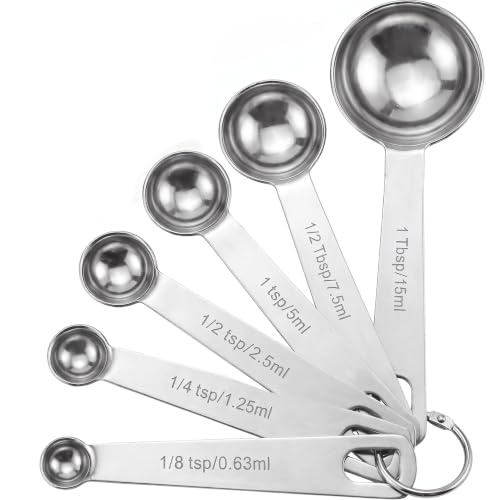
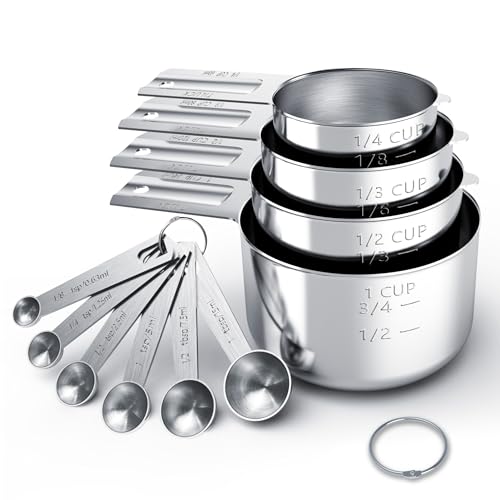
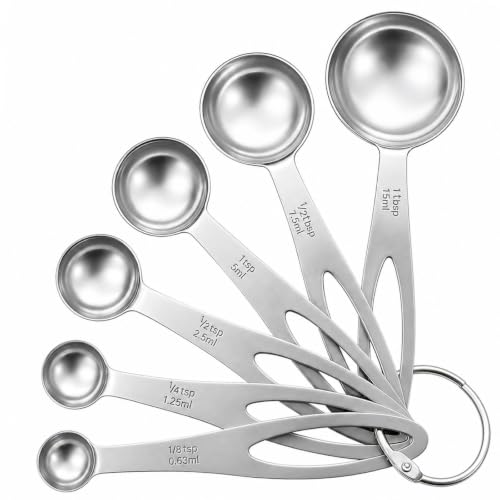
Disclosure: topratedkitchenware.com is reader-supported. When you buy through links on our site, we may earn an affiliate commission from Amazon and other retailers, at no extra cost to you.
Where to buy
The six sets below are the verified picks for this guide to the best set of measuring spoons. Each name links to its Amazon listing, where you can check the latest price on Amazon, confirm the current size list, and read the newest owner feedback before you decide. All six are stainless steel sets that include measuring spoons; two of them bundle measuring cups as well, which the reviews flag clearly so you can choose the format you actually want.
- TILUCK Stainless Steel Measuring Cups and Spoons Set (10)
- TILUCK Stainless Steel Measuring Cups and Spoons Set, Set of 6
- THLHKD 6Pcs Measuring Spoons Set, Stainless Steel
- Spring Chef Nesting Stainless Steel Measuring Spoons Set of 7 with Leveler
- Spring Chef Stainless Steel Measuring Cups and Spoons Set of 14 with Leveler
- Hudson Essentials Stainless Steel Measuring Spoons Set of 7
Read the full guide ↓ for the size-coverage logic behind the ranking, the honest limitation of every set, and the technique notes that make any set measure better.
The search for the best set of measuring spoons usually starts after a small failure: a cake that did not rise because the baking powder was estimated, a curry that overshot its heat because the chilli was poured rather than measured, a coffee routine that tastes different every morning. Measuring spoons look like the simplest tools in the kitchen, and they are the ones whose absence or inaccuracy is tasted most directly, because they handle the potent ingredients — salt, leavening, spices, yeast, extracts — where a small error is a large proportion. A good set is therefore not a decorative bundle on a ring. It is a small system of accurate bowls, legible markings, and sizes that match the quantities real recipes use, stored together so the right spoon is in your hand in seconds.
This guide compares six verified stainless steel sets that approach that system from different directions. Two TILUCK sets bundle cups with spoons for cooks who want one nesting purchase. The THLHKD spoon set competes on clear markings and a confirmed span from an eighth of a teaspoon to a tablespoon. Spring Chef appears twice, once with a rectangular, spice-jar-friendly spoon set with a leveler, and once with a fourteen-piece cups-and-spoons set with a leveler for cooks who want the fullest bundle. Hudson Essentials closes the list with a classic seven-piece spoon set shaped to fit in spice jars. Every set is reviewed with its verified sizes and features only — nothing is credited with a size, a material grade, or an accessory its listing does not confirm.
What separates the picks is rarely the tablespoon. Every set here has one. The separation happens at the small end, in the intermediate sizes, in whether a leveler is included, in whether the bowls enter a spice jar, and in how the set stores between uses. Those are the details this guide weighs, because they are the details that decide whether a set is still your daily set in five years. Readers who need cups as a requirement rather than a bonus should also read our stricter combined-format guide to the Best Set Of Measuring Cups And Spoons, where spoons-only sets are deliberately held to prose-only status.
Key Takeaways
- Judge a spoon set by its size list: the small end and the intermediate sizes matter more than the piece count.
- Stainless steel is the default for a lasting set: rigid bowls level cleanly, wash fast, and hold no flavours.
- A leveler turns heaped scoops into repeatable measures and is worth real weight in the decision if you bake.
- Bowl shape is practical, not cosmetic: narrow or rectangular bowls that fit in spice jars remove the pour-and-guess routine.
- Decide the cups question first: two sets here bundle cups, four focus on spoons, and both answers are right for different kitchens.
- Check the latest price on Amazon for each pick, and confirm the exact sizes on the listing before ordering.
In this guide
Quick Picks
- Best Overall — TILUCK Stainless Steel Measuring Cups and Spoons Set (10): ten nesting pieces giving spoons a cup-equipped home in one bundle. Check on Amazon
- Best Compact Set — TILUCK Stainless Steel Measuring Cups and Spoons Set, Set of 6: six pieces, both families, with a coffee scoop angle. Check on Amazon
- Best for Clear Markings — THLHKD 6Pcs Measuring Spoons Set: six spoons from 1/8 tsp to 1 tbsp with clear size markings called out in the listing. Check on Amazon
- Best for Spice Jars — Spring Chef Nesting Measuring Spoons Set of 7 with Leveler: rectangular bowls and long handles stated to fit in spice jars, plus a leveler. Check on Amazon
- Best Complete Bundle — Spring Chef Measuring Cups and Spoons Set of 14 with Leveler: fourteen nesting pieces, cups and rectangular spoons, with a leveler. Check on Amazon
- Best Classic Spoon Set — Hudson Essentials Stainless Steel Measuring Spoons Set of 7: seven spoons for dry or liquid ingredients, shaped to fit in spice jars. Check on Amazon
How These Picks Were Chosen
This is a research-led guide, built by comparing verified listing information rather than by inventing bench tests. Sets were eligible when their verified titles confirmed stainless steel measuring spoons, and they were ranked on size coverage, storage behaviour, included accessories such as a leveler, bowl geometry for spice jars, and the clarity of their size information. A set that lists its exact sizes earns trust a set with a vague count cannot, and the reviews note which listings enumerate sizes and which ask you to open a size chart.
Accuracy was assessed structurally. A measuring spoon is accurate when its bowl volume is true and stays true: rigid steel, a shape that levels cleanly, and markings you can read at a glance so the right spoon is chosen in the first place. No laboratory claims are made for any set here, and no set is credited with certification or testing its listing does not mention. Where a feature such as dishwasher safety or a material grade is not stated in the verified information, the review leaves it unstated rather than assuming it — an omission you can resolve on the product page in seconds.
The ranking deliberately mixes formats because the search itself mixes intentions. Some readers want spoons alone, done properly; others want the spoon purchase to solve cups at the same time. Rather than forcing one answer, the guide ranks the nesting ten-piece TILUCK first for its all-round balance, gives the compact and specialist sets their own badges, and tells you in each review which intention that set serves. If your intention is specifically the smallest measures and how their sizes are marked, the companion guide to the Best Size Gauge For Small Measuring Spoons takes that single question as its whole subject.
The 6 Best Sets of Measuring Spoons in Detail

TILUCK Stainless Steel Measuring Cups and Spoons Set (10)
Badge: Best Overall
Strengths
- Spoons arrive with their natural partners: ten nesting pieces covering cups and spoons in stainless steel.
- Nesting storage keeps the spoon set findable as part of one bundle.
- Positioned for cooking and baking, the two jobs that use spoons hardest.
Trade-offs
- The verified listing does not enumerate every spoon size; check the size chart before ordering.
- Cups occupy drawer space a spoons-only buyer may not want to spend.
- No leveler is stated in the verified information.
Mini spec box
- Material: stainless steel
- Pieces: 10, cups and spoons
- Storage: nesting
- Use: cooking and baking
The top pick earns its place on balance. Most kitchens do not suffer from a spoon problem in isolation; they suffer from a measuring problem, where spoons live in one drawer, cups in another, and the recipe waits while both are found. A ten-piece nesting bundle ends that geography. The spoons in this set benefit from the bundle’s discipline: they are stored with the cups, washed with the cups, and returned with the cups, so the set stays complete in a way loose spoon rings rarely do over years of daily use. For the cook whose measuring is spread across baking, grains, sauces, and coffee, that completeness is worth more than any single specialist feature.
The honest limitation is size documentation. The verified information confirms format, material, and count without listing each spoon size, so a baker who needs a specific small measure confirmed should open the listing’s size chart and verify it there. If the chart shows the sizes your recipes use — as it will for most standard cooking — this is the set to buy and stop thinking about.
Best for: most home cooks who want spoons and cups solved in one nesting set / Not suited for: spoons-only purists or buyers who need every size confirmed in advance

TILUCK Stainless Steel Measuring Cups and Spoons Set, Set of 6
Badge: Best Compact Set
Strengths
- The smallest footprint here that still includes both spoons and cups.
- Coffee scoop positioning matches the most frequent spoon job in many homes.
- Stainless steel with the same simple care as its larger sibling.
Trade-offs
- Six pieces split across two families guarantees some size gaps.
- Frequent bakers will outgrow the spoon range.
- Individual sizes should be confirmed on the listing.
Mini spec box
- Material: stainless steel
- Pieces: 6, cups and spoons
- Use: cooking and baking, with coffee scoop use noted in the listing
Compact sets succeed when they are honest about their job, and this one’s job is daily light measuring: coffee, oats, a sauce, a simple bake for two. At six pieces it stores anywhere — a shallow drawer, a utensil crock, a single cabinet corner — and it is a natural fit for first kitchens, small apartments, and second sets kept where a holiday home or a camper needs basic measuring without a full kit. The spoon side covers the everyday measures such cooking actually calls for, and the steel construction means the small set does not feel like a toy version of the real thing.
The limitation is coverage, and it should be accepted at purchase rather than discovered mid-recipe. A six-piece, two-family set cannot hold every standard size, so keen bakers and batch cooks should step directly to the ten-piece set or the fourteen-piece Spring Chef bundle below. For the kitchen it matches, this is the tidy, sufficient answer.
Best for: small kitchens, first kitchens, and light daily measuring / Not suited for: enthusiastic bakers who need a full spoon range

THLHKD 6Pcs Measuring Spoons Set, Stainless Steel
Badge: Best for Clear Markings
Strengths
- Confirmed span from 1/8 tsp to 1 tbsp across six spoons.
- Clear size markings are an explicit listing feature, aiding mid-recipe identification.
- Listed for dry and liquid ingredients, and for coffee, spices, and protein powder.
Trade-offs
- Spoons only: no cups in this set.
- Six pieces leave out intermediate sizes found in larger sets.
- No leveler or storage feature is stated in the verified information.
Mini spec box
- Material: stainless steel
- Pieces: 6 spoons
- Sizes: 1/8 tsp to 1 tbsp
- Markings: clear size markings, per listing
- Use: dry and liquid ingredients
Legibility is an underrated accuracy feature. A technically perfect spoon that you misidentify with floury hands is an inaccurate spoon in practice, and this set’s explicit clear markings attack that failure directly. Its confirmed span is equally practical: an eighth of a teaspoon handles the strong spices and small leavening quantities that basic sets skip, while the tablespoon end covers the standard ceiling. The listing’s workload — coffee, spices, protein powder — is a fair portrait of what small spoons actually do all week, and a set chosen for that workload tends to be reached for daily rather than admired occasionally. The same legibility question, pushed further into miniature measures, is the subject of our companion notes on the Best Size Gouge For Small Measuring Spoons, where reading tiny sizes is the entire problem.
The limitation is that six spoons cannot be nine. Intermediate sizes that make halving recipes effortless are absent, and there are no cups, so this is a spoon specialist’s set. Beside cups you own, or in a kitchen that measures volume by jug and scale, it is a sharp, legible choice.
Best for: cooks who value legible markings and a confirmed small-size span / Not suited for: buyers who want cups included or intermediate sizes
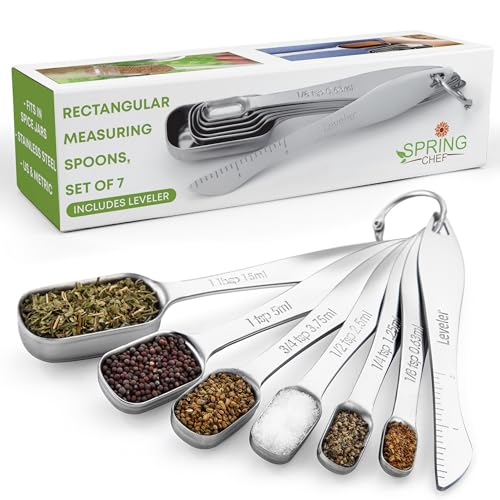
Spring Chef Nesting Stainless Steel Measuring Spoons Set of 7 with Leveler
Badge: Best for Spice Jars
Strengths
- Rectangular bowls and long handles stated to fit in spice jars, ending the pour-and-guess routine.
- A leveler is included for repeatable dry measures.
- Nesting storage keeps seven spoons together.
Trade-offs
- Spoons only: no cups included.
- Rectangular bowls feel unfamiliar if you are used to round spoons.
- The set covers the core range rather than the widest small-size span.
Mini spec box
- Material: stainless steel
- Pieces: 7 spoons, plus leveler
- Design: rectangular bowls, long handles, nesting
- Use: dry and liquid ingredients
This set solves the most common small-measure failure in home cooking: the spoon that cannot enter the spice jar. Cooks respond to that failure by pouring spice onto a spoon over the jar, which is really estimating with extra steps and a dusting of cumin on the counter. A rectangular bowl on a long handle goes into the jar, scoops, and levels against the included leveler on the way out — a true measure of the ingredient that matters most by weight of flavour. For households that cook with spices daily, that geometry is not a novelty; it is the difference between seasoned and approximately seasoned, repeated hundreds of times a year.
The limitations are scope and feel. There are no cups, and the rectangular bowl’s levelling motion differs slightly from a round spoon’s, which takes a few uses to become automatic. Neither point survives contact with the set’s main virtue for a spice-heavy kitchen, and cooks who rarely open a spice jar can safely rank it below the broader sets.
Best for: spice-heavy cooks who measure straight from the jar / Not suited for: buyers who need cups in the same purchase

Spring Chef Stainless Steel Measuring Cups and Spoons Set of 14 with Leveler
Badge: Best Complete Bundle
Strengths
- The largest verified bundle here: fourteen pieces spanning cups and rectangular spoons.
- A leveler is included, extending the spice-jar spoon design’s precision to the whole set.
- Nesting cups keep the big bundle storable as one unit.
Trade-offs
- The biggest drawer commitment in this guide.
- More pieces to wash and account for after big baking sessions.
- Overkill for kitchens that measure only coffee and spices.
Mini spec box
- Material: stainless steel
- Pieces: 14, cups and spoons, with leveler
- Design: nesting cups, rectangular spoons
- Use: dry and liquid ingredients
If the ten-piece TILUCK is the balanced answer, this fourteen-piece Spring Chef set is the maximal one, and for the right kitchen maximal is correct. It pairs the rectangular, jar-friendly spoon design with a full nesting cup family and a leveler, so a baker who measures everything from flour to fennel seed can do it from one bundle with one technique. Large households, committed bakers, and cooks equipping a kitchen from empty will use the whole set across a normal week, which is the test that justifies piece count. The nesting design keeps the bundle’s footprint honest relative to its contents.
The limitation is simply size. Fourteen pieces need a drawer or cabinet section that smaller kitchens may not have, and light cooks will leave half the set untouched, which helps nobody. Buy it because your cooking will use it, not because the count sounds comprehensive — a judgement this guide applies to every set, and one explored from the reputation side in our notes on the Best Measuring Spoons Ever, where long-term owners report which sets they actually kept using.
Best for: bakers and larger households equipping a kitchen completely / Not suited for: small kitchens or light, coffee-and-spices measuring

Hudson Essentials Stainless Steel Measuring Spoons Set of 7
Badge: Best Classic Spoon Set
Strengths
- Seven spoons covering the classic everyday range for dry or liquid ingredients.
- Shaped to fit in spice jars, per the verified listing.
- Stainless steel in a straightforward, no-gimmick format.
Trade-offs
- Spoons only: no cups included.
- No leveler is stated in the verified information.
- The classic range does not reach the smallest specialist measures.
Mini spec box
- Material: stainless steel
- Pieces: 7 spoons
- Design: fits in spice jars, per listing
- Use: dry or liquid ingredients
The classic set still has a constituency, and this is its representative: seven steel spoons, jar-friendly shaping, no accessories to lose and no system to learn. For cooks who level with a knife as their grandparents did, who cook a familiar repertoire whose measures they know by heart, and who want the replacement set to disappear into their routine rather than redesign it, that simplicity is the feature. It is also a sensible gift and a sensible second set, because its format asks nothing of the recipient.
The limitations are the absence of extras: no leveler is stated, no cups are included, and the range is the classic core rather than an extended span. Buyers who bake precisely or scale recipes often will find the sets above better matched. Buyers who want seven honest spoons will find exactly that here.
Best for: traditional cooks who want a simple, jar-friendly spoon set / Not suited for: buyers who want a leveler, cups, or extended small sizes
Comparison Table
| Pick | Badge | Format | Pieces | Standout feature | Link |
|---|---|---|---|---|---|
| TILUCK Set (10) | Best Overall | Cups and spoons, nesting | 10 | One bundle for both families | Check on Amazon |
| TILUCK Set of 6 | Best Compact Set | Cups and spoons | 6 | Smallest combined set | Check on Amazon |
| THLHKD 6Pcs | Best for Clear Markings | Spoons only | 6 | 1/8 tsp to 1 tbsp, clear markings | Check on Amazon |
| Spring Chef Set of 7 | Best for Spice Jars | Spoons only, nesting | 7 plus leveler | Rectangular bowls fit spice jars | Check on Amazon |
| Spring Chef Set of 14 | Best Complete Bundle | Cups and spoons, nesting | 14 plus leveler | Largest bundle | Check on Amazon |
| Hudson Essentials Set of 7 | Best Classic Spoon Set | Spoons only | 7 | Classic format, fits spice jars | Check on Amazon |
How to Choose the Right Set of Measuring Spoons
Start with the size list, and read it from the bottom up. The tablespoon and teaspoon are guaranteed; the buying decision lives in what else is present. A quarter and a half teaspoon are the working core. An eighth teaspoon opens up strong spices, small leavening quantities, and quartered recipes. Intermediate sizes — the ones that let you halve a recipe in single spoons — are the difference between measuring and arithmetic. Count how many of your regular recipes the set can measure without stacking two spoons or estimating, and let that count, not the headline piece number, rank your shortlist.
Decide the cups question honestly next. If your volume measuring is handled by a jug and a scale you trust, a spoons-only set keeps the purchase focused and the drawer light. If you bake with dry cups weekly, a combined nesting bundle will serve you better than spoons plus a separate cup set bought later and stored apart. Then weigh the precision accessories. A leveler matters if you bake or if your seasoning has been inconsistent; jar-fitting bowl shapes matter if you cook from spice jars daily; magnetic or nesting cohesion matters if your current set’s pieces are never all in the same place. Rank those three by your own failure history — the set that fixes your actual failure is the best set, whatever its badge.
Finish with markings and material. Markings should be readable at a glance, in ordinary kitchen light, with the spoon in your hand rather than under a lamp; clear markings are a stated feature of one pick here for a reason. Material, in this guide, is settled — stainless steel throughout — because rigid bowls, fast washing, and flavour neutrality are the properties daily measuring actually uses. Within steel, prefer the set whose whole package you will maintain: the best set is the one still complete, legible, and in daily use in five years, and that outcome is decided by fit to your habits more than by any specification.
How to Use Measuring Spoons Accurately, and Keep Them That Way
Technique is half of accuracy, and it is free. For dry ingredients, scoop from the container, then level with a straight edge in one pass — the leveler two of these sets include, or a knife — while the spoon is held over the container so the excess falls home. Resist the shake: tapping a spoon to settle its contents packs light powders and inflates the measure, which is how the same recipe gains saltiness week to week. For sticky ingredients, a light wipe of oil on the bowl helps honey and syrups release cleanly, a trick that matters for the notoriously clingy cases discussed in our guide to the Best Measuring Spoons For Peanut Butter. For liquids, fill the spoon at rest on the counter, brim-full, and lift it level; a liquid spoon carried half-full from a tilted bottle is an estimate wearing a spoon’s clothes.
Small spoons deserve slow hands. At an eighth of a teaspoon, the difference between heaped and levelled is proportionally enormous, and strong spices punish it. Measure the smallest quantities first, before your hands are floury or wet, and tap the spoon once against the container rim — not to settle it, but to shed the loose excess clinging to the outside of the bowl. When a recipe is scaled down, write the converted measures on the recipe itself the first time, so every future making uses the same spoons in the same way; consistency compounds.
Care is brief because the material is forgiving. Wash promptly after sticky or strongly flavoured ingredients, dry before storing nested or bundled, and keep the set in one home so completeness is visible at a glance. Troubleshooting, in the pattern cooks actually meet it. Problem: the same dish tastes different each time → audit levelling first; inconsistent heaping is the usual cause, and a week of deliberate levelling usually restores the dish. Problem: a size marking has become hard to read → it is usually filmed with oil rather than worn; a degreasing wash restores it. Problem: one spoon is always missing → it is being left in a canister or a coffee tin; assign the set one home and return every piece during the drying wipe, when an absence is easiest to catch.
What a Standard Spoon Range Actually Covers
New buyers often ask what a complete range even means, because sets advertise counts rather than coverage. In everyday American cooking, the working spoon range runs from a tablespoon down through a teaspoon, a half, and a quarter, and that core handles the large majority of printed recipes. Below the core sits the precision zone — an eighth and smaller — used for potent spices, concentrated flavourings, supplements, and scaled-down baking. Above the core there is nothing: larger quantities move to cups or to repeated tablespoons. Between the core sizes sit the intermediates that make scaling clean. A set is complete for you when it covers your core, reaches as far into the precision zone as your cooking goes, and offers the intermediates your scaling habits need. That definition explains this guide’s ranking better than any count: the sets differ mainly in how much of the precision zone and the intermediate band they bring with them, and the right choice is the one whose coverage matches the cooking you actually do, including the tiny, repeatable quantities that our notes on the Best Measuring Spoons For Nootropics treat as the whole discipline.
Matching the Set to Your Cooking Style
Different cooks stress different parts of a spoon set, and naming your style is the fastest way to a shortlist. The baker stresses the small end and the levelling: leavening, salt, and spices are measured in spoons for nearly every bake, quantities are small, and errors announce themselves in the crumb. Bakers should weight the leveler-equipped Spring Chef sets and any confirmed small sizes heavily, and should treat intermediate sizes as working tools rather than extras, because scaling bakes up and down is a weekly act. The spice-led cook stresses access and legibility: jars opened daily, small measures used in rapid sequence, markings read at speed. That cook should weight jar-fitting bowls and clear markings — the Spring Chef seven-piece and the THLHKD set — above bundle size. The batch cook stresses the top of the range and the cups beside it, moving between tablespoons and cup measures for grains, sauces, and marinades; the combined TILUCK and fourteen-piece sets serve that rhythm best. The minimalist cook stresses count and storage: fewest pieces, one home, nothing to lose, which points to the compact TILUCK or the classic Hudson Essentials seven.
Most households contain two of these cooks at once, which is why balanced sets rank first in this guide and specialists carry their own badges rather than pretending to be universal. The exercise worth doing before ordering is a one-week inventory: note each time you measure, which spoon you reach for, and which measure you have to fake. Seven days of notes will show a pattern no product page can — your true core sizes, your true precision needs, and whether your failures are about coverage, access, or levelling. Buy the set that answers your pattern, and the purchase will feel less like shopping and more like a repair.
How a Good Set Changes Everyday Cooking
The benefits of the right set are quiet and cumulative. Recipes become repeatable, which changes how a cook learns: when the measures are trustworthy, a dish that disappoints can be adjusted deliberately — a little less salt, a little more spice — and the adjustment means something, because the baseline was real. Without trustworthy measures, every result is partly weather, and improvement is guesswork. Seasoning, the skill home cooks most want, is especially dependent on this loop, because seasoning is nothing but small quantities judged against memory, and memory is only useful when the quantities were actually what you believed they were.
There is also a speed benefit that surprises new owners of a complete, well-stored set. Cooking flows when the hand finds the right spoon without a search, when the spoon enters the jar without a pour, and when levelling is a single practiced pass. Sauces get seasoned in the moment they need it rather than after a drawer excavation, and baking stops requiring a pre-flight inventory of the measuring drawer. None of these gains appear on a specification sheet, yet they are what owners describe when they say a set changed their kitchen. It is why this guide weighs storage, access, and legibility alongside the size list: the specification that matters most is the one your hand encounters two hundred times a year.
Finally, a good set lowers the barrier to cooking from recipes at all. Cooks estimate when measuring feels like friction, and they follow recipes when measuring feels like nothing. A set that lives in one place, reads at a glance, and covers the quantities real recipes use turns recipe-following back into the default, which is where new dishes, new cuisines, and better weeknight food come from. That is a large return on a small, steel, unglamorous purchase, and it is available from every price tier represented in this guide — the tiers differ in coverage and convenience, not in whether the return exists.
Steel, Storage, and the Five-Year Test
Every set here is stainless steel, and it is worth understanding what that buys over the life of the set rather than on the day it arrives. Steel bowls do not flex while levelling, so a measure taken in year five equals a measure taken in week one. Steel does not absorb the flavours of garlic powder, cumin, or coffee into itself, so yesterday’s spice does not ghost today’s baking powder. Steel tolerates the drawer knocks, the dropped spoon on a hard floor, and the occasional trip through a crowded wash without cracking, and its markings, when well made, remain legible because the surface beneath them is stable. None of this is dramatic, and that is the point: a measuring set is infrastructure, and infrastructure should be boringly reliable for years.
Storage decides whether that reliability is ever used. A set’s five-year enemy is not wear but dispersal — one spoon living in the coffee tin, one in the baking box, one at the back of a drawer under the utensils. Nesting designs, bundles that include the cups, and a single assigned home are the defences, and they are all present in this guide in different forms. When you judge a set, run the five-year test explicitly: picture the set after a thousand washes, a hundred baking sessions, and two kitchen reorganisations. Is it still complete, still legible, still in one place? The sets that pass that mental test are the ones whose cost divides into a trivial amount per year of accurate cooking, and they are the sets this guide has tried to put at the top of your list.
Common Buying Mistakes
The first mistake is buying by piece count
and discovering the sizes are the wrong ones. The second is ignoring the small end, then estimating every strong spice for the life of the set. The third is choosing bowls that cannot enter your spice jars, and pouring — which is estimating — forever. The fourth is splitting the set across drawers on day one, guaranteeing that the needed spoon is always in the other one. The fifth is treating markings as decoration and buying a set you cannot read at speed. Each mistake is visible before purchase, in the size list, the bowl shape, and the storage design, which is why this guide keeps returning to those three readings.
Final Recommendation
For most kitchens, buy the TILUCK Stainless Steel Measuring Cups and Spoons Set (10): it solves spoons and cups as one nesting steel bundle and ends the two-drawer hunt. Spice-heavy cooks should choose the Spring Chef Nesting Measuring Spoons Set of 7 with Leveler for its jar-fitting rectangular bowls, and committed bakers equipping a kitchen should step up to the Spring Chef Measuring Cups and Spoons Set of 14 with Leveler. Choose the THLHKD set for legible markings and a confirmed small-size span, the compact TILUCK for small kitchens, and the Hudson Essentials set for a classic seven spoons done simply. Read the size list from the bottom up, and the right set will identify itself.
Frequently Asked Questions
What sizes should a good set of measuring spoons include?
The working core is a tablespoon, a teaspoon, a half teaspoon, and a quarter teaspoon. A stronger set adds an eighth teaspoon for potent spices and scaled recipes, plus intermediate sizes that make halving clean. Judge any set by how much of that map it covers for your cooking, not by its total piece count.
Are the sets with cups better than spoons-only sets?
They are better if you need cups, and unnecessary if you do not. Combined nesting sets solve the whole measuring problem in one bundle, which is why two of them rank highly here. A spoons-only set beside cups or a jug-and-scale routine you already trust is an equally sound answer, and it keeps the drawer lighter.
Why do two sets in this guide include a leveler?
Because levelling is where dry measures succeed or fail. A heaped spoon of flour, cocoa, or baking powder can hold far more than a levelled one, and a leveler makes the levelled result the default rather than a matter of knife skill. If your baking or seasoning has been inconsistent, a leveler-equipped set addresses the most likely cause directly.
Do rectangular spoons measure as accurately as round ones?
Shape does not determine accuracy; bowl volume and clean levelling do. Rectangular spoons earn their place by entering spice jars that round spoons cannot, which removes pouring and guessing. A rectangular spoon levelled properly is a true measure, and a round spoon poured into over a jar is not, whatever its shape promises.
How do I keep a spoon set complete over years?
Give it one home, store it nested or bundled as designed, and return every piece during the drying wipe after washing — the moment when a missing piece is most visible. Sets are lost one spoon at a time, usually into canisters and coffee tins, and a completeness habit at the sink prevents nearly all of it.
Can stainless steel measuring spoons be used for liquids as well as dry ingredients?
Yes. Every set in this guide is listed for dry and liquid ingredients. Fill liquid measures at rest on the counter, brim-full, and lift them level. For larger liquid volumes, switch to a jug, where the level can be read at eye height; spoons are for the small end of liquid measuring, where they are exact.
Is it worth keeping two spoon sets for different jobs?
For some kitchens, yes: a combined or general set as the daily bundle, and one specialist set — for spice jars, for very small measures, or for a second cooking location — covers more ground than either alone. Think of the second set as you would a second knife: not a duplicate of the first, but a tool kept where its particular job happens, sharpened by proximity to that job, and judged by whether that job gets done measurably better because the set is there. The arrangement works when each set has its own home and its own job, and fails when the two merge into one undifferentiated drawer population. If you adopt it, let the daily set live nearest the stove and the specialist set with the ingredients it serves, and both will stay complete far longer than a single set stretched across every task.
Should I replace a set that is missing one spoon?
Not immediately. First, audit what the missing spoon actually costs you: if it is a size your cooking rarely uses, the set remains serviceable while you decide, and if it is a core size, replacement of the whole set is usually cleaner than hunting a single matching spoon, because a unified set keeps one marking style, one storage system, and one levelling feel. Use the gap as the inventory exercise this guide recommends — a week of noting which measures you fake will tell you whether to replace like for like or to upgrade coverage at the small end while you are at it.
How long should a stainless steel spoon set last?
With ordinary care — prompt washing, dry storage, one home — a stainless steel set should serve for many years without its measures changing, because the bowls do not flex, chip, or absorb flavours. What usually ends a set’s life is not wear but loss of pieces, which is why this guide treats nesting, bundling, and the completeness habit at the sink as durability features in their own right. A set that stays complete stays useful, and completeness is a habit the storage design can either support or undermine.
What is the first thing to check before ordering a set?
The size list. Confirm the small end reaches as far as your cooking needs, that the intermediates suit how often you scale recipes, and — for combined sets — that the cup sizes match your baking. That one reading prevents more disappointment than any other check in this category.