Disclosure: topratedkitchenware.com is reader-supported. When you buy through links on our site, we may earn an affiliate commission from Amazon and other retailers, at no extra cost to you.
Where to buy
The best heat tolerant dutch ovens are the ones whose heat claims you can verify, and this guide separates stated specifications from assumptions throughout. Each name below links to its Amazon listing, and each detailed review carries its own link so you can check the latest price on Amazon and — just as important for this keyword — re-read the listing’s own heat wording before you order.
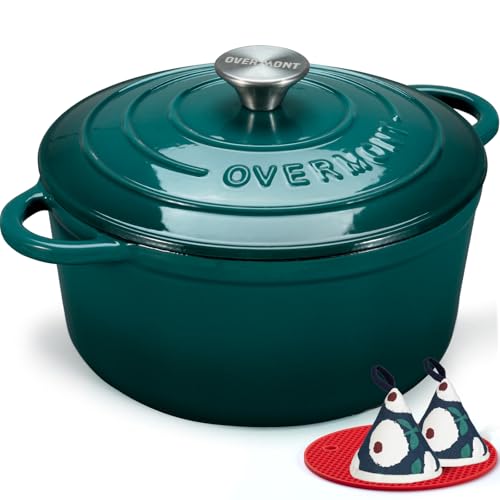
- Overmont Enameled Cast Iron Dutch Oven, 7QT — Best Large Oven Performer. Best for big roasts and loaves at oven heat.
- Amazon Basics Enameled Cast Iron Dutch Oven, 6-Quart, Blue — Best Simple Oven-Safe Format. Best for buyers who want oven-safe positioning stated plainly.
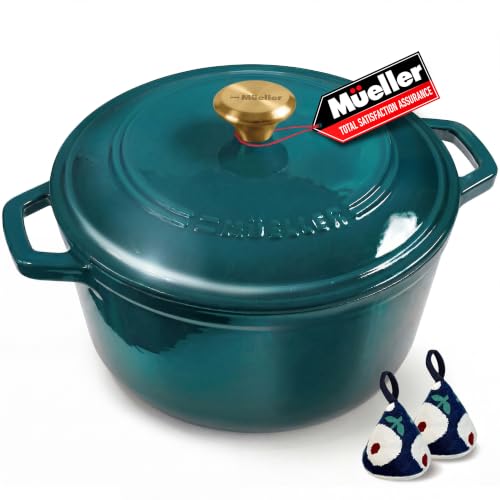
- Mueller DuraCast 6 Quart Enameled Cast Iron Dutch Oven, Emerald — Best Documented Heat Rating. Best for buyers who want a numeric oven-safe figure in the listing.
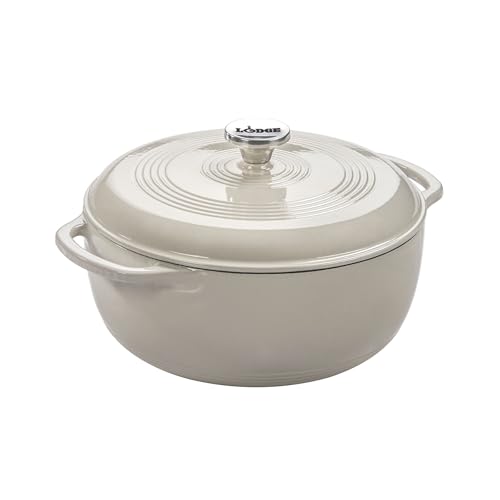
- Lodge Essential Enamel Cast Iron Dutch Oven, 6 Quart, Island Spice Red — Best for Braising Heat Cycles. Best for stove-to-oven braises with a moisture-sealing lid.
- Le Creuset Enameled Cast Iron Round Dutch Oven, 5.5 qt., Cerise — Best Premium Heat Steadiness. Best for cooks who prize even, stored heat above all.
- Umite Chef 7QT Enameled Cast Iron Dutch Oven, Emerald — Best Capacity for Roasting. Best for whole birds and big batches moving between stove and oven.
Read the full guide ↓ for an honest account of what heat tolerance means in this category, which claims are stated where, and how to use high heat without abusing enamel.
People searching for the best heat tolerant dutch ovens usually have a specific fear or a specific plan: a fear that a pot will crack, discolour or fail at roasting temperatures, or a plan that involves serious oven work — bread baked in a fully preheated pot, roasts that start with a hard stovetop sear, braises that live in the oven for hours. Both deserve a precise answer, and precision is this guide’s method. Among the six verified enameled cast iron pots below, exactly one listing states a numeric oven-safe figure, two more state oven-safe positioning in words, and the rest state neither — and we will not invent numbers for them. What we can say for all six is what the material itself guarantees: cast iron is a high-heat material by nature, and enameled cast iron Dutch ovens are built for stovetop-to-oven cooking. The differences that matter are the stated limits, the knob and lid details, and how you handle the pot at temperature.
That honesty matters more for this keyword than for any other in the series, because heat is where marketing language inflates fastest. A pot described as heavy-duty is not thereby rated for your broiler, and a rival’s numeric limit cannot be borrowed across brands. Use this guide to learn which claims live where, then confirm the current listing for the pot you choose — makers revise specifications, and the listing is the document that counts. The neighbouring ranking at Best Oven Proof Dutch Ovens approaches the same shelf from the oven-proof angle and makes a useful cross-check.
Key Takeaways
- Only the Mueller listing here states a numeric limit — 500°F oven safe, in its title. Other pots’ limits must be confirmed on their own listings; do not borrow numbers across brands.
- The Overmont 7QT and Amazon Basics listings state oven-safe positioning in words; the Lodge, Le Creuset and Umite Chef listings in this guide do not state a heat figure in their titles.
- Cast iron itself is inherently heat-hungry: its mass stores heat, which is why these pots sear, roast and bake bread so well. Enamel’s enemies are impact and sudden temperature change, not ordinary oven heat.
- The knob and lid are usually the practical heat frontier, not the iron — treat every knob as hot and confirm model specifics on the listing.
- Gradual preheating, no cold water on a hot pot, and no empty pot on full burner power are the habits that keep enamel intact at temperature.
- Broiler and grill exposure is a separate, harsher question than oven use; verify it per model rather than assuming it.
In this guide
Quick Picks
Six verified pots, ranked for heat-focused buyers, with badges repeated in the detailed reviews.
| Pick | Badge | Who it suits |
|---|---|---|
| Overmont Enameled Cast Iron Dutch Oven, 7QT | Best Large Oven Performer | Big roasts and loaves; oven-safe positioning stated |
| Amazon Basics Enameled Cast Iron Dutch Oven, 6-Quart, Blue | Best Simple Oven-Safe Format | Plain six-quart value with oven-safe positioning stated |
| Mueller DuraCast 6 Quart Enameled Cast Iron Dutch Oven, Emerald | Best Documented Heat Rating | Buyers who want the numeric figure in writing |
| Lodge Essential Enamel Cast Iron Dutch Oven, 6 Quart, Island Spice Red | Best for Braising Heat Cycles | Stove-to-oven braises with a moisture-sealing lid |
| Le Creuset Enameled Cast Iron Round Dutch Oven, 5.5 qt., Cerise | Best Premium Heat Steadiness | Cooks who prize even stored heat and the benchmark name |
| Umite Chef 7QT Enameled Cast Iron Dutch Oven, Emerald | Best Capacity for Roasting | Whole birds and big batches at oven heat |
How These Picks Were Chosen
Selection began with the verified pool of enameled cast iron Dutch ovens and then applied this keyword’s lens: heat. We recorded, for each listing title, exactly what it claims about heat — a numeric oven-safe figure, oven-safe positioning in words, or silence — and the reviews and spec boxes below reproduce that record faithfully. No pot was credited with a limit its listing does not state, and no pot was excluded for silence either, because enameled cast iron as a material is designed for oven cooking; silence is a documentation gap, not a defect. Where a listing names other features — a moisture-sealing lid, an enclosed lid-knob design, dual handles, included potholders — those are reported as the practical heat-adjacent details they are.
We also weighted the cooking that heat-focused buyers actually do: preheated-pot bread baking, hard sears followed by oven braises, long roasts, and the stove-to-oven transfers in between. Capacity therefore still matters — a seven-quart pot roasts a bigger bird — and the shortlist spans 5.5 to 7 quarts so the heat discussion never floats free of the size decision. Confirm current listings before buying; specifications are the one part of a listing makers revise without announcement. Readers whose heat questions centre on family-size roasting should cross-read Best Large Dutch Ovens, where several of these pots are ranked by capacity alone.
The 6 Best Heat Tolerant Dutch Ovens in Detail

Overmont Enameled Cast Iron Dutch Oven, 7QT
Badge: Best Large Oven Performer
Strengths
- Oven-safe positioning is stated in the listing for sourdough baking, braising, stews and roasting.
- The listing names an enclosed lid-knob design — a relevant detail for a pot that lives in the oven.
- Seven quarts gives big roasts and loaves room, and cotton potholders plus a cookbook are included.
Trade-offs
- No numeric oven limit is stated in the title; confirm the current figure on the listing if you need one.
- The heaviest pot here when full — hot lifts demand planning and both hands.
- Oversized for small households’ everyday cooking.
Mini spec box
- Material: enameled cast iron
- Capacity: 7QT
- Heat claim in listing: oven safe positioning (no numeric figure in title)
- Features named in listing: enclosed lid-knob design; includes cookbook and cotton potholders
- Listed uses: sourdough baking, braising, stews, roasting
The big Overmont leads a heat-focused guide because its listing does two useful things: it positions the pot as oven safe for exactly the high-heat repertoire this keyword cares about — sourdough baking, braising, stews, roasting — and it names an enclosed lid-knob design, the component that most often sets a practical ceiling on oven use. At seven quarts it also gives heat somewhere to go: a large roast browns with air around it, a big loaf expands without meeting the lid, and the iron’s mass steadies the oven’s cycles across a long cook. The included cotton potholders are not a garnish on a pot like this; they are the handling system for a vessel that will routinely be moved at full temperature.
It suits hosts, batch cooks and bread bakers working at scale. The honest limitation is documentary: the title states oven-safe positioning without a number, so buyers who cook to a specific figure should confirm the current listing’s detail before relying on it. That is a small errand for a pot this capable, but this guide’s whole discipline is to send you to the listing for numbers rather than to invent them here.
Best for: large-format oven cooking with stated oven-safe positioning / Not suited for: buyers who need a numeric limit confirmed before purchase
Check on Amazon to see the current listing for the Overmont 7QT.

Amazon Basics Enameled Cast Iron Dutch Oven, 6-Quart, Blue
Badge: Best Simple Oven-Safe Format
Strengths
- Oven-safe positioning is stated plainly in the listing for stews, roasting and baking.
- Six round quarts with dual handles — a straightforward, honest format.
- The saturated blue finish tolerates the cosmetic marks of high-heat cooking better than pale enamel.
Trade-offs
- No numeric limit stated in the title, and no named lid or knob feature.
- No potholders included — budget for mitts, because the handles reach pot temperature.
- Plain presentation next to the heritage names here.
Mini spec box
- Material: enameled cast iron
- Capacity: 6-Quart
- Shape: round (per listing title)
- Heat claim in listing: oven safe positioning (no numeric figure in title)
- Features named in listing: dual handles, heavy-duty
- Colour: Blue
The Amazon Basics pot is the heat guide’s value plain-speaker: its title states oven-safe positioning for stews, roasting and baking without ornament, wrapped around six round quarts of enameled cast iron with dual handles. For the bread baker who preheats a pot daily or the roaster who wants a working vessel rather than a display piece, that plainness is a feature. High-heat cooking marks cookware — flame-kissed exteriors, oven patina — and the blue finish absorbs those marks visually better than the pale finishes elsewhere in this series. Dual handles matter at temperature: a preheated six-quart pot is moved with two protected hands, deliberately, and this design supports exactly that grip.
It suits pragmatic buyers and dedicated bread-pot duty. Its limitations are the missing number and the missing bundle: if a numeric limit is your decision criterion, the Mueller below is the only pick that publishes one in its title, and if you need potholders, add them to the order. As an oven-working pot at the simple end of the market, it makes its case cleanly.
Best for: bread bakers and roasters who want stated oven-safe positioning at a simple tier / Not suited for: buyers who need a numeric limit or bundled accessories
Check on Amazon to see the current listing for the Amazon Basics 6-Quart in Blue.

Mueller DuraCast 6 Quart Enameled Cast Iron Dutch Oven, Emerald
Badge: Best Documented Heat Rating
Strengths
- The only listing in this guide that states a numeric oven-safe figure in its title: 500°F oven safe.
- All cooktops including induction are also named in the title, removing the other common compatibility guess.
- Six quarts in Emerald, with PFOA-free positioning also stated in the listing.
Trade-offs
- No potholders or cookbook listed as included, and no named lid feature in the title.
- A stated figure is a ceiling to respect, not a target — cook within it.
- Specifications can be revised; confirm the current listing before buying.
Mini spec box
- Material: enameled cast iron
- Capacity: 6 Quart
- Heat claim in listing: 500°F oven safe (stated in title)
- Also stated in listing: PFOA-free; all cooktops incl. induction
- Colour: Emerald
- Listed uses: sourdough bread baking, braising, slow cooking
If this guide has a headline pick for documentation, it is the Mueller. Its title does what heat-focused buyers wish every title did: it prints the number. A stated 500°F oven-safe figure covers the realistic repertoire — bread preheats, roasting, braising — and gives the buyer a clear ceiling to cook within instead of a fog of implication. The same title confirms all cooktops including induction, which settles the second-most-common compatibility question in this category, and adds PFOA-free positioning. Six quarts in a stain-forgiving Emerald finish completes a specification sheet that reads like it was written for this keyword.
It suits induction owners, bread bakers who preheat hard, and any buyer who prefers written figures to vibes. The honest limitations are the plain bundle — bring your own mitts — and the discipline a stated ceiling imposes: a number in the listing is a promise with an edge, and cooks who routinely work at the top of an oven’s range should respect it rather than treat it as a challenge. Within its stated figure, this is the most completely documented pot in the guide.
Best for: buyers who want the heat figure in writing, and induction households / Not suited for: buyers who want bundled extras or a named lid feature
Check on Amazon to see the current listing for the Mueller DuraCast 6 Quart in Emerald.

Lodge Essential Enamel Cast Iron Dutch Oven, 6 Quart, Island Spice Red
Badge: Best for Braising Heat Cycles
Strengths
- The moisture-sealing lid and dual handles named in the listing are exactly the features stove-to-oven braising uses.
- Six quarts suits family braises that sear on the hob and finish in the oven.
- Island Spice Red hides the cosmetic marks of flame and oven work well.
Trade-offs
- The title states no heat figure and no oven-safe phrase; confirm heat details on the current listing.
- No potholders listed as included.
- Buyers who rank documentation first should choose the Mueller.
Mini spec box
- Material: enamel cast iron (per listing title)
- Capacity: 6 Quart
- Heat claim in listing: none stated in title — confirm on listing
- Features named in listing: moisture-sealing lid, dual handles
- Colour: Island Spice Red
- Listed uses: bread baking, braising, marinating, slow cooking
Heat tolerance in real kitchens is rarely about a single maximum temperature; it is about cycles — sear on the hob, braise in the oven, rest, reheat tomorrow — repeated for years. The Lodge is built for that rhythm in the ways its listing verifies: a moisture-sealing lid that keeps braises basted through long oven hours, dual handles for moving a full, hot pot between surfaces, and a six-quart format that matches family recipes. Lodge’s cast iron heritage is the background assurance here, but this guide rests the pick on the named features rather than the name, and it flags the documentation gap plainly: the title states no heat figure, so heat-focused buyers should read the current listing’s full specification before ordering.
It suits braising households who value the sealing lid and will do that one listing check. If paperwork matters more than the lid, the Mueller out-documents it; if the lid matters more, this is the pot. The red finish, meanwhile, is the pragmatic choice for a pot that will live between flame and oven, since it conceals the cosmetic evidence of both.
Best for: stove-to-oven braising households / Not suited for: buyers who want a heat figure stated in the title
Check on Amazon to see the current listing for the Lodge Essential 6 Quart in Island Spice Red.

Le Creuset Enameled Cast Iron Round Dutch Oven, 5.5 qt., Cerise
Badge: Best Premium Heat Steadiness
Strengths
- The benchmark premium name in enameled cast iron, in the versatile 5.5-quart round format.
- Cast iron mass at this quality level is about steadiness: even searing, calm simmers, uniform bread heat.
- Cerise finish presents as well at the table as it performs in the oven.
Trade-offs
- The title states no heat figure; confirm the current listing for model-specific limits, including knob guidance.
- Premium tier pricing, with no bundled potholders listed.
- At 5.5 quarts it is not the batch or big-roast answer.
Mini spec box
- Material: enameled cast iron
- Capacity: 5.5 qt.
- Shape: round
- Heat claim in listing: none stated in title — confirm on listing
- Colour: Cerise
For many heat-focused buyers, the Le Creuset is the reference point — the pot whose evenness at temperature others are measured against. This guide can verify from its listing the essentials: enameled cast iron, round, 5.5 quarts, Cerise. It does not state a heat figure in the title, and so — consistently with every other pick — we direct you to the current listing for the model’s stated limits rather than repeating figures from general knowledge. What justifies its place in a heat guide is the thing cast iron does when it is made to the standard this name represents: stored heat that sears without hot spots, holds a braise at a calm equilibrium, and surrounds a loaf with uniform radiation. Premium pricing buys that assurance and the presentation; it does not buy a different cooking method.
It suits cooks who will use the pot constantly and value the benchmark. Its limitations for this keyword are documentation and size: check the listing for limits, and look to the seven-quart picks for big roasts. Readers weighing the premium name against the field will find the dedicated comparison in Best Le Creuset Dutch Ovens Braisers helpful.
Best for: cooks who prize even stored heat and the benchmark name / Not suited for: batch cooking or buyers who need a title-stated heat figure
Check on Amazon to see the current listing for the Le Creuset 5.5 qt. in Cerise.

Umite Chef 7QT Enameled Cast Iron Dutch Oven, Emerald
Badge: Best Capacity for Roasting
Strengths
- Seven quarts gives whole birds and big roasts the air space that proper oven browning needs.
- Cotton potholders are included — essential kit for moving a pot this size at temperature.
- The listing describes heavy-duty cookware for bread baking, braising, stews and marinating.
Trade-offs
- The title states no heat figure or oven-safe phrase; confirm heat details on the current listing.
- A full seven-quart pot is the heaviest hot lift in this guide.
- Emerald shows oven patina less than pale finishes, but the pot still needs careful handling at temperature.
Mini spec box
- Material: enameled cast iron
- Capacity: 7QT
- Heat claim in listing: none stated in title — confirm on listing
- Includes: lid and cotton potholders (per listing title)
- Colour: Emerald
- Listed uses: bread baking, braising, stews, marinating
Roasting is a heat-and-space problem: meat browns in the oven when hot air can circulate and surface moisture can escape, and crowded pots steam instead. The seven-quart Umite Chef solves the space half of that equation for whole chickens, large joints and generous vegetable trays, while its cast iron mass holds oven temperature steady when the door opens for basting. The included cotton potholders acknowledge the handling reality of a pot this size at roasting heat. Its listing describes heavy-duty cookware for bread baking, braising, stews and marinating without stating a heat figure, so — as with the Lodge and Le Creuset here — the pre-purchase step is to confirm the current listing’s heat specification, a two-minute check this guide recommends rather than performs on your behalf.
It suits roasters, hosts and batch cooks whose oven work runs large. Buyers who want the number printed in the title should choose the Mueller; buyers who want oven-safe wording plus a named knob design at this size should choose the Overmont. What the Umite Chef offers is capacity, potholders and a forgiving Emerald finish in one heavy-duty package.
Best for: whole-bird roasting and big-batch oven work / Not suited for: buyers who want heat claims stated in the title
Check on Amazon to see the current listing for the Umite Chef 7QT in Emerald.
Comparison Table
| Pick | Capacity | Heat claim in title | Other named features | Link |
|---|---|---|---|---|
| Overmont Dutch Oven | 7QT | Oven safe positioning | Enclosed lid-knob design, cookbook, potholders | Check on Amazon |
| Amazon Basics Dutch Oven | 6-Quart | Oven safe positioning | Dual handles, round shape | Check on Amazon |
| Mueller DuraCast Dutch Oven | 6 Quart | 500°F oven safe stated | All cooktops incl. induction, PFOA-free stated | Check on Amazon |
| Lodge Essential Dutch Oven | 6 Quart | Not stated in title | Moisture-sealing lid, dual handles | Check on Amazon |
| Le Creuset Round Dutch Oven | 5.5 qt. | Not stated in title | Premium benchmark name | Check on Amazon |
| Umite Chef Dutch Oven | 7QT | Not stated in title | Cotton potholders included | Check on Amazon |
How to Choose a Dutch Oven for Heat-Focused Cooking
Decide first what your hottest regular cooking actually is. Bread bakers preheat an empty pot at full baking temperature, which is the most demanding routine here: you want a pot whose listing supports oven use in writing, and the Mueller’s stated figure or the Overmont and Amazon Basics oven-safe positioning give you that footing. Roasters work at moderate-to-high oven heat with food in the pot, which every enameled cast iron design here is built for, so capacity and handles should drive the choice — seven quarts and two good grips. Braisers cycle between a hard stovetop sear and gentle oven hours; for them the lid is the heat feature that matters, which points to the Lodge. Broiler finishing is the outlier: radiant top heat is harsher than oven air, knobs sit closest to the element, and no title in this guide claims it — treat broiler use as a per-listing verification, every time.
Then apply the documentation rule that runs through this guide: a claim you can point to beats a claim you assume. If two pots otherwise tie, choose the one whose listing states what you need — a figure, an oven-safe phrase, an induction confirmation. And whatever you choose, respect the stated ceiling as a ceiling. Heat tolerance is a specification to cook inside, not a dare, and the enamel you protect with gradual heating and cooling will repay you with years of high-heat service. The build-quality view of the same decision is covered in Best Made Dutch Ovens, for readers who want construction cues ranked separately from heat claims.
How to Use High Heat Without Harming Enamel
Technique is the other half of heat tolerance. Preheat gradually: place the pot over low to medium heat with oil or liquid in it and let the iron come up to temperature evenly, rather than setting an empty pot over a full flame. For bread, preheat the pot inside the oven as the oven itself heats, so pot and oven arrive together — and remember the pot you retrieve is uniformly, seriously hot, which is why the included or purchased potholders are equipment, not accessories. Sear with patience: dry meat, uncrowded batches, and time for the crust to form before turning. Move between stove and oven with two protected hands and a planned landing spot, never a rushed one-handed carry.
Cooling deserves the same care as heating. Let the pot shed heat on a trivet before washing; never run cold water into a hot enameled pot or set it on a cold wet surface, because sudden contraction is what stresses the enamel-to-iron bond. Soak, soften and wash with a soft sponge once the pot is merely warm. Store dry, lid ajar in humid kitchens.
Troubleshooting, in brief. Problem: enamel develops a network of fine surface lines after high-heat use → usually cosmetic crazing from thermal stress; review your preheat and cooling habits, avoid shocks, and follow maker guidance if the cooking surface is affected. Problem: a roast steams instead of browning in the oven → the pot is crowded or the lid is on; roast uncovered with space around the meat. Problem: bread crust sets pale despite a long bake → the pot was not fully preheated; preheat pot and lid with the oven and bake covered first, then uncovered to finish.
What Actually Limits Heat in an Enameled Pot
Understanding the frontier helps you shop and cook better. The iron core is rarely the limit — cast iron was born for fire. The enamel coating is tougher than its glassy look suggests, but it dislikes sudden change more than steady heat, which is why technique matters as much as any figure. The practical limits usually arrive at the attachments: the lid knob, which sits in the oven’s hottest air and may be made of a material with its own ceiling, and any component the maker specifies separately. That is why the Overmont’s enclosed lid-knob design earns a mention in a heat guide, and why this guide keeps sending you to listings for model-specific numbers: the number, where one exists, is a property of the whole assembled pot, not of cast iron in general. A buyer who internalises that — material strong, assembly specific, technique decisive — will choose well from this shortlist and from any other.
Heat in Practice: Four Cooking Scenarios
Abstract tolerance becomes concrete when you walk through the cooking. Scenario one: the Saturday loaf. Your oven preheats with the pot inside, the dough drops onto parchment into iron that has stored the oven’s full heat, and the lid traps steam for the first phase. This is the most thermally demanding routine in home cooking for this category — an empty pot at baking temperature, handled hot, then shocked only by room-temperature dough, which cast iron absorbs without drama. It is also the routine the sourdough-positioned listings here are sold for. Scenario two: the Sunday roast. The pot works at roasting temperature with food inside, which buffers the enamel from the air’s full swings; the challenges are handling and space, not survival, and the seven-quart picks earn their keep by giving the joint air to brown in.
Scenario three: the weeknight braise that starts with violence and ends with patience — a hard stovetop sear over lively heat, then hours at a gentle oven temperature. The thermal skill here is transition: the pot must take the sear without complaint and then hold the braise at equilibrium, which is cast iron’s signature trick and the reason the Lodge’s sealing lid matters more to this scenario than any number does. Scenario four: the reheat. Yesterday’s stew returns to a low burner in the same pot, and the enamel — unlike seasoned bare iron after an acidic stew — has no coating politics to consider. Across all four, notice that ordinary oven heat never threatens a sound enameled pot; what threatens it is shock, impact and neglect, which is why this guide spends as much time on technique as on specifications.
Stovetop Heat: The Forgotten Half of Tolerance
Heat discussions fixate on ovens, but half of a Dutch oven’s thermal life happens on the hob. Gas flames lick up the sides of a pot that is too small for the burner and can scorch exterior enamel over time; the fix is matching pot base to burner and centring the pot. Electric and induction surfaces concentrate heat in the contact patch, which rewards gradual preheating — a cold pot slammed onto a full-power ring is the classic way to stress the base enamel and scorch the first food that lands in it. The Mueller’s title-level confirmation of all cooktops including induction is therefore a heat feature as much as a compatibility one: it tells induction owners the base is built for their hob’s particular demands. Whatever your surface, the routine is the same — start low, let the iron equalise, then cook. Cast iron rewards that patience with the steadiest searing surface in the kitchen, and punishes haste only mildly, with uneven browning and, over years, avoidable wear. Tolerance, in other words, is partly a property of the pot and partly a property of the cook, and the buyers who understand that get the longest service from any pick in this guide, at any tier.
Common Buying Mistakes
- Storing the pot while it is still hot or damp. Let it cool and dry fully before it goes away; trapped heat and moisture help nobody’s enamel or cupboard, and a warm lid replaced tightly can hold condensation against the rim.
- Borrowing one brand’s heat figure for another brand’s pot. Limits are model-specific. The Mueller’s stated figure belongs to the Mueller.
- Treating heavy-duty language as a heat rating. It is a description, not a specification. Look for stated oven-safe claims.
- Assuming oven-safe means broiler-safe. Radiant broiler heat is a separate exposure. Verify it per listing if you need it.
- Preheating an empty pot on full burner power. Gradual heating with oil or liquid protects the enamel bond.
- Quenching a hot pot in cold water. Thermal shock is enamel’s real enemy. Cool first, then wash.
- Ignoring the knob. The lid knob often sets the practical ceiling. Note named knob designs and confirm specifics on the listing.
A Short History of Cooking in Iron Over Fire
Context steadies the heat conversation. The Dutch oven descends from cast iron pots designed for hearths and open fires — vessels whose entire purpose was to work in direct, serious heat, baking with coals on the lid and braising in the embers. The enameled descendants in this guide moved that iron indoors and civilised its surface, but the core inheritance is thermal: thick cast iron that absorbs fire’s energy and returns it as steady, surrounding heat. When modern buyers worry whether an enameled pot can handle an oven, they are asking a vessel built from a fire-native material to do considerably less than its ancestors did nightly. The genuine modern cautions are narrower and more specific — enamel shock, knob limits, stated ceilings — and this guide has kept them in that proportion deliberately. Respect the specifics, verify the numbers that matter to your cooking, and then trust the material to do what it has done for centuries.
When Heat Tolerance Should Not Decide Your Purchase
A final calibration: for many households, this keyword’s question answers itself quickly and the decision should move on to size and features. If your cooking tops out at ordinary roasting and braising temperatures — as most home cooking does — every verified enameled cast iron pot in this guide is operating comfortably inside its design, and your energy is better spent on capacity fit, lid design and the bundle. Heat documentation becomes decisive at the edges: the baker who preheats daily, the induction owner who needs written compatibility, the cook who finishes under fierce top heat. Know which buyer you are. The edge cases deserve the Mueller’s paperwork or the Overmont’s stated positioning; the mainstream deserves the pot that fits its meals, bought without anxiety. That perspective is not a dismissal of the keyword — it is the keyword answered honestly, which is that tolerance in this category is high across the board, documented unevenly, and preserved by technique. Choose your documentation level, choose your size, and cook.
Final Recommendation
If documentation decides it, choose the Mueller DuraCast: it is the only pick that prints its oven-safe figure in the listing, and it adds written induction confirmation at a family size. If scale decides it, choose the Overmont 7QT for stated oven-safe positioning, an enclosed lid-knob design and batch capacity — or the Umite Chef 7QT if you prefer its potholder bundle and Emerald finish, after confirming heat details on its listing. Braisers should take the Lodge for its sealing lid, value buyers the Amazon Basics for its plain oven-safe format, and premium buyers the Le Creuset for benchmark steadiness, again with a listing check for its stated limits. Heat rewards the buyer who reads specifications; this shortlist is built to be read that way.
If you want a fast answer, start with one of these three and read its detailed review above: Mueller DuraCast 6 Quart Enameled Cast Iron Dutch Oven, Emerald, Overmont Enameled Cast Iron Dutch Oven, 7QT, Amazon Basics Enameled Cast Iron Dutch Oven, 6-Quart, Blue. Between them they cover the documented, large and simple cases for heat-focused cooking.
And a closing reassurance for the mainstream cook: if your oven work is roasts, braises, stews and the occasional loaf, you are shopping in a category whose material was born for heat. Verify the one or two claims your cooking actually depends on, handle the pot with the respect hot iron deserves, and any of these six will serve at temperature for years.
Frequently Asked Questions
What temperature can an enameled Dutch oven handle?
It depends on the model, which is why this guide refuses to print one number for six pots. The Mueller listing states 500°F oven safe in its title. For every other pick, the current listing is the authority — check it before cooking to a figure, especially for the lid knob’s limit, which is often the binding constraint.
Is oven-safe the same as heat tolerant?
Nearly, for this category. Oven-safe positioning tells you the maker intends the pot for oven use; heat tolerance in the broader sense also includes stovetop searing and the thermal cycling between surfaces. Enameled cast iron is designed for both, but the stated claims in a listing are what you should rely on for specifics.
Can I preheat an empty enameled pot for bread?
Bread bakers do preheat the pot in the oven, and pots positioned for sourdough baking — several here — are sold with that routine in mind. Preheat the pot as the oven heats rather than shocking it, handle it as the uniformly hot object it becomes, and confirm your model’s stated limit covers your baking temperature.
Why does enamel crack or craze at high heat?
Enamel and iron expand at different rates, so sudden temperature swings stress their bond. Fine surface lines are usually cosmetic; chips or damage to the cooking surface deserve maker guidance. Gradual heating, no cold-water quenching and no empty pot on full flame prevent most thermal stress.
Can these pots go under the broiler or on a grill?
Do not assume it from oven-safe positioning. Broiler elements and grill flames expose the lid, knob and exterior to harsher, less even heat than oven air. If broiler or grill use matters to you, verify it explicitly on the listing of the model you choose.
How should I handle a Dutch oven at full oven temperature?
Plan the move before you open the oven: clear landing space on a trivet, both hands protected with potholders or mitts, and a grip on both handles or the lid knob as the design intends. Move deliberately, keep the pot level, and set it down before adjusting anything. Several picks here include cotton potholders for exactly this moment; if yours does not, make proper mitts part of the purchase.
Can high heat damage the enamel colour?
Exterior enamel can pick up patina from flames and oven work over time — darkening, marks where flame licked the sides — which is cosmetic rather than structural. Saturated finishes like red, blue and emerald show this record least; pale finishes show it most. Match the pot’s base to your burner size to reduce flame spill up the sides.
Is a stated oven-safe figure a guarantee?
It is the maker’s specification for that model, and the right basis for your cooking decisions — provided you also cook with sound technique. A figure does not license thermal shock or impact, just as good technique does not extend a figure. Specification and handling work together, which is the summary of this entire guide.
Should I worry about the lid knob at high temperatures?
Pay it the attention the listing invites. The knob sits in the oven’s hottest air and its material sets a practical ceiling on many models, which is why one pick here advertises an enclosed lid-knob design and why this guide directs you to each model’s own stated limits. Grip every knob with protection regardless — at oven temperature, all of them are hot.
Does a bigger pot tolerate heat better?
No — capacity and heat tolerance are separate properties. A seven-quart pot holds more food and more stored heat, which steadies long cooks, but its limits are set by its own listing just as a five-quart pot’s are. Choose size for your cooking and heat claims from the documentation.