Disclosure: topratedkitchenware.com is reader-supported. When you buy through links on our site, we may earn an affiliate commission from Amazon and other retailers, at no extra cost to you.
Where to buy
This guide to the best vacuum sealers for hunters contains only countertop external sealers, each verified — no handhelds, because hunting season means volume. Each machine is linked so you can check the latest price on Amazon before the season starts, which is when stock and your patience are both in better supply.
- FoodSaver FM2100 Vacuum Sealer Machine — Best Overall for Hunters. Roll storage, a cutter and one-touch sealing for steady processing sessions.
- FoodSaver V4400 2-in-1 Vacuum Sealer Machine — Best Automatic. Automatic bag detection for tired hands at the end of a long day.
- FoodSaver Compact Vacuum Sealer Machine — Best Compact for Cabin or Small Kitchen. A small machine supplied with bags and a roll.
- FoodSaver PowerVac Compact VS0150 — Best for Vertical Storage. Stores upright at home base between seasons.
- ROUUO Vacuum Sealer 95kpa — Best for Heavy Batches. High stated vacuum, pulse mode, a removable drip tray and generous starter rolls.
- Bonsenkitchen Vacuum Sealer Machine — Best Simple Compact. A straightforward external system for hunters who seal a few animals a year.
Read the full guide ↓ for badges, trade-offs, a comparison table, a processing-day workflow and the freezer system that keeps game at its best for months.
The best vacuum sealers for hunters are not chosen the way ordinary kitchen sealers are chosen. A home cook seals a few portions a week; a hunter, on two or three days a year, seals an entire animal — or several — in one sustained session, with cold, wet, freshly cut meat, limited help and a freezer that must protect the result for most of a year. That difference in rhythm changes everything about what matters. Roll handling matters because you will make dozens of bags. A drip tray matters because game is juicy. The discipline to seal back to back without fuss matters because the last ten bags are sealed by tired hands. This guide is built around processing day first and ordinary weeks second, because a sealer that survives processing day will handle the rest of the year easily.
It also respects what is at stake. A season’s game represents days of effort, significant cost and food a family will eat for months. A failed seal is not a minor annoyance; it is freezer burn creeping across a roast in February. So the picks below favour proven external machines with roll storage or generous bag supplies, moist-food settings for bloody cuts, and — in the ROUUO’s case — pulse control and a removable drip tray for exactly the conditions a cutting table produces. Hunters who also process domestic meat at the same table will find the overlap discussed in our Best Vacuum Sealers For Meat guide useful, but the weighting here is deliberately game-first.
Key Takeaways
- The FoodSaver FM2100 is the best all-round hunter’s sealer: roll storage and a cutter keep a long session moving, and its moist setting suits freshly cut game.
- The ROUUO is the heavy-session pick, with a stated 95kpa vacuum, 230W power, pulse mode, a removable drip tray and three rolls plus ten bags in the box.
- The V4400’s automatic bag detection earns its place when several people, or one exhausted person, are sealing at the end of the day.
- Double-seal bone-in cuts and pad sharp bone ends; more game is lost to punctures and single failed seams than to any machine’s vacuum strength.
- Chill meat thoroughly before sealing, portion by the meal, label by cut and date, and freeze bags flat for a freezer that works all season.
- Compact picks like the FoodSaver Compact and the Bonsenkitchen suit hunters who process one or two animals a year and store the machine between seasons.
In this guide
Quick Picks
Six verified external sealers, badged for hunting work. The same badges appear in the detailed reviews below.
| Pick | Badge | Format | Standout for hunters |
|---|---|---|---|
| FoodSaver FM2100 | Best Overall for Hunters | External, roll storage | Cutter, moist mode, accessory hose |
| FoodSaver V4400 2-in-1 | Best Automatic | External, 2-in-1 | Automatic bag detection |
| FoodSaver Compact | Best Compact for Cabin | Compact external | Bags and roll included |
| FoodSaver PowerVac VS0150 | Best for Vertical Storage | Compact external | Stores upright, wet and dry |
| ROUUO Vacuum Sealer 95kpa | Best for Heavy Batches | External | Pulse mode, removable drip tray |
| Bonsenkitchen Vacuum Sealer | Best Simple Compact | Compact external | External vacuum system, simple modes |
How These Picks Were Chosen
This guide is research-led. We verified each machine’s format, stated modes and included supplies against its current listing, then weighted the results for hunting use: sustained-session practicality, roll or bag supply in the box, moist-food handling, cleanability after bloody work, and storage between seasons. Only machines whose identity and core features could be confirmed appear here, and only confirmed machines are linked. We deliberately excluded handheld reusable-bag systems from this list even though they appear in general home guides: they are fine tools for a fridge, but a processing table needs cut-to-size bags, continuous workflow and freezer-grade portions, and pretending otherwise would waste a hunter’s money.
We also weighted honesty about scale. None of these is a commercial chamber machine, and a hunter processing for a large camp or a side business should look at that class instead — the workflow in our Best Vacuum Sealers For Small Butcher Shop guide shows where home machines end and shop thinking begins. For the typical hunter processing their own game at home or at camp, the six below cover the realistic range from occasional to intensive.
The 6 Best Vacuum Sealers for Hunters

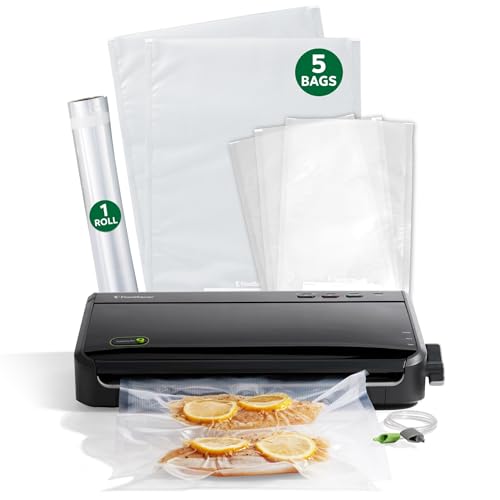
FoodSaver FM2100 Vacuum Sealer Machine
Badge: Best Overall for Hunters
Strengths
- Roll storage with a built-in cutter turns bag-making into part of the rhythm: pull, cut, fill, seal, repeat, without leaving the table.
- Dry and moist settings handle both jerky-dry strips and freshly cut, juicy portions in the same session.
- One-touch operation keeps quality consistent across dozens of bags, and the accessory hose extends the machine to jars and containers at camp or home.
Trade-offs
- It has no pulse mode, so very delicate items need care in how full the bag is and how it is loaded.
- The body is sized for a working counter, not a backpack; this is a home-base or cabin machine.
- Very long back-to-back runs still deserve short pauses, as with any home external sealer.
Spec box — verified from listing: Format: external sealer. Controls: one-touch. Storage: roll storage with cutter. Modes: Dry and Moist. Included: accessory port and hose, starter bags and roll.
Processing day rewards machines that disappear into the work, and the FM2100 is that machine. The roll lives inside it, the cutter lives on it, and the seal cycle starts with one touch, so a two-person team — one cutting and portioning, one bagging and sealing — can settle into a pace and hold it for an entire animal. The moist setting is not a marketing extra in this context; fresh game weeps, and a cycle timed for moist food keeps liquid from racing the vacuum to the seal bar. The listing also names sous vide cooking among its uses, which matters in February when a sealed backstrap goes from freezer to water bath without ever being unwrapped — a point explored further in our Best Vacuum Sealers For Sous Vide comparison.
Its limits are the limits of its class. It will not match a chamber machine on liquid-heavy sealing, and it asks for the ordinary courtesies of home equipment: a clean seal area, a moment’s rest during marathon runs, bags sized with headroom. For the hunter who processes a few animals a season at a kitchen or garage table, it is the most balanced tool here, and the one we would buy first.
Best for: most hunters processing at home or cabin / Not suited for: commercial-volume processing or liquid-heavy chamber work
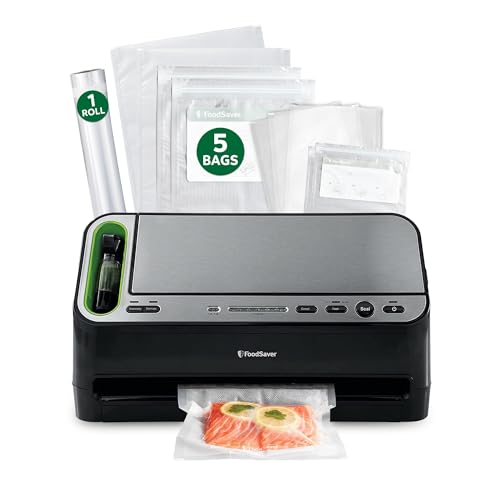
FoodSaver V4400 2-in-1 Vacuum Sealer Machine
Badge: Best Automatic
Strengths
- Automatic bag detection removes the most common tired-hands error: a bag seated slightly wrong at bag forty of the day.
- The 2-in-1 design adds flexibility beyond flat bags for camp containers and odd portions.
- A starter kit is included, so a new owner can practise seals before the season’s meat is on the table.
Trade-offs
- No built-in roll storage is stated in its listing, so rolls live beside the machine rather than inside it.
- Automation cannot rescue a wet seal zone; bloody bags still need a dry, clean edge.
- It is a full countertop machine, best kept at a fixed processing station.
Spec box — verified from listing: Format: external sealer, 2-in-1 design. Feature: automatic vacuum sealer bag detection. Included: starter kit.
Ask anyone who has processed into the evening and they will tell you where seals fail: not at the start, when everyone is fresh, but near the end, when bags get loaded a fraction carelessly. The V4400’s automatic bag detection is aimed squarely at that hour. It senses the bag and runs the cycle as designed, which flattens the difference between your first seal and your fiftieth. For a family processing team, where the sealer may be run by whoever has a free hand, that consistency is a form of insurance on a season’s food.
It asks for a fixed station and a little bench discipline in return — rolls stored alongside, seal area wiped as you go. Hunters who want roll storage inside the machine should take the FM2100; hunters who want the machine to catch their late-day mistakes should take this one. Both instincts are respectable, and the choice says more about your team than about the machines.
Best for: family or team processing where consistency matters / Not suited for: buyers who want in-body roll storage
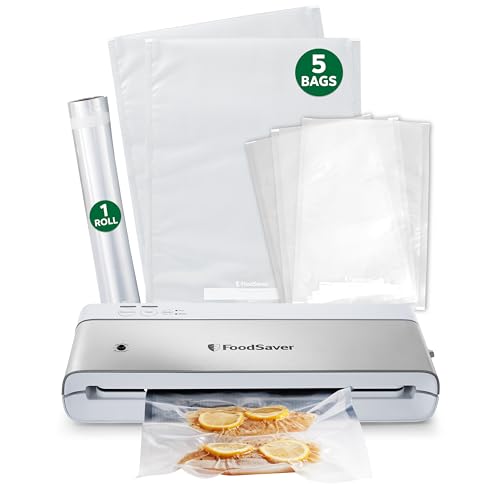
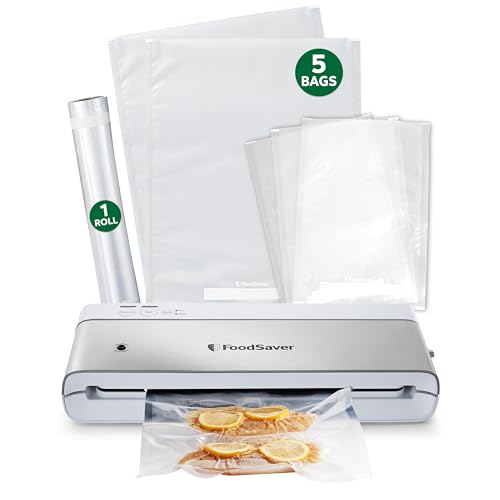
FoodSaver Compact Vacuum Sealer Machine
Badge: Best Compact for Cabin or Small Kitchen
Strengths
- Compact body travels and stores easily — a realistic cabin, RV-adjacent or small-kitchen processing machine.
- Supplied with airtight bags and a roll, so both pre-cut and cut-to-size work are possible immediately.
- The listing names sous vide and airtight storage as core uses, covering the two ways most game is later cooked and kept.
Trade-offs
- A compact working width limits the widest roasts and whole muscle pieces; portioning must respect the machine.
- No roll storage or cutter is stated, so bag-making is a separate, slower step.
- Multi-animal days will feel long; this machine’s pace suits one animal at a time.
Spec box — verified from listing: Format: compact external sealer. Colour: white. Included: airtight bags and roll. Stated uses: sous vide and airtight food storage.
Not every hunter processes at a farmhouse table. For the hunter whose season produces one deer, processed in a small kitchen or at a cabin with a short counter, the Compact is the honest scale of machine: small to store all year, sufficient on the day, and supplied with both bags and a roll so no second order stands between the harvest and the freezer. Its white finish and modest footprint also make it the easiest of these machines to keep in a kitchen rather than in storage, which keeps it available for the ordinary sealing — fish from a summer trip, garden produce, bulk domestic buys — that fills the months between seasons.
Respect its pace and width and it will not let you down. Ask it to run a multi-animal, multi-hunter processing day and the session will outlast its comfort, which is a mismatch of expectations rather than a defect. Occasional hunters under-buy far more often than they over-buy; this is the under-buying cure at the compact end.
Best for: occasional hunters, cabins and small kitchens / Not suited for: wide roasts or multi-animal processing days
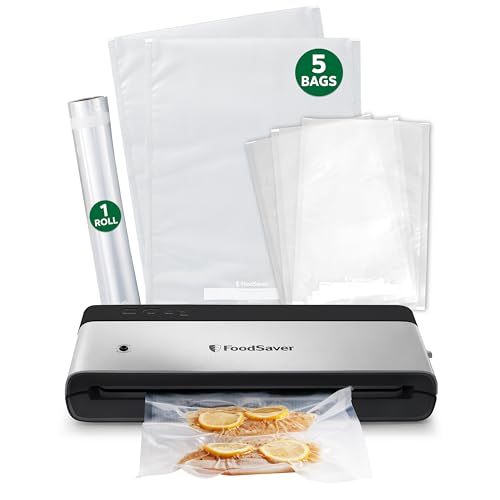
FoodSaver PowerVac Compact Vacuum Sealing Machine VS0150
Badge: Best for Vertical Storage
Strengths
- Vertical storage keeps a capable sealer at home base all year without surrendering a counter to it between seasons.
- The listing states it works for both dry and wet food, covering trail-dry goods and fresh cuts alike.
- Stainless steel and black finish tolerates a working kitchen’s looks and wipes down after processing.
Trade-offs
- Compact class: the widest game pieces may need portioning to suit the machine.
- No roll storage or automatic detection is stated; it is a simpler, more manual machine.
- Heavy processing days are possible but slower than on the FM2100 or ROUUO.
Spec box — verified from listing: Model: VS0150. Format: compact external sealer with vertical storage. Finish: stainless steel and black. Stated foods: dry and wet.
A hunting sealer spends most of its life waiting. Eleven months of storage for a few weeks of glory is a bad bargain if the machine demands prime kitchen territory while it waits, and the PowerVac’s upright storage is a direct answer: it stands in a narrow gap, present but not in the way, ready for the ordinary sealing jobs that justify keeping it out — a fisherman’s catch in June, a garden glut in August — as well as for November’s main event. The dry-and-wet coverage in its listing matches that year-round brief honestly.
On processing day it is a compact machine and behaves like one: steady, capable, and happier with portioned cuts than with the largest whole muscles. Hunters whose seasons are measured in single animals and whose kitchens are small will find that trade exactly right. Hunters building a dedicated processing station should start further up this list.
Best for: small kitchens keeping one sealer ready all year / Not suited for: dedicated high-volume processing stations

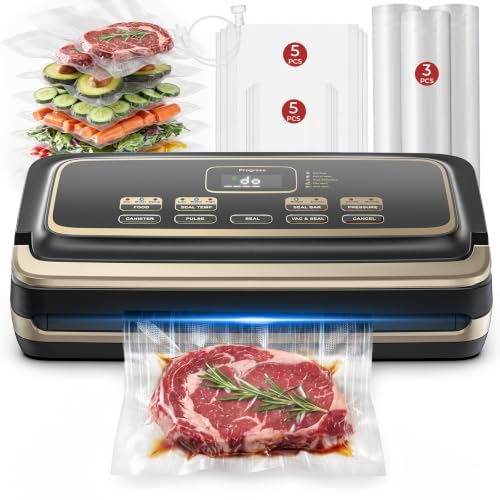
ROUUO Vacuum Sealer 95kpa Food Sealer
Badge: Best for Heavy Batches
Strengths
- The listing states 95kpa vacuum and 230W power — the strongest stated figures in this list — for dense, well-evacuated packs.
- Pulse mode gives manual control for delicate cuts and for stopping liquid before it reaches the seal.
- A removable drip tray is a genuine processing-day feature: bloody work stays cleanable, and three bag rolls plus ten bags are included to start.
Trade-offs
- Power does not forgive poor technique; sharp bones still puncture, and wet seal zones still fail, whatever the vacuum figure.
- It is a working machine, not a compact one; give it a station, not a drawer.
- Pulse control rewards an attentive operator, so a rotating team may prefer the V4400’s automation.
Spec box — verified from listing: Stated vacuum: 95kpa. Stated power: 230W. Modes: Dry/Moist and Pulse. Features: built-in bag storage and cutter, removable drip tray. Included: 3 bag rolls and 10 bags.
If the FM2100 is the balanced hunter’s machine, the ROUUO is the committed one. Its listing reads like it was written at a cutting table: strong stated vacuum for tight packs that resist freezer burn over a long storage year, pulse control for the moment a marinade or bloody juice starts travelling up the bag, a drip tray that lifts out to be washed instead of trapping a day’s work inside the machine, and enough starter roll stock to begin a real session without a supply run. Built-in storage and a cutter keep the same pull-cut-fill-seal rhythm as the FM2100, so a team can run it for hours in an orderly way. Hunters who marinate game before cooking will also value that control; our Best Vacuum Sealers For Marinades guide explains the wet-sealing technique in depth.
The caution is expectation. Strong vacuum pulls harder on everything, including liquid and soft tissue, so the pulse mode is not decoration — use it. And no external sealer, however strong, turns poor chilling or dirty seals into good ones. In disciplined hands, this is the closest a home machine here comes to a processing-station tool.
Best for: intensive processing days and long freezer storage / Not suited for: casual users wanting the simplest automatic machine
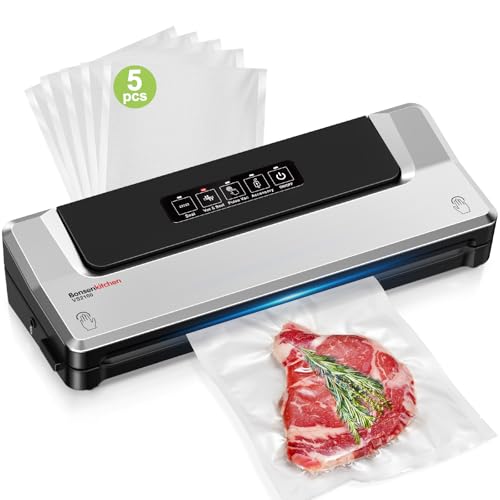
Bonsenkitchen Vacuum Sealer Machine
Badge: Best Simple Compact
Strengths
- A straightforward external vacuum system with multiple modes for meal prep and storage, without a steep learning curve.
- Compact silver body stores easily between seasons and suits a small home-base kitchen.
- Five vacuum bags are included to start, and the listing states an external vacuum system suited to food storage and sous-vide work.
Trade-offs
- The starter supply is small; a processing day needs rolls or bags ordered in advance.
- No cutter, roll storage, pulse mode or drip tray is stated, so the workflow is simpler and slower.
- Its compact pace suits one or two animals a season, not a camp-scale day.
Spec box — verified from listing: Format: compact external vacuum system. Finish: silver. Modes: multiple modes for meal prep. Included: 5 vacuum bags. Stated uses: kitchen food storage and sous-vide.
The Bonsenkitchen is the list’s reminder that not every hunter needs a processing station. If your season is one deer, carefully cut, portioned at the kitchen table over an unhurried afternoon, a simple compact external machine with sensible modes does the whole job and then goes back in the cupboard without ceremony. Its listing’s emphasis on meal prep and storage also fits the hunter whose game is eaten steadily through the winter in weeknight portions rather than held for a year.
Plan its session honestly: order bag stock ahead, portion to its width, and work at its pace. Asked to do that, it is a sound, uncomplicated tool. Asked to imitate the ROUUO for a day, it would only reveal that you bought the wrong end of this list — which is precisely what a six-pick guide exists to prevent.
Best for: one-or-two-animal seasons and simple home processing / Not suited for: high-volume days without advance bag stock
Comparison Table
| Pick | Badge | Session style | Standout verified feature | Check |
|---|---|---|---|---|
| FoodSaver FM2100 | Best Overall for Hunters | Steady, roll-fed | Roll storage, cutter, moist mode | Check on Amazon |
| FoodSaver V4400 2-in-1 | Best Automatic | Team-friendly | Automatic bag detection | Check on Amazon |
| FoodSaver Compact | Best Compact for Cabin | Occasional, portable | Bags and roll included | Check on Amazon |
| FoodSaver PowerVac VS0150 | Best for Vertical Storage | Home-base, year-round | Stores vertically, dry and wet | Check on Amazon |
| ROUUO 95kpa | Best for Heavy Batches | Intensive | Pulse mode, removable drip tray, 230W | Check on Amazon |
| Bonsenkitchen | Best Simple Compact | Light, unhurried | External system, multiple modes | Check on Amazon |
How to Choose a Vacuum Sealer for Hunting
Choose by session, not by season brochure. Count what a real processing day looks like for you: how many animals, how many helpers, how much table, and how long the meat must keep. A one-deer hunter with a kitchen table needs reliability and compact storage, and the FoodSaver Compact, PowerVac or Bonsenkitchen all answer honestly. A hunter processing several animals, or helping process for family, needs roll logistics and session stamina, which is FM2100 and ROUUO territory. A team of mixed experience benefits disproportionately from the V4400’s detection, because the costliest seal failure is the one nobody notices until February.
Then choose by cut. Bone-in work punishes bags: pad bone ends with a folded piece of bag material or butcher paper inside the pack, and double-seal bone-in portions as a matter of routine. Ground meat rewards flat, even packs of a consistent thickness, which freeze fast, stack perfectly and thaw evenly; portion by the recipes you actually cook. Whole muscles and backstraps reward length, so roll machines that make a bag to measure earn their keep. Steaks and chops reward separation — a sheet of parchment between pieces inside one bag lets you take two from a pack of four without thawing the rest, though for most households, meal-sized packs are simpler and safer.
Finally, choose by storage life. Game is often the longest-stored food in a home freezer, and long storage magnifies small faults: a marginal seal that would survive a month may creep open across a year of frost cycles and freezer shuffling. Tight evacuation, a clean wide-looking seal band, flat freezing and a chest freezer’s stable cold are a system; the machine is one component of it. Buy the machine that makes that system easiest to repeat when you are cold, tired and on bag fifty — that, and not a specification headline, is the hunter’s criterion. The cooking end of the system has its own guide in our Best Vacuum Sealers For Sous Vide Cooking article, for hunters who finish game in a water bath.
Freezer Burn: What It Is and How Sealing Defeats It
Freezer burn is not a mystery and it is not, despite the name, a burn. It is dehydration: in a cold, dry freezer, moisture slowly leaves the surface of exposed food and migrates into the air and frost of the cabinet, leaving pale, tough, leathery patches that taste of the freezer rather than of the animal. It needs two things to happen — air contact at the food’s surface and time — and long-stored game gives it both, which is why wrapped game so often disappoints by late winter while the same cuts, sealed, remain sound. A vacuum bag defeats the process mechanically rather than chemically: the air is removed, the film is drawn tight against the surface, and there is no pocket of air at the meat for moisture to move into. That is the whole technology, and it explains both its power and its failure modes. Anything that reintroduces air at the surface — a channel in the seal, a puncture, a bag that never drew down fully over an awkward shape — reopens the process at exactly that spot, which is why this guide returns so often to seals, bones and next-day checks.
It also explains why technique outranks vacuum headlines. A slightly less powerful machine producing a perfect, clean seal protects game better across a year than a stronger machine producing a wrinkled one, because the enemy is the air left behind and the air that creeps back, not the number attached to the pump. Hunters choosing between the picks above should therefore read the workflow features — roll handling, moist cycles, pulse control, detection, drip trays — as freezer-burn defences, each one removing a small way that air survives the process. The machine, the bag and the two minutes of inspection are one system, and the system is what your February dinner will judge.
Processing Day: How to Seal Game Step by Step
Set the station before the first cut is finished: machine at the table’s end, roll or bags within reach, a roll of labels and a marker, a clean tray for finished packs, and a bin for trimmings of bag film. Chill is the first quality step — meat should be thoroughly cold before sealing, because cold meat weeps less, seals cleaner and starts its freezer life at a safer temperature. Work in this order. First, finish cutting a full batch of one cut before sealing it, so portions are consistent. Second, pat each portion’s surface so the bag’s seal zone stays dry. Third, size bags with generous headroom, especially for bone-in pieces. Fourth, load, smooth the seal area flat, and run the moist cycle — or pulse on the ROUUO — watching for liquid travel. Fifth, inspect every seal immediately: a continuous band, no channels, no moisture line crossing it. Sixth, for bone-in or long-storage packs, run a second seal a short distance from the first. Seventh, label with cut, weight and date while the bag is in your hand, not later from memory. Eighth, lay packs flat on a cold tray to freeze before stacking, so they freeze fast and store like books.
Keep a small notebook, or a note on the freezer inventory, for the session itself: which machine settings suited which cuts, which bag length you kept re-cutting, where seals failed and why. Processing happens a few days a year, and the lessons of one season evaporate before the next unless they are written down while your hands still remember them. Hunters who keep that note start each season a full day wiser than hunters who rely on memory, and their second animal is always sealed better than their first.
After the session, clean like you mean it. Wipe the seal area and vacuum channel, wash any removable drip tray, and let everything dry before the machine is stored. Check the freezer the next day: packs should be hard, flat and still tight, with no bag that has relaxed and admitted air. A bag found loose on day one can be resealed or used first; the same bag found in month four is a loss. That next-day check takes two minutes and is the cheapest insurance in the whole process.
Troubleshooting on processing day
Problem: seals look good at the table but bags relax in the freezer → look for a micro-channel caused by moisture or a wrinkle, and for bone punctures; dry the seal zone, double-seal, pad bones, and freeze flat so packs are not stressed while soft.
Problem: liquid keeps reaching the seal → the meat is too warm or the bags are overfilled; chill portions longer, add headroom, blot bag edges, and use pulse control or the moist setting to slow the draw.
Problem: the session slows to a crawl → the bottleneck is usually bag-making or labelling, not the machine; switch to roll-fed workflow, pre-cut a stack of bags during cutting pauses, and label in batches of one cut at a time.
Keeping Game Well for a Full Season
Long storage is a freezer discipline as much as a sealing one. Freeze packs flat and stack them by cut, with the oldest at the front or top, and keep a written inventory on the freezer door: game disappears into a chest freezer’s depths with remarkable ease, and the inventory is what turns “we still have venison?” into a known answer. Keep the freezer full but not jammed — cold mass holds temperature steadily, while blocked air paths create warm pockets. When you take a pack out, take it out whole and thaw it in the fridge in a tray; a vacuum pack that has kept air out for months deserves a tidy thaw, and any pack that smells tired or shows heavy frost inside should be judged on its merits rather than eaten on optimism. Cooked gently — and often best finished with the controlled heat discussed in our Best Vacuum Sealers For Sous Vides notes — well-sealed game in midwinter should still taste like the season it came from. That is the entire point of the work at the table.
Ground Game, Sausage and Jerky: Sealing the Processed Products
A large share of any animal leaves the table processed rather than as whole cuts, and each processed form seals a little differently. Ground game is the volume product, and it rewards flat packs above all else: weigh consistent portions, press each bag flat and even before sealing so the pack freezes quickly, stacks without wasted space and thaws in cold water in a fraction of the time a lump takes. Leave the grind plain in most packs and season at cooking; a few deliberately seasoned packs for burgers or sausage patties are a pleasure, but an entire animal pre-seasoned to one recipe is a winter of repetition. If you grind with fat added, note the blend on the label, because two flat white-flecked packs can hide very different mixtures and the cook in February deserves to know which is which.
Sausage, whether fresh links or bulk, seals well but asks for gentleness. Links can be crushed by an enthusiastic vacuum, changing their texture and squeezing moisture toward the seal; use a lighter touch — pulse control on the ROUUO, or a bag loaded so the cycle stops with the links snug rather than compressed — and freeze links on a tray first if you want them to keep their shape perfectly. Bulk sausage follows the ground-meat rules exactly. Jerky and dried products sit at the opposite extreme: they are the driest sealing job in the hunting kitchen, they seal fast on a dry setting, and their enemies are residual moisture and sharp, stiff edges that can work against the film in storage. Cool jerky completely, condition it so moisture equalises between pieces, then seal in modest packs, because a large jerky pack opened repeatedly across a month admits air every time, undoing the seal’s work. Small packs, opened and finished, are the jerky equivalent of meal-sized meat packs: the same discipline, applied to a drier product.
One more processed product deserves a mention: stock bones and trim destined for the stockpot. They are the most puncture-prone load in the freezer, all angles and edges, and they are also the least precious, which tempts people to seal them carelessly and let a punctured bag frost everything near it. Pad them, double-bag if the bones are sawn, and store them together in one freezer zone. The care is not for the bones’ sake; it is for everything stored beside them.
Camp or Home Base: Deciding Where the Sealer Lives
Where processing happens changes which pick is right, and hunters are often vague about it until the day arrives. A home-base operation — garage, kitchen or porch at home, with the freezer steps away — can use any machine in this list at its best: a fixed station, rolls stored beside it, time to clean properly. This is where the FM2100 and ROUUO belong, and where their roll-fed rhythm pays for itself in a single day. A cabin operation adds two constraints: the machine must travel or live in a cold, sometimes dusty building, and storage space is usually tighter than the hunting stories suggest. Compact machines earn their keep here; the FoodSaver Compact or the PowerVac can live at the cabin year-round, and their modest pace matters less when the alternative is hauling raw meat home before it can be sealed at all. Sealing sooner, closer to the harvest, is itself a quality advantage that a bigger machine at home cannot retroactively provide.
Field sealing — at a tent camp or a vehicle — is the one setting where expectations must drop honestly. Power, cold and workspace all argue for minimal processing in the field: cool the meat properly, protect it, and do the fine cutting and sealing where the equipment lives. Hunters who do seal at a vehicle camp should choose the simplest machine they own, work with pre-cut bags to remove the cutting step, and treat field seals as short-term protection to be checked, and if necessary redone, at home base. What no hunter should do is buy a machine for the field fantasy and then discover it is the wrong machine for the fifty weeks of storage and eating that follow. Buy for home base, adapt for camp, and let the freezer — not the tailgate — be where quality is finally made.
Common Buying Mistakes
The first mistake is buying a handheld or a tiny novelty sealer for processing day because it was cheap in October; October bargains become November regrets. The second is under-ordering bags and rolls, then finishing the session with inferior film or, worse, with wrapped parcels that freezer-burn by Christmas. The third is sealing warm meat in a hurry, which fills bags with moisture and weakens both seal and storage life. The fourth is skipping labels — every hunter believes they will remember which flat pack is which, and no hunter does. The fifth is single-sealing bone-in cuts. The sixth is judging a machine by its vacuum headline while ignoring roll logistics, cleanability and how it behaves at bag fifty, which are the things a processing day actually tests.
A last word on timing: buy and practise before the season, not during it. Run a domestic session in September — portion a bulk buy, seal a tray of chicken, freeze a batch of garden produce — and learn your machine’s loading, its sound at a good seal and its behaviour with moist food while nothing irreplaceable is on the table. The hunter who meets their sealer for the first time beside a whole animal has added an unnecessary opponent to an already full day.
Final Recommendation
Most hunters should buy the FoodSaver FM2100: roll storage, a cutter, one-touch moist sealing and an accessory hose make it the calmest machine across a full processing day. If your days are heavier — several animals, long storage, lots of bloody cuts — step up to the ROUUO 95kpa for its pulse control and removable drip tray. If your season is one animal in a small kitchen, the FoodSaver Compact is the honest scale, and it will serve you without argument.
Frequently Asked Questions
Do hunters need a chamber vacuum sealer instead?
Only at volumes beyond home processing — a large camp operation, a shared club setup or a side business. Chamber machines seal liquids beautifully and run hard all day, but they are heavy, counter-bound and a different class of purchase. For a hunter processing their own game, a good external machine with roll storage, moist control and disciplined technique covers the work, as the picks above show.
How should bone-in cuts be sealed so bags do not puncture?
Pad the bone. Fold a small piece of bag film or butcher paper over sharp bone ends inside the pack, keep bones from pressing a single point of the film, freeze packs flat without stacking weight on them while soft, and double-seal. Most punctures happen in the first day, as packs are moved while freezing; a next-day check catches the failures while the meat can still be resealed.
Should game be sealed in large packs to save bags?
Rarely. Large packs thaw slowly, force you to use more than a meal needs, and turn one seal failure into a large loss. Meal-sized packs — sized to the recipes you cook — thaw evenly, rotate cleanly and make the inventory honest. The exception is a whole muscle you genuinely intend to cook whole, which deserves its own long roll-cut bag.
Can I seal marinade with game for later cooking?
Yes, in modest amounts, using the moist setting or pulse control to stop the liquid before the seal zone, with extra headroom in the bag. Freeze the pack flat and label it as marinated, since it will thaw ready to cook. Keep marinade quantities small; the goal is flavour contact, not a bag of liquid, and very acidic marinades are better added after thawing for texture.
How long will vacuum-sealed game keep?
Far longer than wrapped game, because the seal blocks the air exchange that causes freezer burn. The real variables are how cold and steady your freezer is, how fresh and cold the meat was at sealing, and whether the seal stayed perfect. Hunters who chill thoroughly, seal cleanly, freeze flat and rotate stock routinely eat game in excellent condition many months later; treat any exact promise, from anyone, as marketing rather than knowledge.
Should I freeze game before sealing it, or seal it fresh?
Seal it fresh but thoroughly chilled, in almost every case. Fresh, cold meat seals cleanly because its surface moisture is manageable, and it then freezes once, in its final flat shape, which is the kindest path for texture. Freezing first and sealing the frozen pieces is a useful rescue technique for very wet or awkward items — and the standard trick for liquids — but as a routine for a whole animal it doubles handling and leaves frost on surfaces that the seal then traps. The working rule at a good table is simple: chill hard, portion, pat dry, seal, then freeze flat. Meat that went into the bag cold and clean comes out of the freezer months later in noticeably better condition than meat sealed warm because the day was long and everyone wanted to finish.
What should I check the day after processing?
Every pack. Bags should be hard, flat and still drawn tight. A relaxed bag means air entered — through a channel in the seal or a puncture — and that pack should be resealed if the meat is still fully frozen and cold, or moved to the front to be eaten first. Two minutes of checking protects months of storage, and it tells you, while the lesson is fresh, what your sealing technique needs to fix next season.