Disclosure: topratedkitchenware.com is reader-supported. When you buy through links on our site, we may earn an affiliate commission from Amazon and other retailers, at no extra cost to you.
Where to buy
The six picks below are the models assessed for best hot water pots for camping in this guide. Three are linked because their listing titles name portable, travel, camping or RV use outright; three are covered in full as prose-only picks because their titles make no such claim, and this guide does not pretend otherwise.
- Dezin 1.5L Electric Hot Pot — Check on Amazon
- Dezin 2L Electric Hot Pot
- Elite Gourmet 1.25Qt Noodle Express Hot Pot (EHP120) (covered in full below; sold as a prose-only pick in this guide)
- Bear 2L Electric Hot Pot
- HYTRIC 4.5L Electric Hot Pot (covered in full below; sold as a prose-only pick in this guide)
- Sonya 5L Dual-Sided Electric Hot Pot (covered in full below; sold as a prose-only pick in this guide)
Read the full guide ↓ for the ranking logic, the honest limitations of every pick, and the checks that matter more than any headline claim.
Looking for the best hot water pots for camping means sorting honest portability claims from hopeful ones, so this guide applies a strict rule from the first line: a pick is only linked if its own listing title names portable, travel, camping or RV use. Three of the six models here pass that test. The other three are reviewed in full as prose-only picks, with no link and no photo, because their titles describe family and dorm machines that happen to be movable, which is not the same thing as camping equipment.
The second honesty point is power. Every pot in this pool is a mains electric appliance; none of the titles claims battery or vehicle-socket operation. Camping with one of these pots therefore means camping with power: an electric hookup pitch, an RV, a cabin, or a properly sized power station. Within that reality, the differences that matter are size, weight of the cooking load, how the pot packs, and how quickly it boils a modest amount of water on a picnic table. If your trips are mostly at home-adjacent sites, the wider context in Best Light Weight Hot Water Pots is worth reading alongside this guide.
What follows compares the six models on campsite terms: morning coffee water and oatmeal, one-pot noodle dinners, washing up in a bowl at the side of a tent, and packing the pot back into a car boot or RV cupboard without it dominating the space. Each pick gets strengths, trade-offs and a plain verdict, and the prose-only models are judged just as firmly, because a big family pot can still be the right answer for a powered basecamp or a cabin weekend even though it earns no link here.
Key Takeaways
- Only three picks are linked: their titles name camping, travel, RV or portable use. The rest are prose-only, and this guide says so openly.
- All six pots are mains electric. Camping here means a hookup pitch, RV, cabin or a power station sized for a 700–1200W load.
- For tent and car camping, the 1.5–2L class is the sweet spot: enough for drinks and one-pot meals, small enough to pack.
- Smaller volume boils faster on limited power, which matters more outdoors than any preset or programme.
- Non-stick interiors wipe clean with minimal water, a real advantage when washing up happens in a single bowl.
- Check the latest price on Amazon for the linked picks, and confirm the title’s camping and portable wording still matches the configuration offered.
In this guide
Quick Picks
Badges here separate the genuinely camp-ready linked picks from the prose-only models that suit powered sites and cabins instead. Read the badge before the name.
| Badge | Pick | Why it earns its place |
|---|---|---|
| Best True Camping Pick | Dezin 1.5L Electric Hot Pot | The title names camping, travel and RV outright; 1.5L and dual power make it the honest one-person camp cooker. |
| Best Versatile Camper | Dezin 2L Electric Hot Pot | Also camping-named in its title, with 2L, adjustable power and a spatula included for one-pot campsite cooking. |
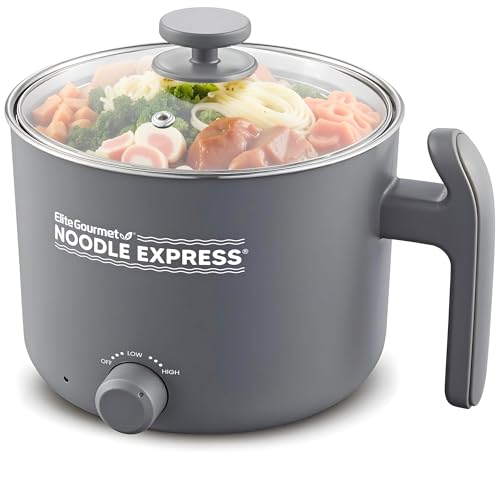
| Best Stainless Steel (Prose-Only) | Elite Gourmet 1.25Qt Noodle Express Hot Pot (EHP120) | A stainless personal pot with a glass lid, covered prose-only because its title names no camping or portable use. |
| Best Portable Power | Bear 2L Electric Hot Pot | Its title calls it a portable cooking pot, and 1000W in a 2L body is the fastest small-pot setup here. |
| Best for Powered Basecamps (Prose-Only) | HYTRIC 4.5L Electric Hot Pot | A 4.5L family and dorm pot, prose-only for camping: useful at a powered basecamp, bulky for a tent. |
| Best for Cabin Gatherings (Prose-Only) | Sonya 5L Dual-Sided Electric Hot Pot | A 5L dual-sided family pot, prose-only here: a cabin-weekend machine, not a pack-and-go cooker. |
How These Picks Were Chosen
The method for this guide starts from the assignment pool of six verified electric hot pots, then applies the camping test to each listing title word by word. The Dezin 1.5L names dorm, travel, camping and RV. The Dezin 2L names dorm, RV, family, travel and camping. The Bear names itself a portable cooking pot. Those three are linked. The Elite Gourmet EHP120, the HYTRIC 4.5L and the Sonya 5L make no portable or camping claim in their titles, so they appear as prose-only picks: fully reviewed, honestly badged, but carrying no Amazon link and no image, exactly as this site’s rules require when a core attribute of the keyword is not confirmed.
That strictness protects campers specifically. A pot that is merely liftable is not a camping pot; what matters is whether the maker designed and described it for travel, and whether its size makes sense in a tent, a campervan or a car boot. Judged that way, the pool divides cleanly into a linked trio of 1.5–2L travel-size cookers and a prose-only trio of larger or home-framed models. Readers whose camping is really cabin cooking may still choose from the second group with eyes open, and our notes on Best Shabu Shabu Hot Pot Pots cover the big divided Sonya’s home ground in more depth.
As with every guide on this site, this is research-led work, not a field test. Specifications come only from the verified listing titles, and where a title is silent, on weight in grams, packed dimensions or cord storage, this guide does not invent a figure. Campers should confirm the current listing before ordering, because a title that names camping today is the same evidence this guide relied on.
The Best Hot Water Pots for Camping, Reviewed in Detail

Dezin 1.5L Electric Hot Pot
Badge: Best True Camping Pick
Strengths
- The smallest footprint here, sized honestly for one person
- Dual power settings cover both boiling and gentler cooking
- The title names dorm, travel, camping and RV use outright
Trade-offs
- At 1.5L it cannot serve a group hot pot, whatever the marketing implies
- 700W boils more slowly than the larger models in this pool
- Non-stick surface calls for soft utensils and hand washing care
Key specs from the listing
- Capacity: 1.5L
- Power: 700W, dual power
- Coating: non-stick
- Colour: black pan
- Named uses in the listing title: steak, egg, oatmeal, soup, ramen; dorm, travel, camping, RV
Dezin pitches this 1.5L pot at one person and does not pretend otherwise, which makes it easy to recommend for the right buyer. It is a mini cooker in the true sense: ramen, a couple of eggs, a bowl of oatmeal, a single portion of soup, or a small steak cooked in the pan-style base. The 700W dual power arrangement matches that scale, with a higher setting to bring water up and a lower one to hold food without scorching the non-stick surface. The listing title names dorm rooms, travel, camping and RVs, and the compact black pan format fits all four settings because it stores like a saucepan rather than an appliance.
On campsite terms, this is the most defensible pick in the guide. The title’s own words, travel, camping and RV, describe exactly the trips this pot suits: a hookup pitch where breakfast is oatmeal and coffee water, a campervan where lunch is ramen, a festival weekend where dinner is a one-pot soup. At 1.5L it asks little of a power supply compared with the big pots, packs like a saucepan, and its dual power settings let you hold a gentle heat under a stew while the evening cools. Its ceiling is portion size, and on a campsite that ceiling is usually acceptable.
Best for: solo campers, students and RV travellers cooking one portion at a time / Not suited for: groups, or anyone needing more than a personal-size pot

Dezin 2L Electric Hot Pot
Badge: Best Versatile Camper
Strengths
- A step up in capacity that still travels and stores easily
- Adjustable power suits everything from fried rice to a gentle soup simmer
- A spatula is included in the box, per the listing title
Trade-offs
- Still a small pot; family hot pot for four is beyond it
- 700W is modest when the pot is filled to the brim
- The included spatula is a basic accessory, not a full utensil set
Key specs from the listing
- Capacity: 2L
- Power: 700W, adjustable
- Coating: non-stick
- Included: spatula
- Named uses in the listing title: steak, egg, fried rice, ramen, soup; dorm, RV, family, travel, camping
The 2L Dezin is the slightly roomier sibling in this pool, and the extra half litre over the 1.5L model is the difference between cooking for one and cooking for one hungry person plus a side, or two modest portions. The title leans into pan cooking as much as boiling: steak, egg and fried rice are named alongside ramen and soup, and the adjustable 700W power supports that range, letting you sear at the top setting and then back off. A spatula is included, a small thing that matters in a dorm or RV kitchen where the utensil drawer may be nearly empty. The portable framing in the title names family use as well as travel and camping.
The 2L Dezin is the camper for people who actually cook outdoors rather than merely reheating. Adjustable power plus the pan-style format means eggs and fried rice at a picnic table are realistic, not just noodles, and the included spatula is one less utensil to pack. The title names camping and travel alongside family use, so it earns its link on the same evidence as its smaller sibling. In a car-camping kitchen box it takes a little more room than the 1.5L, and returns a noticeably more flexible cooker for the space.
Best for: car campers and campervan cooks who fry as well as boil / Not suited for: backpackers counting every gram and litre of pack space
Elite Gourmet 1.25Qt Noodle Express Hot Pot (EHP120)
Badge: Best Stainless Steel (Prose-Only)
Strengths
- Stainless steel cooking surface avoids coating wear entirely
- Glass lid lets you watch noodles and broth without lifting and losing heat
- Compact quart-plus size suits single servings of ramen, rice and soup
Trade-offs
- No non-stick coating, so starchy foods need stirring and a soak before washing
- The title names no power settings, so expect simple operation rather than fine control
- Small capacity rules out shared hot pot meals
Key specs from the listing
- Capacity: 1.25Qt
- Material: stainless steel
- Lid: glass
- Model: EHP120
- Named uses in the listing title: ramen, rice, soups and stews
Elite Gourmet takes the opposite approach to most of this pool: instead of a coated pan, the EHP120 cooks in stainless steel, with a glass lid so the contents stay visible. That makes it the traditionalist option, a small electric pot for ramen, rice, soups and stews that behaves like a saucepan with its own heating base. Stainless steel tolerates metal utensils, does not carry a coating that can age, and browns and deglazes in a familiar way, at the cost of more attentive stirring when noodles or rice are involved. The 1.25-quart size is a single-serving format, aimed at one bowl at a time rather than a shared table.
This Elite Gourmet is reviewed without a link because its title, ramen, rice, soups and stews in a stainless pot with a glass lid, describes a home countertop appliance and never claims portability or camping use. That said, a camper reading this guide deserves the full picture: a small stainless pot is inherently rugged, tolerates being knocked about in a kit box better than a coated pan, and its glass lid helps judge a boil outdoors. It stays prose-only because this guide links evidence, not inference, and the evidence here points at the kitchen, not the campsite.
Best for: home users who want a small stainless pot; campers only as an unlinked, make-do option / Not suited for: buyers who need a maker-confirmed camping or portable claim before they buy
Prose-only pick: no Amazon link or photo is shown for this model in this guide, for the reason explained in the sources file that accompanies this article.

Bear 2L Electric Hot Pot
Badge: Best Portable Power
Strengths
- 1000W is strong for a 2L pot, so water returns to the boil quickly
- Adjustable power and dual power settings cover searing and simmering
- The title calls it a portable cooking pot, and the 2L format backs that up
Trade-offs
- White exterior shows broth splashes and turmeric stains more readily
- Non-stick coating needs the usual soft-utensil care
- No divider and no lid details are named in the title
Key specs from the listing
- Capacity: 2L
- Power: 1000W, adjustable
- Coating: non-stick
- Colour: white
- Named uses in the listing title: steak, egg, ramen, oatmeal; portable cooking pot with dual power
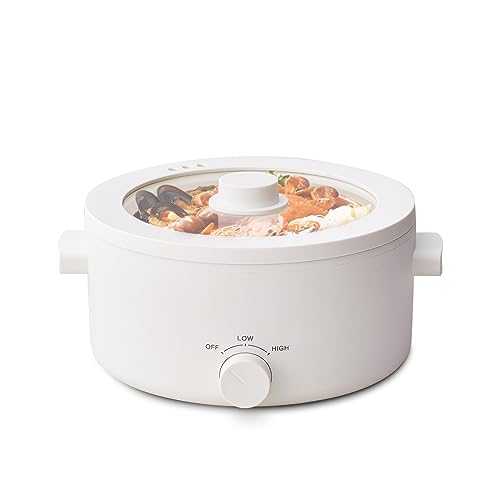
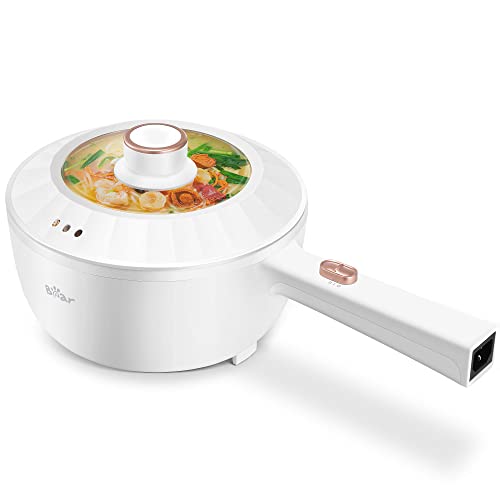
Bear pairs a compact 2L non-stick pot with a 1000W element, and that power-to-size ratio is the story here. Small pots with modest elements can take a long time to recover after cold noodles or frozen dumplings go in; this one is specified to push back to temperature briskly. The adjustable power and dual power wording in the title point to a cooker meant to move between jobs, frying an egg or a small steak at one end of the dial and holding oatmeal or soup at the other. The white finish gives it a cleaner, more appliance-like look on the counter, and the portable framing in the title matches its footprint.
Bear’s claim is the word portable, printed in its title, and the specification backs the claim in the way that matters outdoors: 1000W in a 2L body is the strongest power-to-volume pairing among the linked picks, which means faster boils and quicker recovery on a hookup or power station. For car campers and RV users who cook for two, that pace is the difference between a pot that keeps up with hungry people and one that holds dinner up. The white finish will show campsite splashes honestly; the performance case is stronger than the cosmetic one.
Best for: couples car camping or in an RV who want fast boils from a portable pot / Not suited for: campers limited to very low-wattage power supplies
HYTRIC 4.5L Electric Hot Pot
Badge: Best for Powered Basecamps (Prose-Only)
Strengths
- Large 4.5L capacity with family and dorm use named in the title
- 1200W with fast heating claimed for bigger loads
- Both overheat and boil-dry protection are named in the title
Trade-offs
- A family-size pot is overkill and slower for one-person meals
- Non-stick coating on a big pot means a big, careful hand wash
- No divider, so mixed-heat tables share one broth
Key specs from the listing
- Capacity: 4.5L
- Power: 1200W, dual power
- Coating: non-stick
- Safety: overheat and boil-dry protection
- Named uses in the listing title: pasta and steak; family and dorm use
HYTRIC builds the high-capacity all-rounder in this set: 4.5 litres, 1200W, and a non-stick interior, aimed by its own title at families and dorm groups. The specification that stands out is the safety pairing, overheat protection and boil-dry protection both named outright, which is reassuring in a pot that may simmer through a long shared meal or get switched on by a distracted student. Dual power settings and the fast-heating claim suit the cycle of hot pot cooking, where the broth must recover quickly after each round of ingredients. Pasta and steak are named alongside hot pot use, reflecting the wide, pan-like cooking surface.
HYTRIC’s title frames this 4.5L pot for family and dorm use, with no camping or portable claim, so it is prose-only here. Its campsite role is narrow but real: a powered basecamp for a group, a scout or family pitch with a hookup, or a cabin kitchen, where its capacity and its named overheat and boil-dry protection are assets and its bulk does not matter because it travels in a vehicle and stays put for a week. As a tent pot for one or two, it is simply the wrong shape of answer, and this guide will not dress it up as one.
Best for: powered basecamps, group pitches and cabins needing family capacity / Not suited for: tent campers travelling light with one or two people
Prose-only pick: no Amazon link or photo is shown for this model in this guide, for the reason explained in the sources file that accompanies this article.
Sonya 5L Dual-Sided Electric Hot Pot
Badge: Best for Cabin Gatherings (Prose-Only)
Strengths
- Dual-sided format runs two broths at once for mixed tastes
- Stainless steel pot detaches and is dishwasher safe, per the title
- Five litres serves family dinners and hot pot parties, as the title frames it
Trade-offs
- Stainless steel needs stirring with starchy loads and a soak after broth service
- A 5L divided pot is a large item to store
- Two broths mean two sets of ingredients to buy and manage
Key specs from the listing
- Capacity: 5L
- Format: dual-sided (divided) pot
- Material: stainless steel
- Pot: detachable and dishwasher safe, per the listing title
- Temperature: adjustable
Sonya offers the stainless steel answer to the divided hot pot. The 5L dual-sided format is built for the classic two-broth table, and the construction details in the title are unusually practical: the stainless steel pot detaches from the base and is dishwasher safe, which removes the worst part of hot pot night, scrubbing a fixed pot around its electrical base. Adjustable temperature control keeps both sides at a simmer, and the title frames the size honestly around family dinners and hot pot parties rather than solo cooking. For buyers who want the divider format without a non-stick coating, this is the pool option that lines up.
Sonya’s 5L dual-sided pot is a family-dinner machine by its own title, ideal for hot pot parties, and it makes no portability claim, so it is prose-only in a camping guide. The honest campsite scenario for it is a cabin or lodge weekend with a group, where a two-broth table is the evening’s entertainment and the detachable, dishwasher-safe pot simplifies the clean-up where facilities exist. Packed for a tent trip, its size and two-broth format solve problems campers do not have. Judge it as a cabin pick and it is strong; judge it as camping gear and it is out of its element.
Best for: cabin weekends and lodge gatherings built around a two-broth table / Not suited for: any trip where the pot must pack small and move daily
Prose-only pick: no Amazon link or photo is shown for this model in this guide, for the reason explained in the sources file that accompanies this article.
Comparison Table
Capacities and claims below come from the listing titles. The linked column shows which models carry an Amazon link in this guide and which are prose-only, and why.
| Pick | Capacity | Surface / material | Standout trait | Listing |
|---|---|---|---|---|
| Dezin 1.5L Electric Hot Pot | 1.5L | Non-stick | Camping, travel and RV named in title | Check on Amazon |
| Dezin 2L Electric Hot Pot | 2L | Non-stick | Camping and travel named; spatula included | Check on Amazon |
| Elite Gourmet 1.25Qt Noodle Express Hot Pot (EHP120) | 1.25Qt | Stainless steel | No portable or camping claim in title — prose-only | — |
| Bear 2L Electric Hot Pot | 2L | Non-stick | Portable named in title; 1000W | Check on Amazon |
| HYTRIC 4.5L Electric Hot Pot | 4.5L | Non-stick | Family/dorm framing only — prose-only | — |
| Sonya 5L Dual-Sided Electric Hot Pot | 5L | Stainless steel | Family party framing only — prose-only | — |
How to Choose a Hot Water Pot for Camping
Begin with your power source, because it eliminates more options than any other question. These are mains electric pots drawing between 700W and 1200W where the titles state a figure. A standard electric hookup pitch handles any of them. A vehicle inverter or portable power station must be rated comfortably above the pot’s draw, and its battery capacity decides how many boils you get; a 700W compact pot is a far kinder load than a 1200W family model. If your camping has no power at all, no pot in this guide is the right tool, and a gas stove and kettle remain the honest answer, a contrast explored in Best Propane Shabu Shabu Hot Pots.
Size comes next, and outdoors the maths tightens. One person needs hot water for drinks plus a one-pot meal: 1.5L covers that with room to spare. Two people who cook together do well at 2L. Beyond that, every extra litre is pack space, water to heat and washing up to carry, and it only pays off for group basecamps. Measure your kit box or RV cupboard before ordering; a pot that does not fit the box does not come on the trip, however good its specifications look at home.
Surface choice has an outdoor twist. Water for washing up is often scarce or cold at a campsite, and a non-stick interior that wipes clean with a cloth and a splash of water is worth real convenience at the end of a dark evening. Stainless steel is tougher against knocks and metal utensils in a kit box, but asks for soaking that campsite routines make awkward. The linked picks here are all coated for a reason, and the one stainless model is prose-only partly because its own title never aimed it at this life. For the lightest possible setup, compare the thinking in Best Lifght Hot Water Pots as well.
Finally, read control simplicity as a feature. Outdoors, in gloves or fading light, a dual power switch you can operate by feel beats a fussy programme menu. The linked Dezins and the Bear all keep control simple, with a high setting to boil and a lower one to cook or hold. Lids matter too: a covered pot boils faster on limited power and keeps ash, dust and insects out of dinner, which is a consideration no kitchen-bound guide ever has to make.
How to Cook With an Electric Hot Pot at a Campsite
Set up on the flattest, most sheltered surface available, ideally the picnic table or a stable board, with the cord running directly to the hookup or power station and never across a walkway. Keep the pot out of the tent itself unless the site and the appliance guidance allow it: steam, splashes and a hot vessel belong in the open air or an awning space with ventilation. Fill from your water carrier, and boil only what the meal needs; outdoors, every unnecessary litre is power and time spent for nothing.
- Level the pot, fill to at most three-quarters, and put the lid on before switching to the high setting.
- While the water heats, lay out ingredients in cooking order so the pot is open for the shortest possible time.
- Boil water for drinks first and decant into cups or a flask, then use the same pot for the meal to save power.
- Drop to the lower setting once food is in, keeping a simmer rather than a rolling boil in the open air.
- Cook dense items first, noodles and greens last, and replace the lid between additions to fight heat loss.
- Switch off and unplug before serving from the pot, so nobody trails a sleeve across a live cord.
- Wipe the cooled interior with a cloth and a little water; save a full wash for when facilities are easy.
- Dry the pot and base connection completely before packing, especially after a damp night.
Packing is part of campsite cooking. A pot travels best empty, dry, with its lid inverted or padded and the cord coiled loosely inside a stuff sack or wrapped in a tea towel that doubles as padding. Coated interiors should not have heavy kit-box items stacked inside them; use the cavity for soft things like cloths and utensils instead. If the pot lives in an RV cupboard, a square of non-slip mat under it stops the rattle and the slide on mountain roads.
Troubleshooting outdoors has its own patterns. Problem: the pot is painfully slow to boil → you are likely on a limited supply, overfilled, or losing heat to wind; boil less water, keep the lid on, and shelter the pot. Problem: the power station or hookup trips → the pot’s draw exceeds the supply’s comfort, especially with other loads running; switch other devices off or move to the smaller 700W class. Problem: food catches on the base during a one-pot pasta → the setting stayed on high after the boil; drop to the low setting and stir as the starch releases.
Hookups, Power Stations and the Wattage Reality
The romantic image of campsite cooking is a flame; the practical reality for these pots is a cable, and it is better to plan around the cable honestly. On a hookup pitch, any linked pick here works all weekend without thought. On a portable power station, the arithmetic rules: a 700W pot boiling for ten minutes uses a modest slice of a mid-size station, while repeated boils, long simmers and a 1200W load eat the same battery several times faster. Campers running a station should treat the compact Dezins as the default and the big prose-only pots as hookup-only machines.
There is also a etiquette and safety layer. Hookup posts are shared infrastructure; running a pot plus a heater plus a kettle at once is how bollards trip and neighbours lose power. Sequence your loads, keep the pot’s cord off the grass where people walk in the dark, and never run an electric pot outside in rain on an unprotected connection. These are dull points that decide whether electric campsite cooking feels easy or feels like a series of small incidents.
What to Cook: A Realistic Campsite Menu for a Small Pot
A 1.5–2L pot supports a better menu than many campers expect. Breakfast is oatmeal, eggs boiled in their shells while the coffee water heats, or instant noodles dressed up with an egg and greens. Dinners rotate through one-pot pasta with a jar of sauce stirred in at the end, soup built from a stock cube and whatever vegetables travelled well, ramen upgraded with frozen peas and a boiled egg, and hot pot in miniature for two, using the pot’s low setting as the table simmer. The pattern is always the same: water first, dense ingredients early, delicate things last.
What the small pot does not do well is fry a full breakfast or feed a group from one batch, and planning around that is the difference between a good trip and a resentful one. Pair the pot with cold food for lunches, cook in two batches for three people rather than overfilling for four, and let the big prose-only pots in this guide belong where they belong: at the cabin and the basecamp, where their capacity is the point.
Tent, Caravan or Cabin: Matching the Pot to the Trip
Tent campers travelling from a car should default to the linked compact trio and choose between them by cooking style: the 1.5L Dezin for the lightest, simplest setup, the 2L Dezin for pan cooking, and the Bear for the fastest boils. Everything else about tent life, limited space, limited water, limited power, argues against the larger models, and this guide’s prose-only treatment of them is really a packing judgement as much as a linking rule.
Caravan and RV campers live in a middle world: power is usually available, cupboards are fixed and modest, and a pot that earns a permanent cupboard place must justify it weekly. The 2L models fit that life best, big enough for two-person dinners, small enough to store. Cabin and lodge trips invert the logic again: the vehicle carries everything, the kitchen may be basic, and a large pot, even the dual-sided Sonya, becomes a feature of the holiday rather than a burden, which is why it is reviewed fully here despite its prose-only status.
Festival and event camping deserves a word of its own, because hookups are rare and power stations are shared and precious. There, the smallest linked pot, used for drinks and one hot meal a day, is the ceiling of sensible ambition, and campers should budget their battery for it in advance rather than discovering the limit on the second evening.
A Note on Weight, Bulk and the Walk From the Car
Camping gear earns its place in grams and litres, and a hot pot should be judged like any other piece of kit: what does it displace? A compact 1.5–2L pot displaces roughly a large saucepan, and for car campers that is a fair trade for hot drinks and real dinners. For anyone carrying kit on their back, even the smallest electric pot is hard to justify once the power station it needs is added to the load, and this guide would rather say that plainly than pretend a mains appliance is backpacking equipment.
Bulk has a second effect outdoors: the pot you bring is the pot you wash, dry and store in a small space, often in the dark. Simple shapes with few accessories win. That is why the linked picks’ short accessory lists, a lid, a cord, and in one case a spatula, are a campsite virtue rather than a missing feature, and why elaborate multi-part systems that shine in a kitchen become a burden in a kit box. Judge every camping appliance by its worst moment, the last-night wash and pack, not its best moment on the first evening.
Cold Mornings and Hot Drinks: The Small Ritual That Sells the Pot
Ask experienced campers why they persist with an electric pot and most will not mention dinner at all. They will mention the first ten minutes of a cold morning: water on for coffee or tea while the tent is still zipped up against the chill, oatmeal swelling in the same pot, and the day starting warm instead of with a fumbled stove in the wind. That ritual is why the fast, compact end of this guide matters more than the party end, and why boil time on a small volume is a headline specification for camping even though it barely registers in a kitchen guide.
The ritual also explains the sizing advice running through this article. A pot that boils a litre quickly, pours or ladles without drama, and wipes clean in a minute will be used every single morning of a trip. A pot that is slow, bulky or fussy will be left in the car by day three, whatever its capacity promised. When you choose between the linked picks, choose the one that fits that morning ritual in your own routine, and the rest of the day’s cooking will follow from it.
Common Buying Mistakes
- Assuming electric means anywhere. These pots need mains-class power; a tent trip without a hookup or a serious power station is a gas-stove trip, whatever the listing photos imply.
- Packing a family pot for a solo trip. The prose-only 4.5L and 5L models in this guide are good machines in the wrong place; size for the trip you are actually taking.
- Overfilling outdoors. Wind and uneven ground make boil-overs more likely and more dangerous; three-quarters full is a ceiling, not a target.
- Ignoring the trip load on your power source. A pot plus lights plus a heater trips supplies; sequence loads and know your pot’s wattage before you leave.
- Trusting the word camping without checking the title. This guide linked only titles that say it; do the same when you shop beyond this pool, and be wary of photo-led listings, a habit that also protects you on searches like Best Mongolian Hot Pots.
Final Recommendation
For most campers, the Dezin 1.5L is the first choice: it is the pick whose own title promises camping, travel and RV use, in the size those trips actually reward, with dual power for both boiling and holding food. It asks the least of your power supply and your packing space, and it covers the solo campsite menu completely, from the first coffee of a cold morning to the last bowl of soup at night.
Choose the Dezin 2L instead if you fry as much as you boil, and the Bear 2L if boil speed for two is your priority. Keep the prose-only models for the trips they suit: the HYTRIC for a powered group basecamp and the Sonya for a cabin table. Matching the pot to the trip, rather than to the biggest specification, is the whole lesson of this guide.
Start with the Dezin 1.5L Electric Hot Pot if you want the safest first choice for this search, and look closely at the Dezin 2L Electric Hot Pot if your priorities lean the other way. Check on Amazon to confirm the current configuration of either model before you order.
Frequently Asked Questions
Can I run one of these pots from a portable power station?
Yes, if the station’s inverter rating comfortably exceeds the pot’s wattage and you budget the battery: compact 700W models are the sensible pairing, while a 1200W pot drains a mid-size station quickly. Check both the continuous output rating and the total capacity before relying on it for a weekend.
Are any of these hot pots battery powered or 12V?
None of the six titles in this pool claims battery or vehicle-socket operation; all are mains electric pots. If a listing elsewhere claims dual voltage or a vehicle plug, verify it in the title and specifications before assuming it will work in your setup.
What is the best size for camping for two?
Two litres is the practical sweet spot for a couple: enough for drinks plus a one-pot dinner, still small to pack and kind to a power supply. The linked Dezin 2L and Bear 2L both sit in that class.
Can I use an electric hot pot inside a tent?
Treat it as an outdoor or awning appliance: it produces steam, splashes and real heat, and it trails a cord. Cook outside or in a well-ventilated shelter area on a stable surface, and keep the pot away from bedding and tent fabric at all times.
How do I wash up with limited water?
Choose a coated pot, wipe the interior with a cloth while residues are fresh, and use a small amount of hot water from the next boil to rinse. Stainless steel is tougher but usually wants a soak, which is why the coated linked picks suit campsites better.
Why are three picks in this guide not linked?
Because their listing titles do not claim portable, travel, camping or RV use, and this guide only links picks whose core fit with the keyword is confirmed by the title. They are reviewed in full as prose-only picks so you can still judge them for cabins and basecamps.
What should I cook first on a camping trip with a small pot?
Start with the forgiving meals: oatmeal, ramen with an egg, or a simple soup. Once you know how your pot behaves on your power supply, one-pot pasta and miniature hot pot for two are well within a 2L pot’s ability.